New Semester
Started
Get
50% OFF
Study Help!
--h --m --s
Claim Now
Question Answers
Textbooks
Find textbooks, questions and answers
Oops, something went wrong!
Change your search query and then try again
S
Books
FREE
Study Help
Expert Questions
Accounting
General Management
Mathematics
Finance
Organizational Behaviour
Law
Physics
Operating System
Management Leadership
Sociology
Programming
Marketing
Database
Computer Network
Economics
Textbooks Solutions
Accounting
Managerial Accounting
Management Leadership
Cost Accounting
Statistics
Business Law
Corporate Finance
Finance
Economics
Auditing
Tutors
Online Tutors
Find a Tutor
Hire a Tutor
Become a Tutor
AI Tutor
AI Study Planner
NEW
Sell Books
Search
Search
Sign In
Register
study help
physics
fundamentals thermal fluid
Fundamentals of Thermal-Fluid Sciences 5th edition Yunus A. Cengel, Robert H. Turner, John M. Cimbala - Solutions
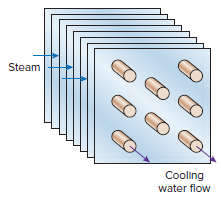
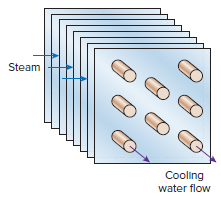
Inside a condenser, there is a bank of seven copper tubes with cooling water flowing in them. Steam condenses at a rate of 0.6 kg/s on the outer surfaces of the tubes that are at a constant temperature of 68°C. Each copper tube is 5-m long and has an inner diameter of 25 mm. Cooling water
Reconsider Prob. 19€“77. Using an appropriate software, evaluate the effect of the cooling water mean velocity on the rate of steam condensation in the condenser. By varying the cooling water mean velocity for 0 < Vavg‰¤ 2 m/s, plot the steam condensation rate as a function
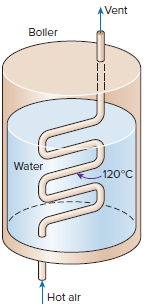
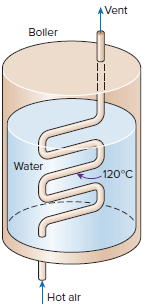
In a gas-fired boiler, water is being boiled at 120°C by hot air flowing through a 5-m-long, 5-cm-diameter tube submerged in water. Hot air enters the tube at 1 atm and 300°C at a mean velocity of 7 m/s and leaves at 150°C. If the surface temperature of the tube is 120°C, determine
Reconsider Prob. 19€“79. Using an appropriate software, evaluate the effect of the tube length on the average convection heat transfer coefficient of air. By varying the tube length from 3 to 18 m, plot the average convection heat transfer coefficient as a function of the tube length.
Consider a 25-mm-diameter and 15-m-long smooth tube that is used for heating fluids. The wall is heated electrically to provide a constant surface heat flux along the entire tube. Fluids enter the tube at 50°C and exit at 150°C. If the mass flow rate is maintained at 0.01 kg/s, determine the
Consider a 25-mm-diameter and 15-m-long smooth tube that is maintained at a constant surface temperature. Fluids enter the tube at 50°C with a mass flow rate of 0.01 kg/s. Determine the tube surface temperatures necessary to heat water, engine oil, and liquid mercury to the desired outlet
In a thermal system, water enters a 25-mm-diameter and 23-m-long circular tube with a mass flow rate of 0.1 kg/s at 25°C. The heat transfer from the tube surface to the water can be expressed in terms of heat flux as qs(x) = ax. The coefficient a is 400 W/m3, and the axial distance from the tube
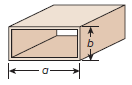
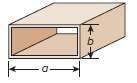
Consider a 10-m-long smooth rectangular tube, with a = 50 mm and b = 25 mm, that is maintained at a constant surface temperature. Liquid water enters the tube at 20°C with a mass flow rate of 0.01 kg/s. Determine the tube surface temperature necessary to heat the water to the desired outlet
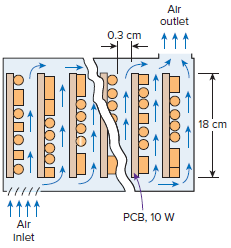
A computer cooled by a fan contains eight printed circuit boards (PCBs), each dissipating 10 W of power. The height of the PCBs is 12 cm and the length is 18 cm. The clearance between the tips of the components on the PCB and the back surface of the adjacent PCB is 0.3 cm. The cooling air is
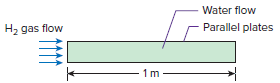
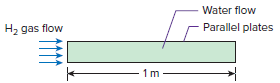
Liquid water is flowing between two very thin parallel 1-m-wide and 10-m-long plates with a spacing of 12.5 mm. The water enters the parallel plates at 20°C with a mass flow rate of 0.58 kg/s. The outer surface of the parallel plates is subjected to hydrogen gas (an ideal gas at 1 atm) flow
Reconsider Prob. 19€“86. Using an appropriate software, evaluate the effect of water mass flow rate on the free-stream H2gas velocity and the surface temperature of the parallel plates, and the effect of the free-stream H2gas velocity on the total heat transfer rate. By varying the mass
Liquid glycerin is flowing through a 25-mm-diameter and 10-m-long tube. The liquid glycerin enters the tube at 20°C with a mass flow rate of 0.5 kg/s. If the outlet mean temperature is 40°C and the tube surface temperature is constant, determine the surface temperature of the tube.
Air at 20°C (1 atm) enters into a 5-mm-diameter and 10-cm-long circular tube at an average velocity of 5 m/s. The tube wall is maintained at a constant surface temperature of 160°C. Determine the convection heat transfer coefficient and the outlet mean temperature. Evaluate the air properties at
Reconsider Prob. 19–91. Using an appropriate software, evaluate the effect of glycerin mass flow rate on the surface temperature of the parallel plates and the total rate of heat transfer necessary to keep the outlet mean temperature of the glycerin at 35°C. By varying the mass flow rate from
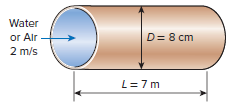
Determine the convection heat transfer coefficient for the flow of(a) Air(b) Water at a velocity of 2 m/s in an 8-cm-diameter and 7-m-long tube when the tube is subjected to uniform heat flux from all surfaces. Use fluid properties at 25°C. Water - or Air 2 m/s D= 8 cm L=7m
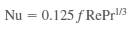
Air at 10°C enters a 12-cm-diameter and 5-m-long pipe at a rate of 0.065 kg/s. The inner surface of the pipe has a roughness of 0.22 mm, and the pipe is nearly isothermal at 50°C. Determine the rate of heat transfer to air using the Nusselt number relation given by(a) Eq.
An 8-m-long, uninsulated square duct of cross section 0.2 m × 0.2 m and relative roughness 10-3 passes through the attic space of a house. Hot air enters the duct at 1 atm and 80°C at a volume flow rate of 0.15 m3/s. The duct surface is nearly isothermal at 60°C. Determine the rate of heat loss
Airstream at 1 atm flows, with a velocity of 15 m/s, in parallel over a 3-m-long flat plate where there is an unheated starting length of 1 m. The airstream has a temperature of 20°C and the heated section of the flat plate is maintained at a constant temperature of 80°C. Determine(a) The local
Water is heated at a rate of 10 kg/s from a temperature of 15°C to 35°C by passing it through five identical tubes, each 5.0 cm in diameter, whose surface temperature is 60.0°C. Estimate(a) The steady rate of heat transfer and(b) The length of tubes necessary to accomplish this task.
Air is flowing through a smooth thin-walled 4-indiameter copper tube that is submerged in water. The water maintains a constant temperature of 60°F and a convection heat transfer coefficient of 176 Btu/hˆ™ft2ˆ™R. If air (1 atm) enters the copper tube at a mean temperature of
In an experiment, the local heat transfer over a flat plate were correlated in the form of local Nusselt number as expressed by the following correlation:Nux = 0.035 Rex0.8 Pr1/3Determine the ratio of the average convection heat transfer coefficient (h) over the entire plate length to the local
During air cooling of steel balls, the convection heat transfer coefficient is determined experimentally as a function of air velocity to be h = 17.9V0.54 for 0.5 < V < 2 m/s, where h and V are in W/m2∙K and m/s, respectively. Consider a 24-mm-diameter steel ball initially at 300°C with a
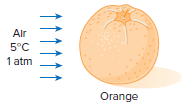
During air cooling of oranges, grapefruit, and tangelos, the heat transfer coefficient for combined convection, radiation, and evaporation for air velocities of 0.11 < V < 0.33 m/s is determined experimentally and is expressed as h = 5.05 kairRe1/3/D, where the diameter D is the
Consider airflow over a plate surface maintained at a temperature of 220°C. The temperature profile of the airflow is given asThe airflow at 1 atm has a free stream velocity and temperature of 0.08 m/s and 20°C, respectively. Determine the heat flux on the plate surface and the convection
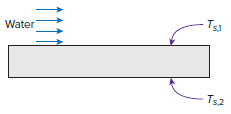
The upper surface of a 50-cm-thick solid plate (k = 237 W/m·K) is being cooled by water with temperature of 20°C. The upper and lower surfaces of the solid plate maintained at constant temperatures of 60°C and 120°C, respectively. Determine the water convection heat transfer
During air cooling of potatoes, the heat transfer coefficient for combined convection, radiation, and evaporation is determined experimentally to be as shown:Air Velocity, m/s Heat Transfer Coefficient,
The convection heat transfer coefficient for a clothed person standing in moving air is expressed as h = 14.8V0.69 for 0.15 < V < 1.5 m/s, where V is the air velocity. For a person with a body surface area of 1.7 m2 and an average surface temperature of 29°C, determine the rate of heat loss
An average man has a body surface area of 1.8 m2 and a skin temperature of 33°C. The convection heat transfer coefficient for a clothed person walking in still air is expressed as h = 8.6V0.53 for 0.5 < V < 2 m/s, where V is the walking velocity in m/s. Assuming the average surface
When is heat transfer through a fluid conduction and when is it convection? For what case is the rate of heat transfer higher? How does the convection heat transfer coefficient differ from the thermal conductivity of a fluid?
What is the physical significance of the Nusselt number? How is it defined?
Consider a hot baked potato. Will the potato cool faster or slower when we blow the warm air coming from our lungs on it instead of letting it cool naturally in the cooler air in the room? Explain.
In which mode of heat transfer is the convection heat transfer coefficient usually higher, natural convection or forced convection? Why?
What is external forced convection? How does it differ from internal forced convection? Can a heat transfer system involve both internal and external convection at the same time? Give an example.
What is forced convection? How does it differ from natural convection? Is convection caused by winds forced or natural convection?
Water is to be heated from 10°C to 80°C as it flows through a 2-cm-internal-diameter, 13-m-long tube. The tube is equipped with an electric resistance heater, which provides uniform heating throughout the surface of the tube. The outer surface of the heater is well insulated, so that in steady
Consider a fluid with a Prandtl number of 7 flowing through a smooth circular tube. Using the Colburn, Petukhov, and Gnielinski equations, determine the Nusselt numbers for Reynolds numbers at 3500, 104, and 5 × 10⁵. Compare and discuss the results.
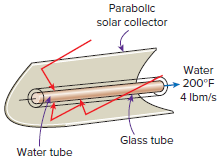
The hot water needs of a household are to be met by heating water at 55°F to 200°F by a parabolic solar collector at a rate of 4 lbm/s. Water flows through a 1.25-in-diameter thin aluminum tube whose outer surface is blackanodized in order to maximize its solar absorption ability. The
Air (1 atm) enters into a 5-cm-diameter circular tube at 20°C with an average velocity of 5 m/s. The tube wall is maintained at a constant surface temperature of 160°C, and the outlet mean temperature is 80°C. Estimate the length of the tube.
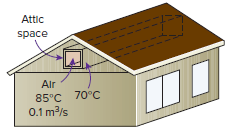
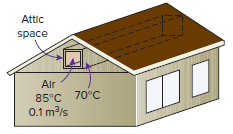
Hot air at atmospheric pressure and 85°C enters a 10-m-long uninsulated square duct of cross section 0.15 m × 0.15 m that passes through the attic of a house at a rate of 0.1 m3/s. The duct is observed to be nearly isothermal at 70°C. Determine the exit temperature of the air
Reconsider Prob. 19€“100. Using an appropriate software, investigate the effect of the volume flow rate of air on the exit temperature of air and the rate of heat loss. Let the flow rate vary from 0.05 m3/s to 0.15 m3/s. Plot the exit temperature and the rate of heat loss as a function of
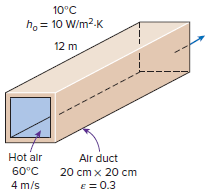
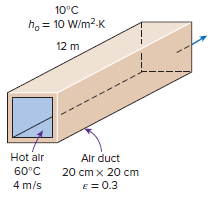
Hot air at 60°C leaving the furnace of a house enters a 12-m-long section of a sheet metal duct of rectangular cross section 20 cm × 20 cm at an average velocity of 4 m/s. The thermal resistance of the duct is negligible, and the outer surface of the duct, whose emissivity is 0.3,
Reconsider Prob. 19€“102. Using an appropriate software, investigate the effect of air velocity and the surface emissivity on the exit temperature of air and the rate of heat loss. Let the air velocity vary from 1 m/s to 10 m/s and the emissivity from 0.1 to 1.0. Plot the exit temperature
The components of an electronic system dissipating 180 W are located in a 1-m-long horizontal duct whose cross section is 16 cm × 16 cm. The components in the duct are cooled by forced air, which enters at 27°C at a rate of 0.65 m3/min. Assuming 85 percent of the heat generated inside is
Repeat Prob. 19–104 for a circular horizontal duct of 15-cm diameter.The components of an electronic system dissipating 180 W are located in a 1-m-long horizontal duct whose cross section is 16 cm × 16 cm. The components in the duct are cooled by forced air, which enters at 27°C at a rate of
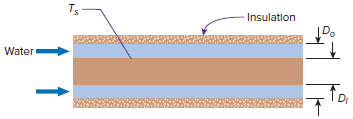
Liquid water flows at a mass flow rate of 0.7 kg/s through a concentric annulus tube with the inlet and outlet mean temperatures of 20°C and 80°C, respectively. The concentric annulus tube has inner and outer diameters of 10 mm and 100 mm, respectively. The inner tube wall is maintained
Four power transistors, each dissipating 12 W, are mounted on a thin vertical aluminum plate (k = 237 W/m∙K) 22 cm × 22 cm in size. The heat generated by the transistors is to be dissipated by both surfaces of the plate to the surrounding air at 20°C, which is blown over the plate by a fan at a
Oil at 60°C flows at a velocity of 20 cm/s over a 5.0-m-long and 1.0-m-wide flat plate maintained at a constant temperature of 20°C. Determine the rate of heat transfer from the oil to the plate if the average oil properties are ρ = 880 kg/m3, μ = 0.005 kg/m∙s, k = 0.15 W/m∙K, and cp = 2.0
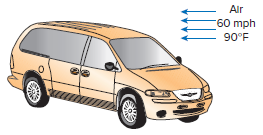
The passenger compartment of a minivan traveling at 60 mph can be modeled as a 3.2-ft-high, 6-ft-wide, and 11-ftlong rectangular box whose walls have an insulating value of R-3 (i.e., a wall thickness-to-thermal conductivity ratio of 3 hˆ™ft2ˆ™°F/Btu). The interior of a
A thin, square flat plate has 1.2 m on each side. Air at 10°C flows over the top and bottom surfaces of a very rough plate in a direction parallel to one edge, with a velocity of 48 m/s. The surface of the plate is maintained at a constant temperature of 54°C. The plate is mounted on a scale that
Consider a house that is maintained at a constant temperature of 22°C. One of the walls of the house has three single-pane glass windows that are 1.5 m high and 1.8 m long. The glass (k = 0.78 W/m·K) is 0.5 cm thick, and the heat transfer coefficient on the inner surface of the glass is 8
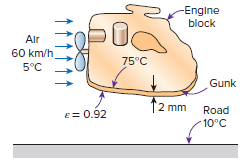
An automotive engine can be approximated as a 0.4-m-high, 0.60-m-wide, and 0.7-m-long rectangular block. The bottom surface of the block is at a temperature of 75°C and has an emissivity of 0.92. The ambient air is at 5°C, and the road surface is at 10°C. Determine the rate of heat
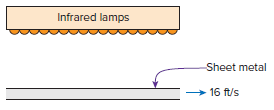
A 15-ft long strip of sheet metal is being transported on a conveyor at a velocity of 16 ft/s. To cure the coating on the upper surface of the sheet metal, infrared lamps providing a constant radiant flux of 1500 Btu/h?ft2 are used. The coating on the upper surface of the metal strip has an
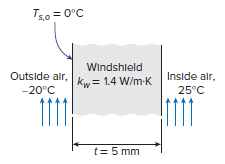
To defrost ice accumulated on the outer surface of an automobile windshield, warm air is blown over the inner surface of the windshield. Consider an automobile windshield (kw= 1.4 W/mˆ™K) with an overall height of 0.5 m and thickness of 5 mm. The outside air (1 atm) ambient temperature is
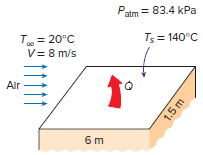
The local atmospheric pressure in Denver, Colorado (elevation 1610 m), is 83.4 kPa. Air at this pressure and 20°C flows with a velocity of 8 m/s over a 1.5 m × 6 m flat plate whose temperature is 140°C. Determine the rate of heat transfer from the plate if the air flows
A 20 mm × 20 mm silicon chip is mounted such that the edges are flush in a substrate. The substrate provides an unheated starting length of 20 mm that acts as turbulator. Airflow at 25°C (1 atm) with a velocity of 25 m/s is used to cool the upper surface of the chip. If the maximum surface
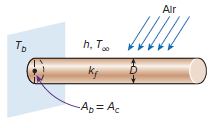
In the effort to increase the removal of heat from a hot surface at 120°C, a cylindrical pin fin (kf= 237 W/m.K) with diameter of 5 mm is attached to the hot surface. Air at 20°C (1 atm) is flowing across the pin fin with a velocity of 10 m/s. Determine the maximum possible rate of heat
Consider a person who is trying to keep cool on a hot summer day by turning a fan on and exposing his body to air flow. The air temperature is 32°C, and the fan is blowing air at a velocity of 5 m/s. The surrounding surfaces are at 40°C, and the emissivity of the person can be taken to be 0.9. If
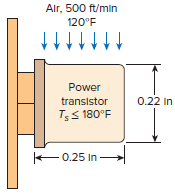
A transistor with a height of 0.25 in and a diameter of 0.22 in is mounted on a circuit board. The transistor is cooled by air flowing over it at a velocity of 500 ft/min. If the air temperature is 120°F and the transistor case temperature is not to exceed 180°F, determine the amount of
Steam at 250°C flows in a stainless steel pipe (k = 15 W/m.K) whose inner and outer diameters are 4 cm and 4.6 cm, respectively. The pipe is covered with 3.5-cm-thick glass wool insulation (k = 0.038 W/m.K) whose outer surface has an emissivity of 0.3. Heat is lost to the surrounding air and
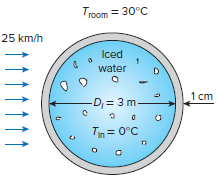
A 3-m-internal-diameter spherical tank made of 1-cm-thick stainless steel (k = 15 W/m. K) is used to store iced water at 0°C. The tank is located outdoors at 30°C and is subjected to winds at 25 km/h. Assuming the entire steel tank to be at 0°C and thus its thermal resistance to be
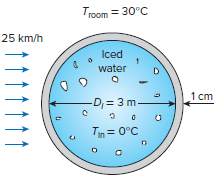
Repeat Prob. 19€“122, assuming the inner surface of the tank to be at 0°C but by taking the thermal resistance of the tank and heat transfer by radiation into consideration. Assume the average surrounding surface temperature for radiation exchange to be 25°C and the outer surface
A fluid (ρ = 1000 kg/m3, m = 1.4 × 10⁻³ kg/m∙s, cp = 4.2 kJ/kg ∙K, and k = 0.58 W/m∙K) flows with an average velocity of 0.3 m/s through a 14-m-long tube with inside diameter of 0.01 m. Heat is uniformly added to the entire tube at the rate of 1500 W/m2. Determine(a) The value of convection
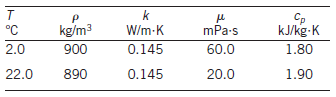
Crude oil at 22°C enters a 20-cm-diameter pipe with an average velocity of 20 cm/s. The average pipe wall temperature is 2°C. Crude oil properties are as given below. Calculate the rate of heat transfer and pipe length if the crude oil outlet temperature is 20°C. kg/m3 W/m-K 0.145
Air (1 atm) entered into a 5-mm-diameter circular tube at an average velocity of 5 m/s. The tube wall is maintained at a constant surface temperature. Determine the convection heat transfer coefficient for(a) A 10-cm-long tube and(b) A 50-cm-long tube. Evaluate the air properties at 50°C.
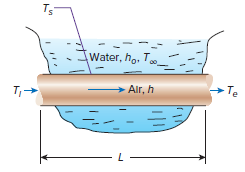
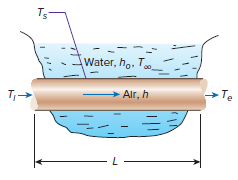
To cool a storehouse in the summer without using a conventional air-conditioning system, the owner decided to hire an engineer to design an alternative system that would make use of the water in the nearby lake. The engineer decided to flow air through a thin smooth 10-cm-diameter copper tube that
Liquid mercury is flowing at 0.6 kg/s through a 5-cm-diameter tube with inlet and outlet mean temperatures of 100°C and 200°C, respectively. The tube surface temperature is maintained constant at 250°C. Determine the tube length using(a) The appropriate Nusselt number relation for liquid
In the effort to find the best way to cool a smooth thin-walled copper tube, an engineer decided to flow air either through the tube or across the outer tube surface. The tube has a diameter of 5 cm, and the surface temperature is maintained constant. Determine(a) The convection heat transfer
Repeat Prob. 19–130 for a flow rate of 20 kg/s.Water is heated at a rate of 10 kg/s from a temperature of 15°C to 35°C by passing it through five identical tubes, each 5.0 cm in diameter, whose surface temperature is 60.0°C. Estimate(a) The steady rate of heat transfer(b) The length of tubes
Water at 1500 kg/h and 10°C enters a 10-mmdiameter smooth tube whose wall temperature is maintained at 49°C. Calculate(a) The tube length necessary to heat the water to 40°C,(b) The water outlet temperature if the tube length is doubled. Assume average water properties to be the same as in (a).
The exhaust gases of an automotive engine leave the combustion chamber and enter a 8-ft-long and 3.5-in-diameter thin-walled steel exhaust pipe at 800°F and 15.5 psia at a rate of 0.05 lbm/s. The surrounding ambient air is at a temperature of 80°F, and the heat transfer coefficient on the outer
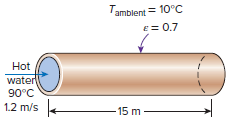
Hot water at 90°C enters a 15-m section of a cast iron pipe (k = 52 W/mˆ™K) whose inner and outer diameters are 4 and 4.6 cm, respectively, at an average velocity of 1.2 m/s. The outer surface of the pipe, whose emissivity is 0.7, is exposed to the cold air at 10°C in a basement,
Repeat Prob. 19€“135 for a pipe made of copper (k = 386 W/mˆ™K) instead of cast iron.Hot water at 90°C enters a 15-m section of a cast iron pipe (k = 52 W/mˆ™K) whose inner and outer diameters are 4 and 4.6 cm, respectively, at an average velocity of 1.2 m/s. The
Hot exhaust gases leaving a stationary diesel engine at 450°C enter a l5-cm-diameter pipe at an average velocity of 4.5 m/s. The surface temperature of the pipe is 180°C. Determine the pipe length if the exhaust gases are to leave the pipe at 250°C after transferring heat to water in a heat
Geothermal steam at 165°C condenses in the shell side of a heat exchanger over the tubes through which water flows. Water enters the 4-cm-diameter, 14-m-long tubes at 20°C at a rate of 0.8 kg/s. Determine the exit temperature of water and the rate of condensation of geothermal steam.
Cold air at 5°C enters a l2-cm-diameter, 20-m-long isothermal pipe at a velocity of 2.5 m/s and leaves at 19°C. Estimate the surface temperature of the pipe.
100 kg/s of a crude oil is heated from 20°C to 40°C through the tube side of a multitube heat exchanger. The crude oil flow is divided evenly among all 100 tubes in the tube bundle. The ID of each tube is 10 mm, and the inside tubewall temperature is maintained at 100°C. Average properties of
Liquid water enters a 10-m-long smooth rectangular tube with a = 50 mm and b = 25 mm. The surface temperature is maintained constant, and water enters the tube at 20°C with a mass flow rate of 0.25 kg/s. Determine the tube surface temperature necessary to heat the water to the desired outlet
Air at 70°F flows over a 10-ft-long flat plate at 25 ft/s. Determine the local friction coefficient at intervals of 1 ft and plot the results against the distance from the leading edge.
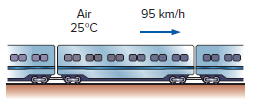
The top surface of the passenger car of a train moving at a velocity of 95 km/h is 2.1 m wide and 8 m long. If the outdoor air is at 1 atm and 25°C, determine the drag force acting on the top surface of the car. Air 95 km/h 25°C
The local atmospheric pressure in Denver, Colorado (elevation 1610 m) is 83.4 kPa. Air at this pressure and at 25°C flows with a velocity of 9 m/s over a 2.5-m × 5-m flat plate. Determine the drag force acting on the top surface of the plate if the air flows parallel to the(a) 5-m-long side
Consider laminar flow of a fluid over a flat plate. Now the free-stream velocity of the fluid is tripled. Determine the change in the drag force on the plate. Assume the flow to remain laminar.
What does the friction coefficient represent in flow over a flat plate? How is it related to the drag force acting on the plate?
What fluid property is responsible for the development of the velocity boundary layer? What is the effect of the velocity on the thickness of the boundary layer?
How is the average friction coefficient determined in flow over a flat plate?
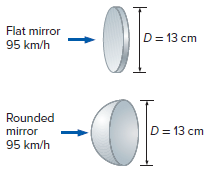
To reduce the drag coefficient and thus to improve the fuel efficiency of cars, the design of side rearview mirrors has changed drastically in recent decades from a simple circular plate to a streamlined shape. Determine the amount of fuel and money saved per year as a result of replacing a
A 7-m-diameter hot air balloon that has a total mass of 350 kg is standing still in air on a windless day. The balloon is suddenly subjected to 40 km/h winds. Determine the initial acceleration of the balloon in the horizontal direction.
A 6-mm-diameter plastic sphere whose density is 1150 kg/m3 is dropped into water at 20°C. Determine the terminal velocity of the sphere in water.
An 0.90-m-diameter, 1.1-m-high garbage can is found in the morning tipped over due to high winds during the night. Assuming the average density of the garbage inside to be 150 kg/m3 and taking the air density to be 1.25 kg/m3, estimate the wind velocity during the night when the can was tipped
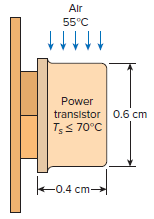
A transistor with a height of 0.4 cm and a diameter of 0.6 cm is mounted on a circuit board. The transistor is cooled by air flowing over it with an average heat transfer coefficient of 30 W/m2·K. If the air temperature is 55°C and the transistor case temperature is not to exceed
A 300-ft-long section of a steam pipe whose outer diameter is 4 in passes through an open space at 50°F. The average temperature of the outer surface of the pipe is measured to be 280°F, and the average heat transfer coefficient on that surface is determined to be 6 Btu/h·ft2·°F. Determine(a)
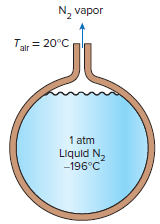
The boiling temperature of nitrogen at atmospheric pressure at sea level (1 atm) is - 196°C. Therefore, nitrogen is commonly used in low-temperature scientific studies since the temperature of liquid nitrogen in a tank open to the atmosphere remains constant at - 196°C until the liquid
A series of experiments were conducted by passing 40°C air over a long 25 mm diameter cylinder with an embedded electrical heater. The objective of these experiments was to determine the power per unit length required (W /L) to maintain the surface temperature of the cylinder at 300°C for
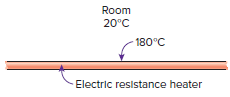
A 2.1-m-long, 0.2-cm-diameter electrical wire extends across a room that is maintained at 20°C. Heat is generated in the wire as a result of resistance heating, and the surface temperature of the wire is measured to be 180°C in steady operation. Also, the voltage drop and electric current
Using the conversion factors between W and Btu/h, m and ft, and K and R, express the Stefan–Boltzmann constant σ = 5.67 × 10⁻⁸ W/m2·K4 in the English unit Btu/h·ft2·R4.
The outer surface of a spacecraft in space has an emissivity of 0.8 and a solar absorptivity of 0.3. If solar radiation is incident on the spacecraft at a rate of 950 W/m2, determine the surface temperature of the spacecraft when the radiation emitted equals the solar energy absorbed.
Consider a person whose exposed surface area is 1.7 m2, emissivity is 0.5, and surface temperature is 32°C. Determine the rate of heat loss from that person by radiation in a large room having walls at a temperature of(a) 300 K(b) 280 K.
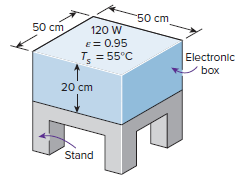
Consider a sealed 20-cm-high electronic box whose base dimensions are 50 cm × 50 cm placed in a vacuum chamber. The emissivity of the outer surface of the box is 0.95. If the electronic components in the box dissipate a total of 120 W of power and the outer surface temperature of the
Two surfaces, one highly polished and the other heavily oxidized, are found to be emitting the same amount of energy per unit area. The highly polished surface has an emissivity of 0.1 at 1070°C, while the emissivity of the heavily oxidized surface is 0.78. Determine the temperature of the heavily
A spherical interplanetary probe, with a diameter of 2 m, is sent out into the solar system. The probe surface is made of material having an emissivity of 0.9 and an absorptivity of 0.1. Signals from the sensors monitoring the probe surface temperatures are indicating an average value of −40°C
An electronic package in the shape of a sphere with an outer diameter of 100 mm is placed in a large laboratory room. The surface emissivity of the package can assume three different values (0.2, 0.25, and 0.3). The walls of the room are maintained at a constant temperature of 77 K. The electronics
Showing 600 - 700
of 1421
1
2
3
4
5
6
7
8
9
10
11
12
13
14
15
Step by Step Answers

 Get 50% OFF
Claim Now
Get 50% OFF
Claim Now