New Semester
Started
Get
50% OFF
Study Help!
--h --m --s
Claim Now
Question Answers
Textbooks
Find textbooks, questions and answers
Oops, something went wrong!
Change your search query and then try again
S
Books
FREE
Study Help
Expert Questions
Accounting
General Management
Mathematics
Finance
Organizational Behaviour
Law
Physics
Operating System
Management Leadership
Sociology
Programming
Marketing
Database
Computer Network
Economics
Textbooks Solutions
Accounting
Managerial Accounting
Management Leadership
Cost Accounting
Statistics
Business Law
Corporate Finance
Finance
Economics
Auditing
Tutors
Online Tutors
Find a Tutor
Hire a Tutor
Become a Tutor
AI Tutor
AI Study Planner
NEW
Sell Books
Search
Search
Sign In
Register
study help
physics
fundamentals thermal fluid
Fundamentals of Thermal-Fluid Sciences 5th edition Yunus A. Cengel, Robert H. Turner, John M. Cimbala - Solutions
Consider a short cylinder whose top and bottom surfaces are insulated. The cylinder is initially at a uniform temperature Ti and is subjected to convection from its side surface to a medium at temperature T∞, with a heat transfer coefficient of h. Is the heat transfer in this short cylinder one-
Reconsider Prob. 17–68. Using an appropriate software, investigate the effect of the thickness of the insulation on the rate of heat loss from the steam and the temperature drop across the insulation layer. Let the insulation thickness vary from 1 cm to 10 cm. Plot the rate of heat loss and the
Superheated steam at an average temperature 200°C is transported through a steel pipe (k = 50 W/m·K, Do = 8.0 cm, Di = 6.0 cm, and L = 20.0 m). The pipe is insulated with a 4-cm thick layer of gypsum plaster (k = 0.5 W/m·K). The insulated pipe is placed horizontally inside a warehouse where the
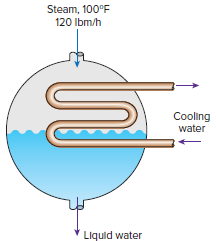
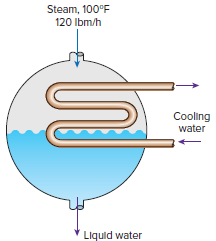
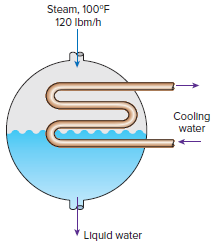
Steam exiting the turbine of a steam power plant at 100°F is to be condensed in a large condenser by cooling water flowing through copper pipes (k = 223 Btu/h·ft·°F) of inner diameter 0.4 in and outer diameter 0.6 in at an average temperature of 70°F. The heat of
Repeat Prob. 17€“72E, assuming that a 0.01-in-thick layer of mineral deposit (k = 0.5 Btu/h·ft·°F) has formed on the inner surface of the pipe.Data from 17-72ESteam exiting the turbine of a steam power plant at 100°F is to be condensed in a large condenser by cooling
Reconsider Prob. 17€“72E. Using an appropriate software, investigate the effects of the thermal conductivity of the pipe material and the outer diameter of the pipe on the length of the tube required. Let the thermal conductivity vary from 10 Btu/h·ft·°F to 400
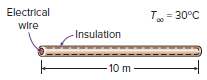
A 2.2-mm-diameter and 10-m-long electric wire is tightly wrapped with a 1-mm-thick plastic cover whose thermal conductivity is k = 0.15 W/m·K. Electrical measurements indicate that a current of 13 A passes through the wire and there is a voltage drop of 8 V along the wire. If the insulated
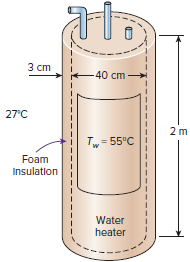
Consider a 2-m-high electric hot-water heater that has a diameter of 40 cm and maintains the hot water at 55°C. The tank is located in a small room whose average temperature is 27°C, and the heat transfer coefficients on the inner and outer surfaces of the heater are 50 and 12
Chilled water enters a thin-shelled 5-cm-diameter, 150-m-long pipe at 7°C at a rate of 0.98 kg/s and leaves at 8°C. The pipe is exposed to ambient air at 30°C with a heat transfer coefficient of 9 W/m2·K. If the pipe is to be insulated with glass wool insulation (k = 0.05 W/m·K) in order to
Steam at 450°F is flowing through a steel pipe (k = 8.7 Btu/h·ft·°F) whose inner and outer diameters are 3.5 in and 4.0 in, respectively, in an environment at 55°F. The pipe is insulated with 2-in-thick fiberglass insulation (k = 0.020 Btu/h·ft·°F). If the heat transfer coefficients on the
Hot water at an average temperature of 70°C is flowing through a 15-m section of a cast iron pipe (k = 52 W/m·K) whose inner and outer diameters are 4 cm and 4.6 cm, respectively. The outer surface of the pipe, whose emissivity is 0.7, is exposed to the cold air at 10°C in the basement, with a
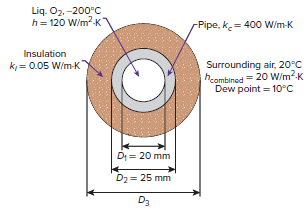
In a pharmaceutical plant, a copper pipe (kc= 400 W/m·K) with inner diameter of 20 mm and wall thickness of 2.5 mm is used for carrying liquid oxygen to a storage tank. The liquid oxygen flowing in the pipe has an average temperature of -200°C and a convection heat transfer coefficient
Liquid hydrogen is flowing through an insulated pipe (k = 23 W/m∙K, Di = 3 cm, Do = 4 cm, and L = 20 m). The pipe is situated in a chemical plant, where the average air temperature is 40°C. The convection heat transfer coefficients of the liquid hydrogen and the ambient air are 200 W/m2∙K and
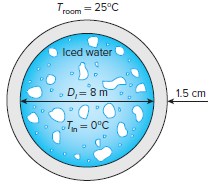
An 8-m-internal-diameter spherical tank made of 1.5-cm-thick stainless steel (k = 15 W/m·K) is used to store iced water at 0°C. The tank is located in a room whose temperature is 25°C. The walls of the room are also at 25°C. The outer surface of the tank is black (emissivity
What is the critical radius of insulation? How is it defined for a cylindrical layer?
Consider an insulated pipe exposed to the atmosphere. Will the critical radius of insulation be greater on calm days or on windy days? Why?
A pipe is insulated to reduce the heat loss from it. However, measurements indicate that the rate of heat loss has increased instead of decreasing. Can the measurements be right?
Consider a pipe at a constant temperature whose radius is greater than the critical radius of insulation. Someone claims that the rate of heat loss from the pipe has increased when some insulation is added to the pipe. Is this claim valid?
A pipe is insulated such that the outer radius of the insulation is less than the critical radius. Now the insulation is taken off. Will the rate of heat transfer from the pipe increase or decrease for the same pipe surface temperature?
A 0.083-in-diameter electrical wire at 90°F is covered by 0.02-in-thick plastic insulation (k = 0.075 Btu/h·ft·°F). The wire is exposed to a medium at 50°F, with a combined convection and radiation heat transfer coefficient of 2.5 Btu/h·ft2·°F. Determine if the plastic insulation on the
Repeat Prob. 17–88E, assuming a thermal contact resistance of 0.001 h·ft2·°F/Btu at the interface of the wire and the insulation.Data from 17-88E.A 0.083-in-diameter electrical wire at 90°F is covered by 0.02-in-thick plastic insulation (k = 0.075 Btu/h·ft·°F). The wire is exposed to a
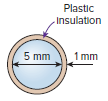
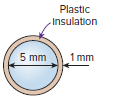
A 5-mm-diameter spherical ball at 50°C is covered by a 1-mm-thick plastic insulation (k = 0.13 W/m·K). The ball is exposed to a medium at 15°C, with a combined convection and radiation heat transfer coefficient of 20 W/m2·K. Determine if the plastic insulation on the ball will
Reconsider Prob. 17€“90. Using an appropriate software, plot the rate of heat transfer from the ball as a function of the plastic insulation thickness in the range of 0.5 mm to 20 mm. Discuss the results.Data from 17-90A 5-mm-diameter spherical ball at 50°C is covered by a 1-mm-thick
Hot air is to be cooled as it is forced to flow through the tubes exposed to atmospheric air. Fins are to be added in order to enhance heat transfer. Would you recommend attaching the fins inside or outside the tubes? Why? When would you recommend attaching fins both inside and outside the tubes?
What is the reason for the widespread use of fins on surfaces?
What is the difference between the fin effectiveness and the fin efficiency?
The fins attached to a surface are determined to have an effectiveness of 0.9. Do you think the rate of heat transfer from the surface has increased or decreased as a result of the addition of these fins?
Explain how the fins enhance heat transfer from a surface. Also, explain how the addition of fins may actually decrease heat transfer from a surface.
How does the overall effectiveness of a finned surface differ from the effectiveness of a single fin?
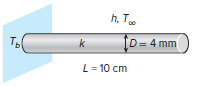
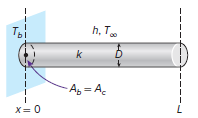
A 4-mm-diameter and 10-cm-long aluminum fin (k = 237 W/m·K) is attached to a surface. If the heat transfer coefficient is 12 W/m2·K, determine the percent error in the rate of heat transfer from the fin when the infinitely long fin assumption is used instead of the adiabatic fin tip
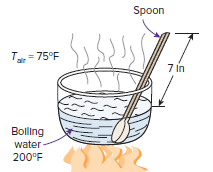
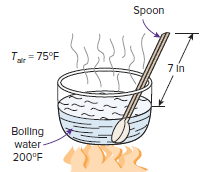
Consider a stainless steel spoon (k = 8.7 Btu/h·ft·°F) partially immersed in boiling water at 200°F in a kitchen at 75°F. The handle of the spoon has a cross section of 0.08 in × 0.5 in, and extends 7 in in the air from the free surface of the water. If the
Reconsider Prob. 18€“15. Using an appropriate software, investigate the effects of the heat transfer coefficient and the final plate temperature on the time it will take for the plate to reach this temperature. Let the heat transfer coefficient vary from 5 W/m2·K to 25
Hot water is to be cooled as it flows through the tubes exposed to atmospheric air. Fins are to be attached in order to enhance heat transfer. Would you recommend attaching the fins inside or outside the tubes? Why?
Consider two finned surfaces that are identical except that the fins on the first surface are formed by casting or extrusion, whereas they are attached to the second surface afterwards by welding or tight fitting. For which case do you think the fins will provide greater enhancement in heat
The heat transfer surface area of a fin is equal to the sum of all surfaces of the fin exposed to the surrounding medium, including the surface area of the fin tip. Under what conditions can we neglect heat transfer from the fin tip?
Does the (a) efficiency (b) effectiveness of a fin increase or decrease as the fin length is increased?
Two pin fins are identical, except that the diameter of one of them is twice the diameter of the other. For which fin is the (a) fin effectiveness (b) fin efficiency higher? Explain.
Two plate fins of constant rectangular cross section are identical, except that the thickness of one of them is twice the thickness of the other. For which fin is the(a) Fin effectiveness(b) Fin efficiency higher? Explain.
Two finned surfaces are identical, except that the convection heat transfer coefficient of one of them is twice that of the other. For which finned surface is the (a) fin effectiveness (b) fin efficiency higher? Explain.
Consider a very long rectangular fin attached to a flat surface such that the temperature at the end of the fin is essentially that of the surrounding air, i.e., 20°C. Its width is 5.0 cm; thickness is 1.0 mm; thermal conductivity is 200 W/m·K; and base temperature is 40°C. The heat transfer
Reconsider Prob. 17€“107E. Using an appropriate software, investigate the effects of the thermal conductivity of the spoon material and the length of its extension in the air on the temperature difference across the exposed surface of the spoon handle. Let the thermal conductivity vary
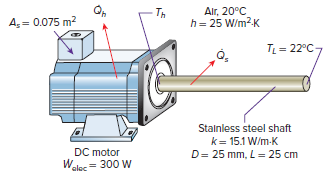
A DC motor delivers mechanical power to a rotating stainless steel shaft (k = 15.1 W/m·K) with a length of 25 cm and a diameter of 25 mm. In a surrounding with ambient air temperature of 20°C and convection heat transfer coefficient of 25 W/m2·K, the surface area of the motor
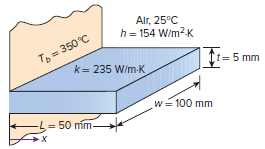
A plane wall with surface temperature of 350°C is attached with straight rectangular fins (k = 235 W/m·K). The fins are exposed to an ambient air condition of 25°C and the convection heat transfer coefficient is 154 W/m2·K. Each fin has a length of 50 mm, a base of 5 mm thick
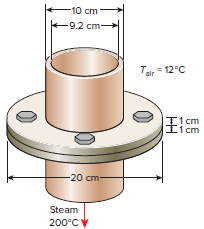
Two 3-m-long and 0.4-cm-thick cast iron (k = 52 W/m·K) steam pipes of outer diameter 10 cm are connected to each other through two 1-cm-thick flanges of outer diameter 20 cm. The steam flows inside the pipe at an average temperature of 200°C with a heat transfer coefficient of 180
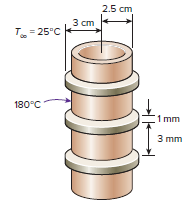
Steam in a heating system flows through tubes whose outer diameter is 5 cm and whose walls are maintained at a temperature of 180°C. Circular aluminum alloy 2024-T6 fins (k = 186 W/m·K) of outer diameter 6 cm and constant thickness 1 mm are attached to the tube. The space between the
A 0.3-cm-thick, 12-cm-high, and 18-cm-long circuit board houses 80 closely spaced logic chips on one side, each dissipating 0.04 W. The board is impregnated with copper fillings and has an effective thermal conductivity of 30 W/m·K. All the heat generated in the chips is conducted across the
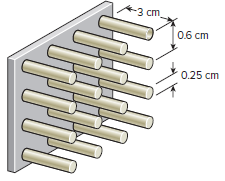
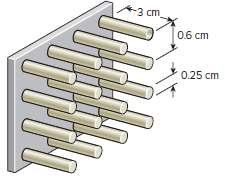
A hot surface at 100°C is to be cooled by attaching 3-cm-long, 0.25-cm-diameter aluminum pin fins (k = 237 W/m·K) to it, with a center-to-center distance of 0.6 cm. The temperature of the surrounding medium is 30°C, and the heat transfer coefficient on the surfaces is 35
Reconsider Prob. 17€“114. Using an appropriate software, investigate the effect of the center-to-center distance of the fins on the rate of heat transfer from the surface and the overall effectiveness of the fins. Let the center-to-center distance vary from 0.4 cm to 2.0 cm. Plot the rate
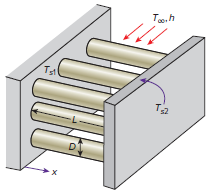
Circular cooling fins of diameter D = 1 mm and length L = 25.4 mm, made of copper (k = 400 W/m·K), are used to enhance heat transfer from a surface that is maintained at temperature Ts1= 132°C. Each rod has one end attached to this surface (x = 0), while the opposite end (x = L) is
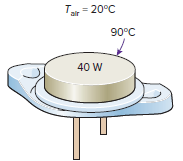
A 40-W power transistor is to be cooled by attaching it to one of the commercially available heat sinks shown in Table 17€“6. Select a heat sink that will allow the case temperature of the transistor not to exceed 90°C in the ambient air at 20°C. T= 20°C 90°C 40 W
A 25-W power transistor is to be cooled by attaching it to one of the commercially available heat sinks shown in Table 17–6. Select a heat sink that will allow the case temperature of the transistor not to exceed 55°C in the ambient air at 18°C.
Consider two identical people each generating 60 W of metabolic heat steadily while doing sedentary work and dissipating it by convection and perspiration. The first person is wearing clothes made of 1-mm-thick leather (k = 0.159 W/m·K) that covers half of the body while the second one is wearing
Cold conditioned air at 12°C is flowing inside a 1.5-cm-thick square aluminum (k = 237 W/m·K) duct of inner cross section 22 cm × 22 cm at a mass flow rate of 0.8 kg/s. The duct is exposed to air at 33°C with a combined convection-radiation heat transfer coefficient of 13 W/m2·K. The
Hot water is flowing at an average velocity of 1.5 m/s through a cast iron pipe (k 5 52 W/m·K) whose inner and outer diameters are 3 cm and 3.5 cm, respectively. The pipe passes through a 15-m-long section of a basement whose temperature is 15°C. If the temperature of the water drops from 70°C
Steam at 235°C is flowing inside a steel pipe (k = 61 W/m·K) whose inner and outer diameters are 10 cm and 12 cm, respectively, in an environment at 20°C. The heat transfer coefficients inside and outside the pipe are 105 W/m2·K and 14 W/m2·K, respectively. Determine(a) The thickness of the
A spherical vessel, 3.0 m in diameter (and negligible wall thickness), is used for storing a fluid at a temperature of 0°C. The vessel is covered with a 5.0-cm-thick layer of an insulation (k = 0.20 W/m·K). The surrounding air is at 22°C. The inside and outside heat transfer coefficients are 40
One wall of a refrigerated warehouse is 10.0-m-high and 5.0-m-wide. The wall is made of three layers: 1.0-cm-thick aluminum (k = 200 W/m·K), 8.0-cm-thick fibreglass (k = 0.038 W/m·K), and 3.0-cm thick gypsum board (k = 0.48 W/m·K). The warehouse inside and outside temperatures are 210°C and
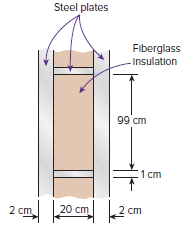
A 4-m-high and 6-m-long wall is constructed of two large 2-cm-thick steel plates (k = 15 W/m·K) separated by 1-cm-thick and 20-cm wide steel bars placed 99 cm apart. The remaining space between the steel plates is filled with fiberglass insulation (k = 0.035 W/m·K). If the temperature
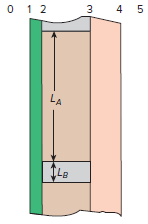
A typical section of a building wall is shown in Fig. P17€“126. This section extends in and out of the page and is repeated in the vertical direction. The wall support members are made of steel (k = 50 W/m·K). The support members are 8 cm (t23) × 0.5 cm (LB). The
Circular fins of uniform cross section, with diameter of 10 mm and length of 50 mm, are attached to a wall with surface temperature of 350°C. The fins are made of material with thermal conductivity of 240 W/m·K, and they are exposed to an ambient air condition of 25°C and the
A total of 10 rectangular aluminum fins (k = 203 W/m·K) are placed on the outside flat surface of an electronic device. Each fin is 100 mm wide, 20 mm high and 4 mm thick. The fins are located parallel to each other at a center-to-center distance of 8 mm. The temperature at the outside surface of
A plane wall surface at 200°C is to be cooled with aluminum pin fins of parabolic profile with blunt tips. Each fin has a length of 25 mm and a base diameter of 4 mm. The fins are exposed to an ambient air condition of 25°C and the heat transfer coefficient is 45 W/m2·K. If the thermal
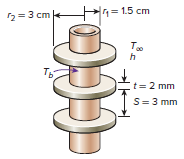
Steam in a heating system flows through tubes whose outer diameter is 3 cm and whose walls are maintained at a temperature of 120°C. Circular aluminum alloy fins (k = 180 W/m·K) of outer diameter 6 cm and constant thickness t = 2 mm are attached to the tube, as shown in Fig.
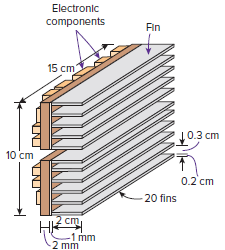
A 0.2-cm-thick, 10-cm-high, and 15-cm-long circuit board houses electronic components on one side that dissipate a total of 15 W of heat uniformly. The board is impregnated with conducting metal fillings and has an effective thermal conductivity of 12 W/m·K. All the heat generated in the
What is the physical significance of the Biot number? Is the Biot number more likely to be larger for highly conducting solids or poorly conducting ones?
What is lumped system analysis? When is it applicable?
In what medium is the lumped system analysis more likely to be applicable: in water or in air? Why?
For which solid is the lumped system analysis more likely to be applicable: an actual apple or a golden apple of the same size? Why?
For which kind of bodies made of the same material is the lumped system analysis more likely to be applicable: slender ones or well-rounded ones of the same volume? Why?
Consider heat transfer between two identical hot solid bodies and the air surrounding them. The first solid is being cooled by a fan while the second one is allowed to cool naturally. For which solid is the lumped system analysis more likely to be applicable? Why?
Consider heat transfer between two identical hot solid bodies and their environments. The first solid is dropped in a large container filled with water, while the second one is allowed to cool naturally in the air. For which solid is the lumped system analysis more likely to be applicable? Why?
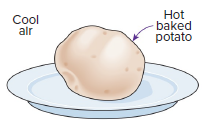
Consider a hot baked potato on a plate. The temperature of the potato is observed to drop by 4°C during the first minute. Will the temperature drop during the second minute be less than, equal to, or more than 4°C? Why? Hot baked potato Col alr
Consider a potato being baked in an oven that is maintained at a constant temperature. The temperature of the potato is observed to rise by 5°C during the first minute. Will the temperature rise during the second minute be less than, equal to, or more than 5°C? Why?
Consider two identical 4-kg pieces of roast beef. The first piece is baked as a whole, while the second is baked after being cut into two equal pieces in the same oven. Will there be any difference between the cooking times of the whole and cut roasts? Why?
Consider a sphere and a cylinder of equal volume made of copper. Both the sphere and the cylinder are initially at the same temperature and are exposed to convection in the same environment. Which do you think will cool faster, the cylinder or the sphere? Why?
Obtain relations for the characteristic lengths of a large plane wall of thickness 2L, a very long cylinder of radius ro, and a sphere of radius ro.
Obtain a relation for the time required for a lumped system to reach the average temperature 1/2 (Ti + T∞), where Ti is the initial temperature and T∞ is the temperature of the environment.
A brick of 203 × 102 × 57 mm in dimension is being burned in a kiln to 1100°C, and then allowed to cool in a room with ambient air temperature of 30°C and convection heat transfer coefficient of 5 W/m2·K. If the brick has properties of ρ = 1920 kg/m3, cp = 790 J/kg·K, and k = 0.90 W/m·K,
Metal plates (k = 180 W/m·K, ρ = 2800 kg/m3, and cp = 880 J/kg?K) with a thickness of 1 cm are being heated in an oven for 2 min. Air in the oven is maintained at 800°C with a convection heat transfer coefficient of 200 W/m2·K. If the initial temperature of the plates is 20°C, determine the
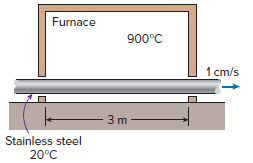
A 5-mm-thick stainless steel strip (k = 21 W/m·K, Ï = 8000 kg/m3, and cp= 570 J/kg·K) is being heat treated as it moves through a furnace at a speed of 1 cm/s. The air temperature in the furnace is maintained at 900°C with a convection heat transfer coefficient of 80
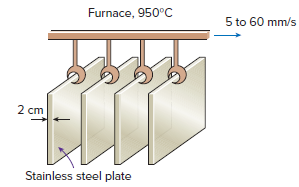
A batch of 2-cm-thick stainless steel plates (k = 21 W/m·K, Ï = 8000 kg/m3, and cp= 570 J/kg·K) are conveyed through a furnace to be heat treated. The plates enter the furnace at 18°C, and travel a distance of 3 m inside the furnace. The air temperature in the furnace
A long copper rod of diameter 2.0 cm is initially at a uniform temperature of 100°C. It is now exposed to an air stream at 20°C with a heat transfer coefficient of 200 W/m2·K. How long would it take for the copper road to cool to an average temperature of 25°C?
Springs in suspension system of automobiles are made of steel rods heated and wound into coils while ductile. Consider steel rods (ρ = 7832 kg/m3, cp = 434 J/kg·K, and k = 63.9 W/m·K) with diameter of 2.5 cm and length of 1.27 m. The steel rods are heated in an oven with a uniform convection
Steel rods (ρ = 7832 kg/m3, cp = 434 J/kg·K, and k = 63.9 W/m·K) are heated in a furnace to 850°C and then quenched in a water bath at 50°C for a period of 40 seconds as part of a hardening process. The convection heat transfer coefficient is 650 W/m2·K. If the steel rods have diameter of 40
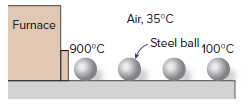
Reconsider Prob. 18€“29. Using an appropriate software, investigate the effect of the initial temperature of the balls on the annealing time and the total rate of heat transfer. Let the temperature vary from 500°C to 1000°C. Plot the time and the total rate of heat transfer as a
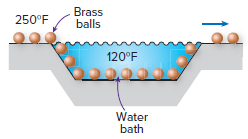
In a manufacturing facility, 2-in-diameter brass balls (k = 64.1 Btu/h·ft·°F, Ï = 532 lbm/ft3, and cp= 0.092 Btu/lbm·°F) initially at 250°F are quenched in a water bath at 120°F for a period of 2 min at a rate of 120 balls per minute. If the
How can we use the transient temperature charts when the surface temperature of the geometry is specified instead of the temperature of the surrounding medium and the convection heat transfer coefficient?
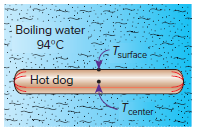
A father and son conducted the following simple experiment on a hot dog which measured 12.5 cm in length and 2.2 cm in diameter. They inserted one food thermometer into the midpoint of the hot dog and another one was placed just under the skin of the hot dog. The temperatures of the thermometers
An experiment is to be conducted to determine heat transfer coefficient on the surfaces of tomatoes that are placed in cold water at 7°C. The tomatoes (k = 0.59 W/m·K, α = 0.141 × 10⁻⁶ m2/s, ρ = 999 kg/m3, cp = 3.99 kJ/kg·K) with an initial uniform temperature of 30°C are spherical in shape
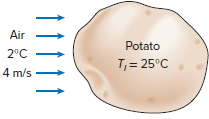
White potatoes (k = 0.50 W/m·K and a = 0.13 × 10⁻⁶m2/s) that are initially at a uniform temperature of 25°C and have an average diameter of 6 cm are to be cooled by refrigerated air at 2°C flowing at a velocity of 4 m/s. The average heat transfer coefficient between the
A bare-footed person whose feet are at 32°C steps on a large aluminum block at 20°C. Treating both the feet and the aluminum block as semi-infinite solids, determine the contact surface temperature. What would your answer be if the person stepped on a wood block instead? At room temperature, the
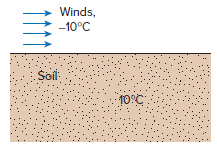
Reconsider Prob. 18€“79. Using an appropriate software, plot the soil temperature as a function of the distance from the earth€™s surface as the distance varies from 0 to 1 m, and discuss the results.Data from 18-79The soil temperature in the upper layers of the earth varies
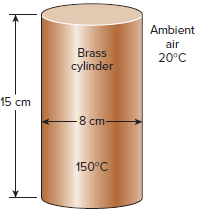
Reconsider Prob. 18€“91. Using an appropriate software, investigate the effect of the cooling time on the center temperature of the cylinder, the center temperature of the top surface of the cylinder, and the total heat transfer. Let the time vary from 5 min to 60 min. Plot the center
How is the product solution used to determine the variation of temperature with time and position in three dimensional systems?
An egg is to be cooked to a certain level of doneness by being dropped into boiling water. Can the cooking time be shortened by turning up the heat and bringing water to a more rapid boiling?
To warm up some milk for a baby, a mother pours milk into a thin-walled cylindrical container whose diameter is 6 cm. The height of the milk in the container is 7 cm. She then places the container into a large pan filled with hot water at 70°C. The milk is stirred constantly, so that its
The temperature of a gas stream is to be measured by a thermocouple whose junction can be approximated as a 1.2-mm-diameter sphere. The properties of the junction are k = 35 W/m·K, ρ = 8500 kg/m3, and cp = 320 J/kg·K, and the heat transfer coefficient between the junction and the gas is h = 90
In an experiment, the temperature of a hot gas stream is to be measured by a thermocouple with a spherical junction. Due to the nature of this experiment, the response time of the thermocouple to register 99 percent of the initial temperature difference must be within 5 s. The properties of the
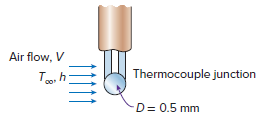
A thermocouple, with a spherical junction diameter of 0.5 mm, is used for measuring the temperature of hot air flow in a circular duct. The convection heat transfer coefficient of the air flow can be related with the diameter (D) of the spherical junction and the average air flow velocity (V) as h
Pulverized coal particles are used in oxy-fuel combustion power plants for electricity generation. Consider a situation where coal particles are suspended in hot air flowing through a heated tube, where the convection heat transfer coefficient is 100 W/m2·K. If the average surface area and volume
Showing 800 - 900
of 1421
1
2
3
4
5
6
7
8
9
10
11
12
13
14
15
Step by Step Answers

 Get 50% OFF
Claim Now
Get 50% OFF
Claim Now