New Semester
Started
Get
50% OFF
Study Help!
--h --m --s
Claim Now
Question Answers
Textbooks
Find textbooks, questions and answers
Oops, something went wrong!
Change your search query and then try again
S
Books
FREE
Study Help
Expert Questions
Accounting
General Management
Mathematics
Finance
Organizational Behaviour
Law
Physics
Operating System
Management Leadership
Sociology
Programming
Marketing
Database
Computer Network
Economics
Textbooks Solutions
Accounting
Managerial Accounting
Management Leadership
Cost Accounting
Statistics
Business Law
Corporate Finance
Finance
Economics
Auditing
Tutors
Online Tutors
Find a Tutor
Hire a Tutor
Become a Tutor
AI Tutor
AI Study Planner
NEW
Sell Books
Search
Search
Sign In
Register
study help
physics
fundamentals thermal fluid
Fundamentals of Thermal-Fluid Sciences 5th edition Yunus A. Cengel, Robert H. Turner, John M. Cimbala - Solutions
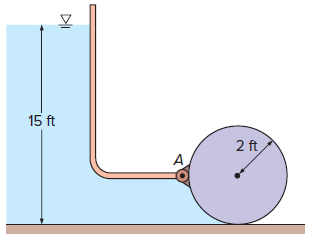
A long, solid cylinder of radius 2 ft hinged at point A is used as an automatic gate, as shown in Fig. P11??9E. When the water level reaches 15 ft, the cylindrical gate opens by turning about the hinge at point A. Determine (a) The hydrostatic force acting on the cylinder and its line of action
Consider a heavy car submerged in water in a lake with a flat bottom. The driver’s side door of the car is 1.1 m high and 0.9 m wide, and the top edge of the door is 10 m below the water surface. Determine the net force acting on the door (normal to its surface) and the location of the pressure
Consider a circular surface subjected to hydrostatic forces by a constant density liquid. If the magnitudes of the horizontal and vertical components of the resultant hydrostatic force are determined, explain how you would find the line of action of this force.
Consider a submerged curved surface. Explain how you would determine the vertical component of the hydrostatic force acting on this surface.
Consider a submerged curved surface. Explain how you would determine the horizontal component of the hydrostatic force acting on this surface.
You may have noticed that dams are much thicker at the bottom. Explain why dams are built that way.
A submerged horizontal flat plate is suspended in water by a string attached at the centroid of its upper surface. Now the plate is rotated 458 about an axis that passes through its centroid. Discuss the change in the hydrostatic force acting on the top surface of this plate as a result of this
Someone claims that she can determine the magnitude of the hydrostatic force acting on a plane surface submerged in water regardless of its shape and orientation if she knew the vertical distance of the centroid of the surface from the free surface and the area of the surface. Is this a valid
Define the resultant hydrostatic force acting on a submerged surface, and the center of pressure.
Express the Bernoulli equation in three different ways using(a) Energies,(b) Pressures,(c) Heads.
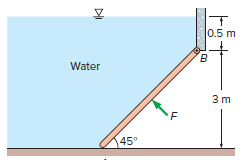
Repeat Prob. 11??52 for a water height of 0.8 m above the hinge at B. 0.5 m B. Water 3 m 145
What is stagnation pressure? Explain how it can be measured.
The volume of a rock is to be determined without using any volume measurement devices. Explain how you would do this with a waterproof spring scale.
Express Newton’s second law of motion for rotating bodies. What can you say about the angular velocity and angular momentum of a rotating nonrigid body of constant mass if the net torque acting on it is zero?
Is momentum a vector? If so, in what direction does it point?
Express the conservation of momentum principle. What can you say about the momentum of a body if the net force acting on it is zero?
Two firefighters are fighting a fire with identical water hoses and nozzles, except that one is holding the hose straight so that the water leaves the nozzle in the same direction it comes, while the other holds it backward so that the water makes a U-turn before being discharged. Which firefighter
How do surface forces arise in the momentum analysis of a control volume? How can we minimize the number of surface forces exposed during analysis?
Explain the importance of the Reynolds transport theorem in fluid mechanics, and describe how the linear momentum equation is obtained from it.
What is the importance of the momentum-flux correction factor in the momentum analysis of flow systems? For which type(s) of flow is it significant and must it be considered in analysis: laminar flow, turbulent flow, or jet flow?
Write the momentum equation for steady one-dimensional flow for the case of no external forces and explain the physical significance of its terms.
In the application of the momentum equation, explain why we can usually disregard the atmospheric pressure and work with gage pressures only.
A rocket in space (no friction or resistance to motion) can expel gases relative to itself at some high velocity V. Is V the upper limit to the rocket’s ultimate velocity?
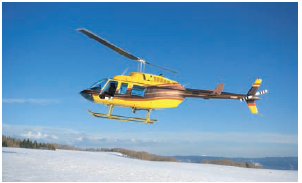
Describe in terms of momentum and airflow how a helicopter is able to hover.
Does it take more, equal, or less power for a helicopter to hover at the top of a high mountain than it does at sea level? Explain.
In a given location, would a helicopter require more energy in summer or winter to achieve a specified performance? Explain.
A horizontal water jet from a nozzle of constant exit cross section impinges normally on a stationary vertical flat plate. A certain force F is required to hold the plate against the water stream. If the water velocity is doubled, will the necessary holding force also be doubled? Explain.
Describe body forces and surface forces, and explain how the net force acting on a control volume is determined. Is fluid weight a body force or surface force? How about pressure?
A constant-velocity horizontal water jet from a stationary nozzle impinges normally on a vertical flat plate that rides on a nearly frictionless track. As the water jet hits the plate, it begins to move due to the water force. Will the acceleration of the plate remain constant or change? Explain.
A horizontal water jet of constant velocity V from a stationary nozzle impinges normally on a vertical flat plate that rides on a nearly frictionless track. As the water jet hits the plate, it begins to move due to the water force. What is the highest velocity the plate can attain? Explain.
Water enters a 10-cm-diameter pipe steadily with a uniform velocity of 3 m/s and exits with the turbulent flow velocity distribution given by u = umax (1 - r/R)1/7. If the pressure drop along the pipe is 10 kPa, determine the drag force exerted on the pipe by water flow.
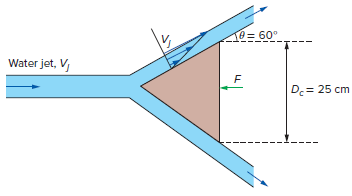
A 2.5-cm-diameter horizontal water jet with a speed of Vj= 40 m/s relative to the ground is deflected by a 60? stationary cone whose base diameter is 25 cm. Water velocity along the cone varies linearly from zero at the cone surface to the incoming jet speed of 40 m/s at the free surface.
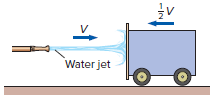
A horizontal water jet of constant velocity V impinges normally on a vertical flat plate and splashes off the sides in the vertical plane. The plate is moving toward the oncoming water jet with velocity 1/2 V. If a force F is required to maintain the plate stationary, how much force is required to
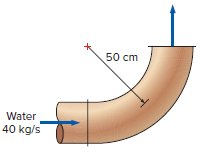
A 90? elbow in a horizontal pipe is used to direct water flow upward at a rate of 40 kg/s. The diameter of the entire elbow is 10 cm. The elbow discharges water into the atmosphere, and thus the pressure at the exit is the local atmospheric pressure. The elevation difference between the centers of
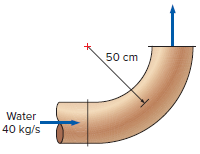
Repeat Prob. 13??22 for the case of another (identical) elbow attached to the existing elbow so that the fluid makes a U-turn. Repeat Prob. A 90? elbow in a horizontal pipe is used to direct water flow upward at a rate of 40 kg/s. The diameter of the entire elbow is 10 cm. The elbow discharges
A horizontal water jet impinges against a vertical flat plate at 25 ft/s and splashes off the sides in the vertical plane. If a horizontal force of 350 lbf is required to hold the plate against the water stream, determine the volume flow rate of the water.
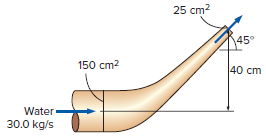
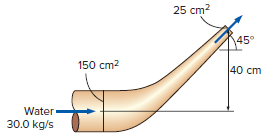
A reducing elbow in a horizontal pipe is used to deflect water flow by an angle u = 45? from the flow direction while accelerating it. The elbow discharges water into the atmosphere. The cross- sectional area of the elbow is 150 cm2at the inlet and 25 cm2at the exit. The elevation difference
Repeat Prob. 13??25 for the case of u = 110?. Repeat Problem A reducing elbow in a horizontal pipe is used to deflect water flow by an angle u = 45? from the flow direction while accelerating it. The elbow discharges water into the atmosphere. The cross- sectional area of the elbow is 150 cm2 at
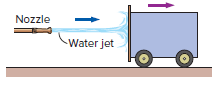
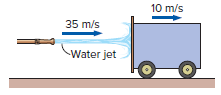
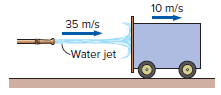
Water accelerated by a nozzle to 35 m/s strikes the vertical back surface of a cart moving horizontally at a constant velocity of 10 m/s in the flow direction. The mass flow rate of water through the stationary nozzle is 30 kg/s. After the strike, the water stream splatters off in all directions in
Reconsider Prob. 13??27. If the mass of the cart is 400 kg and the brakes fail, determine the acceleration of the cart when the water first strikes it. Assume the mass of water that wets the back surface is negligible. 10 m/s 35 m/s Water jet
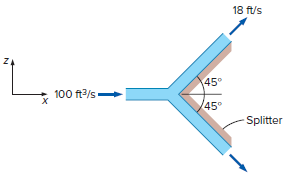
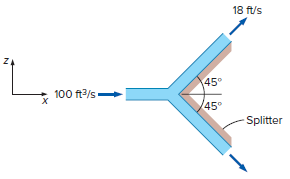
A 100-ft3/s water jet is moving in the positive x-direction at 18 ft/s. The stream hits a stationary splitter, such that half of the flow is diverted upward at 45? and the other half is directed downward, and both streams have a final average speed of 18 ft/s. Disregarding gravitational effects,
Reconsider Prob. 13??29E. Using an appropriate software, investigate the effect of the splitter angle on the force exerted on the splitter in the incoming flow direction. Let the half splitter angle vary from 0? to 180? in increments of 10?. Tabulate and plot your results and draw some
A horizontal 5-cm-diameter water jet with a velocity of 18 m/s impinges normally upon a vertical plate of mass 1000 kg. The plate rides on a nearly frictionless track and is initially stationary. When the jet strikes the plate, the plate begins to move in the direction of the jet. The water always
A fan with 24-in-diameter blades moves 2000 cfm (cubic feet per minute) of air at 70°F at sea level. Determine(a) The force required to hold the fan(b) The minimum power input required for the fan. Choose a control volume sufficiently large to contain the fan, with the inlet sufficiently far
A 3-in-diameter horizontal jet of water, with velocity 140 ft/s, strikes a bent plate, which deflects the water by 135° from its original direction. How much force is required to hold the plate against the water stream and what is its direction? Disregard frictional and gravitational effects.
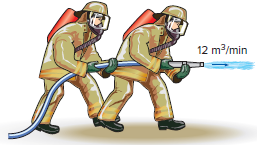
Firefighters are holding a nozzle at the end of a hose while trying to extinguish a fire. If the nozzle exit diameter is 8 cm and the water flow rate is 12 m3/min, determine (a) The average water exit velocity (b) The horizontal resistance force required of the firefighters to hold the nozzle. 12
Reconsider Prob. 13–35. Using an appropriate software, investigate the effect of the plate velocity on the force exerted on the plate. Let the plate velocity vary from 0 to 30 m/s, in increments of 3 m/s. Tabulate and plot your results.In ProblemA 5-cm-diameter horizontal jet of water with a
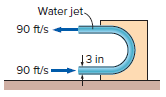
A 3-in-diameter horizontal water jet having a velocity of 90 ft/s strikes a curved plate, which deflects the water 180? at the same speed. Ignoring the frictional effects, determine the force required to hold the plate against the water stream. Water jet, 90 ft/s 13 in 90 ft/s-
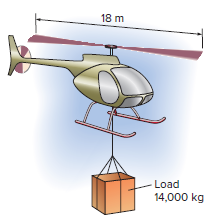
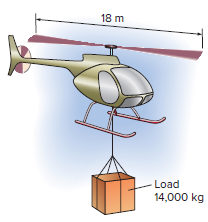
An unloaded helicopter of mass 12,000 kg hovers at sea level while it is being loaded. In the unloaded hover mode, the blades rotate at 550 rpm. The horizontal blades above the helicopter cause a 18-m-diameter air mass to move downward at an average velocity proportional to the overhead blade
Reconsider the helicopter in Prob. 13??38, except that it is hovering on top of a 2800-m-high mountain where the air density is 0.928 kg/m3. Noting that the unloaded helicopter blades must rotate at 550 rpm to hover at sea level, determine the blade rotational velocity to hover at the higher
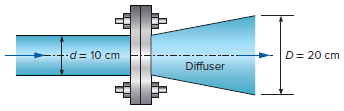
Water is flowing through a 10-cm-diameter water pipe at a rate of 0.1 m3/s. Now a diffuser with an outlet diameter of 20 cm is bolted to the pipe in order to slow down water, as shown in Fig. P13€“40. Disregarding frictional effects, determine the force exerted on the bolts due to the
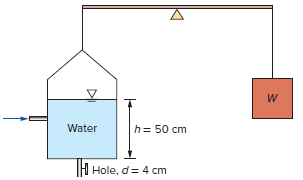
The weight of a water tank open to the atmosphere is balanced by a counterweight, as shown in Fig. P13??41. There is a 4-cm hole at the bottom of the tank with a discharge coefficient of 0.90, and water level in the tank is maintained constant at 50 cm by water entering the tank horizontally.
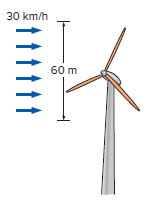
Commercially available large wind turbines have blade span diameters larger than 100 m and generate over 3 MW of electric power at peak design conditions. Consider a wind turbine with a 60-m blade span subjected to 30-km/h steady winds. If the combined turbine??generator efficiency of the wind
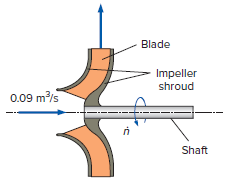
Water enters a centrifugal pump axially at atmospheric pressure at a rate of 0.09 m3/s and at a velocity of 5 m/s, and leaves in the normal direction along the pump casing, as shown in Fig. P13??43. Determine the force acting on the shaft (which is also the force acting on the bearing of the shaft)
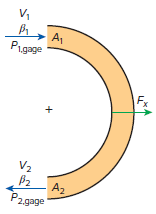
An incompressible fluid of density ρ and viscosity μ flows through a curved duct that turns the flow 180?. The duct cross-sectional area remains constant. The average velocity, momentum flux correction factor, and gage pressure are known at the inlet (1) and outlet (2), as in Fig. P13??44.? (a)
Consider the curved duct of Prob. 13–44, except allow the cross-sectional area to vary along the duct (A1 ≠ A2).(a) Write an expression for the horizontal force Fx of the fluid on the walls of the duct in terms of the given variables.(b) Verify your expression by plugging in the following
Water flowing in a horizontal 25-cm-diameter pipe at 8 m/s and 300 kPa gage enters a 90° bend reducing section, which connects to a 15-cm-diameter vertical pipe. The inlet of the bend is 50 cm above the exit. Neglecting any frictional and gravitational effects, determine the net resultant force
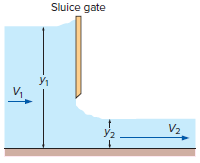
A sluice gate, which controls flow rate in a channel by simply raising or lowering a vertical plate, is commonly used in irrigation systems. A force is exerted on the gate due to the difference between the water heights y1and y2and the flow velocities V1and V2upstream and downstream from the gate,
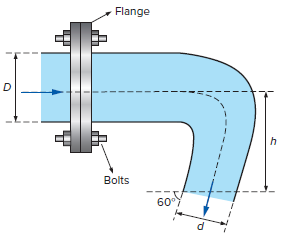
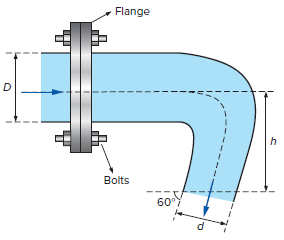
Water flowing steadily at a rate of 0.16 m3/s is deflected downward by an angled elbow as shown in Fig. P13??48. For D = 30 cm, d = 10 cm, and h = 50 cm, determine the force acting on the flanges of the elbow and the angle its line of action makes with the horizontal. Take the internal volume of
Repeat Prob. 13??48 by taking into consideration the weight of the elbow whose mass is 5 kg. Repeat Prob. Water flowing steadily at a rate of 0.16 m3/s is deflected downward by an angled elbow as shown in Fig. P13??48. For D = 30 cm, d = 10 cm, and h = 50 cm, determine the force acting on the
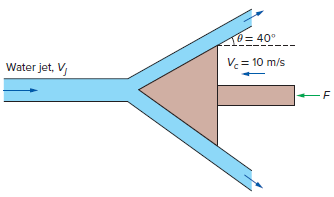
A 12-cm diameter horizontal water jet with a speed of Vj= 25 m/s relative to the ground is deflected by a 40° cone moving to the left at Vc= 10 m/s. Determine the external force, F, needed to maintain the motion of the cone. Disregard the gravity and surface shear effects and assume the
A 6-cm-diameter horizontal water jet having a velocity of 25 m/s strikes a vertical stationary flat plate. The water splatters in all directions in the plane of the plate. How much force is required to hold the plate against the water stream?
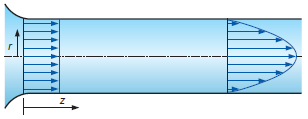
Consider steady developing laminar flow of water in a constant-diameter horizontal discharge pipe attached to a tank. The fluid enters the pipe with nearly uniform velocity V and pressure P1. The velocity profile becomes parabolic after a certain distance with a momentum correction factor of 2
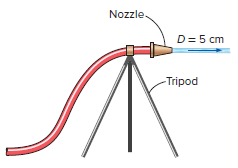
A tripod holding a nozzle, which directs a 5-cmdiameter stream of water from a hose, is shown in Fig. P13??53. The nozzle mass is 10 kg when filled with water. The tripod is rated to provide 1800 N of holding force. A firefighter was standing 60 cm behind the nozzle and was hit by the nozzle when
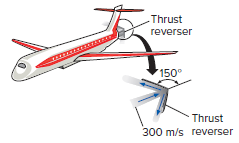
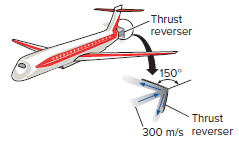
Consider an airplane with a jet engine attached to the tail section that expels combustion gases at a rate of 18 kg/s with a velocity of V = 300 m/s relative to the plane. During landing, a thrust reverser (which serves as a brake for the aircraft and facilitates landing on a short runway) is
Reconsider Prob. 13??54. Using an appropriate software, investigate the effect of thrust reverser angle on the braking force exerted on the airplane. Let the reverser angle vary from 0? (no reversing) to 180? (full reversing) in increments of 10?. Tabulate and plot your results and draw
A spacecraft cruising in space at a constant velocity of 2000 ft/s has a mass of 25,000 lbm. To slow down the spacecraft, a solid fuel rocket is fired, and the combustion gases leave the rocket at a constant rate of 150 lbm/s at a velocity of 5000 ft/s in the same direction as the spacecraft for a
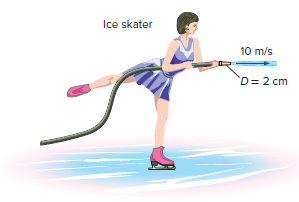
A 60-kg ice skater is standing on ice with ice skates (negligible friction). She is holding a flexible hose (essentially weightless) that directs a 2-cm-diameter stream of water horizontally parallel to her skates. The water velocity at the hose outlet is 10 m/s relative to the skater. If she is
A 5-cm-diameter horizontal jet of water, with velocity 30 m/s, strikes the tip of a horizontal cone, which deflects the water by 45° from its original direction. How much force is required to hold the cone against the water stream?
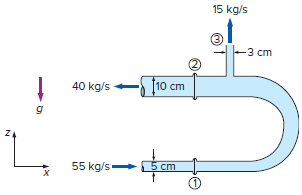
Water is flowing into and discharging from a pipe U-section as shown in Fig. P13??59. At flange (1), the total absolute pressure is 200 kPa, and 55 kg/s flows into the pipe. At flange (2), the total pressure is 150 kPa. At location (3), 15 kg/s of water discharges to the atmosphere, which is at 100
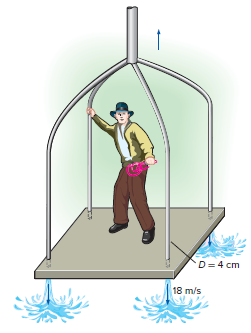
Indiana Jones needs to ascend a 10-m-high building. There is a large hose filled with pressurized water hanging down from the building top. He builds a square platform and mounts four 4-cm-diameter nozzles pointing down at each corner. By connecting hose branches, a water jet with 15-m/s velocity
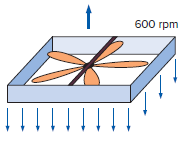
An engineering student considers using a fan as a levitation demonstration. She plans to face the box-enclosed fan so the air blast is directed face down through a 3-ft-diameter blade span area. The system weighs 5 lbf, and the student will secure the system from rotating. By increasing the power
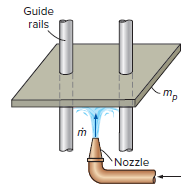
Nearly frictionless vertical guide rails maintain a plate of mass mp in a horizontal position, such that it can slide freely in the vertical direction. A nozzle directs a water stream of area A against the plate underside. The water jet splatters in the plate plane, applying an upward force against
A 7-cm diameter vertical water jet is injected upward by a nozzle at a speed of 15 m/s. Determine the maximum weight of a flat plate that can be supported by this water jet at a height of 2 m from the nozzle.
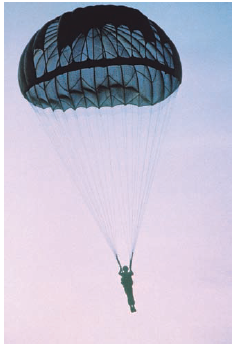
A soldier jumps from a plane and opens his parachute when his velocity reaches the terminal velocity VT. The parachute slows him down to his landing velocity of VF. After the parachute is deployed, the air resistance is proportional to the velocity squared (i.e., F = kV2). The soldier, his
What is vapor pressure? How is it related to saturation pressure?
One of the widely used correlations to describe the variation of the viscosity of gases is the power-law equation given by μ/μ0 = (T/T0)n, where μ0 and T0 are the reference viscosity and temperature, respectively. Using the power and Sutherland laws, examine the variation of the air viscosity
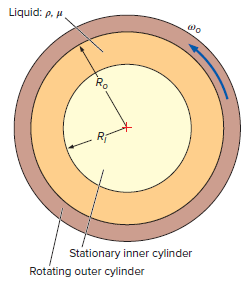
A rotating viscometer consists of two concentric cylinders€”a stationary inner cylinder of radius Riand an outer cylinder of inside radius Rorotating at angular velocity (rotation rate) ωo. In the tiny gap between the two cylinders is the fluid whose viscosity (μ)
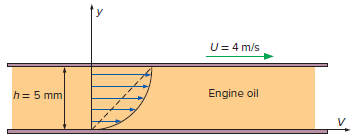
A large plate is pulled at a constant speed of U = 4 m/s over a fixed plate on 5-mm-thick engine oil film at 20°C. Assuming a half-parabolic velocity profile in the oil film, as sketched, determine the shear stress developed on the upper plate and its direction. What would happen if a linear
A capillary tube is immersed vertically in a water container. Knowing that water starts to evaporate when the pressure drops below 2 kPa, determine the maximum capillary rise and tube diameter for this maximum-rise case. Take the contact angle at the inner wall of the tube to be 6° and the surface
The pressure on the suction side of pumps is typically low, and the surfaces on that side of the pump are susceptible to cavitation, especially at high fluid temperatures. If the minimum pressure on the suction side of a water pump is 0.95 psia absolute, determine the maximum water temperature to
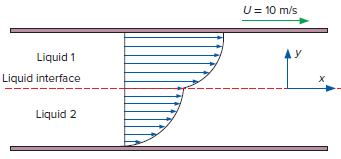
Two immiscible Newtonian liquids flow steadily between two large parallel plates under the influence of an applied pressure gradient. The lower plate is fixed while the upper one is pulled with a constant velocity of U = 10 m/s. The thickness, h, of each layer of fluid is 0.5 m. The velocity
Consider two solid blocks, one hot and the other cold, brought into contact in an adiabatic container. After a while, thermal equilibrium is established in the container as a result of heat transfer. The first law requires that the amount of energy lost by the hot solid be equal to the amount of
During a heat transfer process, the entropy of a system (always, sometimes, never) increases.
The diameter of a cylindrical water tank is Do and its height is H. The tank is filled with water, which is open to the atmosphere. An orifice of diameter D with a smooth entrance (i.e., negligible losses) is open at the bottom. Develop a relation for the time required for the tank(a) To empty
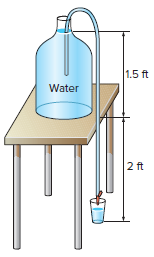
The drinking water needs of an office are met by large water bottles. One end of a 0.25-in-diameter plastic hose is inserted into the bottle placed on a high stand, while the other end with an on/off valve is maintained 2 ft below the bottom of the bottle. If the water level in the bottle is 1.5 ft
A piezometer and a Pitot tube are tapped into a 4-cm-diameter horizontal water pipe, and the height of the water columns are measured to be 26 cm in the piezometer and 35 cm in the Pitot tube (both measured from the top surface of the pipe). Determine the velocity at the center of the pipe.
The air velocity in the duct of a heating system is to be measured by a Pitot-static probe inserted into the duct parallel to the flow. If the differential height between the water columns connected to the two outlets of the probe is 2.4 cm, determine (a) the flow velocity (b) the pressure rise at
A Pitot-static probe is used to measure the speed of an aircraft flying at 3000 m. If the differential pressure reading is 3 kPa, determine the speed of the aircraft.
In a hydroelectric power plant, water enters the turbine nozzles at 800 kPa absolute with a low velocity. If the nozzle outlets are exposed to atmospheric pressure of 100 kPa, determine the maximum velocity to which water can be accelerated by the nozzles before striking the turbine blades.
A student siphons water over a 8.5-m-high wall at sea level. She then climbs to the summit of Mount Shasta (elevation 4390 m, Patm = 58.5 kPa) and attempts the same experiment. Comment on her prospects for success.
The water level of a tank on a building roof is 20 m above the ground. A hose leads from the tank bottom to the ground. The end of the hose has a nozzle, which is pointed straight up. What is the maximum height to which the water could rise? What factors would reduce this height?
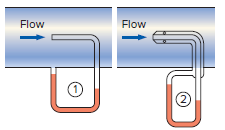
The velocity of a fluid flowing in a pipe is to be measured by two different Pitot-type mercury manometers shown in Fig. P12??12C. Would you expect both manometers to predict the same velocity for flowing water? If not, which would be more accurate? Explain. What would your response be if air were
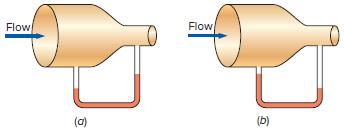
A glass manometer with oil as the working fluid is connected to an air duct as shown in Fig. P12??11. Will the oil levels in the manometer be as in Fig. P12??11Ca or b? Explain. What would your response be if the flow direction is reversed? Flow Flow (b) (a)
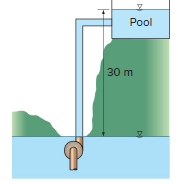
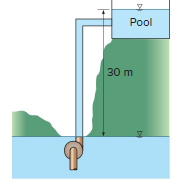
Underground water is to be pumped by a 78 percent efficient 5-kW submerged pump to a pool whose free surface is 30 m above the underground water level. The diameter of the pipe is 7 cm on the intake side and 5 cm on the discharge side. Determine (a) The maximum flow rate of water (b) The pressure
Reconsider Prob. 12??62. Determine the flow rate of water and the pressure difference across the pump if the irreversible head loss of the piping system is 4 m. Data from 12-62 Underground water is to be pumped by a 78 percent efficient 5-kW submerged pump to a pool whose free surface is 30 m above
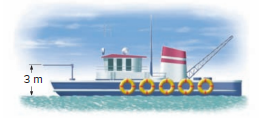
A fireboat is to fight fires at coastal areas by drawing seawater with a density of 1030 kg/m3through a 10-cm-diameter pipe at a rate of 0.04 m3/s and discharging it through a hose nozzle with an exit diameter of 5 cm. The total irreversible head loss of the system is 3 m, and the position of the
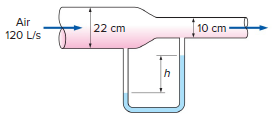
Air flows through a pipe at a rate of 120 L/s. The pipe consists of two sections of diameters 22 cm and 10 cm with a smooth reducing section that connects them. The pressure difference between the two pipe sections is measured by a water manometer. Neglecting frictional effects, determine the
Air at 100 kPa and 25°C flows in a horizontal duct of variable cross section. The water column in the manometer that measures the difference between two sections has a vertical displacement of 8 cm. If the velocity in the first section is low and the friction is negligible, determine the velocity
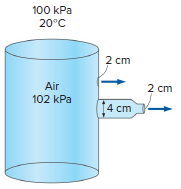
A very large tank contains air at 102 kPa at a location where the atmospheric air is at 100 kPa and 20°C. Now a 2-cm-diameter tap is opened. Determine the maximum flow rate of air through the hole. What would your response be if air is discharged through a 2-m-long, 4-cm-diameter tube with a
Showing 1200 - 1300
of 1421
1
2
3
4
5
6
7
8
9
10
11
12
13
14
15
Step by Step Answers

 Get 50% OFF
Claim Now
Get 50% OFF
Claim Now