New Semester
Started
Get
50% OFF
Study Help!
--h --m --s
Claim Now
Question Answers
Textbooks
Find textbooks, questions and answers
Oops, something went wrong!
Change your search query and then try again
S
Books
FREE
Study Help
Expert Questions
Accounting
General Management
Mathematics
Finance
Organizational Behaviour
Law
Physics
Operating System
Management Leadership
Sociology
Programming
Marketing
Database
Computer Network
Economics
Textbooks Solutions
Accounting
Managerial Accounting
Management Leadership
Cost Accounting
Statistics
Business Law
Corporate Finance
Finance
Economics
Auditing
Tutors
Online Tutors
Find a Tutor
Hire a Tutor
Become a Tutor
AI Tutor
AI Study Planner
NEW
Sell Books
Search
Search
Sign In
Register
study help
physics
fundamentals thermal fluid
Fundamentals of Thermal-Fluid Sciences 5th edition Yunus A. Cengel, Robert H. Turner, John M. Cimbala - Solutions
Explain when an external flow is two-dimensional, three-dimensional, and axisymmetric. What type of flow is the flow of air over a car?
Define the planform area of a body subjected to external flow. When is it appropriate to use the planform area in drag and lift calculations?
Define the frontal area of a body subjected to external flow. When is it appropriate to use the frontal area in drag and lift calculations?
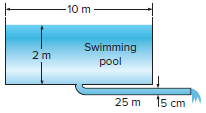
Repeat Prob. 14€“116 for a sharp-edged entrance to the pipe with KL= 0.5. Is this €œminor loss€ truly €œminor€ or not? -10 m Swimming pool 25 m 15 cm
Reconsider Prob. 14€“116. Using an appropriate software, investigate the effect of the discharge pipe diameter on the time required to empty the pool completely. Let the diameter vary from 1 to 10 cm, in increments of 1 cm. Tabulate and plot the results. -10 m Swimming pool 25 m 15 cm
The water at 20°C in a 10-m-diameter, 2-m-high aboveground swimming pool is to be emptied by unplugging a 5-cm-diameter, 25-m-long horizontal plastic pipe attached to the bottom of the pool. Determine the initial rate of discharge of water through the pipe and the time (hours) it would take to
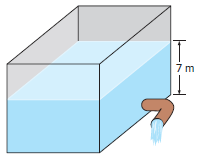
Water is to be withdrawn from a 7-m-high water reservoir by drilling a well-rounded 4-cm-diameter hole with negligible loss near the bottom and attaching a horizontal 90° bend of negligible length. Taking the kinetic energy correction factor to be 1.05, determine the flow rate of water through
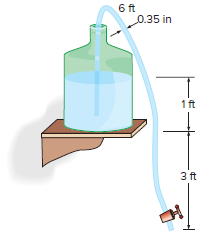
Reconsider Prob. 14€“112E. The office worker who set up the siphoning system purchased a 12-ft-long reel of the plastic tube and wanted to use the whole thing to avoid cutting it in pieces, thinking that it is the elevation difference that makes siphoning work, and the length of the tube
Reconsider Prob. 14€“112E. an appropriate software, investigate the effect of the hose diameter on the time required to fill a glass when the bottle is full. Let the diameter vary from 0.2 to 2 in, in increments of 0.2 in. Tabulate and plot the results. 6 ft 0.35 in 1 ft 3 ft
Consider laminar flow over a flat plate. How does the local friction coefficient change with position?
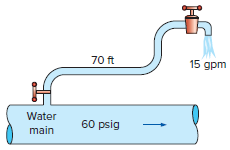
Repeat Prob. 14€“108E for plastic (smooth) pipes.Repeat Prob.A water fountain is to be installed at a remote location by attaching a cast iron pipe directly to a water main through which water is flowing at 70°F and 60 psig. The entrance to the pipe is sharp-edged, and the 70-ft-long
In a hydroelectric power plant, water at 20°C is supplied to the turbine at a rate of 0.6 m3/s through a 200-m-long, 0.35-m-diameter cast iron pipe. The elevation difference between the free surface of the reservoir and the turbine discharge is 140 m, and the combined turbine–generator
In Prob. 14–110, the pipe diameter is tripled in order to reduce the pipe losses. Determine the percent increase in the net power output as a result of this modification.In Prob.In a hydroelectric power plant, water at 20°C is supplied to the turbine at a rate of 0.6 m3/s through a 200-m-long,
The drinking water needs of an office are met by large water bottles. One end of a 0.35-in-diameter, 6-ft-long plastic hose is inserted into the bottle placed on a high stand, while the other end with an on/off valve is maintained 3 ft below the bottom of the bottle. If the water level in the
A water fountain is to be installed at a remote location by attaching a cast iron pipe directly to a water main through which water is flowing at 70°F and 60 psig. The entrance to the pipe is sharp-edged, and the 70-ft-long piping system involves three 90° miter bends without vanes, a fully
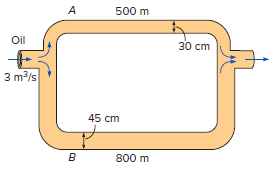
Repeat Prob. 14€“106 for hot-water flow of a district heating system at 100°C. 500 m Oil 30 cm 3 m/s 45 cm 800 m в
A pipeline that transports oil at 40°C at a rate of 3 m3/s branches out into two parallel pipes made of commercial steel that reconnect downstream. Pipe A is 500 m long and has a diameter of 30 cm while pipe B is 800 m long and has a diameter of 45 cm. The minor losses are considered to be
Two pipes of identical diameter and material are connected in parallel. The length of pipe A is five times the length of pipe B. Assuming the flow is fully turbulent in both pipes and thus the friction factor is independent of the Reynolds number and disregarding minor losses, determine the ratio
In a geothermal district heating system, 10,000 kg/s of hot water must be delivered a distance of 10 km in a horizontal pipe. The minor losses are negligible, and the only significant energy loss arises from pipe friction. The friction factor is taken to be 0.015. Specifying a larger-diameter pipe
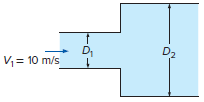
A circular water pipe has an abrupt expansion from diameter D1= 8 cm to D2= 24 cm. The pressure and the average water velocity in the smaller pipe are P1= 135 kPa and 10 m/s, respectively, and the flow is turbulent. By applying the continuity, momentum, and energy equations and disregarding the
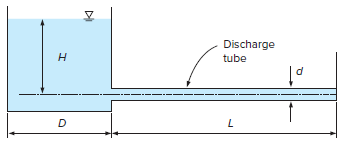
A student is to determine the kinematic viscosity of an oil using the system shown in Prob. 14–101. The initial fluid height in the tank is H = 40 cm, the tube diameter is d 5 6 mm, the tube length is L = 0.65 m, and the tank diameter is D = 0.63 m. The student observes that it takes 1400 s for
A highly viscous liquid discharges from a large container through a small-diameter tube in laminar flow. Disregarding entrance effects and velocity heads, obtain a relation for the variation of fluid depth in the tank with time. Discharge н tube
Repeat Prob. 14–99E assuming the pipe is inclined 12° from the horizontal and the flow is uphill. The velocity profile in a fully developed laminar flow of water at 40°F in a 250-ft-long horizontal circular pipe, in ft/s, is given by u(r) = 0.8(1 - 625r2), where r is the radial distance from
The velocity profile in a fully developed laminar flow of water at 40°F in a 250-ft-long horizontal circular pipe, in ft/s, is given by u(r) = 0.8(1 - 625r2), where r is the radial distance from the centerline of the pipe in ft. Determine (a) the volume flow rate of water through the pipe, (b) the
The velocity profile in fully developed laminar flow in a circular pipe, in m/s, is given by u(r) = 6(1 - 100r2), where r is the radial distance from the centerline of the pipe in m. Determine (a) the radius of the pipe, (b) the average velocity through the pipe, (c) the maximum velocity in the
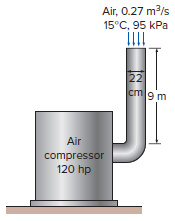
The compressed air requirements of a manufacturing facility are met by a 120-hp compressor that draws in air from the outside through an 9-m-long, 22-cm-diameter duct made of thin galvanized iron sheets. The compressor takes in air at a rate of 0.27 m3/s at the outdoor conditions of 15°C and 95
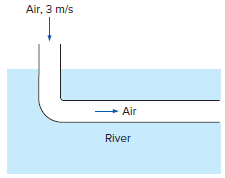
A house built on a riverside is to be cooled in summer by utilizing the cool water of the river. A 15-m-long section of a circular stainless-steel duct of 20-cm diameter passes through the water. Air flows through the underwater section of the duct at 3 m/s at an average temperature of 15°C.
In a laminar flow through a circular tube of radius of R, the velocity and temperature profiles at a cross section are given by u = u0 (1 - r2/R2) and T(r) = A + Br2 - Cr4 where A, B and C are positive constants. Obtain a relation for the bulk fluid temperature at that cross section.
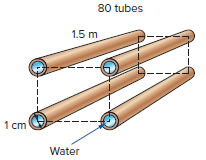
Shell-and-tube heat exchangers with hundreds of tubes housed in a shell are commonly used in practice for heat transfer between two fluids. Such a heat exchanger used in an active solar hot-water system transfers heat from a waterantifreeze solution flowing through the shell and the solar collector
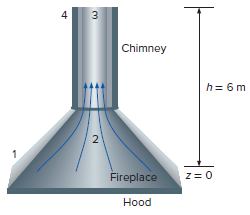
A 6-m-tall chimney shown in Fig. P14€“92 is to be designed to discharge hot gases from a fireplace at 180°C at a constant rate of 0.15 m3/s when the atmospheric air temperature is 20°C. Assuming no heat transfer from the chimney and taking the chimney entrance loss coefficient to
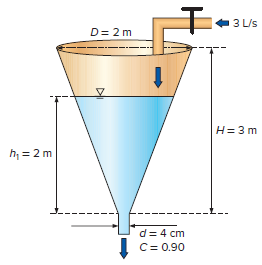
An inverted 3-m-high conical container shown in Fig. P14€“93 is initially filled with 2-m-high water. At time t = 0, a faucet is opened to supply water into the container at a rate of 3 L/s. At the same time, a 4-cm-diameter hole with a discharge coefficient of 0.90 at the bottom of the
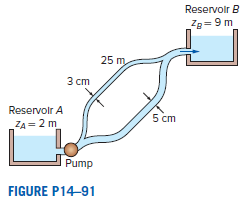
Water at 20°C is to be pumped from a reservoir (zA= 2 m) to another reservoir at a higher elevation (zB= 9 m) through two 25-m-long plastic pipes connected in parallel. The diameters of the two pipes are 3 cm and 5 cm. Water is to be pumped by a 68 percent efficient motor€“pump unit
Repeat Prob. 14–88 for plastic (smooth) pipes.In Prob.In large buildings, hot water in a water tank is circulated through a loop so that the user doesn’t have to wait for all the water in long piping to drain before hot water starts coming out. A certain recirculating loop involves 40-m-long,
Reconsider Prob. 14–88. Using an appropriate software, investigate the effect of the average flow velocity on the power input to the recirculating pump. Let the velocity vary from 0 to 3 m/s in increments of 0.3 m/s. Tabulate and plot the results.In Prob.In large buildings, hot water in a water
In large buildings, hot water in a water tank is circulated through a loop so that the user doesn’t have to wait for all the water in long piping to drain before hot water starts coming out. A certain recirculating loop involves 40-m-long, 1.2-cm-diameter cast iron pipes with six 90° threaded
Gasoline (ρ = 680 kg/m3 and v = 4.29 × 10⁻⁷ m2/s) is transported at a rate of 240 L/s for a distance of 2 km. The surface roughness of the piping is 0.03 mm. If the head loss due to pipe friction is not to exceed 10 m, determine the minimum diameter of the pipe.
Water is transported by gravity through a 12-cmdiameter 800-m-long plastic pipe with an elevation gradient of 0.01 (i.e., an elevation drop of 1 m per 100 m of pipe length). Taking ρ = 1000 kg/m3 and v = 1 × 10⁻⁶ m2/s for water, determine the flow rate of water through the pipe. If the pipe were
Repeat Prob. 14€“84 assuming pipe A has a halfway-closed gate valve (KL= 2.1) while pipe B has a fully open globe valve (KL = 10), and the other minor losses are negligible.Repeat Prob.A certain part of cast iron piping of a water distribution system involves a parallel section. Both
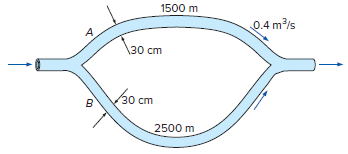
A certain part of cast iron piping of a water distribution system involves a parallel section. Both parallel pipes have a diameter of 30 cm, and the flow is fully turbulent. One of the branches (pipe A) is 1500 m long while the other branch (pipe B) is 2500 m long. If the flow rate through pipe A
Two pipes of identical length and material are connected in parallel. The diameter of pipe A is twice the diameter of pipe B. Assuming the friction factor to be the same in both cases and disregarding minor losses, determine the ratio of the flow rates in the two pipes.
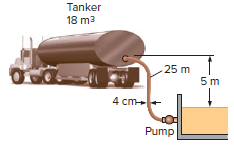
A vented tanker is to be filled with fuel oil with Ï = 920 kg/m3and μ = 0.045 kg/m·s from an underground reservoir using a 25-m-long, 4-cm-diameter plastic hose with a slightly rounded entrance and two 90° smooth bends. The elevation difference between the oil
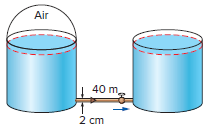
Two water reservoirs A and B are connected to each other through a 40-m-long, 2-cm-diameter cast iron pipe with a sharp-edged entrance. The pipe also involves a swing check valve and a fully open gate valve. The water level in both reservoirs is the same, but reservoir A is pressurized by
A water tank filled with solar-heated water at 40°C is to be used for showers in a field using gravity-driven flow. The system includes 35 m of 1.5-cm-diameter galvanized iron piping with four miter bends (90°) without vanes and a wide-open globe valve. If water is to flow at a rate of 1.2 L/s
Reconsider Prob. 14–78E. Using an appropriate software, investigate the effect of the pipe diameter on the required electric power input to the pump. Let the pipe diameter vary from 1 to 10 in, in increments of 1 in. Tabulate and plot the results and draw conclusions.In Problem.A farmer is to
A farmer is to pump water at 70°F from a river to a water storage tank nearby using a 125-ft-long, 5-in-diameter plastic pipe with three flanged 90° smooth bends. The water velocity near the river surface is 6 ft/s, and the pipe inlet is placed in the river normal to the flow direction of water
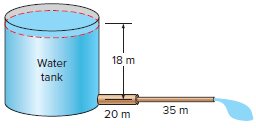
Water at 15°C is drained from a large reservoir using two horizontal plastic pipes connected in series. The first pipe is 20 m long and has a 10-cm diameter, while the second pipe is 35 m long and has a 4-cm diameter. The water level in the reservoir is 18 m above the centerline of the pipe.
Water to a residential area is transported at a rate of 1.5 m3/s via 70-cm-internal-diameter concrete pipes with a surface roughness of 3 mm and a total length of 1500 m. In order to reduce pumping power requirements, it is proposed to line the interior surfaces of the concrete pipe with 2-cm-thick
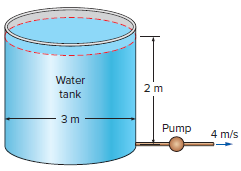
Reconsider Prob. 14€“74. In order to drain the tank faster, a pump is installed near the tank exit as in Fig. P14€“75. Determine how much pump power input is necessary to establish an average water velocity of 4 m/s when the tank is full at z = 2 m. Also, assuming the discharge
A 3-m-diameter tank is initially filled with water 2 m above the center of a sharp-edged 10-cm-diameter orifice. The tank water surface is open to the atmosphere, and the orifice drains to the atmosphere through a 100-m-long pipe. The friction coefficient of the pipe is taken to be 0.015 and the
Consider the flow of air and water in pipes of the same diameter, at the same temperature, and at the same mean velocity. Which flow is more likely to be turbulent? Why?
Consider laminar flow in a circular pipe. Is the wall shear stress τw higher near the inlet of the pipe or near the exit? Why? What would your response be if the flow were turbulent?
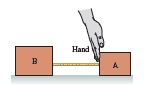
The hand in FIGURE Q7.13 is pushing on the back of block A. Blocks A and B, with mB > mA, are connected by a massless string and slide on a frictionless surface. Is the force of the string on B larger than, smaller than, or equal to the force of the hand on A? Explain. Нand в
What is hydraulic diameter? How is it defined? What is it equal to for a circular pipe of diameter D?
Consider fully developed flow in a circular pipe with negligible entrance effects. If the length of the pipe is doubled, the head loss will (a) Double, (b) More than double, (c) Less than double, (d) Reduce by half, (e) Remain constant.
In fully developed laminar flow in a circular pipe, the velocity at R/2 (midway between the wall surface and the centerline) is measured to be 11 m/s. Determine the velocity at the center of the pipe.
The velocity profile for incompressible turbulent flow in a pipe of radius R is given by u(r) = umax(1 - r/R2)1/7. Obtain an expression for the average velocity in the pipe.
Reconsider Prob. 14–48. Using an appropriate software, investigate the effect of the pipe diameter on the pressure drop for the same constant flow rate. Let the pipe diameter vary from 1 to 10 cm in increments of 1 cm. Tabulate and plot the results and draw conclusions.
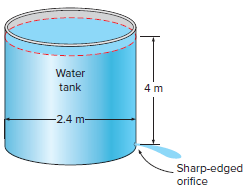
A 2.4-m-diameter tank is initially filled with water 4 m above the center of a sharp-edged 10-cm-diameter orifice. The tank water surface is open to the atmosphere, and the orifice drains to the atmosphere. Neglecting the effect of the kinetic energy correction factor, calculate (a) the initial
Water at 70°F flows by gravity from a large reservoir at a high elevation to a smaller one through a 60-ft-long, 2-in-diameter cast iron piping system that includes four standard flanged elbows, a well-rounded entrance, a sharp-edged exit, and a fully open gate valve. Taking the free surface of
The water needs of a small farm are to be met by pumping water from a well that can supply water continuously at a rate of 4 L/s. The water level in the well is 20 m below the ground level, and water is to be pumped to a large tank on a hill, which is 58 m above the ground level of the well, using
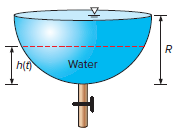
A semi-spherical tank of radius R is completely filled with water. Now a hole of cross sectional area Ah and discharge coefficient Cdat the bottom of the tank is fully opened and water starts to flow out. Develop an expression for the time needed to empty the tank completely. R h(t Water
A 4-m-high cylindrical tank having a cross-sectional area of AT = 1.5 m2 is filled with equal volumes of water and oil whose specific gravity is SG = 0.75. Now a 1-cm-diameter hole at the bottom of the tank is opened, and water starts to flow out. If the discharge coefficient of the hole is Cd =
For a piping system, define the system curve, the characteristic curve, and the operating point on a head versus flow rate chart.
A piping system involves two pipes of identical diameters but of different lengths connected in parallel. How would you compare the pressure drops in these two pipes?
A piping system involves two pipes of different diameters (but of identical length, material, and roughness) connected in series. How would you compare the(a) Flow rates(b) Pressure drops in these two pipes?
Consider two identical 2-m-high open tanks filled with water on top of a 1-m-high table. The discharge valve of one of the tanks is connected to a hose whose other end is left open on the ground while the other tank does not have a hose connected to its discharge valve. Now the discharge valves of
A person filling a bucket with water using a garden hose suddenly remembers that attaching a nozzle to the hose increases the discharge velocity of water and wonders if this increased velocity would decrease the filling time of the bucket. What would happen to the filling time if a nozzle were
A piping system equipped with a pump is operating steadily. Explain how the operating point (the flow rate and the head loss) is established.
Water is pumped from a large lower reservoir to a higher reservoir. Someone claims that if the head loss is negligible, the required pump head is equal to the elevation difference between the free surfaces of the two reservoirs. Do you agree?
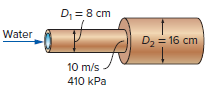
A horizontal pipe has an abrupt expansion from D1= 8 cm to D2= 16 cm. The water velocity in the smaller section is 10 m/s and the flow is turbulent. The pressure in the smaller section is P1= 410 kPa. Taking the kinetic energy correction factor to be 1.06 at both the inlet and the outlet, determine
Repeat Prob. 14??59 for a slightly rounded entrance (KL= 0.12). Repeat Prob. Consider flow from a water reservoir through a circular hole of diameter D at the side wall at a vertical distance H from the free surface. The flow rate through an actual hole with a sharp-edged entrance (KL = 0.5) is
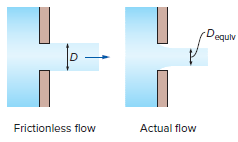
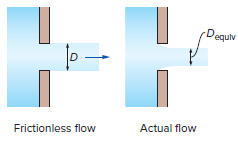
Consider flow from a water reservoir through a circular hole of diameter D at the side wall at a vertical distance H from the free surface. The flow rate through an actual hole with a sharp-edged entrance (KL= 0.5) is considerably less than the flow rate calculated assuming ??frictionless?? flow
Water is to be withdrawn from an 8-m-high water reservoir by drilling a 2.2-cm-diameter hole at the bottom surface. Disregarding the effect of the kinetic energy correction factor, determine the flow rate of water through the hole if (a) The entrance of the hole is well-rounded, (b) The entrance is
What is minor loss in pipe flow? How is the minor loss coefficient KL defined?
A piping system involves sharp turns, and thus large minor head losses. One way of reducing the head loss is to replace the sharp turns by circular elbows. What is another way?
Which has a greater minor loss coefficient during pipe flow: gradual expansion or gradual contraction? Why?
The effect of rounding of a pipe inlet on the loss coefficient is (a) Negligible, (b) Somewhat significant, or (c) Very significant.
Define equivalent length for minor loss in pipe flow. How is it related to the minor loss coefficient?
During a retrofitting project of a fluid flow system to reduce the pumping power, it is proposed to install vanes into the miter elbows or to replace the sharp turns in 90° miter elbows by smooth curved bends. Which approach will result in a greater reduction in pumping power requirements?
Liquid ammonia at - 20°C is flowing through a 20-m-long section of a 5-mm-diameter copper tube at a rate of 0.09 kg/s. Determine the pressure drop, the head loss, and the pumping power required to overcome the frictional losses in the tube.
Oil at 80°F (ρ = 56.8 lbm/ft3 and μ = 0.0278 lbm/ft·s) is flowing steadily in a 0.5-in-diameter, 175-ft-long pipe. During the flow, the pressure at the pipe inlet and exit is measured to be 80 psi and 14 psi, respectively. Determine the flow rate of oil through the pipe assuming the pipe is(a)
Glycerin at 40°C with ρ = 1252 kg/m3 and μ = 0.27 kg/m·s is flowing through a 4-cm-diameter horizontal smooth pipe with an average velocity of 3.5 m/s. Determine the pressure drop per 10 m of the pipe.
In an air heating system, heated air at 40°C and 105 kPa absolute is distributed through a 0.2 m × 0.3 m rectangular duct made of commercial steel at a rate of 0.5 m3/s. Determine the pressure drop and head loss through a 40-m-long section of the duct.
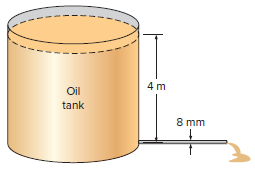
Oil with a density of 850 kg/m3and kinematic viscosity of 0.00062 m2/s is being discharged by a 8-mm-diameter, 40-m-long horizontal pipe from a storage tank open to the atmosphere. The height of the liquid level above the center of the pipe is 4 m. Disregarding the minor losses, determine the flow
Water enters into a cone of height H and base radius R through a small hole of cross-sectional area Ah and the discharge coefficient is Cd at the base with a constant uniform velocity of V. Obtain a relation for the variation of water height h from the cone base with time. Air escapes the cone
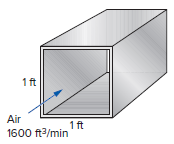
Air at 1 atm and 60?F is flowing through a 1 ft × 1 ft square duct made of commercial steel at a rate of 1600 cfm. Determine the pressure drop and head loss per ft of the duct. 1ft Air 1 ft 1600 ft3/min
Glycerin at 40°C with ρ = 1252 kg/m3 and μ = 0.27 kg/m·s is flowing through a 2-cm-diameter, 25-m-long pipe that discharges into the atmosphere at 100 kPa. The flow rate through the pipe is 0.048 L/s.(a) Determine the absolute pressure 25 m before the pipe exit.(b) At what angle θ must the
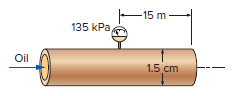
Oil with r = 876 kg/m3and m = 0.24 kg/m?s is flowing through a 1.5-cm-diameter pipe that discharges into the atmosphere at 88 kPa. The absolute pressure 15 m before the exit is measured to be 135 kPa. Determine the flow rate of oil through the pipe if the pipe is (a) Horizontal, (b) Inclined 88
Water at 70°F passes through 0.75-in-internaldiameter copper tubes at a rate of 0.5 lbm/s. Determine the pumping power per ft of pipe length required to maintain this flow at the specified rate.
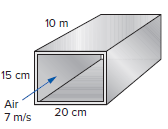
Air enters a 10-m-long section of a rectangular duct of cross section 15 cm × 20 cm made of commercial steel at 1 atm and 35?C at an average velocity of 7 m/s. Disregarding the entrance effects, determine the fan power needed to overcome the pressure losses in this section of the duct. 10 m 15 cm
Repeat Prob. 14–37 for turbulent flow in smooth pipes for which the friction factor is given as f = 0.184Re-0.2. What would your answer be for fully turbulent flow in a rough pipe?
Consider laminar flow of a fluid through a square channel with smooth surfaces. Now the average velocity of the fluid is doubled. Determine the change in the head loss of the fluid. Assume the flow regime remains unchanged.
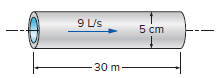
Water at 15°C (r = 999.1 kg/m3and μ = 1.138 × 10⁻³kg/m·s) is flowing steadily in a 30-m-long and 5-cm-diameter horizontal pipe made of stainless steel at a rate of 9 L/s. Determine (a) The pressure drop, (b) The head loss, (c) The pumping power requirement to
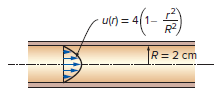
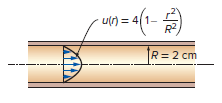
Repeat Prob. 14??34 for a pipe of inner radius 7 cm. Repeat Prob. The velocity profile in fully developed laminar flow in a circular pipe of inner radius R = 2 cm, in m/s, is given by u(r) = 4(1 - r2/R2). Determine the average and maximum velocities in the pipe and the volume flow rate. u(r) =
The velocity profile in fully developed laminar flow in a circular pipe of inner radius R = 2 cm, in m/s, is given by u(r) = 4(1 - r2/R2). Determine the average and maximum velocities in the pipe and the volume flow rate. u(r) = 4(1- uln)= R= 2 cm
Heated air at 1 atm and 100°F is to be transported in a 400-ft-long circular plastic duct at a rate of 12 ft3/s. If the head loss in the pipe is not to exceed 50 ft, determine the minimum diameter of the duct.
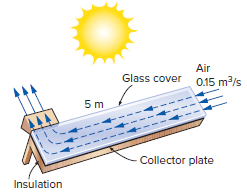
Consider an air solar collector that is 1 m wide and 5 m long and has a constant spacing of 3 cm between the glass cover and the collector plate. Air flows at an average temperature of 45?C at a rate of 0.15 m3/s through the 1-m-wide edge of the collector along the 5-m-long passageway. Disregarding
Water at 10°C (ρ = 999.7 kg/m3 and μ = 1.307 × 10⁻³ kg/m·s) is flowing steadily in a 0.12-cm-diameter, 15-m-long pipe at an average velocity of 0.9 m/s. Determine(a) The pressure drop,(b) The head loss,(c) The pumping power requirement to overcome this pressure drop.
Water flows steadily through a reducing pipe section. The flow upstream with a radius of R1 is laminar with a velocity profile of u1(r) = u01(1 - r2/R21) while the flow downstream is turbulent with a velocity profile of u2(r) = u02(1 - r/R2)1/7. For incompressible flow with R2/R1 = 4/7, determine
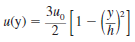
The velocity profile for the fully developed laminar flow of a Newtonian fluid between two large parallel plates is given by where 2h is the distance between the two plates, u0 is the velocity at the center plane, and y is the vertical coordinate from the center plane. For a plate width of b,
Showing 1000 - 1100
of 1421
1
2
3
4
5
6
7
8
9
10
11
12
13
14
15
Step by Step Answers

 Get 50% OFF
Claim Now
Get 50% OFF
Claim Now