New Semester
Started
Get
50% OFF
Study Help!
--h --m --s
Claim Now
Question Answers
Textbooks
Find textbooks, questions and answers
Oops, something went wrong!
Change your search query and then try again
S
Books
FREE
Study Help
Expert Questions
Accounting
General Management
Mathematics
Finance
Organizational Behaviour
Law
Physics
Operating System
Management Leadership
Sociology
Programming
Marketing
Database
Computer Network
Economics
Textbooks Solutions
Accounting
Managerial Accounting
Management Leadership
Cost Accounting
Statistics
Business Law
Corporate Finance
Finance
Economics
Auditing
Tutors
Online Tutors
Find a Tutor
Hire a Tutor
Become a Tutor
AI Tutor
AI Study Planner
NEW
Sell Books
Search
Search
Sign In
Register
study help
physics
fundamentals thermal fluid
Fundamentals of Thermal-Fluid Sciences 5th edition Yunus A. Cengel, Robert H. Turner, John M. Cimbala - Solutions
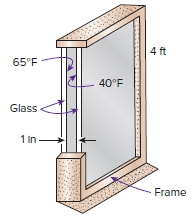
Reconsider Prob. 20€“73E. Using an appropriate software, investigate the effect of the air gap thickness on the rates of heat transfer by natural convection and radiation, and the R-value of insulation. Let the air gap thickness vary from 0.2 in to 2.0 in. Plot the rates of heat transfer
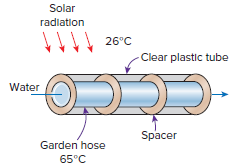
A simple solar collector is built by placing a 5-cmdiameter clear plastic tube around a garden hose whose outer diameter is 1.6 cm. The hose is painted black to maximize solar absorption, and some plastic rings are used to keep the spacing between the hose and the clear plastic cover constant.
Reconsider Prob. 20€“75. Using an appropriate software, plot the rate of heat loss from the water by natural convection as a function of the ambient air temperature as the temperature varies from 4°C to 40°C and discuss the results.Reconsider Prob. 20€“75.A simple solar
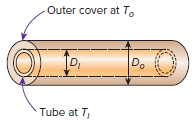
Consider two concentric horizontal cylinders of diameters 55 cm and 65 cm, and length 125 cm. The surfaces of the inner and outer cylinders are maintained at 54°C and 106°C, respectively. Determine the rate of heat transfer between the cylinders by natural convection if the annular space is
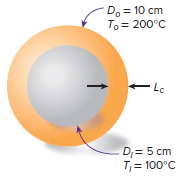
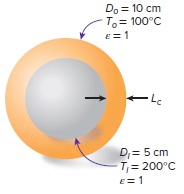
Two concentric spheres with diameters of 5 cm and 10 cm are having the surface temperatures maintained at 100°C and 200°C, respectively. The enclosure between the two concentric spherical surfaces is filled with nitrogen gas at 1 atm. Determine the rate of heat transfer through the
Two concentric spheres of diameters 15 cm and 25 cm are separated by air at 1 atm pressure. The surface temperatures of the two spheres enclosing the air are T1 = 350 K and T2 = 275 K, respectively. Determine the rate of heat transfer from the inner sphere to the outer sphere by natural convection.
Reconsider Prob. 20–79. Using an appropriate software, plot the rate of natural convection heat transfer as a function of the hot surface temperature of the sphere as the temperature varies from 250 K to 450 K and discuss the results.Reconsider Prob. 20–79.Two concentric spheres of diameters 15
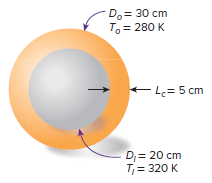
The two concentric spheres of diameters Di= 20 cm and Do= 30 cm are separated by air at 1 atm pressure. The surface temperatures of the two spheres enclosing the air are Ti= 320 K and To= 280 K, respectively. Determine the rate of heat transfer from the inner sphere to the outer sphere by natural
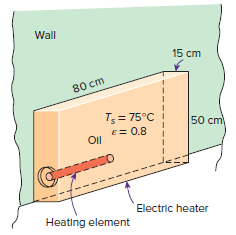
An electric resistance space heater is designed such that it resembles a rectangular box 50 cm high, 80 cm long, and 15 cm wide filled with 45 kg of oil. The heater is to be placed against a wall, and thus heat transfer from its back surface is negligible. The surface temperature of the heater is
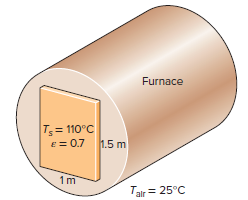
During a plant visit, it was observed that a 1.5-m-high and 1-m-wide section of the vertical front section of a natural gas furnace wall was too hot to touch. The temperature measurements on the surface revealed that the average temperature of the exposed hot surface was 110°C, while the
A plate (0.5 m × 0.5 m) is inclined at an angle of 30°. The top surface of the plate is well insulated. Estimate the rate of heat loss from the plate when the bottom surface is maintained at 60°C and the surrounding atmospheric quiescent air is at 0°C.
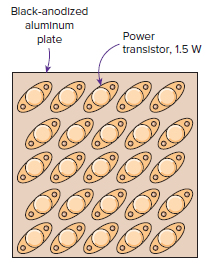
A group of 25 power transistors, dissipating 1.5 W each, are to be cooled by attaching them to a black-anodized square aluminum plate and mounting the plate on the wall of a room at 30°C. The emissivity of the transistor and the plate surfaces is 0.9. Assuming the heat transfer from the back
Repeat Prob. 20€“85 assuming the plate to be positioned horizontally with(a) Transistors facing up(b) Transistors facing down.Repeat Prob. 20€“85A group of 25 power transistors, dissipating 1.5 W each, are to be cooled by attaching them to a black-anodized square aluminum plate
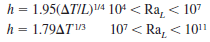
Consider an L × L horizontal plate that is placed in quiescent air with the hot surface facing up. If the film temperature is 20°C and the average Nusselt number in natural convection is of the form Nu = CRanL, show that the average heat transfer coefficient can be expressed as
Consider a flat-plate solar collector placed horizontally on the flat roof of a house. The collector is 1.5 m wide and 4.5 m long, and the average temperature of the exposed surface of the collector is 42°C. Determine the rate of heat loss from the collector by natural convection during a calm day
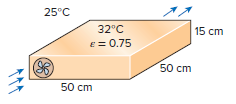
An electronic box that consumes 200 W of power is cooled by a fan blowing air into the box enclosure. The dimensions of the electronic box are 15 cm × 50 cm × 50 cm, and all surfaces of the box are exposed to the ambient except the base surface. Temperature measurements
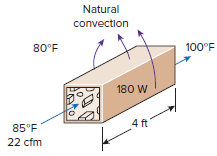
The components of an electronic system dissipating 180 W are located in a 4-ft-long horizontal duct whose cross section is 6 in × 6 in. The components in the duct are cooled by forced air, which enters at 85°F at a rate of 22 cfm and leaves at 100°F. The surfaces of the sheet
Repeat Prob. 20€“90E assuming the fan fails and thus the entire heat generated inside the duct must be rejected to the ambient air by natural convection through the outer surfaces of the duct. Evaluate air properties at a film temperature of 120°F and 1 atm pressure. Is this a good
Repeat Prob. 20€“90E for a circular horizontal duct of diameter 4 in. Evaluate air properties at a film temperature of 115°F and 1 atm pressure. Is this a good assumption?Repeat Prob. 20€“90EThe components of an electronic system dissipating 180 W are located in a 4-ft-long
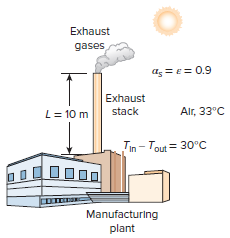
Exhaust gases from a manufacturing plant are being discharged through a 10-m-tall exhaust stack with outer diameter of 1 m. The exhaust gases are discharged at a rate of 0.125 kg/s, while temperature drop between inlet and exit of the exhaust stack is 30°C, and the constant pressure-specific
A 40-cm-diameter, 110-cm-high cylindrical hotwater tank is located in the bathroom of a house maintained at 20°C. The surface temperature of the tank is measured to be 44°C and its emissivity is 0.4. Taking the surrounding surface temperature to be also 20°C, determine the rate of heat loss from
A 10-cm-diameter and 10-m-long cylinder with a surface temperature of 10°C is placed horizontally in air at 40°C. Calculate the steady rate of heat transfer for the cases of(a) Free-stream air velocity of 10 m/s due to normal winds(b) No winds and thus a free stream velocity of zero.
Hot water is flowing at an average velocity of 4 ft/s through a cast iron pipe (k = 30 Btu/h·ft·°F) whose inner and outer diameters are 1.0 in and 1.2 in, respectively. The pipe passes through a 50-ft-long section of a basement whose temperature is 60°F. The emissivity of the outer surface of
A 0.1-W small cylindrical resistor mounted on a lower part of a vertical circuit board is 0.3 in long and has a diameter of 0.2 in. The view of the resistor is largely blocked by another circuit board facing it, and the heat transfer through the connecting wires is negligible. The air is free to
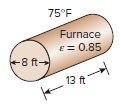
Consider an industrial furnace that resembles a 13-ft-long horizontal cylindrical enclosure 8 ft in diameter whose end surfaces are well insulated. The furnace burns natural gas at a rate of 48 therms/h. The combustion efficiency of the furnace is 82 percent (i.e., 18 percent of the chemical energy
A 6-m-internal-diameter spherical tank made of 1.5-cm-thick stainless steel (k = 15 W/m·K) is used to store iced water at 0°C in a room at 20°C. The walls of the room are also at 20°C. The outer surface of the tank is black (emissivity ε = 1), and heat transfer between the outer surface of the
Consider a 1.2-m-high and 2-m-wide double-pane window consisting of two 3-mm-thick layers of glass (k = 0.78 W/m·K) separated by a 3-cm-wide air space. Determine the steady rate of heat transfer through this window and the temperature of its inner surface for a day during which the room is
A spherical vessel, with 30.0-cm outside diameter, is used as a reactor for a slow endothermic reaction. The vessel is completely submerged in a large water-filled tank, held at a constant temperature of 30°C. The outside surface temperature of the vessel is 20°C. Calculate the rate of heat
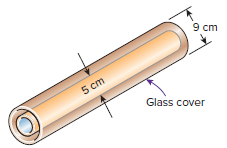
A solar collector consists of a horizontal copper tube of outer diameter 5 cm enclosed in a concentric thin glass tube of 9 cm diameter. Water is heated as it flows through the tube, and the annular space between the copper and glass tube is filled with air at 1 atm pressure. During a clear day,
A solar collector consists of a horizontal aluminum tube of outer diameter 5 cm enclosed in a concentric thin glass tube of 7 cm diameter. Water is heated as it flows through the aluminum tube, and the annular space between the aluminum and glass tubes is filled with air at 1 atm pressure. The pump
Two concentric spheres with diameters of 5 cm and 10 cm are having the surface temperatures maintained at 200°C and 100°C, respectively. The enclosure between the two concentric spherical surfaces is filled with nitrogen gas at 1 atm. If both concentric sphere surfaces are black
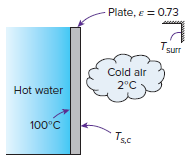
Reconsider Prob. 20€“18. Using an appropriate software, evaluate the effect of the plate thickness on the surface temperature exposed to the cold air. By varying the plate thickness from 0.01 to 0.1 m, plot the plate surface temperature on the cold air side as a function of the plate
A 0.2-m-long and 25-mm-thick vertical plate (k = 1.5 W/mˆ™K) separates the hot water from the cold air at 2°C. The plate surface exposed to the hot water has a temperature of 100°C, and the surface exposed to the cold air has an emissivity of 0.73. Determine the temperature of the
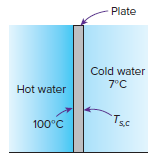
Reconsider Prob. 20€“16. Using an appropriate software, investigate the effect of the plate thermal conductivity on the surface temperature exposed to the cold water. By varying the plate thermal conductivity from 3 to 200 W/mˆ™K, plot the plate surface temperature on the cold
A 0.2-m-long and 25-mm-thick vertical plate (k = 15 W/mˆ™K) separates the hot water from the cold water. The plate surface exposed to the hot water has a temperature of 100°C, and the temperature of the cold water is 7°C. Determine the temperature of the plate surface exposed to
Under what conditions can the outer surface of a vertical cylinder be treated as a vertical plate in natural convection calculations?
Consider laminar natural convection from a vertical hot-plate. Will the heat flux be higher at the top or at the bottom of the plate? Why?
Will a hot horizontal plate whose back side is insulated cool faster or slower when its hot surface is facing down instead of up?
A 10 cm × 10 cm plate has a constant surface temperature of 150°C. Determine the Grashof number if the chip is placed in the following fluids: air (1 atm, 30°C), liquid water (30°C), and engine oil (10°C). Discuss how the Grashof number affects the natural convection flow.
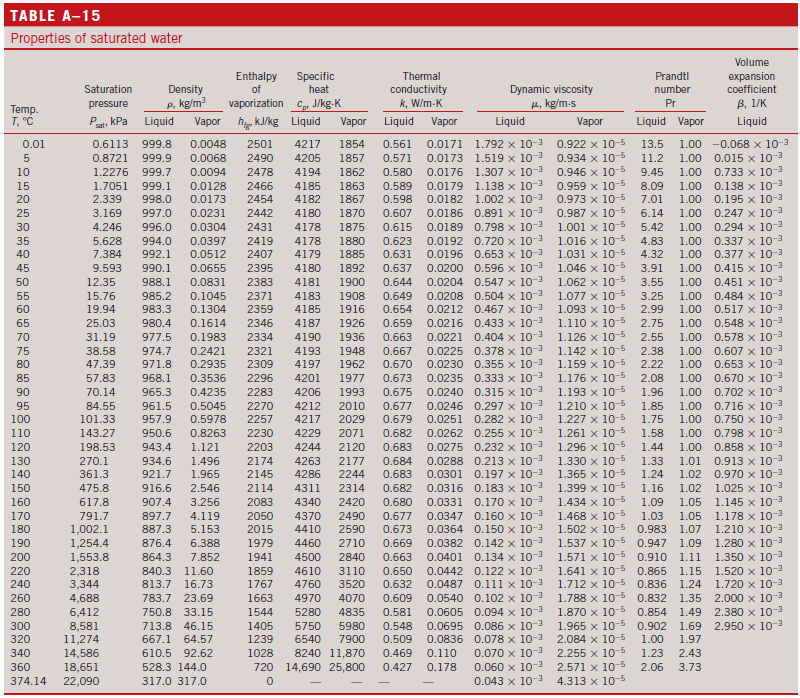
The density of liquid water can be correlated as Ï(T) = 1000-0.0736T-0.00355T2where Ï and T are in kg/m and °C, respectively. Determine the volume expansion coefficient at 70°C. Compare the result with the value tabulated in Table A€“15. TABLE A-15 Properties
Using its definition and the values listed in Table A€“15, determine the volume expression coefficient of saturated liquid water at 70°C. Compare the result with the value tabulated in Table A€“15. TABLE A-15 Properties of saturated water Volume expansion Enthalpy of
Show that the volume expansion coefficient of an ideal gas is β = 1/T, where T is the absolute temperature.
Physically, what does the Grashof number represent? How does the Grashof number differ from the Reynolds number?
Consider two fluids, one with a large coefficient of volume expansion and the other with a small one. In what fluid will a hot surface initiate stronger natural convection currents? Why? Assume the viscosity of the fluids to be the same.
What is buoyancy force? Compare the relative magnitudes of the buoyancy force acting on a body immersed in these mediums:(a) Air,(b) Water,(c) Mercury,(d) An evacuated chamber.
When will the hull of a ship sink in water deeper: when the ship is sailing in fresh water or in seawater? Why?
Consider a hot boiled egg in a spacecraft that is filled with air at atmospheric pressure and temperature at all times. Will the egg cool faster or slower when the spacecraft is in space instead of on the ground? Explain.
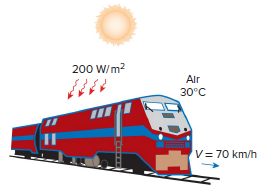
Reconsider Prob. 19€“31. Using an appropriate software, investigate the effects of the train velocity and the rate of absorption of solar radiation on the equilibrium temperature of the top surface of the car. Let the train velocity vary from 10 km/h to 120 km/h and the rate of solar
Consider heat transfer through a windowless wall of a house on a winter day. Discuss the parameters that affect the rate of heat conduction through the wall.
Glycerin is being heated by flowing between two parallel 1-m-wide and 10-m-long plates with 12.5-mm spacing. The glycerin enters the parallel plates with a temperature of 25°C and a mass flow rate of 0.7 kg/s. The plates have a constant surface temperature of 40°C. Determine the outlet mean
In a manufacturing plant that produces cosmetic products, glycerin is being heated by flowing through a 25-mm-diameter and 10-m-long tube. With a mass flow rate of 0.5 kg/s, the flow of glycerin enters the tube at 25°C. The tube surface is maintained at a constant surface temperature of 140°C.
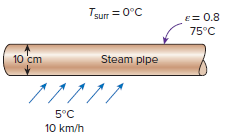
Reconsider Prob. 19€“55. There seems to be some uncertainty about the average temperature of the surfaces surrounding the pipe used in radiation calculations, and you are asked to determine if it makes any significant difference in overall heat transfer. Repeat the calculations for
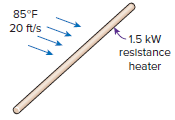
A 12-ft-long, 1.5-kW electrical resistance wire is made of 0.1-in-diameter stainless steel (k = 8.7 Btu/h. ft. °F). The resistance wire operates in an environment at 85°F. Determine the surface temperature of the wire if it is cooled by a fan blowing air at a velocity of 20 ft/s. For
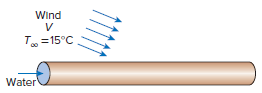
In a geothermal power plant, the used geothermal water at 80°C enters a 15-cm-diameter and 400-m-long uninsulated pipe at a rate of 8.5 kg/s and leaves at 70°C before being reinjected back to the ground. Windy air at 15°C flows normal to the pipe. Disregarding radiation, determine the
Consider laminar flow of air across a hot circular cylinder. At what point on the cylinder will the heat transfer be highest? What would your answer be if the flow were turbulent?
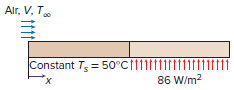
Reconsider Prob. 18€“38. Using an appropriate software, evaluate the local convection heat transfer coefficient, the local surface temperature, and the local film temperature along the plate. By varying the location along the plate for 0.2 ‰¤ x ‰¤ 4 m, plot the
Reconsider Prob. 19€“36. Using an appropriate software, evaluate the local convection heat transfer coefficient, the local surface temperature, and the local film temperature along the plate. By varying the location along the plate for 0.2 ‰¤ x ‰¤ 3 m, plot the
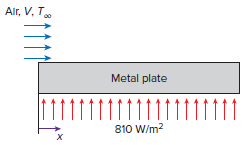
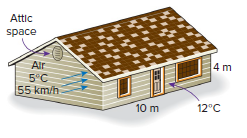
Reconsider Prob. 19€“28. Using an appropriate software, investigate the effects of wind velocity and outside air temperature on the rate of heat loss from the wall by convection. Let the wind velocity vary from 10 km/h to 80 km/h and the outside air temperature from 0°C to 10°C.
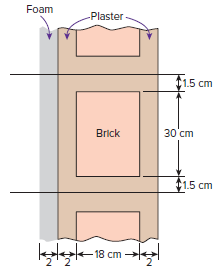
Reconsider Prob. 17€“59. Using an appropriate software, plot the rate of heat transfer through the wall as a function of the thickness of the rigid foam in the range of 1 cm to 10 cm. Discuss the results.Data from 17-59.A 4-m-high and 6-m-wide wall consists of a long 18-cm ×
Reconsider Prob. 16€“47. Using an appropriate software, plot the convection heat transfer coefficient as a function of the wire surface temperature in the range of 100°C to 300°C. Discuss the results.Reconsider Prob. 16€“47.A 2.1-m-long, 0.2-cm-diameter electrical wire
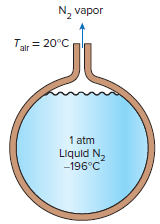
Reconsider Prob. 16€“43. Using an appropriate software, plot the rate of evaporation of liquid nitrogen as a function of the ambient air temperature in the range of 0°C to 40°C. Discuss the results.Reconsider Prob. 16€“43.The boiling temperature of nitrogen at
Repeat Prob. 16€“43 for liquid oxygen, which has a boiling temperature of - 183°C, a heat of vaporization of 213 kJ/kg, and a density of 1140 kg/m3at 1 atm pressure.Repeat Prob. 16€“43The boiling temperature of nitrogen at atmospheric pressure at sea level (1 atm) is
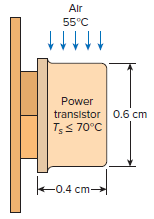
Reconsider Prob. 16€“40. Using an appropriate software, plot the amount of power the transistor can dissipate safely as a function of the maximum case temperature in the range of 60°C to 90°C. Discuss the results.Reconsider Prob.A transistor with a height of 0.4 cm and a diameter
Reconsider Prob. 16–37. Using an appropriate software, plot the rate of heat transfer as a function of the heat transfer coefficient in the range of 20 W/ m2·K to 100 W/m2·K. Discuss the results.Reconsider Prob.Hot air at 80°C is blown over a 2-m × 4-m flat surface at 30°C. If the average
An electric current of 5 A passing through a resistor has a measured voltage of 6 V across the resistor. The resistor is cylindrical with a diameter of 2.5 cm and length of 15 cm. The resistor has a uniform temperature of 90°C and the room air temperature is 20°C. Assuming that heat transfer by
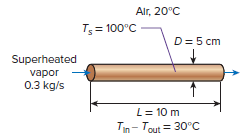
In a power plant, pipes transporting superheated vapor are very common. Superheated vapor is flowing at a rate of 0.3 kg/s inside a pipe with 5 cm in diameter and 10 m in length. The pipe is located in a power plant at 20°C, and has a uniform pipe surface temperature of 100°C. If the
Four power transistors, each dissipating 12 W, are mounted on a thin vertical aluminum plate 22 cm × 22 cm in size. The heat generated by the transistors is to be dissipated by both surfaces of the plate to the surrounding air at 25°C, which is blown over the plate by a fan. The entire plate can
Air at 20°C with a convection heat transfer coefficient of 20 W/m2·K blows over a pond. The surface temperature of the pond is at 40°C. Determine the heat flux between the surface of the pond and the air.
An engineer who is working on the heat transfer analysis of a house in English units needs the convection heat transfer coefficient on the outer surface of the house. But the only value he can find from his handbooks is 22 W/m2·K, which is in SI units. The engineer does not have a direct
The inner and outer glasses of a 4-ft × 4-ft double-pane window are at 60°F and 48°F, respectively. If the 0.25-in. space between the two glasses is filled with still air, determine the rate of heat transfer through the window.
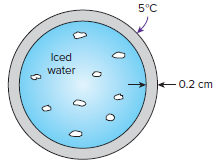
Reconsider Prob. 16€“29. Using an appropriate software, plot the rate at which ice melts as a function of the container thickness in the range of 0.1 cm to 1.0 cm. Discuss the results.Reconsider Prob. 16€“29.A hollow spherical iron container with outer diameter 20 cm and
A hollow spherical iron container with outer diameter 20 cm and thickness 0.2 cm is filled with iced water at 0°C. If the outer surface temperature is 5°C, determine the approximate rate of heat loss from the sphere, in kW, and the rate at which ice melts in the container. The heat of
A concrete wall with a surface area of 20 m2 and a thickness of 0.30 m separates conditioned room air from ambient air. The temperature of the inner surface of the wall (T1) is maintained at 25°C.(a) Determine the heat loss Q (W) through the concrete wall for three thermal conductivity values of
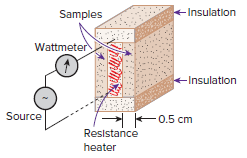
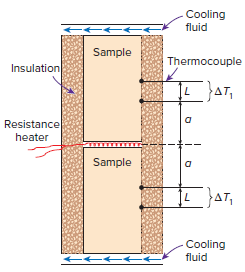
One way of measuring the thermal conductivity of a material is to sandwich an electric thermofoil heater between two identical rectangular samples of the material and to heavily insulate the four outer edges, as shown in the figure. Thermocouples attached to the inner and outer surfaces of the
In a certain experiment, cylindrical samples of diameter 4 cm and length 7 cm are used (see Fig. 16€“9). The two thermocouples in each sample are placed 3 cm apart. After initial transients, the electric heater is observed to draw 0.6 A at 110 V, and both differential thermometers read a
The north wall of an electrically heated home is 20 ft long, 10 ft high, and 1 ft thick, and is made of brick whose thermal conductivity is k = 0.42 Btu/h·ft·°F. On a certain winter night, the temperatures of the inner and the outer surfaces of the wall are measured to be at about 62°F and
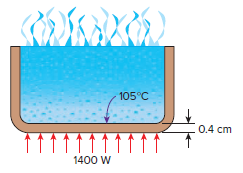
An aluminum pan whose thermal conductivity is 237 W/m·K has a flat bottom with diameter 15 cm and thickness 0.4 cm. Heat is transferred steadily to boiling water in the pan through its bottom at a rate of 1400 W. If the inner surface of the bottom of the pan is at 105°C, determine the
Reconsider Prob. 16€“22. Using an appropriate software, plot the amount of heat loss through the glass as a function of the window glass thickness in the range of 0.1 cm to 1.0 cm. Discuss the results.Reconsider Prob. 16€“22.The inner and outer surfaces of a 4-m ×
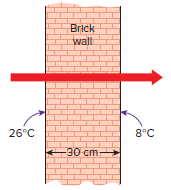
The inner and outer surfaces of a 4-m × 7-m brick wall of thickness 30 cm and thermal conductivity 0.69 W/m·K are maintained at temperatures of 26°C and 8°C, respectively. Determine the rate of heat transfer through the wall, in W. Brick walt 26°C 8°C -30 cm-
A wood slab with a thickness of 0.05 m is subjected to a heat flux of 40 W/m2. The left and right surface temperatures of the wood slab are kept at constant temperatures of 40°C and 20°C, respectively. What is the thermal conductivity of the wood slab?
Consider two walls of a house that are identical except that one is made of 10-cm-thick wood, while the other is made of 25-cm-thick brick. Through which wall will the house lose more heat in winter?
Consider two houses that are identical, except that the walls are built using bricks in one house, and wood in the other. If the walls of the brick house are twice as thick, which house do you think will be more energy efficient?
Consider heat loss through the two walls of a house on a winter night. The walls are identical, except that one of them has a tightly fit glass window. Through which wall will the house lose more heat? Explain.
What is the physical mechanism of heat conduction in a solid, a liquid, and a gas?
How does heat conduction differ from convection?
Write down the expressions for the physical laws that govern each mode of heat transfer, and identify the variables involved in each relation.
What are the mechanisms of heat transfer? How are they distinguished from each other?
Consider an alloy of two metals whose thermal conductivities are k1 and k2. Will the thermal conductivity of the alloy be less than k1, greater than k2, or between k1 and k2?
Why do we characterize the heat conduction ability of insulators in terms of their apparent thermal conductivity instead of the ordinary thermal conductivity?
Why is the thermal conductivity of superinsulation orders of magnitude lower than the thermal conductivity of ordinary insulation?
How do the thermal conductivity of gases and liquids vary with temperature?
Judging from its unit W/m·K, can we define thermal conductivity of a material as the rate of heat transfer through the material per unit thickness per unit temperature difference? Explain.
Define thermal conductivity and explain its significance in heat transfer.
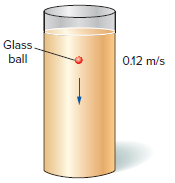
Stokes law can be used to determine the viscosity of a fluid by dropping a spherical object in it and measuring the terminal velocity of the object in that fluid. This can be done by plotting the distance traveled against time and observing when the curve becomes linear. During such an experiment a
Engine oil at 40°C is flowing over a long flat plate with a velocity of 6 m/s. Determine the distance xcr from the leading edge of the plate where the flow becomes turbulent, and calculate and plot the thickness of the boundary layer over a length of 2xcr.
Repeat Prob. 15–99 by considering the more general form of Stokes law expressed as FD = 3πμDV + (9π/16)ρV2D2 where r is the fluid density.Repeat prob.During an experiment, three aluminum balls (ρs = 2600 kg/m3) having diameters 2, 4, and 10 mm, respectively, are dropped into a tank filled
During an experiment, three aluminum balls (ρs = 2600 kg/m3) having diameters 2, 4, and 10 mm, respectively, are dropped into a tank filled with glycerin at 22°C (ρf = 1274 kg/m3 and μ = 1 kg/m·s). The terminal settling velocities of the balls are measured to be 3.2, 12.8, and 60.4 mm/s,
Janie likes to drive with a tennis ball on her car antenna. The ball diameter is D = 2.62 in and its equivalent roughness factor is ε/D = 1.5 × 10⁻³. Her friends tell her she is wasting gas because of the additional drag on the ball. Estimate how much money (in dollars)
A 17,000-kg tractor-trailer rig has a frontal area of 9.2 m2, a drag coefficient of 0.96, a rolling resistance coefficient of 0.05 (multiplying the weight of a vehicle by the rolling resistance coefficient gives the rolling resistance), a bearing friction resistance of 350 N, and a maximum speed of
A 9-cm-diameter smooth sports ball has a velocity of 36 km/h during a typical hit. Determine the percent increase in the drag coefficient if the ball is given a spin of 3500 rpm in air at 1 atm and 25°C.
Showing 400 - 500
of 1421
1
2
3
4
5
6
7
8
9
10
11
12
13
14
15
Step by Step Answers

 Get 50% OFF
Claim Now
Get 50% OFF
Claim Now