New Semester
Started
Get
50% OFF
Study Help!
--h --m --s
Claim Now
Question Answers
Textbooks
Find textbooks, questions and answers
Oops, something went wrong!
Change your search query and then try again
S
Books
FREE
Study Help
Expert Questions
Accounting
General Management
Mathematics
Finance
Organizational Behaviour
Law
Physics
Operating System
Management Leadership
Sociology
Programming
Marketing
Database
Computer Network
Economics
Textbooks Solutions
Accounting
Managerial Accounting
Management Leadership
Cost Accounting
Statistics
Business Law
Corporate Finance
Finance
Economics
Auditing
Tutors
Online Tutors
Find a Tutor
Hire a Tutor
Become a Tutor
AI Tutor
AI Study Planner
NEW
Sell Books
Search
Search
Sign In
Register
study help
physics
physics scientists and engineers
Physics for Scientists and Engineers A Strategic Approach with Modern Physics 4th edition Randall D. Knight - Solutions
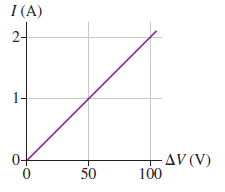
Figure EX27.35 is a current versus- potential-difference graph for a material. What is the material€™s resistance? I (A) 2- 04 AV (V) 100 50
The resistance of a very fine aluminum wire with a 10 μm × 10 μm square cross section is 1000 Ω. A 1000 Ω resistor is made by wrapping this wire in a spiral around a 3.0-mm diameter glass core. How many turns of wire are needed?
Pencil “lead” is actually carbon. What is the current if a 9.0 V potential difference is applied between the ends of a 0.70 mm-diameter, 6.0-cm-long lead from a mechanical pencil?
The femoral artery is the large artery that carries blood to the leg. What is the resistance of a 20-cm-long column of blood in a 1.0-cm-diameter femoral artery? The conductivity of blood is 0.63 Ω-1 m-1.
The terminals of a 0.70 V watch battery are connected by a 100-m-long gold wire with a diameter of 0.10 mm. What is the current in the wire?
a. How long must a 0.60-mm-diameter aluminum wire be to have a 0.50 A current when connected to the terminals of a 1.5 V flashlight battery?b. What is the current if the wire is half this length?
The electric field inside a 30-cm-long copper wire is 5.0 mV/m. What is the potential difference between the ends of the wire?
An engineer cuts a 1.0-m-long, 0.33-mm-diameter piece of wire, connects it across a 1.5 V battery, and finds that the current in the wire is 8.0 A. Of what material is the wire made?
What is the resistance ofa. A 2.0-m-long gold wire that is 0.20 mm in diameter?b. A 10-cm-long piece of carbon with a 1.0 mm × 1.0 mm square cross section?
Wires 1 and 2 are made of the same metal. Wire 2 has twice the length and twice the diameter of wire 1. What are the ratios(a) ρ2/ρ1 of the resistivities(b) R2/R1 of the resistances of the two wires?
A 1.5 V battery provides 0.50 A of current.a. At what rate (C/s) is charge lifted by the charge escalator?b. How much work does the charge escalator do to lift 1.0 C of charge?c. What is the power output of the charge escalator?
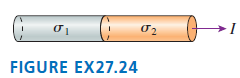
The two segments of the wire in Figure EX27.24 have equal diameters but different conductivities σ1and σ2. Current I passes through this wire. If the conductivities have the ratio σ2/σ1= 2, what is the ratio E2/E1of the electric field strengths in the two
A 0.50-mm-diameter silver wire carries a 20 mA current.What are(a) The electric field(b) The electron drift speed in the wire?
What is the mean time between collisions for electrons in(a) An aluminum wire(b) An iron wire?
A car battery is rated at 90 A h, meaning that it can supply a 90 A current for 1 h before being completely discharged. If you leave your headlights on until the battery is completely dead, how much charge leaves the battery?
A hollow copper wire with an inner diameter of 1.0 mm and an outer diameter of 2.0 mm carries a current of 10 A. What is the current density in the wire?
The current in a 2.0 mm × 2.0 mm square aluminum wire is 2.5 A. What are(a) The current density(b) The electron drift speed?
When a nerve cell fires, charge is transferred across the cell membrane to change the cell’s potential from negative to positive.For a typical nerve cell, 9.0 pC of charge flows in a time of 0.50 ms. What is the average current through the cell membrane?
The current in an electric hair dryer is 10.0 A. How many electrons flow through the hair dryer in 5.0 min?
Which, if any, of these statements are true? (More than one may be true.) Explain. Assume the batteries are ideal.a. A battery supplies the energy to a circuit.b. A battery is a source of potential difference; the potential difference between the terminals of the battery is always the same.c. A
In an integrated circuit, the current density in a 2.5-μm-thick × 75-μm-wide gold film is 7.5 × 10⁵ A/m2. How much charge flows through the film in 15 min?
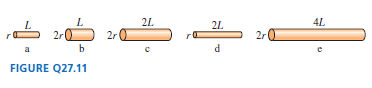
The wires in Figure Q27.11 are all made of the same material.Rank in order, from largest to smallest, the resistances Rato Reof these wires. Explain. 2L 2r 4L 2L 2r 2r FIGURE Q27.11
The current in a 100 watt lightbulb is 0.85 A. The filament inside the bulb is 0.25 mm in diameter.a. What is the current density in the filament?b. What is the electron current in the filament?
The current in a wire is doubled. What happens to(a) The current density,(b) The conduction-electron density,(c) The mean time between collisions,(d) The electron drift speed? Are each of these doubled, halved, or unchanged? Explain.
The wires leading to and from a 0.12-mm-diameter lightbulb filament are 1.5 mm in diameter. The wire to the filament carries a current with a current density of 4.5 × 10⁵ A/m2. What are(a) The current(b) The current density in the filament?
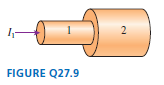
The wire in Figure Q27.9 consists of two segments of different diameters but made from the same metal. The current in segment 1 is I1.a. Compare the currents in the two segments. That is, is I2 greater than, less than, or equal to I1? Explain.b. Compare the current densities J1 and J2 in the two
The mean time between collisions in iron is 4.2 × 10⁻¹⁵ s.What electron current is driven through a 1.8-mm-diameter iron wire by a 0.065 V/m electric field?
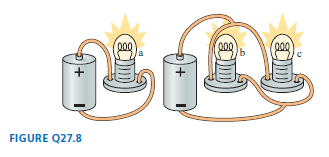
Both batteries in Figure Q27.8 are ideal and identical, and all lightbulbs are the same. Rank in order, from brightest to least bright, the brightness of bulbs a to c. Explain. 00 Q00 000 FIGURE Q27.8
A 2.0 × 10⁻³ V/m electric field creates a 3.5 × 10¹⁷ electrons/s current in a 1.0-mm-diameter aluminum wire. What are(a) The drift speed(b) The mean time between collisions for electrons in this wire?
The electron drift speed is 2.0 × 10⁻⁴ m/s in a metal with a mean time between collisions of 5.0 × 10⁻¹⁴ s. What is the electric field strength?
1.0 × 10¹⁶ electrons flow through a cross section of a silver wire in 320 μs with a drift speed of 8.0 × 10⁻⁴ m/s. What is the diameter of the wire?
1.0 × 10²⁰ electrons flow through a cross section of a 2.0 mm-diameter iron wire in 5.0 s. What is the electron drift speed?
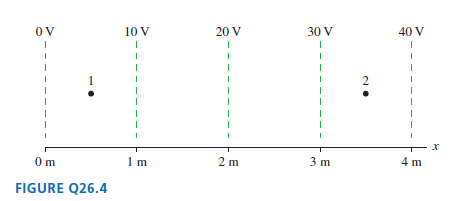
Estimate the electric fields E1and E2at points 1 and 2 in Figure Q26.4. Don€™t forget that E is a vector. ov OV 10 V 20 V 30 V 40 V 2 m 0m 4 m FIGURE Q26.4
a. Suppose that E = 0 V/m throughout some region of space. Can you conclude that V = 0 V in this region? Explain.b. Suppose that V = 0 V throughout some region of space. Can you conclude that E = 0 V/m in this region? Explain.
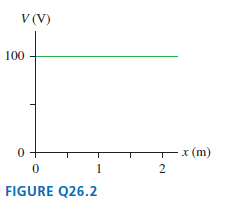
Figure Q26.2 shows the electric potential as a function of x. Draw a graph of Exversus x in this same region of space. V (V) 100 x (m) FIGURE Q26.2
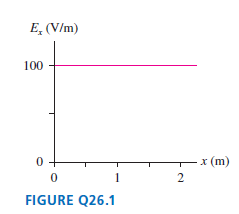
Figure Q26.1 shows the x-component of E as a function of x.Draw a graph of V versus x in this same region of space. Let V = 0 V at x = 0 m and include an appropriate vertical scale. E, (V/m) 100 - x (m) FIGURE Q26.1
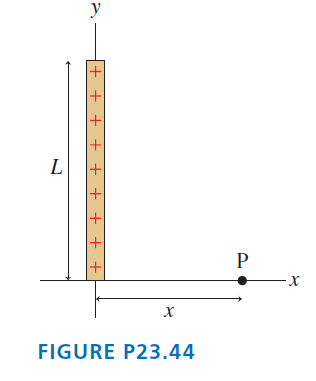
FIGURE P23.44 shows a thin rod of length L with total charge Q. Find an expression for the electric field E at point P. Give your answer in component form. P х FIGURE P23.44 + + + + + + + + +
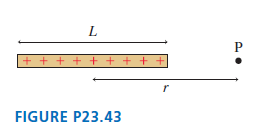
FIGURE P23.43 shows a thin rod of length L with total charge Q. a. Find an expression for the electric field strength at point P on the axis of the rod at distance r from the center.b. Verify that your expression has the expected behavior if r >> L.c. Evaluate E at r = 3.0 cm if L = 5.0 cm
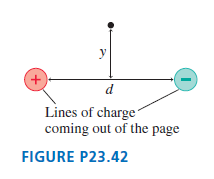
FIGURE P23.42 is a cross section of two infinite lines of charge that extend out of the page. The linear charge densities are ±Î».Find an expression for the electric field strength E at height y above the midpoint between the lines. y +. Lines of charge coming out of the page
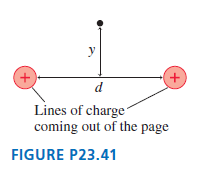
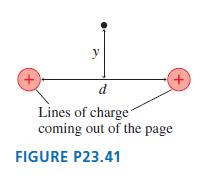
FIGURE P23.41 is a cross section of two infinite lines of charge that extend out of the page. Both have linear charge density λ.Find an expression for the electric field strength E at height y above the midpoint between the lines. y Lines of charge coming out of the page FIGURE P23.41
Derive Equation 23.11 for the field Edipole in the plane that bisects an electric dipole. y Lines of charge coming out of the page FIGURE P23.41
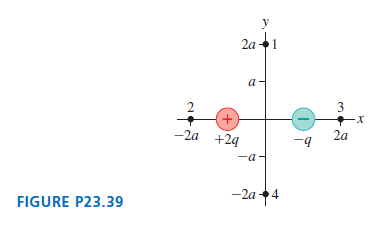
Charges -q and +2q in FIGURE P23.39 are located at x = ±a. Determine the electric field at points 1 to 4. Write each field in component form. y 2a +1 2 3 х -2a +29 2a -a- -2a +4 FIGURE P23.39
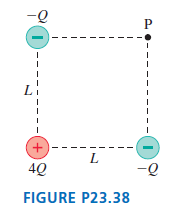
FIGURE P23.38 shows three charges at the corners of a square. Write the electric field at point P in component form. -Q FIGURE P23.38 PO-
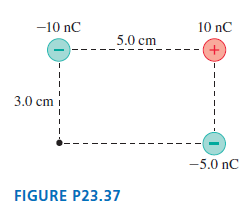
What are the strength and direction of the electric field at the position indicated by the dot in FIGURE P23.37? Give your answer (a) In component form. (b) As a magnitude and angle measured cw or ccw (specify which) from the positive x-axis. -10 nC 10 nC 5.0 cm 3.0 cm i -5.0 nC FIGURE P23.37
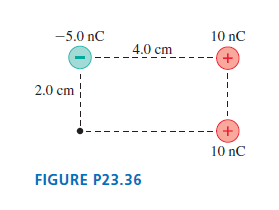
What are the strength and direction of the electric field at the position indicated by the dot in FIGURE P23.36? Give your answer (a) In component form. (b) As a magnitude and angle measured cw or ccw (specify which) from the positive x-axis. -5.0 nC 10 nC 4.0 cm 2.0 cm 10 nC FIGURE P23.36
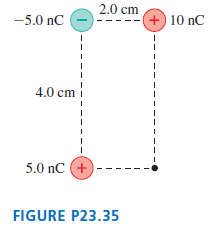
What are the strength and direction of the electric field at the position indicated by the dot in FIGURE P23.35? Give your answer(a) In component form.(b) As a magnitude and angle measured cw or ccw (specify which) from the positive x-axis. 2.0 cm + 10 nC -5.0 nC 4.0 cm i 5.0 nC (+ FIGURE P23.35
An ammonia molecule (NH3) has a permanent electric dipole moment 5.0 × 10⁻³⁰ C m. A proton is 2.0 nm from the molecule in the plane that bisects the dipole. What is the electric force of the molecule on the proton?
A point charge Q is distance r from a dipole consisting of charges ±q separated by distance s. The dipole is initially oriented so that Q is in the plane bisecting the dipole. Immediately after the dipole is released, what are(a) The magnitude of the force(b) The magnitude of the torque on the
The permanent electric dipole moment of the water molecule (H2O) is 6.2 × 10⁻³⁰ C m. What is the maximum possible torque on a water molecule in a 5.0 × 10⁸ N/C electric field?
A 1.0-μm-diameter oil droplet (density 900 kg/m3) is negatively charged with the addition of 25 extra electrons. It is released from rest 2.0 mm from a very wide plane of positive charge, after which it accelerates toward the plane and collides with a speed of 3.5 m/s. What is the surface charge
An electron in a vacuum chamber is fired with a speed of 8300 km/s toward a large, uniformly charged plate 75 cm away.The electron reaches a closest distance of 15 cm before being repelled. What is the plate’s surface charge density?
The surface charge density on an infinite charged plane is -2.0 × 10⁻⁶ C/m2. A proton is shot straight away from the plane at 2.0 × 10⁶ m/s. How far does the proton travel before reaching its turning point?
An electron traveling parallel to a uniform electric field increases its speed from 2.0 × 10⁷ m/s to 4.0 × 10⁷ m/s over a distance of 1.2 cm. What is the electric field strength?
Honeybees acquire a charge while flying due to friction with the air. A 100 mg bee with a charge of +23 pC experiences an electric force in the earth’s electric field, which is typically 100 N/C, directed downward.a. What is the ratio of the electric force on the bee to the bee’s weight?b. What
A hollow cylindrical shell of length L and radius R has charge Q uniformly distributed along its length. What is the electric potential at the center of the cylinder?
A thin rod of length L and total charge Q has the nonuniform linear charge distribution λ(x) = λ0 x/L, where x is measured from the rod’s left end.a. What is λ0 in terms of Q and L?b. What is the electric potential on the axis at distance d left of the rod’s left end?
Two 2.0-mm-diameter beads, C and D, are 10 mm apart, measured between their centers. Bead C has mass 1.0 g and charge 2.0 nC. Bead D has mass 2.0 g and charge -1.0 nC. If the beads are released from rest, what are the speeds vC and vD at the instant the beads collide?
Bead A has a mass of 15 g and a charge of -5.0 nC. Bead B has a mass of 25 g and a charge of -10.0 nC. The beads are held 12 cm apart (measured between their centers) and released. What maximum speed is achieved by each bead?
A proton and an alpha particle (q = +2e, m = 4 u) are fired directly toward each other from far away, each with an initial speed of 0.010c. What is their distance of closest approach, as measured between their centers?
An electric dipole consists of 1.0 g spheres charged to ±2.0 nC at the ends of a 10-cm-long massless rod. The dipole rotates on a frictionless pivot at its center. The dipole is held perpendicular to a uniform electric field with field strength 1000 V/m, then released. What is the dipole’s
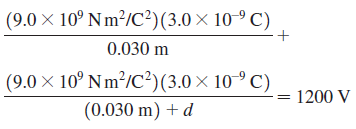
You are given the equation(s) used to solve a problem. For each of these,a. Write a realistic problem for which this is the correct equation(s).b. Finish the solution of the problem. (9.0 × 10° Nm²/C²)(3.0× 10-º C) 0.030 m (9.0 × 10° Nm/C²)(3.0× 10° C) (0.030 m) + d 1200 V
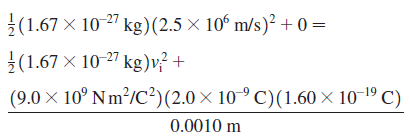
You are given the equation(s) used to solve a problem. For each of these,a. Write a realistic problem for which this is the correct equation(s).b. Finish the solution of the problem. (1.67 X 10⁻²⁷ kg)(2.5 × 10° m/s)² + 0 = |(1.67 x 10⁻²⁷ kg)v? + (9.0 × 10° Nm²/C²)(2.0× 10° C)(1.60 ×
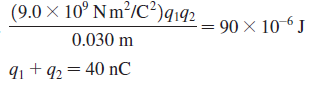
You are given the equation(s) used to solve a problem. For each of these,a. Write a realistic problem for which this is the correct equation(s).b. Finish the solution of the problem. (9.0 × 10° Nm²/C²)qıq2 = 90 × 10-6 J 0.030 m 91+q2 = 40 nC
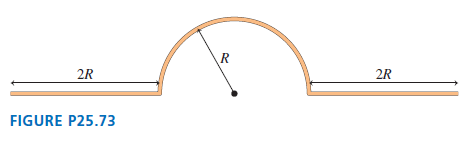
The wire in FIGURE P25.73 has linear charge density λ. What is the electric potential at the center of the semicircle? 2R 2R FIGURE P25.73
A disk with a hole has inner radius Rin and outer radius Rout.The disk is uniformly charged with total charge Q. Find an expression for the on-axis electric potential at distance z from the center of the disk. Verify that your expression has the correct behavior when Rin → 0.
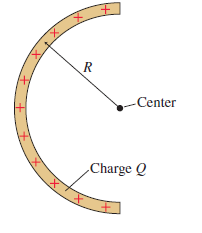
FIGURE P25.71 shows a thin rod with charge Q that has been bent into a semicircle of radius R. Find an expression for the electric potential at the center. Center Charge Q
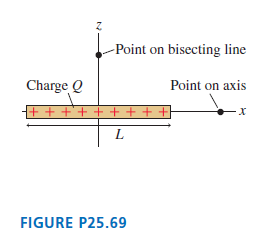
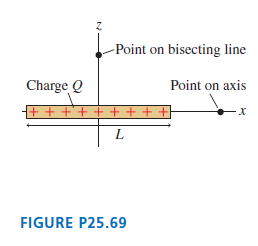
FIGURE P25.69 shows a thin rod of length L and charge Q. Find an expression for the electric potential a distance z away from the center of rod on the line that bisects the rod. -Point on bisecting line Charge Q Point on axis ++ + + + + L FIGURE P25.69
FIGURE P25.69 shows a thin rod of length L and charge Q. Find an expression for the electric potential a distance x away from the center of the rod on the axis of the rod. -Point on bisecting line Point on axis Charge Q + + +} +++'+ + + FIGURE P25.69
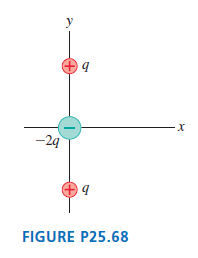
The arrangement of charges shown in FIGURE P25.68 is called a linear electric quadrupole. The positive charges are located at y = ±s. Notice that the net charge is zero. Find an expression for the electric potential on the y-axis at distances y W s. Give your answer in terms of the
Two positive point charges q are located on the y-axis at y = ±1/2s.a. Find an expression for the potential along the x-axis.b. Draw a graph of V versus x for - ∞ < x < ∞ . For comparison, use a dotted line to show the potential of a point charge 2q located at the origin.
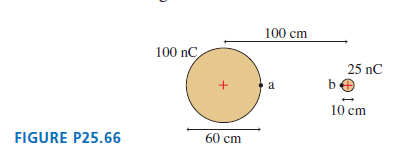
FIGURE P25.66 shows two uniformly charged spheres. What is the potential difference between points a and b? Which point is at the higher potential? 100 cm 100 nC 25 nC a b e 10 cm FIGURE P25.66 60 cm
A Van de Graaff generator is a device for generating a large electric potential by building up charge on a hollow metal sphere. A typical classroom-demonstration model has a diameter of 30 cm.a. How much charge is needed on the sphere for its potential to be 500,000 V?b. What is the electric field
Two spherical drops of mercury each have a charge of 0.10 nC and a potential of 300 V at the surface. The two drops merge to form a single drop. What is the potential at the surface of the new drop?
a. Find an algebraic expression for the electric field strength E0 at the surface of a charged sphere in terms of the sphere’s potential V0 and radius R.b. What is the electric field strength at the surface of a 1.0-cm-diameter marble charged to 500 V?
Electrodes of area A are spaced distance d apart to form a parallel-plate capacitor. The electrodes are charged to ±q.a. What is the infinitesimal increase in electric potential energy dU if an infinitesimal amount of charge dq is moved from the negative electrode to the positive electrode?b. An
Two 10-cm-diameter electrodes 0.50 cm apart form a parallelplate capacitor. The electrodes are attached by metal wires to the terminals of a 15 V battery. What are the charge on each electrode, the electric field strength inside the capacitor, and the potential difference between the
Two 10-cm-diameter electrodes 0.50 cm apart form a parallelplate capacitor. The electrodes are attached by metal wires to the terminals of a 15 V battery. After a long time, the capacitor is disconnected from the battery but is not discharged. What are the charge on each electrode, the electric
One form of nuclear radiation, beta decay, occurs when a neutron changes into a proton, an electron, and a neutral particle called a neutrino: n → p+ + e- + ν where ν is the symbol for a neutrino. When this change happens to a neutron within the nucleus of an atom, the proton remains behind in
In the form of radioactive decay known as alpha decay, an unstable nucleus emits a helium-atom nucleus, which is called an alpha particle. An alpha particle contains two protons and two neutrons, thus having mass m = 4 u and charge q = 2e. Suppose a uranium nucleus with 92 protons decays into
A proton is fired from far away toward the nucleus of a mercury atom. Mercury is element number 80, and the diameter of the nucleus is 14.0 fm. If the proton is fired at a speed of 4.0 × 10⁷ m/s, what is its closest approach to the surface of the nucleus? Assume the nucleus remains at rest.
A proton is fired from far away toward the nucleus of an iron atom. Iron is element number 26, and the diameter of the nucleus is 9.0 fm. What initial speed does the proton need to just reach the surface of the nucleus? Assume the nucleus remains at rest.
Your lab assignment for the week is to measure the amount of charge on the 6.0-cm-diameter metal sphere of a Van de Graaff generator. To do so, you’re going to use a spring with spring constant 0.65 N/m to launch a small, 1.5 g bead horizontally toward the sphere. You can reliably charge the bead
A 2.0-mm-diameter glass bead is positively charged. The potential difference between a point 2.0 mm from the bead and a point 4.0 mm from the bead is 500 V. What is the charge on the bead?
Three electrons form an equilateral triangle 1.0 nm on each side. A proton is at the center of the triangle. What is the potential energy of this group of charges?
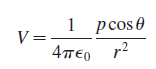
An electric dipole has dipole moment p. If r >> s, where s is the separation between the charges, show that the electric potential of the dipole can be writtenwhere r is the distance from the center of the dipole and u is the angle from the dipole axis. pcos0 V= 4πεο
What is the escape speed of an electron launched from the surface of a 1.0-cm-diameter glass sphere that has been charged to 10 nC?
Two 2.0 g plastic buttons each with +50 nC of charge are placed on a frictionless surface 2.0 cm (measured between centers) on either side of a 5.0 g button charged to +250 nC. All three are released simultaneously.a. How many interactions are there that have a potential energy?b. What is the final
A group of science and engineering students embarks on a quest to make an electrostatic projectile launcher. For their first trial, a horizontal, frictionless surface is positioned next to the 12-cm-diameter sphere of a Van de Graaff generator, and a small, 5.0 g plastic cube is placed on the
A room with 3.0-m-high ceilings has a metal plate on the floor with V = 0 V and a separate metal plate on the ceiling. A 1.0 g glass ball charged to +4.9 nC is shot straight up at 5.0 m/s. How high does the ball go if the ceiling voltage is(a) +3.0 × 10⁶ V(b) -3.0 × 10⁶ V?
The electron gun in an old TV picture tube accelerates electrons between two parallel plates 1.2 cm apart with a 25 kV potential difference between them. The electrons enter through a small hole in the negative plate, accelerate, then exit through a small hole in the positive plate. Assume that the
A proton moves along the x-axis where some arrangement of charges has produced the potential V(x) = V0sin(2πx/λ, where V0 = 5000 V and λ = 1.0 mm.a. What minimum speed must the proton have at x = 0 to move down the axis without being reflected?b. What is the maximum speed reached by a proton
An arrangement of source charges produces the electric potential V = 5000x2 along the x-axis, where V is in volts and x is in meters.What is the maximum speed of a 1.0 g, 10 nC charged particle that moves in this potential with turning points at ±8.0 cm?
Living cells “pump” singly ionized sodium ions, Na+, from the inside of the cell to the outside to maintain a membrane potential ΔVmembrane = Vin - Vout = - 70 mV. It is called pumping because work must be done to move a positive ion from the negative inside of the cell to the
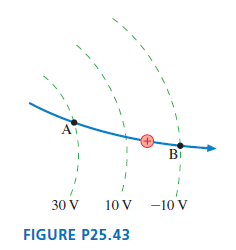
A proton€™s speed as it passes point A is 50,000 m/s. It follows the trajectory shown in FIGURE P25.43. What is the proton€™s speed at point B? BI -10 V 30 V 10 V FIGURE P25.43
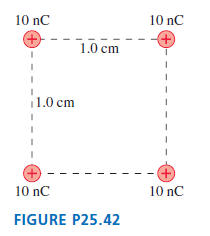
The four 1.0 g spheres shown in FIGURE P25.42 are released simultaneously and allowed to move away from each other. What is the speed of each sphere when they are very far apart? 10 nC 10 nC 1.0 cm 11.0 cm 10 nC 10 nC FIGURE P25.42
Two small metal cubes with masses 2.0 g and 4.0 g are tied together by a 5.0-cm-long massless string and are at rest on a frictionless surface. Each is charged to +2.0 μC.a. What is the energy of this system?b. What is the tension in the string?c. The string is cut. What is the speed of each cube
A -3.0 nC charge is on the x-axis at x = -9 cm and a +4.0 nC charge is on the x-axis at x = 16 cm. At what point or points on the y-axis is the electric potential zero?
A +3.0 nC charge is at x = 0 cm and a -1.0 nC charge is at x = 4 cm. At what point or points on the x-axis is the electric potential zero?
A -10.0 nC point charge and a +20.0 nC point charge are 15.0 cm apart on the x-axis.a. What is the electric potential at the point on the x-axis where the electric field is zero?b. What is the magnitude of the electric field at the point on the x-axis, between the charges, where the electric
Two point charges 2.0 cm apart have an electric potential energy -180 μJ. The total charge is 30 nC. What are the two charges?
Showing 1700 - 1800
of 3693
First
11
12
13
14
15
16
17
18
19
20
21
22
23
24
25
Last
Step by Step Answers

 Get 50% OFF
Claim Now
Get 50% OFF
Claim Now