New Semester
Started
Get
50% OFF
Study Help!
--h --m --s
Claim Now
Question Answers
Textbooks
Find textbooks, questions and answers
Oops, something went wrong!
Change your search query and then try again
S
Books
FREE
Study Help
Expert Questions
Accounting
General Management
Mathematics
Finance
Organizational Behaviour
Law
Physics
Operating System
Management Leadership
Sociology
Programming
Marketing
Database
Computer Network
Economics
Textbooks Solutions
Accounting
Managerial Accounting
Management Leadership
Cost Accounting
Statistics
Business Law
Corporate Finance
Finance
Economics
Auditing
Tutors
Online Tutors
Find a Tutor
Hire a Tutor
Become a Tutor
AI Tutor
AI Study Planner
NEW
Sell Books
Search
Search
Sign In
Register
study help
physics
physics scientists and engineers
Physics for Scientists and Engineers A Strategic Approach with Modern Physics 4th edition Randall D. Knight - Solutions
The voltage across the terminals of a 9.0 V battery is 8.5 V when the battery is connected to a 20 Ω load. What is the battery’s internal resistance?
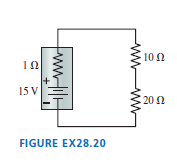
Compared to an ideal battery, by what percentage does the battery??s internal resistance reduce the potential difference across the 20 Ω resistor in FIGURE EX28.20? 10 N 10 15 V 20 Ω FIGURE EX28.20
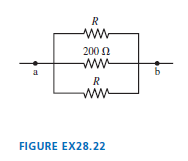
Two of the three resistors in FIGURE EX28.22 are unknown but equal. The total resistance between points a and b is 75 Ω. What is the value of R? R ww- 200 Ω ww a R ww FIGURE EX28.22
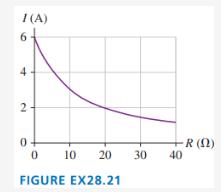
A variable resistor R is connected across the terminals of a battery. FIGURE EX28.21 shows the current in the circuit as R is varied. What are the emf and internal resistance of the battery? I (A) 6- 4 2. 20 30 +R() 40 10 FIGURE EX28.21
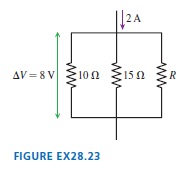
What is the value of resistor R in FIGURE EX28.23? 2A AV = 8 V 10n :150 R FIGURE EX28.23
A metal wire of resistance R is cut into two pieces of equal length. The two pieces are connected together side by side. What is the resistance of the two connected wires?
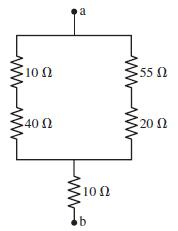
What is the equivalent resistance between points a and b in FIGURE EX28.26? 10 55 Ω 40 N 200 10Ω FIGURE EX28.26 ww
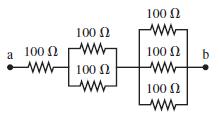
What is the equivalent resistance between points a and b in FIGURE EX28.27? 100 Ω 100 Ω ww 100 n WW ww- ww 100 0 b -ww a 100 N Lww 100 N ww FIGURE EX28.27
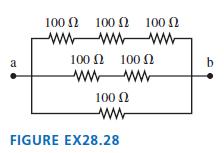
What is the equivalent resistance between points a and b in FIGURE EX28.28? In Figure EX 28.28 100 Ω 100 Ω 100 Ω wwwwww 100 Ω 100 Ω b wwww 100 N ww FIGURE EX28.28
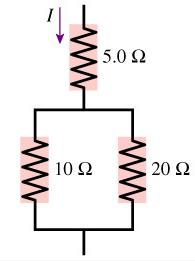
The 10 Ω resistor in the figure is dissipating 40 W of power. (Figure 1) How much power is the 20Ω resistor dissipating? 10 0 50 ww- FIGURE EX28.29 20 1
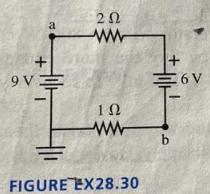
In FIGURE EX28.30, what is the value of the potential at points a and b? 20 ww 9 V 6V b FIGURE EX28.30
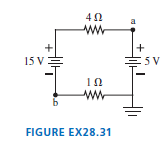
In FIGURE EX28.31, what is the value of the potential at points a and b? + 15 V E5V FIGURE EX28.31
Show that the product RC has units of s.
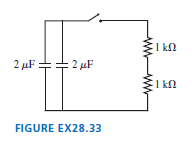
What is the time constant for the discharge of the capacitors in FIGURE EX28.33? 1 kn 2 µF 2 µF 1 kN FIGURE EX28.33
A lightbulb is in series with a 2.0 Ω resistor. The lightbulb dissipates 10 W when this series circuit is connected to a 9.0 V battery. What is the current through the lightbulb? There are two possible answers; give both of them.
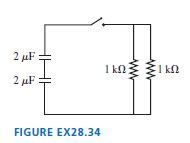
What is the time constant for the discharge of the capacitors in FIGURE EX28.34? 2 µF 1 kn kn 2 µF FIGURE EX28.34
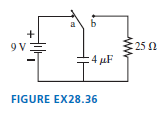
The switch in FIGURE EX28.36 has been in position a for a long time. It is changed to position b at t = 0 s. What are the charge Q on the capacitor and the current I through the resistor (a) Immediately after the switch is closed? (b) At t = 50 μs? (c) At t = 200 μs? a b + 9 V :25 4 µF FIGURE
A 10 μF capacitor initially charged to 20 μC is discharged through a 1.0 kΩ resistor. How long does it take to reduce the capacitor’s charge to 10 μC?
What value resistor will discharge a 1.0 μF capacitor to 10% of its initial charge in 2.0 ms?
A capacitor is discharged through a 100 Ω resistor. The discharge current decreases to 25% of its initial value in 2.5 ms.What is the value of the capacitor?
It seems hard to justify spending $4.00 for a compact fluorescent lightbulb when an ordinary incandescent bulb costs 50¢. To see if this makes sense, compare a 60 W incandescent bulb lasting 1000 hours to a 15 W compact fluorescent bulb having a lifetime of 10,000 hours. Both bulbs produce the
A refrigerator has a 1000 W compressor, but the compressor runs only 20% of the time.If electricity costs $0.10/kWh, what is the monthly (30 day) cost of running the refrigerator?
Two 75 W (120 V) lightbulbs are wired in series, then the combination is connected to a 120 V supply. How much power is dissipated by each bulb?
An electric eel develops a 450 V potential difference between its head and tail. The eel can stun a fish or other prey by using this potential difference to drive a 0.80 A current pulse for 1.0 ms. What are(a) The energy delivered by this pulse(b) The total charge that flows?
You have a 2.0 Ω resistor, a 3.0 Ω resistor, a 6.0 Ω resistor, and a 6.0 V battery. Draw a diagram of a circuit in which all three resistors are used and the battery delivers 9.0 W of power.
A 2.0-m-long, 1.0-mm-diameter wire has a variable resistivity given by where x is measured from one end of the wire. What is the current if this wire is connected to the terminals of a 9.0 V battery? Р(х) — (2.5 х 10 1+ 1.0 m %3D
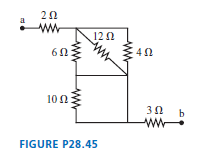
What is the equivalent resistance between points a and b in FIGURE P28.45? 20 a 12Ω 69 10 0 30 FIGURE P28.45
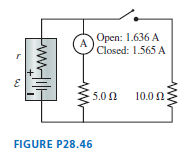
What are the emf and internal resistance of the battery in FIGURE P28.46? Open: 1.636 A A Closed: 1.565 A 50Ω 100Ω FIGURE P28.46
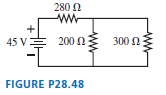
The circuit shown in FIGURE P28.48 is inside a 15-cm diameter balloon filled with helium that is kept at a constant pressure of 1.2 atm.How long will it take the balloon??s diameter to increase to 16 cm? 280 Ω -ww 45 V 200 Ω 300 0 FIGURE P28.48
A string of holiday lights can be wired in series, but all the bulbs go out if one burns out because that breaks the circuit. Most lights today are wired in series, but each bulb has a special fuse that short-circuits the bulb—making a connection around it—if it burns out, thus keeping the
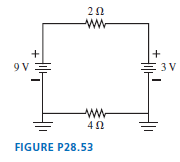
What is the current in the 2 Ω resistor in FIGURE P28.53? 20 9V 3 E 3 V FIGURE P28.53
Suppose you have resistors 2.5 kΩ, 3.5 kΩ, and 4.5 kΩ and a 100 V power supply. What is the ratio of the total power delivered to the resistors if they are connected in parallel to the total power delivered if they are connected in series?
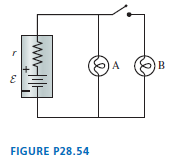
For an ideal battery (r = 0 Ω), closing the switch in FIGURE P28.54 does not affect the brightness of bulb A. In practice, bulb A dims just a little when the switch closes. To see why, assume that the 1.50 V battery has an internal resistance r = 0.50 Ω and that the resistance of a glowing bulb
a. Load resistor R is attached to a battery of emf Ԑ and internal resistance r. For what value of the resistance R, in terms of Ԑ and r, will the power dissipated by the load resistor be a maximum?b. What is the maximum power that the load can dissipate if the battery has Ԑ = 9.0 V and r = 1.0
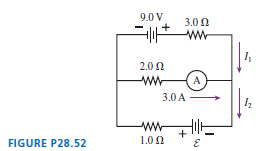
The ammeter in FIGURE P28.52 reads 3.0 A. Find I1, I2, and Ԑ. 9.0 V 3.0 Ω ww- 2.0 Ω ww A 3.0 A 1.0Ω FIGURE P28.52
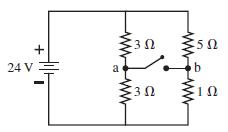
What are the battery current Ibat and the potential difference Va - Vb between points a and b when the switch in FIGURE P28.55 is (a) Open (b) Closed? 24 V FIGURE P28.55
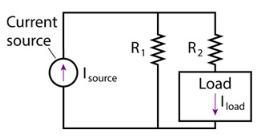
A battery is a voltage source, always providing the same potential difference regardless of the current. It is possible to make a current source that always provides the same current regardless of the potential difference. The circuit in FIGURE P28.56 is called a current divider. It sends a
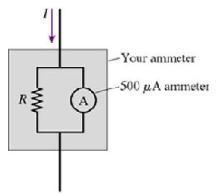
A circuit you're building needs an ammeter that goes from 0 mA to a full-scale reading of 50 mA. Unfortunately, the only ammeter in the storeroom goes from 0μA to a full scale reading of only 500μA. Fortunately, you've just finished a physics class, and you realize that you can make this ammeter
For the circuit shown in FIGURE P28.58, find the current through and the potential difference across each resistor. Place your results in a table for ease of reading. 6Ω 50 24 V= 10 Ω ww FIGURE P28.58
For the circuit shown in FIGURE P28.60, find the current through and the potential difference across each resistor. Place your results in a table for ease of reading. 30 160 ww 12 V Ut 48 n FIGURE P28.60
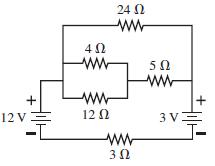
For the circuit shown in FIGURE P28.62, find the current through and the potential difference across each resistor. Place your results in a table for ease of reading. 24 0 5Ω ww ww 12 V 12Ω 3 V FIGURE P28.62
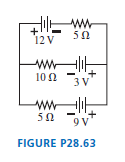
What is the current through the 10 Ω resistor in FIGURE P28.63?Is the current from left to right or right to left? ww 50 12 V ww 10 N 3 V ww 50 9 V FIGURE P28.63
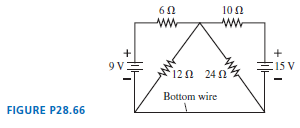
How much current flows through the bottom wire in FIGURE P28.66, and in which direction? 10Ω ww 9 V E15 V 12Ω 24Ω Bottom wire FIGURE P28.66
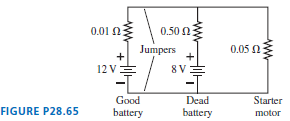
A 12 V car battery dies not so much because its voltage drops but because chemical reactions increase its internal resistance.A good battery connected with jumper cables can both start the engine and recharge the dead battery. Consider the automotive circuit of FIGURE P28.65. a. How much current
The capacitor in an RC circuit is discharged with a time constant of 10 ms. At what time after the discharge begins are(a) The charge on the capacitor reduced to half its initial value(b) The energy stored in the capacitor reduced to half its initial value?
A 150 μF defibrillator capacitor is charged to 1500 V. When fired through a patient’s chest, it loses 95% of its charge in 40 ms.What is the resistance of the patient’s chest?
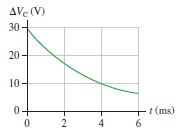
A 50 μF capacitor that had been charged to 30 V is discharged through a resistor. FIGURE P28.70 shows the capacitor voltage as a function of time.What is the value of the resistance? AVc (V) 30- 20- 10- -t (ms) 2 4 6
A 70 μF capacitor is discharged through two parallel resistors, 15 kΩ and 25 kΩ. By what factor will the time constant of this circuit increase if the resistors are instead placed in series with each other?
A 0.25 μF capacitor is charged to 50 V. It is then connected in series with a 25 Ω resistor and a 100 Ω resistor and allowed to discharge completely. How much energy is dissipated by the 25 Ω resistor?
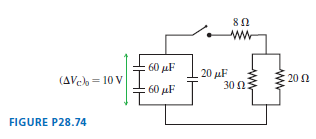
The capacitors in FIGURE P28.74 are charged and the switch closes at t = 0 s. At what time has the current in the 8 Ω resistor decayed to half the value it had immediately after the switch was closed? 60 µF 20 μ 30 Ω: (AVeb = 10 V 20 Ω 60 µF FIGURE P28.74
The flash on a compact camera stores energy in a 120 μF capacitor that is charged to 220 V. When the flash is fired, the capacitor is quickly discharged through a lightbulb with 5.0 Ω of resistance.a. Light from the flash is essentially finished after two time constants have elapsed. For how long
Large capacitors can hold a potentially dangerous charge long after a circuit has been turned off, so it is important to make sure they are discharged before you touch them. Suppose a 120 μF capacitor from a camera flash unit retains a voltage of 150 V when an unwary student removes it from the
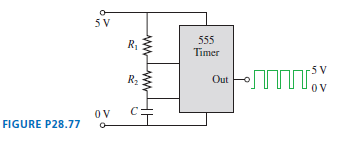
Digital circuits require actions to take place at precise times, so they are controlled by a clock that generates a steady sequence of rectangular voltage pulses. One of the most widely used integrated circuits for creating clock pulses is called a 555 timer. FIGURE P28.77 shows how the timer??s
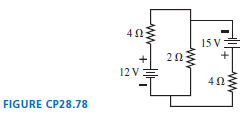
What power is dissipated by the 2 Ω resistor in FIGURE CP28.78? 15 VE 203 12 V FIGURE CP28.78
You’ve made the finals of the Science Olympics! As one of your tasks, you’re given 1.0 g of aluminum and asked to make a wire, using all the aluminum, that will dissipate 7.5 W when connected to a 1.5 V battery. What length and diameter will you choose for your wire?
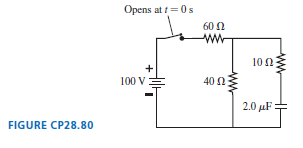
The switch in FIGURE CP28.80 has been closed for a very long time. a. What is the charge on the capacitor?b. The switch is opened at t = 0 s. At what time has the charge on the capacitor decreased to 10% of its initial value? Opens at t=0s 60 N ww 10 Ω. 100 V 40 2 2.0 µF = FIGURE CP28.80
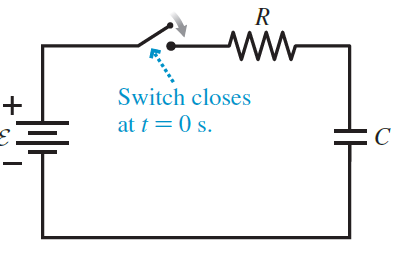
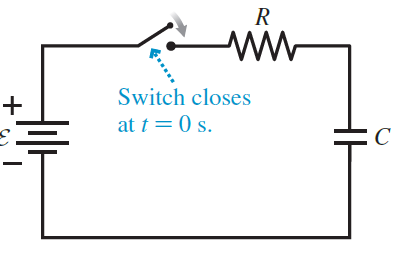
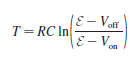
The capacitor in Figure 28.38a begins to charge after the switch closes at t = 0 s. Analyze this circuit and show that Q = Qmax(1 - e-t/Ï„), where Qmax= CÔ.Figure 28.38a Switch closes at t= 0 s.
The switch in Figure 28.38a closes at t = 0 s and, after a very long time, the capacitor is fully charged. Find expressions forFigure 28.38a(a) The total energy supplied by the battery as the capacitor is being charged,(b) Total energy dissipated by the resistor as the capacitor is being
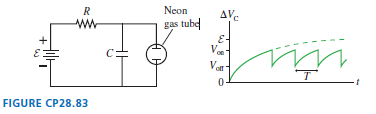
An oscillator circuit is important to many applications. A simple oscillator circuit can be built by adding a neon gas tube to an RC circuit, as shown in FIGURE CP28.83. Gas is normally a good insulator, and the resistance of the gas tube is essentially infinite when the light is off. This allows
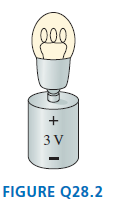
The tip of a flashlight bulb is touching the top of the 3 V battery in FIGURE Q28.2. Does the bulb light? Why or why not? 00, 3 V FIGURE Q28.2
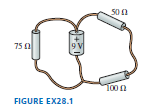
Draw a circuit diagram for the circuit of FIGURE EX28.1. 75 0 T00n FIGURE EX28.1
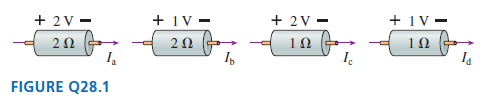
Rank in order, from largest to smallest, the currents Iato Idthrough the four resistors in FIGURE Q28.1. + 2V - + 1V - 2Ω + 2V - 1Ω + 1V - 1Ω Ia FIGURE Q28.1
A thin metal cylinder of length L and radius R1 is coaxial with a thin metal cylinder of length L and a larger radius R2. The space between the two coaxial cylinders is filled with a material that has resistivity ρ. The two cylinders are connected to the terminals of a battery with potential
A 300 μF capacitor is charged to 9.0 V, then connected in parallel with a 5000 Ω resistor. The capacitor will discharge because the resistor provides a conducting pathway between the capacitor plates, but much more slowly than if the plates were connected by a wire. Let t = 0 s be the instant the
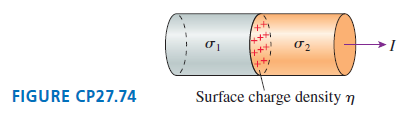
Figure CP27.74 shows a wire that is made of two equaldiameter segments with conductivities σ1and σ2. When current I passes through the wire, a thin layer of charge appears at the boundary between the segments.a. Find an expression for the surface charge density η
A 5.0-mm-diameter proton beam carries a total current of 1.5 mA. The current density in the proton beam, which increases with distance from the center, is given by J = Jedge(r/R), where R is the radius of the beam and Jedge is the current density at the edge.a. How many protons per second are
A long, round wire has resistance R. What will the wire’s resistance be if you stretch it to twice its initial length?
Two 10-cm-diameter metal plates 1.0 cm apart are charged to ±12.5 nC. They are suddenly connected together by a 0.224-mm-diameter copper wire stretched taut from the center of one plate to the center of the other.a. What is the maximum current in the wire?b. Does the current increase with time,
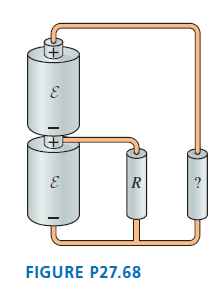
The batteries in Figure P27.68 are identical. Both resistors have equal currents. What is the resistance of the resistor on the right? R ? FIGURE P27.68 3.
A 20-cm-long hollow nichrome tube of inner diameter 2.8 mm, outer diameter 3.0 mm is connected, at its ends, to a 3.0 V battery. What is the current in the tube?
A 0.60-mm-diameter wire made from an alloy (a combination of different metals) has a conductivity that decreases linearly with distance from the center of the wire: σ(r) = σ0 - cr, with σ0 = 5.0 × 10⁷ Ω-1 m-1 and c = 1.2 × 10¹¹ Ω-1 m-2 . What is the resistance of a 4.0 m length of this wire?
A wire of radius R has a current density that increases linearly with distance from the center of the wire: J(r) = kr, where k is a constant. Find an expression for k in terms of R and the total current I carried by the wire.
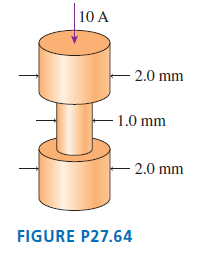
An aluminum wire consists of the three segments shown in FIGURE P27.64.The current in the top segment is 10 A.For each of these three segments, find thea. Current I.b. Current density J.c. Electric field E.d. Drift velocity vd.e. Electron current i.Place your results in a table for easy viewing. 10
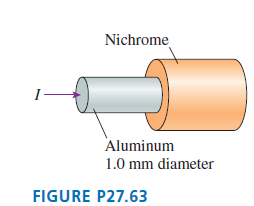
What diameter should the nichrome wire in FIGURE P27.63 be in order for the electric field strength to be the same in both wires? Nichrome Aluminum 1.0 mm diameter FIGURE P27.63
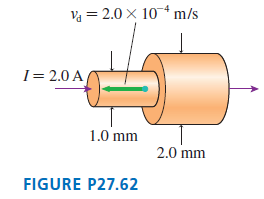
The two wires in FIGURE P27.62 are made of the same material.What are the current and the electron drift speed in the 2.0-mm-diameter segment of the wire? Va = 2.0 x 10⁴ m/s I = 2.0 A 1.0 mm 2.0 mm FIGURE P27.62
The current supplied by a battery slowly decreases as the battery runs down. Suppose that the current as a function of time is I = (0.75 A)e-t/(6 h). What is the total number of electrons transported from the positive electrode to the negative electrode by the charge escalator from the time the
The current in a wire at time t is given by the expression I = (2.0 A)e-t/(2.0 μs), where t is in microseconds and t ≥ 0.a. Find an expression for the total amount of charge (in coulombs) that has entered the wire at time t. The initial conditions are Q = 0 C at t = 0 μs.b. Graph Q versus t for
The total amount of charge that has entered a wire at time t is given by the expression Q = (20 C)(1 - e-t/(2.0 s)), where t is in seconds and t ≥ 0.a. Find an expression for the current in the wire at time t.b. What is the maximum value of the current?c. Graph I versus t for the interval 0 ≤ t
A hollow metal sphere has inner radius a, outer radius b, and conductivity σ. The current I is radially outward from the inner surface to the outer surface.a. Find an expression for the electric field strength inside the metal as a function of the radius r from the center.b. Evaluate the electric
A hollow metal cylinder has inner radius a, outer radius b, length L, and conductivity σ. The current I is radially outward from the inner surface to the outer surface.a. Find an expression for the electric field strength inside the metal as a function of the radius r from the cylinder’s axis.b.
You need to design a 1.0 A fuse that “blows” if the current exceeds 1.0 A. The fuse material in your stockroom melts at a current density of 500 A/cm2. What diameter wire of this material will do the job?
Electrical engineers sometimes use a wire’s conductance, G = σA/L, instead of its resistance.a. Write Ohm’s law in terms of conductance, starting with “ΔV = ”.b. What is the conductance of a 5.4-cm-long, 0.15-mm diameter tungsten wire?c. A 1.5 A current flows through the wire of part b.
The resistivity of a metal increases slightly with increased temperature. This can be expressed as ρ = ρ0 [1 + α(T - T0)], where T0 is a reference temperature, usually 20°C, and α is the temperature coefficient of resistivity.a. First find an expression for the current I through a wire of
The conductive tissues of the upper leg can be modeled as a 40-cm-long, 12-cm-diameter cylinder of muscle and fat. The resistivities of muscle and fat are 13 Ω m and 25 Ω m, respectively. One person’s upper leg is 82% muscle, 18% fat. What current is measured if a 1.5 V potential difference is
The conducting path between the right hand and the left hand can be modeled as a 10-cm-diameter, 160-cm-long cylinder. The average resistivity of the interior of the human body is 5.0 Ω m. Dry skin has a much higher resistivity, but skin resistance can be made negligible by soaking the hands in
Variations in the resistivity of blood can give valuable clues about changes in various properties of the blood. Suppose a medical device attaches two electrodes into a 1.5-mm-diameter vein at positions 5.0 cm apart. What is the blood resistivity if a 9.0 V potential difference causes a 230 μA
The resistivity of a metal increases slightly with increased temperature. This can be expressed as ρ = ρ0[ 1 + α(T - T0)], where T0 is a reference temperature, usually 20°C, and α is the temperature coefficient of resistivity. For copper, α = 3.9 × 10⁻³ °C-1 . Suppose a long, thin
A 1.5-m-long wire is made of a metal with the same electron density as copper. The wire is connected across the terminals of a 9.0 V battery. What conductivity would the metal need for the drift velocity of electrons in the wire to be 60 mph? By what factor is this larger than the conductivity of
The starter motor of a car engine draws a current of 150 A from the battery. The copper wire to the motor is 5.0 mm in diameter and 1.2 m long. The starter motor runs for 0.80 s until the car engine starts.a. How much charge passes through the starter motor?b. How far does an electron travel along
The biochemistry that takes place inside cells depends on various elements, such as sodium, potassium, and calcium, that are dissolved in water as ions. These ions enter cells through narrow pores in the cell membrane known as ion channels. Each ion channel, which is formed from a specialized
You’ve been asked to determine whether a new material your company has made is ohmic and, if so, to measure its electrical conductivity. Taking a 0.50 mm × 1.0 mm × 45 mm sample, you wire the ends of the long axis to a power supply and then measure the current for several different potential
In a classic model of the hydrogen atom, the electron moves around the proton in a circular orbit of radius 0.053 nm.a. What is the electron’s orbital frequency?b. What is the effective current of the electron?
A sculptor has asked you to help electroplate gold onto a brass statue. You know that the charge carriers in the ionic solution are singly charged gold ions, and you’ve calculated that you must deposit 0.50 g of gold to reach the necessary thickness. How much current do you need, in mA, to plate
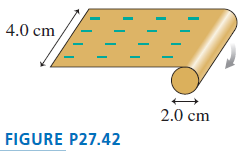
Figure P27.42 shows a 4.0-cm-wide plastic film being wrapped onto a 2.0-cm-diameter roller that turns at 90 rpm. The plastic has a uniform surface charge density of -2.0 nC/cm2.a. What is the current of the moving film?b. How long does it take the roller to accumulate a charge of -10
Energetic particles, such as protons, can be detected with a silicon detector. When a particle strikes a thin piece of silicon, it creates a large number of free electrons by ionizing silicon atoms. The electrons flow to an electrode on the surface of the detector, and this current is then
The electron beam inside an old television picture tube is 0.40 mm in diameter and carries a current of 50 μA. This electron beam impinges on the inside of the picture tube screen.a. How many electrons strike the screen each second?b. What is the current density in the electron beam?c. The
For what electric field strength would the current in a 2.0 mm-diameter nichrome wire be the same as the current in a 1.0-mm-diameter aluminum wire in which the electric field strength is 0.0080 V/m?
An ideal battery would produce an extraordinarily large current if “shorted” by connecting the positive and negative terminals with a short wire of very low resistance. Real batteries do not. The current of a real battery is limited by the fact that the battery itself has resistance. What is
Household wiring often uses 2.0-mm-diameter copper wires. The wires can get rather long as they snake through the walls from the fuse box to the farthest corners of your house. What is the potential difference across a 20-m-long, 2.0-mm-diameter copper wire carrying an 8.0 A current?
A circuit calls for a 0.50-mm-diameter copper wire to be stretched between two points. You don’t have any copper wire, but you do have aluminum wire in a wide variety of diameters.What diameter aluminum wire will provide the same resistance?
Showing 1600 - 1700
of 3693
First
10
11
12
13
14
15
16
17
18
19
20
21
22
23
24
Last
Step by Step Answers

 Get 50% OFF
Claim Now
Get 50% OFF
Claim Now