New Semester
Started
Get
50% OFF
Study Help!
--h --m --s
Claim Now
Question Answers
Textbooks
Find textbooks, questions and answers
Oops, something went wrong!
Change your search query and then try again
S
Books
FREE
Study Help
Expert Questions
Accounting
General Management
Mathematics
Finance
Organizational Behaviour
Law
Physics
Operating System
Management Leadership
Sociology
Programming
Marketing
Database
Computer Network
Economics
Textbooks Solutions
Accounting
Managerial Accounting
Management Leadership
Cost Accounting
Statistics
Business Law
Corporate Finance
Finance
Economics
Auditing
Tutors
Online Tutors
Find a Tutor
Hire a Tutor
Become a Tutor
AI Tutor
AI Study Planner
NEW
Sell Books
Search
Search
Sign In
Register
study help
physics
university physics
University Physics with Modern Physics 14th edition Hugh D. Young, Roger A. Freedman - Solutions
It is stated in Section 40.3 that a finite potential well always has at least one bound level, no matter how shallow the well. Does this mean that as U0 → 0, E1 → 0? Does this violate the Heisenberg uncertainty principle? Explain.
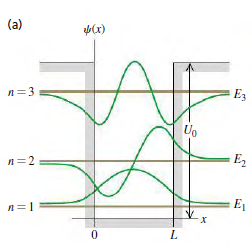
Figure 40.15a shows that the higher the energy of a bound state for a finite potential well, the more the wave function extends outside the well (into the intervals x < 0 and x > L). Explain why this happens.Fig.40.15a (a) (x) n=3 E3 Ug E2 E1 n=1
A particle is confined to a finite potential well in the region 0 < x < L. How does the area under the graph of |ψ|2 in the region 0 < x < L compare to the total area under the graph of |ψ|2 when including all possible x?
An electron in a one dimensional box has ground state energy 2.00 eV. What is the wavelength of the photon absorbed when the electron makes a transition to the second excited state?
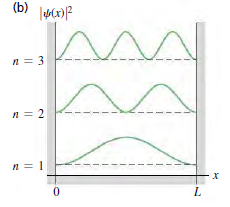
In Fig. 40.12b, the probability function is zero at the points x = 0 and x = L, the €œwalls€ of the box. Does this mean that the particle never strikes the walls? Explain.Fig.40.12b (b) х
For a particle in a finite potential well, is it correct to say that each bound state of definite energy is also a state of definite wavelength? Is it a state of definite momentum? Explain.
For a particle confined to an infinite square well, is it correct to say that each state of definite energy is also a state of definite wavelength? Is it also a state of definite momentum? Explain.
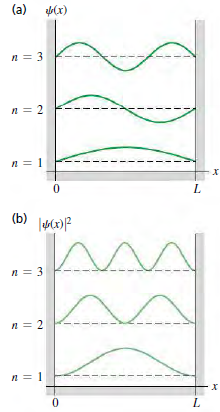
A particle in a box is in the ground level. What is the probability of finding the particle in the right half of the box? (Refer to Fig. 40.12, but don€™t evaluate an integral.) Is the answer the same if the particle is in an excited level? Explain.Fig.40.12 (a) x) (b) L
In Chapter 15 we represented a standing wave as a superposition of two waves traveling in opposite directions. Can the wave functions for a particle in a box also be thought of as a combination of two traveling waves? Why or why not? What physical interpretation does this representation have?
For a particle in a box, what would the probability distribution function |ψ|2 look like if the particle behaved like a classical (Newtonian) particle? Do the actual probability distributions approach this classical form when n is very large? Explain.
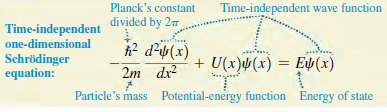
Let Ψ1and Ψ2be two solutions of Eq. (40.23) with energies E1and E2, respectively, where E1‰ E2. Is Ψ = AΨ1+ BΨ2, where A and B are nonzero constants, a solution to Eq. (40.23)? Explain your answer.Eq.40.23 Time-independent wave
If ψ is normalized, what is the physical significance of the area under a graph of |ψ|2 versus x between x1 and x2? What is the total area under the graph of |ψ|2 when all x are included? Explain.
Laser light results from transitions from long-lived metastable states. Why is it more monochromatic than ordinary light?
Which has more total energy: a hydrogen atom with an electron in a high shell (large n) or in a low shell (small n)? Which is moving faster: the high shell electron or the low-shell electron? Is there a contradiction here? Explain.
You have been asked to design a magnet system to steer a beam of 54 eV electrons like those described in Example 39.. The goal is to be able to direct the electron beam to a specific target location with an accuracy of ±1.0 mm. In your design, do you need to take the wave nature of electrons into
Galaxies tend to be strong emitters of Lyman-α photons (from the n = 2 to n = 1 transition in atomic hydrogen). But the intergalactic medium the very thin gas between the galaxies— tends to absorb Lyman-α photons. What can you infer from these observations about the temperature in these two
When an electron beam goes through a very small hole, it produces a diffraction pattern on a screen, just like that of light. Does this mean that an electron spreads out as it goes through the hole? What does this pattern mean?
In our universe, the rest energy of an electron is approximately 8.2 × 10⁻¹⁴ J. What would it be in the alternate universe?(a) 8.2 × 10⁻⁸ J;(b) 8.2 × 10⁻²⁶ J;(c) 8.2 × 10⁻² J;(d) 0.82 J.Our universe has properties that are determined by the values of the fundamental physical constants, and it
For the particle in a box, we chose k = np/L with n = 1, 2, 3, c to fit the boundary condition that ψ = 0 at x = L. However, n = 0, -1, -2, -3, c also satisfy that boundary condition. Why didn’t we also choose those values of n?
If a particle is in a stationary state, does that mean that the particle is not moving? If a particle moves in empty space with constant momentum p̅(vector) and hence constant energy E = p2/2m, is it in a stationary state? Explain your answers.
Why must the wave function of a particle be normalized?
As Eq. (40.21) indicates, the time-dependent wave function for a stationary state is a complex number having a real part and an imaginary part. How can this function have any physical meaning, since part of it is imaginary?Eq.40.21 Time-independent wave function .... | Time-dependent wave function
A student remarks that the relationship of ray optics to the more general wave picture is analogous to the relationship of Newtonian mechanics, with well-defined particle trajectories, to quantum mechanics. Comment on this remark.
An electron is moving as a free particle in the -x-direction with momentum that has magnitude 4.50 × 10⁻²⁴ kg ∙ m/s. What is the one dimensional time dependent wave function of the electron?
If quantum mechanics replaces the language of Newtonian mechanics, why don’t we have to use wave functions to describe the motion of macroscopic bodies such as baseballs and cars?
In the second type of helium-ion microscope, a 1.2-MeV ion passing through a cell loses 0.2 MeV per mm of cell thickness. If the energy of the ion can be measured to 6 keV, what is the smallest difference in thickness that can be discerned?(a) 0.03 µm;(b) 0.06 µm;(c) 3 µm;(d) 6 µm.Whereas
Why is it easier to use helium ions rather than neutral helium atoms in such a microscope?(a) Helium atoms are not electrically charged, and only electrically charged particles have wave properties.(b) Helium atoms form molecules, which are too large to have wave properties.(c) Neutral helium atoms
Can the first type of helium-ion microscope, used for surface imaging, produce helium ions with a wavelength of 0.1 pm?(a) Yes; the voltage required is 21 kV.(b) Yes; the voltage required is 42 kV.(c) No; a voltage higher than 50 kV is required.(d) No; a voltage lower than 10 kV is required.Whereas
How does the wavelength of a helium ion compare to that of an electron accelerated through the same potential difference?(a) The helium ion has a longer wavelength, because it has greater mass.(b) The helium ion has a shorter wavelength, because it has greater mass.(c) The wavelengths are the same,
To investigate the structure of extremely small objects, such as viruses, the wavelength of the probing wave should be about one-tenth the size of the object for sharp images. But as the wavelength gets shorter, the energy of a photon of light gets greater and could damage or destroy the object
The wavelength 10.0 µm is in the infrared region of the electromagnetic spectrum, whereas 600 nm is in the visible region and 100 nm is in the ultraviolet. What is the temperature of an ideal blackbody for which the peak wavelength λm is equal to each of these wavelengths?
Using a mixture of CO2, N2, and sometimes He, CO2 lasers emit a wavelength of 10.6 µm. At power outputs of 0.100 kW, such lasers are used for surgery. How many photons per second does a CO2 laser deliver to the tissue during its use in an operation?
(a) For one-electron ions with nuclear charge Z, what is the speed of the electron in a Bohr-model orbit labeled with n? Give your answer in terms of v1, the orbital speed for the n = 1 Bohr orbit in hydrogen.(b) What is the largest value of Z for which the n = 1 orbital speed is less than 10% of
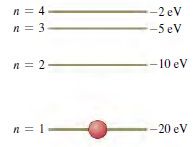
The energy-level scheme for the hypothetical one electron element Searsium is shown in Fig. E39.25. The potential energy is taken to be zero for an electron at an infinite distance from the nucleus.(a) How much energy (in electron volts) does it take to ionize an electron from the ground level?(b)
When you check the air pressure in a tire, a little air always escapes; the process of making the measurement changes the quantity being measured. Think of other examples of measurements that change or disturb the quantity being measured.
Why can an electron microscope have greater magnification than an ordinary microscope?
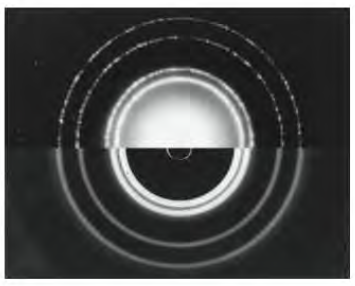
As the lower half of Fig. 39.4 shows, the diffraction pattern made by electrons that pass through aluminum foil is a series of concentric rings. But if the aluminum foil is replaced by a single crystal of aluminum, only certain points on these rings appear in the pattern. Explain.Fig. 39.4
Could an electron-diffraction experiment be carried out using three or four slits? Using a grating with many slits? What sort of results would you expect with a grating? Would the uncertainty principle be violated? Explain.
Equation (39.30) states that the energy of a system can have uncertainty. Does this mean that the principle of conservation of energy is no longer valid? Explain.Eq.39.30Δt ΔE ≥ h/2
Suppose a two-slit interference experiment is carried out using an electron beam. Would the same interference pattern result if one slit at a time is uncovered instead of both at once? If not, why not? Doesn’t each electron go through one slit or the other? Or does every electron go through both
Does the uncertainty principle have anything to do with marksmanship? That is, is the accuracy with which a bullet can be aimed at a target limited by the uncertainty principle? Explain.
Why go through the expense of building an electron microscope for studying very small objects such as organic molecules? Why not just use extremely short electromagnetic waves, which are much cheaper to generate?
Do the planets of the solar system obey a distance law (rn = n2r1) as the electrons of the Bohr atom do? Should they? Why (or why not)?
Higher-energy photons might be desirable for the treatment of certain tumors. Which of these actions would generate higher-energy photons in this linear accelerator?(a) Increasing the number of electrons that hit the tungsten target;(b) Accelerating the electrons through a higher potential
If a proton and an electron have the same kinetic energy, which has the longer de Broglie wavelength? Explain.
Does a photon have a de Broglie wavelength? If so, how is it related to the wavelength of the associated electromagnetic wave? Explain.
A doubly ionized lithium atom (Li++) is one that has had two of its three electrons removed. The energy levels of the remaining single-electron ion are closely related to those of the hydrogen atom. The nuclear charge for lithium is +3e instead of just +e. How are the energy levels related to those
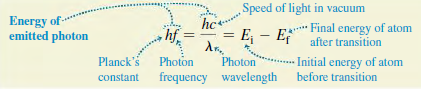
The emission of a photon by an isolated atom is a recoil process in which momentum is conserved. Thus Eq. (39.5) should include a recoil kinetic energy Kr for the atom. Why is this energy negligible in that equation?Eq.39.5 Speed of light in vacuum Final energy of atom after transition Energy of
How might the energy levels of an atom be measured directly that is, without recourse to analysis of spectra?
Elements in the gaseous state emit line spectra with well defined wavelengths. But hot solid bodies always emit a continuous spectrum that is, a continuous smear of wavelengths. Can you account for this difference?
As a body is heated to a very high temperature and becomes self luminous, the apparent color of the emitted radiation shifts from red to yellow and finally to blue as the temperature increases. Why does the color shift? What other changes in the character of the radiation occur?
The speed of light relative to still water is 2.25 × 10⁸ m/s. If the water is moving past us, the speed of light we measure depends on the speed of the water. Do these facts violate Einstein’s second postulate? Explain.
If the airplane of Passage Problem 37.71 has a rest mass of 20,000 kg, what is its relativistic mass when the plane is moving at 180 m/s ?(a) 8000 kg;(b) 12,000 kg;(c) 16,000 kg;(d) 25,000 kg;(e) 33,300 kg.Our universe has properties that are determined by the values of the fundamental physical
According to the photon model, light carries its energy in packets called quanta or photons. Why then don’t we see a series of flashes when we look at things?
Why must engineers and scientists shield against x-ray production in high-voltage equipment?
In attempting to reconcile the wave and particle models of light, some people have suggested that the photon rides up and down on the crests and troughs of the electromagnetic wave. What things are wrong with this description?
Some lasers emit light in pulses that are only 10-12 s in duration. The length of such a pulse is (3 × 10⁸ m/s)(10-12 s) = 3 × 10⁻⁴ m = 0.3 mm. Can pulsed laser light be as monochromatic as light from a laser that emits a steady, continuous beam? Explain.
X rays with an initial wavelength of 0.900 × 10⁻¹⁰ m undergo Compton scattering. For what scattering angle is the wavelength of the scattered x rays greater by 1.0% than that of the incident x rays?
(a) If only a fraction p of the electric power supplied is converted into x rays, at what rate is energy being delivered to the target?(b) If the target has mass m and specific heat c (in J/kg ∙ K), at what average rate would its temperature rise if there were no thermal losses?(c) Evaluate your
How much energy is imparted to one cell during one day’s treatment? Assume that the specific gravity of the tumor is 1 and that 1 J = 6 × 10¹⁸ eV.(a) 120 keV;(b) 12 MeV;(c) 120 MeV;(d) 120 × 103 MeV.Malignant tumors are commonly treated with targeted x-ray radiation therapy. To generate these
While interacting with molecules (mainly water) in the tumor tissue, each Compton electron or photoelectron causes a series of ionizations, each of which takes about 40 eV. Estimate the maximum number of ionizations that one photon generated by this linear accelerator can produce in tissue.(a)
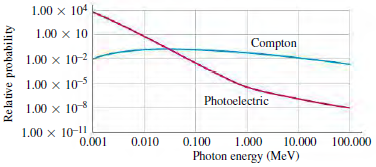
The probability of a photon interacting with tissue via the photoelectric effect or the Compton effect depends on the photon energy. Use Fig. P38.44 to determine the best description of how the photons from the linear accelerator described in the passage interact with a tumor.(a) Via the Compton
Can Compton scattering occur with protons as well as electrons? For example, suppose a beam of x rays is directed at a target of liquid hydrogen. (Recall that the nucleus of hydrogen consists of a single proton.) Compared to Compton scattering with electrons, what similarities and differences would
A photon of frequency f undergoes Compton scattering from an electron at rest and scatters through an angle ϕ. The frequency of the scattered photon is f'. How is f' related to f? Does your answer depend on ϕ? Explain.
In a photoelectric-effect experiment, which of the following will increase the maximum kinetic energy of the photoelectrons?(a) Use light of greater intensity;(b) Use light of higher frequency;(c) Use light of longer wavelength;(d) Use a metal surface with a larger work function. In each case
In an experiment involving the photoelectric effect, if the intensity of the incident light (having frequency higher than the threshold frequency) is reduced by a factor of 10 without changing anything else, which (if any) of the following statements about this process will be true?(a) The number
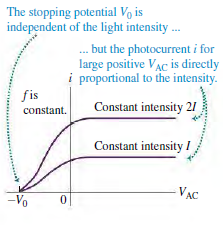
In a photoelectric-effect experiment, the photocurrent i for large positive values of VAC has the same value no matter what the light frequency f (provided that f is higher than the threshold frequency f0). Explain why.
Explain why Fig. 38.4 shows that most photoelectrons have kinetic energies less than hf - f, and also explain how these smaller kinetic energies occur.Fig.38.4 The stopping potential Vo is independent of the light intensity . but the photocurrent i for large positive VẠC is directly i
Human skin is relatively insensitive to visible light, but ultraviolet radiation can cause severe burns. Does this have anything to do with photon energies? Explain.
Most black-and-white photographic film (with the exception of some special-purpose films) is less sensitive to red light than blue light and has almost no sensitivity to infrared. How can these properties be understood on the basis of photons?
During the photoelectric effect, light knocks electrons out of metals. So why don’t the metals in your home lose their electrons when you turn on the lights?
Would you expect effects due to the photon nature of light to be generally more important at the low-frequency end of the electromagnetic spectrum (radio waves) or at the high-frequency end (x rays and gamma rays)? Why?
There is a certain probability that a single electron may simultaneously absorb two identical photons from a high-intensity laser. How would such an occurrence affect the threshold frequency and the equations of Section 38.1? Explain.
In what ways do photons resemble other particles such as electrons? In what ways do they differ? Do photons have mass? Do they have electric charge? Can they be accelerated? What mechanical properties do they have?
In the alternate universe, how fast must an object be moving for it to have a kinetic energy equal to its rest mass?(a) 225 m/s;(b) 260 m/s;(c) 300 m/s;(d) The kinetic energy could not be equal to the rest mass.Our universe has properties that are determined by the values of the fundamental
An airplane has a length of 60 m when measured at rest. When the airplane is moving at 180 m/s (400 mph) in the alternate universe, how long would the plane appear to be to a stationary observer?(a) 24 m;(b) 36 m;(c) 48 m;(d) 60 m;(e) 75 m.Our universe has properties that are determined by the
In a particle accelerator a proton moves with constant speed 0.750c in a circle of radius 628 m. What is the net force on the proton?
Inside a spaceship flying past the earth at three-fourths the speed of light, a pendulum is swinging.(a) If each swing takes 1.80 s as measured by an astronaut performing an experiment inside the spaceship, how long will the swing take as measured by a person at mission control (on earth) who is
Electrons are accelerated through a potential difference of 750 kV, so that their kinetic energy is 7.50 × 10⁵ eV.(a) What is the ratio of the speed v of an electron having this energy to the speed of light, c?(b) What would the speed be if it were computed from the principles of classical
If a muon is traveling at 0.999c, what are its momentum and kinetic energy? (The mass of such a muon at rest in the laboratory is 207 times the electron mass.)
An electron is acted upon by a force of 5.00 × 10⁻¹⁵ N due to an electric field. Find the acceleration this force produces in each case:(a) The electron’s speed is 1.00 km/s.(b) The electron’s speed is 2.50 × 10⁸ m/s and the force is parallel to the velocity.
A proton has momentum with magnitude p0 when its speed is 0.400c. In terms of p0, what is the magnitude of the proton’s momentum when its speed is doubled to 0.800c?
A source of electromagnetic radiation is moving in a radial direction relative to you. The frequency you measure is 1.25 times the frequency measured in the rest frame of the source. What is the speed of the source relative to you? Is the source moving toward you or away from you?
Electromagnetic radiation from a star is observed with an earth-based telescope. The star is moving away from the earth at a speed of 0.520c. If the radiation has a frequency of 8.64 × 10¹⁴ Hz in the rest frame of the star, what is the frequency measured by an observer on earth?
What do you think would be different in everyday life if the speed of light were 10 m/s instead of 3.00 × 10⁸ m/s ?
When a monochromatic light source moves toward an observer, its wavelength appears to be shorter than the value measured when the source is at rest. Does this contradict the hypothesis that the speed of light is the same for all observers? Explain.
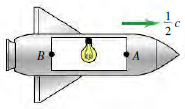
A rocket is moving to the right at 1/2 the speed of light relative to the earth. A light bulb in the center of a room inside the rocket suddenly turns on. Call the light hitting the front end of the room event A and the light hitting the back of the room event B (Fig. Q37.3). Which event occurs
Ordinary photographic film reverses black and white, in the sense that the most brightly illuminated areas become blackest upon development (hence the term negative). Suppose a hologram negative is viewed directly, without making a positive transparency. How will the resulting images differ from
A hologram is made using 600-nm light and then viewed by using white light from an incandescent bulb. What will be seen? Explain.
Parallel rays of monochromatic light with wavelength 568 nm illuminate two identical slits and produce an interference pattern on a screen that is 75.0 cm from the slits. The centers of the slits are 0.640 mm apart and the width of each slit is 0.434 mm. If the intensity at the center of the
If a hologram is made using 600-nm light and then viewed with 500-nm light, how will the images look compared to those observed when viewed with 600-nm light? Explain.
One sometimes sees rows of evenly spaced radio antenna towers. A student remarked that these act like diffraction gratings. What did she mean? Why would one want them to act like a diffraction grating?
Why is a diffraction grating better than a two-slit setup for measuring wavelengths of light?
Could x-ray diffraction effects with crystals be observed by using visible light instead of x rays? Why or why not?
With which color of light can the Hubble Space Telescope see finer detail in a distant astronomical object: red, blue, or ultraviolet? Explain your answer.
Information is stored on an audio compact disc, CD-ROM, or DVD disc in a series of pits on the disc. These pits are scanned by a laser beam. An important limitation on the amount of information that can be stored on such a disc is the width of the laser beam. Explain why this should be, and explain
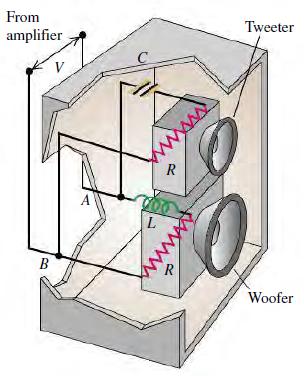
Figure 31.12 (Section 31.2) shows a loudspeaker system. Low-frequency sounds are produced by the woofer, which is a speaker with large diameter; the tweeter, a speaker with smaller diameter, produces high-frequency sounds. Use diffraction ideas to explain why the tweeter is more effective for
Some loudspeaker horns for outdoor concerts (at which the entire audience is seated on the ground) are wider vertically than horizontally. Use diffraction ideas to explain why this is more efficient at spreading the sound uniformly over the audience than either a square speaker horn or a horn that
A rainbow ordinarily shows a range of colors (see Section 33.4). But if the water droplets that form the rainbow are small enough, the rainbow will appear white. Explain why, using diffraction ideas. How small do you think the raindrops would have to be for this to occur?
You use a lens of diameter D and light of wavelength λ and frequency f to form an image of two closely spaced and distant objects. Which of the following will increase the resolving power?(a) Use a lens with a smaller diameter;(b) Use light of higher frequency;(c) Use light of longer wavelength.
Showing 300 - 400
of 2042
1
2
3
4
5
6
7
8
9
10
11
12
13
14
15
Last
Step by Step Answers

 Get 50% OFF
Claim Now
Get 50% OFF
Claim Now