New Semester
Started
Get
50% OFF
Study Help!
--h --m --s
Claim Now
Question Answers
Textbooks
Find textbooks, questions and answers
Oops, something went wrong!
Change your search query and then try again
S
Books
FREE
Study Help
Expert Questions
Accounting
General Management
Mathematics
Finance
Organizational Behaviour
Law
Physics
Operating System
Management Leadership
Sociology
Programming
Marketing
Database
Computer Network
Economics
Textbooks Solutions
Accounting
Managerial Accounting
Management Leadership
Cost Accounting
Statistics
Business Law
Corporate Finance
Finance
Economics
Auditing
Tutors
Online Tutors
Find a Tutor
Hire a Tutor
Become a Tutor
AI Tutor
AI Study Planner
NEW
Sell Books
Search
Search
Sign In
Register
study help
physics
university physics
University Physics with Modern Physics 14th edition Hugh D. Young, Roger A. Freedman - Solutions
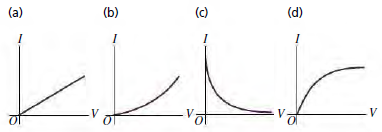
Which of the graphs in Fig. Q25.12 best illustrates the current I in a real resistor as a function of the potential difference V across it? Explain.Figure Q25.12 (a) (b) (c) (d)
Temperature coefficients of resistivity are given in Table 25.2.(a) If a copper heating element is connected to a source of constant voltage, does the electrical power consumed by the heating element increase or decrease as its temperature increases? Explain.(b) A resistor in the form of a carbon
Electrons in an electric circuit pass through a resistor. The wire on either side of the resistor has the same diameter.(a) How does the drift speed of the electrons before entering the resistor compare to the speed after leaving the resistor? Explain your reasoning.(b) How does the potential
Nerve cells transmit electric signals through their long tubular axons. These signals propagate due to a sudden rush of Na+ ions, each with charge +e, into the axon. Measurements have revealed that typically about 5.6 × 10¹¹ Na+ ions enter each meter of the axon during a time of 10 ms. What is the
We have seen that a coulomb is an enormous amount of charge; it is virtually impossible to place a charge of 1 C on an object. Yet, a current of 10 A, 10 C/s, is quite reasonable. Explain this apparent discrepancy.
Batteries are always labeled with their emf; for instance, an AA flashlight battery is labeled “1.5 volts.” Would it also be appropriate to put a label on batteries stating how much current they provide? Why or why not?
A rule of thumb used to determine the internal resistance of a source is that it is the open-circuit voltage divided by the short-circuit current. Is this correct? Why or why not?
Can the potential difference between the terminals of a battery ever be opposite in direction to the emf ? If it can, give an example. If it cannot, explain why not.
When is a 1.5-V AAA battery not actually a 1.5-V battery? That is, when do its terminals provide a potential difference of less than 1.5 V?
Two copper wires with different diameters are joined end to end. If a current flows in the wire combination, what happens to electrons when they move from the larger-diameter wire into the smaller-diameter wire? Does their drift speed increase, decrease, or stay the same? If the drift speed
A cylindrical rod has resistivity ρ. If we triple its length and diameter, what is its resistivity, in terms of ρ?
A cylindrical rod has resistance R. If we triple its length and diameter, what is its resistance, in terms of R?
During lightning strikes from a cloud to the ground, currents as high as 25,000 A can occur and last for about 40 ms. How much charge is transferred from the cloud to the earth during such a strike?
The definition of resistivity (r = E/J) implies that an electric field exists inside a conductor. Yet we saw in Chapter 21 that there can be no electrostatic electric field inside a conductor. Is there a contradiction here? Explain.
What is the minimum amount of work that must be done by the cell to restore Vm to -70 mV?(a) 3 mJ;(b) 3 µJ;(c) 3 nJ;(d) 3 pJ.Upon fertilization, the eggs of many species undergo a rapid change in potential difference across their outer membrane. This change affects the physiological development of
Suppose that the change in Vm was caused by the entry of Ca2+ instead of Na+. How many Ca2+ ions would have to enter the cell per unit membrane to produce the change?(a) Half as many as for Na+;(b) The same as for Na+;(c) Twice as many as for Na+;(d) cannot say without knowing the inside and
Suppose that the egg has a diameter of 200 mm. What fractional change in the internal Na+ concentration results from the fertilization-induced change in Vm? Assume that Na+ ions are distributed throughout the cell volume. The concentration increases by(a) 1 part in 104;(b) 1 part in 105;(c) 1 part
How many moles of Na+ must m ove per unit area of membrane to change Vm from -70 mV to +30 mV, if we assume that the membrane behaves purely as a capacitor?(a) 10-4 mol/cm2;(b) 10-9 mol/cm2;(c) 10-12 mol/cm2;(d) 10-14 mol/cm2.Upon fertilization, the eggs of many species undergo a rapid change in
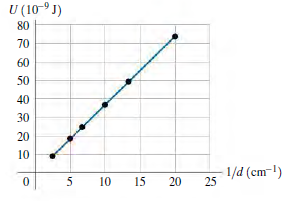
You are conducting experiments with an airfilled parallel-plate capacitor. You connect the capacitor to a battery with voltage 24.0 V. Initially the separation d between the plates is 0.0500 cm. In one experiment, you leave the battery connected to the capacitor, increase the separation between the
You are designing capacitors for various applications. For one application, you want the maximum possible stored energy. For another, you want the maximum stored charge. For a third application, you want the capacitor to withstand a large applied voltage without dielectric breakdown. You start with
Your electronics company has several identical capacitors with capacitance C1 and several others with capacitance C2. You must determine the values of C1 and C2 but don’t have access to C1 and C2 individually. Instead, you have a network with C1 and C2 connected in series and a network
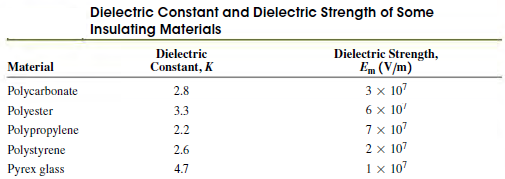
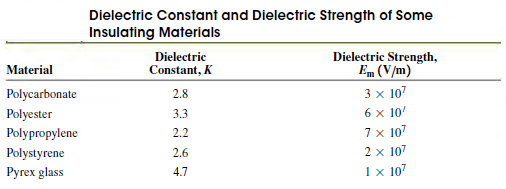
A parallel-plate capacitor has square plates that are 8.00 cm on each side and 3.80 mm apart. The space between the plates is completely filled with two square slabs of dielectric, each 8.00 cm on a side and 1.90 mm thick. One slab is Pyrex glass and the other is polystyrene. If the potential
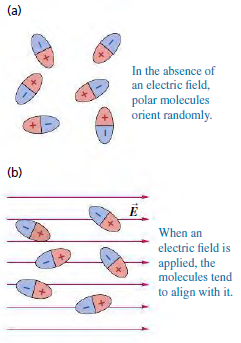
A potential difference Vab= 48.0 V is applied across the capacitor network of Fig. E24.17. If C1= C2= 4.00 µF and C4= 8.00 µF, what must the capacitance C3be if the network is to store 2.90 × 10⁻³J of electrical energy?Fit.24.17 (a) In the absence of an electric field,
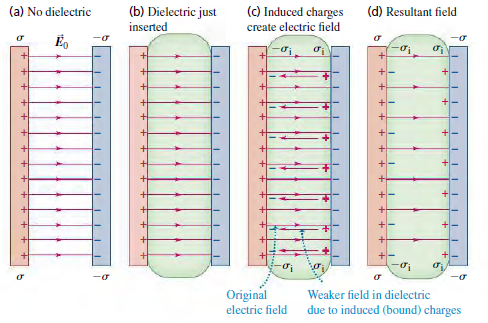
In Fig. E24.20, C1= 3.00 µF and Vab= 150 V. The charge on capacitor C1is 150 µC and the charge on C3is 450 µC. What are the values of the capacitances of C2and C3?Fig.24.20 (C) Induced charges create electric field (a) No dielectric (b) Dielectric just (d) Resultant field inserted
Polystyrene has dielectric constant 2.6 and dielectric strength 2.0 × 10⁷ V/m. A piece of polystyrene is used as a dielectric in a parallel-plate capacitor, filling the volume between the plates.(a) When the electric field between the plates is 80% of the dielectric strength, what is the energy
Some cell walls in the human body have a layer of negative charge on the inside surface and a layer of positive charge of equal magnitude on the outside surface. Suppose that the charge density on either surface is ± 0.50 × 10⁻³ C/m2, the cell wall is 5.0 nm thick, and the cell-wall material is
The two plates of a capacitor are given charges ±Q. The capacitor is then disconnected from the charging device so that the charges on the plates can’t change, and the capacitor is immersed in a tank of oil. Does the electric field between the plates increase, decrease, or stay the same? Explain
A conductor is an extreme case of a dielectric, since if an electric field is applied to a conductor, charges are free to move within the conductor to set up “induced charges.” What is the dielectric constant of a perfect conductor? Is it K = 0, K → ∞, or something in between? Explain your
Liquid dielectrics that have polar molecules (such as water) always have dielectric constants that decrease with increasing temperature. Why?
A parallel-plate capacitor is connected to a power supply that maintains a fixed potential difference between the plates.(a) If a sheet of dielectric is then slid between the plates, what happens to(i) The electric field between the plates,(ii) The magnitude of charge on each plate, and(iii) The
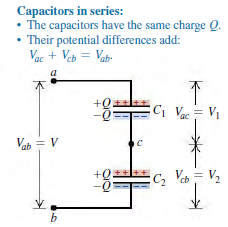
In Fig. 24.8a, let C1= 3.00 µF, C2= 5.00 µF, and Vab= +64.0 V. Calculate(a) The charge on each capacitor and(b) The potential difference across each capacitor.Fig.24.3a Capacitors in series: • The capacitors have the same charge Q. • Their potential differences add: Vac + Veb = Vab-
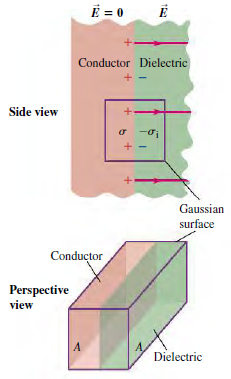
In terms of the dielectric constant K, what happens to the electric flux through the Gaussian surface shown in Fig. 24.22 when the dielectric is inserted into the previously empty space between the plates? Explain. E = 0 Conductor Dielectric Side view Gaussian surface Conductor Perspective view
Electrolytic capacitors use as their dielectric an extremely thin layer of nonconducting oxide between a metal plate and a conducting solution. Discuss the advantage of such a capacitor over one constructed using a solid dielectric between the metal plates.
Suppose you bring a slab of dielectric close to the gap between the plates of a charged capacitor, preparing to slide it between the plates. What force will you feel? What does this force tell you about the energy stored between the plates once the dielectric is in place, compared to before the
A capacitor made of aluminum foil strips separated by Mylar film was subjected to excessive voltage, and the resulting dielectric breakdown melted holes in the Mylar. After this, the capacitance was found to be about the same as before, but the breakdown voltage was much less. Why?
Is dielectric strength the same thing as dielectric constant? Explain any differences between the two quantities. Is there a simple relationship between dielectric strength and dielectric constant(see Table 24.2)?Table 24.2 Dielectric Constant and Dielectric Strength of Some Insulating Materials
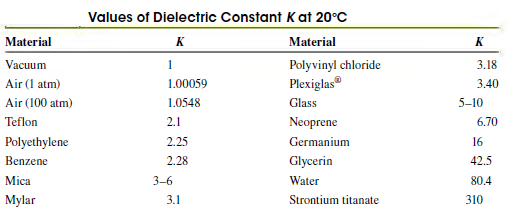
As shown in Table 24.1, water has a very large dielectric constant K = 80.4. Why do you think water is not commonly used as a dielectric in capacitors?Table 24.1 Values of Dielectric Constant Kat 20°C Material к Material Polyvinyl chloride Plexiglas Vacuum 1 3.18 Air (1 atm) 1.00059 3.40 Air (100
You have two capacitors and want to connect them across a voltage source (battery) to store the maximum amount of energy. Should they be connected in series or in parallel?
The charged plates of a capacitor attract each other, so to pull the plates farther apart requires work by some external force. What becomes of the energy added by this work? Explain.
Two parallel-plate capacitors, identical except that one has twice the plate separation of the other, are charged by the same voltage source. Which capacitor has a stronger electric field between the plates? Which capacitor has a greater charge? Which has greater energy density? Explain your
A parallel-plate capacitor is charged by being connected to a battery and is then disconnected from the battery. The separation between the plates is then doubled. How does the electric field change? The potential difference? The total energy? Explain.
A parallel-plate capacitor is charged by being connected to a battery and is kept connected to the battery. The separation between the plates is then doubled. How does the electric field change? The charge on the plates? The total energy? Explain.
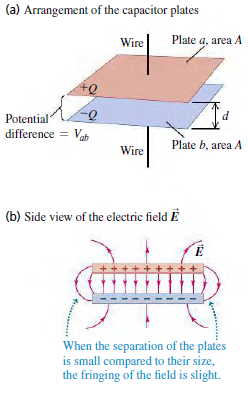
In the parallel-plate capacitor of Fig. 24.2, suppose the plates are pulled apart so that the separation d is much larger than the size of the plates.(a) Is it still accurate to say that the electric field between the plates is uniform? Why or why not?(b) In the situation shown in Fig. 24.2, the
To store the maximum amount of energy in a parallelplate capacitor with a given battery (voltage source), would it be better to have the plates far apart or close together?
Suppose the two plates of a capacitor have different areas. When the capacitor is charged by connecting it to a battery, do the charges on the two plates have equal magnitude, or may they be different? Explain your reasoning.
Suppose several different parallel-plate capacitors are charged up by a constant voltage source. Thinking of the actual movement and position of the charges on an atomic level, why does it make sense that the capacitances are proportional to the surface areas of the plates? Why does it make sense
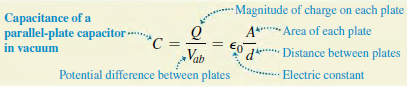
Equation (24.2) shows that the capacitance of a parallelplate capacitor becomes larger as the plate separation d decreases. However, there is a practical limit to how small d can be made, which places limits on how large C can be. Explain what sets the limit on d. What happens to the magnitude of
The maximum voltage at the center of a typical tandem electrostatic accelerator is 6.0 MV. If the distance from one end of the acceleration tube to the midpoint is 12 m, what is the magnitude of the average electric field in the tube under these conditions?(a) 41,000 V/m;(b) 250,000 V/m;(c) 500,000
A helium ion (He++) that comes within about 10 fm of the center of the nucleus of an atom in the sample may induce a nuclear reaction instead of simply scattering. Imagine a helium ion with a kinetic energy of 3.0 MeV heading straight toward an atom at rest in the sample. Assume that the atom stays
For a particular experiment, helium ions are to be given a kinetic energy of 3.0 MeV. What should the voltage at the center of the accelerator be, assuming that the ions start essentially at rest?(a) -3.0 MV;(b) +3.0 MV;(c) +1.5 MV;(d) +1.0 MV.Rutherford backscattering spectrometry (RBS) is a
A small, stationary sphere carries a net charge Q. You perform the following experiment to measure Q: From a large distance you fire a small particle with mass m = 4.00 × 10⁻⁴kg and charge q = 5.00 × 10⁻⁸C directly at the center of the sphere. The apparatus you are using
An alpha particle with kinetic energy 9.50 MeV (when far away) collides headon with a lead nucleus at rest. What is the distance of closest approach of the two particles? (Assume that the lead nucleus remains stationary and may be treated as a point charge. The atomic number of lead is 82. The
Charge Q = +4.00 µC is distributed uniformly over the volume of an insulating sphere that has radius R = 5.00 cm. What is the potential difference between the center of the sphere and the surface of the sphere?
A proton and an alpha particle are released from rest when they are 0.225 nm apart. The alpha particle (a helium nucleus) has essentially four times the mass and two times the charge of a proton. Find the maximum speed and maximum acceleration of each of these particles. When do these maxima occur:
When radium-226 decays radioactively, it emits an alpha particle (the nucleus of helium), and the end product is radon-222. We can model this decay by thinking of the radium-226 as consisting of an alpha particle emitted from the surface of the spherically symmetric radon-222 nucleus, and we can
A small sphere with mass 5.00 × 10⁻⁷ kg and charge +7.00 µC is released from rest a distance of 0.400 m above a large horizontal insulating sheet of charge that has uniform surface charge density σ = +8.00 pC/m2. Using energy methods, calculate the speed of the sphere when it is 0.100 m above
A gold nucleus has a radius of 7.3 × 10⁻¹⁵ m and a charge of +79e. Through what voltage must an alpha particle, with charge +2e, be accelerated so that it has just enough energy to reach a distance of 2.0 × 10⁻¹⁴ m from the surface of a gold nucleus? (Assume that the gold nucleus remains
A positive point charge q1 = +5.00 × 10⁻⁴ C is held at a fixed position. A small object with mass 4.00 × 10⁻³ kg and charge q2 = -3.00 × 10⁻⁴ C is projected directly at q1. Ignore gravity. When q2 is 0.400 m away, its speed is 800 m/s. What is its speed when it is 0.200 m from q1?
A point charge q1 = +5.00 µC is held fixed in space. From a horizontal distance of 6.00 cm, a small sphere with mass 4.00 × 10⁻³ kg and charge q2 = +2.00 µC is fired toward the fixed charge with an initial speed of 40.0 m/s. Gravity can be neglected. What is the acceleration of the sphere at the
In a certain region of space the electric potential is given by V = +Ax2y - Bxy2, where A = 5.00 V/m3 and B = 8.00 V/m3. Calculate the magnitude and direction of the electric field at the point in the region that has coordinates x = 2.00 m, y = 0.400 m, and z = 0.
Certain sharks can detect an electric field as weak as 1.0 µ/m. To grasp how weak this field is, if you wanted to produce it between two parallel metal plates by connecting an ordinary 1.5V AA battery across these plates, how far apart would the plates have to be?
A very small sphere with positive charge q = +8.00 µC is released from rest at a point 1.50 cm from a very long line of uniform linear charge density l = +3.00 µC/m. What is the kinetic energy of the sphere when it is 4.50 cm from the line of charge if the only force on it is the force exerted by
Charge Q = 5.00 µC is distributed uniformly over the volume of an insulating sphere that has radius R = 12.0 cm. A small sphere with charge q = +3.00 µC and mass 6.00 × 10⁻⁵ kg is projected toward the center of the large sphere from an initial large distance. The large sphere is held at a fixed
A thin spherical shell with radius R1 = 3.00 cm is concentric with a larger thin spherical shell with radius R2 = 5.00 cm. Both shells are made of insulating material. The smaller shell has charge q1 = +6.00 nC distributed uniformly over its surface, and the larger shell has charge q2 = -9.00 nC
A positive point charge is placed near a very large conducting plane. A professor of physics asserted that the field caused by this configuration is the same as would be obtained by removing the plane and placing a negative point charge of equal magnitude in the mirror image position behind the
When a thunderstorm is approaching, sailors at sea sometimes observe a phenomenon called “St. Elmo’s fire,” a bluish flickering light at the tips of masts. What causes this? Why does it occur at the tips of masts? Why is the effect most pronounced when the masts are wet?
A highvoltage dc power line falls on a car, so the entire metal body of the car is at a potential of 10,000 V with respect to the ground. What happens to the occupants (a) When they are sitting in the car and(b) When they step out of the car? Explain your reasoning.
A conductor that carries a net charge Q has a hollow, empty cavity in its interior. Does the potential vary from point to point within the material of the conductor? What about within the cavity? How does the potential inside the cavity compare to the potential within the material of the conductor?
A conducting sphere is placed between two charged parallel plates such as those shown in Fig. 23.2. Does the electric field inside the sphere depend on precisely where between the plates the sphere is placed? What about the electric potential inside the sphere? Do the answers to these questions
Point charges q1 = +2.00 µC and q2 = -2.00 µC are placed at adjacent corners of a square for which the length of each side is 3.00 cm. Point a is at the center of the square, and point b is at the empty corner closest to q2. Take the electric potential to be zero at a distance far from both
In electronics it is customary to define the potential of ground (thinking of the earth as a large conductor) as zero. Is this consistent with the fact that the earth has a net electric charge that is not zero?
A conducting sphere is to be charged by bringing in positive charge a little at a time until the total charge is Q. The total work required for this process is alleged to be proportional to Q2. Is this correct? Why or why not?
We often say that if point A is at a higher potential than point B, A is at positive potential and B is at negative potential. Does it necessarily follow that a point at positive potential is positively charged, or that a point at negative potential is negatively charged? Illustrate your answers
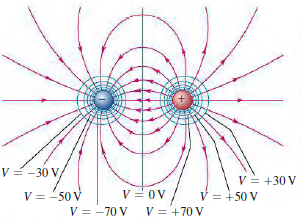
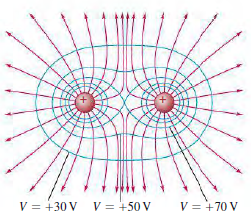
Because electric field lines and equipotential surfaces are always perpendicular, two equipotential surfaces can never cross; if they did, the direction of EÌ…(vector) would be ambiguous at the crossing points. Yet two equipotential surfaces appear to cross at the center of Fig. 23.23c.
An object with charge q = -6.00 × 10⁻⁹ C is placed in a region of uniform electric field and is released from rest at point A. After the charge has moved to point B, 0.500 m to the right, it has kinetic energy 3.00 × 10⁻⁷ J.(a) If the electric potential at point A is +30.0 V, what is the electric
If the electric potential at a single point is known, can E̅(vector) at that point be determined? If so, how? If not, why not?
It is easy to produce a potential difference of several thousand volts between your body and the floor by scuffing your shoes across a nylon carpet. When you touch a metal doorknob, you get a mild shock. Yet contact with a power line of comparable voltage would probably be fatal. Why is there a
The potential difference between the two terminals of an AA battery (used in flashlights and portable stereos) is 1.5 V. If two AA batteries are placed end to end with the positive terminal of one battery touching the negative terminal of the other, what is the potential difference between the
Two protons are released from rest when they are 0.750 nm apart.(a) What is the maximum speed they will reach? When does this speed occur?(b) What is the maximum acceleration they will achieve? When does this acceleration occur?
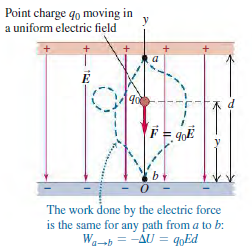
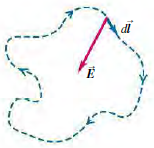
If you carry out the integral of the electric field ˆ«EÌ…(vector) ˆ™ dlÌ…(vector) for a closed path like that shown in Fig. Q23.9, the integral will always be equal to zero, independent of the shape of the path and independent of where charges may
(a) If the potential (relative to infinity) is zero at a point, is the electric field necessarily zero at that point?(b) If the electric field is zero at a point, is the potential (relative to infinity) necessarily zero there? Prove your answers, using simple examples.
Two protons, starting several meters apart, are aimed directly at each other with speeds of 2.00 × 10⁵ m/s, measured relative to the earth. Find the maximum electric force that these protons will exert on each other.
Which way do electric field lines point, from high to low potential or from low to high? Explain.
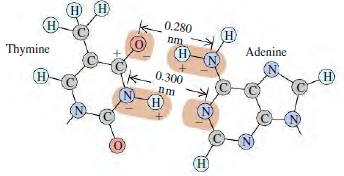
(See Exercise 21.21.)(a) Calculate the electric potential energy of the adenine€“thymine bond, using the same combinations of molecules (O-H-N and N-H-N) as in Exercise 21.21.(b) Compare this energy with the potential energy of the proton€“electron pair in the hydrogen atom.Data
If E̅(vector) is zero throughout a certain region of space, is the potential necessarily also zero in this region? Why or why not? If not, what can be said about the potential?
If E̅(vector) is zero everywhere along a certain path that leads from point A to point B, what is the potential difference between those two points? Does this mean that E̅(vector) is zero everywhere along any path from A to B? Explain.
Since potential can have any value you want depending on the choice of the reference level of zero potential, how does a voltmeter know what to read when you connect it between two points?
Is it possible to have an arrangement of two point charges separated by a finite distance such that the electric potential energy of the arrangement is the same as if the two charges were infinitely far apart? Why or why not? What if there are three charges? Explain.
The potential (relative to a point at infinity) midway between two charges of equal magnitude and opposite sign is zero. Is it possible to bring a test charge from infinity to this midpoint in such a way that no work is done in any part of the displacement? If so, describe how it can be done. If it
A student asked, “Since electrical potential is always proportional to potential energy, why bother with the concept of potential at all?” How would you respond?
Which statement is true about E̅(vector) inside a negatively charged sphere as described here?(a) It points from the center of the sphere to the surface and is largest at the center.(b) It points from the surface to the center of the sphere and is largest at the surface.(c) It is zero.(d) It is
What is the direction of E̅(vector) just outside the surface of such a sphere?(a) Tangent to the surface of the sphere;(b) Perpendicular to the surface, pointing toward the sphere;(c) Perpendicular to the surface, pointing away from the sphere;(d) There is no electric field just outside the
What is the magnitude of E̅(vector) just outside the surface of such a sphere?(a) 0;(b) 106 N/C;(c) 107 N/C;(d) 108 N/C.One of the hazards facing humans in space is space radiation: high-energy charged particles emitted by the sun. During a solar flare, the intensity of this radiation can reach
Suppose that to repel electrons in the radiation from a solar flare, each sphere must produce an electric field E̅(vector) of magnitude 1 × 10⁶ N/C at 25 m from the center of the sphere. What net charge on each sphere is needed?(a) -0.07 C;(b) -8 µC;(c) -80 µC;(d) -1 × 10-20 C.One of the
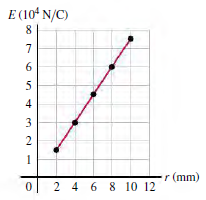
The electric field is measured for points at distances r from the center of a uniformly charged insulating sphere that has volume charge density Ï and radius R, where r < R (Fig. P22.60). Calculate Ï.Figure P22.60 E (10ª N/C) 4 3 r (mm) 2 4 6 8 10 12
An insulating hollow sphere has inner radius a and outer radius b. Within the insulating material the volume charge density is given by ρ(r) = α/r, where a is a positive constant.(a) In terms of a and a, what is the magnitude of the electric field at a distance r from the center of the shell,
In a region of space there is an electric field E̅(vector) that is in the z-direction and that has magnitude E = [3964 N/ (C ∙ m)]x. Find the flux for this field through a square in the xy-plane at z = 0 and with side length 0.350 m. One side of the square is along the +x-axis and another side
An infinitely long cylindrical conductor has radius R and uniform surface charge density σ.(a) In terms of σ and λ, what is the charge per unit length l for the cylinder?(b) In terms of σ, what is the magnitude of the electric field produced by the charged cylinder at a distance r > R from
A very large, horizontal, nonconducting sheet of charge has uniform charge per unit area s = 5.00 × 10⁻⁶ C/m2.(a) A small sphere of mass m = 8.00 × 10⁻⁶ kg and charge q is placed 3.00 cm above the sheet of charge and then released from rest. (a) If the sphere is to remain motionless when it is
Charge Q is distributed uniformly throughout the volume of an insulating sphere of radius R = 4.00 cm. At a distance of r = 8.00 cm from the center of the sphere, the electric field due to the charge distribution has magnitude E = 940 N/C. What are(a) The volume charge density for the sphere and(b)
Showing 700 - 800
of 2042
1
2
3
4
5
6
7
8
9
10
11
12
13
14
15
Last
Step by Step Answers

 Get 50% OFF
Claim Now
Get 50% OFF
Claim Now


![Temperature Coefficients of Resistivity (Approximate Values Near Room Temperature) a [(°C)-'] 0.0039 a [(°C)-'] Materi](https://dsd5zvtm8ll6.cloudfront.net/si.question.images/images/question_images/1539/8/6/5/3665bc87b16c979a1539891016624.jpg)