New Semester
Started
Get
50% OFF
Study Help!
--h --m --s
Claim Now
Question Answers
Textbooks
Find textbooks, questions and answers
Oops, something went wrong!
Change your search query and then try again
S
Books
FREE
Study Help
Expert Questions
Accounting
General Management
Mathematics
Finance
Organizational Behaviour
Law
Physics
Operating System
Management Leadership
Sociology
Programming
Marketing
Database
Computer Network
Economics
Textbooks Solutions
Accounting
Managerial Accounting
Management Leadership
Cost Accounting
Statistics
Business Law
Corporate Finance
Finance
Economics
Auditing
Tutors
Online Tutors
Find a Tutor
Hire a Tutor
Become a Tutor
AI Tutor
AI Study Planner
NEW
Sell Books
Search
Search
Sign In
Register
study help
physics
university physics
University Physics with Modern Physics 14th edition Hugh D. Young, Roger A. Freedman - Solutions
Lane dividers on highways sometimes have regularly spaced ridges or ripples. When the tires of a moving car roll along such a divider, a musical note is produced. Why? Explain how this phenomenon could be used to measure the car’s speed.
In a popular and amusing science demonstration, a person inhales helium and then his voice becomes high and squeaky. Why does this happen? (Warning: Inhaling too much helium can cause unconsciousness or death.)
Symphonic musicians always “warm up” their wind instruments by blowing into them before a performance. What purpose does this serve?
In most modern wind instruments the pitch is changed by using keys or valves to change the length of the vibrating air column. The bugle, however, has no valves or keys, yet it can play many notes. How might this be possible? Are there restrictions on what notes a bugle can play?
Would you expect the pitch (or frequency) of an organ pipe to increase or decrease with increasing temperature? Explain.
The hero of a western movie listens for an oncoming train by putting his ear to the track. Why does this method give an earlier warning of the approach of a train than just listening in the usual way?
When sound travels from air into water, does the frequency of the wave change? The speed? The wavelength? Explain your reasoning.
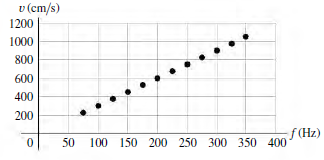
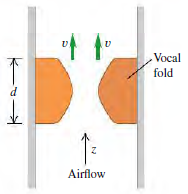
The wave speed is measured for different vibration frequencies. A graph of the wave speed as a function of frequency (Fig. P15.80) indicates that as the frequency increases, the wavelength(a) Increases;(b) Decreases;(c) Doesn€™t change;(d) Becomes undefined.Figure P15.80In the larynx,
Violins are short instruments, while cellos and basses are long. In terms of the frequency of the waves they produce, explain why this is so.
As we discussed in Section 15.1, water waves are a combination of longitudinal and transverse waves. Defend the following statement: “When water waves hit a vertical wall, the wall is a node of the longitudinal displacement but an antinode of the transverse displacement.”
The speed of ocean waves depends on the depth of the water; the deeper the water, the faster the wave travels. Use this to explain why ocean waves crest and “break” as they near the shore.
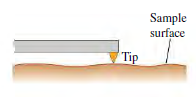
By what percentage does the frequency of oscillation change if ksurf= 5 N/m?(a) 0.1%;(b) 0.2%;(c) 0.5%;(d) 1.0%.One technique for making images of surfaces at the nanometer scale, including membranes and biomolecules, is dynamic atomic force microscopy. In this technique, a small tip is attached to
In the model of Problem 14.94, what is the mechanical energy of the vibration when the tip is not interacting with the surface?(a) 1.2 × 10⁻¹⁸ J;(b) 1.2 × 10⁻¹⁶ J;(c) 1.2 × 10⁻⁹ J;(d) 5.0 × 10⁻⁸ J.One technique for making images of surfaces at the
If we model the vibrating system as a mass on a spring, what is the mass necessary to achieve the desired resonant frequency when the tip is not interacting with the surface?(a) 25 ng;(b) 100 ng;(c) 2.5 µg;(d) 100 mg.One technique for making images of surfaces at the nanometer scale,
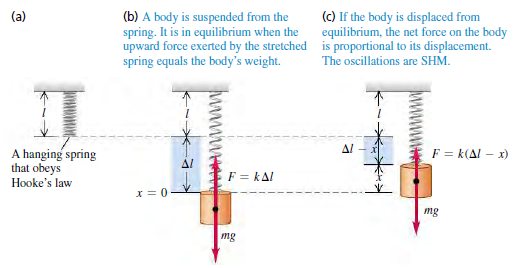
The system shown in Fig. 14.17 is mounted in an elevator. What happens to the period of the motion (does it increase, decrease, or remain the same) if the elevator(a) Accelerates upward at 5.0 m/s2;(b) Moves upward at a steady 5.0 m/s;(c) Accelerates downward at 5.0 m/s2?Justify your
Observations of this planet over time show that it is in a nearly circular orbit around its star and completes one orbit in only 9.5 days. How many times the orbital radius r of the earth around our sun is this exoplanet’s orbital radius around its sun? Assume that the earth is also in a nearly
How many times the acceleration due to gravity g near the earth’s surface is the acceleration due to gravity near the surface of this exoplanet?(a) About 0.29g;(b) about 0.65g;(c) about 1.5g;(d) about 7.9g.As planets with a wide variety of properties are being discovered outside our solar system,
Based on these data, what is the most likely composition of this planet?(a) Mostly iron;(b) Iron and rock;(c) Iron and rock with some lighter elements;(d) Hydrogen and helium gases.As planets with a wide variety of properties are being discovered outside our solar system, astrobiologists are
For a planet in our solar system, assume that the axis of orbit is at the sun and is circular. Then the angular momentum about that axis due to the planet’s orbital motion is L = MvR.(a) Derive an expression for L in terms of the planet’s mass M, orbital radius R, and period T of the orbit.(b)
A satellite with mass 848 kg is in a circular orbit with an orbital speed of 9640 m/s around the earth. What is the new orbital speed after friction from the earth’s upper atmosphere has done -7.50 × 10⁹ J of work on the satellite? Does the speed increase or decrease?
A planet makes a circular orbit with period T around a star. If the planet were to orbit at the same distance around this star, but the planet had three times as much mass, what would the new period (in terms of T) be:(a) 3T,(b) T√3,(c) T,(d) T/√13, or(e) T/3?
A spaceship makes a circular orbit with period T around a star. If it were to orbit, at the same distance, a star with three times the mass of the original star, would the new period (in terms of T) be(a) 3T,(b) T√3,(c) T,(d) T/√13, or(e) T/3?
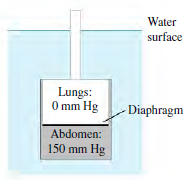
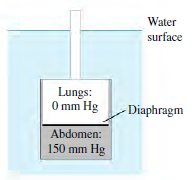
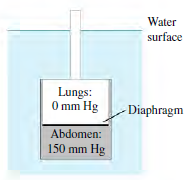
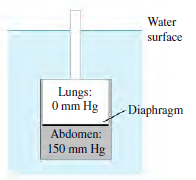
If the elephant were to snorkel in salt water, which is more dense than freshwater, would the maximum depth at which it could snorkel be different from that in freshwater?(a) Yes€”that depth would increase, because the pressure would be lower at a given depth in salt water than in
How does the force the diaphragm experiences due to the difference in pressure between the lungs and abdomen depend on the abdomen€™s distance below the water surface? The force(a) Increases linearly with distance;(b) Increases as distance squared;(c) Increases as distance cubed;(d)
The maximum force the muscles of the diaphragm can exert is 24,000 N. What maximum pressure difference can the diaphragm withstand? (a) 160 mm Hg; (b) 760 mm Hg; (c) 920 mm Hg; (d) 5000 mm Hg. An elephant can swim or walk with its chest several meters underwater while the animal breathes through
For the situation shown, the tissues in the elephant€™s abdomen are at a gauge pressure of 150 mm Hg. This pressure corresponds to what distance below the surface of a lake?(a) 1.5 m;(b) 2.0 m;(c) 3.0 m;(d) 15 m.An elephant can swim or walk with its chest several meters underwater while
The Environmental Protection Agency is investigating an abandoned chemical plant. A large, closed cylindrical tank contains an unknown liquid. You must determine the liquid€™s density and the height of the liquid in the tank (the vertical distance from the surface of the liquid to the
A cargo ship travels from the Atlantic Ocean (salt water) to Lake Ontario (freshwater) via the St. Lawrence River. The ship rides several centimeters lower in the water in Lake Ontario than it did in the ocean. Explain.
You drop a solid sphere of aluminum in a bucket of water that sits on the ground. The buoyant force equals the weight of water displaced; this is less than the weight of the sphere, so the sphere sinks to the bottom. If you take the bucket with you on an elevator that accelerates upward, the
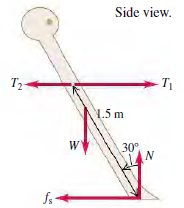
His body is leaning back at 30.0oto the vertical, but the coefficient of static friction between his feet and the ground is suddenly reduced to 0.50. What will happen?(a) His entire body will accelerate forward;(b) His feet will slip forward;(c) His feet will slip backward;(d) His feet will not
His body is again leaning back at 30.0oto the vertical, but now the height at which the rope is held above but still parallel to the ground is varied. The tension in the rope in front of the competitor (T1) is measured as a function of the shortest distance between the rope and the ground (the
If he leans slightly farther back (increasing the angle between his body and the vertical) but remains stationary in this new position, which of the following statements is true? Assume that the rope remains horizontal.(a) The difference between T1 and T2 will increase, balancing the increased
Certain features of a person, such as height and mass, are fixed (at least over relatively long periods of time). Are the following features also fixed?(a) Location of the center of gravity of the body;(b) Moment of inertia of the body about an axis through the person’s center of mass. Explain
You are balancing a wrench by suspending it at a single point. Is the equilibrium stable, unstable, or neutral if the point is above, at, or below the wrench’s center of gravity? In each case give the reasoning behind your answer. (For rotation, a rigid body is in stable equilibrium if a small
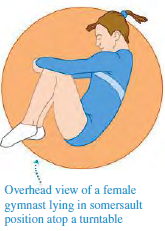
If the body€™s center of mass were not placed on the rotational axis of the turntable, how would the person€™s measured moment of inertia compare to the moment of inertia for rotation about the center of mass?(a) The measured moment of inertia would be too large;(b) The measured
A doubling of the torque produces a greater angular acceleration. Which of the following would do this, assuming that the tension in the rope doesn€™t change?(a) Increasing the pulley diameter by a factor of ˆš2;(b) Increasing the pulley diameter by a factor of 2;(c) Increasing
While the turntable is being accelerated, the person suddenly extends her legs. What happens to the turntable?(a) It suddenly speeds up;(b) It rotates with constant speed;(c) Its acceleration decreases;(d) It suddenly stops rotating.The moment of inertia of the human body about an axis through its
The moment of inertia of the empty turntable is 1.5 kg m2. With a constant torque of 2.5 N ˆ™ m, the turntable€“person system takes 3.0 s to spin from rest to an angular speed of 1.0 rad/s. What is the person€™s moment of inertia about an axis through her center of
You are testing a small flywheel (radius 0.166 m) that will be used to store a small amount of energy. The flywheel is pivoted with low friction bearings about a horizontal shaft through the flywheel€™s center. A thin, light cord is wrapped multiple times around the rim of the flywheel.
You have one object of each of these shapes, all with mass 0.840 kg: a uniform solid cylinder, a thin-walled hollow cylinder, a uniform solid sphere, and a thin-walled hollow sphere. You release each object from rest at the same vertical height h above the bottom of a long wooden ramp that is
The V6 engine in a 2014 Chevrolet Silverado 1500 pickup truck is reported to produce a maximum power of 285 hp at 5300 rpm and a maximum torque of 305 ft ∙ lb at 3900 rpm.(a) Calculate the torque, in both ft ∙ lb and N ∙ m, at 5300 rpm. Is your answer in ft ∙ lb smaller than the specified
In Example 10.10 (Section 10.6) the angular speed v changes, and this must mean that there is nonzero angular acceleration. But there is no torque about the rotation axis if the forces the professor applies to the weights are directly, radially inward. Then, by Eq. (10.7), αzmust be
When you stand with bare feet in a wet bathtub, the grip feels fairly secure, and yet a catastrophic slip is quite possible. Explain this in terms of the two coefficients of friction.
A point particle travels in a straight line at constant speed, and the closest distance it comes to the origin of coordinates is a distance l. With respect to this origin, does the particle have nonzero angular momentum? As the particle moves along its straight-line path, does its angular momentum
A ball is rolling along at speed v without slipping on a horizontal surface when it comes to a hill that rises at a constant angle above the horizontal. In which case will it go higher up the hill: if the hill has enough friction to prevent slipping or if the hill is perfectly smooth? Justify your
You are designing a flywheel to store kinetic energy. If all of the following uniform objects have the same mass and same angular velocity, which one will store the greatest amount of kinetic energy? Which will store the least? Explain. (a) A solid sphere of diameter D rotating about a
What is the purpose of the spin cycle of a washing machine? Explain in terms of acceleration components.
A flywheel rotates with constant angular velocity. Does a point on its rim have a tangential acceleration? A radial acceleration? Are these accelerations constant in magnitude? In direction? In each case give your reasoning.
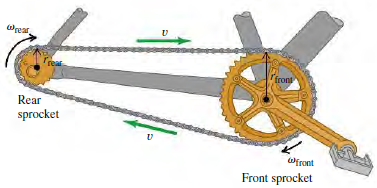
In Fig. Q9.4, how are the radial accelerations of points at the teeth of the two sprockets related? Explain. Wrear Treat front Rear sprocket Wfront Front sprocket
The fish shoots the drop of water at an insect that hovers on the water’s surface, so just before colliding with the insect, the drop is still moving at the speed it had when it left the fish’s mouth. In the collision, the drop sticks to the insect, and the speed of the insect and water just
What is the average force the fish exerts on the drop of water?(a) 0.00015 N;(b) 0.00075 N;(c) 0.075 N;(d) 0.15 N.Archerfish are tropical fish that hunt by shooting drops of water from their mouths at insects above the water’s surface to knock them into the water, where the fish can eat them. A
What is the speed of the archerfish immediately after it expels the drop of water?(a) 0.0025 m/s;(b) 0.012 m/s;(c) 0.75 m/s;(d) 2.5 m/sArcherfish are tropical fish that hunt by shooting drops of water from their mouths at insects above the water’s surface to knock them into the water, where the
What is the momentum of one drop of water immediately after it leaves the fish’s mouth?(a) 7.5 × 10⁻⁴ kg ∙ m/s;(b) 1.5 × 10⁻⁴ kg ∙ m/s;(c) 7.5 × 10⁻³ kg ∙ m/s;(d) 1.5 × 10⁻³ kg ∙ m/s.Archerfish are tropical fish that hunt by shooting drops of water from their mouths at insects above
Block B (mass 4.00 kg) is at rest at the edge of a smooth platform, 2.60 m above the floor. Block A (mass 2.00 kg) is sliding with a speed of 8.00 m/s along the platform toward block B. A strikes B and rebounds with a speed of 2.00 m/s. The collision projects B horizontally off the platform. What
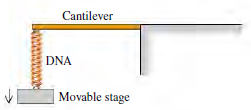
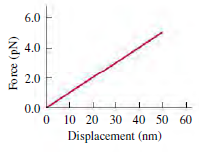
Based on Fig. P7.82, how much elastic potential energy is stored in the DNA when it is stretched 50 nm?(a) 2.5 * 10-19 J;(b) 1.2 * 10-19 J;(c) 5.0 * 10-12 J;(d) 2.5 * 10-12 J.A DNA molecule, with its doublehelix structure, can in some situations behave like a spring. Measuring the force required to
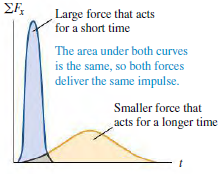
A glass dropped on the floor is more likely to break if the floor is concrete than if it is wood. Why? (Refer to Fig. 8.3b.)Fig 8.3b ΣΗ Large force that acts for a short time The area under both curves is the same, so both forces deliver the same impulse. Smaller force that acts for a longer time
A segment of DNA is put in place and stretched. Figure P7.82 shows a graph of the force exerted on the DNA as a function of the displacement of the stage. Based on this graph, which statement is the best interpretation of the DNA€™s behavior over this range of displacements? The DNA(a)
During the calibration process, the cantilever is observed to deflect by 0.10 nm when a force of 3.0 pN is applied to it. What deflection of the cantilever would correspond to a force of 6.0 pN?(a) 0.07 nm;(b) 0.14 nm;(c) 0.20 nm;(d) 0.40 nm.A DNA molecule, with its doublehelix structure, can in
A small block with mass 0.0400 kg is moving in the xy-plane. The net force on the block is described by the potential energy function U(x, y) = (5.80 J/m2)x2 - (3.60 J/m3)y3. What are the magnitude and direction of the acceleration of the block when it is at the point (x = 0.300 m, y = 0.600 m)?
When people are cold, they often rub their hands together to warm up. How does doing this produce heat? Where does the heat come from?
An object is released from rest at the top of a ramp. If the ramp is frictionless, does the object’s speed at the bottom of the ramp depend on the shape of the ramp or just on its height? Explain. What if the ramp is not frictionless?
How many times greater is the kinetic energy of the person when biking than when walking? Ignore the mass of the bike.(a) 1.7;(b) 3;(c) 6;(d) 9.On flat ground, a 70-kg person requires about 300 W of metabolic power to walk at a steady pace of 5.0 km/h(1.4 m/s). Using the same metabolic power
A 70-kg person walks at a steady pace of 5.0 km/h on a treadmill at a 5.0% grade. (That is, the vertical distance covered is 5.0% of the horizontal distance covered.) If we assume the metabolic power required is equal to that required for walking on a flat surface plus the rate of doing work for
Based on the given data, how does the energy used in biking 1 km compare with that used in walking 1 km? Biking takes(a) 1/3 of the energy of walking the same distance;(b) The same energy as walking the same distance;(c) 3 times the energy of walking the same distance;(d) 9 times the energy of
Suppose you are in a rocket with no windows, traveling in deep space far from other objects. Without looking outside the rocket or making any contact with the outside world, explain how you could determine whether the rocket is(a) Moving forward at a constant 80% of the speed of light and(b)
The sign of many physical quantities depends on the choice of coordinates. For example, ay for free-fall motion can be negative or positive, depending on whether we choose upward or downward as positive. Is the same true of work? In other words, can we make positive work negative by a different
A person wearing these shoes stands on a smooth, horizontal rock. She pushes against the ground to begin running. What is the maximum horizontal acceleration she can have without slipping?(a) 0.20g;(b) 0.75g;(c) 0.90g;(d) 1.2g.
If the person steps onto a smooth rock surface that’s inclined at an angle large enough that these shoes begin to slip, what will happen?(a) She will slide a short distance and stop;(b) She will accelerate down the surface;(c) She will slide down the surface at constant speed;(d) We can’t tell
For a person wearing these shoes, what’s the maximum angle (with respect to the horizontal) of a smooth rock that can be walked on without slipping?(a) 42°;(b) 50°;(c) 64°;(d) larger than 90°.
When a batted baseball moves with air drag, when does the ball travel a greater horizontal distance?(i) While climbing to its maximum height;(ii) While descending from its maximum height back to the ground;(iii) The same for both? Explain in terms of the forces acting on the ball.
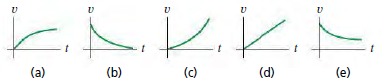
A ball is dropped from rest and feels air resistance as it falls. Which of the graphs in Fig. Q5.26 best represents its vertical velocity component as a function of time?Figure Q5.26 (a) (c) (d) (e) (b)
You throw a baseball straight upward. If you do not ignore air resistance, how does the time required for the ball to reach its maximum height compare to the time required for it to fall from its maximum height back down to the height from which you threw it? Explain.
A crate slides up an inclined ramp and then slides down the ramp after momentarily stopping near the top. There is kinetic friction between the surface of the ramp and the crate. Which is greater?(i) The crate’s acceleration going up the ramp;(ii) The crate’s acceleration going down the
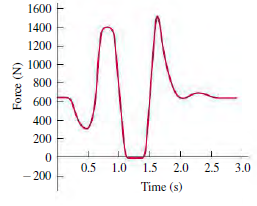
The forces on a dancer can be measured directly when a dancer performs a jump on a force plate that measures the force between her feet and the ground. A graph of force versus time throughout a vertical jump performed on a force plate is shown in Fig. P4.60. What is happening at 0.4 s? The dancer
While the dancer is in the air and holding a fixed pose, what is the magnitude of the force her neck exerts on her head?(a) 0 N;(b) 60 N;(c) 120 N;(d) 180 N.
Compared with the force her neck exerts on her head during the landing, the force her head exerts on her neck is(a) The same;(b) Greater;(c) Smaller;(d) Greater during the first half of the landing and smaller during the second half of the landing.
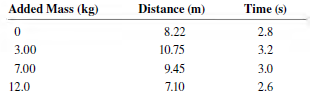
An 8.00-kg box sits on a level floor. You give the box a sharp push and find that it travels 8.22 m in 2.8 s before coming to rest again.(a) You measure that with a different push the box traveled 4.20 m in 2.0 s. Do you think the box has a constant acceleration as it slows down? Explain your
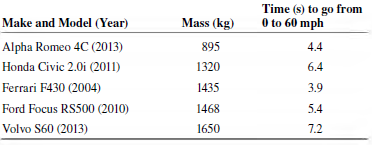
The table* gives automobile performance data for a few types of cars:(a) During an acceleration of 0 to 60 mph, which car has the largest average net force acting on it? The smallest?(b) During this acceleration, for which car would the average net force on a 72.0 kg passenger be the largest? The
A mysterious rocket-propelled object of mass 45.0 kg is initially at rest in the middle of the horizontal, frictionless surface of an ice-covered lake. Then a force directed east and with magnitude F(t) = (16.8 N/s)t is applied. How far does the object travel in the first 5.00 s after the force is
You have landed on an unknown planet, Newtonia, and want to know what objects weigh there. When you push a certain tool, starting from rest, on a frictionless horizontal surface with a 12.0-N force, the tool moves 16.0 m in the first 2.00 s. You next observe that if you release this tool from rest
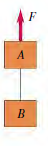
Boxes A and B are connected to each end of a light vertical rope (Fig. P4.49). A constant upward force F = 80.0 N is applied to box A. Starting from rest, box B descends 12.0 m in 4.00 s. The tension in the rope connecting the two boxes is 36.0 N. What are the masses of(a) Box B,(b) Box A?Figure
After an annual checkup, you leave your physician’s office, where you weighed 683 N. You then get into an elevator that, conveniently, has a scale. Find the magnitude and direction of the elevator’s acceleration if the scale reads(a) 725 N and(b) 595 N.
In a head-on collision between a compact 1000-kg car and a large 2500-kg car, which one experiences the greater force? Explain. Which one experiences the greater acceleration? Explain why. Why are passengers in the small car more likely to be injured than those in the large car, even when the two
In a head-on auto collision, passengers who are not wearing seat belts may be thrown through the windshield. Use Newton’s laws of motion to explain why this happens.
When a car is hit from behind, the occupants may experience whiplash. Use Newton’s laws of motion to explain what causes this result.
If you squat down (such as when you examine the books on a bottom shelf) and then suddenly get up, you may temporarily feel light-headed. What do Newton’s laws of motion have to say about why this happens?
If your hands are wet and no towel is handy, you can remove some of the excess water by shaking them. Why does this work?
A manual for student pilots contains this passage: “When an airplane flies at a steady altitude, neither climbing nor descending, the upward lift force from the wings equals the plane’s weight. When the plane is climbing at a steady rate, the upward lift is greater than the weight; when the
Boxes A and B are in contact on a horizontal, frictionless surface. You push on box A with a horizontal 100-N force (Fig. Q4.31). Box A weighs 150 N, and box B weighs 50 N. Is the force that box A exerts on box B equal to 100 N, greater than 100 N, or less than 100 N? Explain.
Consider a tug-of-war between two people who pull in opposite directions on the ends of a rope. By Newton’s third law, the force that A exerts on B is just as great as the force that B exerts on A. So what determines who wins?
A small compact car is pushing a large van that has broken down, and they travel along the road with equal velocities and accelerations. While the car is speeding up, is the force it exerts on the van larger than, smaller than, or the same magnitude as the force the van exerts on it? Which vehicle
When a car comes to a stop on a level highway, what force causes it to slow down? When the car increases its speed on the same highway, what force causes it to speed up? Explain.
A large truck and a small compact car have a head-on collision. During the collision, the truck exerts a force F̅T on C on the car, and the car exerts a force F̅C on T on the truck. Which force has the larger magnitude, or are they the same? Does your answer depend on how fast each vehicle was
True or false? You exert a push P on an object and it pushes back on you with a force F. If the object is moving at constant velocity, then F is equal to P, but if the object is being accelerated, then P must be greater than F.
A horse is hitched to a wagon. Since the wagon pulls back on the horse just as hard as the horse pulls on the wagon, why doesn’t the wagon remain in equilibrium, no matter how hard the horse pulls?
Why is it incorrect to say that 1.0 kg equals 2.2 lb?
Which feels a greater pull due to the earth’s gravity: a 10-kg stone or a 20-kg stone? If you drop the two stones, why doesn’t the 20-kg stone fall with twice the acceleration of the 10-kg stone? Explain.
A large crate is suspended from the end of a vertical rope. Is the tension in the rope greater when the crate is at rest or when it is moving upward at constant speed? If the crate is traveling upward, is the tension in the rope greater when the crate is speeding up or when it is slowing down? In
When a string barely strong enough lifts a heavy weight, it can lift the weight by a steady pull; but if you jerk the string, it will break. Explain in terms of Newton’s laws of motion.
Why are cars designed to crumple in front and back for safety? Why not for side collisions and rollovers?
Showing 1000 - 1100
of 2042
First
4
5
6
7
8
9
10
11
12
13
14
15
16
17
18
Last
Step by Step Answers

 Get 50% OFF
Claim Now
Get 50% OFF
Claim Now