New Semester
Started
Get
50% OFF
Study Help!
--h --m --s
Claim Now
Question Answers
Textbooks
Find textbooks, questions and answers
Oops, something went wrong!
Change your search query and then try again
S
Books
FREE
Study Help
Expert Questions
Accounting
General Management
Mathematics
Finance
Organizational Behaviour
Law
Physics
Operating System
Management Leadership
Sociology
Programming
Marketing
Database
Computer Network
Economics
Textbooks Solutions
Accounting
Managerial Accounting
Management Leadership
Cost Accounting
Statistics
Business Law
Corporate Finance
Finance
Economics
Auditing
Tutors
Online Tutors
Find a Tutor
Hire a Tutor
Become a Tutor
AI Tutor
AI Study Planner
NEW
Sell Books
Search
Search
Sign In
Register
study help
physics
university physics
University Physics with Modern Physics 14th edition Hugh D. Young, Roger A. Freedman - Solutions
Two very long uniform lines of charge are parallel and are separated by 0.300 m. Each line of charge has charge per unit length +5.20 µC/m. What magnitude of force does one line of charge exert on a 0.0500-m section of the other line of charge?
Explain this statement: “In a static situation, the electric field at the surface of a conductor can have no component parallel to the surface because this would violate the condition that the charges on the surface are at rest.” Would this statement be valid for the electric field at the
A solid conductor has a cavity in its interior. Would the presence of a point charge inside the cavity affect the electric field outside the conductor? Why or why not? Would the presence of a point charge outside the conductor affect the electric field inside the cavity? Again, why or why not?
A lightning rod is a rounded copper rod mounted on top of a building and welded to a heavy copper cable running down into the ground. Lightning rods are used to protect houses and barns from lightning; the lightning current runs through the copper rather than through the building. Why? Why should
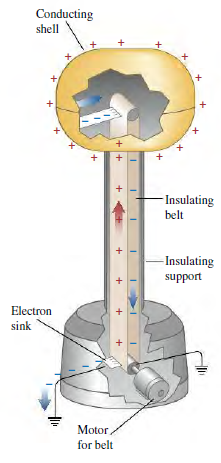
You charge up the Van de Graaff generator shown in Fig. 22.26, and then bring an identical but uncharged hollow conducting sphere near it, without letting the two spheres touch. Sketch the distribution of charges on the second sphere. What is the net flux through the second sphere? What is the
In a conductor, one or more electrons from each atom are free to roam throughout the volume of the conductor. Does this contradict the statement that any excess charge on a solid conductor must reside on its surface? Why or why not?
If the electric field of a point charge were proportional to 1/r3 instead of 1/r2, would Gauss’s law still be valid? Explain your reasoning. Consider a spherical Gaussian surface centered on a single point charge.
A solid copper sphere has a net positive charge. The charge is distributed uniformly over the surface of the sphere, and the electric field inside the sphere is zero. Then a negative point charge outside the sphere is brought close to the surface of the sphere. Is all the net charge on the sphere
You find a sealed box on your doorstep. You suspect that the box contains several charged metal spheres packed in insulating material. How can you determine the total net charge inside the box without opening the box? Or isn’t this possible?
A spherical Gaussian surface encloses a point charge q. If the point charge is moved from the center of the sphere to a point away from the center, does the electric field at a point on the surface change? Does the total flux through the Gaussian surface change? Explain.
A certain region of space bounded by an imaginary closed surface contains no charge. Is the electric field always zero everywhere on the surface? If not, under what circumstances is it zero on the surface?
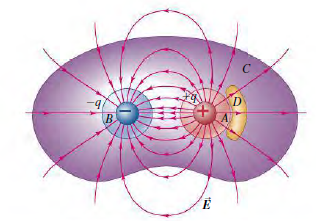
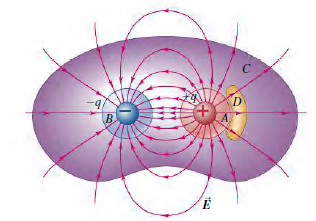
In Fig. 22.15, suppose a third point charge were placed outside the purple Gaussian surface C. Would this affect the electric flux through any of the surfaces A, B, C, or D in the figure? Why or why not?Fig. 22.15 B.
Suppose that in Fig. 22.15 both charges were positive. What would be the fluxes through each of the four surfaces in the example?Fig. 22.15 B.
A rubber balloon has a single point charge in its interior. Does the electric flux through the balloon depend on whether or not it is fully inflated? Explain your reasoning.
In a follow-up experiment, a charge of +40 pC was placed at the center of an artificial flower at the end of a 30-cm long stem. Bees were observed to approach no closer than 15 cm from the center of this flower before they flew away. This observation suggests that the smallest external electric
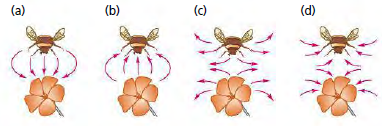
After one bee left a flower with a positive charge, that bee flew away and another bee with the same amount of positive charge flew close to the plant. Which diagram in Fig. P21.100 best represents the electric field lines between the bee and the flower?Figure P21.100Flying insects such as bees may
What is the best explanation for the observation that the electric charge on the stem became positive as the charged bee approached (before it landed)?(a) Because air is a good conductor, the positive charge on the bee’s surface flowed through the air from bee to plant.(b) Because the earth is a
Consider a bee with the mean electric charge found in the experiment. This charge represents roughly how many missing electrons?(a) 1.9 × 10⁸;(b) 3.0 × 10⁸;(c) 1.9 × 10¹⁸;(d) 3.0 × 10¹⁸.Flying insects such as bees may accumulate a small positive electric charge as they fly. In one experiment,
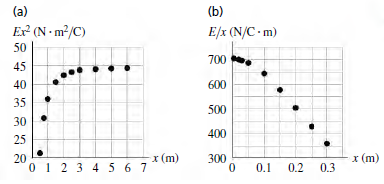
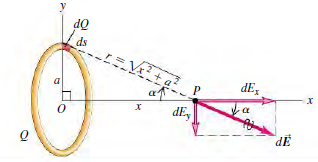
Positive charge Q is distributed uniformly around a very thin conducting ring of radius a, as in Fig. 21.23. You measure the electric field E at points on the ring axis, at a distance x from the center of the ring, over a wide range of values of x. (a) Your results for the larger values of x
Two small spheres, each carrying a net positive charge, are separated by 0.400 m. You have been asked to perform measurements that will allow you to determine the charge on each sphere. You set up a coordinate system with one sphere (charge q1) at the origin and the other sphere (charge q2) at x =
In a region where there is a uniform electric field that is upward and has magnitude 3.60 × 10⁴ N/C, a small object is projected upward with an initial speed of 1.92 m/s. The object travels upward a distance of 6.98 cm in 0.200 s. What is the object’s chargeto- mass ratio q/m? Assume g = 9.80
The earth has a downward-directed electric field near its surface of about 150 N/C. If a raindrop with a diameter of 0.020 mm is suspended, motionless, in this field, how many excess electrons must it have on its surface?
A nerve signal is transmitted through a neuron when an excess of Na+ ions suddenly enters the axon, a long cylindrical part of the neuron. Axons are approximately 10.0 mm in diameter, and measurements show that about 5.6 × 10¹¹ Na+ ions per meter (each of charge +e) enter during this process.
Two point charges Q and +q (where q is positive) produce the net electric field shown at point P in Fig. E21.36. The field points parallel to the line connecting the two charges.(a) What can you conclude about the sign and magnitude of Q? Explain your reasoning.(b) If the lower charge were negative
The air temperature and the velocity of the air have different values at different places in the earth’s atmosphere. Is the air velocity a vector field? Why or why not? Is the air temperature a vector field? Again, why or why not?
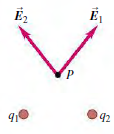
The electric fields at point P due to the positive charges q1and q2are shown in Fig. Q21.22. Does the fact that they cross each other violate the statement in Section 21.6 that electric field lines never cross? Explain.Figure Q21.22 Ë, 92
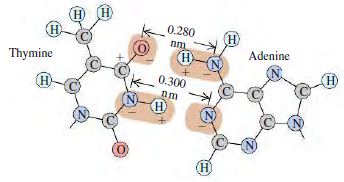
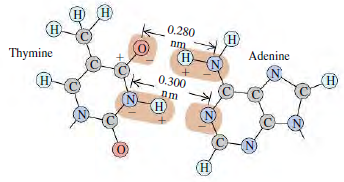
Refer to Exercise 21.21. Figure E21.22 shows the bonding of cytosine and guanine. The O€”H and H€”N distances are each 0.110 nm. In this case, assume that the bonding is due only to the forces along the O€”H€”O, N€”H€”N, and
Sufficiently strong electric fields can cause atoms to become positively ionized that is, to lose one or more electrons. Explain how this can happen. What determines how strong the field must be to make this happen?
The two sides of the DNA double helix are connected by pairs of bases (adenine, thymine, cytosine, and guanine). Because of the geometric shape of these molecules, adenine bonds with thymine and cytosine bonds with guanine. Figure E21.21 shows the bonding of thymine and adenine. Each charge shown
Atomic nuclei are made of protons and neutrons. This shows that there must be another kind of interaction in addition to gravitational and electric forces. Explain.
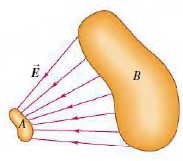
Two irregular objects A and B carry charges of opposite sign. Figure Q21.19 shows the electric field lines near each of these objects.(a) Which object is positive, A or B? How do you know?(b) Where is the electric field stronger, close to A or close to B? How do you know?Figure Q21.19 B
What similarities do electric forces have with gravitational forces? What are the most significant differences?
In Example 21.1 (Section 21.3) we saw that the electric force between two a particles is of the order of 1035 times as strong as the gravitational force. So why do we readily feel the gravity of the earth but no electric force from it?
A proton is placed in a uniform electric field and then released. Then an electron is placed at this same point and released. Do these two particles experience the same force? The same acceleration? Do they move in the same direction when released?
A point charge of mass m and charge Q and another point charge of mass m but charge 2Q are released on a frictionless table. If the charge Q has an initial acceleration a0, what will be the acceleration of 2Q: a0, 2a0, 4a0, a0/2, or a0/4? Explain.
When two point charges of equal mass and charge are released on a frictionless table, each has an initial acceleration (magnitude) a0. If instead you keep one fixed and release the other one, what will be its initial acceleration: a0 , 2a0 , or a0/2? Explain.
You have a negatively charged object. How can you use it to place a net negative charge on an insulated metal sphere? To place a net positive charge on the sphere?
If you walk across a nylon rug and then touch a large metal object such as a doorknob, you may get a spark and a shock. Why does this tend to happen more on dry days than on humid days? Why are you less likely to get a shock if you touch a small metal object, such as a paper clip?Fig.21.30 The
Two identical metal objects are mounted on insulating stands. Describe how you could place charges of opposite sign but exactly equal magnitude on the two objects.
Good conductors of electricity, such as metals, are typically good conductors of heat; insulators, such as wood, are typically poor conductors of heat. Explain why there is a relationship between conduction of electricity and conduction of heat in these materials.
Your clothing tends to cling together after going through the dryer. Why? Would you expect more or less clinging if all your clothing were made of the same material (say, cotton) than if you dried different kinds of clothing together? Again, why? (You may want to experiment with your next load of
You have a pure (24-karat) gold ring of mass 10.8 g. Gold has an atomic mass of 197 g/mol and an atomic number of 79.(a) How many protons are in the ring, and what is their total positive charge?(b) If the ring carries no net charge, how many electrons are in it?
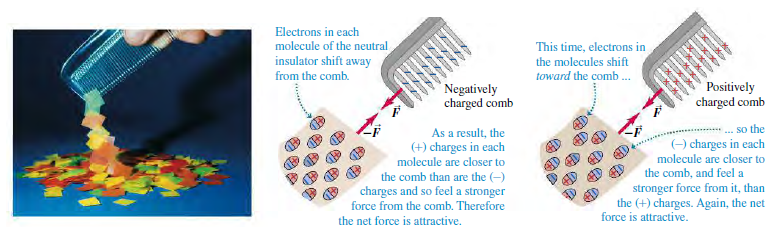
The electric force between two charged particles becomes weaker with increasing distance. Suppose instead that the electric force were independent of distance. In this case, would a charged comb still cause a neutral insulator to become polarized as in Fig. 21.8? Why or why not? Would the neutral
If a proton and an electron are released when they are 2.0 × 10⁻¹⁰ m apart (a typical atomic distance), find the initial acceleration of each particle.
Two metal spheres are hanging from nylon threads. When you bring the spheres close to each other, they tend to attract. Based on this information alone, discuss all the possible ways that the spheres could be charged. Is it possible that after the spheres touch, they will cling together? Explain.
If you peel two strips of transparent tape off the same roll and immediately let them hang near each other, they will repel each other. If you then stick the sticky side of one to the shiny side of the other and rip them apart, they will attract each other. Give a plausible explanation, involving
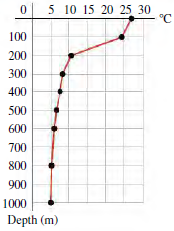
Ocean thermal energy conversion is a process that uses the temperature difference between the warm surface water of tropical oceans and the cold deep ocean water to run a heat engine. The graph shows a typical decrease of temperature with depth below the surface in tropical oceans. In the heat
Compare the entropy change of the warmer water to that of the colder water during one cycle of the heat engine, assuming an ideal Carnot cycle.(a) The entropy does not change during one cycle in either case.(b) The entropy of both increases, but the entropy of the colder water increases by more
What is the change in entropy of the ammonia vaporized per second in the 10-MW power plant, assuming an ideal Carnot efficiency of 6.5%?(a) +6 × 10⁶ J/K per second;(b) +5 × 10⁵ J/K per second;(c) +1 × 10⁵ J/K per second;(d) 0.Ocean thermal energy conversion is
If the power plant uses a Carnot cycle and the desired theoretical efficiency is 6.5%, from what depth must cold water be brought?(a) 100 m;(b) 400 m;(c) 800 m;(d) deeper than 1000 m.Ocean thermal energy conversion is a process that uses the temperature difference between the warm surface water of
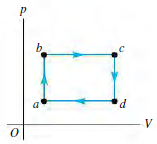
You are conducting experiments to study prototype heat engines. In one test, 4.00 mol of argon gas are taken around the cycle shown in Fig. P20.57. The pressure is low enough for the gas to be treated as ideal. You measure the gas temperature in states a, b, c, and d and find Ta= 250.0 K, Tb= 300.0
For a refrigerator or air conditioner, the coefficient of performance K (often denoted as COP) is, as in Eq. (20.9), the ratio of cooling output |QC| to the required electrical energy input |W| , both in joules. The coefficient of performance is also expressed as a ratio of powers, where
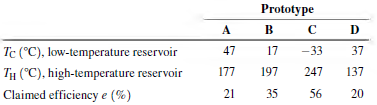
In your summer job with a venture capital firm, you are given funding requests from four inventors of heat engines. The inventors claim the following data for their operating prototypes:(a) Based on the TC and TH values for each prototype, find the maximum possible efficiency for each.(b) Are any
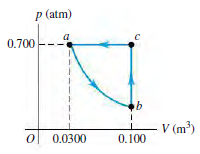
The pV-diagram in Fig. P20.51 shows the cycle for a refrigerator operating on 0.850 mol of H2. Assume that the gas can be treated as ideal. Process ab is isothermal. Find the coefficient of performance of this refrigerator.Figure P20.51 p (atm) 0.700 V (m) ol 0.0300 0.100
Premium gasoline produces 1.23 × 10⁸ J of heat per gallon when it is burned at approximately 400°C (although the amount can vary with the fuel mixture). If a car’s engine is 25% efficient, three-fourths of that heat is expelled into the air, typically at 20°C. If your car gets 35 miles per
A growing plant creates a highly complex and organized structure out of simple materials such as air, water, and trace minerals. Does this violate the second law of thermodynamics? Why or why not? What is the plant’s ultimate source of energy? Explain.
If you run a movie film backward, it is as if the direction of time were reversed. In the time-reversed movie, would you see processes that violate conservation of energy? Conservation of linear momentum? Would you see processes that violate the second law of thermodynamics? In each case, if
Suppose that you put a hot object in thermal contact with a cold object and observe (much to your surprise) that heat flows from the cold object to the hot object, making the cold one colder and the hot one hotter. Does this process necessarily violate the first law of thermodynamics? The second
Are the earth and sun in thermal equilibrium? Are there entropy changes associated with the transmission of energy from the sun to the earth? Does radiation differ from other modes of heat transfer with respect to entropy changes? Explain your reasoning.
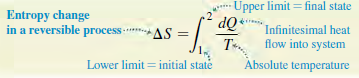
The free expansion of an ideal gas is an adiabatic process and so no heat is transferred. No work is done, so the internal energy does not change. Thus, Q/T = 0, yet the randomness of the system and thus its entropy have increased after the expansion. Why does Eq. (20.19) not apply to this
Explain why each of the following processes is an example of increasing randomness: mixing hot and cold water; free expansion of a gas; irreversible heat flow; developing heat by mechanical friction. Are entropy increases involved in all of these? Why or why not?
How can the thermal conduction of heat from a hot object to a cold object increase entropy when the same amount of heat that flows out of the hot object flows into the cold one?
In Example 20.4, a Carnot refrigerator requires a work input of only 230 J to extract 346 J of heat from the cold reservoir. Doesn’t this discrepancy imply a violation of the law of conservation of energy? Explain why or why not.
Does a refrigerator full of food consume more power if the room temperature is 20°C than if it is 15°C? Or is the power consumption the same? Explain your reasoning.
Real heat engines, like the gasoline engine in a car, always have some friction between their moving parts, although lubricants keep the friction to a minimum. Would a heat engine with completely frictionless parts be 100% efficient? Why or why not? Does the answer depend on whether or not the
What would be the efficiency of a Carnot engine operating with TH = TC? What would be the efficiency if TC = 0 K and TH were any temperature above 0 K? Interpret your answers.
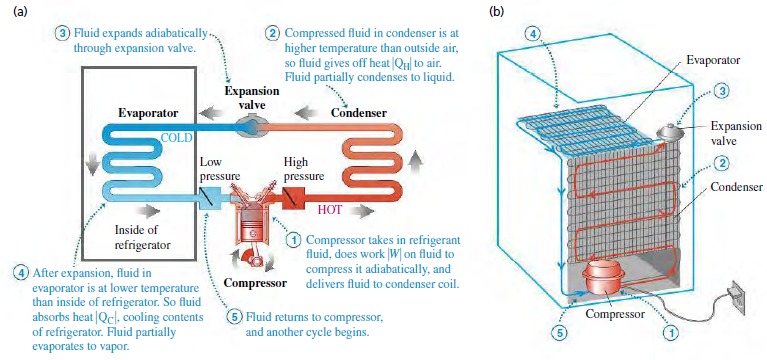
The efficiency of heat engines is high when the temperature difference between the hot and cold reservoirs is large. Refrigerators, on the other hand, work better when the temperature difference is small. Thinking of the mechanical refrigeration cycle shown in Fig. 20.9, explain in physical terms
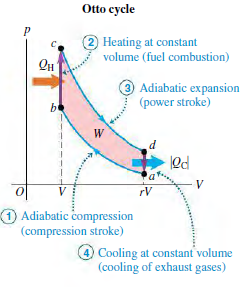
Compare the pV-diagram for the Otto cycle in Fig. 20.6 with the diagram for the Carnot heat engine in Fig. 20.13. Explain some of the important differences between the two cycles.Fig. 20.6 Otto cycle 2 Heating at constant volume (fuel combustion) Adiabatic expansion (power stroke) be rV (1
When a wet cloth is hung up in a hot wind in the desert, it is cooled by evaporation to a temperature that may be 20 C° or so below that of the air. Discuss this process in light of the second law of thermodynamics.
Imagine a special air filter placed in a window of a house. The tiny holes in the filter allow only air molecules moving faster than a certain speed to exit the house, and allow only air molecules moving slower than that speed to enter the house from outside. Explain why such an air filter would
Is it a violation of the second law of thermodynamics to convert mechanical energy completely into heat? To convert heat completely into work? Explain your answers.
Why must a room air conditioner be placed in a window rather than just set on the floor and plugged in? Why can a refrigerator be set on the floor and plugged in?
Suppose you try to cool the kitchen of your house by leaving the refrigerator door open. What happens? Why? Would the result be the same if you left open a picnic cooler full of ice? Explain the reason for any differences.
Household refrigerators have arrays or coils of tubing on the outside, usually at the back or bottom. When the refrigerator is running, the tubing becomes quite hot. Where does the heat come from?
Give two examples of reversible processes and two examples of irreversible processes in purely mechanical systems, such as blocks sliding on planes, springs, pulleys, and strings. Explain what makes each process reversible or irreversible.
A pot is half-filled with water, and a lid is placed on it, forming a tight seal so that no water vapor can escape. The pot is heated on a stove, forming water vapor inside the pot. The heat is then turned off and the water vapor condenses back to liquid. Is this cycle reversible or irreversible?
In a hospital, pure oxygen may be delivered at 50 psi (gauge pressure) and then mixed with N2O. What volume of oxygen at 20°C and 50 psi (gauge pressure) should be mixed with 1.7 kg of N2O to get a 50%/50% mixture by volume at 20°C?(a) 0.21 m3;(b) 0.27 m3;(c) 1.9 m3;(d) 100 m3.One type of gas
You have a cylinder that contains 500 L of the gas mixture pressurized to 2000 psi (gauge pressure). A regulator sets the gas flow to deliver 8.2 L/min at atmospheric pressure. Assume that this flow is slow enough that the expansion is isothermal and the gases remain mixed. How much time will it
In another test, the valve of a 500-L cylinder full of the gas mixture at 2000 psi (gauge pressure) is opened wide so that the gas rushes out of the cylinder very rapidly. Why might some N2O condense during this process?(a) This is an isochoric process in which the pressure decreases, so the
In a test of the effects of low temperatures on the gas mixture, a cylinder filled at 20.0°C to 2000 psi (gauge pressure) is cooled slowly and the pressure is monitored. What is the expected pressure at -5.00°C if the gas remains a homogeneous mixture?(a) 500 psi;(b) 1500 psi;(c) 1830 psi;(d)
You place a quantity of gas into a metal cylinder that has a movable piston at one end. No gas leaks out of the cylinder as the piston moves. The external force applied to the piston can be varied to change the gas pressure as you move the piston to change the volume of the gas. A pressure gauge
You compress a gas in an insulated cylinder no heat flows into or out of the gas. The gas pressure is fairly low, so treating the gas as ideal is a good approximation. When you measure the pressure as a function of the volume of the gas, you obtain these results:(a) Graph log (p) versus log (V),
You have recorded measurements of the heat flow Q into 0.300 mol of a gas that starts at T1= 20.0°C and ends at a temperature T2. You measured Q for three processes: one isobaric, one isochoric, and one adiabatic. In each case, T2was the same. Figure P19.59 summarizes your results. But you lost
A certain ideal gas has molar heat capacity at constant volume CV . A sample of this gas initially occupies a volume V0 at pressure p0 and absolute temperature T0 . The gas expands isobarically to a volume 2V0 and then expands further adiabatically to a final volume 4V0.(a) Draw a pV-diagram
Five moles of monatomic ideal gas have initial pressure 2.50 × 10³ Pa and initial volume 2.10 m3. While undergoing an adiabatic expansion, the gas does 1480 J of work. What is the final pressure of the gas after the expansion?
The gas used in separating the two uranium isotopes 235U and 238U has the formula UF6. If you added heat at equal rates to a mole of UF6 gas and a mole of H2 gas, which one’s temperature would you expect to rise faster? Explain.
When a gas expands adiabatically, it does work on its surroundings. But if there is no heat input to the gas, where does the energy come from to do the work?
When a gas surrounded by air is compressed adiabatically, its temperature rises even though there is no heat input to the gas. Where does the energy come from to raise the temperature?
In a constant-volume process, dU = nCV dT. But in a constant-pressure process, it is not true that dU = nCp dT. Why not?
Applying the same considerations as in Question Q19.17, explain why the island of Niihau, a few kilometers to the southwest of Kauai, is almost a desert and farms there need to be irrigated.Data from Q19.17The prevailing winds on the Hawaiian island of Kauai blow from the northeast. The winds cool
The prevailing winds on the Hawaiian island of Kauai blow from the northeast. The winds cool as they go up the slope of Mt. Waialeale (elevation 1523 m), causing water vapor to condense and rain to fall. There is much more precipitation at the summit than at the base of the mountain. In fact, Mt.
On a sunny day, large “bubbles” of air form on the sunwarmed earth, gradually expand, and finally break free to rise through the atmosphere. Soaring birds and glider pilots are fond of using these “thermals” to gain altitude easily. This expansion is essentially an adiabatic process. Why?
In the carburetor of an aircraft or automobile engine, air flows through a relatively small aperture and then expands. In cool, foggy weather, ice sometimes forms in this aperture even though the outside air temperature is above freezing. Why?
When you use a hand pump to inflate the tires of your bicycle, the pump gets warm after a while. Why? What happens to the temperature of the air in the pump as you compress it? Why does this happen? When you raise the pump handle to draw outside air into the pump, what happens to the temperature of
When you blow on the back of your hand with your mouth wide open, your breath feels warm. But if you partially close your mouth to form an “o” and then blow on your hand, your breath feels cool. Why?
Imagine a gas made up entirely of negatively charged electrons. Like charges repel, so the electrons exert repulsive forces on each other. Would you expect that the temperature of such a gas would rise, fall, or stay the same in a free expansion? Why?
You bake chocolate chip cookies and put them, still warm, in a container with a loose (not airtight) lid. What kind of process does the air inside the container undergo as the cookies gradually cool to room temperature (isothermal, isochoric, adiabatic, isobaric, or some combination)? Explain.
You hold an inflated balloon over a hot-air vent in your house and watch it slowly expand. You then remove it and let it cool back to room temperature. During the expansion, which was larger: the heat added to the balloon or the work done by the air inside it? Explain. (Assume that air is an ideal
When ice melts at 0°C, its volume decreases. Is the internal energy change greater than, less than, or equal to the heat added? How can you tell?
Discuss the application of the first law of thermodynamics to a mountaineer who eats food, gets warm and perspires a lot during a climb, and does a lot of mechanical work in raising herself to the summit. The mountaineer also gets warm during the descent. Is the source of this energy the same as
Showing 800 - 900
of 2042
First
2
3
4
5
6
7
8
9
10
11
12
13
14
15
16
Last
Step by Step Answers

 Get 50% OFF
Claim Now
Get 50% OFF
Claim Now