New Semester
Started
Get
50% OFF
Study Help!
--h --m --s
Claim Now
Question Answers
Textbooks
Find textbooks, questions and answers
Oops, something went wrong!
Change your search query and then try again
S
Books
FREE
Study Help
Expert Questions
Accounting
General Management
Mathematics
Finance
Organizational Behaviour
Law
Physics
Operating System
Management Leadership
Sociology
Programming
Marketing
Database
Computer Network
Economics
Textbooks Solutions
Accounting
Managerial Accounting
Management Leadership
Cost Accounting
Statistics
Business Law
Corporate Finance
Finance
Economics
Auditing
Tutors
Online Tutors
Find a Tutor
Hire a Tutor
Become a Tutor
AI Tutor
AI Study Planner
NEW
Sell Books
Search
Search
Sign In
Register
study help
physics
university physics
University Physics with Modern Physics 14th edition Hugh D. Young, Roger A. Freedman - Solutions
If you are told the initial and final states of a system and the associated change in internal energy, can you determine whether the internal energy change was due to work or to heat transfer? Explain.
In which situation must you do more work: inflating a balloon at sea level or inflating the same balloon to the same volume at the summit of Mt. McKinley? Explain in terms of pressure and volume change.
It is not correct to say that a body contains a certain amount of heat, yet a body can transfer heat to another body. How can a body give away something it does not have in the first place?
For the following processes, is the work done by the system (defined as the expanding or contracting gas) on the environment positive or negative?(a) Expansion of the burned gasoline–air mixture in the cylinder of an automobile engine;(b) Opening a bottle of champagne;(c) Filling a scuba tank
The rate of effusion—that is, leakage of a gas through tiny cracks—is proportional to vrms . If tiny cracks exist in the material that’s used to seal the space between two glass panes, how many times greater is the rate of He leakage out of the space between the panes than the rate of Xe
Estimate the ratio of the thermal conductivity of Xe to that of He.(a) 0.015;(b) 0.061;(c) 0.10;(d) 0.17.One way to improve insulation in windows is to fill a sealed space between two glass panes with a gas that has a lower thermal conductivity than that of air. The thermal conductivity k of a gas
What is one reason the noble gases are preferable to air (which is mostly nitrogen and oxygen) as an insulating material?(a) Noble gases are monatomic, so no rotational modes contribute to their molar heat capacity;(b) Noble gases are monatomic, so they have lower molecular masses than do nitrogen
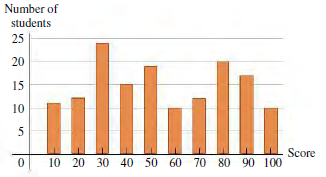
The statistical quantities €œaverage value€ and €œroot-mean-square value€ can be applied to any distribution. Figure P18.82 shows the scores of a class of 150 students on a 100-point quiz.(a) Find the average score for the class.(b) Find the rms score for
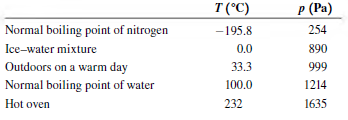
A steel cylinder with rigid walls is evacuated to a high degree of vacuum; you then put a small amount of helium into the cylinder. The cylinder has a pressure gauge that measures the pressure of the gas inside the cylinder. You place the cylinder in various temperature environments, wait for
Helium gas is in a cylinder that has rigid walls. If the pressure of the gas is 2.00 atm, then the root-mean-square speed of the helium atoms is vrms = 176 m/s. By how much (in atmospheres) must the pressure be increased to increase the vrms of the He atoms by 100 m/s? Ignore any change in the
A sealed box contains a monatomic ideal gas. The number of gas atoms per unit volume is 5.00 × 10²⁰ atoms/cm3, and the average translational kinetic energy of each atom is 1.80 × 10⁻²³ J.(a) What is the gas pressure?(b) If the gas is neon (molar mass 20.18 g/mol), what is vrms for the gas atoms?
A light, plastic sphere with mass m = 9.00 g and density r = 4.00 kg/m3 is suspended in air by thread of negligible mass.(a) What is the tension T in the thread if the air is at 5.00oC and p = 1.00 atm? The molar mass of air is 28.8 g/mol.(b) How much does the tension in the thread change if the
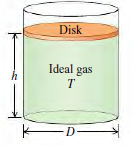
In an evacuated enclosure, a vertical cylindrical tank of diameter D is sealed by a 3.00-kg circular disk that can move up and down without friction. Beneath the disk is a quantity of ideal gas at temperature T in the cylinder (Fig. P18.50). Initially the disk is at rest at a distance of h = 4.00 m
Calculate the volume of 1.00 mol of liquid water at 20°C (at which its density is 998 kg/m3), and compare that with the volume occupied by 1.00 mol of water at the critical point, which is 56 × 10-6 m3. Water has a molar mass of 18.0 g/mol.
In addition to the normal cooking directions printed on the back of a box of rice, there are also “high-altitude directions.” The only difference is that the “high altitude directions” suggest increasing the cooking time and using a greater volume of boiling water in which to cook the rice.
The dark areas on the moon’s surface are called maria, Latin for “seas,” and were once thought to be bodies of water. In fact, the maria are not “seas” at all, but plains of solidified lava. Given that there is no atmosphere on the moon, how can you explain the absence of liquid water on
Hydrothermal vents are openings in the ocean floor that discharge very hot water. The water emerging from one such vent off the Oregon coast, 2400 m below the surface, is at 279°C. Despite its high temperature, the water doesn’t boil. Why not?
Ice is slippery to walk on, and especially slippery if you wear ice skates. What does this tell you about how the melting temperature of ice depends on pressure? Explain.
A beaker of water at room temperature is placed in an enclosure, and the air pressure in the enclosure is slowly reduced. When the air pressure is reduced sufficiently, the water begins to boil. The temperature of the water does not rise when it boils; in fact, the temperature drops slightly.
In a gas that contains N molecules, is it accurate to say that the number of molecules with speed v is equal to f (v)? Is it accurate to say that this number is given by Nf (v)? Explain your answers.
The discussion in Section 18.4 concluded that all ideal monatomic gases have the same heat capacity CV. Does this mean that it takes the same amount of heat to raise the temperature of 1.0 g of each one by 1.0 K? Explain your reasoning.
(a) If you apply the same amount of heat to 1.00 mol of an ideal monatomic gas and 1.00 mol of an ideal diatomic gas, which one (if any) will increase more in temperature?(b) Physically, why do diatomic gases have a greater molar heat capacity than monatomic gases?
If the root-mean-square speed of the atoms of an ideal gas is to be doubled, by what factor must the Kelvin temperature of the gas be increased? Explain.
The temperature of an ideal monatomic gas is increased from 25°C to 50°C. Does the average translational kinetic energy of each gas atom double? Explain. If your answer is no, what would the final temperature be if the average translational kinetic energy was doubled?
Consider two specimens of ideal gas at the same temperature. Specimen A has the same total mass as specimen B, but the molecules in specimen A have greater molar mass than they do in specimen B. In which specimen is the total kinetic energy of the gas greater? Does your answer depend on the
A gas storage tank has a small leak. The pressure in the tank drops more quickly if the gas is hydrogen or helium than if it is oxygen. Why?
Imagine a special air filter placed in a window of a house. The tiny holes in the filter allow only air molecules moving faster than a certain speed to exit the house, and allow only air molecules moving slower than that speed to enter the house from outside. What effect would this filter have on
If the pressure of an ideal monatomic gas is increased while the number of moles is kept constant, what happens to the average translational kinetic energy of one atom of the gas? Is it possible to change both the volume and the pressure of an ideal gas and keep the average translational kinetic
The temperature of an ideal gas is directly proportional to the average kinetic energy of its molecules. If a container of ideal gas is moving past you at 2000 m/s, is the temperature of the gas higher than if the container was at rest? Explain your reasoning.
The kinetic-molecular model contains a hidden assumption about the temperature of the container walls. What is this assumption? What would happen if this assumption were not valid?
An ideal gas has a density of 1.33 × 10⁻⁶ g/cm3 at 1.00 × 10⁻³ atm and 20.0°C. Identify the gas.
Comment on the following statement: When two gases are mixed, if they are to be in thermal equilibrium, they must have the same average molecular speed. Is the statement correct? Why or why not?
Use the concepts of the kinetic-molecular model to explain:(a) why the pressure of a gas in a rigid container increases as heat is added to the gas and(b) why the pressure of a gas increases as we compress it, even if we do not change its temperature.
(a) Which has more atoms: a kilogram of hydrogen or a kilogram of lead? Which has more mass?(b) Which has more atoms: a mole of hydrogen or a mole of lead? Which has more mass? Explain your reasoning.
A rigid, perfectly insulated container has a membrane dividing its volume in half. One side contains a gas at an absolute temperature T0 and pressure p0 , while the other half is completely empty. Suddenly a small hole develops in the membrane, allowing the gas to leak out into the other half until
The derivation of the ideal-gas equation included the assumption that the number of molecules is very large, so that we could compute the average force due to many collisions. However, the ideal-gas equation holds accurately only at low pressures, where the molecules are few and far between. Is
A group of students drove from their university (near sea level) up into the mountains for a skiing weekend. Upon arriving at the slopes, they discovered that the bags of potato chips they had brought for snacks had all burst open. What caused this to happen?
To measure the specific heat in the liquid phase of a newly developed cryoprotectant, you place a sample of the new cryoprotectant in contact with a cold plate until the solution’s temperature drops from room temperature to its freezing point. Then you measure the heat transferred to the cold
In another experiment, you place a layer of this cryoprotectant between one 10 cm × 10 cm cold plate maintained at -40°C and a second cold plate of the same size maintained at liquid nitrogen’s boiling temperature (77 K). Then you measure the rate of heat transfer. Another lab wants to repeat
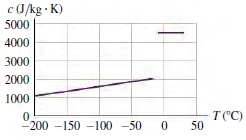
Careful measurements show that the specific heat of the solid phase depends on temperature (Fig. P17.117). How will the actual time needed for this cryoprotectant to come to equilibrium with the cold plate compare with the time predicted by using the values in the table? Assume that all values
You place 35 g of this cryoprotectant at 22°C in contact with a cold plate that is maintained at the boiling temperature of liquid nitrogen (77 K). The cryoprotectant is thermally insulated from everything but the cold plate. Use the values in the table to determine how much heat will be
Consider a poor lost soul walking at 5 km/h on a hot day in the desert, wearing only a bathing suit. This person’s skin temperature tends to rise due to four mechanisms:(i) Energy is generated by metabolic reactions in the body at a rate of 280 W, and almost all of this energy is converted to
During your mechanical engineering internship, you are given two uniform metal bars A and B, which are made from different metals, to determine their thermal conductivities. Measuring the bars, you determine that both have length 40.0 cm and uniform cross-sectional area 2.50 cm2. You place one end
At a chemical plant where you are an engineer, a tank contains an unknown liquid. You must determine the liquid’s specific heat capacity. You put 0.500 kg of the liquid into an insulated metal cup of mass 0.200 kg. Initially the liquid and cup are at 20.0°C. You add 0.500 kg of water that has a
A metal sphere with radius 3.20 cm is suspended in a large metal box with interior walls that are maintained at 30.0°C. A small electric heater is embedded in the sphere. Heat energy must be supplied to the sphere at the rate of 0.660 J/s to maintain the sphere at a constant temperature of
A brass rod 12.0 cm long, a copper rod 18.0 cm long, and an aluminum rod 24.0 cm long—each with cross-sectional area 2.30 cm3 are welded together end to end to form a rod 54.0 cm long, with copper as the middle section. The free end of the brass section is maintained at 100.0°C, and the
A thirsty nurse cools a 2.00-L bottle of a soft drink (mostly water) by pouring it into a large aluminum mug of mass 0.257 kg and adding 0.120 kg of ice initially at -15.0°C. If the soft drink and mug are initially at 20.0°C, what is the final temperature of the system, assuming that no heat is
You have 1.50 kg of water at 28.0°C in an insulated container of negligible mass. You add 0.600 kg of ice that is initially at -22.0°C. Assume that no heat exchanges with the surroundings.(a) After thermal equilibrium has been reached, has all of the ice melted?(b) If all of the ice has melted,
Shivering is your body’s way of generating heat to restore its internal temperature to the normal 37°C, and it produces approximately 290 W of heat power per square meter of body area. A 68-kg, 1.78-m-tall woman has approximately 1.8 m2 of surface area. How long would this woman have to shiver
A spherical pot contains 0.75 L of hot coffee (essentially water) at an initial temperature of 95°C. The pot has an emissivity of 0.60, and the surroundings are at 20.0°C. Calculate the coffee’s rate of heat loss by radiation.
When energy shortages occur, magazine articles sometimes urge us to keep our homes at a constant temperature day and night to conserve fuel. They argue that when we turn down the heat at night, the walls, ceilings, and other areas cool off and must be reheated in the morning. So if we keep the
We’re lucky that the earth isn’t in thermal equilibrium with the sun (which has a surface temperature of 5800 K). But why aren’t the two bodies in thermal equilibrium?
Some folks claim that ice cubes freeze faster if the trays are filled with hot water, because hot water cools off faster than cold water. What do you think?
Glider pilots in the Midwest know that thermal updrafts are likely to occur in the vicinity of freshly plowed fields. Why?
In coastal regions in the winter, the temperature over the land is generally colder than the temperature over the nearby ocean; in the summer, the reverse is usually true. Explain.
Old-time kitchen lore suggests that things cook better (evenly and without burning) in heavy cast-iron pots. What desirable characteristics do such pots have?
When a freshly baked apple pie has just been removed from the oven, the crust and filling are both at the same temperature. Yet if you sample the pie, the filling will burn your tongue but the crust will not. Why is there a difference?
A person pours a cup of hot coffee, intending to drink it five minutes later. To keep the coffee as hot as possible, should she put cream in it now or wait until just before she drinks it? Explain.
A cold block of metal feels colder than a block of wood at the same temperature. Why? A hot block of metal feels hotter than a block of wood at the same temperature. Again, why? Is there any temperature at which the two blocks feel equally hot or cold? What temperature is this?
Before giving you an injection, a physician swabs your arm with isopropyl alcohol at room temperature. Why does this make your arm feel cold? The reason is not the fear of the injection! The boiling point of isopropyl alcohol is 82.4°C.
When water is placed in ice-cube trays in a freezer, why doesn’t the water freeze all at once when the temperature has reached 0°C? In fact, the water freezes first in a layer adjacent to the sides of the tray. Why?
The climate of regions adjacent to large bodies of water (like the Pacific and Atlantic coasts) usually features a narrower range of temperature than the climate of regions far from large bodies of water (like the prairies). Why?
When you first step out of the shower, you feel cold. But as soon as you are dry you feel warmer, even though the room temperature does not change. Why?
Desert travelers sometimes keep water in a canvas bag. Some water seeps through the bag and evaporates. How does this cool the water inside the bag?
A piece of aluminum foil used to wrap a potato for baking in a hot oven can usually be handled safely within a few seconds after the potato is removed from the oven. The same is not true of the potato, however! Give two reasons for this difference.
The units of specific heat c are J/kg ∙ K, but the units of heat of fusion Lf or heat of vaporization Lv are simply J/kg. Why do the units of Lf and Lv not include a factor of (K)-1 to account for a temperature change?
In some household air conditioners used in dry climates, air is cooled by blowing it through a water-soaked filter, evaporating some of the water. How does this cool the air? Would such a system work well in a high humidity climate? Why or why not?
A student asserts that a suitable unit for specific heat is 1 m2/s2 ∙ C°. Is she correct? Why or why not?
A newspaper article about the weather states that “the temperature of a body measures how much heat the body contains.” Is this description correct? Why or why not?
The inside of an oven is at a temperature of 200°C (392°F). You can put your hand in the oven without injury as long as you don’t touch anything. But since the air inside the oven is also at 200°C, why isn’t your hand burned just the same?
Why is it sometimes possible to loosen caps on screw-top bottles by dipping the capped bottle briefly into hot water?
Two bodies made of the same material have the same external dimensions and appearance, but one is solid and the other is hollow. When their temperature is increased, is the overall volume expansion the same or different? Why?
Why do frozen water pipes burst? Would a mercury thermometer break if the temperature went below the freezing temperature of mercury? Why or why not?
Many automobile engines have cast-iron cylinders and aluminum pistons. What kinds of problems could occur if the engine gets too hot? (The coefficient of volume expansion of cast iron is approximately the same as that of steel.)
If you heat the air inside a rigid, sealed container until its Kelvin temperature doubles, the air pressure in the container will also double. Is the same thing true if you double the Celsius temperature of the air in the container? Explain.
Explain why it would not make sense to use a full-size glass thermometer to measure the temperature of a thimbleful of hot water.
For cranial ultrasound, why is it advantageous to use frequencies in the kHZ range rather than the MHz range?(a) The antinodes of the standing waves will be closer together at the lower frequencies than at the higher frequencies;(b) There will be no standing waves at the lower frequencies;(c)
In some applications of ultrasound, such as its use on cranial tissues, large reflections from the surrounding bones can produce standing waves. This is of concern because the large pressure amplitude in an antinode can damage tissues. For a frequency of 1.0 MHz, what is the distance between
Because the speed of ultrasound in bone is about twice the speed in soft tissue, the distance to a structure that lies beyond a bone can be measured incorrectly. If a beam passes through 4 cm of tissue, then 2 cm of bone, and then another 1 cm of tissue before echoing off a cyst and returning to
If the deepest structure you wish to image is 10.0 cm from the transducer, what is the maximum number of pulses per second that can be emitted?(a) 3850;(b) 7700;(c) 15,400;(d) 1,000,000.A typical ultrasound transducer used for medical diagnosis produces a beam of ultrasound with a frequency of 1.0
A long, closed cylindrical tank contains a diatomic gas that is maintained at a uniform temperature that can be varied. When you measure the speed of sound v in the gas as a function of the temperature T of the gas, you obtain these results:(a) Explain how you can plot these results so that the
A stationary police car emits a sound of frequency 1200 Hz that bounces off a car on the highway and returns with a frequency of 1250 Hz. The police car is right next to the highway, so the moving car is traveling directly toward or away from it.(a) How fast was the moving car going? Was it moving
Small speakers A and B are driven in phase at 725 Hz by the same audio oscillator. Both speakers start out 4.50 m from the listener, but speaker A is slowly moved away (Fig. E16.34).(a) At what distance d will the sound from the speakers first produce destructive interference at the
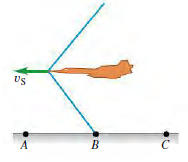
A jet airplane is flying at a constant altitude at a steady speed vS greater than the speed of sound. Describe what observers at points A, B, and C hear at the instant shown in Fig. Q16.25, when the shock wave has just reached point B. Explain.Figure Q16.25 Us
If you are riding in a supersonic aircraft, what do you hear? Explain. In particular, do you hear a continuous sonic boom? Why or why not?
Does an aircraft make a sonic boom only at the instant its speed exceeds Mach 1? Explain.
In case 1, a source of sound approaches a stationary observer at speed u. In case 2, the observer moves toward the stationary source at the same speed u. If the source is always producing the same frequency sound, will the observer hear the same frequency in both cases, since the relative speed is
If you wait at a railroad crossing as a train approaches and passes, you hear a Doppler shift in its sound. But if you listen closely, you hear that the change in frequency is continuous; it does not suddenly go from one high frequency to another low frequency. Instead the frequency smoothly (but
Stars other than our sun normally appear featureless when viewed through telescopes. Yet astronomers can readily use the light from these stars to determine that they are rotating and even measure the speed of their surface. How do you think they can do this?
Can you think of circumstances in which a Doppler effect would be observed for surface waves in water? For elastic waves propagating in a body of water deep below the surface? If so, describe the circumstances and explain your reasoning. If not, explain why not.
A sound source and a listener are both at rest on the earth, but a strong wind is blowing from the source toward the listener. Is there a Doppler effect? Why or why not?
A large church has part of the organ in the front of the church and part in the back. A person walking rapidly down the aisle while both segments are playing at once reports that the two segments sound out of tune. Why?
Two vibrating tuning forks have identical frequencies, but one is stationary and the other is mounted at the rim of a rotating platform. What does a listener hear? Explain.
A small metal band is slipped onto one of the tines of a tuning fork. As this band is moved closer and closer to the end of the tine, what effect does this have on the wavelength and frequency of the sound the tine produces? Why?
A small fraction of the energy in a sound wave is absorbed by the air through which the sound passes. How does this modify the inverse square relationship between intensity and distance from the source? Explain.
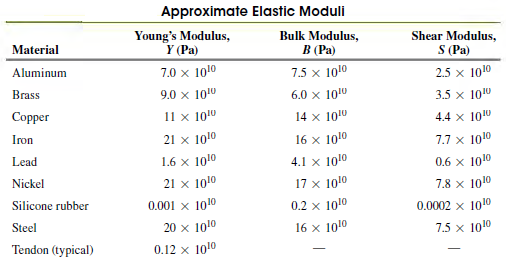
A 60.0-m-long brass rod is struck at one end. A person at the other end hears two sounds as a result of two longitudinal waves, one traveling in the metal rod and the other traveling in air. What is the time interval between the two sounds? (The speed of sound in air is 344 m/s; see Tables 11.1 and
Does the sound intensity level b obey the inverse-square law? Why?
If the pressure amplitude of a sound wave is halved, by what factor does the intensity of the wave decrease? By what factor must the pressure amplitude of a sound wave be increased in order to increase the intensity by a factor of 16? Explain.
Which has a more direct influence on the loudness of a sound wave: the displacement amplitude or the pressure amplitude? Explain.
(a) Does a sound level of 0 dB mean that there is no sound?(b) Is there any physical meaning to a sound having a negative intensity level? If so, what is it?(c) Does a sound intensity of zero mean that there is no sound?(d) Is there any physical meaning to a sound having a negative intensity? Why?
Showing 900 - 1000
of 2042
First
3
4
5
6
7
8
9
10
11
12
13
14
15
16
17
Last
Step by Step Answers

 Get 50% OFF
Claim Now
Get 50% OFF
Claim Now


![Coefficients of Volume Expansion Solids В (к- оr (С)-1] Liquids B [K-! or (C°)-'] 75 x 10-5 115 x 10-5 Aluminum 7.2](https://dsd5zvtm8ll6.cloudfront.net/si.question.images/images/question_images/1539/3/5/5/5275bc0b38780a3c1539381175303.jpg)