New Semester
Started
Get
50% OFF
Study Help!
--h --m --s
Claim Now
Question Answers
Textbooks
Find textbooks, questions and answers
Oops, something went wrong!
Change your search query and then try again
S
Books
FREE
Study Help
Expert Questions
Accounting
General Management
Mathematics
Finance
Organizational Behaviour
Law
Physics
Operating System
Management Leadership
Sociology
Programming
Marketing
Database
Computer Network
Economics
Textbooks Solutions
Accounting
Managerial Accounting
Management Leadership
Cost Accounting
Statistics
Business Law
Corporate Finance
Finance
Economics
Auditing
Tutors
Online Tutors
Find a Tutor
Hire a Tutor
Become a Tutor
AI Tutor
AI Study Planner
NEW
Sell Books
Search
Search
Sign In
Register
study help
physics
university physics
University Physics with Modern Physics 14th edition Hugh D. Young, Roger A. Freedman - Solutions
What is the difference between Fresnel and Fraunhofer diffraction? Are they different physical processes? Explain.
Why can we readily observe diffraction effects for sound waves and water waves, but not for light? Is this because light travels so much faster than these other waves? Explain.
The professor once again returns the apparatus to its original setting, but now she adjusts the oscillator to produce sound waves of half the original frequency. What happens?(a) The students who originally heard a loud tone again hear a loud tone, and the students who originally heard nothing
The professor again returns the apparatus to its original setting, so you again hear the original loud tone. She then slowly moves one speaker away from you until it reaches a point at which you can no longer hear the tone. If she has moved the speaker by 0.34 m (farther from you), what is the
The professor returns the apparatus to the original setting. She then adjusts the speakers again. All of the students who had heard nothing originally now hear a loud tone, while you and the others who had originally heard the loud tone hear nothing. What did the professor do? (a) She turned
Monochromatic light is directed at normal incidence on a thin film. There is destructive interference for the reflected light, so the intensity of the reflected light is very low. What happened to the energy of the incident light?
Physicians use high-frequency (f = 195 MHz) sound waves, called ultrasound, to image internal organs. The speed of these ultrasound waves is 1480 m/s in muscle and 344 m/s in air. We define the index of refraction of a material for sound waves to be the ratio of the speed of sound in air to the
Coherent light with wavelength λ falls on two narrow slits separated by a distance d. If d is less than some minimum value, no dark fringes are observed. Explain. In terms of λ , what is this minimum value of d?
The professor then adjusts the apparatus. The frequency that you hear does not change, but the loudness decreases. Now all of your fellow students can hear the tone. What did the professor do?(a) She turned off the oscillator.(b) She turned down the volume of the speakers.(c) She changed the phase
Short-wave radio antennas A and B are connected to the same transmitter and emit coherent waves in phase and with the same frequency f. You must determine the value of f and the placement of the antennas that produce a maximum intensity through constructive interference at a receiving antenna that
A researcher measures the thickness of a layer of benzene (n = 1.50) floating on water by shining monochromatic light onto the film and varying the wavelength of the light. She finds that light of wavelength 575 nm is reflected most strongly from the film. What does she calculate for the minimum
Consider two antennas separated by 9.00 m that radiate in phase at 120 MHz. A receiver placed 150 m from both antennas measures an intensity I0. The receiver is moved so that it is 1.8 m closer to one antenna than to the other.(a) What is the phase difference f between the two radio waves produced
When a thin oil film spreads out on a puddle of water, the thinnest part of the film looks dark in the resulting interference pattern. What does this tell you about the relative magnitudes of the refractive indexes of oil and water?
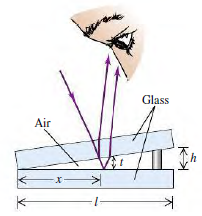
If we shine white light on an air wedge like that shown in Fig. 35.12, the colors that are weak in the light reflected from any point along the wedge are strong in the light transmitted through the wedge. Explain why this should be so. Glass Air
Interference can occur in thin films. Why is it important that the films be thin? Why don’t you get these effects with a relatively thick film? Where should you put the dividing line between “thin” and “thick”? Explain your reasoning.
A very thin soap film (n = 1.33), whose thickness is much less than a wavelength of visible light, looks black; it appears to reflect no light at all. Why? By contrast, an equally thin layer of soapy water (n = 1.33) on glass (n = 1.50) appears quite shiny. Why is there a difference?
A glass windowpane with a thin film of water on it reflects less than when it is perfectly dry. Why?
In using the superposition principle to calculate intensities in interference patterns, could you add the intensities of the waves instead of their amplitudes? Explain.
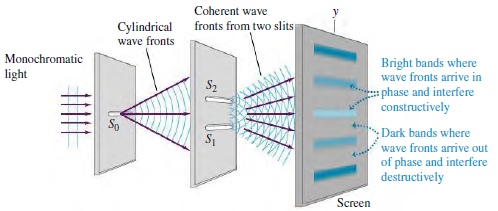
If the monochromatic light shown in Fig. 35.5a were replaced by white light, would a two-slit interference pattern be seen on the screen? Explain.fig.35.5a Coherent wave Cylindrical wave fronts fronts from two slits Monochromatic Bright bands where wave fronts arrive in light e phase and interfere
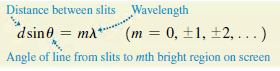
A fellow student, who values memorizing equations above understanding them, combines Eqs. (35.4) and (35.13) to €œprove€ that Ï• can only equal 2Ï€m. How would you explain to this student that Ï• can have values other than
Coherent red light illuminates two narrow slits that are 25 cm apart. Will a two-slit interference pattern be observed when the light from the slits falls on a screen? Explain.
Could the Young two-slit interference experiment be performed with gamma rays? If not, why not? If so, discuss differences in the experimental design compared to the experiment with visible light.
Scientists working with a particle accelerator determine that an unknown particle has a speed of 1.35 × 10⁸ m/s and a momentum of 2.52 × 10⁻¹⁹ kg ∙ m/s. From the curvature of the particle’s path in a magnetic field, they also deduce that it has a positive charge. Using this information,
A rocket ship flies past the earth at 91.0% of the speed of light. Inside, an astronaut who is undergoing a physical examination is having his height measured while he is lying down parallel to the direction in which the ship is moving.(a) If his height is measured to be 2.00 m by his doctor inside
Why do you think the development of Newtonian mechanics preceded the more refined relativistic mechanics by so many years?
In principle, does a hot gas have more mass than the same gas when it is cold? Explain. In practice, would this be a measurable effect? Explain.
A student asserts that a material particle must always have a speed slower than that of light, and a massless particle must always move at exactly the speed of light. Is she correct? If so, how do massless particles such as photons and neutrinos acquire this speed? Can’t they start from rest and
The theory of relativity sets an upper limit on the speed that a particle can have. Are there also limits on the energy and momentum of a particle? Explain.
A high-speed train passes a train platform. Larry is a passenger on the train, Adam is standing on the train platform, and David is riding a bicycle toward the platform in the same direction as the train is traveling. Compare the length of a train car as measured by Larry, Adam, and David.
Two events occur at the same space point in a particular inertial frame of reference and are simultaneous in that frame. Is it possible that they may not be simultaneous in a different inertial frame? Explain.
You are holding an elliptical serving platter. How would you need to travel for the serving platter to appear round to another observer?
The average life span in the United States is about 70 years. Does this mean that it is impossible for an average person to travel a distance greater than 70 light-years away from the earth? (A light-year is the distance light travels in a year.) Explain.
A spaceship is traveling toward the earth from the space colony on Asteroid 1040A. The ship is at the halfway point of the trip, passing Mars at a speed of 0.9c relative to the Mars frame of reference. At the same instant, a passenger on the spaceship receives a radio message from her boyfriend on
If simultaneity is not an absolute concept, does that mean that we must discard the concept of causality? If event A is to cause event B, A must occur first. Is it possible that in some frames A appears to be the cause of B, and in others B appears to be the cause of A? Explain.
Light of wavelength λ and frequency f passes through a single slit of width a. The diffraction pattern is observed on a screen a distance x from the slit. Which of the following will decrease the width of the central maximum?(a) Decrease the slit width;(b) Decrease the frequency f of the light;(c)
In a diffraction experiment with waves of wavelength λ, there will be no intensity minima (that is, no dark fringes) if the slit width is small enough. What is the maximum slit width for which this occurs? Explain your answer.
You are standing on a train platform watching a high-speed train pass by. A light inside one of the train cars is turned on and then a little later it is turned off.(a) Who can measure the proper time interval for the duration of the light: you or a passenger on the train?(b) Who can measure the
When the light is passed through the bottom of the sample container, the interference maximum is observed to be at 41°; when it is passed through the top, the corresponding maximum is at 37°. What is the best explanation for this observation?(a) The microspheres are more tightly packed at the
Why is visible light, which has much longer wavelengths than x rays do, used for Bragg reflection experiments on colloidal crystals?(a) The microspheres are suspended in a liquid, and it is more difficult for x rays to penetrate liquid than it is for visible light.(b) The irregular spacing of the
What plane spacing in the colloidal crystal could produce the maximum in this experiment?(a) 390 nm;(b) 520 nm;(c) 650 nm;(d) 780 nm.A colloid consists of particles of one type of substance dispersed in another substance. Suspensions of electrically charged microspheres (microscopic spheres, such
If an optical telescope focusing light of wavelength 550 nm has a perfectly ground mirror, what would the minimum mirror diameter have to be so that the telescope could resolve a Jupiter-size planet around our nearest star, Alpha Centauri, which is about 4.3 light-years from earth?
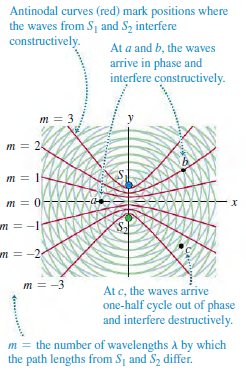
The two sources S1and S2shown in Fig. 35.3 emit waves of the same wavelength l and are in phase with each other. Suppose S1is a weaker source, so that the waves emitted by S1have half the amplitude of the waves emitted by S2. How would this affect the positions of the antinodal lines and nodal
Would the headlights of a distant car form a two-source interference pattern? If so, how might it be observed? If not, why not?
In a two-slit interference pattern on a distant screen, are the bright fringes midway between the dark fringes? Is this ever a good approximation?
Monochromatic coherent light passing through two thin slits is viewed on a distant screen. Are the bright fringes equally spaced on the screen? If so, why? If not, which ones are closest to being equally spaced?
Could an experiment similar to Young’s two-slit experiment be performed with sound? How might this be carried out? Does it matter that sound waves are longitudinal and electromagnetic waves are transverse? Explain.
A two-slit interference experiment is set up, and the fringes are displayed on a screen. Then the whole apparatus is immersed in the nearest swimming pool. How does the fringe pattern change?
To determine whether a frog can judge distance by means of the amount its lens must move to focus on an object, researchers covered one eye with an opaque material. An insect was placed in front of the frog, and the distance that the frog snapped its tongue out to catch the insect was measured with
A person with a near point of 85 cm, but excellent distant vision, normally wears corrective glasses. But he loses them while traveling. Fortunately, he has his old pair as a spare.(a) If the lenses of the old pair have a power of +2.25 diopters, what is his near point (measured from his eye) when
If you run away from a plane mirror at 3.60 m/s, at what speed does your image move away from you?
Ordinary glasses are worn in front of the eye and usually 2.0 cm in front of the eyeball. Suppose that the person in Exercise 34.52 prefers ordinary glasses to contact lenses. What focal length lenses are needed to correct his vision, and what is their power in diopters?
You take a lens and mask it so that light can pass through only the bottom half of the lens. How does the image formed by the masked lens compare to the image formed before 32 masking?
You can’t see clearly underwater with the naked eye, but you can if you wear a face mask or goggles (with air between your eyes and the mask or goggles). Why is there a difference? Could you instead wear eyeglasses (with water between your eyes and the eyeglasses) in order to see underwater? If
You’ve entered a survival contest that will include building a crude telescope. You are given a large box of lenses. Which two lenses do you pick? How do you quickly identify them?
According to the discussion in Section 34.2, light rays are reversible. Are the formulas in the table in this chapter’s Summary still valid if object and image are interchanged? What does reversibility imply with respect to the forms of the various formulas?
If a piece of photographic film is placed at the location of a real image, the film will record the image. Can this be done with a virtual image? How might one record a virtual image?
Can an image formed by one reflecting or refracting surface serve as an object for a second reflection or refraction? Does it matter whether the first image is real or virtual? Explain.
A transparent liquid fills a cylindrical tank to a depth of 3.60 m. There is air above the liquid. You look at normal incidence at a small pebble at the bottom of the tank. The apparent depth of the pebble below the liquid’s surface is 2.45 m. What is the refractive index of this liquid?
A spherical air bubble in water can function as a lens. Is it a converging or diverging lens? How is its focal length related to its radius?
When a converging lens is immersed in water, does its focal length increase or decrease in comparison with the value in air? Explain.
The focal length of a simple lens depends on the color (wavelength) of light passing through it. Why? Is it possible for a lens to have a positive focal length for some colors and negative for others? Explain.
How could you very quickly make an approximate measurement of the focal length of a converging lens? Could the same method be applied if you wished to use a diverging lens? Explain.
The bottom of the passenger-side mirror on your car notes, “Objects in mirror are closer than they appear.” Is this true? Why?
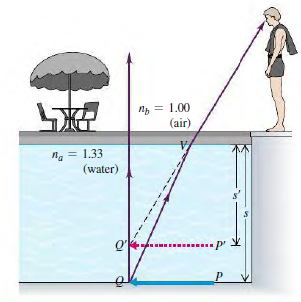
Suppose that in the situation of Example 34.7 of Section 34.3 (see Fig. 34.26) a vertical arrow 2.00 m tall is painted on the side of the pool beneath the water line. According to the calculations in the example, this arrow would appear to the person shown in Fig. 34.26 to be 1.50 m long. But the
For a concave spherical mirror that has focal length f = +18.0 cm, what is the distance of an object from the mirror’s vertex if the image is real and has the same height as the object?
In Example 34.4 (Section 34.2), there appears to be an ambiguity for the case s = 10 cm as to whether s' is +∞ or -∞ and whether the image is erect or inverted. How is this resolved? Or is it?
A person looks at his reflection in the concave side of a shiny spoon. Is it right side up or inverted? Does it matter how far his face is from the spoon? What if he looks in the convex side?
A student claims that she can start a fire on a sunny day using just the sun’s rays and a concave mirror. How is this done? Is the concept of image relevant? Can she do the same thing with a convex mirror? Explain.
You may have noticed a small convex mirror next to your bank’s ATM. Why is this mirror convex, as opposed to flat or concave? What considerations determine its radius of curvature?
For a spherical mirror, if s = f , then s' = ∞, and the lateral magnification m is infinite. Does this make sense? If so, what does it mean?
When a room has mirrors on two opposite walls, an infinite series of reflections can be seen. Discuss this phenomenon in terms of images. Why do the distant images appear fainter?
For what range of object positions does a concave spherical mirror form a real image? What about a convex spherical mirror?
If a spherical mirror is immersed in water, does its focal length change? Explain.
Explain why the focal length of a plane mirror is infinite, and explain what it means for the focal point to be at infinity.
The laws of optics also apply to electromagnetic waves invisible to the eye. A satellite TV dish is used to detect radio waves coming from orbiting satellites. Why is a curved reflecting surface (a “dish”) used? The dish is always concave, never convex; why? The actual radio receiver is placed
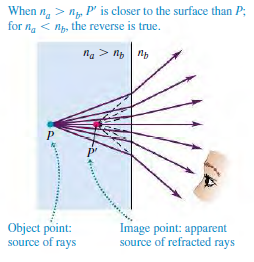
For the situation shown in Fig. 34.3, is the image distance s' positive or negative? Is the image real or virtual? Explain your answers.Fig.34.3 When n, > n. P' is closer to the surface than P: for ng < np, the reverse is true. Object point: source of rays Image point: apparent source of refracted
A spherical mirror is cut in half horizontally. Will an image be formed by the bottom half of the mirror? If so, where will the image be formed?
To vary the angle as well as the intensity of polarized light, ordinary unpolarized light is passed through one polarizer with its transmission axis vertical, and then a second polarizer is placed between the first polarizer and the insect. When the light leaving the second polarizer has half the
Next, unpolarized light is reflected off a smooth horizontal piece of glass, and the reflected light shines on the insect. Which statement is true about the two types of cells?(a) When the light is directly above the glass, only type V detects the reflected light.(b) When the light is directly
First, light with a plane of polarization at 45° to the horizontal shines on the insect. Which statement is true about the two types of cells?(a) Both types detect this light.(b) Neither type detects this light.(c) Only type H detects the light.(d) Only type V detects the light.Some insect eyes
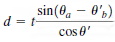
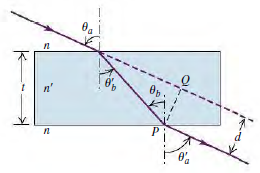
Light is incident in air at an angle ua (Fig. P33.54) on the upper surface of a transparent plate, the surfaces of the plate being plane and parallel to each other.(a) Prove that θa = θ'a.(b) Show that this is true for any number of different parallel plates.(c) Prove that
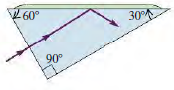
Light is incident normally on the short face of a 30°-960°-990°- prism (Fig. P33.50). A drop of liquid is placed on the hypotenuse of the prism. If the index of refraction of the prism is 1.56, find the maximum index that the liquid may have for the light to be totally reflected.Figure
Can water waves be reflected and refracted? Give examples. Does Huygens’s principle apply to water waves? Explain.
Huygens’s principle also applies to sound waves. During the day, the temperature of the atmosphere decreases with increasing altitude above the ground. But at night, when the ground cools, there is a layer of air just above the surface in which the temperature increases with altitude. Use this to
The explanation given in Section 33.6 for the color of the setting sun should apply equally well to the rising sun, since sunlight travels the same distance through the atmosphere to reach your eyes at either sunrise or sunset. Typically, however, sunsets are redder than sunrises. Why?
The indexes of refraction for violet light (λ = 400 nm) and red light (λ = 700 nm) in diamond are 2.46 and 2.41, respectively. A ray of light traveling through air strikes the diamond surface at an angle of 53.5° to the normal. Calculate the angular separation between these two colors of light
Atmospheric haze is due to water droplets or smoke particles (“smog”). Such haze reduces visibility by scattering light, so that the light from distant objects becomes randomized and images become indistinct. Explain why visibility through haze can be improved by wearing red tinted sunglasses,
Light scattered from blue sky is strongly polarized because of the nature of the scattering process described in Section 33.6. But light scattered from white clouds is usually not polarized. Why not?
You are sunbathing in the late afternoon when the sun is relatively low in the western sky. You are lying flat on your back, looking straight up through Polaroid sunglasses. To minimize the amount of sky light reaching your eyes, how should you lie: with your feet pointing north, east, south, west,
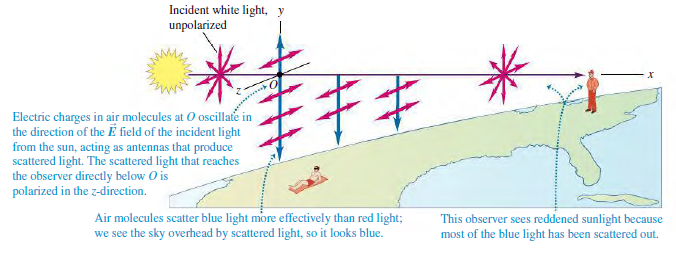
In Fig. 33.31, since the light that is scattered out of the incident beam is polarized, why is the transmitted beam not also partially polarized?fig.33.31 Incident white light, y unpolarized *- Electric charges in air molecules at O oscillate in the direction of the E field of the incident light
For the old “rabbit-ear” style TV antennas, it’s possible to alter the quality of reception considerably simply by changing the orientation of the antenna. Why?
When unpolarized light is incident on two crossed polarizers, no light is transmitted. A student asserted that if a third polarizer is inserted between the other two, some transmission will occur. Does this make sense? How can adding a third filter increase transmission?
If you sit on the beach and look at the ocean through Polaroid sunglasses, the glasses help to reduce the glare from sunlight reflecting off the water. But if you lie on your side on the beach, there is little reduction in the glare. Explain why there is a difference.
When a sheet of plastic food wrap is placed between two crossed polarizers, no light is transmitted. When the sheet is stretched in one direction, some light passes through the crossed polarizers. What is happening?
It has been proposed that automobile windshields and headlights should have polarizing filters to reduce the glare of oncoming lights during night driving. Would this work? How should the polarizing axes be arranged? What advantages would this scheme have? What disadvantages?
How can you determine the direction of the polarizing axis of a single polarizer?
Does it make sense to talk about the polarization of a longitudinal wave, such as a sound wave? Why or why not?
A salesperson at a bargain counter claims that a certain pair of sunglasses has Polaroid filters; you suspect that the glasses are just tinted plastic. How could you find out for sure?
When light is incident on an interface between two materials, the angle of the refracted ray depends on the wavelength, but the angle of the reflected ray does not. Why should this be?
A ray of light in air strikes a glass surface. Is there a range of angles for which total internal reflection occurs? Explain.
Showing 400 - 500
of 2042
1
2
3
4
5
6
7
8
9
10
11
12
13
14
15
Last
Step by Step Answers

 Get 50% OFF
Claim Now
Get 50% OFF
Claim Now