New Semester
Started
Get
50% OFF
Study Help!
--h --m --s
Claim Now
Question Answers
Textbooks
Find textbooks, questions and answers
Oops, something went wrong!
Change your search query and then try again
S
Books
FREE
Study Help
Expert Questions
Accounting
General Management
Mathematics
Finance
Organizational Behaviour
Law
Physics
Operating System
Management Leadership
Sociology
Programming
Marketing
Database
Computer Network
Economics
Textbooks Solutions
Accounting
Managerial Accounting
Management Leadership
Cost Accounting
Statistics
Business Law
Corporate Finance
Finance
Economics
Auditing
Tutors
Online Tutors
Find a Tutor
Hire a Tutor
Become a Tutor
AI Tutor
AI Study Planner
NEW
Sell Books
Search
Search
Sign In
Register
study help
physics
university physics
University Physics with Modern Physics 14th edition Hugh D. Young, Roger A. Freedman - Solutions
A small car of mass 380 kg is pushing a large truck of mass 900 kg due east on a level road. The car exerts a horizontal force of 1600 N on the truck. What is the magnitude of the force that the truck exerts on the car?
A person can dive into water from a height of 10 m without injury, but a person who jumps off the roof of a 10-m-tall building and lands on a concrete street is likely to be seriously injured. Why is there a difference?
(a) An ordinary flea has a mass of 210 µg. How many newtons does it weigh?(b) The mass of a typical froghopper is 12.3 mg. How many newtons does it weigh? (c) A house cat typically weighs 45 N. How many pounds does it weigh, and what is its mass in kilograms?
Why can it hurt your foot more to kick a big rock than a small pebble? Must the big rock hurt more? Explain.
Students sometimes say that the force of gravity on an object is 9.8 m/s2. What is wrong with this view?
You can play catch with a softball in a bus moving with constant speed on a straight road, just as though the bus were at rest. Is this still possible when the bus is making a turn at constant speed on a level road? Why or why not?
The acceleration of a falling body is measured in an elevator that is traveling upward at a constant speed of 9.8 m/s. What value is obtained?
Some students refer to the quantity ma̅(vector) as “the force of acceleration.” Is it correct to refer to this quantity as a force? If so, what exerts this force? If not, what is a better description of this quantity?
Does Newton’s second law hold true for an observer in a van as it speeds up, slows down, or rounds a corner? Explain.
Why is the earth only approximately an inertial reference frame?
Suppose you chose the fundamental physical quantities to be force, length, and time instead of mass, length, and time. What would be the units of mass in terms of those fundamental quantities?
A passenger in a moving bus with no windows notices that a ball that has been at rest in the aisle suddenly starts to move toward the rear of the bus. Think of two possible explanations, and devise a way to decide which is correct.
Some people say that the “force of inertia” (or “force of momentum”) throws the passengers forward when a car brakes sharply. What is wrong with this explanation?
You walk into an elevator, step onto a scale, and push the “up” button. You recall that your normal weight is 625 N. Draw a free-body diagram.(a) When the elevator has an upward acceleration of magnitude 2.50 m/s2, what does the scale read?(b) If you hold a 3.85-kg package by a light vertical
When a car stops suddenly, the passengers tend to move forward relative to their seats. Why? When a car makes a sharp turn, the passengers tend to slide to one side of the car. Why?
A 68.5-kg skater moving initially at 2.40 m/s on rough horizontal ice comes to rest uniformly in 3.52 s due to friction from the ice. What force does friction exert on the skater?
You tie a brick to the end of a rope and whirl the brick around you in a horizontal circle. Describe the path of the brick after you suddenly let go of the rope.
If the two ends of a rope in equilibrium are pulled with forces of equal magnitude and opposite directions, why isn’t the total tension in the rope zero?
When you fly in an airplane at night in smooth air, you have no sensation of motion, even though the plane may be moving at 800 km/h (500 mi/h). Why?
A helium balloon hovers in midair, neither ascending nor descending. Is it in equilibrium? What forces act on it?
A ball thrown straight up has zero velocity at its highest point. Is the ball in equilibrium at this point? Why or why not?
If a seed is launched at an angle of 0° with the maximum initial speed, how far from the plant will it land? Ignore air resistance, and assume that the ground is flat.(a) 20 cm;(b) 93 cm;(c) 2.2 m;(d) 4.6 m.
About how long does it take a seed launched at 90° at the highest possible initial speed to reach its maximum height? Ignore air resistance.(a) 0.23 s;(b) 0.47 s;(c) 1.0 s;(d) 2.3 s.
You are a member of a geological team in Central Africa. Your team comes upon a wide river that is flowing east. You must determine the width of the river and the current speed (the speed of the water relative to the earth). You have a small boat with an outboard motor. By measuring the time it
In the middle of the night you are standing a horizontal distance of 14.0 m from the high fence that surrounds the estate of your rich uncle. The top of the fence is 5.00 m above the ground. You have taped an important message to a rock that you want to throw over the fence. The ground is level,
A firefighting crew uses a water cannon that shoots water at 25.0 m/s at a fixed angle of 53.0° above the horizontal. The firefighters want to direct the water at a blaze that is 10.0 m above ground level. How far from the building should they position their cannon? There are two possibilities;
A boy 12.0 m above the ground in a tree throws a ball for his dog, who is standing right below the tree and starts running the instant the ball is thrown. If the boy throws the ball horizontally at 8.50 m/s,(a) How fast must the dog run to catch the ball just as it reaches the ground, and (b)
A baseball thrown at an angle of 60.0° above the horizontal strikes a building 18.0 m away at a point 8.00 m above the point from which it is thrown. Ignore air resistance.(a) Find the magnitude of the ball’s initial velocity (the velocity with which the ball is thrown).(b) Find the magnitude
You are on the west bank of a river that is flowing north with a speed of 1.2 m/s. Your swimming speed relative to the water is 1.5 m/s, and the river is 60 m wide. What is your path relative to the earth that allows you to cross the river in the shortest time? Explain your reasoning.
In a rainstorm with a strong wind, what determines the best position in which to hold an umbrella?
Raindrops hitting the side windows of a car in motion often leave diagonal streaks even if there is no wind. Why? Is the explanation the same or different for diagonal streaks on the windshield?
In uniform circular motion, how does the acceleration change when the speed is increased by a factor of 3? When the radius is decreased by a factor of 2?
A projectile is fired upward at an angle θ above the horizontal with an initial speed v0. At its maximum height, what are its velocity vector, its speed, and its acceleration vector?
If a jumping frog can give itself the same initial speed regardless of the direction in which it jumps (forward or straight up), how is the maximum vertical height to which it can jump related to its maximum horizontal range Rmax = v20/g?
A projectile moves in a parabolic path without air resistance. Is there any point at which a̅(vector) is parallel to v̅(vector)? Perpendicular to v̅(vector)? Explain.
A simple pendulum (a mass swinging at the end of a string) swings back and forth in a circular arc. What is the direction of the acceleration of the mass when it is at the ends of the swing? At the midpoint? In each case, explain how you obtained your answer.
If the contraction of the left ventricle lasts 250 ms and the speed of blood flow in the aorta (the large artery leaving the heart) is 0.80 m/s at the end of the contraction, what is the average acceleration of a red blood cell as it leaves the heart?(a) 310 m/s2;(b) 31 m/s2;(c) 3.2 m/s2;(d) 0.32
A small rock is thrown vertically upward with a speed of 22.0 m/s from the edge of the roof of a 30.0-m-tall building. The rock doesn’t hit the building on its way back down and lands on the street below. Ignore air resistance.(a) What is the speed of the rock just before it hits the street?(b)
A small block has constant acceleration as it slides down a frictionless incline. The block is released from rest at the top of the incline, and its speed after it has traveled 6.80 m to the bottom of the incline is 3.80 m/s. What is the speed of the block when it is 3.40 m from the top of the
When you drop an object from a certain height, it takes time T to reach the ground with no air resistance. If you dropped it from three times that height, how long (in terms of T) would it take to reach the ground?
An object is thrown straight up into the air and feels no air resistance. How can the object have an acceleration when it has stopped moving at its highest point?
You run due east at a constant speed of 3.00 m/s for a distance of 120.0 m and then continue running east at a constant speed of 5.00 m/s for another 120.0 m. For the total 240.0-m run, is your average velocity 4.00 m/s, greater than 4.00 m/s, or less than 4.00 m/s? Explain.
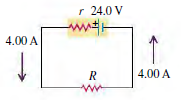
Consider the circuit shown in Fig. E25.26. The terminal voltage of the 24.0-V battery is 21.2 V. What are(a) The internal resistance r of the battery and(b) The resistance R of the circuit resistor?Figure e25.26 r 24.0 V 4.00 A 4.00 A
The battery for a certain cell phone is rated at 3.70 V. According to the manufacturer it can produce 3.15 × 10⁴ J of electrical energy, enough for 5.25 h of operation, before needing to be recharged. Find the average current that this cell phone draws when turned on.
In an ionic solution, a current consists of Ca2+ ions (of charge +2e) and Cl- ions (of charge -e) traveling in opposite directions. If 5.11 × 10¹⁸ Cl- ions go from A to B every 0.50 min, while 3.24 × 10¹⁸ Ca2+ ions move from B to A, what is the current (in mA) through this solution, and in which
An overhead transmission cable for electrical power is 2000 m long and consists of two parallel copper wires, each encased in insulating material. A short circuit has developed somewhere along the length of the cable where the insulation has worn thin and the two wires are in contact. As a
Unlike the idealized ammeter described in Section 25.4, any real ammeter has a nonzero resistance.(a) An ammeter with resistance RA is connected in series with a resistor R and a battery of emf ε and internal resistance r. The current measured by the ammeter is IA. Find the current through the
Compact fluorescent bulbs are much more efficient at producing light than are ordinary incandescent bulbs. They initially cost much more, but they last far longer and use much less electricity. According to one study of these bulbs, a compact bulb that produces as much light as a 100-W incandescent
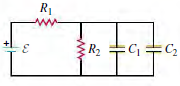
Consider the circuit shown in Fig. P25.72. The battery has emf 72.0 V and negligible internal resistance. R2= 2.00 Ω, C1= 3.00 µF, and C2= 6.00 µF. After the capacitors have attained their final charges, the charge on C1 is Q1= 18.0 µC. What is(a) The final charge
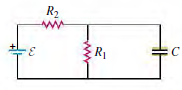
Consider the circuit shown in Fig. P25.73. The emf source has negligible internal resistance. The resistors have resistances R1= 6.00 Ω and R2= 4.00 Ω. The capacitor has capacitance C = 9.00 µF. When the capacitor is fully charged, the magnitude of the charge on its
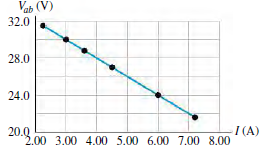
An external resistor R is connected between the terminals of a battery. The value of R varies. For each R value, the current I in the circuit and the terminal voltage Vabof the battery are measured. The results are plotted in Fig. P25.74, a graph of Vabversus I that shows the best straight-line fit
In which 120-V light bulb does the filament have greater resistance: a 60-W bulb or a 120-W bulb? If the two bulbs are connected to a 120-V line in series, through which bulb will there be the greater voltage drop? What if they are connected in parallel? Explain your reasoning.
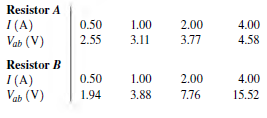
The voltage drop Vabacross each of resistors A and B was measured as a function of the current I in the resistor. The results are shown in the table:(a) For each resistor, graph Vab as a function of I and graph the resistance R = Vab/I as a function of I.(b) Does resistor A obey Ohm€™s
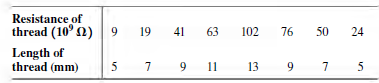
What is the best explanation for the behavior exhibited in the data? (a) Longer threads can carry more current than shorter threads do and so make better electrical conductors. (b) The thread stops being a conductor when it is stretched to 13 mm, due to breaks that occur in the thin coating. (c) As
If the conductivity of the thread results from the aqueous coating only, how does the cross-sectional area A of the coating compare when the thread is 13 mm long versus the starting length of 5 mm? Assume that the resistivity of the coating remains constant and the coating is uniform along the
What is the maximum current that flows in the thread during this experiment if the voltage source is a 9-V battery?(a) About 1 A;(b) About 0.1 A;(c) About 1 µA;(d) about 1 nA.Some types of spiders build webs that consist of threads made of dry silk coated with a solution of a variety of
In another experiment, a piece of the web is suspended so that it can move freely. When either a positively charged object or a negatively charged object is brought near the web, the thread is observed to move toward the charged object. What is the best interpretation of this observation? The web
From the top of a tall building, you throw one ball straight up with speed v0 and one ball straight down with speed v0.(a) Which ball has the greater speed when it reaches the ground?(b) Which ball gets to the ground first?(c) Which ball has a greater displacement when it reaches the ground?(d)
If you know the initial position and initial velocity of a vehicle and have a record of the acceleration at each instant, can you compute the vehicle’s position after a certain time? If so, explain how this might be done.
A dripping water faucet steadily releases drops 1.0 s apart. As these drops fall, does the distance between them increase, decrease, or remain the same? Prove your answer.
Prove these statements:(a) As long as you can ignore the effects of the air, if you throw anything vertically upward, it will have the same speed when it returns to the release point as when it was released.(b) The time of flight will be twice the time it takes to get to its highest point.
You throw a baseball straight up in the air so that it rises to a maximum height much greater than your height. Is the magnitude of the ball’s acceleration greater while it is being thrown or after it leaves your hand? Explain.
Under constant acceleration the average velocity of a particle is half the sum of its initial and final velocities. Is this still true if the acceleration is not constant? Explain.
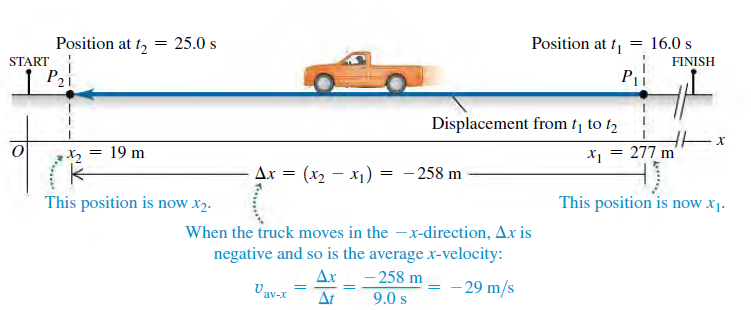
The official€™s truck in Fig. 2.2 is at x1= 277 m at t1= 16.0 s and is at x2= 19 m at t2= 25.0 s.(a) Sketch two different possible x-t graphs for the motion of the truck.(b) Does the average velocity vav-x during the time interval from t1 to t2 have the same value for both of your graphs?
An automobile is traveling west. Can it have a velocity toward the west and at the same time have an acceleration toward the east? Under what circumstances?
Can you have zero velocity and nonzero average acceleration? Zero velocity and nonzero acceleration? Use a vx-t graph to explain, and give an example of such motion.
Can you have zero acceleration and nonzero velocity? Use a vx-t graph to explain.
Can you have zero displacement and nonzero average velocity? Zero displacement and nonzero velocity? Illustrate your answers on an x-t graph.
A driver in Massachusetts was sent to traffic court for speeding. The evidence against the driver was that a policewoman observed the driver’s car alongside a second car at a certain moment, and the policewoman had already clocked the second car going faster than the speed limit. The driver
When a Dodge Viper is at Elwood’s Car Wash, a BMW Z3 is at Elm and Main. Later, when the Dodge reaches Elm and Main, the BMW reaches Elwood’s Car Wash. How are the cars’ average velocities between these two times related?
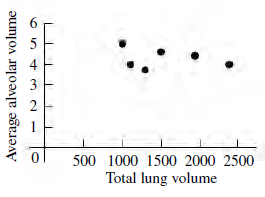
Individuals vary considerably in total lung volume. Figure P1.94 shows the results of measuring the total lung volume and average alveolar volume of six individuals. From these data, what can you infer about the relationship among alveolar size, total lung volume, and number of alveoli per
If we assume that alveoli are spherical, what is the diameter of a typical alveoulus?(a) 0.20 mm;(b) 2 mm(c) 20mm(d) 200 mm
What is total volume of the gas-exchanging region of the lungs? (a) 2000 µm3(b) 2m3(c) 2.0 L(d) 120 L
Bacteria vary in size, but a diameter of 2.0 µm is not unusual. What are the volume (in cubic centimeters) and surface area (in square millimeters) of a spherical bacterium of that size?
The density of gold is 19.3 g>cm3. What is this value in kilograms per cubic meter?
The density of gold is 19.3 g/cm3. What is this value in kilograms per cubic meter?
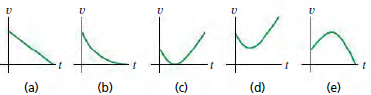
A stone is thrown into the air at an angle above the horizontal and feels negligible air resistance. Which graph in Fig. Q3.16 best depicts the stone€™s speed v as a function of time t while it is in the air?Fig. Q3.16 (a) (b) (d) (e) (c)
A 124-kg balloon carrying a 22-kg basket is descending with a constant downward velocity of 20.0 m/s. A 1.0-kg stone is thrown from the basket with an initial velocity of 15.0 m/s perpendicular to the path of the descending balloon, as measured relative to a person at rest in the basket. That
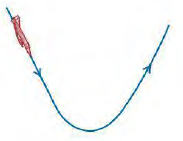
A jet plane comes in for a downward dive as shown in Fig. E3.25. The bottom part of the path is a quarter circle with a radius of curvature of 280 m. According to medical tests, pilots will lose consciousness when they pull out of a dive at an upward acceleration greater than 5.5g. At what speed
Canada geese migrate essentially along a north–south direction for well over a thousand kilometers in some cases, traveling at speeds up to about 100 km/h. If one goose is flying at 100 km/h relative to the air but a 40-km/h wind is blowing from west to east,(a) At what angle relative to the
Is it possible for an object to be(a) Slowing down while its acceleration is increasing in magnitude;(b) Speeding up while its acceleration is decreasing? In both cases, explain your reasoning.
Under what conditions does the magnitude of the average velocity equal the average speed?
Under what conditions is average velocity equal to instantaneous velocity?
Can an object with constant acceleration reverse its direction of travel? Can it reverse its direction twice? In both cases, explain your reasoning.
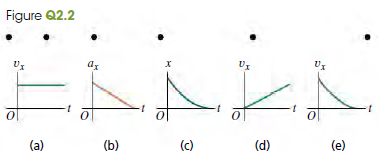
The black dots at the top of Fig. Q2.2 represent a series of high-speed photographs of an insect flying in a straight line from left to right (in the positive x-direction). Which of the graphs in Fig. Q2.2 most plausibly depicts this insect€™s motion? Figure Q2.2 х (a) (b) (c) (d) (e)
You make two versions of the same object out of the same material having uniform density. For one version, all the dimensions are exactly twice as great as for the other one. If the same torque acts on both versions, giving the smaller version angular acceleration a, what will be the angular
Can you think of a body that has the same moment of inertia for all possible axes? If so, give an example, and if not, explain why this is not possible. Can you think of a body that has the same moment of inertia for all axes passing through a certain point? If so, give an example and indicate
To maximize the moment of inertia of a flywheel while minimizing its weight, what shape and distribution of mass should it have? Explain.
How might you determine experimentally the moment of inertia of an irregularly shaped body about a given axis?
A cylindrical body has mass M and radius R. Can the mass be distributed within the body in such a way that its moment of inertia about its axis of symmetry is greater than MR2? Explain.
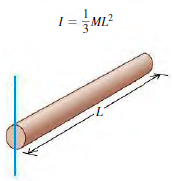
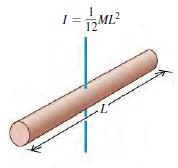
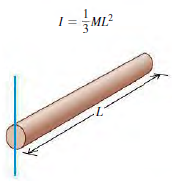
Describe how you could use part (b) of Table 9.2 to derive the result in part (d). 1=ML?
A hollow spherical shell of radius R that is rotating about an axis through its center has rotational kinetic energy K. If you want to modify this sphere so that it has three times as much kinetic energy at the same angular speed while keeping the same mass, what should be its radius in terms of R?
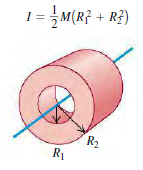
For the equations for I given in parts (a) and (b) of Table 9.2 to be valid, must the rod have a circular cross section? Is there any restriction on the size of the cross section for these equations to apply? Explain.Table 9.2 aTable 9.2 b ML? 1=ML?
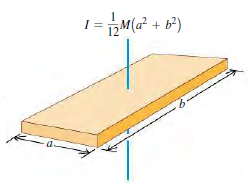
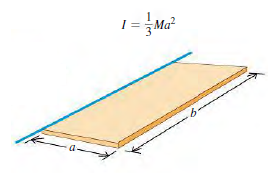
In part (d) of Table 9.2, the thickness of the plate must be much less than a for the expression given for I to apply. But in part (c), the expression given for I applies no matter how thick the plate is. Explain.Table 9.2 cTable 9.2 d 1(a? + b²)
Two identical balls, A and B, are each attached to very light string, and each string is wrapped around the rim of a frictionless pulley of mass M. The only difference is that the pulley for ball A is a solid disk, while the one for ball B is a hollow disk, like part (e) in Table 9.2. If both balls
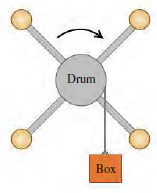
An elaborate pulley consists of four identical balls at the ends of spokes extending out from a rotating drum (Fig. Q9.18). A box is connected to a light, thin rope wound around the rim of the drum. When it is released from rest, the box acquires a speed V after having fallen a distance d. Now the
You can use any angular measure—radians, degrees, or revolutions—in some of the equations in Chapter 9, but you can use only radian measure in others. Identify those for which using radians is necessary and those for which it is not, and in each case give your reasoning.
When calculating the moment of inertia of an object, can we treat all its mass as if it were concentrated at the center of mass of the object? Justify your answer.
A wheel is rotating about an axis perpendicular to the plane of the wheel and passing through the center of the wheel. The angular speed of the wheel is increasing at a constant rate. Point A is on the rim of the wheel and point B is midway between the rim and center of the wheel. For each of the
You are a project manager for a manufacturing company. One of the machine parts on the assembly line is a thin, uniform rod that is 60.0 cm long and has mass 0.400 kg.(a) What is the moment of inertia of this rod for an axis at its center, perpendicular to the rod?(b) One of your engineers has
Showing 1100 - 1200
of 2042
First
5
6
7
8
9
10
11
12
13
14
15
16
17
18
19
Last
Step by Step Answers

 Get 50% OFF
Claim Now
Get 50% OFF
Claim Now