New Semester
Started
Get
50% OFF
Study Help!
--h --m --s
Claim Now
Question Answers
Textbooks
Find textbooks, questions and answers
Oops, something went wrong!
Change your search query and then try again
S
Books
FREE
Study Help
Expert Questions
Accounting
General Management
Mathematics
Finance
Organizational Behaviour
Law
Physics
Operating System
Management Leadership
Sociology
Programming
Marketing
Database
Computer Network
Economics
Textbooks Solutions
Accounting
Managerial Accounting
Management Leadership
Cost Accounting
Statistics
Business Law
Corporate Finance
Finance
Economics
Auditing
Tutors
Online Tutors
Find a Tutor
Hire a Tutor
Become a Tutor
AI Tutor
AI Study Planner
NEW
Sell Books
Search
Search
Sign In
Register
study help
physics
university physics
University Physics with Modern Physics 14th edition Hugh D. Young, Roger A. Freedman - Solutions
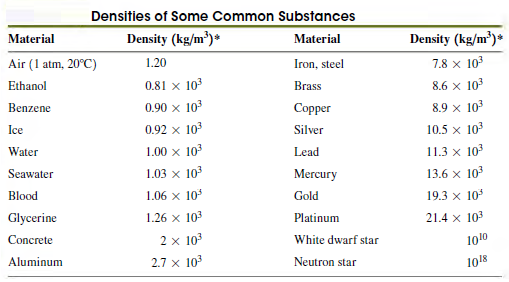
The density values in Table 12.1 are listed in increasing order. A chemistry student notices that the first four chemical elements that are included are also listed in order of increasing atomic mass.(a) See whether there is a simple relationship between density and atomic mass by plotting a graph
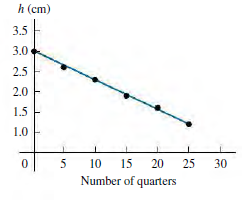
You have a bucket containing an unknown liquid. You also have a cube-shaped wooden block that you measure to be 8.0 cm on a side, but you don€™t know the mass or density of the block. To find the density of the liquid, you perform an experiment. First you place the wooden block in the
A student wrote: “The only reason an apple falls downward to meet the earth instead of the earth rising upward to meet the apple is that the earth is much more massive and so exerts a much greater pull.” Please comment.
If all planets had the same average density, how would the acceleration due to gravity at the surface of a planet depend on its radius?
Is a pound of butter on the earth the same amount as a pound of butter on Mars? What about a kilogram of butter? Explain.
Example 13.2 (Section 13.1) shows that the acceleration of each sphere caused by the gravitational force is inversely proportional to the mass of that sphere. So why does the force of gravity give all masses the same acceleration when they are dropped near the surface of the earth?
When will you attract the sun more: today at noon, or tonight at midnight? Explain.
Since the moon is constantly attracted toward the earth by the gravitational interaction, why doesn’t it crash into the earth?
The sun pulls on the moon with a force that is more than twice the magnitude of the force with which the earth attracts the moon. Why, then, doesn’t the sun take the moon away from the earth?
Which takes more fuel: a voyage from the earth to the moon or from the moon to the earth? Explain.
A planet is moving at constant speed in a circular orbit around a star. In one complete orbit, what is the net amount of work done on the planet by the star’s gravitational force: positive, negative, or zero? What if the planet’s orbit is an ellipse, so that the speed is not constant? Explain
There is strong evidence that Europa, a satellite of Jupiter, has a liquid ocean beneath its icy surface. Many scientists think we should land a vehicle there to search for life. Before launching it, we would want to test such a lander under the gravity conditions at the surface of Europa. One way
If a pendulum clock is taken to a mountaintop, does it gain or lose time, assuming it is correct at a lower elevation? Explain.
Two waves travel on the same string. Is it possible for them to have(a) Different frequencies;(b) Different wavelengths;(c) Different speeds;(d) Different amplitudes;(e) The same frequency but different wavelengths?Explain your reasoning.
Under a tension F, it takes 2.00 s for a pulse to travel the length of a taut wire. What tension is required (in terms of F) for the pulse to take 6.00 s instead? Explain how you arrive at your answer.
What kinds of energy are associated with waves on a stretched string? How could you detect such energy experimentally?
The amplitude of a wave decreases gradually as the wave travels down a long, stretched string. What happens to the energy of the wave when this happens?
For the wave motions discussed in this chapter, does the speed of propagation depend on the amplitude? What makes you say this?
Is it possible to have a longitudinal wave on a stretched string? Why or why not? Is it possible to have a transverse wave on a steel rod? Again, why or why not? If your answer is yes in either case, explain how you would create such a wave.
For transverse waves on a string, is the wave speed the same as the speed of any part of the string? Explain the difference between these two speeds. Which one is constant?
The four strings on a violin have different thicknesses, but are all under approximately the same tension. Do waves travel faster on the thick strings or the thin strings? Why? How does the fundamental vibration frequency compare for the thick versus the thin strings?
A sinusoidal wave can be described by a cosine function, which is negative just as often as positive. So why isn’t the average power delivered by this wave zero?
Two strings of different mass per unit length µ1 and µ2 are tied together and stretched with a tension F. A wave travels along the string and passes the discontinuity in µ. Which of the following wave properties will be the same on both sides of the discontinuity, and which will change: speed of
A long rope with mass m is suspended from the ceiling and hangs vertically. A wave pulse is produced at the lower end of the rope, and the pulse travels up the rope. Does the speed of the wave pulse change as it moves up the rope, and if so, does it increase or decrease? Explain.
In a transverse wave on a string, the motion of the string is perpendicular to the length of the string. How, then, is it possible for energy to move along the length of the string?
Energy can be transferred along a string by wave motion. However, in a standing wave on a string, no energy can ever be transferred past a node. Why not?
Can a standing wave be produced on a string by superposing two waves traveling in opposite directions with the same frequency but different amplitudes? Why or why not? Can a standing wave be produced by superposing two waves traveling in opposite directions with different frequencies but the same
If you stretch a rubber band and pluck it, you hear a (somewhat) musical tone. How does the frequency of this tone change as you stretch the rubber band further? (Try it!) Does this agree with Eq. (15.35) for a string fixed at both ends? Explain.Eq.15.35 F . Tension in string Fundamental frequency,
A musical interval of an octave corresponds to a factor of 2 in frequency. By what factor must the tension in a guitar or violin string be increased to raise its pitch one octave? To raise it two octaves? Explain your reasoning. Is there any danger in attempting these changes in pitch?
By touching a string lightly at its center while bowing, a violinist can produce a note exactly one octave above the note to which the string is tuned that is, a note with exactly twice the frequency. Why is this possible?
A heavy rope 6.00 m long and weighing 29.4 N is attached at one end to a ceiling and hangs vertically. A 0.500-kg mass is suspended from the lower end of the rope. What is the speed of transverse waves on the rope at the(a) Bottom of the rope,(b) Middle of the rope, and(c) Top of the rope?(d) Is
What is the purpose of the frets on a guitar? In terms of the frequency of the vibration of the strings, explain their use.
Scale length is the length of the part of a guitar string that is free to vibrate. A standard value of scale length for an acoustic guitar is 25.5 in. The frequency of the fundamental standing wave on a string is determined by the string€™s scale length, tension, and linear mass density.
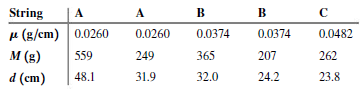
In your physics lab, an oscillator is attached to one end of a horizontal string. The other end of the string passes over a frictionless pulley. You suspend a mass M from the free end of the string, producing tension Mg in the string. The oscillator produces transverse waves of frequency f on the
Does the escape speed for an object at the earth’s surface depend on the direction in which it is launched? Explain. Does your answer depend on whether or not you include the effects of air resistance?
If a projectile is fired straight up from the earth’s surface, what would happen if the total mechanical energy (kinetic plus potential) is(a) Less than zero, and(b) Greater than zero? In each case, ignore air resistance and the gravitational effects of the sun, the moon, and the other planets.
Discuss whether this statement is correct: “In the absence of air resistance, the trajectory of a projectile thrown near the earth’s surface is an ellipse, not a parabola.”
The earth is closer to the sun in November than in May. In which of these months does it move faster in its orbit? Explain why.
A communications firm wants to place a satellite in orbit so that it is always directly above the earth’s 45th parallel (latitude 45o north). This means that the plane of the orbit will not pass through the center of the earth. Is such an orbit possible? Why or why not?
At what point in an elliptical orbit is the acceleration maximum? At what point is it minimum? Justify your answers.
What would Kepler’s third law be for circular orbits if an amendment to Newton’s law of gravitation made the gravitational force inversely proportional to r3? Would this change affect Kepler’s other two laws? Explain.
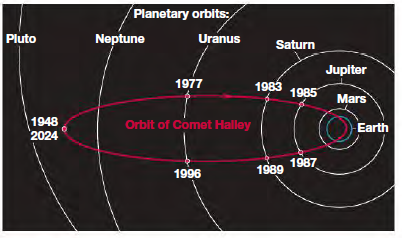
In the elliptical orbit of Comet Halley shown in Fig. 13.21a, the sun€™s gravity is responsible for making the comet fall inward from aphelion to perihelion. But what is responsible for making the comet move from perihelion back outward to aphelion?Fig.13.21 Planetary orbits: Neptune
A planet orbiting a distant star has radius 3.24 × 10⁶ m. The escape speed for an object launched from this planet’s surface is 7.65 × 10³ m/s. What is the acceleration due to gravity at the surface of the planet?
Many people believe that orbiting astronauts feel weightless because they are “beyond the pull of the earth’s gravity.” How far from the earth would a spacecraft have to travel to be truly beyond the earth’s gravitational influence? If a spacecraft were really unaffected by the earth’s
As part of their training before going into orbit, astronauts ride in an airliner that is flown along the same parabolic trajectory as a freely falling projectile. Explain why this gives the same experience of apparent weightlessness as being in orbit.
Some scientists are eager to send a remote-controlled submarine to Jupiter’s moon Europa to search for life in its oceans below an icy crust. Europa’s mass has been measured to be 4.80 × 10²² kg, its diameter is 3120 km, and it has no appreciable atmosphere. Assume that the layer of ice at the
You are exploring a distant planet. When your spaceship is in a circular orbit at a distance of 630 km above the planet’s surface, the ship’s orbital speed is 4900 m/s. By observing the planet, you determine its radius to be 4.48 × 10⁶ m. You then land on the surface and, at a place where the
A rocket with mass 5.00 × 10³ kg is in a circular orbit of radius 7.20 × 10⁶ m around the earth. The rocket’s engines fire for a period of time to increase that radius to 8.80 × 10⁶ m, with the orbit again circular.(a) What is the change in the rocket’s kinetic energy? Does the kinetic
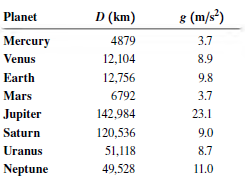
For a spherical planet with mass M, volume V, and radius R, derive an expression for the acceleration due to gravity at the planet€™s surface, g, in terms of the average density of the planet, r = M/V, and the planet€™s diameter, D = 2R. The table gives the values of D and g for
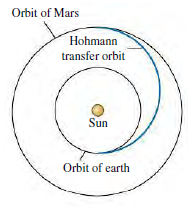
The most efficient way to send a spacecraft from the earth to another planet is to use a Hohmann transfer orbit (Fig. P13.79). If the orbits of the departure and destination planets are circular, the Hohmann transfer orbit is an elliptical orbit whose perihelion and aphelion are tangent to the
An object is moving with SHM of amplitude A on the end of a spring. If the amplitude is doubled, what happens to the total distance the object travels in one period? What happens to the period? What happens to the maximum speed of the object? Discuss how these answers are related.
Think of several examples in everyday life of motions that are, at least approximately, simple harmonic. In what respects does each differ from SHM?
Does a tuning fork or similar tuning instrument undergo SHM? Why is this a crucial question for musicians?
A box containing a pebble is attached to an ideal horizontal spring and is oscillating on a friction-free air table. When the box has reached its maximum distance from the equilibrium point, the pebble is suddenly lifted out vertically without disturbing the box. Will the following characteristics
If a uniform spring is cut in half, what is the force constant of each half? Justify your answer. How would the frequency of SHM using a half spring differ from the frequency using the same mass and the entire spring?
The wings of the blue-throated hummingbird (Lampornis clemenciae), which inhabits Mexico and the southwestern United States, beat at a rate of up to 900 times per minute. Calculate(a) The period of vibration of this bird’s wings,(b) The frequency of the wings’ vibration, and(c) The angular
A glider is attached to a fixed ideal spring and oscillates on a horizontal, friction-free air track. A coin rests atop the glider and oscillates with it. At what points in the motion is the friction force on the coin greatest? The least? Justify your answers.
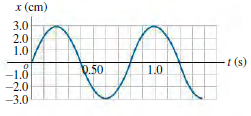
A 2.40-kg ball is attached to an unknown spring and allowed to oscillate. Figure E14.7 shows a graph of the ball€™s position x as a function of time t. What are the oscillation€™s(a) Period,(b) Frequency,(c) Angular frequency, and(d) Amplitude?(e) What is the force constant of
Two identical gliders on an air track are connected by an ideal spring. Could such a system undergo SHM? Explain. How would the period compare with that of a single glider attached to a spring whose other end is rigidly attached to a stationary object? Explain.
You are captured by Martians, taken into their ship, and put to sleep. You awake some time later and find yourself locked in a small room with no windows. All the Martians have left you with is your digital watch, your school ring, and your long silverchain necklace. Explain how you can determine
If a pendulum has a period of 2.5 s on earth, what would be its period in a space station orbiting the earth? If a mass hung from a vertical spring has a period of 5.0 s on earth, what would its period be in the space station? Justify your answers.
A simple pendulum is mounted in an elevator. What happens to the period of the pendulum (does it increase, decrease, or remain the same) if the elevator(a) Accelerates upward at 5.0 m/s2;(b) Moves upward at a steady 5.0 m/s;(c) Accelerates downward at 5.0 m/s2;(d) Accelerates downward at 9.8
What should you do to the length of the string of a simple pendulum to (a) Double its frequency;(b) Double its period;(c) Double its angular frequency?
When the amplitude of a simple pendulum increases, should its period increase or decrease? Give a qualitative argument; do not rely on Eq. (14.35). Is your argument also valid for a physical pendulum?Eq.14.35 12.32 T= 2ㅠ 12 Ө +. sin Ө 22.42 Sin
Why do short dogs (like Chihuahuas) walk with quicker strides than do tall dogs (like Great Danes)?
At what point in the motion of a simple pendulum is the string tension greatest? Least? In each case give the reasoning behind your answer.
Could a standard of time be based on the period of a certain standard pendulum? What advantages and disadvantages would such a standard have compared to the actual present-day standard discussed in Section 1.3?
For a simple pendulum, clearly distinguish between ω (the angular speed) and ω (the angular frequency). Which is constant and which is variable?
In designing structures in an earthquake-prone region, how should the natural frequencies of oscillation of a structure relate to typical earthquake frequencies? Why? Should the structure have a large or small amount of damping?
A 1.35-kg object is attached to a horizontal spring of force constant 2.5 N/cm. The object is started oscillating by pulling it 6.0 cm from its equilibrium position and releasing it so that it is free to oscillate on a frictionless horizontal air track. You observe that after eight cycles its
At the end of a ride at a winter-theme amusement park, a sleigh with mass 250 kg (including two passengers) slides without friction along a horizontal, snow-covered surface. The sleigh hits one end of a light horizontal spring that obeys Hooke’s law and has its other end attached to a wall. The
You hang various masses m from the end of a vertical, 0.250-kg spring that obeys Hooke€™s law and is tapered, which means the diameter changes along the length of the spring. Since the mass of the spring is not negligible, you must replace m in the equation T =
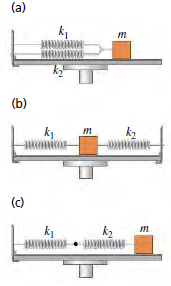
Two springs with the same unstretched length but different force constants k1and k2are attached to a block with mass m on a level, frictionless surface. Calculate the effective force constant keffin each of the three cases (a), (b), and (c) depicted in Fig. P14.92. (The effective force constant is
Experimenting with pendulums, you attach a light string to the ceiling and attach a small metal sphere to the lower end of the string. When you displace the sphere 2.00 m to the left, it nearly touches a vertical wall; with the string taut, you release the sphere from rest. The sphere swings back
A man sits in a seat that is hanging from a rope. The rope passes over a pulley suspended from the ceiling, and the man holds the other end of the rope in his hands. What is the tension in the rope, and what force does the seat exert on him? Draw a freebody force diagram for the man.
“In general, the normal force is not equal to the weight.” Give an example in which these two forces are equal in magnitude, and at least two examples in which they are not.
A clothesline hangs between two poles. No matter how tightly the line is stretched, it sags a little at the center. Explain why.
You drive a car up a steep hill at constant speed. Discuss all of the forces that act on the car. What pushes it up the hill?
For medical reasons, astronauts in outer space must determine their body mass at regular intervals. Devise a scheme for measuring body mass in an apparently weightless environment.
To push a box up a ramp, which requires less force: pushing horizontally or pushing parallel to the ramp? Why?
A woman in an elevator lets go of her briefcase, but it does not fall to the floor. How is the elevator moving?
A block rests on an inclined plane with enough friction to prevent it from sliding down. To start the block moving, is it easier to push it up the plane or down the plane? Why?
A crate of books rests on a level floor. To move it along the floor at a constant velocity, why do you exert less force if you pull it at an angle u above the horizontal than if you push it at the same angle below the horizontal?
In a world without friction, which of the following activities could you do (or not do)? Explain your reasoning.(a) Drive around an unbanked highway curve;(b) Jump into the air;(c) Start walking on a horizontal sidewalk;(d) Climb a vertical ladder;(e) Change lanes while you drive.
You are pushing a large crate from the back of a freight elevator to the front as the elevator is moving to the next floor. In which situation is the force you must apply to move the crate the least, and in which is it the greatest: when the elevator is accelerating upward, when it is accelerating
It is often said that “friction always opposes motion.” Give at least one example in which(a) Static friction causes motion, and(b) Kinetic friction causes motion.
If there is a net force on a particle in uniform circular motion, why doesn’t the particle’s speed change?
A curve in a road has a bank angle calculated and posted for 80 km/h. However, the road is covered with ice, so you cautiously plan to drive slower than this limit. What might happen to your car? Why?
You swing a ball on the end of a lightweight string in a horizontal circle at constant speed. Can the string ever be truly horizontal? If not, would it slope above the horizontal or below the horizontal? Why?
You throw a baseball straight upward with speed v0. When the ball returns to the point from where you threw it, how does its speed compare to v0(a) In the absence of air resistance and(b) In the presence of air resistance? Explain.
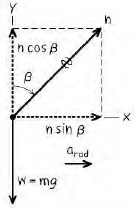
The centrifugal force is not included in the free-body diagrams of Figs. 5.34b and 5.35. Explain why not. n cos B n sin B Grud w-mg
A professor swings a rubber stopper in a horizontal circle on the end of a string in front of his class. He tells Caroline, in the front row, that he is going to let the string go when the stopper is directly in front of her face. Should Caroline worry?
To keep the forces on the riders within allowable limits, many loop-the-loop roller coaster rides are designed so that the loop is not a perfect circle but instead has a larger radius of curvature at the bottom than at the top. Explain.
A tennis ball drops from rest at the top of a tall glass cylinder—first with the air pumped out of the cylinder so that there is no air resistance, and again after the air has been readmitted to the cylinder. You examine multiflash photographs of the two drops. Can you tell which photo belongs to
You have two identical tennis balls and fill one with water. You release both balls simultaneously from the top of a tall building. If air resistance is negligible, which ball will strike the ground first? Explain. What if air resistance is not negligible?
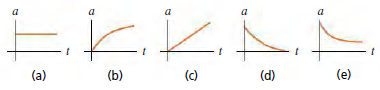
A ball is dropped from rest and feels air resistance as it falls. Which of the graphs in Fig. Q5.25 best represents its acceleration as a function of time?Figure Q5.25 (e) (a) (b) (d) (c)
“A ball is thrown from the edge of a high cliff. Regardless of the angle at which it is thrown, due to air resistance, the ball will eventually end up moving vertically downward.” Justify this statement.
A box with mass 10.0 kg moves on a ramp that is inclined at an angle of 55.0o above the horizontal. The coefficient of kinetic friction between the box and the ramp surface is µk = 0.300. Calculate the magnitude of the acceleration of the box if you push on the box with a constant force F = 120.0
A stone with mass 0.80 kg is attached to one end of a string 0.90 m long. The string will break if its tension exceeds 60.0 N. The stone is whirled in a horizontal circle on a frictionless tabletop; the other end of the string remains fixed.(a) Draw a freebody diagram of the stone.(b) Find the
A 52-kg ice skater spins about a vertical axis through her body with her arms horizontally outstretched; she makes 2.0 turns each second. The distance from one hand to the other is 1.50 m. Biometric measurements indicate that each hand typically makes up about 1.25% of body weight.(a) Draw a
Showing 1300 - 1400
of 2042
First
7
8
9
10
11
12
13
14
15
16
17
18
19
20
21
Step by Step Answers

 Get 50% OFF
Claim Now
Get 50% OFF
Claim Now