New Semester
Started
Get
50% OFF
Study Help!
--h --m --s
Claim Now
Question Answers
Textbooks
Find textbooks, questions and answers
Oops, something went wrong!
Change your search query and then try again
S
Books
FREE
Study Help
Expert Questions
Accounting
General Management
Mathematics
Finance
Organizational Behaviour
Law
Physics
Operating System
Management Leadership
Sociology
Programming
Marketing
Database
Computer Network
Economics
Textbooks Solutions
Accounting
Managerial Accounting
Management Leadership
Cost Accounting
Statistics
Business Law
Corporate Finance
Finance
Economics
Auditing
Tutors
Online Tutors
Find a Tutor
Hire a Tutor
Become a Tutor
AI Tutor
AI Study Planner
NEW
Sell Books
Search
Search
Sign In
Register
study help
physics
university physics
University Physics with Modern Physics 14th edition Hugh D. Young, Roger A. Freedman - Solutions
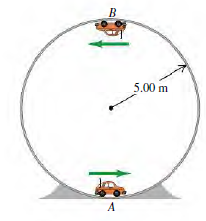
A small car with mass 0.800 kg travels at constant speed on the inside of a track that is a vertical circle with radius 5.00 m (Fig. E5.45). If the normal force exerted by the track on the car when it is at the top of the track (point B) is 6.00 N, what is the normal force on the car when it is at
A small model car with mass m travels at constant speed on the inside of a track that is a vertical circle with radius 5.00 m (Fig. E5.45). If the normal force exerted by the track on the car when it is at the bottom of the track (point A) is equal to 2.50mg, how much time does it take the car to
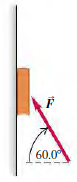
You place a book of mass 5.00 kg against a vertical wall. You apply a constant force FÌ…(vector) to the book, where F = 96.0 N and the force is at an angle of 60.0oabove the horizontal (Fig. P5.75). The coefficient of kinetic friction between the book and the wall is 0.300. If the book
Jack sits in the chair of a Ferris wheel that is rotating at a constant 0.100 rev/s. As Jack passes through the highest point of his circular path, the upward force that the chair exerts on him is equal to one-fourth of his weight. What is the radius of the circle in which Jack travels? Treat him
An elevator is hoisted by its cables at constant speed. Is the total work done on the elevator positive, negative, or zero? Explain.
A rope tied to a body is pulled, causing the body to accelerate. But according to Newton’s third law, the body pulls back on the rope with a force of equal magnitude and opposite direction. Is the total work done then zero? If so, how can the body’s kinetic energy change? Explain.
If it takes total work W to give an object a speed v and kinetic energy K, starting from rest, what will be the object’s speed (in terms of v) and kinetic energy (in terms of K) if we do twice as much work on it, again starting from rest?
If there is a net nonzero force on a moving object, can the total work done on the object be zero? Explain, using an example.
In Example 5.5 (Section 5.1), how does the work done on the bucket by the tension in the cable compare with the work done on the cart by the tension in the cable?
In the conical pendulum of Example 5.20 (Section 5.4), which of the forces do work on the bob while it is swinging?
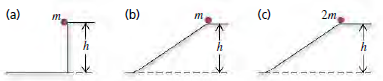
For the cases shown in Fig. Q6.8, the object is released from rest at the top and feels no friction or air resistance. In which (if any) cases will the mass have(i) The greatest speed at the bottom and(ii) The most work done on it by the time it reaches the bottom?Figure Q6.8 (a) 2m, m. (c) (b)
A force F̅(vector) is in the x-direction and has a magnitude that depends on x. Sketch a possible graph of F versus x such that the force does zero work on an object that moves from x1 to x2, even though the force magnitude is not zero at all x in this range.
Does a car’s kinetic energy change more when the car speeds up from 10 to 15 m/s or from 15 to 20 m/s? Explain.
A falling brick has a mass of 1.5 kg and is moving straight downward with a speed of 5.0 m/s. A 1.5-kg physics book is sliding across the floor with a speed of 5.0 m/s. A 1.5-kg melon is traveling with a horizontal velocity component 3.0 m/s to the right and a vertical component 4.0 m/s upward. Do
A 128.0-N carton is pulled up a frictionless baggage ramp inclined at 30.0° above the horizontal by a rope exerting a 72.0-N pull parallel to the ramp’s surface. If the carton travels 5.20 m along the surface of the ramp, calculate the work done on it by(a) The rope,(b) Gravity, and(c) The
Can the total work done on an object during a displacement be negative? Explain. If the total work is negative, can its magnitude be larger than the initial kinetic energy of the object? Explain.
A net force acts on an object and accelerates it from rest to a speed v1. In doing so, the force does an amount of work W1. By what factor must the work done on the object be increased to produce three times the final speed, with the object again starting from rest?
A large crate sits on the floor of a warehouse. Paul and Bob apply constant horizontal forces to the crate. The force applied by Paul has magnitude 48.0 N and direction 61.0° south of west. How much work does Paul’s force do during a displacement of the crate that is 12.0 m in the direction
A truck speeding down the highway has a lot of kinetic energy relative to a stopped state trooper but no kinetic energy relative to the truck driver. In these two frames of reference, is the same amount of work required to stop the truck? Explain.
You are holding a briefcase by the handle, with your arm straight down by your side. Does the force your hand exerts do work on the briefcase when(a) You walk at a constant speed down a horizontal hallway and(b) You ride an escalator from the first to second floor of a building? In both cases
Time yourself while running up a flight of steps, and compute the average rate at which you do work against the force of gravity. Express your answer in watts and in horsepower.
When a book slides along a tabletop, the force of friction does negative work on it. Can friction ever do positive work? Explain.
Many terms from physics are badly misused in everyday language. In both cases, explain the errors involved.(a) A strong person is called powerful. What is wrong with this use of power?(b) When a worker carries a bag of concrete along a level construction site, people say he did a lot of work. Did
An advertisement for a portable electrical generating unit claims that the unit’s diesel engine produces 28,000 hp to drive an electrical generator that produces 30 MW of electrical power. Is this possible? Explain.
A car speeds up while the engine delivers constant power. Is the acceleration greater at the beginning of this process or at the end? Explain.
Consider a graph of instantaneous power versus time, with the vertical P-axis starting at P = 0. What is the physical significance of the area under the P-versus-t curve between vertical lines at t1 and t2 ? How could you find the average power from the graph? Draw a P-versus-t curve that consists
A nonzero net force acts on an object. Is it possible for any of the following quantities to be constant: the object’s(a) Speed;(b) Velocity;(c) Kinetic energy?
If work W is required to stretch a spring a distance x from its unstretched length, what work (in terms of W) is required to stretch the spring an additional distance x?
When a certain force is applied to an ideal spring, the spring stretches a distance x from its unstretched length and does work W. If instead twice the force is applied, what distance (in terms of x) does the spring stretch from its unstretched length, and how much work (in terms of W) is required
A crate on a motorized cart starts from rest and moves with a constant eastward acceleration of a = 2.80 m/s2. A worker assists the cart by pushing on the crate with a force that is eastward and has magnitude that depends on time according to F(t) = 15.40 N/s2t. What is the instantaneous power
You are applying a constant horizontal force F̅(vector) (-8.00 N)î + (3.00 N)ĵ to a crate that is sliding on a factory floor. At the instant that the velocity of the crate is υ̅(vector) = (3.20 m/s)î + 12.20 m/s2ĵ, what is the instantaneous power supplied by this force?
One end of a horizontal spring with force constant 130.0 N/m is attached to a vertical wall. A 4.00-kg block sitting on the floor is placed against the spring. The coefficient of kinetic friction between the block and the floor is µk = 0.400. You apply a constant force F̅(vector) to the block.
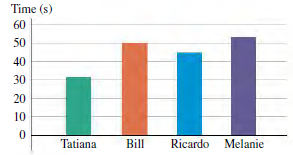
For a physics lab experiment, four classmates run up the stairs from the basement to the top floor of their physics building€”a vertical distance of 16.0 m. The classmates and their masses are: Tatiana, 50.2 kg; Bill, 68.2 kg; Ricardo, 81.8 kg; and Melanie, 59.1 kg. The time it takes each
A baseball is thrown straight up with initial speed v0. If air resistance cannot be ignored, when the ball returns to its initial height its speed is less than v0. Explain why, using energy concepts.
A projectile has the same initial kinetic energy no matter what the angle of projection. Why doesn’t it rise to the same maximum height in each case?
An egg is released from rest from the roof of a building and falls to the ground. Its fall is observed by a student on the roof of the building, who uses coordinates with origin at the roof, and by a student on the ground, who uses coordinates with origin at the ground. Do the values the two
A physics teacher had a bowling ball suspended from a very long rope attached to the high ceiling of a large lecture hall. To illustrate his faith in conservation of energy, he would back up to one side of the stage, pull the ball far to one side until the taut rope brought it just to the end of
Is it possible for a friction force to increase the mechanical energy of a system? If so, give examples.
A woman bounces on a trampoline, going a little higher with each bounce. Explain how she increases the total mechanical energy.
People often call their electric bill a power bill, yet the quantity on which the bill is based is expressed in kilowatt-hours. What are people really being billed for?
(a) A book is lifted upward a vertical distance of 0.800 m. During this displacement, does the gravitational force acting on the book do positive work or negative work? Does the gravitational potential energy of the book increase or decrease?(b) A can of beans is released from rest and falls
A 25.0-kg child plays on a swing having support ropes that are 2.20 m long. Her brother pulls her back until the ropes are 42.0° from the vertical and releases her from rest.(a) What is her potential energy just as she is released, compared with the potential energy at the bottom of the swing’s
(a) A block of wood is pushed against a spring, which is compressed 0.080 m. Does the force on the block exerted by the spring do positive or negative work? Does the potential energy stored in the spring increase or decrease?(b) A block of wood is placed against a vertical spring that is compressed
A 1.0kg stone and a 10.0kg stone are released from rest at the same height above the ground. Ignore air resistance. Which of these statements about the stones are true? Justify each answer.(a) Both have the same initial gravitational potential energy.(b) Both will have the same acceleration as they
Two objects with different masses are launched vertically into the air by placing them on identical compressed springs and then releasing the springs. The two springs are compressed by the same amount before launching. Ignore air resistance and the masses of the springs. Which of these statements
A box slides down a ramp and work is done on the box by the forces of gravity and friction. Can the work of each of these forces be expressed in terms of the change in a potential energy function? For each force explain why or why not.
A force of 520 N keeps a certain spring stretched a distance of 0.200 m.(a) What is the potential energy of the spring when it is stretched 0.200 m?(b) What is its potential energy when it is compressed 5.00 cm?
In physical terms, explain why friction is a nonconservative force. Does it store energy for future use?
Since only changes in potential energy are important in any problem, a student decides to let the elastic potential energy of a spring be zero when the spring is stretched a distance x1. The student decides, therefore, to let U = 1/2 k(x - x1)2. Is this correct? Explain.
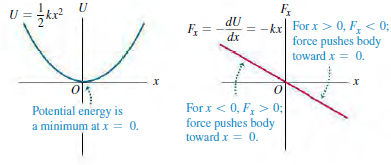
Figure 7.22a shows the potential energy function for the force Fx= -kx. Sketch the potential energy function for the force Fx= +kx. For this force, is x = 0 a point of equilibrium? Is this equilibrium stable or unstable? Explain.Figure 7.22aElastic potential energy and force as functions of x U =
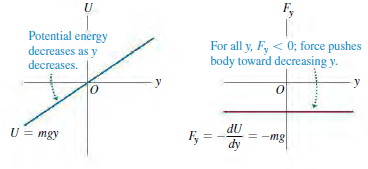
Figure 7.22b shows the potential energy function associated with the gravitational force between an object and the earth. Use this graph to explain why objects always fall toward the earth when they are released.Figure 7.22bGravitational potential energy and force as functions of y F, Potential
For a system of two particles we often let the potential energy for the force between the particles approach zero as the separation of the particles approaches infinity. If this choice is made, explain why the potential energy at noninfinite separation is positive if the particles repel one another
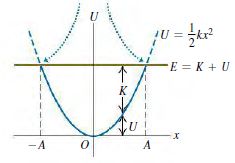
Explain why the points x = A and x = -A in Fig. 7.23b are called turning points. How are the values of E and U related at a turning point?Fig. 7.23bOn the graph, the limits of motion are the points where the U curve intersects the horizontal line representing total mechanical energy E. и -Jue -E =
A particle is in neutral equilibrium if the net force on it is zero and remains zero if the particle is displaced slightly in any direction. Sketch the potential energy function near a point of neutral equilibrium for the case of one dimensional motion. Give an example of an object in neutral
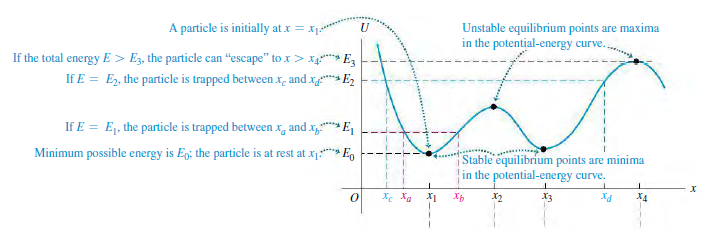
The net force on a particle of mass m has the potential energy function graphed in Fig. 7.24a. If the total energy is E1, graph the speed v of the particle versus its position x. At what value of x is the speed greatest? Sketch v versus x if the total energy is E2.Fig. 7.24aA hypothetical
The potential energy function for a force F̅(vector) is U = ax3, where α is a positive constant. What is the direction of F̅(vector) ?
A conservative force F̅(vector) is in the +x-direction and has magnitude F(x) = α/(x + x0)2, where α = 0.800 N ∙ m2 and x0 = 0.200 m.(a) What is the potential-energy function U(x) for this force? Let U(x) → 0 as x → ∞. (b) An object with mass m = 0.500 kg is released from rest at x
You are designing an amusement park ride. A cart with two riders moves horizontally with speed v = 6.00 m/s. You assume that the total mass of cart plus riders is 300 kg. The cart hits a light spring that is attached to a wall, momentarily comes to rest as the spring is compressed, and then regains
A small object with mass m = 0.0900 kg moves along the +x-axis. The only force on the object is a conservative force that has the potential-energy function U(x) = -αx2 + βx3, where α = 2.00 J/m2 and β = 0.300 J/m3. The object is released from rest at small x. When the object is at x = 4.00 m,
You are designing a pendulum for a science museum. The pendulum is made by attaching a brass sphere with mass m to the lower end of a long, light metal wire of (unknown) length L. A device near the top of the wire measures the tension in the wire and transmits that information to your laptop
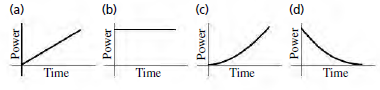
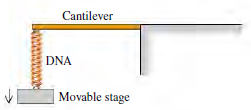
The stage moves at a constant speed while stretching the DNA. Which of the graphs in Fig. P7.84 best represents the power supplied to the stage versus time?Figure P7.84A DNA molecule, with its doublehelix structure, can in some situations behave like a spring. Measuring the force required to
In splitting logs with a hammer and wedge, is a heavy hammer more effective than a lighter hammer? Why?
Suppose you catch a baseball and then someone invites you to catch a bowling ball with either the same momentum or the same kinetic energy as the baseball. Which would you choose? Explain.
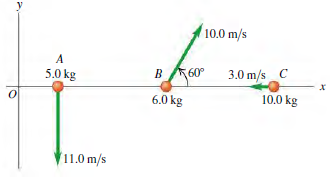
Objects A, B, and C are moving as shown in Fig. E8.3. Find the x- and y components of the net momentum of the particles if we define the system to consist of(a) A and C,(b) B and C,(c) all three objects.Figure E8.3 10.0 m/s B60° 5.0 kg 3.0 m/s_C 10.0 kg 6.0 kg 11.0 m/s
When rain falls from the sky, what happens to its momentum as it hits the ground? Is your answer also valid for Newton’s famous apple?
A car has the same kinetic energy when it is traveling south at 30 m/s as when it is traveling northwest at 30 m/s. Is the momentum of the car the same in both cases? Explain.
A truck is accelerating as it speeds down the highway. One inertial frame of reference is attached to the ground with its origin at a fence post. A second frame of reference is attached to a police car that is traveling down the highway at constant velocity. Is the momentum of the truck the same in
(a) If the momentum of a single point object is equal to zero, must the object’s kinetic energy also be zero?(b) If the momentum of a pair of point objects is equal to zero, must the kinetic energy of those objects also be zero?(c) If the kinetic energy of a pair of point objects is equal to
A woman holding a large rock stands on a frictionless, horizontal sheet of ice. She throws the rock with speed v0 at an angle a above the horizontal. Consider the system consisting of the woman plus the rock. Is the momentum of the system conserved? Why or why not? Is any component of the momentum
In Example 8.7 (Section 8.3), where the two gliders of Fig. 8.18 stick together after the collision, the collision is inelastic because K21 . In Example 8.5 (Section 8.2), is the collision inelastic? Explain.
In a completely inelastic collision between two objects, where the objects stick together after the collision, is it possible for the final kinetic energy of the system to be zero? If so, give an example in which this would occur. If the final kinetic energy is zero, what must the initial momentum
Since for a particle the kinetic energy is given by K = 1/2 mv2 and the momentum by P̅(vector) = mυ̅(vector), it is easy to show that K = p2/2m. How, then, is it possible to have an event during which the total momentum of the system is constant but the total kinetic energy changes?
In each of Examples 8.10, 8.11, and 8.12 (Section 8.4), verify that the relative velocity vector of the two bodies has the same magnitude before and after the collision. In each case, what happens to the direction of the relative velocity vector?
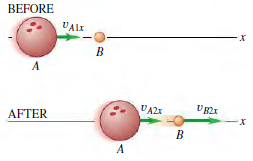
In Fig. 8.23b, the kinetic energy of the Ping-Pong ball is larger after its interaction with the bowling ball than before. From where does the extra energy come? Describe the event in terms of conservation of energy.Fig. 8.23b BEFORE VALI A AFTER х
A machine gun is fired at a steel plate. Is the average force on the plate from the bullet impact greater if the bullets bounce off or if they are squashed and stick to the plate? Explain.
A net force of 4 N acts on an object initially at rest for 0.25 s and gives it a final speed of 5 m/s. How could a net force of 2 N produce the same final speed?
A net force with x-component ΣFx acts on an object from time t1 to time t2. The x-component of the momentum of the object is the same at t1 as it is at t2, but ΣFx is not zero at all times between t1 and t2 . What can you say about the graph of ΣFx versus t?
A tennis player hits a tennis ball with a racket. Consider the system made up of the ball and the racket. Is the total momentum of the system the same just before and just after the hit? Is the total momentum just after the hit the same as 2 s later, when the ball is in midair at the high point of
Two figure skaters, one weighing 625 N and the other 725 N, push off against each other on frictionless ice.(a) If the heavier skater travels at 1.50 m/s, how fast will the lighter one travel?(b) How much kinetic energy is “created” during the skaters’ maneuver, and where does this energy
In Example 8.4 (Section 8.2), consider the system consisting of the rifle plus the bullet. What is the speed of the system’s center of mass after the rifle is fired? Explain.
An egg is released from rest from the roof of a building and falls to the ground. As the egg falls, what happens to the momentum of the system of the egg plus the earth?
A woman stands in the middle of a perfectly smooth, frictionless, frozen lake. She can set herself in motion by throwing things, but suppose she has nothing to throw. Can she propel herself to shore without throwing anything?
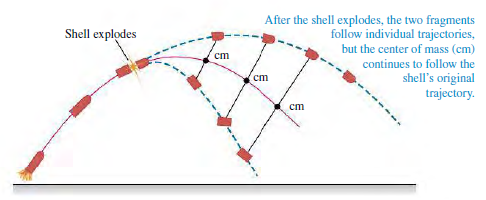
At the highest point in its parabolic trajectory, a shell explodes into two fragments. Is it possible for both fragments to fall straight down after the explosion? Why or why not?
When an object breaks into two pieces (explosion, radioactive decay, recoil, etc.), the lighter fragment gets more kinetic energy than the heavier one. This is a consequence of momentum conservation, but can you also explain it by using Newton’s laws of motion?
An apple falls from a tree and feels no air resistance. As it is falling, which of these statements about it are true?(a) Only its momentum is conserved;(b) Only its mechanical energy is conserved;(c) Both its momentum and its mechanical energy are conserved;(d) Its kinetic energy is conserved.
Two pieces of clay collide and stick together. During the collision, which of these statements are true?(a) Only the momentum of the clay is conserved;(b) Only the mechanical energy of the clay is conserved;(c) Both the momentum and the mechanical energy of the clay are conserved;(d) The kinetic
Two objects of mass M and 5M are at rest on a horizontal, frictionless table with a compressed spring of negligible mass between them. When the spring is released, which of the following statements are true?(a) The two objects receive equal magnitudes of momentum.(b) The two objects receive equal
A very heavy SUV collides head-on with a very light compact car. Which of these statements about the collision are correct?(a) The amount of kinetic energy lost by the SUV is equal to the amount of kinetic energy gained by the compact;(b) The amount of momentum lost by the SUV is equal to the
You (mass 55 kg) are riding a frictionless skateboard (mass 5.0 kg) in a straight line at a speed of 4.5 m/s. A friend standing on a balcony above you drops a 2.5 kg sack of flour straight down into your arms.(a) What is your new speed while you hold the sack?(b) Since the sack was dropped
Two cars collide at an intersection. Car A, with a mass of 2000 kg, is going from west to east, while car B, of mass 1500 kg, is going from north to south at 15 m/s. As a result, the two cars become enmeshed and move as one. As an expert witness, you inspect the scene and determine that, after the
Jack (mass 55.0 kg) is sliding due east with speed 8.00 m/s on the surface of a frozen pond. He collides with Jill (mass 48.0 kg), who is initially at rest. After the collision, Jack is traveling at 5.00 m/s in a direction 34.0° north of east. What is Jill’s velocity (magnitude and direction)
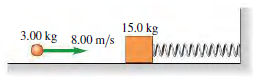
A 15.0-kg block is attached to a very light horizontal spring of force constant 500.0 N/m and is resting on a frictionless horizontal table (Fig. E8.44). Suddenly it is struck by a 3.00-kg stone traveling horizontally at 8.00 m/s to the right, whereupon the stone rebounds at 2.00 m/s horizontally
A 0.800-kg ornament is hanging by a 1.50-m wire when the ornament is suddenly hit by a 0.200-kg missile traveling horizontally at 12.0 m/s. The missile embeds itself in the ornament during the collision. What is the tension in the wire immediately after the collision?
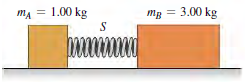
Two blocks have a spring compressed between them, as in Exercise 8.24. The spring has force constant 720 N/m and is initially compressed 0.225 m from its original length. For each block, what is(a) The acceleration just after the blocks are released;(b) The final speed after the blocks leave the
You are called as an expert witness to analyze the following auto accident: Car B, of mass 1900 kg, was stopped at a red light when it was hit from behind by car A, of mass 1500 kg. The cars locked bumpers during the collision and slid to a stop with brakes locked on all wheels. Measurements of the
A 1500-kg sedan goes through a wide intersection traveling from north to south when it is hit by a 2200-kg SUV traveling from east to west. The two cars become enmeshed due to the impact and slide as one thereafter. On-the scene measurements show that the coefficient of kinetic friction between the
In a fireworks display, a rocket is launched from the ground with a speed of 18.0 m>s and a direction of 51.0° above the horizontal. During the flight, the rocket explodes into two pieces of equal mass (Fig. 8.32).Figure 8.32(a) What horizontal distance from the launch point will the center
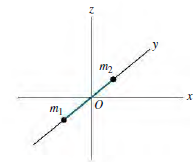
A diatomic molecule can be modeled as two point masses, m1and m2, slightly separated (Fig. Q9.2). If the molecule is oriented along the y-axis, it has kinetic energy K when it spins about the x-axis. What will its kinetic energy (in terms of K) be if it spins at the same angular speed about(a) The
Which of the following formulas is valid if the angular acceleration of an object is not constant? Explain your reasoning in each case.(a) v = rω;(b) atan = rα;(c) ω = ω0 + αt;(d) atan = rω2;(e) K = 1/2 Iω2.
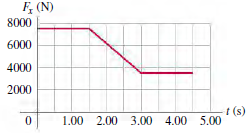
A 2004 Prius with a 150-lb driver and no passengers weighs 3071 lb. The car is initially at rest. Starting at t = 0, a net horizontal force Fx(t) in the +x-direction is applied to the car. The force as a function of time is given in Fig. P8.100.(a) For the time interval t = 0 to t = 4.50 s, what is
Showing 1400 - 1500
of 2042
First
7
8
9
10
11
12
13
14
15
16
17
18
19
20
21
Step by Step Answers

 Get 50% OFF
Claim Now
Get 50% OFF
Claim Now