New Semester
Started
Get
50% OFF
Study Help!
--h --m --s
Claim Now
Question Answers
Textbooks
Find textbooks, questions and answers
Oops, something went wrong!
Change your search query and then try again
S
Books
FREE
Study Help
Expert Questions
Accounting
General Management
Mathematics
Finance
Organizational Behaviour
Law
Physics
Operating System
Management Leadership
Sociology
Programming
Marketing
Database
Computer Network
Economics
Textbooks Solutions
Accounting
Managerial Accounting
Management Leadership
Cost Accounting
Statistics
Business Law
Corporate Finance
Finance
Economics
Auditing
Tutors
Online Tutors
Find a Tutor
Hire a Tutor
Become a Tutor
AI Tutor
AI Study Planner
NEW
Sell Books
Search
Search
Sign In
Register
study help
physics
university physics
University Physics with Modern Physics 14th edition Hugh D. Young, Roger A. Freedman - Solutions
If you look up from underneath toward the surface of the water in your aquarium, you may see an upside-down reflection of your pet fish in the surface of the water. Explain how this can happen.
Sometimes when looking at a window, you see two reflected images slightly displaced from each other. What causes this?
When hot air rises from a radiator or heating duct, objects behind it appear to shimmer or waver. What causes this?
A student claimed that, because of atmospheric refraction (see Discussion Question Q33.2), the sun can be seen after it has set and that the day is therefore longer than it would be if the earth had no atmosphere. First, what does she mean by saying that the sun can be seen after it has set?
A beam of light goes from one material into another. On physical grounds, explain why the wavelength changes but the frequency and period do not.
Sunlight or starlight passing through the earth’s atmosphere is always bent toward the vertical. Why? Does this mean that a star is not really where it appears to be? Explain.
Light requires about 8 minutes to travel from the sun to the earth. Is it delayed appreciably by the earth’s atmosphere? Explain.
Doubling the frequency of a wave in the range of 25 Hz to 3 kHz represents what change in the maximum allowed electromagnetic-wave intensity?(a) A factor of 2;(b) A factor of 1/√2;(c) A factor of 1/2;(d) a factor of 1/4There have been many studies of the effects on humans of electromagnetic waves
In the United States, household electrical power is provided at a frequency of 60 Hz, so electromagnetic radiation at that frequency is of particular interest. On the basis of the ICNIRP guidelines, what is the maximum intensity of an electromagnetic wave at this frequency to which the general
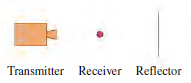
As a physics lab instructor, you conduct an experiment on standing waves of microwaves, similar to the standing waves produced in a microwave oven. A transmitter emits microwaves of frequency f . The waves are reflected by a flat metal reflector, and a receiver measures the waves€™
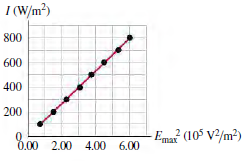
Because the speed of light in vacuum (or air) has such a large value, it is very difficult to measure directly. To measure this speed, you conduct an experiment in which you measure the amplitude of the electric field in a laser beam as you change the intensity of the beam. Figure P32.49 is a graph
The energy flow to the earth from sunlight is about 1.4 kW/m2.(a) Find the maximum values of the electric and magnetic fields for a sinusoidal wave of this intensity.(b) The distance from the earth to the sun is about 1.5 × 10¹¹ m. Find the total power radiated by the sun.
Does an electromagnetic standing wave have energy? Does it have momentum? Are your answers to these questions the same as for a traveling wave? Why or why not?
A light source radiates a sinusoidal electromagnetic wave uniformly in all directions. This wave exerts an average pressure p on a perfectly reflecting surface a distance R away from it. What average pressure (in terms of p) would this wave exert on a perfectly absorbing surface that was twice as
If a light beam carries momentum, should a person holding a flashlight feel a recoil analogous to the recoil of a rifle when it is fired? Why is this recoil not actually observed?
Most automobiles have vertical antennas for receiving radio broadcasts. Explain what this tells you about the direction of polarization of E̅(vector) in the radio waves used in broadcasting.
The magnetic-field amplitude of the electromagnetic wave from the laser described in Example 32.1 (Section 32.3) is about 100 times greater than the earth’s magnetic field. If you illuminate a compass with the light from this laser, would you expect the compass to deflect? Why or why not?
For a certain sinusoidal wave of intensity I, the amplitude of the magnetic field is B. What would be the amplitude (in terms of B) in a similar wave of twice the intensity?
The light beam from a searchlight may have an electricfield magnitude of 1000 V/m, corresponding to a potential difference of 1500 V between the head and feet of a 1.5-m-tall person on whom the light shines. Does this cause the person to feel a strong electric shock? Why or why not?
Suppose that a positive point charge q is initially at rest on the x-axis, in the path of the electromagnetic plane wave described in Section 32.2. Will the charge move after the wave front reaches it? If not, why not? If the charge does move, describe its motion qualitatively. (Remember that
Is polarization a property of all electromagnetic waves, or is it unique to visible light? Can sound waves be polarized? What fundamental distinction in wave properties is involved? Explain.
Medical x rays are taken with electromagnetic waves having a wavelength of around 0.10 nm in air. What are the frequency, period, and wave number of such waves?
Sometimes neon signs located near a powerful radio station are seen to glow faintly at night, even though they are not turned on. What is happening?
Give several examples of electromagnetic waves that are encountered in everyday life. How are they all alike? How do they differ?
When driving on the upper level of the Bay Bridge, westbound from Oakland to San Francisco, you can easily pick up a number of radio stations on your car radio. But when driving eastbound on the lower level of the bridge, which has steel girders on either side to support the upper level, the radio
By measuring the electric and magnetic fields at a point in space where there is an electromagnetic wave, can you determine the direction from which the wave came? Explain.
If the frequency at which the electrode is oscillated is increased to a very large value, the electrode’s impedance(a) Approaches infinity;(b) Approaches zero;(c) Approaches a constant but nonzero value;(d) Does not change.An individual cell such as an egg cell (an ovum, produced in the ovaries)
The signal from the oscillating electrode is fed into an amplifier, which reports the measured voltage as an rms value, 1.5 nV. What is the potential difference between the two extremes?(a) 1.5 nV;(b) 3.0 nV;(c) 2.1 nV;(d) 4.2 nV.An individual cell such as an egg cell (an ovum, produced in the
If the electrode oscillates between two points 20 mm apart at a frequency of (5000/π)Hz, what is the electrode’s impedance?(a) 0;(b) Infinite;(c) √2 × 10⁴ Ω;(d) √2 × 10⁶ Ω.An individual cell such as an egg cell (an ovum, produced in the ovaries) is commonly organized spatially, as
What is the dc impedance of the electrode, assuming that it behaves as an ideal capacitor?(a) 0;(b) Infinite;(c) √2 × 10⁴ Ω;(d) √2 × 10⁶ Ω.An individual cell such as an egg cell (an ovum, produced in the ovaries) is commonly organized spatially, as manifested in part by asymmetries in the
An ideal transformer has N1 windings in the primary and N2 windings in its secondary. If you double only the number of secondary windings, by what factor does(a) The voltage amplitude in the secondary change, and(b) The effective resistance of the secondary circuit change?
Can a transformer be used with dc? Explain. What happens if a transformer designed for 120-V ac is connected to a 120-V dc line?
A circuit consists of a light bulb, a capacitor, and an inductor connected in series to an ac source. Is it possible for both the capacitor and the inductor to be removed and the brightness of the bulb to remain the same? Explain.
A coil of wire wrapped on a hollow tube and a light bulb are connected in series to an ac source. What happens to the brightness of the bulb when an iron rod is inserted in the tube?
A light bulb and a parallel-plate capacitor with air between the plates are connected in series to an ac source. What happens to the brightness of the bulb when a dielectric is inserted between the plates of the capacitor? Explain.
In Example 31.6 (Section 31.4), a hair dryer is treated as a pure resistor. But because there are coils in the heating element and in the motor that drives the blower fan, a hair dryer also has inductance. Qualitatively, does including an inductance increase or decrease the values of R, Irms, and P?
When an L-R-C series circuit is connected across a 120-V ac line, the voltage rating of the capacitor may be exceeded even if it is rated at 200 or 400 V. How can this be?
In an L-R-C series circuit, what are the phase angle ϕ and power factor cos ϕ when the resistance is much smaller than the inductive or capacitive reactance and the circuit is operated far from resonance? Explain.
In an L-R-C series circuit, can the instantaneous voltage across the capacitor exceed the source voltage at that same instant? Can this be true for the instantaneous voltage across the inductor? Across the resistor? Explain.
Is it possible for the power factor of an L-R-C series ac circuit to be zero? Justify your answer on physical grounds.
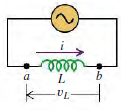
Equation (31.9) says that vab= L di/dt (see Fig. 31.8a). Using Faraday€™s law, explain why point a is at higher potential than point b when i is in the direction shown in Fig. 31.8a and is increasing in magnitude. When i is counterclockwise and decreasing in magnitude, is vab= L di/dt
Fluorescent lights often use an inductor, called a ballast, to limit the current through the tubes. Why is it better to use an inductor rather than a resistor for this purpose?
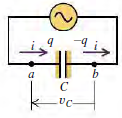
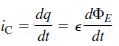
Equation (31.14) was derived by using the relationship i = dq/dt between the current and the charge on the capacitor. In Fig. 31.9a the positive counterclockwise current increases the charge on the capacitor. When the charge on the left plate is positive but decreasing in time, is i = dq/dt still
In an ac circuit, why is the average power for an inductor and a capacitor zero, but not for a resistor?
The current in an ac power line changes direction 120 times per second, and its average value is zero. Explain how it is possible for power to be transmitted in such a system.
Household electric power in most of western Europe is supplied at 240 V, rather than the 120 V that is standard in the United States and Canada. What are the advantages and disadvantages of each system?
If all of the magnetic energy stored in this MRI magnet is converted to thermal energy, how much liquid helium will boil off? (a) 27 kg; (b) 38 kg; (c) 60 kg; (d) 110 kg.
If part of the magnet develops resistance and liquid helium boils away, rendering more and more of the magnet nonsuperconducting, how will this quench affect the time for the current to drop to half of its initial value?(a) The time will be shorter because the resistance will increase;(b) The time
If a small part of this magnet loses its superconducting properties and the resistance of the magnet wire suddenly rises from 0 to a constant 0.005 Ω, how much time will it take for the current to decrease to half of its initial value?(a) 4.7 min;(b) 10 min;(c) 15 min;(d) 30 min.Magnets carrying
How many turns does this typical MRI magnet have?(a) 1100;(b) 3000;(c) 4000;(d) 22,000.Magnets carrying very large currents are used to produce the uniform, large-magnitude magnetic fields that are required for magnetic resonance imaging (MRI). A typical MRI magnet may be a solenoid that is 2.0 m
Consider the circuit in Exercise 30.23.(a) Just after the circuit is completed, at what rate is the battery supplying electrical energy to the circuit?(b) When the current has reached its final steady-state value, how much energy is stored in the inductor? What is the rate at which electrical
In an L-R-C series circuit, what criteria could be used to decide whether the system is overdamped or underdamped? For example, could we compare the maximum energy stored during one cycle to the energy dissipated during one cycle? Explain.
Suppose there is a steady current in an inductor. If you attempt to reduce the current to zero instantaneously by quickly opening a switch, an arc can appear at the switch contacts. Why? Is it physically possible to stop the current instantaneously? Explain.
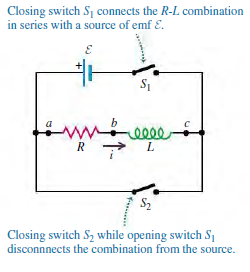
In the R-L circuit shown in Fig. 30.11, is the current in the resistor always the same as the current in the inductor? How do you know?Fig.30.11 Closing switch S, connects the R-L combination in series with a source of emf E. S1 eo00 S2 Closing switch Sz while opening switch S, disconnnects the
A toroidal solenoid has mean radius 12.0 cm and crosssectional area 0.600 cm2.(a) How many turns does the solenoid have if its inductance is 0.100 mH?(b) What is the resistance of the solenoid if the wire from which it is wound has a resistance per unit length of 0.0760 Ω/m?
In the R-L circuit shown in Fig. 30.11, when switch S1 is closed, the potential vac changes suddenly and discontinuously, but the current does not. Explain why the voltage can change suddenly but the current can’t.
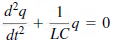
In Section 30.5 the relationship i = dq/dt is used in deriving Eq. (30.20). But a flow of current corresponds to a decrease in the charge on the capacitor. Explain, therefore, why this is the correct equation to use in the derivation, rather than i = -dq/dt.Eq.30.20 |d²q dr? LC9 = 0 b:
In Section 30.5 Kirchhoff’s loop rule is applied to an L-C circuit where the capacitor is initially fully charged and the equation -L (di/dt) - (q/C) = 0 is derived. But as the capacitor starts to discharge, the current increases from zero. The equation says L di/dt = -q/C, so it says L di/dt is
In an R-C circuit, a resistor, an uncharged capacitor, a dc battery, and an open switch are in series. In an R-L circuit, a resistor, an inductor, a dc battery, and an open switch are in series. Compare the behavior of the current in these circuits(a) Just after the switch is closed and(b) Long
For the same magnetic field strength B, is the energy density greater in vacuum or in a magnetic material? Explain. Does Eq. (30.11) imply that for a long solenoid in which the current is I the energy stored is proportional to 1/µ? And does this mean that for the same current less energy is
You are to make a resistor by winding a wire around a cylindrical form. To make the inductance as small as possible, it is proposed that you wind half the wire in one direction and the other half in the opposite direction. Would this achieve the desired result? Why or why not?
Two closely wound circular coils have the same number of turns, but one has twice the radius of the other. How are the self-inductances of the two coils related? Explain your reasoning.
Two identical, closely wound, circular coils, each having self-inductance L, are placed next to each other, so that they are coaxial and almost touching. If they are connected in series, what is the self-inductance of the combination? What if they are connected in parallel? Can they be connected so
The tightly wound toroidal solenoid is one of the few configurations for which it is easy to calculate self-inductance. What features of the toroidal solenoid give it this simplicity?
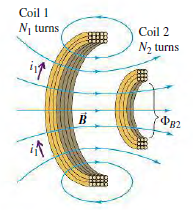
In Fig. 30.1, if coil 2 is turned 90° so that its axis is vertical, does the mutual inductance increase or decrease? Explain.Fig.30.1 Coil 1 Nj turns Coil 2 N2 turns Фв2 it
In an electric trolley or bus system, the vehicle’s motor draws current from an overhead wire by means of a long arm with an attachment at the end that slides along the overhead wire. A brilliant electric spark is often seen when the attachment crosses a junction in the wires where contact is
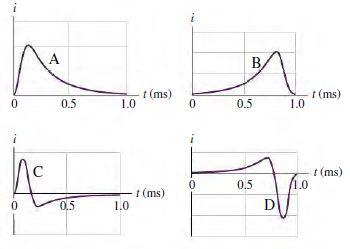
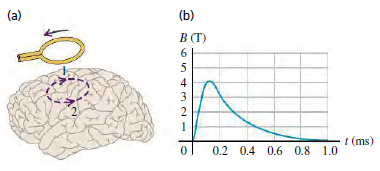
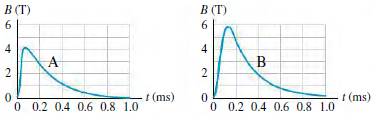
Which graph in Fig. P29.74 best represents the time t dependence of the current i induced in the brain tissue, assuming that this tissue can be modeled as a resistive circuit? (The units of i are arbitrary.)(a) A;(b) B;(c) C;(d) D.Figure P29.74Communication in the nervous system is based on the
It may be desirable to increase the maximum induced current in the brain tissue. In Fig. P29.73, which time-dependent graph of the magnetic field B in the coil achieves that goal? Assume that everything else remains constant.(a) A;(b) B;(c) Either A or B;(d) Neither A nor B.Figure
Consider the brain tissue at the level of the dashed line to be a series of concentric circles, each behaving independently of the others. Where will the induced emf be the greatest?(a) At the center of the dashed line;(b) At the periphery of the dashed line;(c) Nowhere€”it will be the
In part (a) of the figure, a current pulse increases to a peak and then decreases to zero in the direction shown in the stimulating coil. What will be the direction of the induced current (dashed line) in the brain tissue?(a) 1;(b) 2;(c) 1 while the current increases in the stimulating coil, 2
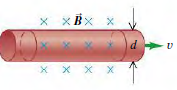
Blood contains positive and negative ions and thus is a conductor. A blood vessel, therefore, can be viewed as an electrical wire. We can even picture the flowing blood as a series of parallel conducting slabs whose thickness is the diameter d of the vessel moving with speed v. (See Fig.
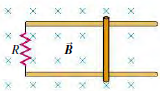
A 0.250-m-long bar moves on parallel rails that are connected through a 6.00-Ω resistor, as shown in Fig. E29.33, so the apparatus makes a complete circuit. You can ignore the resistance of the bar and rails. The circuit is in a uniform magnetic field B = 1.20 T that is directed into
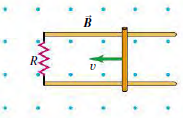
Consider the circuit shown in Fig. E29.31, but with the bar moving to the right with speed v. As in Exercise 29.31, the bar has length 0.360 m, R = 45.0 Ω, and B = 0.650 T.(a) Is the induced current in the circuit clockwise or counterclockwise?(b) At an instant when the
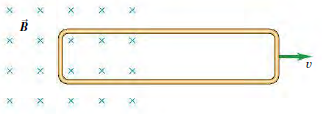
A rectangular loop of wire with dimensions 1.50 cm by 8.00 cm and resistance R = 0.600 Ω is being pulled to the right out of a region of uniform magnetic field. The magnetic field has magnitude B = 2.40 T and is directed into the plane of Fig. E29.24.At the instant when the speed of the
If magnetic monopoles existed, the right-hand side of Eq. (29.20) would include a term proportional to the current of magnetic monopoles. Suppose a steady monopole current is moving in a long straight wire. Sketch the electric field lines that such a current would produce.Eq.29.20 Line integral of
Match the mathematical statements of Maxwell’s equations as given in Section 29.7 to these verbal statements.(a) Closed electric field lines are evidently produced only by changing magnetic flux.(b) Closed magnetic field lines are produced both by the motion of electric charge and by changing
Your physics study partner asks you to consider a parallel plate capacitor that has a dielectric completely filling the volume between the plates. He then claims that Eqs. (29.13) and (29.14) show that the conduction current in the dielectric equals the displacement current in the dielectric. Do
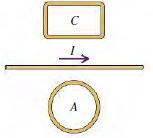
Two closed loops A and C are close to a long wire carrying a current I (Fig. E29.17).(a) Find the direction (clockwise or counterclockwise) of the current induced in each loop if I is steadily decreasing.(b) While I is decreasing, what is the direction of the net force that the wire exerts on each
Can one have a displacement current as well as a conduction current within a conductor? Explain.
Does Faraday’s law say that a large magnetic flux induces a large emf in a coil? Explain.
Does Lenz’s law say that the induced current in a metal loop always flows to oppose the magnetic flux through that loop? Explain.
Small one-cylinder gasoline engines sometimes use a device called a magneto to supply current to the spark plug. A permanent magnet is attached to the flywheel, and a stationary coil is mounted adjacent to it. Explain how this device is able to generate current. What happens when the magnet passes
A metal ring is oriented with the plane of its area perpendicular to a spatially uniform magnetic field that increases at a steady rate. If the radius of the ring is doubled, by what factor do(a) The emf induced in the ring and(b) The electric field induced in the ring change?
In many magnetic resonance imaging (MRI) systems, the magnetic field is produced by a superconducting magnet that must be kept cooled below the superconducting transition temperature. If the cryogenic cooling system fails, the magnet coils may lose their superconductivity and the strength of the
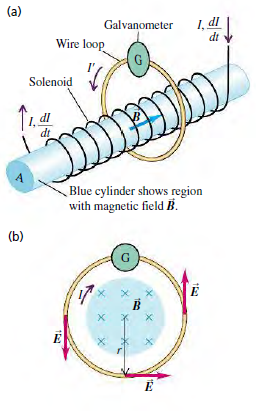
In the situation shown in Fig. 29.18, would it be appropriate to ask how much energy an electron gains during a complete trip around the wire loop with current I'? Would it be appropriate to ask what potential difference the electron moves through during such a complete trip? Explain your
Discusses the external force that must be applied to the slidewire to move it at constant speed. If there were a break in the left-hand end of the U-shaped conductor, how much force would be needed to move the slidewire at constant speed? As in the example, you can ignore friction.
A square conducting loop is in a region of uniform, constant magnetic field. Can the loop be rotated about an axis along one side and no emf be induced in the loop? Discuss, in terms of the orientation of the rotation axis relative to the magnetic-field direction.
A metal rectangle is close to a long, straight, current-carrying wire, with two of its sides parallel to the wire. If the current in the long wire is decreasing, is the rectangle repelled by or attracted to the wire? Explain why this result is consistent with Lenz’s law.
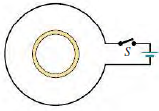
Consider the situation in Exercise 29.21. In part (a), find the direction of the force that the large circuit exerts on the small one. Explain how this result is consistent with Lenz€™s law.Data from exercise 29.21A small, circular ring is inside a larger loop that is connected to a
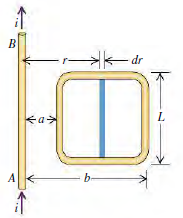
The current in the long, straight wire AB shown in Fig. E29.7 is upward and is increasing steadily at a rate di/dt.(a) At an instant when the current is i, what are the magnitude and direction of the field BÌ…(vector) at a distance r to the right of the wire?(b) What is the flux
An airplane is in level flight over Antarctica, where the magnetic field of the earth is mostly directed upward away from the ground. As viewed by a passenger facing toward the front of the plane, is the left or the right wingtip at higher potential? Does your answer depend on the direction the
A student asserted that if a permanent magnet is dropped down a vertical copper pipe, it eventually reaches a terminal velocity even if there is no air resistance. Why should this be? Or should it?
A long, straight conductor passes through the center of a metal ring, perpendicular to its plane. If the current in the conductor increases, is a current induced in the ring? Explain.
Two circular loops lie side by side in the same plane. One is connected to a source that supplies an increasing current; the other is a simple closed ring. Is the induced current in the ring in the same direction as the current in the loop connected to the source, or opposite? What if the current
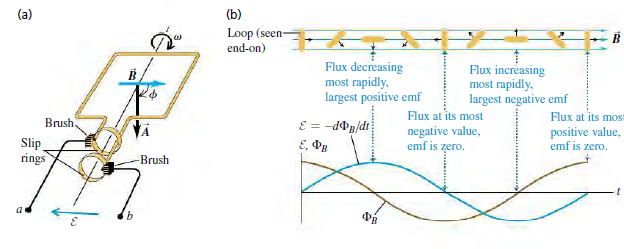
In Fig. 29.8, if the angular speed v of the loop is doubled, then the frequency with which the induced current changes direction doubles, and the maximum emf also doubles. Why? Does the torque required to turn the loop change? Explain.Fig.29.8 (a) (b) Loop (seen- end-on) Flux decreasing most
A sheet of copper is placed between the poles of an electromagnet with the magnetic field perpendicular to the sheet. When the sheet is pulled out, a considerable force is required, and the force required increases with speed. Explain. Is a force required also when the sheet is inserted between the
The solenoid is removed from the enclosure and then used in a location where the earth’s magnetic field is 50 µT and points horizontally. A sample of bacteria is placed in the center of the solenoid, and the same current is applied that produced a magnetic field of 150 µT in the lab. Describe
To use a larger sample, the experimenters construct a solenoid that has the same length, type of wire, and loop spacing but twice the diameter of the original. How does the maximum possible magnetic torque on a bacterium in this new solenoid compare with the torque the bacterium would have
What current is needed in the wire so that the magnetic field experienced by the bacteria has a magnitude of 150 µT?(a) 0.095 A;(b) 0.12 A;(c) 0.30 A;(d) 14 A.Some types of bacteria contain chains of ferromagnetic particles parallel to their long axis. The chains act like small bar magnets that
An electric bus operates by drawing direct current from two parallel overhead cables, at a potential difference of 600 V, and spaced 55 cm apart. When the power input to the bus’s motor is at its maximum power of 65 hp, (a) what current does it draw and(b) what is the attractive force per
Showing 500 - 600
of 2042
1
2
3
4
5
6
7
8
9
10
11
12
13
14
15
Last
Step by Step Answers

 Get 50% OFF
Claim Now
Get 50% OFF
Claim Now