New Semester
Started
Get
50% OFF
Study Help!
--h --m --s
Claim Now
Question Answers
Textbooks
Find textbooks, questions and answers
Oops, something went wrong!
Change your search query and then try again
S
Books
FREE
Study Help
Expert Questions
Accounting
General Management
Mathematics
Finance
Organizational Behaviour
Law
Physics
Operating System
Management Leadership
Sociology
Programming
Marketing
Database
Computer Network
Economics
Textbooks Solutions
Accounting
Managerial Accounting
Management Leadership
Cost Accounting
Statistics
Business Law
Corporate Finance
Finance
Economics
Auditing
Tutors
Online Tutors
Find a Tutor
Hire a Tutor
Become a Tutor
AI Tutor
AI Study Planner
NEW
Sell Books
Search
Search
Sign In
Register
study help
sciences
chemistry a molecular approach
Chemistry A Molecular Approach 5th Edition Nivaldo Tro - Solutions
Arrange these elements in order of decreasing electronegativity: P, Na, N, Al.(a) N > P > Al > Na (b) P > Na > N > Al(c) Na > Al > P > N (d) Al > Na > N > P
Which compound has the lattice energy with the greatest magnitude?a) MgS b) CaS c) SrS d) BaS
Describe the octet rule in the Lewis model.
Write the Lewis structure for NH3.
The HCl( g) molecule has a bond length of 127 pm and a dipole moment of 1.08 D. Without doing detailed calculations, identify the best estimate for its percent ionic character.(a) 5% (b) 15% (c) 50% (d) 80%
Which set of compounds is arranged in order of increasing magnitude of lattice energy?a) CsI < NaCl < MgS b) NaCl < CsI < MgSc) MgS < NaCl < CsI d) CsI < MgS < NaCl
According to the Lewis model, what is a chemical bond?
Write the Lewis structure for the NH4+ ion.
Which structure is NOT a resonance structure of the ion shown here? (a) [:S=C=N:] [:$-C=N:] (b) [S-N=C:] (Ⓒ)[:S=C-N:]
Which pair of atoms forms the most polar bond?a) N and O b) C and O c) C and F d) N and F
How do you draw an ionic Lewis structure?
Which molecule would you expect to be a free radical?(a) CO (b) CO2(c) N2O (d) ClO
Which pair of atoms forms a nonpolar covalent bond?a) C and S b) C and O c) B and O d) Na and Cl
How can Lewis structures be used to determine the formula of ionic compounds? Give an example.
Assign formal charges to each atom in the resonance structures of the cyanate ion (OCN–). Which resonance structure is likely to contribute most to the correct structure of (OCN–)? A B C |Ö–C=N] [Ô=C=N] [O=C-N
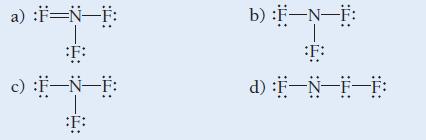
Which is the correct Lewis structure for nitrogen trifluoride? a) :F=N-F: F: c) :F-N-F: :F: b) :F-N-F: F: d) :F-N-F-F:
Which molecule could have an expanded octet?(a) H2CO3 (b) H3PO4 (c) HNO2
What is lattice energy?
Draw the Lewis structure (including resonance structures) for nitromethane (CH3NO2). For each resonance structure, assign formal charges to all atoms that have formal charge.
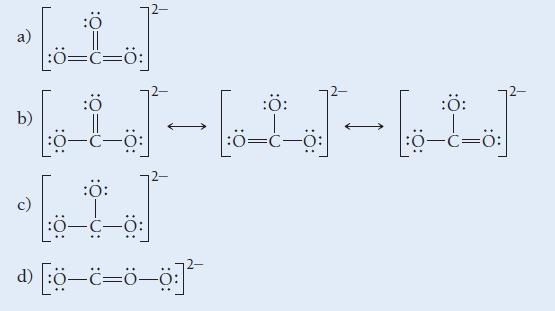
Which is the correct Lewis structure for CO32 -? ه ده b) :Ö |:0=C=0: :Ö :Ö: - - - :Ö= ھا- ا :Ö: :0–c—0: 20 -=- :Ö: :ة=-
The reaction between hydrogen and oxygen to form water is highly exothermic. Which statement is true of the energies of the bonds that break and form during the reaction?(a) The energy needed to break the required bonds is greater than the energy released when the new bonds form.(b) The energy
Why is the formation of solid sodium chloride from solid sodium and gaseous chlorine exothermic, even though it takes more energy to form the Na+ ion than the amount of energy released upon formation of Cl–?
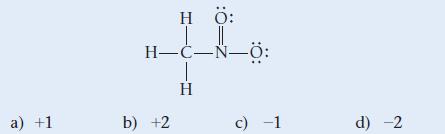
Determine the formal charge of nitrogen in the structure shown here: a) +1 HÖ: H-C-N-8: b) +2 H c) -1 d) -2
Write the Lewis structure for XeF2.
Hydrogen gas, a potential fuel, can be made by the reaction of methane gas and steam.Use bond energies to calculate ΔHrxn for this reaction. CH4(g) + 2 H₂O(8) 4 H₂(8) + CO₂(g)
What is the Born–Haber cycle? List each step in the cycle and show how the cycle is used to calculate lattice energy.
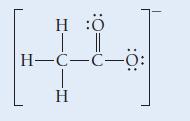
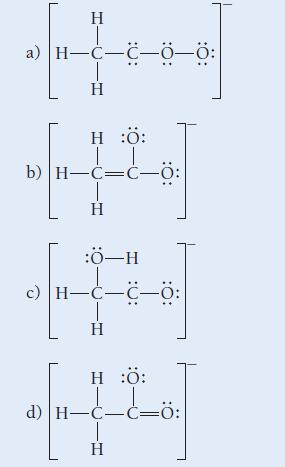
A Lewis structure for the acetate ion is shown here:Which structure is the best resonance structure for the acetate ion? HÖ | || H-C-C-Ö: H
How does lattice energy relate to ionic radii? To ion charge?
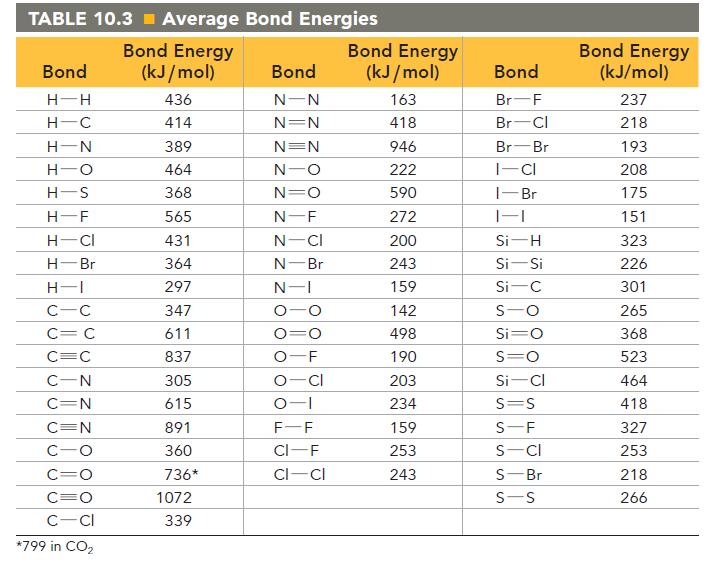
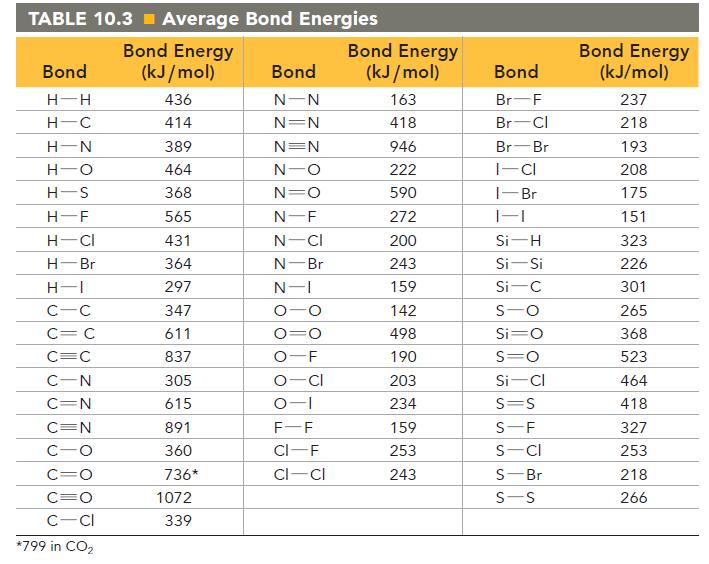
Use bond energies from Table 10.3 to determine ΔHrxn for the reaction between ethanol and hydrogen chloride. CH₂CH₂OH(g) + HCI(g) →→→→→ CH₂CH₂Cl(g) + H₂O(g) b) 1549 kJ c) -12 kJ d) 12 kJ a) -1549 kJ
In a covalent Lewis structure, what is the difference between lone pair and bonding pair electrons?
Consider the halogenation of ethene, where X is a generic halogen:Use bond energies to determine which halogen produces the most exothermic halogenation reaction with ethene.The C—F, C—Br, and C—I bond energies are 552 kJ/mol, 280 kJ/mol, and 209 kJ/mol, respectively. Look up all other
In what ways are double and triple covalent bonds different from single covalent bonds?
How does the Lewis model for covalent bonding account for why certain combinations of atoms are stable while others are not?
How does the ionic bonding model explain the nonconductivity of ionic solids, and at the same time the conductivity of ionic solutions?
How does the Lewis model for covalent bonding account for the relatively low melting and boiling points of molecular compounds (compared to ionic compounds)?
How do a pure covalent bond, a polar covalent bond, and an ionic bond differ?
Explain percent ionic character of a bond. Do any bonds have 100% ionic character?
What is electronegativity? What are the periodic trends in electronegativity?
What is a dipole moment?
What is the magnitude of the dipole moment formed by separating a proton and an electron by 100 pm? 200 pm?
What is the basic procedure for writing a covalent Lewis structure?
How do you determine the number of electrons in the Lewis structure of a molecule? A polyatomic ion?
What are resonance structures? What is a resonance hybrid?
Do resonance structures always contribute equally to the overall structure of a molecule? Explain.
What is formal charge? How is formal charge calculated? How is it helpful?
Why does the octet rule have exceptions? List the three major categories of exceptions and an example of each.
Write the Lewis symbol for each atom or ion.a. Al b. Na+ c. Cl d. Cl–
Write the Lewis symbols for the ions in each ionic compound.a. NaF b. CaO c. SrBr2 d. K2O
Write the Lewis symbol for each atom or ion.a. S2–b. Mg c. Mg2 + d. P
Write the Lewis symbols for the ions in each ionic compound.a. SrO b. Li2S c. CaI2 d. RbF
Use Lewis symbols to determine the formula for the compound that forms between each pair of elements.a. Sr and Se b. Ba and Cl c. Na and S d. Al and O
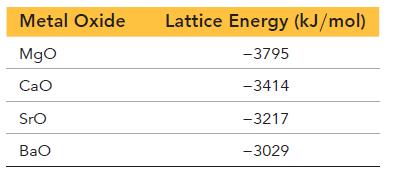
Explain the trend in the lattice energies of the alkaline earth metal oxides. Metal Oxide MgO CaO SrO BaQ Lattice Energy (kJ/mol) -3795 -3414 -3217 -3029
Use Lewis symbols to determine the formula for the compound that forms between each pair of elements:a. Ca and N b. Mg and I c. Ca and S d. Cs and F
Rubidium iodide has a lattice energy of -617 kJ/mol, while potassium bromide has a lattice energy of -671 kJ/mol. Why is the lattice energy of potassium bromide more exothermic than the lattice energy of rubidium iodide?
The lattice energy of CsF is -744 kJ/mol, whereas that of BaO is -3029 kJ/mol. Explain this large difference in lattice energy.
Arrange these compounds in order of increasing magnitude of lattice energy: KCl, SrO, RbBr, CaO.
A compound composed of only carbon and hydrogen is 7.743% hydrogen by mass. Propose a Lewis structure for the compound.
A compound composed of only carbon and chlorine is 85.5% chlorine by mass. Propose a Lewis structure for the compound.
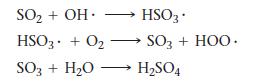
The main component of acid rain (H2SO4) forms from the SO2 pollutant in the atmosphere via these steps:Draw the Lewis structure for each of the species in these steps and use bond energies and Hess’s law to estimate ΔHrxn for the overall process. SO₂ + OH. HSO3 + 0₂1 SO3 + H₂O HSO3* SO3
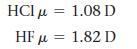
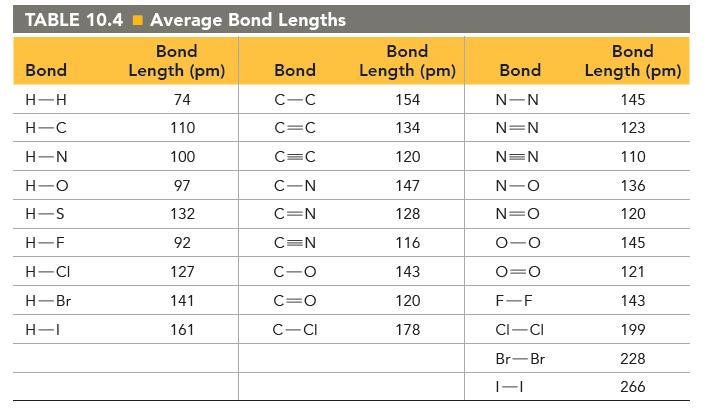
Use the dipole moments of HF and HCl (given at the end of the problem) together with the percent ionic character of each bond (Figure 10.10) to estimate the bond length in each molecule.How well does your estimated bond length agree with the bond length in Table 10.4? HCl p = 1.08 D HF м = 1.82 D
A 0.167-g sample of an unknown acid requires 27.8 mL of 0.100 M NaOH to titrate to the equivalence point. Elemental analysis of the acid gives the following percentages by mass: 40.00% C, 6.71% H, 53.29% O. Determine the molecular formula, molar mass, and Lewis structure of the unknown acid.
Use average bond energies together with the standard enthalpy of formation of C(g) (718.4 kJ/mol) to estimate the standard enthalpy of formation of gaseous benzene, C6H6(g). (Remember that average bond energies apply to the gas phase only.)Compare the value you obtain using average bond energies to
The standard state of phosphorus at 25 °C is P4. This molecule has four equivalent P atoms, no double or triple bonds, and no expanded octets. Draw its Lewis structure.
The standard heat of formation of CaBr2 is -675 kJ/mol. The first ionization energy of Ca is 590 kJ/mol, and its second ionization energy is 1145 kJ/mol. The heat of sublimation of Ca[Ca(s) → Ca(g)] is 178 kJ/mol. The bond energy of Br2 is 193 kJ/mol, the heat of vaporization of Br2(1) is 31
The standard heat of formation of PI3(s) is -24.7 kJ/mol, and the PI bond energy in this molecule is 184 kJ/mol. The standard heat of formation of P(g) is 334 kJ/mol, and that of I2(g) is 62 kJ/mol.The I2 bond energy is 151 kJ/mol. Calculate the heat of sublimation of PI33PI3(s) → PI3(g)4.
A compound has the formula C8H8 and does not contain any double or triple bonds. All the carbon atoms are chemically identical, and all the hydrogen atoms are chemically identical.Draw the Lewis structure for this molecule.
Find the oxidation number of each sulfur in the molecule H2S4, which has a linear arrangement of its atoms.
Ionic solids of the O– and O3– anions do not exist, while ionic solids of the O2– anion are common. Explain.
The standard state of sulfur is solid rhombic sulfur. Use the appropriate standard heats of formation given in Appendix II to find the average bond energy of the S = O in SO2.
Which statement is true of an endothermic reaction?a. Strong bonds break and weak bonds form.b. Weak bonds break and strong bonds form.c. The bonds that break and those that form are of approximately the same strength.
When a firecracker explodes, energy is obviously released. The compounds in the firecracker can be viewed as being “energy rich.” What does this mean? Explain the source of the energy in terms of chemical bonds.
A fundamental difference between compounds containing ionic bonds and those containing covalent bonds is the existence of molecules. Explain why molecules exist in solid covalent compounds but not in solid ionic compounds.
In the very first chapter of this book, we described the scientific approach and put a special emphasis on scientific models or theories. In this chapter, we looked carefully at a model for chemical bonding (the Lewis model). Why is this theory successful?What are some of the limitations of the
Have each member of your group represent an atom of a metal or an atom of a nonmetal. Each group member holds a coin to represent an electron. Which group members are most reluctant to give up their electrons? Which group members are most willing to give up their electrons? Determine which kind of
Spend a few minutes reviewing the Lewis dot symbols for the atoms H through Ne. Form a circle and have each group member ask the group member on his or her right to draw the Lewis symbol for a specific atom. Keep going around until each group member can write all the Lewis dot symbols for the
Draw the Lewis dot symbols for the atoms Al and O. Use the Lewis model to determine the formula for the compound formed from these two atoms.
Draft a list of step-by-step instructions for writing the correct Lewis dot structure for any molecule or polyatomic ion.
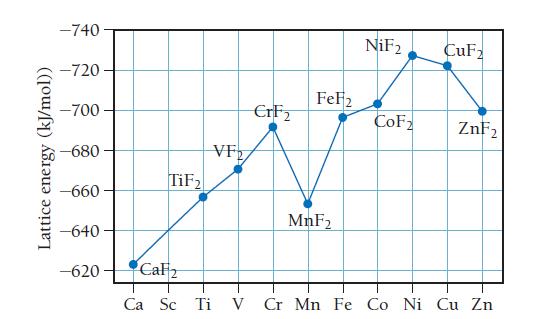
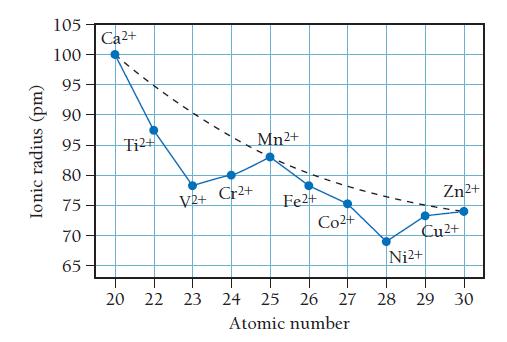
Evidence for the additional stabilization of certain electron configurations comes from the experimental lattice energies of the metal fluorides, MF2. The first figure below plots lattice energy for the 2+ metal cations for period 4 elements. The figure that follows plots the ionic radii of the 2+
Pass a piece of paper around the group and ask each group member in turn to perform the next step in the process of determining a correct Lewis structure (including formal charges on all atoms and resonance structures, if appropriate) for the following molecules and ions: N2H4, CCl4, CO32–, and
Why is molecular geometry important? Cite some examples.
Determine the molecular geometry of NO3–.
A central atom in a three-atom molecule forms two double bonds (and has no lone pairs). What is the geometry of the molecule?(a) Trigonal planar (b) Linear (c) Not enough information is given to determine the geometry of the molecule.To solve the problem, it is necessary to know how many electron
Determine the molecular geometry of CBr4.a) Linearb) Trigonal planarc) Tetrahedrald) Trigonal pyramidal
According to VSEPR theory, what determines the geometry of a molecule?
What is the geometry of the HCN molecule? The Lewis structure of HCN is (a) Linear (b) Trigonal planar(c) Tetrahedral H-C=N:.
Determine the molecular geometry of SeF4.a) Tetrahedralb) Trigonal bipyramidalc) T-shapedd) Seesaw
Predict the geometry and bond angles of PCl3.
Name and sketch the five basic electron geometries, and state the number of electron groups corresponding to each. What constitutes an electron group?
Predict the geometry and bond angles of ICl4–.
What is the molecular geometry of a molecule whose central atom has three bonding groups and one lone pair?(a) Linear (b) Trigonal planar (c) Tetrahedral (d) Trigonal pyramidal
Predict the relative bond angles in BF3 and SO2.a) BF3 bond angles > SO2 bond angleb) SO2 bond angle > BF3 bond anglesc) BF3 bond angles = SO2 bond angled) Relative bond angles cannot be predicted.
Explain the difference between electron geometry and molecular geometry. Under what circumstances are they not the same?
Predict the geometry about each interior atom in methanol (CH3OH) and make a sketch of the molecule.
Imagine that a molecule with six electron groups is confined to two dimensions and therefore has a hexagonal planar electron geometry. If two of the six groups are lone pairs, where are they located?(a) Positions 1 and 2 (b) Positions 1 and 3 (c) Positions 1 and 4 2. 31 -+ 4 2 3
Predict the molecular geometry about nitrogen in the molecule CH3NHCH3.a) Linearb) Trigonal planarc) Trigonal pyramidald) Bent
Which molecule is polar?a) SF2b) BH3 c) PF5d) CS2
Determine whether NH3 is polar.
Which statement is always true according to VSEPR theory?(a) The shape of a molecule is determined only by repulsions among bonding electron groups.(b) The shape of a molecule is determined only by repulsions among nonbonding electron groups.(c) The shape of a molecule is determined by the polarity
Determine the hybridization about oxygen in CH3OH.a) sp b) sp2 c) sp3d) sp3d
How do you apply VSEPR theory to predict the shape of a molecule with more than one interior atom?
Showing 2500 - 2600
of 4045
First
19
20
21
22
23
24
25
26
27
28
29
30
31
32
33
Last
Step by Step Answers

 Get 50% OFF
Claim Now
Get 50% OFF
Claim Now


![(a) [:S=C=N:] [:$-C=N:] (b) [S-N=C:] ()[:S=C-N:]](https://dsd5zvtm8ll6.cloudfront.net/images/question_images/1700/0/3/3/246655472dea25f21700033244876.jpg)
![A B C |C=N] [=C=N] [O=C-N](https://dsd5zvtm8ll6.cloudfront.net/images/question_images/1700/0/3/1/95365546dd1e8d521700031952441.jpg)