New Semester
Started
Get
50% OFF
Study Help!
--h --m --s
Claim Now
Question Answers
Textbooks
Find textbooks, questions and answers
Oops, something went wrong!
Change your search query and then try again
S
Books
FREE
Study Help
Expert Questions
Accounting
General Management
Mathematics
Finance
Organizational Behaviour
Law
Physics
Operating System
Management Leadership
Sociology
Programming
Marketing
Database
Computer Network
Economics
Textbooks Solutions
Accounting
Managerial Accounting
Management Leadership
Cost Accounting
Statistics
Business Law
Corporate Finance
Finance
Economics
Auditing
Tutors
Online Tutors
Find a Tutor
Hire a Tutor
Become a Tutor
AI Tutor
AI Study Planner
NEW
Sell Books
Search
Search
Sign In
Register
study help
sciences
chemistry principles and practice
Chemistry Principles And Practice 3rd Edition Daniel L. Reger, Scott R. Goode, David W. Ball - Solutions
(a) How many subshells are present in the n = 3 shell?(b) How many orbitals are in the 4p subshell?(c) What is the maximum value of ℓ that is allowed in the shell with n = 4?(d) What are the values of n and ℓ for a 3d subshell? Give all allowed values of the mℓ quantum number for this
(a) How many subshells are present in the n = 4 shell?(b) How many orbitals are in the 3d subshell?(c) What is the maximum value of ℓ that is allowed in the shell with n = 3?(d) What are the values of n and ℓ for a 3p subshell? Give all allowed values of the mℓ quantum number for this
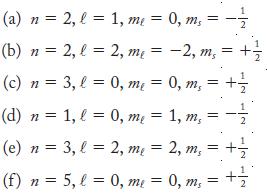
In each part, a set of quantum numbers is given. If the set is an allowed combination of n, ℓ, mℓ, and ms, give the subshell to which this wave function belongs (1s, 2s, 2p, and so on). If the combination of quantum numbers is not allowed, state why. (a) n = 2, l = 1, me = (b) n = 2, l2, me
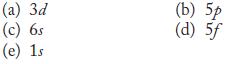
Give the values of the n and ℓ quantum numbers for the subshells identified by the following designations. (a) 3d (c) 6s (e) 1s (b) 5p (d) 5f
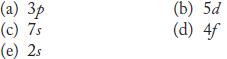
Give the values of the n and ℓ quantum numbers for the subshells identified by the following designations. (a) 3p (c) 7s (e) 2s (b) 5d (d) 4f 69
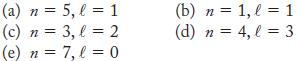
Give the notation (1s, 2s, 2p, and so on) for each of the following subshells. If the combination is not allowed, state why. (a) n = 5, l = 1 (c) n = 3, l = 2 (e) n = 7, l = 0 (b) n = 1, l=1 (d) n = 4, l = 3
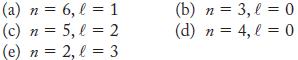
Give the notation (1s, 2s, 2p, and so on) for each of the following subshells. If the combination is not allowed, state why. l=1 (a) n = 6, (c) n = 5, l = 2 (e) n = 2, l = 3 (b) n = 3,l = 0 (d) n = 4, l = 0
What is the velocity of an electron that has a de Broglie wavelength of 1.00 nm?
Neutrons (mass = 1.67 × 10⁻²⁷ kg) with a wavelength of 0.150 nm are needed for a diffraction experiment. What velocity must these neutrons have?
Find the de Broglie wavelength associated with each of the following objects:(a) A 68-kg sprinter traveling at 10.0 m/s(b) A 50.0-g ball traveling at 100 mph (44.7 m/s)(c) An electron (mass = 9.11 × 10⁻³¹ kg) with a velocity of 1.2 × 10⁵ m/s. This is the root-mean-square speed of an electron at
Find the de Broglie wavelength that is associated with each of the following objects:(a) A ball with a mass of 0.100 kg traveling at 40.0 m/s(b) A 753-kg car traveling at 24.6 m/s (55 mph)(c) A neutron (mass = 1.67 × 10⁻²⁷ kg) with a velocity of 2.70 × 10³ m/s; this is the root-mean-square
Find the wavelength of an electron having n = 2 in Bohr’s model of hydrogen if the velocity of the electron is 1.096 × 10⁶ m/s. The radius of this orbit is 212 pm. Compare the wavelength of the electron with the circumference of the orbit (c = 2πr).
The velocity of an electron having n = 1 in Bohr’s model is 2.19 × 10⁶ m/s. What is the wavelength of this electron? The radius of its orbit is 52.9 pm. Compare the wavelength of the electron to the circumference of the orbit (c = 2πr).
What is the wavelength, in nanometers, of a neutron (mass = 1.67 × 10⁻²⁷ kg) that is moving at a velocity of 1.7 × 10² m/s?
What is the wavelength, in nanometers, of an electron that is moving at a velocity of 2.9 × 10⁵ m/s?
The spectrum below is of the hydrogen atom in the visible region. Label each emission line with the wavelength, the initial quantum number, and the final quantum number. Hydrogen (H)
What is the wavelength (in nm) of the line in the spectrum of the hydrogen atom that arises from the transition of the electron from the Bohr orbit with n = 3 to the orbit with n = 1? In what region of the electromagnetic spectrum (ultraviolet, visible, and so on) is this radiation observed?
The charge of an electron is -1.602 × 10⁻¹⁹ C. How many microamperes (1 A = 1 C/s) of electrical current are produced by a photoelectric cell that ejects 2.50 × 10¹³ electrons each second? How many photons must be absorbed each second to produce this number of photoelectrons, assuming that each
The charge of an electron is -1.602 × 10⁻¹⁹ C. How many electrons must be ejected from the metal each second to produce an electric current of 1.0 mA (1 A = 1 C/s)? How many photons must be absorbed each second to produce this number of photoelectrons, assuming that each photon causes an electron
Electrons are ejected from sodium metal by any light that has a wavelength shorter than 544 nm. What is the photoelectric threshold frequency for sodium metal?
The photoelectric threshold frequency for carbon is 1.16 × 10¹⁵ s-1.(a) What is the longest wavelength of light that will eject electrons from a sample of solid carbon? What is the name of the region of the electromagnetic spectrum with light of this wavelength?(b) Are electrons ejected from
The red color of neon signs is due to electromagnetic radiation with a wavelength of 640 nm. What is the change in the energy of a neon atom when it emits a photon of this wavelength?
The yellow light emitted by sodium vapor consists of photons with a wavelength of 589 nm. What is the energy change of a sodium atom that emits a photon with this wavelength?
What is the energy (in kJ) of 1 mol of photons with a frequency of 2.50 × 10¹⁴ Hz?
What is the energy (in kJ) of 1 mol of photons with a frequency of 3.70 × 10¹⁵ Hz?
The photoelectric effect for cadmium has a threshold frequency of 9.83 × 10¹⁴ Hz. For light of this frequency, fi nd the following characteristics:(a) The wavelength(b) The energy of one photon (in J)(c) The energy of 1 mol of photons (in kJ)
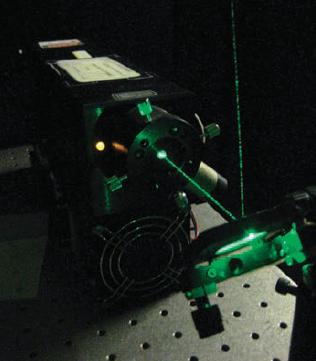
This laser emits green light with a wavelength of 533 nm.(a) What is the energy, in joules, of one photon of light at this wavelength?(b) If a particular laser produces 1.00 watt (W) of power (1 W = 1 J/s), how many photons are produced each second by the laser?
The electromagnetic radiation used by amateur radio operators has a wavelength of 10 m. Calculate the frequency (in s-1) of this electromagnetic radiation.
The wavelength used by citizen’s band radio is 21 m. Calculate the frequency (in s-1) of this electromagnetic radiation.
Gamma rays are electromagnetic radiation of very short wavelength emitted by the nuclei of radioactive elements. Strontium-91 emits a gamma ray with a frequency of 2.47 × 10²⁰ Hz. Express the wavelength of this radiation, in picometers.
Gamma rays are electromagnetic radiation of very short wavelength emitted by the nuclei of radioactive elements. Arsenic-74 emits a gamma ray with a frequency of 1.44 × 10²⁰ Hz. Express the wavelength of this radiation, in picometers.
An FM radio station broadcasts at a frequency of 101.3 MHz. What is the wavelength, in meters and nanometers, of this radiation?
An AM radio station broadcasts at a frequency of 580 kHz. What is the wavelength, in meters and nanometers, of this signal?
Microwave ovens operate using radiation that has a frequency of 2.45 × 10⁹ Hz. What is the wavelength of this radiation? What name is used for the spectral region of this radiation?
The human eye is most sensitive to light that has a frequency of 5.41 × 10¹⁴ Hz. What is the wavelength of this light? What name is used for the spectral region of this radiation?
The introduction to this chapter indicates that lead is the main component of bullets. The strongest emission from excited-state Pb atoms has a wavelength of 405.8 nm. What is the frequency of this light (in s-1)? Name the spectral region for this light (ultraviolet, x ray, and so on).
Tin is a component of some bullets. The most intense light that is emitted by excited tin atoms has a wavelength of 284.0 nm. What is the frequency of this light (measured in s-1)? Name the spectral region for this light (ultraviolet, x ray, and so on).
Use the Pauli exclusion principle to explain why the 3p subshell can contain a maximum of six electrons.
State Hund’s rule; then use it to explain why there are two unpaired electrons in both the carbon atom and the oxygen atom.
State the Pauli exclusion principle; then use it to explain why an orbital can contain a maximum of two electrons.
Draw an energy-level diagram for a multielectron atom through n = 3.
How and why do the energy-level diagrams for the hydrogen atom and the many-electron atom differ?
Why is the Heisenberg uncertainty principle an important factor for electrons in atoms but unimportant for large objects such as a baseball?
Explain what is meant by “penetration” in the explanation of the dependence of electron energies on the ℓ quantum number.
How is the effective nuclear charge different from the nuclear charge in a beryllium atom? Is the effective nuclear charge the same for all electrons in this atom? Explain.
How is interelectronic repulsion related to shielding?
In a carbon atom, do the 2s or 2p electrons experience a higher effective nuclear charge? Explain.
(a) Which quantum number is related to the average distance of the electron from the nucleus?(b) What name and symbol are used for the quantum number that determines the shape of the electron probability distribution?(c) Which quantum number contains information about the orientation of the
How does the electron spin quantum number affect the energy of the electron in the hydrogen atom?
How is the wave function, ψ, related to the location of the electron in space?
How did de Broglie justify Bohr’s assumption that angular momentum was quantized?
What assumptions did Bohr make in explaining the hydrogen atom spectrum?
Why are there many more lines observed in the emission spectra of hydrogen and other elements than are found in their absorption spectra?
The most intense emissions of silver and bismuth, both elements found in bullets (see the chapter introduction), are 328.1 and 195.5 nm, respectively. Compare the energies and frequencies of light from these two elements.
Two light sources have exactly the same color, but the second source has twice the brightness of the first. Which of the four characteristics of a light wave (amplitude, speed, frequency, wavelength) are the same and which are different for these two waves? Compare the energy of the photons and the
The container above contains a gas and has a piston that can move. Redraw this container; then draw the container again after the pressure on top of the piston has doubled.
Explain why most gases deviate from ideal behavior at low temperatures but not at high temperatures.
Express a pressure of 433 torr in atmospheres.
Express a pressure of 0.450 atm in the following units:(a) Torr(b) KPaStrategyUse the relationship 1 atm = 760 torr to determine the pressure in torr and the equality 1 atm = 101.3 kPa to determine the pressure in kilopascals (kPa).
Describe the similarities and differences between the ways in which a gas and a liquid occupy a container.
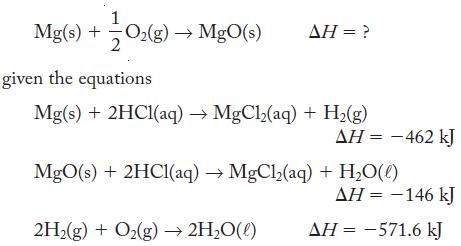
Calculate ΔH for Mg(s) + O₂(g) → MgO(s) 2 AH = ? given the equations Mg(s) + 2HCl(aq) →MgCl₂(aq) + H₂(g) 2H₂(g) + O₂(g) → 2H₂O(l) ΔΗ = -462 kJ MgO(s) + 2HC1(aq) → MgCl₂(aq) + H₂O(0) ΔΗ = -146 kJ AH = -571.6 kJ
What are the molar concentrations of the ions in a 0.20 M calcium nitrate, Ca(NO3)2, solution?StrategyIn aqueous solution, Ca(NO3)2 dissociates into one Ca2+(aq) and two (aq) ions.Use the coefficients for Ca(NO3)2, Ca2+(aq), and (aq) to calculate the Ca2+(aq) and (aq) concentration. NO3
Describe how atmospheric pressure is measured with a barometer and how pressure differences are measured with an open-end manometer.
A balloon containing 575 mL nitrogen gas at a pressure of 1.03 atm is compressed to a final volume of 355 mL. What is the resulting pressure of the nitrogen?
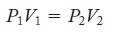
A sample of argon gas at an initial pressure of 1.35 atm and an initial volume of 18.5 L is compressed to a final pressure of 3.89 atm. What is the final volume of the argon? Assume temperature and amount remain constant.StrategyUse Equation 6.1 and solve for V2.Equation 6.1 P₁V₁ = P₂V₂
Compare the densities of a single substance as a solid, a liquid, and a gas.
At a pressure of 740 torr, a sample of gas occupies 5.00 L. Calculate the volume of the sample if the pressure is changed to 1.00 atm at constant temperature.
In the lungs of a deep-sea diver (V = 6.0 L) at a depth of 100 m, the pressure of the air is 7400 torr. At a constant temperature of 37 °C, to what volume would the air expand if the diver were immediately brought to the surface (1.0 atm)?StrategyAfter making sure the units are consistent, use
Th e volume of a sample of nitrogen gas increases from 0.440 L at 27 °C to 1.01 L as it is heated to a new temperature. Calculate the new temperature of the nitrogen.
A balloon filled with oxygen gas at 25 °C occupies a volume of 2.1 L. Assuming that the pressure remains constant, what is the volume at 100 °C?StrategyConvert the temperatures to kelvins and use Equation 6.2.Equation 6.2 V₁ E T₁ V2 T₂ 2
Make a drawing of an open-end manometer measuring the pressure of a sample of a gas that is at 200 torr. Assume the pressure on the open end is 1.00 atm.
The pressure of a sample of gas is 2.60 atm in a 1.54-L container at a temperature of 0 °C. Calculate the pressure exerted by this sample if the volume changes to 1.00 L and the temperature changes to 27 °C.
Define three units that are used to express pressure.
A helium weather balloon is filled to a volume of 219 m3 on the ground, where the pressure is 754 torr and the temperature is 25 °C. As the balloon rises, the pressure and temperature decrease, so it is important to know how much the gas will expand to ensure that the balloon can withstand the
Calculate the temperature of a 350-mL container that holds 0.620 mol of an ideal gas at a pressure of 42.0 atm.
Describe the change in the volume of a gas sample that occurs when each of the following three properties is increased with the other two held constant:(a) Pressure(b) Temperature(c) Amount
Calculate the pressure of a 1.2-mol sample of methane gas in a 3.3-L container at 25 °C.StrategySubstitute the given values into the ideal gas law, being sure to match the units given in the ideal gas constant, R.
An experiment shows that a 0.495-g sample of an unknown gas occupies 127 mL at 98 °C and 754 torr pressure. Calculate the molar mass of the gas.StrategyUse the data given in the problem to calculate moles, using the ideal gas law; then combine this result with the measured mass of the sample to
Calculate the molar mass of a gas if a 9.21-g sample occupies 4.30 L at 127 °C and a pressure of 342 torr.
Describe an experiment with a gas that allows the determination of absolute zero on the temperature scale. In this experiment, is the temperature of absolute zero measured directly?
What is the density of N2 gas at 1.00 atm and 100 °C?StrategyDensity is mass per unit volume. The mass of 1 mol nitrogen is 28.0 g . Use the ideal gas law to calculate the volume of 1 mol of a gas under the given conditions.
Calculate the density of H2 gas at 1.00 atm and 100 °C.
Many scientists believe that when Earth’s atmosphere evolved, some of the oxygen gas came from the decomposition of water induced by solar radiation.What volume of oxygen at 754 torr and 40 °C does the decomposition of 2.33 g of H2O produce? 2H₂O(l)- light >2H₂(g) + O₂(g)
Demonstrate how Boyle’s, Charles’s, and Avogadro’s laws can be obtained from the ideal gas law.
Derive an equation for density of a gas from the ideal gas law.
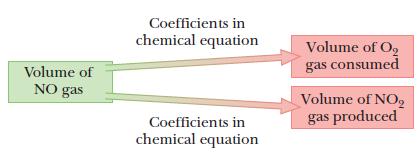
Nitrogen monoxide, NO, is a pollutant formed in running automobile engines. It reacts with oxygen in the air to produce nitrogen dioxide, NO2. Calculate the volume of NO2 gas produced and the volume of O2 gas consumed when 2.34 L NO gas reacts with excess O2. Assume that all volumes are measured at
Chemists frequently prepare hydrogen gas in the laboratory by the reaction of zinc and hydrochloric acid. Th e other product is ZnCl2(aq). Calculate the volume of hydrogen produced at 744 torr pressure and 27 °C by the reaction of 32.2 g zinc and 500 mL of 2.20 M HCl .StrategyThe strategy of this
Hydrogen, H2, and chlorine, Cl2, react to form hydrogen chloride, HCl. Calculate the volume of HCl formed by the reaction of 2.34 L H2 and 3.22 L Cl2.
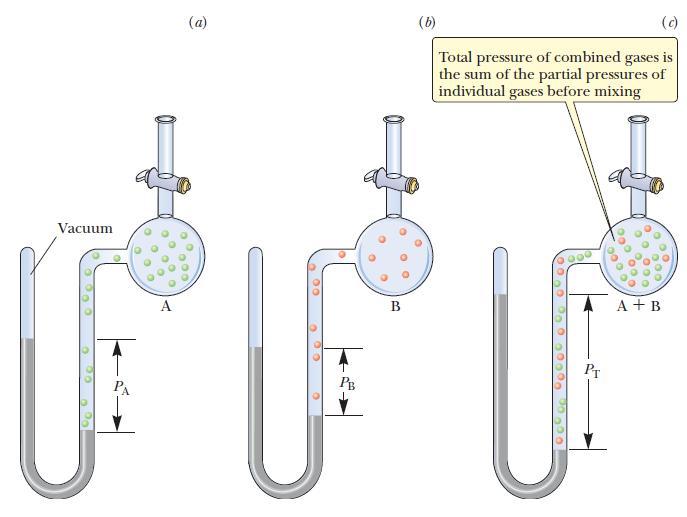
A gas sample in a 1.2-L container holds 0.22 mol N2 and 0.13 mol O2. Calculate the partial pressure of each gas and the total pressure at 50 °C.StrategyUse the ideal gas law to calculate the partial pressure of each gas in the container, and sum these two numbers to obtain the total pressure.
Why do 1 mol N2 and 1 mol O2 both exert the same pressure if placed in the same 20-L container? Is the mass of the gas sample the same in both cases? Explain why it is the same or diff erent, and if it is diff erent, predict which gas sample weighs more.
Calculate the partial pressure of each gas and the total pressure in a 4.6-L container at 27 °C that contains 3.22 g Ar and 4.11 g Ne.
Calculate the number of moles of hydrogen produced by the reaction of sodium with water. In the reaction, 1.3 L gas is collected by water displacement at 26 °C. The atmospheric pressure is 756 torr.
List the four assumptions of the kinetic molecular theory.
A sample of KClO3 is heated and decomposes to produce O2 gas. Th e gas is collected by water displacement at 26 °C. Th e total volume of the collected gas is 229 mL at a pressure equal to the measured atmospheric pressure, 754 torr. How many moles of O2 form?StrategyThe collected gas is a mixture
Calculate the rms speed of neon atoms at 27 °C.
Discuss the origin of gas pressure in terms of the kinetic molecular theory.
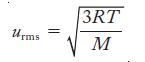
Calculate the rms speed in meters per second of argon atoms at 27 °C.StrategyUse Equation 6.6, remembering to use the proper values and units for R, to convert the molar mass into units of kilograms per mole (kg/mol).Equation 6.6 Urms 3RT M
Calculate the molar mass of a gas if equal volumes of oxygen gas and the unknown gas take 3.25 and 8.41 minutes, respectively, to effuse through a small hole under conditions of constant pressure and temperature.
Draw an approximate Maxwell–Boltzmann distribution curve for the distribution of speeds of gas molecules. What are the units on each axis? About where is the root mean-square speed on the curve?
Calculate the molar mass of a gas if equal volumes of nitrogen and the unknown gas take 2.2 and 4.1 minutes, respectively, to effuse through the same small hole under conditions of constant pressure and temperature.StrategyBecause the rates of effusion are inversely proportional to the square root
Showing 1900 - 2000
of 2906
First
13
14
15
16
17
18
19
20
21
22
23
24
25
26
27
Last
Step by Step Answers

 Get 50% OFF
Claim Now
Get 50% OFF
Claim Now