New Semester
Started
Get
50% OFF
Study Help!
--h --m --s
Claim Now
Question Answers
Textbooks
Find textbooks, questions and answers
Oops, something went wrong!
Change your search query and then try again
S
Books
FREE
Study Help
Expert Questions
Accounting
General Management
Mathematics
Finance
Organizational Behaviour
Law
Physics
Operating System
Management Leadership
Sociology
Programming
Marketing
Database
Computer Network
Economics
Textbooks Solutions
Accounting
Managerial Accounting
Management Leadership
Cost Accounting
Statistics
Business Law
Corporate Finance
Finance
Economics
Auditing
Tutors
Online Tutors
Find a Tutor
Hire a Tutor
Become a Tutor
AI Tutor
AI Study Planner
NEW
Sell Books
Search
Search
Sign In
Register
study help
sciences
chemistry principles and practice
Chemistry Principles And Practice 3rd Edition Daniel L. Reger, Scott R. Goode, David W. Ball - Solutions
A sample is shown to contain 0.173 g chromium and 0.160 g oxygen. What is the empirical formula of this substance?
A compound contains only carbon, hydrogen, and oxygen, and is 66.6% carbon and 11.2% hydrogen. What is the empirical formula of this substance?
A 1.20-g sample of a compound gave 2.92 g of CO2 and 1.22 g of H2O on combustion in oxygen. The compound is known to contain only C, H, and O. What is its empirical formula?
A platinum compound named cisplatin is effective in the treatment of certain types of cancer. Analysis shows that it contains 65.02% platinum, 2.02% hydrogen, 9.34% nitrogen, and 23.63% chlorine. What is its empirical formula?
Carvone is an oil isolated from caraway seeds that is used in perfumes and soaps. This compound contains 79.95% carbon, 9.40% hydrogen, and 10.65% oxygen. What is its empirical formula?
When a 2.074-g sample that contains only carbon, hydrogen, and oxygen burns in excess O2, the products are 3.80 g CO2 and 1.04 g H2O. What is the empirical formula of this compound?
A 0.459-g sample that contains only carbon, hydrogen, and oxygen reacts with an excess of O2 to produce 0.170 g CO2 and 0.0348 g H2O. What is the percentage of C and H in the starting material?
A compound contains only C, H, N, and O. Combustion of a 1.48-g sample in excess O2 yields 2.60 g CO2 and 0.799 g H2O. A separate experiment shows that a 2.43-g sample contains 0.340 g N. What is the empirical formula of the compound?
A compound contains only C, H, N, and O. Combustion of a 2.18-g sample in excess O2 yields 3.94 g CO2 and 1.89 g H2O. A separate experiment shows that a 1.23-g sample contains 0.235 g N. What is the empirical formula of the compound?
What is the molecular formula of a compound with an empirical formula of CH2O and a molar mass of 90 g/mol?
What is the molecular formula of a compound with an empirical formula of HO and a molar mass of 34 g/mol?
What is the molecular formula of each of the following compounds?(a) Empirical formula of C2H4O and molar mass of 132 g/mol(b) Empirical formula of C3H4NO3 and molar mass of 408 g/mol
What is the molecular formula of each of the following compounds?(a) Empirical formula C5H10O and molar mass of 258 g/mol(b) Empirical formula PCl3 and molar mass of 137.3 g/mol?
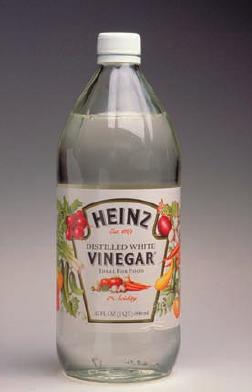
Acetic acid gives vinegar its sour taste. Analysis of acetic acid shows it is 40.0% carbon, 6.71% hydrogen, and 53.3% oxygen. Its molar mass is 60 g/mol. What is its molecular formula? HEINZ DISTILLED WHITE VINEGAR Foo 30-01 ROD
A compound contains 62.0% carbon, 10.4% hydrogen, and 27.5% oxygen by mass, and has a molar mass of 174 g/mol. What is the molecular formula of the compound?
Fructose, an important sugar, is made up of 40.0% carbon, 6.71% hydrogen, and 53.3% oxygen. Its molar mass is 180 g/mol. What is its molecular formula?
(a) Write the equation for the combustion of propylene, C3H6.(b) Calculate the mass of CO2 produced when 2.45 g C3H6 burns in excess oxygen.
(a) Write the equation for the combustion of C4H8O.(b) Calculate the mass of O2 consumed in the combustion of a 5.33-g sample of C4H8O.
The reaction of P4, a common elemental form of phosphorus, with Cl2 yields PCl5. Calculate the mass of Cl2 needed to react completely with 0.567 g P4.
What mass of NH3 forms from the reaction of 5.33 g N2 with excess H2?
Chlorine can be produced in the laboratory by the reaction of hydrochloric acid with excess manganese(IV) oxide.How many moles of HCl are needed to form 12.5 mol Cl2? 4HCl(aq) + MnO₂(s) → Cl₂(g) + 2H₂O(0) + MnCl₂(aq)
Aluminum metal reacts with sulfuric acid, H2SO4, to yield aluminum sulfate and hydrogen gas. Calculate the mass of aluminum metal needed to produce 13.2 g hydrogen.
Lithium metal reacts with O2 to form lithium oxide. What is the theoretical yield of lithium oxide when 0.45 g lithium reacts with excess O2?
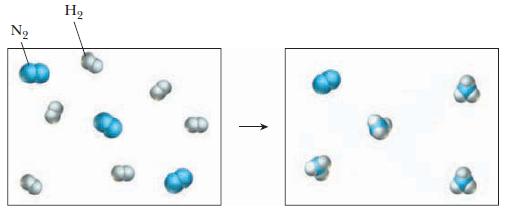
A mixture of hydrogen and nitrogen gas reacts as shown in the drawing below.(a) Write the balanced equation.(b) Which reactant is the limiting reactant? N₂ H₂
In a reaction of HCl and NaOH, the theoretical yield of H2O is 78.2 g. What is the theoretical yield of NaCl?
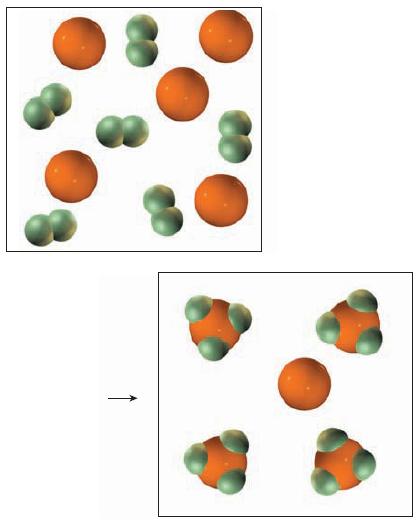
A mixture of antimony atoms and Cl2 in the gas phase reacts as shown in the drawing below.(a) Write the balanced equation.(b) Which reactant is the limiting reactant?
Calculate the mass of silver produced if 3.22 g zinc metal and 4.35 g AgNO3 react according to the following equation. Zn(s) + 2AgNO3(aq) → 2Ag(s) + Zn(NO3)2(aq)
Hydrogen and nitrogen react to form ammonia, NH3. Calculate the mass of NH3 produced from the reaction of 14 g N2 and 1.0 g H2.
What is the theoretical yield, in grams, of CO2 formed from the reaction of 3.12 g CS2 and 1.88 g O2? The second product is SO2.
What is the theoretical yield, in grams, of P4O10 formed from the reaction of 2.2 g P4 with 4.2 g O2?
In a reaction of 3.3 g Al with excess HCl, 3.5 g AlCl3 is isolated (hydrogen gas also forms in this reaction). What is the percent yield of the aluminum compound?
A reaction of 43.1 g CS2 with excess Cl2 yields 45.2 g CCl4 and 41.3 g S2Cl2. What is the percent yield of each product?
The reaction of 9.66 g O2 with 9.33 g NO produces 10.1 g NO2. What is the percent yield?
The reaction of 7.0 g Cl2 with 2.3 g P4 produces 7.1 g PCl5. What is the percent yield?
Methanol, CH3OH, is used in racing cars because it is a clean-burning fuel. It can be made by this reaction:What is the percent yield if 5.0 × 10³ g H2 reacts with excess CO to form 3.5 × 10³ g CH3OH? (2) H←(8)
The combustion of 33.5 g C3H6 with 127 g O2 yields 16.1 g H2O. What is the percent yield?
Th e reaction of 23.1 g NaOH with 21.2 g HNO3 yields a 12.9-g sample of NaNO3.(a) What is the percent yield?(b) Identify the reactant that is present in excess and calculate the mass of it that remains at the end of the reaction.
In the second step of the Ostwald process (see previous exercise), the nitrogen monoxide reacts with more O2 to yield nitrogen dioxide. In an experiment, 75.0 g NO and 45.0 g O2 are sealed in a container and heated so the reaction goes to completion.(a) What is the limiting reactant?(b) How much
A 2.24-g sample of an unknown metal reacts with HCl to produce 0.0808 g H2 gas. The reaction is M + 2HCl → MCl2 + H2. Assuming that the percent yield of product is 100%, identify the metal.
A 3.11-g sample of one of the halogens, X2, is shown to react with NaOH to produce 2.00 g NaX. The equation is 2NaOH + X2 → NaX + NaXO + H2O. Assuming that the percent yield of product is 100%, identify the halogen.
Predict the formula of an ionic compound formed from calcium and nitrogen. Calculate the mass percentage composition of the elements in this compound.
Write the formula of iron(III) sulfate and calculate the mass percentage of each element in the compound.
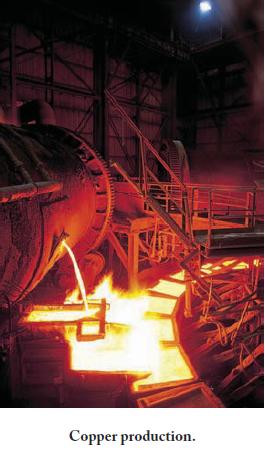
Copper can be commercially obtained from an ore that contains 10.0 mass percent chalcopyrite, CuFeS2, as the only source of copper. How many tons of the ore are needed to produce 20.0 tons of 99.0% pure copper? Copper production.
In2S3 can be converted into metallic indium by a twostep process. First, it is converted into In2O3 by reaction with oxygen. The other product of the reaction is SO2. Indium metal is obtained by reaction of In2O3 with carbon. Assume that the other product of the second reaction is carbon
Some ionic compounds exist in crystalline form with a certain number of water molecules associated with the ions. Such compounds are called hydrates. For example, calcium sulfate can exist with either one-half water molecule per formula unit, written as CaSO4 · ½H2O, or two water molecules per
A hydrate can be heated to drive off the water molecules from the crystal. A sample of hydrated magnesium sulfate with an initial mass of 3.650 g was placed in a crucible and heated with a Bunsen burner. After thorough heating, the mass of the solid remaining was 1.782 g. How many water molecules
A backup system on the space shuttle that removes carbon dioxide is canisters of LiOH. Th is compound reacts with CO2 to produce Li2CO3 and water. How many grams of CO2 can be removed from the atmosphere by a canister that contains 83 g LiOH?
Copper sulfate is generally isolated as its hydrate, CuSO4 xH2O. If a sample contains 25.5% Cu, 12.8% S, 57.7% O, and 4.04% H, what is the value of x?
The compound dinitrogen monoxide, N2O, is a nontoxic gas that is used as the propellant in cans of whipped cream. How many nitrogen atoms are in a 34.7-g sample of N2O?
Morphine is a narcotic substance that has been used medically as a painkiller. Its use has been highly restricted because of its addictive nature. Morphine is 71.56% C, 6.71% H, 4.91% N, and 16.82% O, and its molar mass is 285 g/mol. What is its molecular formula?
Heating NaWCl6 at 300° C converts it into Na2WCl6 and WCl6. If the reaction of 5.64 g NaWCl6 produces 1.52 g WCl6, what is the percentage yield?
The compound K[PtCl3(C2H4)] was first prepared by a Danish pharmacist around 1830. Scientists have only recently determined its structure. This complex is now known to be the first example of an important class of compounds known as organometallics. It can be prepared by the reaction of K2[PtCl4]
Many important chemical processes require two (or more) steps. One example is a process used to determine the amount copper in a sample. Many copper compounds, dissolved in water, will react with zinc metal to yield copper metal and a water-soluble zinc compound.The metallic copper is collected and
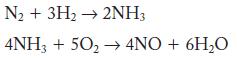
Molecular nitrogen can be converted to NO in two steps. The equations follow. These two reactions are the first steps in the industrially important conversion of nitrogen into nitric acid. Calculate the mass of NO formed from 100 g N2 and excess H2 and O2. N₂ + 3H₂ → 2NH3 4NH3 + 50₂ →
The reaction of sulfur dichloride and sodium fluoride yields sulfur tetrafluoride, disulfurdichloride, and sodium chloride. Write the balanced equation. What mass of sulfur tetrafluoride is formed by the reaction of 12.44 g sulfur dichloride and 10.11 g sodium fluoride?
The reaction of equal molar amounts of benzene, C6H6, and chlorine, Cl2, carried out under special conditions completely consumes the reactants and yields a gas and a clear liquid. Analysis of the liquid shows that it contains 64.03% carbon, 4.48% hydrogen, and 31.49% chlorine, and has a molar mass
Although copper does not usually react with acids, it does react with concentrated nitric acid. The reaction is complicated, but one outcome is(a) Name all of the reactants and products.(b) Balance the reaction.(c) Assign oxidation numbers to the atoms. Is this a redox reaction?(d) Pre-1983
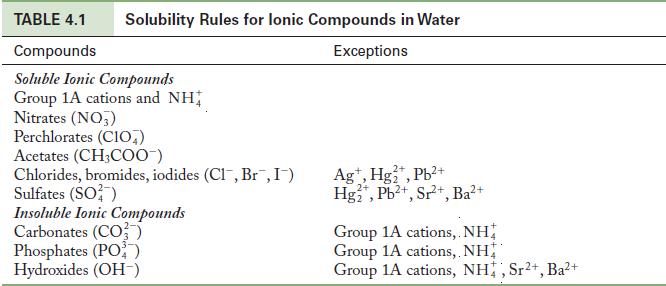
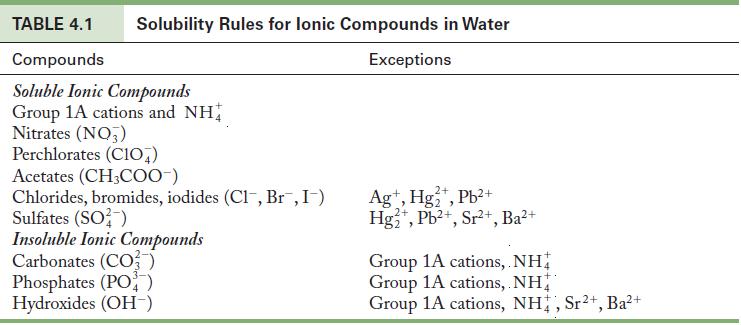
Are the compounds listed below soluble or insoluble in water?(a) Ba(NO3)2(b) PbSO4(c) LiOH(d) AgClStrategyUse the solubility rules in Table 4.1 to predict whether each compound is soluble or insoluble in water.Table 4.1 TABLE 4.1 Compounds Soluble Ionic Compounds Group 1A cations and NH Nitrates
A solution is formed by dissolving 3 g sugar in 100 mL water. Identify the solvent and the solute.
Use the solubility rules in Table 4.1 to predict whether BaSO4 is soluble or insoluble in water.Table 4.1 TABLE 4.1 Compounds Soluble Ionic Compounds Group 1A cations and NH Nitrates (NO3) Solubility Rules for lonic Compounds in Water Exceptions Perchlorates (C107) Acetates (CH3COO-) Chlorides,
Th e reaction of acetylene, C2H2, with oxygen, O2, yields carbon dioxide, CO2, and water. Write the balanced chemical equation for this reaction. As shown, this reaction produces a very hot flame that is used to weld metals.
What is the difference between writing the names of the reactants and products of the reaction, and writing the chemical equation?
Using the solubility rules in Table 4.1 as a guide, predict whether an insoluble product forms when each of the following pairs of solutions is mixed. Write the balanced chemical equation if a precipitation reaction does occur.(a) Pb(NO3)2 and sodium carbonate(b) Ammonium bromide and AgClO4(c)
A solution is formed by mixing 1 gal ethanol with 10 gal gasoline. Identify the solvent and the solute.
Predict whether an insoluble product forms when solutions of strontium nitrate, Sr(NO3)2, and sodium sulfate are mixed.
Mixing aqueous solutions of magnesium nitrate with potassium hydroxide produces insoluble magnesium hydroxide. Write the overall equation, the complete ionic equation, and the net ionic equation for this reaction.StrategyWrite the overall equation that shows all of the compounds in the reaction.
An aqueous sample is known to contain either Sr2+ or ions. Use the solubility rules to propose an experiment that will determine which ion is present. Hg2+
Mixing aqueous solutions of lead(II) nitrate and potassium sulfate produces insoluble lead sulfate. Write the net ionic equation for this reaction.
A physician attending to a dehydrated patient ordered that the patient be given intravenous normal saline. The recipe for normal saline solution is to weigh 180 g of very pure NaCl into a container and add enough water to produce 20.0 L of solution . What is the molar concentration of
Ammonium chloride is a strong electrolyte. Draw a molecular-level picture of this substance after it dissolves in water.
What is the molar concentration of KBr in a solution prepared by dissolving 0.321 g KBr in enough water to form 0.250 L solution?
Concentrated nitric acid, HNO3, is 15.9 M and is frequently sold in 2.5-L containers . How many moles of HNO3 are present in each container?StrategyMolarity, given in the problem, is the conversion between volume and moles present in a given volume of solution. Volume (L) of HNO3 solution Molarity
Experiments show that propionic acid (CH3CH2COOH) is a weak acid. Write the chemical equation.
What mass of potassium sulfate, K2SO4, is needed to prepare 500 mL of a 0.200 M K2SO4 solution?StrategyUse the molarity and volume of solution to determine the amount (moles) of K2SO4 that is needed to prepare the solution; then use the molar mass to calculate the mass of K2SO4.
Frequently physicians prescribe half-saline solutions rather than normal saline solution for their patients to reduce the amount of sodium the patient receives. Th e concentration of sodium chloride in half-saline solutions is 0.0770 M. How many moles of sodium chloride are in a 500-mL bag of the
Describe the procedure used to make 1.250 L of 0.154 M sodium chloride from solid NaCl and water.
Calculate the mass of AgNO3 needed to prepare 1.00 L of a 0.150 M AgNO3 solution?
If enough Li2SO4 dissolves in water to make a 0.33 M solution, explain why the molar concentration of Li+ is different from the molar concentration of Li2SO4(aq).
What are the molar concentrations of the ions in a 1.10 M Li2CO3 solution?
Describe how 500 mL of a 1.5 M solution of HCl can be prepared from 12.1 M HCl and pure solvent.
Concentrated hydrochloric acid is sold as a 12.1 M solution. What volume of this solution of concentrated HCl is needed to prepare 0.500 L of 0.250 M HCl?StrategyWe know the volume and the concentration of the dilute solution; this information is used to calculate the number of moles of HCl needed
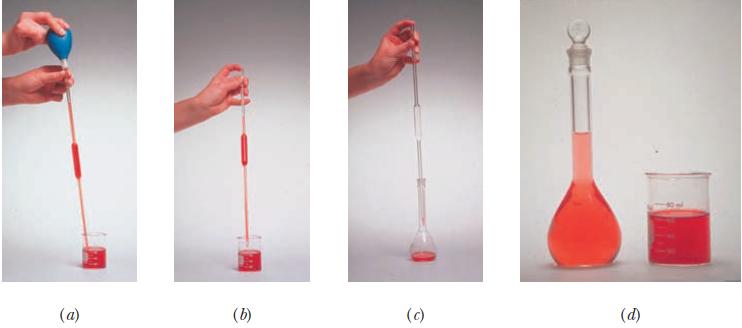
Addition of water to concentrated sulfuric acid is dangerous because it generates enough heat to boil the water, causing it to spatter out of the container. For this reason, chemists remember to add acid to water. In a dilution experiment, we calculate the amount of the more concentrated solution
Sodium hydroxide is sold as a 1.00 M solution. What volume of this solution of NaOH is needed to prepare 250 mL of 0.110 M NaOH?
Calculate the molar concentration of a solution prepared by diluting 50 mL of 5.23 M NaOH to 2.0 L.StrategyUsing the algebraic method described above, substitute quantities into the formula and solve for the desired quantity, the concentration of the prepared (i.e., diluted) solution.
What is the molar concentration of a solution prepared by diluting 20 mL of 5.2 M HNO3 to 0.50 L?
Draw the flow diagram for a calculation that illustrates how to use a titration to determine the concentration of a solution of HNO3, by reaction with 1.00 g Na2CO3.
Calculate the mass, in grams, of Al(OH)3 (molar mass = 78.00 g/mol) formed by the reaction of exactly 0.500 L of 0.100 M NaOH with excess Al(NO3)3.StrategyThis problem is identical in strategy to the stoichiometry problems in Chapter 3. We write the balanced equation, then calculate the number of
Calculate the mass of AgCl that forms in the reaction of 0.500 L of 1.30 M CaCl2 with excess AgNO3.
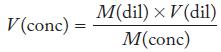
Explain why the algebraic expressioncan be used for dilution problems but not for titration calculations. V (conc) = M(dil) × V(dil) M(conc)
What volume of 0.20 M HNO3 is needed to react completely with 37 g Ca(OH)2?StrategyWe use the same four steps as for all stoichiometry problems. Write the balanced equation, calculate the amount of the given substance from the data supplied, calculate the amount of the desired substance from the
What volume of 1.50 M hydrochloric acid is needed to react completely with 4.50 g magnesium hydroxide?
Describe in words the titration of an acid with a base. Be sure to use the terms equivalence point, indicator, and end point correctly.
A tank car carrying concentrated hydrochloric acid overturns and spills into a small irrigation canal. An analysis of the canal water must be performed before chemists will decide how to remediate the spill. A chemist titrates a 200-mL sample of water from the canal with a 0.00100 M NaOH solution.
What is the molarity of NaOH in a 300-mL sample that is neutralized by 55.00 mL of 1.33 M HCl solution?
To standardize an HCl solution, a chemist weighs 0.210 g of pure Na2CO3 into a flask. She finds that it takes 5.50 mL HCl to react completely with the Na2CO3. Calculate the concentration of the HCl. Th e equation for the reaction taking place in aqueous solution isStrategyUse the strategy outlined
Describe the use of gravimetric analysis to determine the percentage of chlorine in a water-soluble unknown solid.
What is the molarity of an HCl solution if a 50.0-mL sample is neutralized by 10.00 mL of 0.23 M sodium hydroxide?
Draw the contents of a beaker of water that contains dissolved forms of the following (draw only the substances added to the water):(a) Potassium chloride(b) Barium hydroxide(c) Molecular oxygen, O2
A recycling company has purchased several tons of scrap wire that is known to contain silver. A sample of wire with a mass of 2.0764 g is completely dissolved in nitric acid. Then dilute hydrochloric acid is added until precipitation stops. The precipitate is filtered, dried thoroughly, and
An unknown sample of a carbonate salt has a mass of 3.775 g. The sample is dissolved in water, and aqueous barium nitrate is added until precipitation is complete. The precipitate is filtered, dried, and weighed. Its mass is 2.006 g. Assuming the precipitate is pure BaCO3, what is the percentage
Showing 2400 - 2500
of 2906
First
16
17
18
19
20
21
22
23
24
25
26
27
28
29
30
Step by Step Answers

 Get 50% OFF
Claim Now
Get 50% OFF
Claim Now





![Pt Cl Model of [PtC13(CH4)]. - H](https://dsd5zvtm8ll6.cloudfront.net/images/question_images/1703/5/7/3/817658a7939c6ad51703573807629.jpg)