New Semester
Started
Get
50% OFF
Study Help!
--h --m --s
Claim Now
Question Answers
Textbooks
Find textbooks, questions and answers
Oops, something went wrong!
Change your search query and then try again
S
Books
FREE
Study Help
Expert Questions
Accounting
General Management
Mathematics
Finance
Organizational Behaviour
Law
Physics
Operating System
Management Leadership
Sociology
Programming
Marketing
Database
Computer Network
Economics
Textbooks Solutions
Accounting
Managerial Accounting
Management Leadership
Cost Accounting
Statistics
Business Law
Corporate Finance
Finance
Economics
Auditing
Tutors
Online Tutors
Find a Tutor
Hire a Tutor
Become a Tutor
AI Tutor
AI Study Planner
NEW
Sell Books
Search
Search
Sign In
Register
study help
sciences
chemistry principles and practice
Chemistry Principles And Practice 3rd Edition Daniel L. Reger, Scott R. Goode, David W. Ball - Solutions
Which of the following compounds dissolves in water?(a) BaI2(b) Lead (II) chloride(c) Na2CO3(d) Ammonium sulfate
Which of the following compounds dissolves in water?(a) Hg2Cl2(b) Calcium bromide(c) KNO3(d) Silver perchlorate
Which of the following compounds dissolves in water?(a) CaCl2(b) Barium hydroxide(c) AgNO3(d) Calcium carbonate
Which of the following compounds dissolves in water?(a) Na3PO4(b) Ammonium carbonate(c) NH4Cl(d) Strontium sulfate
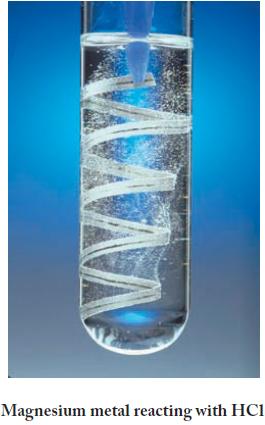
Write the net ionic equation for the reaction, if any, that occurs on mixing(a) Solutions of sodium hydroxide and magnesium chloride.(b) Solutions of sodium nitrate and magnesium bromide.(c) Magnesium metal and a solution of hydrochloric acid to produce magnesium chloride and hydrogen. Magnesium
Write the net ionic equation for the reaction, if any, that occurs on mixing(a) Solutions of ammonium carbonate and magnesium chloride.(b) Solutions of nitric acid and sodium hydroxide.(c) Solutions of beryllium sulfate and sodium hydroxide.
Write the net ionic equation for the reaction, if any, that occurs on mixing(a) Solutions of hydrochloric acid and calcium hydroxide.(b) Solutions of ammonium chloride and AgClO4.(c) Solutions of Ba(ClO4)2 and sodium carbonate.
Write the net ionic equation for the reaction, if any, that occurs on mixing(a) Solutions of potassium bromide and silver nitrate.(b) A solution of nitric acid and calcium metal to produce calcium nitrate and hydrogen gas.(c) Solutions of lithium hydroxide and iron(III) chloride.
Write the overall equation (including the physical states), the complete ionic equation, and the net ionic equation for the reaction that occurs when aqueous solutions of silver nitrate and calcium chloride are mixed.
Write the overall equation (including the physical states), the complete ionic equation, and the net ionic equation for the reaction that occurs when aqueous solutions of cobalt(II) bromide and sodium hydroxide are mixed.
Write the overall equation (including the physical states), the complete ionic equation, and the net ionic equation for the reaction that occurs when aqueous solutions of ammonium phosphate and silver nitrate are mixed.
Write the overall equation (including the physical states), the complete ionic equation, and the net ionic equation for the reaction that occurs when aqueous solutions of lead (II) acetate and barium bromide are mixed.
An aqueous sample is known to contain either Pb2+or Ba2+. Treatment of the sample with NaCl produces a precipitate. Use the solubility rules to determine which cation is present.
An aqueous sample is known to contain either Ag+ or Mg2+ ions. Treatment of the sample with NaOH produces a precipitate, but treatment with KBr does not. Use the solubility rules to determine which cation is present.
An aqueous sample is known to contain either Mg2+ or Ba2+ ions. Treatment of the sample with Na2CO3 produces a precipitate, but treatment with ammonium sulfate does not. Use the solubility rules to determine which cation is present.
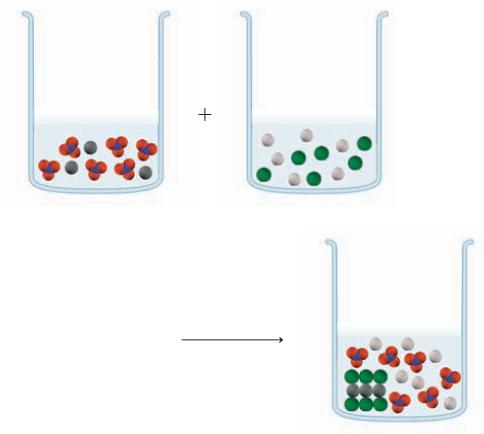
In the beakers shown below, the colored spheres represent a particular ion, with the dark gray balls representing Pb2+. In one reactant beaker is Pb(NO3)2 and in the other is NaCl. In the product beaker, the organized solid represents an insoluble compound. Write the overall equation, the complete
An aqueous sample is known to contain either Pb2+ or Fe3+ ions. Treatment of the sample with Na2SO4 produces a precipitate. Use the solubility rules to determine which cation is present.
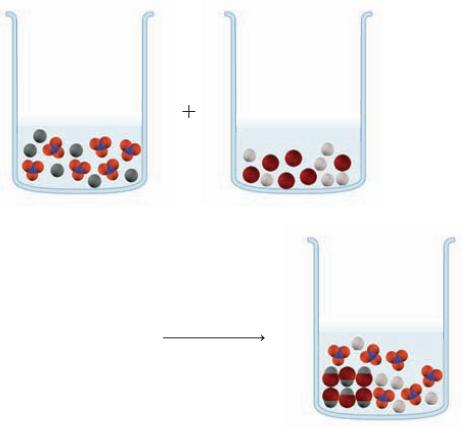
In the beakers shown below, the colored spheres represent a particular ion, with the dark gray balls representing Ag+. In one reactant beaker is AgNO3 and in the other is NaBr. In the product beaker, the organized solid represents an insoluble compound. Write the overall equation, the complete
Calculate the molarity of KOH in a solution prepared by dissolving 8.23 g KOH in enough water to form 250 mL solution.
Calculate the molarity of NaCl in a solution prepared by dissolving 23.1 g NaCl in enough water to form 500 mL solution.
Calculate the molarity of AgNO3 in a solution prepared by dissolving 1.44 g AgNO3 in enough water to form 1.00 L solution.
Calculate the molarity of NaOH in a solution prepared by dissolving 1.11 g NaOH in enough water to form 0.250 L solution.
What volume of a 2.3 M HCl solution is needed to prepare 2.5 L of a 0.45 M HCl solution?
What volume of a 5.22 M NaOH solution is needed to prepare 1.00 L of a 2.35 M NaOH solution?
What volume of a 2.11 M Li2CO3 solution is needed to prepare 2.00 L of a 0.118 M Li2CO3 solution?
What volume of a 5.00 M H2SO4 solution is needed to prepare 1.00 L of a 0.113 M H2SO4 solution?
What is the molarity of a glucose (C6H12O6) solution prepared from 55.0 mL of a 1.0 M solution that is diluted with water to a final volume of 2.0 L?
Calculate the molarity of 2.0 L solution prepared by dilution with water of(a) 3.56 g NaOH.(b) 25 mL of a 1.4 M NaOH solution.
Calculate the molarity of 250 mL solution prepared by dilution with water of(a) 0.12 g sodium nitrate.(b) 0.75 mL of a 0.42 M NaOH solution.
Calculate the mass of solute in(a) 3.13 L of a 2.21 M HCl solution.(b) 1.5 L of a 1.2 M KCl solution.
Calculate the mass of solute in(a) 0.113 L of a 1.00 M KBr solution.(b) 120 mL of a 2.11 M KNO3 solution.
How many grams of AgNO3 are needed to prepare 300 mL of a 1.00 M solution?
How many grams of barium chloride are needed to prepare 1.00 L of a 0.100 M solution?
What mass of sodium sulfate, in grams, is needed to prepare 400 mL of a 2.50 M solution?
What is the molarity of a solution of strontium chloride that is prepared by dissolving 4.11 g SrCl2 in enough water to form 1.00-L solution? What is the molarity of each ion in the solution?
What is the molarity of a solution of sodium hydrogen sulfate that is prepared by dissolving 9.21 g NaHSO4 in enough water to form 2.00-L solution? What is the molarity of each ion in the solution?
If 6.73 g of Na2CO3 is dissolved in enough water to make 250 mL of solution, what is the molar concentration of the sodium carbonate? What are the molar concentrations of the Na+ and ions? CO3/
What is the molarity of a solution of magnesium nitrate that is prepared by dissolving 21.5 g Mg(NO3)2 in enough water to form 5.00 L solution? What is the molarity of each ion in the solution?
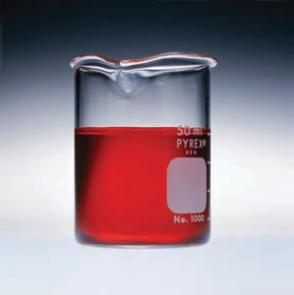
The substance KSCN is frequently used to test for iron in solution, because a distinctive red color forms when it is added to a solution of the Fe3+ cation. As a laboratory assistant, you are supposed to prepare 1.00 L of a 0.200 M KSCN solution. What mass, in grams, of KSCN do you need?A solution
Potassium permanganate (KMnO4) solutions are used for the determination of Fe2+ in samples of unknown concentration. As a laboratory assistant, you are supposed to prepare 500 mL of a 0.1000 M KMnO4 solution. What mass of KMnO4, in grams, do you need?
Two liters of a 1.5 M solution of sodium hydroxide are needed for a laboratory experiment. A stock solution of 5.0 M NaOH is available. How is the desired solution prepared?
A 6.00-g sample of sodium hydroxide is added to a 1.00-L volumetric flask, and water is added to dissolve the solid and fill the flask to the mark. A 100-mL portion of this solution is added to a 5.00-L volumetric flask, and water is added to fill the flask to the mark. What is the concentration of
Calculate the number of moles of solute in(a) 33 mL of a 3.11 M HNO3 solution.(b) 1.0 L of a 3.2 M HNO3 solution.
Calculate the number of moles of solute in(a) 0.22 L of a 1.2 M NaCl solution.(b) 500 mL of a 0.22 M solution of AgNO3.
Calculate the number of moles of solute in(a) 1.33 L of a 0.211 M AgNO3 solution.(b) 1000 mL of a 0.00113 M solution of calcium chloride.
Calculate the number of moles of solute in(a) 238 mL of a 0.211 M NaBr solution.(b) 1.2 L of a 0.077 M solution of ammonium chloride.
Calculate the number of moles of solute in(a) 34 mL of a 0.11 M potassium sulfate solution.(b) 10 mL of an 8.3 M solution of sodium chloride.
Calculate the number of moles of solute in(a) 12.4 mL of a 1.2 M NaCl solution.(b) 22 L of a 2.2 M solution of calcium nitrate.
What volume of 2.4 M HCl is needed to obtain 1.3 mol HCl?
What volume of 0.022 M CaCl2 is needed to obtain 0.13 mol CaCl2?
What mass of AgCl, in grams, forms in the reaction of 3.11 mL of 0.11 M AgNO3 with excess CaCl2?
What mass of barium sulfate, in grams, forms in the reaction of 25.0 mL of 0.11 M Ba(OH)2 with excess H2SO4?
What mass of sodium hydroxide, in grams, is needed to react with 100.0 mL of 3.13 M H2SO4?
What mass of calcium hydroxide, in grams, is needed to react with 100.0 mL of 0.0922 M HCl?
What volume of 0.66 M HNO3 is needed to react completely with 22 g of strontium hydroxide?
What volume of 0.22 M hydrochloric acid is needed to react completely with 2.5 g magnesium hydroxide?
What is the molar concentration of a solution of HCl if 135 mL react completely with 2.55 g Ba(OH)2?
What is the molar concentration of a solution of H2SO4 if 5.11 mL react completely with 0.155 g NaOH?
What mass, in grams, of BaSO4 forms in the reaction of 355 mL of 0.032 M H2SO4 with 266 mL of 0.015 M Ba(OH)2?
Calculate the mass of magnesium hydroxide formed in the reaction of 1.2 L of a 5.5 M solution of sodium hydroxide and excess magnesium nitrate.
What mass of lead(II) sulfate precipitates on mixing 20.0 mL of a 1.11 M solution of lead(II) acetate with an excess of sodium sulfate solution?
What mass of iron (III) hydroxide precipitates on mixing 100.0 mL of a 1.545 M solution of iron (III) nitrate with an excess of sodium hydroxide solution?
What is the solid that precipitates, and how much of it forms, when an excess of sodium sulfate solution is mixed with 10.0 mL of a 2.10 M barium bromide solution?
What is the solid that precipitates, and how much of it forms, when an excess of sodium chloride solution is mixed with 10.0 mL of a 2.10 M silver nitrate solution?
What volume of 1.212 M silver nitrate is needed to precipitate all of the iodide ions in 120.0 mL of a 1.200 M solution of sodium iodide?
What volume of 0.112 M potassium carbonate is needed to precipitate all of the calcium ions in 50.0 mL of a 0.100 M solution of calcium chloride?
A solid forms when excess barium chloride is added to 21 mL of 3.5 M ammonium sulfate. Write the overall equation, and calculate the mass of the precipitate.
A solid forms when excess iron(II) chloride is added to 220 mL of 1.22 M sodium hydroxide. Write the overall equation, and calculate the mass of the precipitate.
Write the overall equation (including the physical states), the complete ionic equation, and the net ionic equation for the reaction that occurs on mixing aqueous solutions of silver nitrate and sodium bromide. What mass of solid precipitates if 345 mL of a 0.330 M silver nitrate solution mixes
Write the overall equation (including the physical states), the complete ionic equation, and the net ionic equation for the reaction of aqueous solutions of sodium hydroxide and magnesium chloride. What mass of solid forms on mixing 50.0 mL of 3.30 M sodium hydroxide with 35.0 mL of 1.00 M
If a volume of 32.45 mL HCl is used to completely neutralize 2.050 g Na2CO3 according to the following equation, what is the molarity of the HCl? Na₂CO3(aq) + 2HC1(aq) → 2NaCl(aq) + CO₂(g) + H₂O(0)
What is the molar concentration of a solution of HNO3 if 50.00 mL react completely with 22.40 mL of a 0.0229 M solution of Sr(OH)2?
What is the molar concentration of an HCl solution if a 100.0-mL sample requires 33.40 mL of a 2.20 M solution of KOH to reach the equivalence point?
What is the molar concentration of an H2SO4 solution if a 50.0-mL sample requires 9.65 mL of a 1.33 M solution of NaOH to reach the equivalence point?
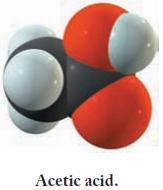
The pungent odor of vinegar is a result of the presence of acetic acid, CH3COOH. Only one hydrogen atom of the CH3COOH reacts with a base in a neutralization reaction. What is the concentration of acetic acid if a 10.00-mL sample is neutralized by 3.32 mL of 0.0100 M strontium hydroxide? Acetic
(a) What volume of 0.223 M HNO3 is required to neutralize 50.00 mL of 0.033 M barium hydroxide?(b) What volume of 1.13 M AgNO3 is required to precipitate all of the chloride ions in 10.00 mL of 2.43 M calcium chloride?
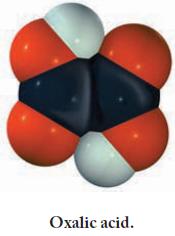
Oxalic acid, H2C2O4, is an acid in which both of the hydrogens react with base in a neutralization reaction. What is the concentration of an oxalic acid solution if 10.00 mL of the solution is neutralized by 22.05 mL of 0.100 M sodium hydroxide? Oxalic acid.
Oranges and grapefruits are known as citrus fruits because their acidity comes mainly from citric acid, H3C6H5O7. Calculate the concentration of citric acid in a solution if a 30.00-mL sample is neutralized by 15.10 mL of 0.0100 M KOH. Assume that three acidic hydrogens of each citric acid molecule
A 125-mL sample of a Ba(OH)2 solution is mixed with 75 mL of 0.10 M HCl. The resulting solution is still basic. An additional 35 mL of 0.012 M HCl is needed to neutralize the base. What is the molarity of the Ba(OH)2 solution?
A solution is prepared by placing 14.2 g KCl in a 1.00-L volumetric flask and adding water to dissolve the solid, then filling the flask to the mark. What is the molarity of an AgNO3 solution if 25.0 mL of the KCl solution reacts with exactly 33.2 mL of the AgNO3 solution?
Mixing excess potassium carbonate with 300 mL of a calcium chloride solution of unknown concentration yields 4.50 g of a solid. Give the formula of the solid, and calculate the molar concentration of the calcium chloride solution.
Mixing excess silver nitrate with 246 mL of a magnesium chloride solution of unknown concentration yields 2.21 g of a solid. Give the formula of the solid, and calculate the molar concentration of the magnesium chloride solution.
What is the percentage of barium in an ionic compound of unknown composition if a 2.11-g sample of the compound is completely dissolved in water and produces 1.22 g barium sulfate on addition of an excess of a sodium sulfate solution?
What is the percentage of silver in an ionic compound of unknown composition if a 3.13-g sample of the compound is completely dissolved in water and produces 2.02 g silver chloride on addition of an excess of a sodium chloride solution?
Sterling silver is a mixture of silver and copper. It dissolves in nitric acid to form the Ag+ and Cu2+ ions. A 0.360-g sample of sterling silver is dissolved in nitric acid, and the Ag+ precipitates with excess NaCl as AgCl. The mass of the AgCl produced is 0.435 g. What is the mass percentage of
Th e percentage of copper ions in a sample can be determined by reaction with zinc metal to produce copper metal.The copper produced is collected and weighed. If a 15.5-g ore sample containing copper ions is dissolved and produces 4.33 g copper metal when it reacts with zinc, what is the percentage
What is the molarity of a sodium chloride solution if addition of excess AgNO3 to a 20-mL sample yields 0.0112 g precipitate?
What is the molarity of a potassium sulfate solution if addition of excess BaCl2 to a 100-mL sample yields 0.233 g precipitate?
An environmental laboratory wants to remove from a water solution. Suggest a method of removal. 2+ Hg+
A solution contains Be2+, Ca2+, and Ba2+. Predict what happens if NaOH is added to the solution.
A 5.30-g sample of NaOH is placed in a 1.00-L volumetric flask and water is added to the mark. A 100.0-mL sample of the resulting solution is placed in a 500.0-mL volumetric and diluted to the mark with water. What volume of the second sample is needed to neutralize 33.0 mL of 0.0220 M H2SO4?
A 10.0-mL sample of solution that is 0.332 M NaCl and 0.222 M KBr is evaporated to dryness. What mass of solid remains?
What is the concentration of hydroxide ion in a solution made by mixing 200.0 mL of 0.0123 M NaOH with 200.0 mL of 0.0154 M Ba(OH)2, followed by dilution of the mixture to 500.0 mL?
What is the molar concentration of chloride ion in a solution formed by mixing 150.0 mL of 1.54 M sodium chloride with 200.0 mL of 2.00 M calcium chloride, followed by dilution of the mixture to 500.0 mL?
What mass of NaOH is needed to prepare 1.00 L of an NaOH solution with the correct concentration such that 50.0 mL of it will exactly neutralize 10.0 mL of 3.11 M H2SO4?
Sodium thiosulfate, Na2S2O3, is used in photographic film developing. Th e amount of Na2S2O3 in a solution can be determined by a titration with I2, according to the following equation:Calculate the concentration of the Na2S2O3 solution if 30.30 mL of a 0.1120 M I2 solution reacts completely with a
Toxic nitrogen monoxide gas can be prepared in the laboratory by carefully mixing a dilute sulfuric acid with an aqueous solution of sodium nitrite, as the following equation shows. What volume of 1.22 M sulfuric acid (assume excess sodium nitrite) is needed to prepare 2.44 g NO? 3H₂SO4(aq) +
Although silver chloride is insoluble in water, adding ammonia to a mixture of water and silver chloride causes the silver ions to dissolve because of the formation of [Ag(NH3)2]+ ions. What is the concentration of [Ag(NH3)2]+ ions that results from the addition of excess ammonia to a mixture of
An 83.5-g sample contains NaCl contaminated with a substance that is not water soluble. The sample is added to water, which is then filtered to remove the contaminant and diluted to form 250.0 mL of a homogeneous solution. Th at solution is analyzed and the concentration of NaCl is 1.23 M. What is
A 0.3120-g sample of a soluble compound made up of aluminum and chlorine yields 1.006 g AgCl when mixed with enough AgNO3 to react completely with all of the chloride ions. What is the empirical formula of the compound?
Showing 2500 - 2600
of 2906
First
16
17
18
19
20
21
22
23
24
25
26
27
28
29
30
Step by Step Answers

 Get 50% OFF
Claim Now
Get 50% OFF
Claim Now