New Semester
Started
Get
50% OFF
Study Help!
--h --m --s
Claim Now
Question Answers
Textbooks
Find textbooks, questions and answers
Oops, something went wrong!
Change your search query and then try again
S
Books
FREE
Study Help
Expert Questions
Accounting
General Management
Mathematics
Finance
Organizational Behaviour
Law
Physics
Operating System
Management Leadership
Sociology
Programming
Marketing
Database
Computer Network
Economics
Textbooks Solutions
Accounting
Managerial Accounting
Management Leadership
Cost Accounting
Statistics
Business Law
Corporate Finance
Finance
Economics
Auditing
Tutors
Online Tutors
Find a Tutor
Hire a Tutor
Become a Tutor
AI Tutor
AI Study Planner
NEW
Sell Books
Search
Search
Sign In
Register
study help
sciences
chemistry principles and practice
Chemistry Principles And Practice 3rd Edition Daniel L. Reger, Scott R. Goode, David W. Ball - Solutions
Which gas and set of conditions best follows the ideal gas law:(a) N2 at 25 °C and 1 atm,(b) SO2 at 25 °C and 1 atm,(c) N2 at 25 °C and 100 atm?
Define the terms diffusion and effusion.
In each part, predict which gas sample is likely to follow the ideal gas law more closely:(a) SO2 gas at 0 °C or SO2 at 100 °C, both at 1 atm(b) N2 gas at 1 atm or N2 at 100 atm, both at 25 °C(c) O2 gas or NH3 gas, both at -20 °C and 1 atmStrategyIn each case, choose the gas that is
Calculate the pressure in atmospheres of 0.223 mol ammonia gas at 30.0 °C in a 3.23-L container, using the ideal gas law and van der Waals equation.
Describe why gases at high pressures do not follow the ideal gas law.
Calculate the pressure in atmospheres of 2.01 mol gaseous H2O at 400 °C in a 2.55-L container, using the ideal gas law and van der Waals equation. Compare the two answers.StrategyUse both the ideal gas law and the van der Waals equation to calculate the pressure under the conditions given.
In each of the following cases, does the ratio PV/nRT for a real gas have a value greater than or less than 1?(a) Attractive forces between particles are strong.(b) The volume of the gas particle becomes important relative to the total volume of the gas.
Express a pressure of(a) 334 torr in atm.(b) 3944 Pa in atm.(c) 2.4 atm in torr.
Express a pressure of(a) 3.2 atm in torr.(b) 54.9 atm in kPa.(c) 356 torr in atm.
The temperature terms for gas law problems must always be expressed in kelvins. Convert the following temperatures to kelvins.(a) 45 °C(b) -28 °C(c) 230 °C
Trimix, as outlined in the introduction to this chapter, is a mixture of O2, N2, and He that is used for very deep SCUBA dives. What is the partial pressure of oxygen if 0.10 mol oxygen is mixed with 0.20 mol nitrogen and 0.70 mol helium? The total pressure of gas is 4.2 atm.StrategyThe partial
What is the partial pressure of helium in a fl ask at a total pressure of 700 torr, if the sample contains 10.2 mol argon and 10.4 mol helium?
Explain the differences between the concentration unit’s molarity and mole fraction. Can molarity be used to describe the concentration of a mixture of gases?
Convert the following kelvin temperatures to degrees Celsius.(a) 344 K(b) 122 K(c) 1537 K
A sample of gas at 1.02 atm of pressure and 39 °C is heated to 499 °C at constant volume. What is the new pressure in atmospheres?
A 256-mL sample of a gas exerts a pressure of 2.75 atm at 16.0 °C. What volume would it occupy at 1.00 atm and 100 °C?
A 39.6-mL sample of gas is trapped in a syringe and heated from 27 °C to 127 °C. What is the new volume (in mL) in the syringe if the pressure is constant?
The quantity of gas in a 34-L balloon is increased from 3.2 to 5.3 mol at constant pressure. What is the new volume of the balloon at constant temperature?
The pressure on a balloon holding 166 mL of gas is increased from 399 torr to 1.00 atm. What is the new volume of the balloon (in mL) at constant temperature?
A sample of hydrogen gas is in a 2.33-L container at 745 torr and 27 °C. Express the pressure of hydrogen (in atm) after the volume is changed to 1.22 L and the temperature is increased to 100 °C.
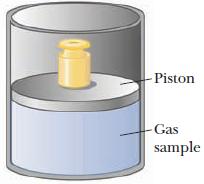
The container below contains a gas and has a piston that can move without changing the pressure in the container. Redraw this container; then draw the container again after the temperature of the container has doubled on the Kelvin scale. i Piston Gas sample
A sample of argon occupies 3.22 L at 33 °C and 230 torr. How many moles of argon are present in the sample?
What is the temperature of a gas, in °C, if a 2.49-mol sample in a 24.0-L container is under a pressure of 2.44 atm?
A 3.00-L container is rated to hold a gas at a pressure no greater than 100 atm. Assuming that the gas behaves ideally, what is the maximum number of moles of gas that this vessel can hold at 27 °C?
What is the pressure, in atm, of 0.322 g N2 gas in a 300-mL container at 24 °C?
What is the volume, in liters, of a balloon that contains 82.3 mol H2 gas at 25 °C and 1.01 × 10⁵ Pa?
What is the temperature of an ideal gas if 1.33 mol occupies 22.1 L at a pressure of 1.21 atm?
What is the pressure in a 2.33-L container holding 1.44 g CO2 at 211 °C?
What is the pressure exerted by 1.55 g Xe gas at 20 °C in a 560-mL flask?
How many N2 molecules are in a 33.2-L container that is at 1.13 atm of pressure and 122 °C?
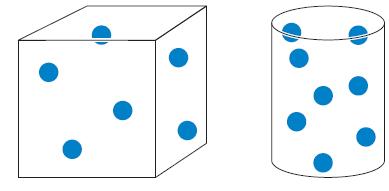
In the cubical container below, each dot represents 0.10 of a mole of gas. If the container volume is 2.3 L and is at 27 °C, calculate the pressure in the container.
Calculate the volume of a gas sample containing 2.35 × 1025 water molecules at 0.173 atm of pressure and 229 °C.
In the cylindrical container above, each dot represents 0.22 of a mole of gas. If the container pressure is 2.3 atm and is at 127 °C, calculate the volume of the container.
A balloon is filled to the volume of 135 L on a day when the temperature is 21 °C. If no gases escaped, what would be the volume of the balloon after its temperature has changed to -8 °C?
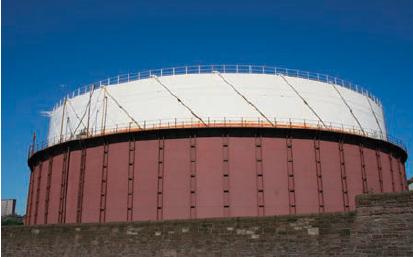
Natural gas has been stored in an expandable tank that keeps a constant pressure as gas is added or removed. Th e tank has a volume of 4.50 × 104 ft3 when it contains 77.4 million mol natural gas at -5 °C. What is the new volume of the tank if consumers use up 5.3 million mol and the temperature
A sample of gas occupies 135 mL at 22.5 °C; the pressure is 165 torr. What is the pressure of the gas sample when it is placed in a 252-mL flask at a temperature of 0.0 °C?
A 10-L cylinder contains helium gas at a pressure of 3.3 atm. The hosts of a party use the gas to fill balloons. How many 4-L balloons can be filled if the ambient pressure is 1.03 atm and the temperature remains constant? The final pressure in the tank will be 1.03 atm.
A 40-L cylinder contains helium gas at a pressure of 20.3 atm. Meteorologists fi ll a balloon with the gas to lift weather equipment into the stratosphere. What is the fi nal pressure in the cylinder after a 105-L balloon is fi lled to a pressure of 1.03 atm?
The pressure of a 900-mL sample of helium is increased from 2.11 to 4.33 atm, and the temperature is also increased from 0 °C to 22 °C. What is the new volume (in mL) of the sample?
What is the molar mass of a gas if a 0.550-g sample occupies 258 mL at a pressure of 744 torr and a temperature of 22 °C?
Calculate the molar mass of a gas if a 0.165-g sample at 1.22 atm occupies a volume of 34.8 mL at 50 °C.
What is the molar mass of a gas if a 0.121-g sample at 740 torr occupies a volume of 21.0 mL at 29 °C?
Calculate the molar mass of a gaseous element if 0.480 g of the gas occupies 367 mL at 365 torr and 45 °C. Suggest the identity of the element.
What is the density of He gas at 10.00 atm and 0 °C?
What is the density of CO2 gas at 1.00 atm and 27 °C?
What is the density of C2H6 gas at 0.55 atm and 100 °C?
Assuming the ideal gas law holds, what is the density of the atmosphere on the planet Venus if it is composed of CO2 (g) at 730 K and 91.2 atm?
What volume, in milliliters, of hydrogen gas at 1.33 atm and 33 °C is produced by the reaction of 0.0223 g lithium metal with excess water? Th e other product is LiOH.
Assuming the ideal gas law holds, what is the density of the atmosphere on the planet Mars if it is composed of CO2 (g) at -55 °C and 700 Pa?
Calculate the volume of methane, CH4, measured at 300 K and 825 torr, that can be produced by the bacterial breakdown of 1.25 kg of a simple sugar. C6H12O6 →3CH4 + 3CO₂
Heating potassium chlorate, KClO3, yields oxygen gas and potassium chloride. What volume, in liters, of oxygen at 23 °C and 760 torr is produced by the decomposition of 4.42 g potassium chlorate?
What volume of oxygen gas, in liters, at 30 °C and 0.993 atm reacts with excess hydrogen to produce 4.22 g water?
What volume of hydrogen gas, in liters, is produced by the reaction of 1.33 g zinc metal with 300 mL of 2.33 M H2SO4? The gas is collected at 1.12 atm of pressure and 25 °C. The other product is ZnSO4(aq).
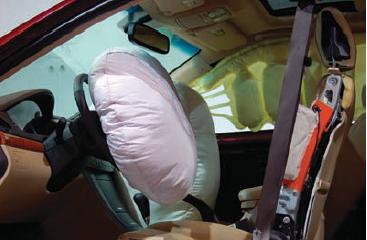
The “air” that fills the air bags installed in automobiles is generally nitrogen produced by a complicated process involving sodium azide, NaN3, and KNO3. Assuming that one mole of NaN3 produces one mol of N2, what volume, in liters, of nitrogen gas is released from the decomposition of 1.88 g
What volume of hydrogen gas, in liters, is produced by the reaction of 3.43 g of iron metal with 40.0 mL of 2.43 M HCl? Th e gas is collected at 2.25 atm of pressure and 23 °C. The other product is FeCl2(aq).
Ammonia gas is synthesized from hydrogen and nitrogen:If you want to produce 562 g of NH3, what volume of H2 gas, at 56 °C and 745 torr, is required? 3H₂(g) + N₂(g) →2NH3(g)
The gas hydrogen sulfide, H2S, has the offensive smell associated with rotten eggs. It reacts slowly with the oxygen in the atmosphere to form sulfur dioxide and water. What volume of sulfur dioxide gas, in liters, forms at constant pressure and temperature from 2.44 L hydrogen sulfide, and what
What volume of ammonia, NH3, is produced from the reaction of 3 L hydrogen gas with 3 L nitrogen gas? What volume, if any, of the reactants will remain after the reaction ends. Assume all volumes are measured at the same pressure and temperature.
Nitrogen monoxide gas reacts with oxygen gas to produce nitrogen dioxide gas. What volume of nitrogen dioxide is produced from the reaction of 1 L nitrogen monoxide gas with 3 L oxygen gas? What volume, if any, of the reactants will remain after the reaction ends? Assume all volumes are measured at
Assuming the volumes of all gases in the reaction are measured at the same temperature and pressure, calculate the volume of water vapor obtainable by the explosive reaction of a mixture of 725 mL of hydrogen gas and 325 mL of oxygen gas.
What volume of hydrogen gas is needed to exactly react with 4.2 L nitrogen gas to produce ammonia?
Considerable concern exists that an increase in the concentration of CO2 in the atmosphere will lead to global warming. This gas is the product of the combustion of hydrocarbons used as energy sources. What volume of CO2 gas, at constant temperature and pressure, is produced by the combustion of
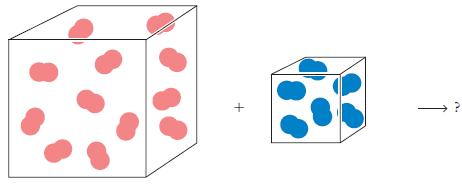
Nitrogen dioxide can form in the reaction of oxygen gas and nitrogen gas. In the containers below, the red molecules represent oxygen gas and the blue molecules represent nitrogen gas. Redraw these two containers; then draw a container of the products of the reaction along with any unreacted
What is the total pressure, in atm, in a container that holds 1.22 atm of hydrogen gas and 4.33 atm of argon gas?
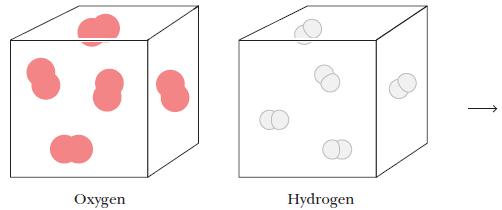
What mass of water forms when oxygen gas in the container below, where each red molecule represents 0.10 of a mole, reacts with hydrogen gas in the other container, where each white molecule represents 0.10 of a mole. Oxygen Hydrogen
What is the partial pressure of argon, in torr, in a container that also contains neon at 235 torr and is at a total pressure of 500 torr?
The pressure in a 3.11-L container is 4.33 atm. What is the new pressure in the tank when 2.11 L gas at 2.55 atm is added to the container? All the gases are at 27 °C.
A 4.53-L sample of neon at 3.22 atm of pressure is added to a 10.0-L cylinder that contains argon. If the pressure in the cylinder is 5.32 atm after the neon is added, what was the original pressure of argon in the cylinder?
What is the pressure, in atm, in a 3.22-L container that holds 0.322 mol oxygen and 1.53 mol nitrogen? The temperature of the gases is 100 °C.
Calculate the partial pressure of oxygen, in atm, in a container that holds 3.22 mol oxygen and 4.53 mol nitrogen. The total pressure in the container is 7.32 atm.
A 10.5-g sample of hydrogen is added to a 30-L container that also holds argon gas at 1.53 atm. Th e gases are at 120 °C. What is the partial pressure of hydrogen gas in the mixture, and what is the total pressure in the container?
What is the total pressure exerted by a mixture of 1.50 g H2 and 5.00 g N2 in a 5.00-L vessel at 25 °C?
Calculate the partial pressure of hydrogen gas, in atm, in a container that holds 0.220 mol hydrogen and 0.432 mol nitrogen. The total pressure is 5.22 atm.
What is the partial pressure of neon, in torr, in a flask that contains 3.11 mol of neon and 1.02 mol of argon under a total pressure of 209 torr?
What is the partial pressure of each gas in a flask that contains 0.22 mol neon, 0.33 mol nitrogen, and 0.22 mol oxygen if the total pressure in the flask is 2.6 atm?
What is the partial pressure of each gas in a flask that contains 2.3 g neon, 0.33 g xenon, and 1.1 g argon if the total pressure in the flask is 2.6 atm?
What is the partial pressure of oxygen gas, in torr, collected over water at 26 °C if the total pressure is 755 torr?
What is the total pressure, in torr, in a 1.00-L flask that contains 0.0311 mol hydrogen gas collected over water? The temperature is 25 °C.
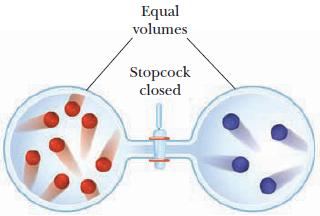
Two 1-L containers at 27 °C are connected by a stopcock as pictured below. If each dot in the containers represents 0.0050 mol of a nonreactive gas, what is the pressure in each container before and after the stopcock is opened? Equal volumes Stopcock closed
Hydrogen gas is frequently prepared in the laboratory by the reaction of zinc metal with sulfuric acid, H2SO4. The other product of the reaction is zinc(II) sulfate. The hydrogen gas is generally collected over water. What volume of pure H2 gas is produced by the reaction of 0.113 g zinc metal and
Sodium metal reacts with water to produce hydrogen gas and sodium hydroxide. Calculate the mass of sodium used in a reaction if 499 mL of wet hydrogen gas are collected over water at 22 °C and the barometric pressure is 755 torr. The vapor pressure of the water at 22 °C is 22 torr.
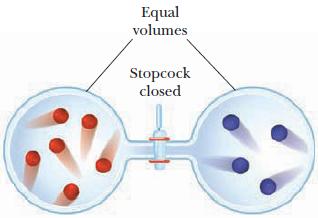
Two 1-L containers at 27 °C are connected by a stopcock as pictured below. If each dot in the containers represents 0.0020 mol of a nonreactive gas, what is the pressure in each container before and after the stopcock is opened ?Draw the container after the stopcock is opened, indicating the
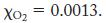
A robotic analysis of the atmosphere of the planet Venus shows that it has 0.0020. If the total atmospheric pressure on Venus is 91.2 atm, what are the partial pressures (in atm) of each gas? XCO₂ 0.964, XN₂ 0.034, and XH₂O = = ||
A robotic analysis of the atmosphere of the planet Mars shows that it has 0.016, and If the total atmospheric pressure on Mars is 7.00 × 10² Pa, what are the partial pressures (in Pa) of each gas? XCO₂ = 0.9532, XN2 = 0.027, XAr
Arrange the following gases in order of increasing rms speed of the particles at the same temperature: N2, O2, Ne.
Place the following gases in order of increasing average molecular speed at 25 °C: Ar, CH4, N2, CH2F2.
Arrange the following gases, at the temperatures indicated, in order of increasing rms speed of the particles: neon at 25 °C, neon at 100 °C, argon at 25 °C.
Arrange the following gases, at the temperatures indicated, in order of increasing rms speed of the particles: helium at 100 °C, neon at 50 °C, argon at 0 °C.
Calculate the rms speed of neon atoms at 100 °C.
Calculate the rms speed of SO2 molecules at 127 °C. What is the rms speed if the temperature is doubled on the Kelvin scale?
Calculate the ratio of the rate of effusion of helium to that of neon gas under the same conditions.
Calculate the molar mass of a gas that has an rms speed of 518 m/s at 28 °C.
What is the temperature, in kelvins, of neon atoms that have an rms speed of 700 m/s?
Calculate the ratio of the rate of effusion of CO2 to that of CH4 gas under the same conditions.
Calculate the ratio of the rate of effusion of helium to that of argon under the same conditions.
A container is filled with equal molar amounts of N2 and SO2 gas. Calculate the ratio of the rates of effusion of the two gases.
Calculate the molar mass of a gas if equal volumes of it and hydrogen take 9.12 and 1.20 minutes, respectively, to effuse into a vacuum through a small hole under the same conditions of constant pressure and temperature.
Calculate the molar mass of a gas if equal volumes of oxygen and the unknown gas take 5.2 and 8.3 minutes, respectively, to effuse into a vacuum through a small hole under the same conditions of constant pressure and temperature.
A gas effuses 1.55 times faster than propane (C3H8) at the same temperature and pressure.(a) Is the gas heavier or lighter than propane?(b) What is the molar mass of the gas?
For each of the following pairs of gases at the given conditions, predict which one would more closely follow the ideal gas law. Explain your choice.(a) Oxygen (boiling point = -183 °C) gas at -150 °C or at 30 °C, both measured at 1.0 atm(b) Nitrogen (boiling point = -196 °C) or xenon (boiling
Showing 2000 - 2100
of 2906
First
14
15
16
17
18
19
20
21
22
23
24
25
26
27
28
Last
Step by Step Answers

 Get 50% OFF
Claim Now
Get 50% OFF
Claim Now