New Semester
Started
Get
50% OFF
Study Help!
--h --m --s
Claim Now
Question Answers
Textbooks
Find textbooks, questions and answers
Oops, something went wrong!
Change your search query and then try again
S
Books
FREE
Study Help
Expert Questions
Accounting
General Management
Mathematics
Finance
Organizational Behaviour
Law
Physics
Operating System
Management Leadership
Sociology
Programming
Marketing
Database
Computer Network
Economics
Textbooks Solutions
Accounting
Managerial Accounting
Management Leadership
Cost Accounting
Statistics
Business Law
Corporate Finance
Finance
Economics
Auditing
Tutors
Online Tutors
Find a Tutor
Hire a Tutor
Become a Tutor
AI Tutor
AI Study Planner
NEW
Sell Books
Search
Search
Sign In
Register
study help
sciences
modern engineering mathematics
Modern Engineering Mathematics 6th Edition Glyn James - Solutions
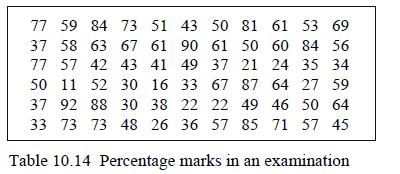
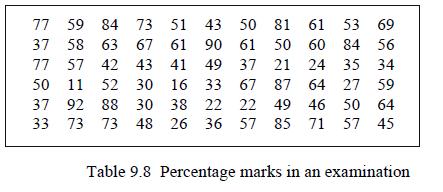
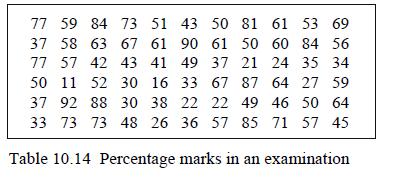
1. Calculate the mean deviation of the data set representing the lengths of names for a class of pupils.2. In Practice Question 9.2 of Refresher Unit 9, data was presented on the percentage marks scored by 66 candidates in an examination. This data is reproduced in Table 10.14.Calculate the mean
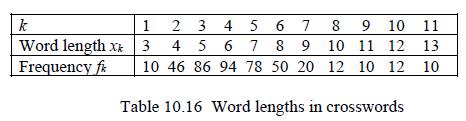
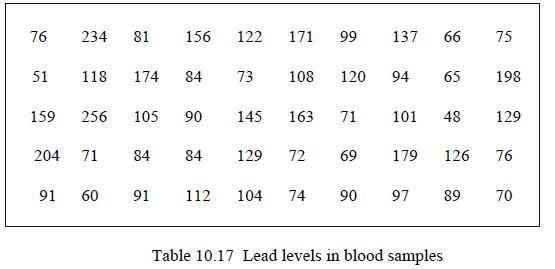
1. Word lengths in newspaper crosswords are summarised in Table 10.16Calculate the mean, mode, median, mean deviation and standard deviation for this data.2. Lead levels in blood samples from 50 primary school children (μg/l) are given in Table 10.17Calculate the mean and median and use the
Determine the Laplace transform of the function f(t) = c where c is a constant.
Determine the Laplace transform of the ramp function f(t) = t.
Determine the Laplace transform of the one-sided exponential function f(t) = ekt
Determine the Laplace transforms of the sine and cosine functions f(t) = sin at, g(t) = cos at where a is a real constant.
Show that the function f(t) = t3 (t ≥ 0) is of exponential order.
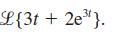
Determine L{3t + 2e}.
Determine L{5 - 3t + 4 sin 2t - 6e*}.
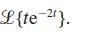
Determine L{te-}.
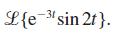
Determine L {e- sin 2t}.
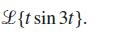
Determine L {t sin 3t}.
Determine L{te}.
Determine where n is a positive integer. '{ws}
Find L-1 1 [(s + 3)(s-2)]
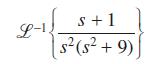
Find p-1. +1 I + S s (5+9)
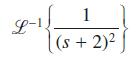
Find L-1 1 (s + 2)
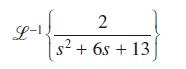
Find L-1. 2 s + 6s + 13
Find L-1. S+7] s+2s +5
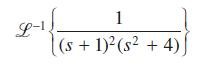
Find L-1 1 (s + 1) (s + 4)
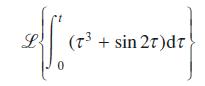
Obtain off L (T3 + sin 2T)dr 0
Solve the differential equationsubject to the initial conditions x = 1 and dx/dt = 0 at t = 0. dx dt dx + 5 + 6x = 2e (t > 0) dt
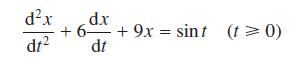
Solve the differential equationsubject to the initial conditions x = 0 and dx/dt = 0 at t = 0. dx dt dx + 6 + 9x = sint (t > 0) dt
Solve the differential equationsubject to the initial conditions x = dx/dt = 1 and d2x/dt2 = 0 at t = 0. dx dt3 dx +5- dt dx + 17 +13x = 1 (t > 0) dt
Solve for t > 0 the simultaneous first-order differential equationssubject to the initial conditions x = 2 and y = 1 at t = 0. dx dy dt dt dx 2- dt + + 5x + 3y = e- dy dt + x +y = 3 (11.20) (11.21)
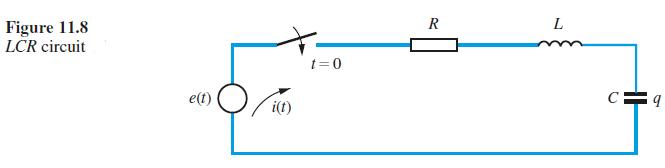
The LCR circuit of Figure 11.8 consists of a resistor R, a capacitor C and an inductor L connected in series together with a voltage source e(t). Prior to closing the switch at time t = 0, both the charge on the capacitor and the resulting current in the circuit are zero. Determine the charge q(t)
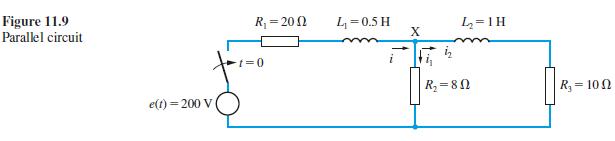
In the parallel network of Figure 11.9 there is no current flowing in either loop prior to closing the switch at time t = 0. Deduce the currents i1(t) and i2(t) flowing in the loops at time t. Figure 11.9 Parallel circuit e(t)=200 V R = 2002 t=0 L = 0.5 H X + L=1H R=802 R = 100
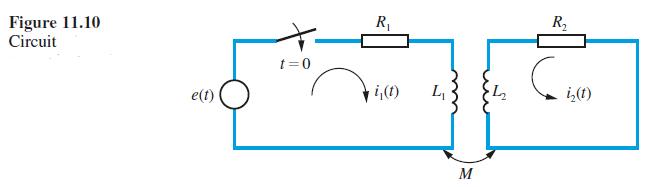
A voltage e(t) is applied to the primary circuit at time t = 0, and mutual induction M drives the current i2(t) in the secondary circuit of Figure 11.10. If, prior to closing the switch, the currents in both circuits are zero, determine the induced current i2(t) in the secondary circuit at time t
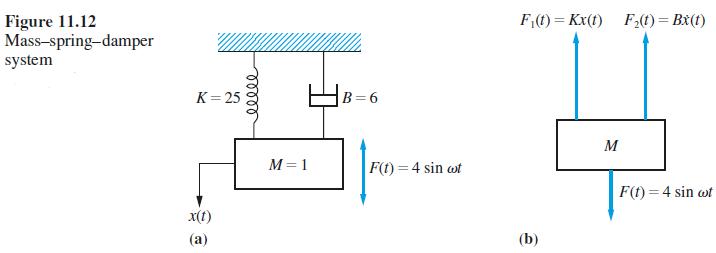
The mass of the mass–spring–damper system of Figure 11.12(a) is subjected to an externally applied periodic force F(t) = 4 sinωt at time t = 0. Determine the resulting displacement x(t) of the mass at time t, given that x(0) = ẋ (0) = 0, for the two cases(a) ω = 2 (b) ω = 5In the case ω
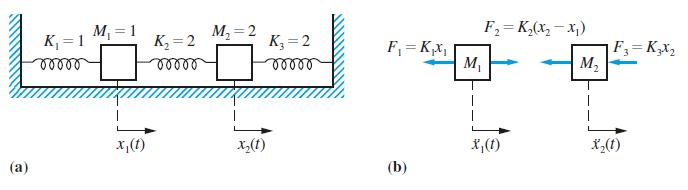
Consider the mechanical system of Figure 11.13(a), which consists of two masses M1 =1 and M2 = 2, each attached to a fixed base by a spring, having constants K1 = 1 and K3 = 2 respectively, and attached to each other by a third spring having constant K2 = 2. The system is released from rest at time
Find the derivatives of the following functions:(a) x5 (b) 1/x2(c) √x (d) 1/√x(e) x5/2
Find the derivatives of the following functions:(a) 6x7 (b) 4/x4(c) 6√x5
Find the derivative of the functiony = 3x3 − 2x2 + 5x + 3
Find the derivatives of the following functions:(a) y = (3x2 + 8)3(b) y = 4x - 2
Using the product rule, find the derivatives of the following functions:(a) y =(x2 + 3)(x3 − 2x2 +1)(b) y = x2 (2x2 +1)8
Using the quotient rule, find the derivatives of the following functions: (a) y = x +1 x-3 x + 2x-1 2x+5 (b) y=-
Find the second derivative d2y/dx2 for the following y: (a) 4x +2x+6 (b) X x-2
Find the slope of the tangent at the point (1, 3) on the graph of the cubic y = 2x3 − 3x2 + x + 3 What is the equation of the tangent at this point?
Find the derivatives of the following functions:(a) e2x (b) exp(x2 + 1)
Determine the derivatives of the following functions:(a) exp(6x) (b) exp(−3x) (c) exp(3x2 − 4)
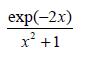
Find the derivatives of the following questions:(a) x2 exp(4x)(b) exp(-2x) x2 +1 X
Find the derivatives of the following functions:(a) ln (6x) (b) ln(x2 + 2) (c) x2 ln x(d) In x
Find the derivatives of the following functions:(a) sin(5x) (b) cos(2x + 3) (c) tan(8x)(d) sin(x3 +1) (e) x2 tan x (f) exp(−2x) cos3x
Find the derivatives of the following functions:(a) sin−1 (3x)(b)(c) x2 cos−1 x tan X
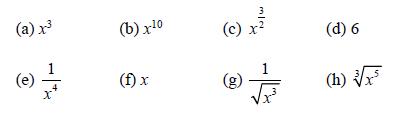
Find the derivatives of the following functions: (a) x3 (e) X (b) x10 (f) x (c) 1 " (d) 6 (h) i/
Find the derivatives of the following functions: (a) 7x8 (b) 4 (c) 3x (d)
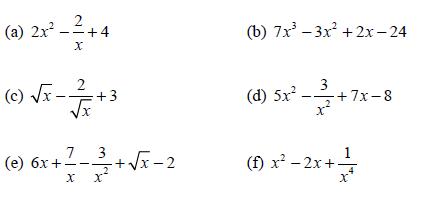
Find the derivatives of the following functions: (a) 2x - +4 X (c) x - 7/7 + 3 VX () 6x + 17 - 23/- + x - 2 - X X (b) 7x-3x+2x-24 (d) 5x 3 X +7x-8 (f) x-2x+- x"
By introducing an appropriate intermediate variable z use the chain rule to find the derivatives of the following functions: (a) (x - 5x+4) (b) 3x - 2x (c) 1 (x + 4x-5)
Using the product rule, find the derivatives of the following functions: (a) y = (x+6)(4x + 5) (b) y = (x-1)x (c) y = x(x - 2) (d) y = x(x - 2x+1)+ (e) y = x(x + 1)
Using the quotient rule, find the derivatives of the following functions: (a) y = (b) y = (d) y = x+6 x-3 (e) y = 2x+3 3x + 2 (c) y=- x - 2x+3 2x-1 2x x +2 3x-4 2x+x+5
1. Find the second derivative d2y/dx2 for the following y:2. IfHence show that: (a) x + 2x - 6x+8 (b) x + - +|+ X
1. Find the equation of the tangent to the curve y = x2 + 4 at the point where x = 2.2. Find the equation of the tangent to the graph of the cubic y = x3 − 2x2 + 2x + 4 at the point (1, 5). What is the equation of the normal to this curve at this point?3. Find the equations of the tangents at the
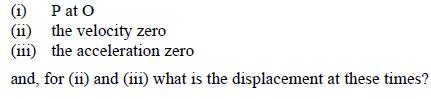
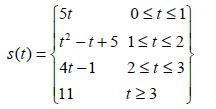
1. A particle is thrown vertically upwards into the air. The height s metres above the ground after t seconds is given by s = 25t − 5t2(a) Find an expression for the velocity v of the particle at time t.(b) The particle will reach its maximum height when it is momentarily at rest; that is, when v
Find the derivatives of the following functions:(a) exp(5x) (b) exp(−3x +1) (c) exp(x2 + 2x −1)(d) exp(√x) (e) exp(2x +1) (f) exp(−x2 + 4)
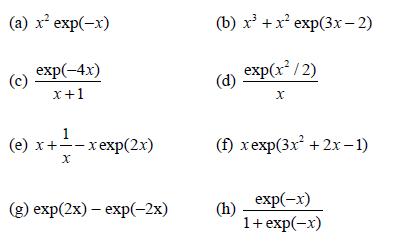
Find the derivatives of the following functions: (a) x exp(-x) (c) exp(-4x) x+1 1 (e) x+=-xexp(2x) x (g) exp(2x) - exp(-2x) (b) x + x exp(3x-2) exp(x/2) X (d) (f) x exp(3x + 2x-1) (h) exp(-x) 1+ exp(-x)
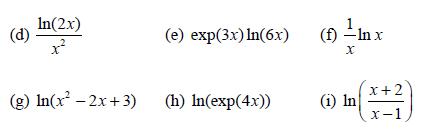
1. Find the derivatives of the following functions:2. IfHence show that (a) In(8x) (b) In(3x-2) (c) x In(2x)
Find the derivatives of the following functions: (a) tan(3x) (d) cos 1-x (b) sin (2x) (e) x tan x (c) cos (6x) (f) 1-x sin: in x
The distance s metres travelled, from a given starting point, by a moving object at time t seconds after starting is given by s = 6t + 8t2 Determine the velocity and acceleration of the object when t = 4 seconds.
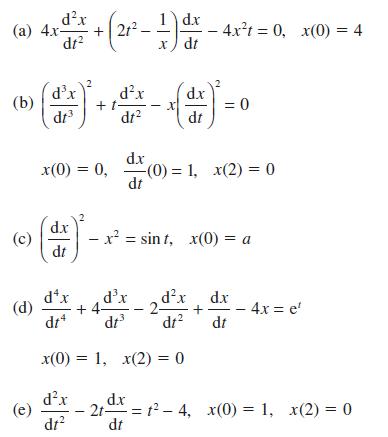
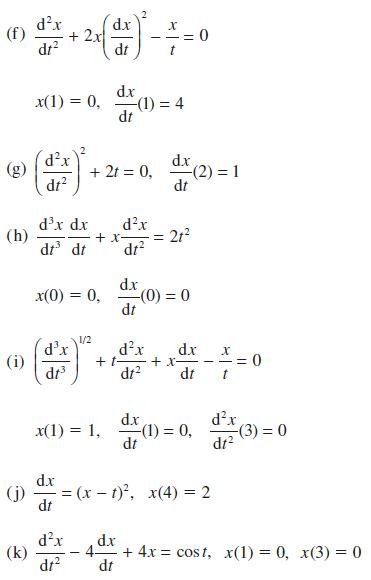
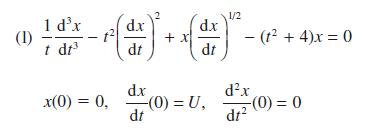
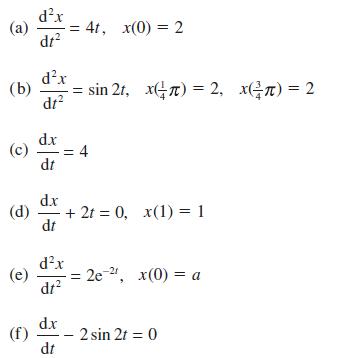
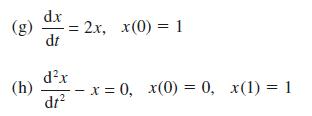
State which of the following problems are under-determined (that is, have insufficient boundary conditions to determine all the arbitrary constants in the general solution) and which are fully determined. In the case of fully determined problems state which are boundary-value problems and which are
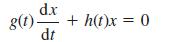
What conditions on the functions g(t) and h(t) must be satisfied for the differential equationto be exact, and what is the solution of the equation when they are satisfied? d.x g(t) + h(t)x = 0 dt
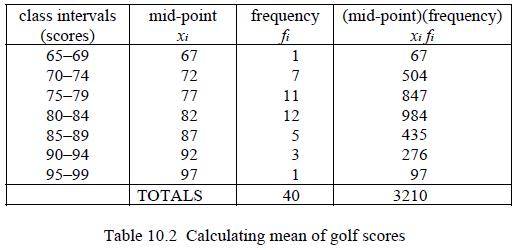
To illustrate the method determine the median of the grouped golf scores given in Table 10.2. class intervals (scores) 65-69 70-74 75-79 80-84 85-89 90-94 95-99 mid-point Xi 67 72 77 82 87 92 97 TOTALS frequency (mid-point)(frequency) fi 1 7 11 12 5 3 1 40 67 504 847 984 435 276 97 3210 Table 10.2
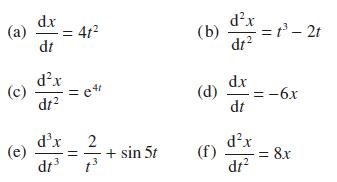
Give the general solution of the following differential equations. In each case state how many arbitrary constants you expect to find in the general solution. Are your expectations confirmed in practice? (a) dx dt (e) dx (c) =e4 dz = 41 dx dt 2 1/1/3+ + sin 5t (b) (d) (f) dx dt dx dt dx dr -= t -
For each of the following differential equation problems, state how many arbitrary constants you would expect to find in the most general solution satisfying the problem. Find the solution and check whether your expectation is confirmed. (a) (b) (c) (d) (e) (f) dx dt dx dt dx dt d.x dt dx dr dx dt
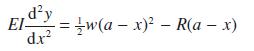
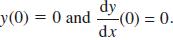
A uniform horizontal beam OA, of length a and weight w per unit length, is clamped horizontally at O and freely supported at A. The transverse displacement y of the beam is governed by the differential equationwhere x is the distance along the beam measured from O, R is the reaction at A, and E
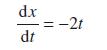
Sketch the direction field of the differential equationFind the solution of the equation. Sketch the particular solutions for which x(0) = 2, and for which x(2) = –3, and check that these are consistent with your direction field. d.x dt = -2t ||
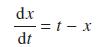
Sketch the direction field of the differential equationVerify that x = t – 1 + Ce–t is the solution of the equation. Sketch the solution curve for which x(0) = 2, and that for which x(4) = 0, and check that these are consistent with your direction field. d.x dt = -x
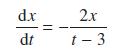
Draw the direction field of the equation Sketch some of the solution curves suggested by the direction field. Verify that the general solution of the equation is x = C/(t – 3)2 and check that the members of this family resemble the solution curves you have sketched on the direction field. dx dt
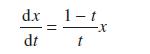
Draw the direction field of the equationSketch some of the solution curves suggested by the direction field. Verify that the general solution of the equation is x = Cte–t and check that the members of this family resemble the solution curves you have sketched on the direction field. dx dt 1-t t -X
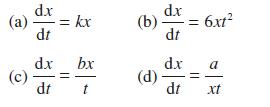
Find the general solutions of the following differential equations: (a) (c) d.x dt = kx dx dt t bx d.x (b) -= 6xt dt d.x (d) - dt = a xt
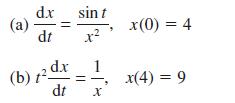
Find the solutions of the following initial-value problems: (a) d.x dt (b) 72 dx dt sin t X || 1 x(0) = 4 x(4) = 9
Find the general solutions of the following differential equations: (a) r dx dt = x (b) dx dt = (1 + sin t) cotx
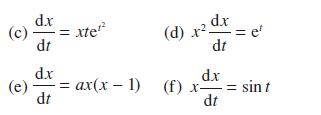
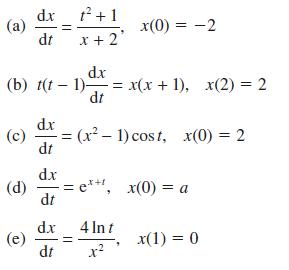
Find the solutions of the following initial-value problems: dx + 1 (a) = dt (b) t(t-1) = x(x+1), x(2) = 2 dx dt (c) (d) (e) +++ 2 x(0) = -2 dx d = (x dt d.x dt dx dt (x - 1) cost, x(0) = 2 e**, x(0) = a 4 Int x x(1) = 0
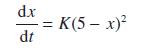
A chemical reaction is governed by the differential equationwhere x(t) is the concentration of the chemical at time t. The initial concentration is zero and the concentration at time 5 s is found to be 2. Determine the reaction rate constant K and find the concentration at time 10 s and 50 s. What
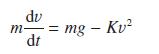
A skydiver’s vertical velocity is governed by the differential equationwhere K is the skydiver’s coefficient of drag. If the skydiver leaves her aeroplane at time t = 0 with zero vertical velocity, find at what time she reaches half her final velocity. du m = mg - Kv dt
A chemical A is formed by an irreversible reaction from chemicals B and C. Assuming that the amounts of B and C are adequate to sustain the reaction, the amount of A formed at time t is governed by the differential equationIf no A is present at time t = 0, find an expression for the amount of A
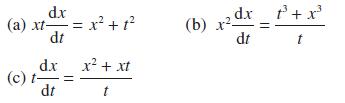
Find the general solutions of the following differential equations: dx (a) xt = x + t dt d.x (c) t- dt x + xt t r dx dt (b) x P + x to
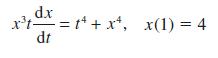
Find the solution of the following initial-value problem: d.x x1 = 1 + x, x(1) = 4 dt
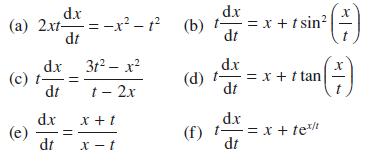
Find the general solutions of the following differential equations: d.x (a) 2x1 = -x - 1 dt dx (c) t- (e) dt d.x dt 3t - x t - 2x x + 1 x-t dx dt (b) t- (d) dx dt = x + tsin = x + t tan d.x (f) 1= x + tex/t dt (+)
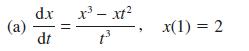
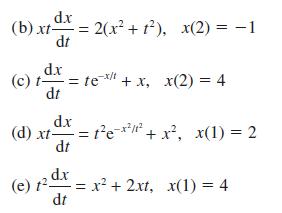
Find the solutions of the following initial-value problems: x(1) = 2 zAX - EX IP xp (a)
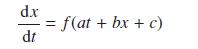
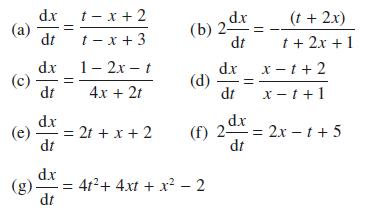
Show that, by making the substitution y = at + bx + c, equations of the formcan be reduced to separable form. Hence find the general solutions of the following differential equations: dx dt = f(at + bx + c)
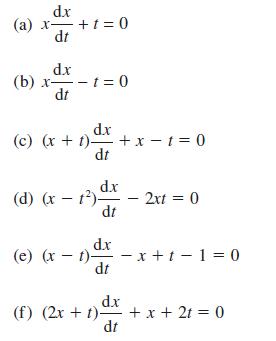
For each of the following differential equations determine whether they are exact equations and, if so, find the general solutions: dx (a) x + t=0 = dt dx (b) x-t=0 dt dx (c) (x + 1)+x-t=0 dt d.x (d) (x - )- dt d.x dt - - 2xt = 0 (e) (xt) -x+t-1= 0 dx (f) (2x +t) + x + 2t = 0 dt
For each of the following differential equations determine whether they are exact, and, if so, find the general solution: 0 = 1 + X - dt (a) (x + t) - xp
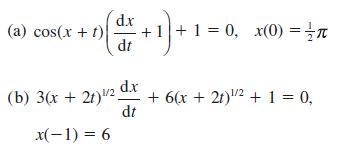
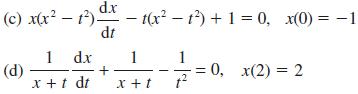
11. Find the solutions of the following initial-value problems: (a) cos(x + t) d.x dt +1=0, x(0) = d.x (b) 3(x + 2)/2 + 6(x + 2)/2 + 1 = 0, dt x(-1) = 6
What conditions on the constants a, b, e and f must be satisfied for the differential equation to be exact, and what is the solution of the equation when they are satisfied? (ax + bt)- + ex + ft = 0 d.x dt
For what value of k is the function (x + t)k an integrating factor for the differential equation d.x [(x + 1)In(x + t) + x] + x = 0? dt
For what value of k is the function tk an integrating factor for the differential equation (tcos.xt)- + 3 sinxt + xt cos xt = 0? d.x dt
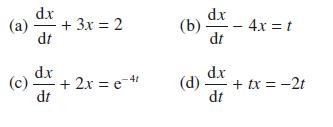
Find the solution of the following differential equations: d.x (a) + 3x = 2 dt (c) dr dt + 2x=e=4 (b) (d) dx dt dx dt - 4x = t + tx = -2t
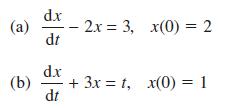
Find the solution of the following initial-value problems: (a) (b) d.x dt dx dt - - 2x3, x(0) = 2 + 3x = 1, x(0) = 1
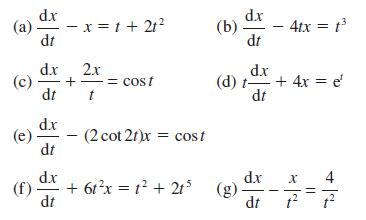
Find the solutions of the following differential equations: dx (a). - x = 1 + 2t dt d.x 2x (c) + -= cost dt t (e) + d.x dt dx dt - (2 cot 2t)x = cost (b) dx dt d.x (d) t- dt dx + 6tx = 1 +21 (g). 4tx = t + 4x = e X 2 dt ||
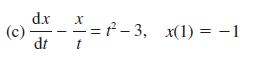
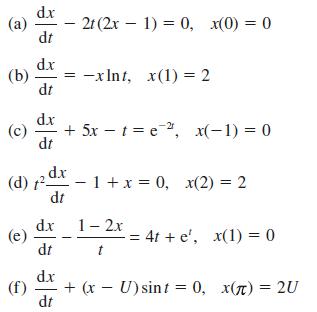
Find the solutions of the following initial-value problems: (a) (b) (c) (e) d.x dt (f) d.x dt dx dt (d) 2x - 1 + x = 0, x(2) = 2 dt dx dt 2t (2x1) = 0, x(0) = 0 dx dt = -xlnt, x(1) = 2 + 5x t = e , x(-1) = 0 1 - 2x t = 4t+e', x(1) = 0 + (x - U) sint = 0, x(x) = 2U
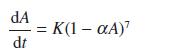
Solve (10.6), which arose from the model of the heating of the water in a domestic hot-water storage tank developed. If the water in the tank is initially at 10°C and Tin is 80°C, what is the ratio of the times taken for the water in the tank to reach 60°C, 70°C and 75°C?Data from 10.6 dTw dt
Solve (10.7), which arose from the model of a hydroelectric power station developed. The setting of the control valve is represented in the model by the value of the parameter γ. Derive an expression for the discharge Q(t) following a sudden increase in the valve opening such that the parameter γ
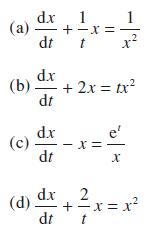
Find the solutions of the following differential equations: (a) d.x 1 1 dt (c) d.x dt = x -+ dx (b) + 2x = tx dt (d) dx dt t - = x - e' X 2 += x= x t
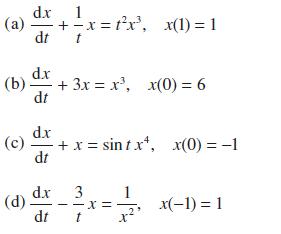
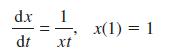
Find the solutions of the following initial-value problems: (a) d.x dt (c) dx (b). + 3x = x, x(0) = 6 dt dx dt dx dt (d). 1 { x=fx, _x(1)=1 + x = sint x, x(0) = -1 3 t X = 1 X x(-1) = 1
Find the value of X(0.3) for the initial-value problemusing Euler’s method with steps of h = 0.1. d.x dt = x - 2t, x(0) = 1
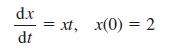
Find the value of X(0.25) for the initial-value problemusing Euler’s method with steps of h = 0.05. d.x dt = xt, x(0) = 2
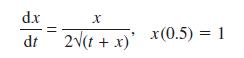
Find the value of X(1) for the initial-value problemusing Euler’s method with step size h = 0.1. dx X dt 2(t+ x) x(0.5) = 1
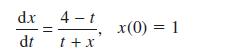
Find the value of X(0.5) for the initial-value problemusing Euler’s method with step size h = 0.05. d.x dt || 4-t t + x x(0) = 1
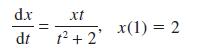
Denote Euler’s method solution of the initial-value problemusing step size h = 0.1 by Xa(t), and that using h = 0.05 by Xb(t). Find the values of Xa(2) and Xb(2). Estimate the error in the value of Xb(2), and suggest a value of step size that would provide a value of X(2) accurate to 0.1%. Find
Denote Euler’s method solution of the initial-value problemusing step size h = 0.1 by Xa(t), and that using h = 0.05 by Xb(t). Find the values of Xa(2) and Xb(2). Estimate the error in the value of Xb(2), and suggest a value of step size that would provide a value of X(2) accurate to 0.2%. Find
Showing 300 - 400
of 2006
1
2
3
4
5
6
7
8
9
10
11
12
13
14
15
Last
Step by Step Answers

 Get 50% OFF
Claim Now
Get 50% OFF
Claim Now





![L-1 1 [(s + 3)(s-2)]](https://dsd5zvtm8ll6.cloudfront.net/images/question_images/1705/4/8/6/05165a7a6e3c18181705486051396.jpg)
![L-1. S+7] s+2s +5](https://dsd5zvtm8ll6.cloudfront.net/images/question_images/1705/4/8/6/18465a7a768e082a1705486184505.jpg)










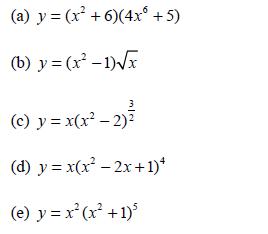
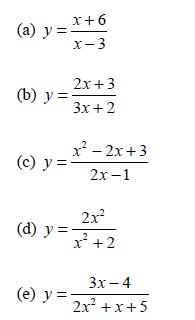


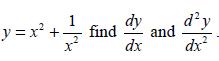
![[Reminder: (slope of normal) = -1/ (slope of tangent)]](https://dsd5zvtm8ll6.cloudfront.net/images/question_images/1705/4/9/3/97465a7c5d6b63a31705493974264.jpg)
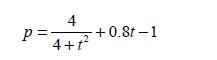




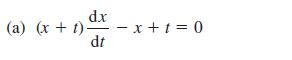
![d.x (b) txt = 0. dt d.x (c) [sin(x + 1) + x cos(x + 1)] + x cos(x + 1) = 0 dt dx (d) sin(xt). + cos.xt = 0 dt](https://dsd5zvtm8ll6.cloudfront.net/images/question_images/1705/3/9/2/07965a637cfdebe61705392081687.jpg)

![d.x [(x + 1)In(x + t) + x] + x = 0? dt](https://dsd5zvtm8ll6.cloudfront.net/images/question_images/1705/3/9/2/20665a6384e1cba81705392207927.jpg)


![pd dQ A dt + + ( + + B + r)]Q = Q = pgh (10.7)](https://dsd5zvtm8ll6.cloudfront.net/images/question_images/1705/3/9/4/24765a640479186a1705394249463.jpg)