New Semester
Started
Get
50% OFF
Study Help!
--h --m --s
Claim Now
Question Answers
Textbooks
Find textbooks, questions and answers
Oops, something went wrong!
Change your search query and then try again
S
Books
FREE
Study Help
Expert Questions
Accounting
General Management
Mathematics
Finance
Organizational Behaviour
Law
Physics
Operating System
Management Leadership
Sociology
Programming
Marketing
Database
Computer Network
Economics
Textbooks Solutions
Accounting
Managerial Accounting
Management Leadership
Cost Accounting
Statistics
Business Law
Corporate Finance
Finance
Economics
Auditing
Tutors
Online Tutors
Find a Tutor
Hire a Tutor
Become a Tutor
AI Tutor
AI Study Planner
NEW
Sell Books
Search
Search
Sign In
Register
study help
sciences
modern engineering mathematics
Modern Engineering Mathematics 6th Edition Glyn James - Solutions
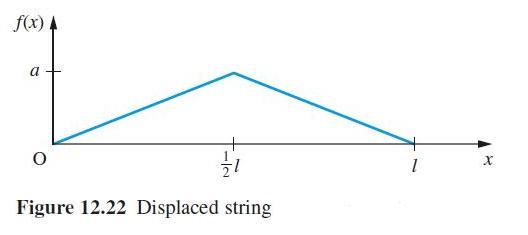
A tightly stretched, flexible, uniform string has its ends fixed at the points x = 0 and x = l. The midpoint of the string is displaced a distance a, as shown in Figure 12.22. If f(x) denotes the displaced profile of the string, express f(x) as a Fourier series expansion consisting only of sine
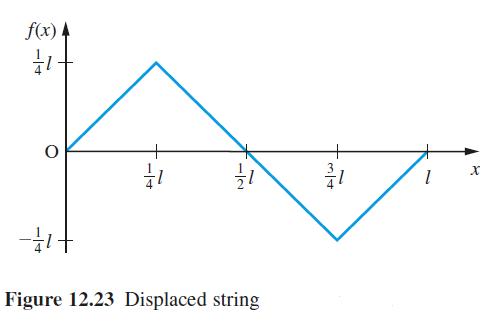
Repeat Question 18 for the case where the displaced profile of the string is as shown in Figure 12.23.Data from Question 18A tightly stretched, flexible, uniform string has its ends fixed at the points x = 0 and x = l. The midpoint of the string is displaced a distance a, as shown in Figure 12.22.
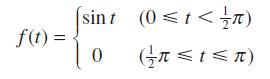
function f(t) is defined on 0 ≤ t ≤ π byFind a half-range Fourier series expansion of f(t) on this interval. Sketch a graph of the function represented by the series for –2π ≤ t ≤ 2π. f(t) = [sint (0
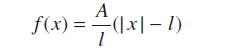
A function f(t) is defined on the interval –l ≤ x ≤ l byObtain a Fourier series expansion of f (x) and sketch a graph of the function represented by the series for –3l ≤ x ≤ 3l. A f(x) = (x-1) 1
The temperature distribution T(x) at a distance x, measured from one end, along a bar of length L is given byExpress T(x) as a Fourier series expansion consistingof sine terms only. T(x) = Kx(Lx) (0xL), K = constant
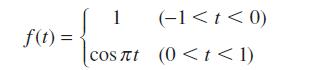
Find the Fourier series expansion of the function f(t) valid for –1 To what value does this series converge when t = 1? f(t) = 1 ost (-1 < t < 0) (0
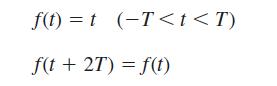
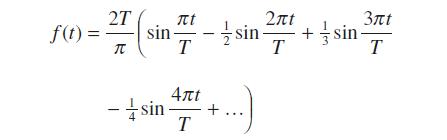
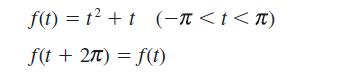
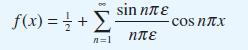
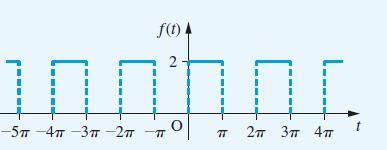
Show that the periodic functionhas a Fourier series expansionBy term-by-term integration of this series, show that the periodic function f(t) = t (-T
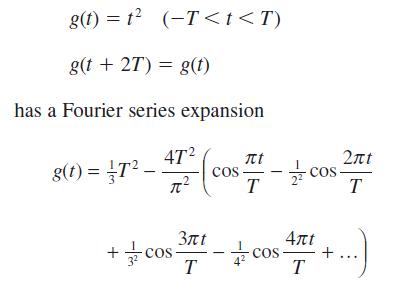
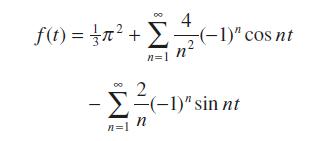
The periodic functionhas a Fourier series expansionBy term-by-term differentiation of this series, confirm the series obtained for f(t) in Question 24 for the case when T = π.Data from Question 24Show that the periodic functionhas a Fourier series expansionBy term-by-term integration of this
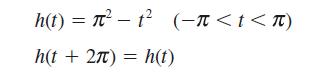
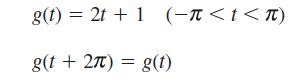
(a) In Example 12.7 we saw that the periodic functionhas a Fourier series expansionDifferentiate this series term by term, and explain why it is not a Fourier expansion of the periodic function(b) Use the results of (a) to obtain the Fourier series expansion of g(t) and confirm your solution by
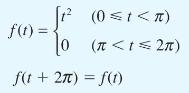
A periodic function f(t) is defined byObtain a Fourier series expansion of f(t) and deduce that f(t) = {. (0 t < ) (
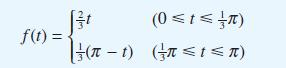
Determine the full-range Fourier series expansion of the even function f(t) of period 2π defined byTo what value does the series converge at t = 1/3π? f(t) = (1) - (0 t n) (1 T)
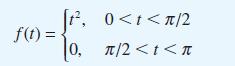
A function f(t) is defined for 0 ≤ t ≤ 1/2T byf(t)={t(0⩽t⩽14T)12T−t(14T⩽t⩽12T)f(t)={t(0⩽t⩽14T)12T−t(14T⩽t⩽12TSketch odd and even functions that have a period T and are equal to f (t) for 0 ≤ t ≤ 1/2T.(a) Find the half-range Fourier sine series of f(t).(b) To what value
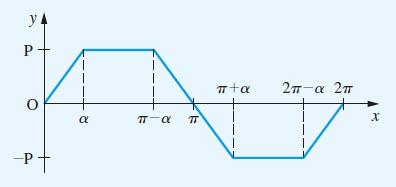
The magnetomotive force, y, in the air gap of an alternator can be represented approximately by a graph of the form shown in Figure 12.25. Find a Fourier series for y, explaining beforehand, with reasons, any special characteristics you would expect to find. P is a constant amplitude.Figure 12.25 y
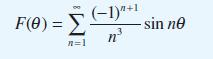
Prove that if g(x) is an odd function and f(x) an even function of x, the product g(x)[c + f(x)] is an odd function if c is a constant. A periodic function with period 2π is defined byin the interval –π ≤ θ ≤ π. Show that the Fourier series representation of the function is F(0) = 20(0)
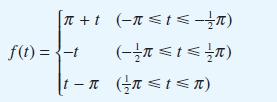
A repeating waveform of period 2π is described bySketch the waveform over the range t = –2π to t = 2 and find the Fourier series representation of f(t), making use of any properties of the waveform that you can identify before any integration is performed. [n+t__(_nt
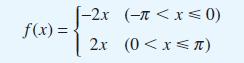
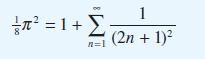
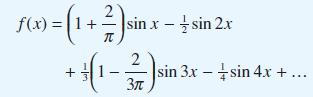
A function f(x) is periodic of period 2 and is defined bySketch a graph of f(x) from –2π to 3π and prove thatHence show that f(x) = [-2x (- < x 0) 2x (0 < x )
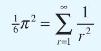
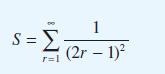
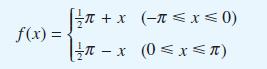
A function f(x) of period 2π is defined in the interval –π ≤ x ≤ π bySketch a graph of f(x) over the interval –3π ≤ x ≤ 3π. Express f(x) as a Fourier series and from this deduce a numerical series for . S/n + x (x0) (0x) f(x) = 1 1/2 = x -x
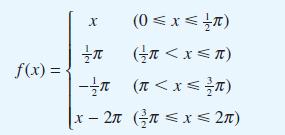
A periodic function of period 2π is defined for 0 ≤ x ≤ 2π bySketch f(x) for –2π ≤ x ≤ 4π and show that its Fourier series representation isExpress this series in a general form. f(x) = (0 x /n) ( < xn) - (
A waveform is defined by V(t) = 10e–3t for 0 ≤ t < 0.4 and V(t) = V(t – 0.4) for all t. Sketch the graphs of V, dV/dt and ∫t0 Vdt. Express V as a Fourier series and show that the amplitude of the nth harmonic is about 2.22/n.
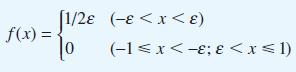
A function f(x) is defined in the interval –1 ≤ x ≤ 1 bySketch a graph of f(x) and show that a Fourier series expansion of f(x) valid in the interval–1 ≤ x ≤ 1 is given by f(x) = [1/28 (-e
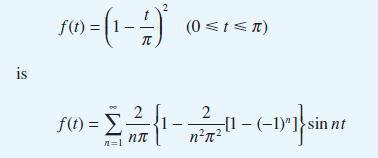
Show that the half-range Fourier sine series for the function is 500)=(1-2)* f(t) (0 t ) 50) = { 1 - 201- (-101} sin er f(t n n n=1
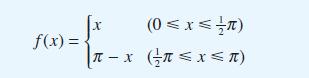
Find a half-range Fourier sine and Fourier cosine series for f (x) valid in the interval 0 Sketch the graph of the Fourier series obtained for –2π, x ≤ 2π. X (0 x = n) f(x) = -- n-x x ) X
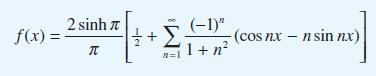
A function f(x) is periodic of period 2π and is defined by f(x) = ex (–π f(x) = 2 sinh (-1)" + (cos nx - n sin nx) 1 + n2 n=1
A function f(t) is defined on 0 Find(a) A half-range Fourier sine series, and(b) A half-range Fourier cosine series for f(t) valid for 0 f(t) = - t
A periodic function f(t) of period 2 is defined in the interval –1 < t < 1 by f(t) = 1 – t2 Sketch a graph of f (t) for –3 < t < 3 and obtain a Fourier series expansion for it.
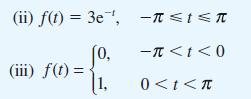
(a) Without actually finding the series, state what terms you would expect to find in the Fourier series for the following periodic functions of period 2π:(b) Find, up to and including the term in cos 4t, the Fourier half-range cosine series for the function defined by (i) f(t) = sint, -IE
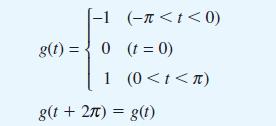
(a) A periodic function f(t), of period 2π, is defined in –π ≤ t ≤ π byObtain a Fourier series expansion for f(t).(b) By formally differentiating the series obtained in (a), obtain the Fourier series expansion of the periodic square waveCheck the validity of your result by determining
The periodic waveform f(t) shown in Figure 12.26 may be written aswhere g(t) represents an odd function.(a) Sketch the graph of g(t).(b) Obtain the Fourier series expansion for g(t), and hence write down the Fourier series expansion for f(t).Figure 12.26 f(t) = 1 + g(t)
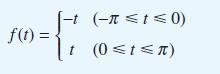
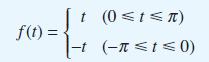
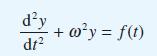
Show that the Fourier series represents the function f(t), of period 2π, given byDeduce that, apart from a transient component (that is, a complementary function that dies away as t → ∞), the differential equation f(t) = t (0 t ) -t (-t0)
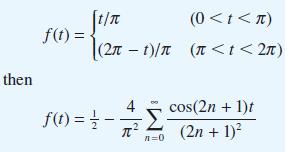
Show that if f(t) is a periodic function of period 2π andShow also that, when ω is not an integer,satisfies the differential equationsubject to the initial conditions y = dy/dt = 0 at t = 0. then f(1) = [t/n [(2n-1)/n (0
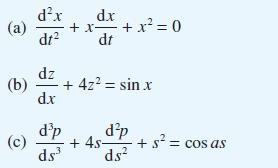
Classify each of the following as ordinary and as linear homogeneous, linear nonhomogeneous or nonlinear differential equations, state the order of the equations and name the dependent and independent variables: (a) (b) (c) dx dx dt +x- + x = 0 dt dz + 4z = sin x dx dp ds dp ds + 45- + s = cos as
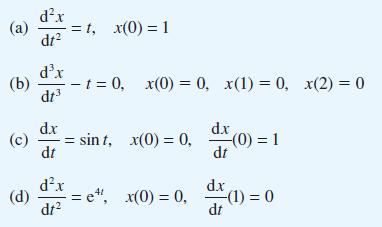
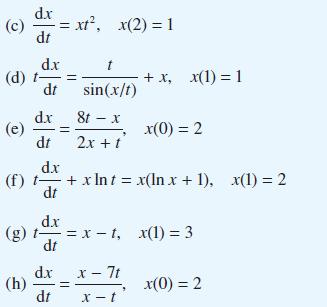
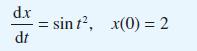
Classify the following differential equation problems as under-determined, fully determined or over-determined, and solve them where possible: (a) =t, x(0) = 1 dx dt (b) dx dt (d) d.x (c) = sin t, x(0) = 0, dt - t=0, x(0) = 0, x(1)=0, x(2) = 0 dx dt =e, x(0) = 0, dx dt dx (0) = 1 -(1) = 0 dt
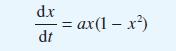
Sketch the direction field of the differential equationand sketch the form of solution suggested by the direction field. Solve the equation and confirm that the solution supports the inferences you made from the direction field. dx dt ax(1 - x)
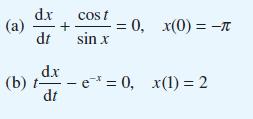
Solve the following differential equation problems: dx cost (a) + dt sin x d.x (b) te=0, x(1)=2 dt = 0, Xx(0) = -
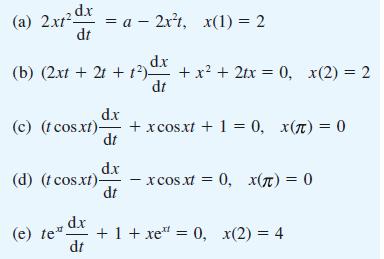
For each of the following problems, determine which are exact differentials, and hence solve the differential equations where possible: (a) 2x1 dx = a - 2x4, x(1) = 2 dt (b) (2xt + 2t + f) dx + x + 2x = 0, x(2) = 2 dt dx (c) (t cos.xt) + xcos.xt + 1 = 0, x(T) = 0 dt dx dr (d) (t cosxt)- - xcos xt
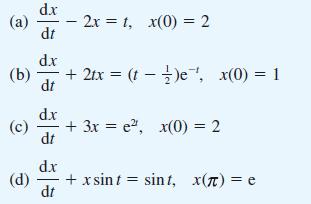
Solve the following differential equation problems: (a) d.x dt dx (b) + 2tx=(t)e, x(0) = 1 dt (d) -2x = 1, x(0) = 2 dx (c) + 3x = e, x(0) = 2 dt d.x dt + x sint sint, x(T) = e
Solve the differential equation to find the value of X(0.4) using Euler’s method with step size 0.1 and 0.05. By comparing these two estimates of x(0.4), estimate the accuracy of the better of the two values that you have obtained and also the step size you would need to use in order to
Solve the differential equationto find the value of X(0.25) using Euler’s method with steps of size 0.05 and 0.025. By comparing these two estimates of x(0.25), estimate the accuracy of the better of the two values that you have obtained and also the step size you would need to use in order to
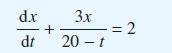
Solve the differential equation obtained in Example 8.4 to determine the amount x(t) of salt in the tank at time t minutes. Initially the tank contains pure water.Data from Example 8.4Suppose that a tank initially contains 80 litres of pure water. At a given instant (taken to be t = 0) a salt
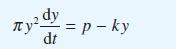
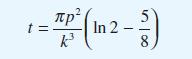
An open vessel is in the shape of a right-circular cone of semi-vertical angle 45° with axis vertical and apex downwards. At time t = 0 the vessel is empty. Water is pumped in at a constant rate pm3s–1 and escapes through a small hole at the vertex at a rate kym3s–1, where k is a positive
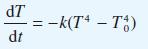
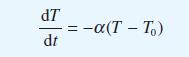
Stefan’s law states that the rate of change of temperature of a body due to radiation of heat iswhere T is the temperature of the body, T0 is the temperature of the surrounding medium (both measured in K) and k is a constant. Show that the solution of this differential equation isShow that, when
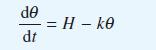
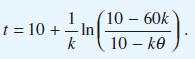
A motor under load generates heat internally at a constant rate H and radiates heat, in accordance with Newton’s law of cooling, at a rate kθ, where k is a constant and θ is the temperature difference of the motor over its surroundings. With suitable non-dimensionalization of time the
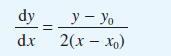
A linear cam is to be made whose rate of rise (as it moves in the negative x direction) at the point (x, y) on the profile is equal to one-half of the gradient of the line joining (x, y) to a fixed point on the cam (x0, y0). Show that the cam profile is a solution of the differential equationand
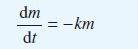
Radioactive elements decay at a constant rate per unit mass of the element. Show that such decays obey equations of the formwhere k is the decay rate of the element and m is the mass of the element present. The half life of an element is the time taken for one-half of any given mass of the element
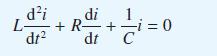
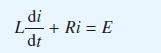
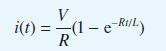
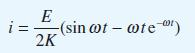
In Section 10.2.4 we showed that the equation governing the current flowing in a series LRC electrical circuit is (equation (10.9))Show, by a similar method, that the equation governing the current flowing in a series LR circuit containing a voltage source E isAt time t = 0 a switch is closed
The tread of a car tyre wears more rapidly as it becomes thinner. The tread-wear rate, measured in mm per 10 000 miles, may be modelled as a + b(d – t)2 where d is the initial tread depth, t is the current tread depth and a and b are constants. A tyre company takes measurements on a new design
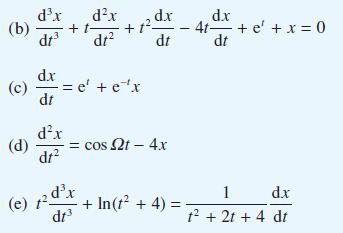
Express each of the following differential equations in the form (a) L[x(1)] = f(t) dx + (sin t) - 9x + cost = 0 dt dx dt
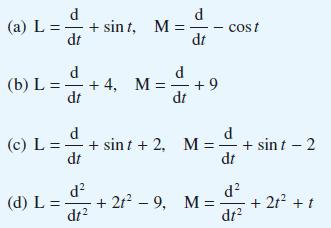
For each of the following pairs of operators calculate the operator LM – ML; hence state which of the pairs are commutative (that is, satisfy LMx(t) = MLx(t)): (a) L= (b) L= (c) L = (d) L = d dt d - dt + sin t, M = dt +4, M = +9 d dt d+sint + 2, M = dt d dt - cost +21 -9, M = dt d dt + sint - 2
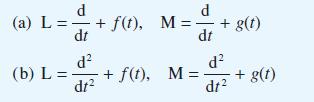
What conditions must the functions f(t) and g(t) satisfy in order for the following operator pairs to be commutative? (a) L = (b) L= d dt d dt + f(t), M=. dt + f(t), M= + g(t) d = + g(t) dr
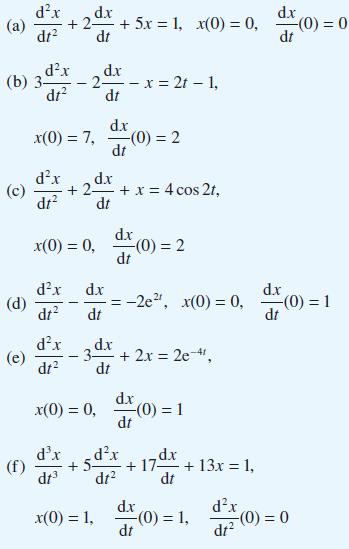
Solve the following initial-value problems: (a) (c) dx dt (d) dx d.x (b) 3-2-x = 2t - 1, dr dt x(0) = 7, x(0) = 0, dx dt d.x 2- + 5x = 1, x(0) = 0, dt dx d.x +2- dt dt dx dt - - d.x dx dt + dt d.x dt -(0) = 2 = + x = 4 cos 2t, d.x dt dx 5dx dr dt -(0) = 2 -2e, x(0) = 0, d.x x(0) = 0,0)=1 -(0) + 2x
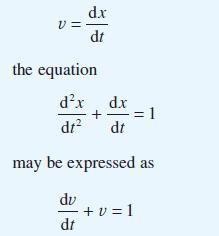
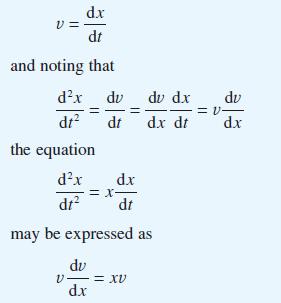
Show that by making the substitutionShow that the solution of this equation is v = 1 + Ce–t and hence find x(t). This technique is a standard method for solving second-order differential equations in which the dependent variable itself does not appear explicitly. Apply the same method to obtain
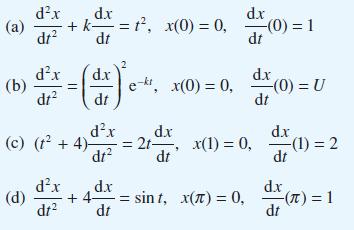
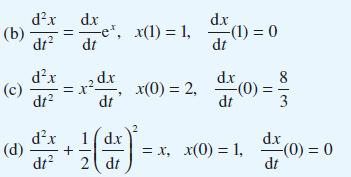
Using the method introduced in Question 24, find the solutions of the following initial-value problems:Data from Question 24Show that by making the substitutionShow that the solution of this equation is v = 1 + Ce–t and hence find x(t). This technique is a standard method for solving second-order
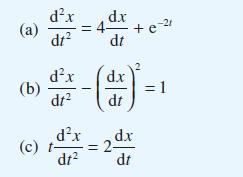
Show that by making the substitutionShow that the solution of this equation is v = 1/2x2 + C and hence find x(t). This technique is a standard method for solving second-order differential equations in which the independent variable does not appear explicitly. Apply the same method to obtain the
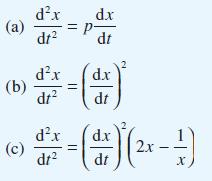
Using the method introduced in Question 26, find the solutions of the following initial-value problems:Data from Question 26Show that by making the substitutionShow that the solution of this equation is v = 1/2x2 + C and hence find x(t). This technique is a standard method for solving second-order
Equation (10.3), arising from the model of the take-off run of an aircraft developed, can be solved by the techniques introduced in Exercises 24 and 26. Assuming that the thrust is constant, find the speed of the aircraft as a function both of time and of distance run along the ground. The take-off
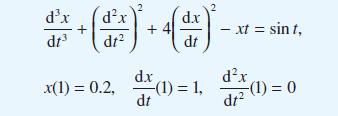
Find the values of X(t) for t up to 2, where X(t) is the solution of the differential equation problemusing Euler’s method with step size h = 0.025. Repeat the computation with h = 0.0125. Hence estimate the accuracy of the value of X(2) given by your solution. dx dt + dx dt + d.x dt - xt = sint,
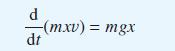
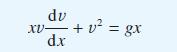
The end of a chain, coiled near the edge of a horizontal surface, falls over the edge. If the friction between the chain and the horizontal surface is negligible and the chain is inextensible then, when a length x of chain has fallen, the equation of motion iswhere m is the mass per unit length of
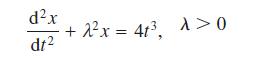
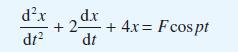
A simple mass–spring system, subject to light damping, is vibrating under the action of a periodic force Fcos pt. The equation of motion iswhere F and p are constants. Solve the differential equation for the displacement x(t). Show that one part of the solution tends to zero as t → ∞ and show
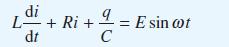
An alternating emf of Esinωt volts is supplied to a circuit containing an inductor of L henrys, a resistor of R ohms and a capacitor of C farads in series. The differential equation satisfied by the current i amps and the charge q coulombs on the capacitor isUsing i = dq/dt obtain a second-order
A truck of mass m moves along a horizontal test track subject only to a force resisting motion that is proportional to its speed. At time t = 0 the truck passes a reference point moving with speed U. Find the velocity of the truck both as a function of time and as a function of displacement from
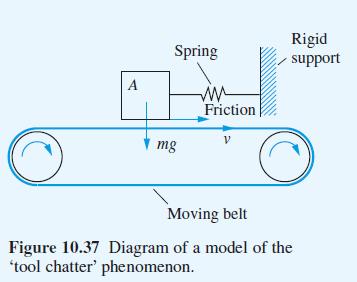
Figure 10.37 shows a system that serves as a simplified model of the phenomenon of ‘tool chatter’. The mass A rests on a moving belt and is connected to a rigid support by a spring. The coefficient of sliding friction between the belt and the mass is less than the coefficient of static
The second-order, linear, nonhomogeneous constant-coefficient differential equation(often referred to as a forced harmonic oscillator) has a responseis often called the frequency response (strictly it is the amplitude response or gain spectrum) and is given by (10.55) and shown in Figure 10.27. How
Classify the equations (10.3), (10.6), (10.7) and (10.9) derived in the engineering examples of Section 10.2.(a)(b)(c)(d) ds dt m- - - ( ) ds dt = Tumg (10.3)
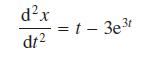
Find the general solution of the differential equation dx dt = t - 3et
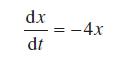
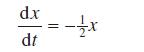
Find the function x(t) that satisfies the differential equationand that has the value 2.5 when t = 0. dx dt = -4x ||
Find the function x(t) that satisfies the initial-value problem dx dt +2x = 0 x(0) = 4, d.x - (0) = 3, = 0 dt
Find the function x(t) that satisfies the boundary-value problem dx dt +2x = 0 x(0) = 4, dx ( dt = 3, A # 0
Sketch the direction field of the differential equationVerify that x(t) = Ce–t/2 is the general solution of the differential equation. Find the particular solution that satisfies x(0) = 2 and sketch it on the direction field. Do the same with the solution for which x(3) = –1. x- dt Xp
Solve the equation dx/dt = 4xt, x > 0
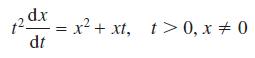
Solve the equation 2 dx = x + xt, t > 0, x #0 dt
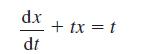
Solve the first-order linear differential equation dx dt + tx = t
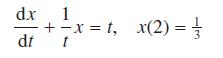
Solve the first-order linear initial-value problem dx 1 += x=t, x(2) = dt t
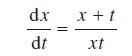
The function x(t) satisfies the differential equationand the initial condition x(1) = 2. Use Euler’s method to obtain an approximation to the value of x(2) using a step size of h = 0.1. dx dt x + t xt
Let Xa denote the approximation to the solution of the initial-value problemobtained using Euler’s method with a step size h = 0.1, and Xb that obtained using a step size of h = 0.05. Compute the values of Xa(t) and Xb(t) for t = 0.1, 0.2, . . . . , 1.0. Compare these values with the values of
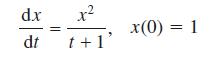
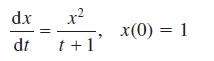
Compute an approximation X(1) to the value of x(1) satisfying the initial-value problemby using Euler’s method with a step size h = 0.008. dx dt x t +1' x(0) = 1
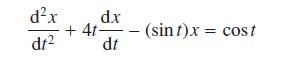
The equationis a linear differential equation. Identify the operator of the equation and show that (10.36) holds for this operator. dx dt d.x +4t- dt (sint) x = cost
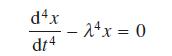
Find the general solution of the equation d4x dr4 - 14x = 0
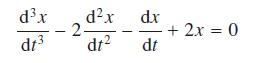
Find the general solution of the differential equation dx dt dx 2- dt dx dt + 2x = 0
Which of the following sets of functions are linearly dependent and which are linearly independent?(a) {1 + t, t, 1}(b) {1 + t, 1 + t + t2, 1 + t2}(c) {sin(t), cos(t)}(d) {et, e2t, e3t}
Find the general solution of the differential equation dx dt + 2x=41, X>0
Find the general solution of the boundary-value problem dx dt IC - kx = sin 2t, k> 0, x(0) = 0, x 4 = 0
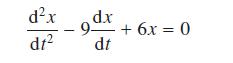
Find the general solution of the equation dx dt d.x 0=X9 +6 dt
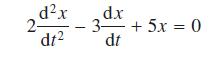
Find the general solution of the equation dx 2- dt dx 3+5x = 0 dt
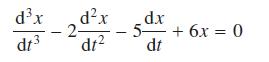
Find the general solution of the equation dx dt3 dx dt dx - 5- + 6x = 0 dt
Find the general solution of the equation d4x dx +3- dt4 dt dx 22- dt dx -73- dt - - 60x = 0
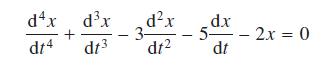
Find the general solution of the equation d4x dx dt4 + dt3 dx dt 3- dx 5- dt 2x = 0
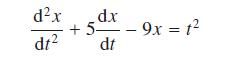
Find the general solution of the equation dx dx +5- - 9x = 1 dt dt
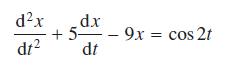
Find the general solution of the equation dx dz dx + 5 - dt 9x = 9x = cos 2t
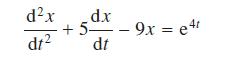
Find the general solution of the equation dx dt +5dx _ 9x = e4r dt
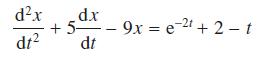
Find the general solution of the equation dx dx +59x = e-2 +2 - t dt dt
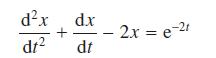
Find the general solution of the equation dx dx dt dt 2x = e-2t
Find the general solution of the equation d4x dt4 - dx 2- dt3 5dx dt +5- - dx 8 + 4x = e dt
A pendulum of mass 4 kg, length 2 m and an air resistance coefficient of 5 Nsm–1 is released from an initial position in which it makes an angle of 20° with the vertical. Assuming that this angle is small enough for the small-angle approximation to be made in the equation of motion, how many
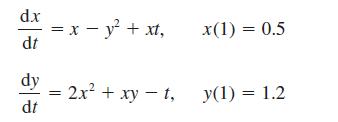
Find the value of X(1.4) satisfying the following initial-value problem:using Euler’s method with time step h = 0.1. dx dt dy dt = x y + xt, = 2x + xy - t, x(1) = 0.5 y(1) = 1.2
Find the value of X(0.2) satisfying the initial-value problemusing Euler’s method with step size h = 0.05. dx dx dx dt dt +xt- +1 -1x = 0, x(0) = 1, dt dx -(0) = dt 0.5, dx dt (0) = = -0.2
Draw a phase-plane direction field for the equationHence sketch the solution path of the equation that starts from the initial conditions x = 1, dx/dt = 0. dx dt +1.5 d.x dt + 40x = 0 (10.60)
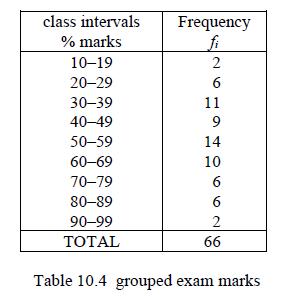
1. In a five-match test series, the runs scored by the two opening batsmen were as given in Table 10.3. Calculate the mean score over the series for each batsman.2. The grouped data of Table 10.4 represents the percentage marks scored by 66 candidates in an examination. Calculate the mean
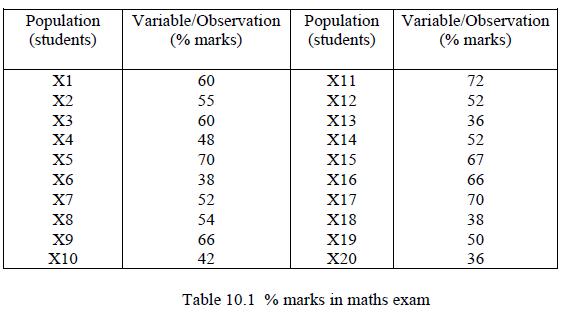
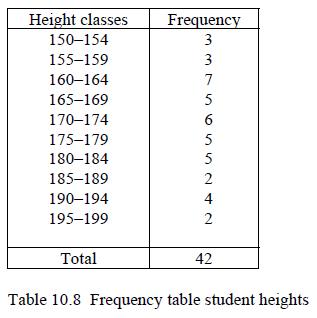
1. Determine the median of the set of percentage marks obtained in a mathematics examination and presented in Table 10.1.2. Find the median scores of the two opening batsmen recorded in Table 10.3.3. The heights, to the nearest cm, of a group of 42 students are recorded in the frequency table of
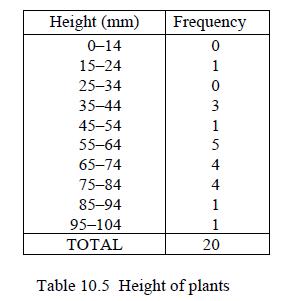
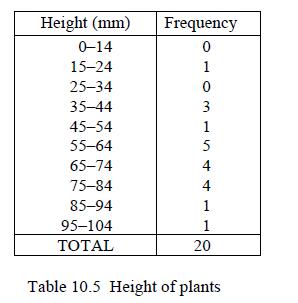
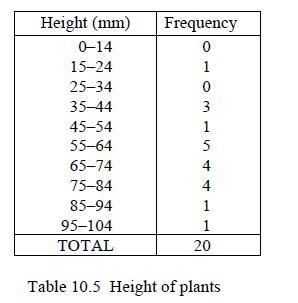
1. A small organisation employs 13 staff and their weekly salaries are given in Table 10.11. Determine the mode of the 13 salaries.2. Determine the mode of the plant height data of Table 10.5.3. A liquid-soap manufacturer produce a bottle with an advertised content of 310 ml. A sample of 16 bottles
1. Construct a cumulative frequency table of the plant height data in Table 10.5 and draw a cumulative graph. Determine the lower quartile, upper quartile, median and inter-quartile range of the data.2. The pre-names of pupils in a class were:(a) Draw up a tally chart for the lengths of the names
Showing 200 - 300
of 2006
1
2
3
4
5
6
7
8
9
10
11
12
13
14
15
Last
Step by Step Answers

 Get 50% OFF
Claim Now
Get 50% OFF
Claim Now









![dx 1 - + x = f(t) dt has the solution 4 x = - - n=1 cos(2n-1)t + (2n-1) sin(2n-1)t (2n-1)[1+ (2n-1)]](https://dsd5zvtm8ll6.cloudfront.net/images/question_images/1705/5/8/3/25565a92297116e81705583254869.jpg)
![1 202 (1-cost) y = 4 10 cos(2n +1)t - cos cot (2n +1)[w (2n + 1)]](https://dsd5zvtm8ll6.cloudfront.net/images/question_images/1705/5/8/3/35965a922ff616de1705583359191.jpg)


![(a) L[x(1)] = f(t) dx +(sin t) - 9x + cost = 0 dt dx dt](https://dsd5zvtm8ll6.cloudfront.net/images/question_images/1705/4/6/8/56265a762923a02d1705468565086.jpg)


![-1/2 F[(4 - p) + 4p]-/](https://dsd5zvtm8ll6.cloudfront.net/images/question_images/1705/4/6/9/41965a765eb6d0501705469421619.jpg)





![pd dQ A dt + ( a + B + r)] = Q = pgh (10.7)](https://dsd5zvtm8ll6.cloudfront.net/images/question_images/1705/4/7/4/50365a779c76b7291705474503213.jpg)


![L[ax + bx] = aL[x] + bL[x] for all functions x, and x and all constants a and b. (10.36)](https://dsd5zvtm8ll6.cloudfront.net/images/question_images/1705/4/7/5/85865a77f122281d1705475857033.jpg)