New Semester
Started
Get
50% OFF
Study Help!
--h --m --s
Claim Now
Question Answers
Textbooks
Find textbooks, questions and answers
Oops, something went wrong!
Change your search query and then try again
S
Books
FREE
Study Help
Expert Questions
Accounting
General Management
Mathematics
Finance
Organizational Behaviour
Law
Physics
Operating System
Management Leadership
Sociology
Programming
Marketing
Database
Computer Network
Economics
Textbooks Solutions
Accounting
Managerial Accounting
Management Leadership
Cost Accounting
Statistics
Business Law
Corporate Finance
Finance
Economics
Auditing
Tutors
Online Tutors
Find a Tutor
Hire a Tutor
Become a Tutor
AI Tutor
AI Study Planner
NEW
Sell Books
Search
Search
Sign In
Register
study help
sciences
physical chemistry
Physical Chemistry 3rd edition Thomas Engel, Philip Reid - Solutions
Which of the following functions are single-valued functions of the variable x?a. x2b. √xc. √x + 3xd. cos-1 2πx/a
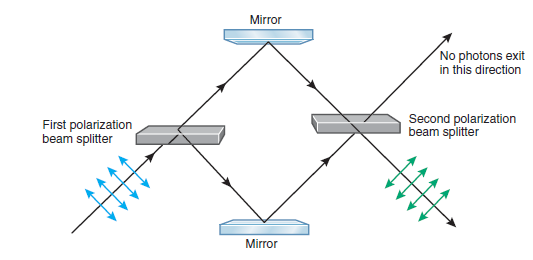
Would the outcome of the experiment shown in Figure 14.6 change if you carried out a measurement of the polarization between the two polarization beam splitters?Figure 14.6 Mirror No photons exit in this direction Second polarization beam splitter First polarization beam splitter Mirror
If hair color were a quantum mechanical observable, you would not have a hair color until you looked in the mirror or someone else looked at you. Is this reasoning consistent with the discussion of quantum mechanics in this chapter?
If the wave function for a system is a superposition wave function, the wave function of the system cannot be determined. Explain this assertion.
If a system is in an eigenstate of the operator of interest, the wave function of the system can be determined. Explain this assertion. How could you know that the system is in an eigenstate of the operator of interest?
A superposition wave function can be expanded in the eigenfunctions of the operator corresponding to an observable to be measured. In analogy to rolling a single die, each of the infinite number of eigenvalues of the operator is equally likely to be measured. Is this statement correct?
If you flip a coin 1000 times, what prediction can you make about the number of times it comes up heads?
If you flip a coin, what prediction can you make about it coming up heads in a single event?
Why must a quantum mechanical operator Aˆ satisfy the relation l(x)[µ(x)] dx = f¥(x)[¼(x)]* dx?
Why must the first derivative of an acceptable wave function be continuous?
Why must an acceptable wave function be single valued?
According to the 3rd postulate, in any single measurement of the total energy, the only values that will ever be measured are the eigenvalues of the total energy operator. Apart from the discrete energy values characteristic of a quantum mechanical system, is the result of an individual measurement
The amplitude of a standing wave function representing a moving particle can change from positive to negative values in the domain (0, a) over which the wave function is defined. It must therefore pass through zero at some value x0, where 0 < x0 < a. Therefore the probability of the particle
Cos x an eigenfunction of the operator  if  f (x) = xf (x)?
Two operators can be applied to a function in succession. By definition, ÂB̂ f(x) =  [B̂ f(x)]. Evaluate ÂB̂ f(x) if  = d /dx, B̂ = x, and f (x) = cos x.
Is  a linear operator if  f (x) = d2 f (x) / dx2 + xf (x)?
A wave traveling in the z direction is described by the wave function Ψ(z, t) = A1 xsin (kz – ωt + ∅1) + A2 ysin (kz – ωt + ∅2), where x and y are vectors of unit length along the x and y axes, respectively. Because the amplitude is perpendicular to the propagation direction,
A linear operator satisfies the condition  (f (x) + g(x)) =  f (x) +  g(x). Are  or B̂ linear operators if  f (x) = (f (x))2 and B̂ f (x) = df (x)/dx?
Can the function sin kx be normalized over the interval −∞ < x < ∞? Explain your answer.
What is the usefulness of a complete set of functions?
Why can we conclude that the wave function ψ (x, t) = ψ (x) e−i (E /h)t represents a standing wave?
Distinguish between the following terms applied to a set of functions: orthogonal and normalized, and orthonormal.
Why does a quantum mechanical system with discrete vibrational energy levels behave as if it has a continuous energy spectrum if the energy difference between vibrational energy levels ΔE satisfies the relationship ΔE ≪ kBT?
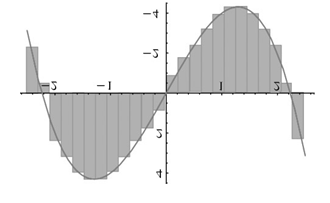
In Figure 13.6 the extent to which the approximate and true functions agree was judged visually. How could you quantify the quality of the fit?Figure 13.6 -5
If ψ (x, t) = A sin (kx −ω t) describes a wave traveling in the plus x direction, how would you describe a wave moving in the minus x direction? Justify your answer.
Why is it necessary in normalizing the function r e−r in spherical coordinates to integrate over θ and ∅ even though it is not a function of θ and ∅?
Give three examples of properties of a gas phase molecule of H2 that are quantized and three properties that are not quantized.
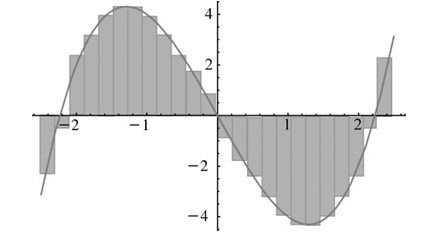
Redraw Figure 13.2 to show surfaces corresponding to both minimum and maximum values of the amplitude.Figure 13.2 2 12 2. -2 4.
Form the operator Â2 if  = d2 /dy2 + 3y (d / dy) − 5. Be sure to include an arbitrary function on which the operator acts.
By discussing the diffraction of a beam of particles by a single slit, justify the statement that there is no sharp boundary between particle-like and wave-like behavior.
Why is it true for any quantum mechanical problem that the set of wave functions is larger than the set of eigenfunctions?
A traveling wave with arbitrary phase ∅ can be written as ψ (x, t) = A sin (kx −ω t + ∅). What are the units of ∅? Show that ∅ could be used to represent a shift in the origin of time or distance.
Which of the following wave functions are eigenfunctions of the operator d/dx? If they are eigenfunctions, what is the eigenvalue?a. a e−3x + be−3ixb. sin2 xc. e−ixd. cos a xe. e−ix2
What is the relationship between evaluating an integral and graphing the integrand?
One source emits spherical waves and another emits plane waves. For which source does the intensity measured by a detector of fixed size fall off more rapidly with distance? Why?
Express the following complex numbers in the form a + ib.a. 2e3iπ /2b. 4√3 eiπ/4c. eiπd. √5 / 1+ √2 eiπ/4
Show that the following pairs of wave functions are orthogonal over the indicated range.a. e−αx2 and x (x2 − 1) e−αx2, −∞ ≤ x < ∞, where α is a constant that is greater than zerob. (6r /a0 – r2 / a02) e-r/3a0 and (r / a0) e-r/2a0 cos over the interval 0 ≤ r < ∞ 0 ≤ θ
Is the function e-ay2/2 an eigenfunction of the operator d2 /dy2 − a2 y2? If so, what is the eigenvalue?
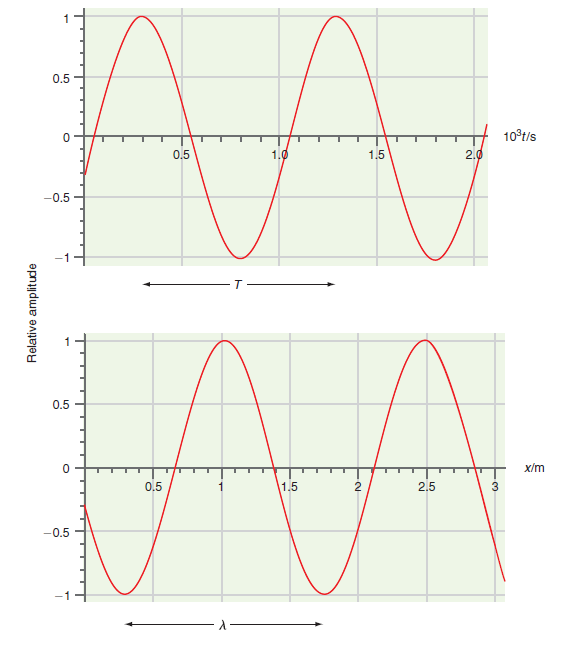
To plot Ψ(x, t) = Asin (kx ˆ’ ωt) as a function of one of the variables x and t, the other variable needs to be set at a fixed value, x0or t0. If Ψ(x0, 0) / Ψmax= ˆ’0.280, what is the constant value of x0in the upper panel of Figure
Show by carrying out the integration that sin (mπx / a) and cos (mπx / a), where m is an integer, are orthogonal over the interval 0 ≤ x ≤ a. would you get the same result if you used the interval 0 ≤ x ≤ 3a/4? Explain your result.
Use a Fourier series expansion to express the function f (y) = y2, ˆ’ b ‰¤ y ‰¤ b, in the formObtain d0 and the first five pairs of coefficients cn and dn. плу cos f0) -d0+ Σ, sin |+ d„c nty n=1
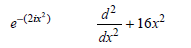
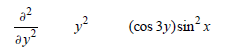
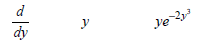
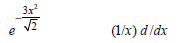
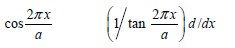
Determine in each of the following cases if the function in the first column is an eigenfunction of the operator in the second column. If so, what is the eigenvalue?a.b.c. 1 cose sin e- sin e de de e (2ix) d? +16x? dx?
Form the operator Â2 if  = x – d/dx. Be sure to include an arbitrary function on which the operator acts.
Does the superposition ψ (x, t) = A sin (kx – ωt) + 2A sin (kx + ωt) generate a standing wave? Answer this question by using trigonometric identities to combine the two terms.
Operate witha. ∂/∂x + ∂/∂y + ∂/∂zb. ∂2/∂x2 + ∂2/∂y2 + ∂2/∂32On the function A e−ik1x e−ik1y e−ik1z. Under what conditions is the function an eigenfunction of one or both operators? What is the eigenvalue?
Which of the following wave functions are eigenfunctions of the operator d2/dx2? If they are eigenfunctions, what is the eigenvalue?a. a(e-3x + e -3ix)b. sin 2πx / a c. e –2ixd. cos ax/πe. e-2ix2
Operate witha. ∂/∂x + ∂/∂y + ∂/∂zb. ∂2/∂x2 + ∂2/∂y2 + ∂2/∂32on the function Ae−ik1xe−ik2ye−ik3z. Is the function an eigenfunction of either operator? If so, what is the eigenvalue?
In normalizing wave functions, the integration is over all space in which the wave function is defined.a. Normalize the wave function x (a − x) y (b − y) over the range 0 ≤ x ≤ a, 0 ≤ y ≤ b. The element of area in two-dimensional Cartesian coordinates is dx dy; a and b are constants.b.
Show that the set of functions ∅n (θ) = einθ, 0 ≤ θ ≤ 2πis orthogonal if n is an integer. To do so, you need to ʃ2π0 ∅*m (θ) ∅n (θ) = dθ = 0 for m ≠ n if n and m are intergers.
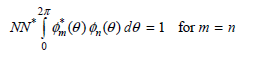
Normalize the set of functions ˆ…n(θ) = einθ, 0 ‰¤ θ ‰¤ 2Ï€. To do so, you need to multiply the functions by a so-called normalization constant N so that the integral NN* | (e) ,(0) de = 1 for m = n
Find the result of operating with (1/r2) (d /dr) (r2d /dr) + 2/r on the function Ae−br. What must the values of A and b be to make this function an eigenfunction of the operator?
Consider a two-level system with ε1= 2.25 × 10⁻²² J and ε2 = 4.50 × 10⁻²¹ J. If g2 = 2g1, what value of T is required to obtain n2 /n1 = 0.175? What value of T is required to obtain n2 /n1 = 0.750?
Express the following complex numbers in the form reiθ.a. 5 + 6ib. 2ic. 4d. 5 + i / 3 – 4ie. 2- i / 1 + i
Show that a + tb/c +ld = ac + bd + l(bc – ad)/c2 + d2
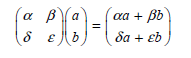
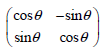
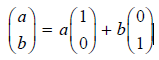
Operators can also be expressed as matrices and wave functions as column vectors. The operator matrixacts on the wave function (a, b) according to the ruleIn words, the 2 × 2 matrix operator acting on the two-element column wave function generates another two-element column wave
Carry out the following coordinate transformations:a. Express the point x = 3, y = 1, and z = 1 in spherical coordinates.b. Express the point r = 5, θ = π / 4, and 3π / 4 in Cartesian coordinates.
Make the three polynomial functions a0, a1 + b1x, and a2 + b2x + c2x2 orthonormal in the interval −1 ≤ x ≤ +1 by determining appropriate values for the constants a0, a1, b1, a2, b2, and c2.
If two operators act on a wave function as indicated by AÌ‚BÌ‚ f(x), it is important to carry out the operations in succession, with the first operation being that nearest to the function. Mathematically, AÌ‚BÌ‚ f(x) = AÌ‚(BÌ‚f
Let (1, 0) and (0, 1) represent the unit vectors along the x and y directions, respectively. The operatorEffects a rotation in the x-y plane. Show that the length of an arbitrary vector which is defined as ˆša2 + b2 , is unchanged by this rotation. See the Math Supplement (Appendix
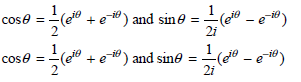
Using the exponential representation of the sine and cosine functions,
Find the result of operating with d2 /dx2 + d2 /dy2 + d2 /dz2 on the function x2 + y2 + z2. Is this function an eigenfunction of the operator?
If two operators act on a wave function as indicated by AÌ‚BÌ‚ f(x), it is important to carry out the operations in succession, with the first operation being that nearest to the function. Mathematically, AÌ‚BÌ‚ f (x) =
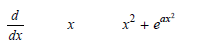
Determine in each of the following cases if the function in the first column is an eigenfunction of the operator in the second column. If so, what is the eigenvalue?a. b.c. sine cosø 3x (1/x) d/dx
Find the result of operating with d2 /dx2 − 2x2 on the function 2 e−ax2. What must the value of a be to make this function an eigenfunction of the operator? What is the eigenvalue?
Is the function 2x2 − 1 an eigenfunction of the operator − (3/2 − x2) (d2 /dx2) + 2x (d /dx)? If so, what is the eigenvalue?
Determine in each of the following cases if the function in the first column is an eigenfunction of the operator in the second column. If so, what is the eigenvalue?a. x2………………..x2 / 8 d2/dx2b. x3 + y3………….. x3(∂3 / ∂x3) + y3 (∂3 / 2y3)c. sin 2θ
Assume that a system has a very large number of energy levels given by the formula εl = ε0l2 with ε0 = 1.75 × 10⁻²² J, where l takes on the integral values 1, 2, 3, . . Assume further that the degeneracy of a level is given by gl = 2l. Calculate the ratios n4 /n1 and n8 /n1 for T =
Because ʃd-d cos (nπx / d) cos (mπx / dx) = 0, m ≠n, the functions cos (n π x/d) for n = 1, 2, 3, . . . form an orthogonal set in the interval (−d, d). What constant must these functions be multiplied by to form an orthonormal set?
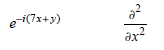
Determine in each of the following cases if the function in the first column is an eigenfunction of the operator in the second column. If so, what is the eigenvalue?a.b.c. ei(7x+y) хе ax? уЗx? + 2y? + 2у (1/3x)(3x² + 2y*) ах
Which of the following functions are eigenfunctions of the operator B̂ if B̂ f (x) = d2 f (x) / dx2: x2, cos x, e−3ix? State the eigenvalue if applicable.
Pulsed lasers are powerful sources of nearly monochromatic radiation. Lasers that emit photons in a pulse of 5.00 ns duration with a total energy in the pulse of 0.175 J at 875 nm are commercially available.a. What is the average power (energy per unit time) in units of watts (1W = 1 J/s)
A ground state H atom absorbs a photon and makes a transition to the n = 4 energy level. It then emits a photon of frequency 1.598 × 10¹⁴ s−1. What is the final energy and n value of the atom?
The power per unit area emitted by a blackbody is given by P = σ T4 with σ = 5.67 × 10⁻⁸ W m−2 K−4. Calculate the power radiated by a spherical blackbody of radius 0.500 m at 925 K. What would the radius of a black body at 3000. K be if it emitted the same energy as the spherical blackbody
A 1000. W gas discharge lamp emits 4.50 W of ultraviolet radiation in a narrow range centered near 275 nm. How many photons of this wavelength are emitted per second?
Calculate the longest and the shortest wavelength observed in the Lyman series.
Assume that water absorbs light of wavelength 4.20 × 10⁻⁶ m with 100% efficiency. How many photons are required to heat 5.75 g of water by 1.00 K? The heat capacity of water is 75.3 J mol−1 K−1.
The work function of palladium is 5.22 eV. What is the minimum frequency of light required to observe the photoelectric effect on Pd? If light with a 200. nm wavelength is absorbed by the surface, what is the velocity of the emitted electrons?
The power (energy per unit time) radiated by a blackbody per unit area of surface expressed in units of W m−2 is given by P = σ T4 with σ = 5.67 × 10⁻⁸ W m−2 K−4. The radius of the sun is 7.00 × 10⁵ km and the surface temperature is 5800. K. Calculate the total energy radiated per
The following data were observed in an experiment on the photoelectric effect from potassium:Graphically evaluate these data to obtain values for the work function and Planck€™s constant. 1019 Kinetic Energy (J) 4.49 1.89 3.09 1.34 0.700 0.311 Wavelength (nm) 250. 300. 450. 350. 400. 500.
X-rays can be generated by accelerating electrons in a vacuum and letting them impact on atoms in a metal surface. If the 1250. eV kinetic energy of the electrons is completely converted to the photon energy, what is the wavelength of the X-rays produced? If the electron current is 3.50 × 10⁻⁵
Calculate the longest and the shortest wavelength observed in the Balmer series.
If an electron passes through an electrical potential difference of 1 V, it has an energy of 1 electron-volt. What potential difference must it pass through in order to have a wavelength of 0.300 nm?
A beam of electrons with a speed of 5.25 × 10⁴ m/s is incident on a slit of width 200. nm. The distance to the detector plane is chosen such that the distance between the central maximum of the diffraction pattern and the first diffraction minimum is 0.300 cm. How far is the detector plane from
The distribution in wavelengths of the light emitted from a radiating blackbody is a sensitive function of the temperature. This dependence is used to measure the temperature of hot objects, without making physical contact with those objects, in a technique called optical pyrometry. In the limit
For a monatomic gas, one measure of the “average speed” of the atoms is the root mean square speed, v rms = (v2)1/2 = √3kBT/m, in which m is the molecular mass and kB is the Boltzmann constant. Using this formula, calculate the de Broglie wavelength for H2 and Ar at 200. and at 900. K.
Electrons have been used to determine molecular structure by diffraction. Calculate the speed and kinetic energy of an electron for which the wavelength is equal to a typical bond length, namely, 0.125 nm.
Using the root mean square speed, v rms = (v2)1/2 = √3kBT/m, calculate the gas temperatures of He and Ar for which λ = 0.25 nm, a typical value needed to resolve diffraction from the surface of a metal crystal. On the basis of your result, explain why Xe atomic beams are not suitable for atomic
In our discussion of blackbody radiation, the average energy of an oscillator E̅ osc = hv/(ehv/kBT – 1) was approximated as E̅ osc = hv/[(1 + hv/kBT) − 1] = kBΤ for hv/kBT << 1. Calculate the relative error = (E – E approx )/E in making this approximation for v = 7.50 ×
A newly developed substance that emits 250. W of photons with a wavelength of 325 nm is mounted in a small rocket initially at rest in outer space such that all of the radiation is released in the same direction. Because momentum is conserved, the rocket will be accelerated in the opposite
What speed does a F2 molecule have if it has the same momentum as a photon of wavelength 225 nm?
Show that the energy density radiated by a blackbodydepends on the temperature as T4. The definite integral Using your result, calculate the energy density radiated by a blackbody at 1100. K and 6000. K. Eger) - pv.T)dv = ,² E1otai (T) 87hv3 hv/kT Ap- -dv – 1)] dx = n*/15.
What is the maximum number of electrons that can be emitted if a potassium surface of work function 2.40 eV absorbs 5.00 × 10⁻³ J of radiation at a wavelength of 325 nm? What is the kinetic energy and velocity of the electrons emitted?
Calculate the highest possible energy of a photon that can be observed in the emission spectrum of H.
Calculate the speed that a gas-phase fluorine molecule would have if it had the same energy as an infrared photon (λ = 1.00 × 10⁴ nm), a visible photon (λ = 500. nm), an ultraviolet photon (λ = 100. nm), and an X-ray photon (λ = 0.100. nm). What temperature would the gas have if it had the
The observed lines in the emission spectrum of atomic hydrogen are given byIn the notation favored by spectroscopists, ν̅ = 1/λ = E/hc and RH =109,677 cm−1. The Lyman, Balmer, and Paschen series refers to n1 = 1, 2, and 3, respectively, for emission from atomic hydrogen. What
A more accurate expression for E̅ oscwould be obtained by including additional terms in the Taylor–MacLaurin series. The Taylor–MacLaurin series expansion of f (x) in the vicinity of x0is given by (see Math Supplement)Use this formalism to better approximate E̅ osc
When a molecule absorbs a photon, momentum is conserved. If an H2 molecule at 500. K absorbs an ultraviolet photon of wavelength 175 nm, what is the change in its velocity, Δv?Given that its average speed is v rms = √3kBT/m, what is ∆v/v rms?
Planck’s explanation of blackbody radiation was met by skepticism by his colleagues because Equation (12.4) seemed like a mathematical trick rather than being based on a microscopic model. Justify this equation using Einstein’s explanation of the photoelectric effect that came five years later.
Write down formulas relating the wave number with the frequency, wavelength, and energy of a photon.
How did Planck conclude that the discrepancy between experiments and classical theory for blackbody radiation was at high and not low frequencies?
Showing 2800 - 2900
of 3563
First
22
23
24
25
26
27
28
29
30
31
32
33
34
35
36
Step by Step Answers

 Get 50% OFF
Claim Now
Get 50% OFF
Claim Now


![l(x)[µ(x)] dx = f¥(x)[¼(x)]* dx?](https://dsd5zvtm8ll6.cloudfront.net/si.question.images/images/question_images/1525/2/3/4/2605ae93a54c76d31525234252249.jpg)













![– 1)] dx = n*/15.](https://dsd5zvtm8ll6.cloudfront.net/si.question.images/images/question_images/1524/8/0/5/5475ae2afab31ddd1524805531880.jpg)




