New Semester
Started
Get
50% OFF
Study Help!
--h --m --s
Claim Now
Question Answers
Textbooks
Find textbooks, questions and answers
Oops, something went wrong!
Change your search query and then try again
S
Books
FREE
Study Help
Expert Questions
Accounting
General Management
Mathematics
Finance
Organizational Behaviour
Law
Physics
Operating System
Management Leadership
Sociology
Programming
Marketing
Database
Computer Network
Economics
Textbooks Solutions
Accounting
Managerial Accounting
Management Leadership
Cost Accounting
Statistics
Business Law
Corporate Finance
Finance
Economics
Auditing
Tutors
Online Tutors
Find a Tutor
Hire a Tutor
Become a Tutor
AI Tutor
AI Study Planner
NEW
Sell Books
Search
Search
Sign In
Register
study help
sciences
physical chemistry
Physical Chemistry 3rd edition Thomas Engel, Philip Reid - Solutions
The d orbitals have the nomenclature and dz2, dxy, dxz, dyzand dx2 - y2. Show how the d orbitalcan be written in the form yzF(r). 3/2 1 3a, sin@cos@ sino r/3a, V3d, (r, 0.0) 81(ao
The force acting between the electron and the proton in the H atom is given by F = −e2 / 4πε0r2. Calculate the expectation value 〈F〉 for the 1s and 2pz states of the H atom in terms of e, ε0, and a0.
In spherical coordinates, z = r cosθ. Calculate 〈z〉 and 〈z2〉 for the H atom in its ground state. Without doing the calculation, what would you expect for 〈x〉 and 〈 y〉, and 〈x2〉 and 〈 y2〉? Why?
Calculate the expectation value (r − 〈r〉)2 if the H atom wave function is ψ100(r).
a. Calculate the mass density of the H atom.b. Compare your answer with the nuclear density assuming a nuclear radius of 1.0 × 10ˆ’15m.c. Calculate the mass density of the H atom outside of the nucleus.Result of 20.13The answer can be obtained using a numerical problem solver
The radius of an atom ratom can be defined as that value for which 90% of the electron charge is contained within a sphere of radius ratom. Use the formula in P 20.12b to calculate the radius of the H atom.
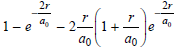
In this problem, you will calculate the probability of finding an electron within a sphere of radius r for the H atom in its ground state.a. Show, using integration by parts,b. Using this result, show that the probability density of finding the electron within a sphere of radius r for the hydrogen
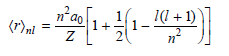
As the principal quantum number n increases, the electron is more likely to be found far from the nucleus. It can be shown that for H and for ions with only one electron such as He+,Calculate the value of n for an s state in the hydrogen atom such that Ωrλ= 500a0. Round
Ions with a single electron such as He+, Li2+, and Be3+ are described by the H atom wave functions with Z/a0 substituted for 1/a0, where Z is the nuclear charge. The 1s wave function becomes ψ (r) = 1/√π (Z/a0)3/2. Using this result, compare the mean value of the radius r at which you would
Ions with a single electron such as He+, Li2+, and Be3+ are described by the H atom wave functions with Z/a0 substituted for 1/a0, where Z is the nuclear charge. The 1s wave function becomes ψ (r) = 1 / √π (Z/a0)3/2 e-Zr/a0 Using this result, calculate the total energy for the 1s
Calculate the expectation value for the kinetic energy of the H atom with the electron in the 2s orbital. Compare your result with the total energy.
Calculate the expectation value of the radius r at which you would find the electron if the H atom wave function is ψ100(r).
Calculate the distance from the nucleus for which the radial distribution function for the 2p orbital has its main and subsidiary maxima.
Calculate the probability that the 1s electron for H will be found between r = a0 and r = 2a0.
Calculate the expectation value for the potential energy of the H atom with the electron in the 1s orbital. Compare your result with the total energy.
Determine the probability of finding the electron in the region for which the ψ320 wave function is negative (the toroidal region).
Show that the function (r/a0) e-r/2a0is a solution of the following differential equation forl= 1.What is the eigenvalue? Using this result, what is the value for the principal quantum number n for this function? h1(1 + 1) 2m,r e? 2dRr) 2m,r² dr |R(r) = E R(r).
Calculate the wave number corresponding to the most and least energetic spectral lines in the Lyman, Balmer, and Paschen series for the hydrogen atom.
Why is the radial probability density rather than the probability density used to calculate the most probable distance of the electron from the nucleus?
Why does the centrifugal potential force the 3d electrons further from the nucleus than the 3s electrons?
To what physical state does hydrogen atom energy of +1 × 10-19 J correspond?
What is the minimum photon energy needed to ionize a hydrogen atom in the ground state?
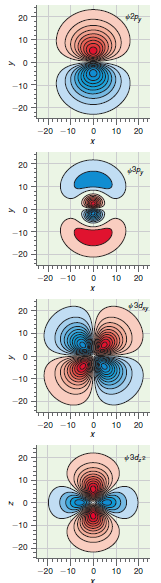
What is the difference between an angular and a radial node? How can you distinguish the two types of nodes in a contour diagram such as Figure 20.7? 20 10 -10 -20 -20 -10 10 20 20 10 -10 -20 -20 -10 0 10 20 3d 20 10 -10 -20 -20 -10 10 20 +3d,a 20 10 -10 -20 -20 -10 0 10 20
Explain why the radial distribution function rather than the square of the magnitude of the wave function should be used to make a comparison with the shell model of the atom.
Use an analogy with the particle in the box to explain why the energy levels for the H atom are more closely spaced as n increases.
Why is the radial probability function rather than ψ*(r)ψ (r) r2 sinθ dr dθ d∅ the best measure of the probability of finding the electron at a distance r from the nucleus?
What are the units of the H atom total energy eigenfunctions? Why is a03/2R(r) graphed in Figure 20.6 rather than R(r)?
Just as for the finite depth box, wave functions for which E-V0 is small (3s) penetrate further into the barrier than wave functions for which E-V0 is large (1s). The 2s wave function is intermediate between these two extremes.
If the probability density of finding the electron in the 1s orbital in the H atom has its maximum value for r = 0, does this mean that the proton and electron are located at the same point in space?
Why does the centrifugal potential dominate the effective potential for small values of r?
How does the effective potential differ for p and d electrons?
What effect does the centrifugal potential have in determining the maximum in the radial function for the 3s, 3p, and 3d orbitals?
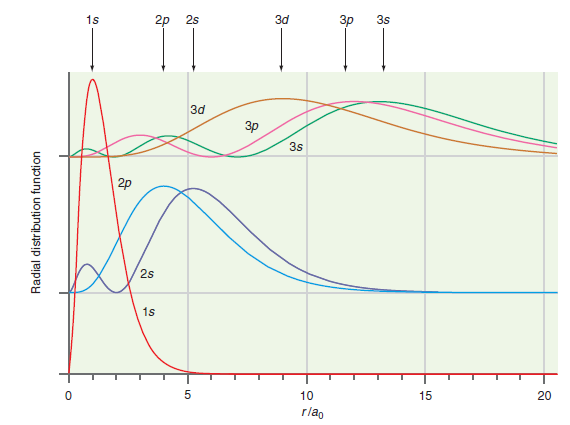
How do the results shown in Figure 20.10 differ from the predictions of the Bohr model of the H atom?Figure 20.10 1s 2p 2s Зd Зр 3s Зd Зр 3s 2p 2s 1s 10 15 20 rlag Radial distribution function
Why are the total energy eigenfunctions for the H atom not eigenfunctions of the kinetic energy?
Is it always true that the probability of finding the electron in the H atom is greater in the interval r − dr < r < r + dr than in the interval r − dr < r < r + dr θ − dθ < θ < θ + dθ - ∅ − d∅ < ∅ < ∅ + d∅?
What transition gives rise to the highest-frequency spectral line in the Lyman series?
What possible geometrical forms can the nodes in the angular function for p and d orbitals in the H atom have? What possible geometrical forms can the nodes in the radial function for s, p, and d orbitals in the H atom have?
If the vibrational potential is not harmonic, the force constant is not independent of degree of stretching or compression of a molecule. Using the relation k effective = (d2V(x)/dx2), derive an expression for the vibrational force constant for a Morse potential as a function of x − xe. Using the
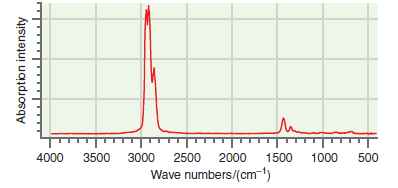
An infrared absorption spectrum of an organic compound is shown in the following figure. Use the characteristic group frequencies listed in Section 19.5 to decide whether this compound is more likely to be hexene, hexane, or hexanol. 4000 1000 3500 3000 2500 2000 1500 500 Wave numbers/(cm-1)
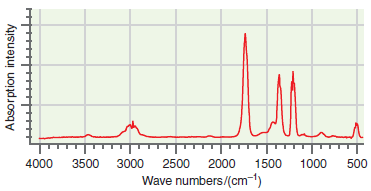
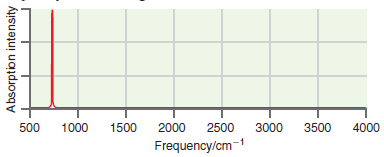
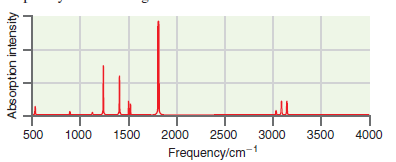
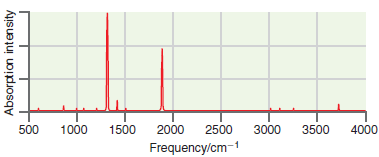
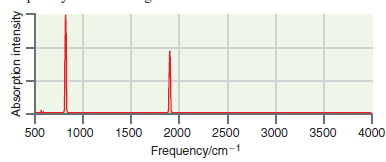
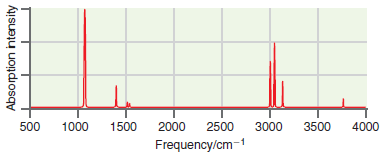
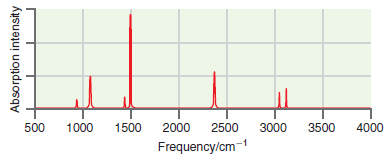
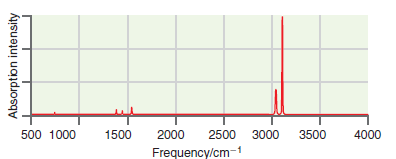
A simulated infrared absorption spectrum of a gas-phase organic compound is shown in the following figure. Use the characteristic group frequencies listed in Section 19.5 to decide whether this compound is more likely to be Cl2CO, (CH3)2CO, CH3OH, CH3COOH, CH3CN, CCl4or C3H8. Explain your
The rotational energy of 7 Li2 in the J = 5 state is 4.0126 × 10⁻²² J. Calculate the bond length of the molecule.
Calculate the angular momentum of 7 Li2 in the J = 5 state.
The moment of inertia of 7 Li2 is 4.161 × 10−46 kg m2. Calculate the bond length of the molecule.
Of the 190 nm wavelength light incident on a 15.0-mm-thick piece of fused silica quartz glass, 35% passes through the glass and the remainder is absorbed. What percentage of the light will pass through a 35.0 mm thick piece of the same glass?
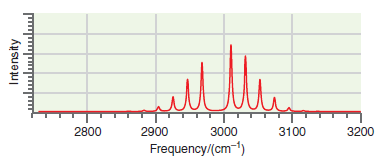
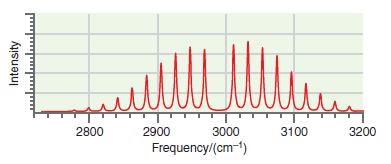
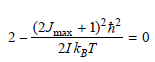
In Problem P19.29 you obtained the resultJ max = ½ ˆš4I kBT/h2 €“ 1]Using this result, estimate T for the simulated 1H35Cl rotational spectra shown in the following figure. Give realistic estimates of the precision with which you can determine T from the spectra. In
Use your results from P19.36 to solve the following problem. For 1H35Cl, De = 7.41 × 10 -19 J and ν = 8.97 × 10¹³ s-1. As n increases, the energy difference between adjacent vibrational levels decreases and approaches zero, corresponding to dissociation. Assuming a Morse potential, calculate all
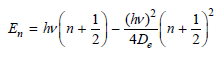
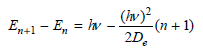
Using the formula for the energy levels for the Morse potential,show that the energy spacing between adjacent levels is given by (hv)² n + E, = hv n+ ADE En+1 - E, = iw 2D. (in² (n + 1) (Iv)?
A measurement of the vibrational energy levels of12C16O gives the relationshipwhere n is the vibrational quantum number. The fundamental vibrational frequency is ν0 = 2170.21 cm-1. From these data, calculate the depth De of the Morse potential for 12C16O. Calculate the bond energy of
A simulated infrared absorption spectrum of a gas-phase organic compound is shown in the following figure. Use the characteristic group frequencies listed in Section 19.5 to decide whether this compound is more likely to be Cl2CO, (CH3)2CO, CH3OH, CH3COOH, CH3CN, CCl4, or C3H8. Explain your
Calculate the moment of inertia, the magnitude of the rotational angular momentum, and the energy in the J = 4 rotational state for 14 N2.
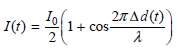
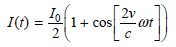
In this problem, you will derive the equations used to explain the Michelson interferometer for incident light of a single frequency.a. Show that the expressionrepresents the sum of two waves of the form (A0 / ˆš2)exp[i(k x ˆ’ω t)], one of which is phase shifted by
The spacing between lines in the pure rotational spectrum of 11B2D is 3.9214 × 10¹¹ s−1. Calculate the bond length of this molecule.
A strong absorption band in the infrared region of the electromagnetic spectrum is observed at ν̅ = 1298 cm−1 for 40Ca1H. Assuming that the harmonic potential applies, calculate the fundamental frequency ν in units of inverse seconds, the vibrational period in seconds, and the zero point
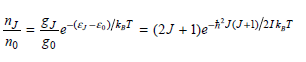
Because the intensity of a transition to first order is proportional to the population of the originating state, the J value for which the maximum intensity is observed in a rotational€“vibrational spectrum is not generally J = 0. Treat J in the equationas a continuous variable.a. Show
The force constant to 7Li2 is 26.0 N m−1. Calculate the vibrational frequency and zero point energy of this molecule.
Overtone transitions in vibrational absorption spectra for which Δn = +2, + 3, €¦ are forbidden for the harmonic potential V = (1 2)kx2because μmnx= 0 for ˆ£m ˆ’ nˆ£ ‰ 1 as shown in Section 19.4. However,
The rigid rotor model can be improved by recognizing that in a realistic anharmonic potential, the bond length increases with the vibrational quantum number n. Therefore, the rotational constant depends on n, and it can be shown that Bn = B − (n + 1/2)α , where B is the rigid rotor value. The
Greenhouse gases generated from human activity absorb infrared radiation from Earth and keep it from being dispersed outside our atmosphere. This is a major cause of global warming. Compare the path length required to absorb 90.% of the Earth’s radiation near a wavelength of 7 μm for CH3CCl3[ε
Show that the Morse potential approaches the harmonic potential for small values of the vibrational amplitude.
The rotational constant for 7Li19F determined from microwave spectroscopy is 1.342583 cm−1. The atomic masses of 7Li and 19F are 7.00160041 and 18.9984032 amu, respectively. Calculate the bond length in 7Li19F to the maximum number of significant figures consistent with this information.
A simulated infrared absorption spectrum of a gas-phase organic compound is shown in the following figure. Use the characteristic group frequencies listed in Section 19.5 to decide whether this compound is more likely to be Cl2CO, (CH3)2CO, CH3OH, CH3COOH, CH3CN, CCl4, or C3H8Explain your
The fundamental vibrational frequencies for 1 H2 and 2 D2 are 4401 and 3115 cm–1, respectively, and De for both molecules is 7.667 × 10⁻¹⁹ J. Using this information, calculate the bond energy of both molecules.
A simulated infrared absorption spectrum of a gas-phase organic compound is shown in the following figure. Use the characteristic group frequencies listed in Section 19.5 to decide whether this compound is more likely to be Cl2CO, (CH3)2CO, CH3OH, CH3COOH, CH3CN, CCl4, or C3H8. Explain your
Isotopic substitution is used to identify characteristic groups in an unknown compound using vibrational spectroscopy. Consider the C~C bond in ethane (12C2 1H6). By what factor would the frequency change if deuterium were substituted for all the hydrogen atoms? Treat the H and D atoms as being
A simulated infrared absorption spectrum of a gas-phase organic compound is shown in the following figure. Use the characteristic group frequencies listed in Section 19.5 to decide whether this compound is more likely to be Cl2CO, (CH3)2CO, CH3OH, CH3COOH, CH3CN, CCl4, or C3H8. Explain your
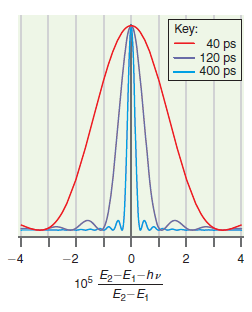
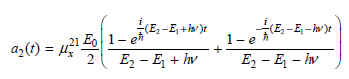
Fill in the missing step in the derivation that led to the calculation of the spectral line shape in Figure 19.24. Starting fromand neglecting the first term in the parentheses, show thatFigure 19.24 НЕ -Е -w Ez – E – lv НЕ, -Е, +i 21 Eo| 1-eй 2 а(0) %3 д 1-e E2 – E + hv оiОда,
The force constants for F2 and I2 are 470. And 172 N m−1, respectively. Calculate the ratio of the vibrational state populations n1/n0 and n2 /n0 at T = 300. and at 1000.K.
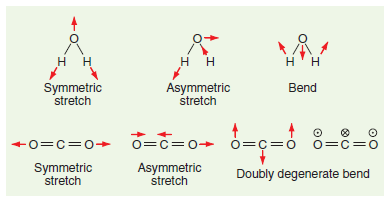
Calculating the motion of individual atoms in the vibrational modes of molecules (called normal modes) is an advanced topic. Given the normal modes shown in the following figure, decide which of the normal modes of CO2and H2O have a nonzero dynamical dipole moment and are therefore infrared active.
The bond length of 7Li1H is 159.49 pm. Calculate the value of B and the spacing between lines in the pure rotational spectrum of this molecule in units of s−1.
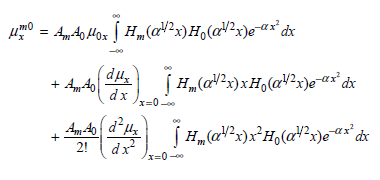
Selection rules in the dipole approximation are determined by the integral μmnx= ˆ«Ïˆ*m(Ï„) μx(Ï„) ψn(Ï„) dÏ„. If this integral is nonzero, the transition will be observed in an absorption
Following Example Problem 19.5, show that the J = 1 → J = 2 rotational transition is allowed.
Show that the selection rule for the two-dimensional rotor in the dipole approximation is Δml = ±1. Use A+φ eim1φ and A′ e+φ eim2φ for the initial and final states of the rotor and μ cosφ as the dipole moment element.
Write an expression for the moment of inertia of the acetylene molecule in terms of the bond distances. Does this molecule have a pure rotational spectrum?
Calculate the zero point energies for1H19F and 2D19F. Compare the difference in the zero point energies to kBT at 298 K.
An infrared absorption spectrum of an organic compound is shown in the following figure. Use the characteristic group frequencies listed in Section 19.5 to decide whether this compound is more likely to be ethyl amine, pentanol, or acetone. T. 4000 3500 3000 2500 2000 1500 1000 500 Wave
The rotational constant for 14 N2 determined from microwave spectroscopy is 1.99824 cm−1. Calculate the bond length in 14 N2 to the maximum number of significant figures consistent with this information.
A simulated infrared absorption spectrum of a gas-phase organic compound is shown in the following figure. Use the characteristic group frequencies listed in Section 19.5 to decide whether this compound is more likely to be Cl2CO, (CH3)2CO, CH3OH, CH3COOH, CH3CN, CCl4, or C3H8. Explain your
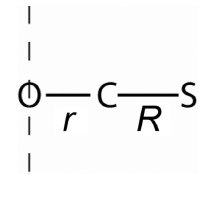
The molecules16O12C32S and16O12C34S have values for h/8Ï€2I of 6081.490 × 106sˆ’1and 5932.816 × 106sˆ’1, respectively. Calculate the C€“O and C€“S bond distances. The molecule is pictured below. C-
A simulated infrared absorption spectrum of a gas phase organic compound is shown in the following figure. Use the characteristic group frequencies listed in Section 19.5 to decide whether this compound is more likely to be CCl4, (CH3)2CO, CH3OH, CH3CN, C3H8, CH3COOH, or Cl2CO. Explain your
Purification of water for drinking using UV light is a viable way to provide potable water in many areas of the world. Experimentally, the decrease in UV light of wavelength 250 nm follows the empirical relation I /I0 = e−ε ′l, where l is the distance that the light passed through the water
The infrared spectrum of 7Li19F has an intense line at 910.57 cm−1. Calculate the force constant and period of vibration of this molecule.
The 1H35Cl molecule can be described by a Morse potential with De = 7.41 × 10⁻¹⁹ J. The force constant k for this molecule is 516 N m−1 and v = 8.97 × 10¹³ s−1.a. Calculate the lowest four energy levels for a Morse potential.b. Calculate the fundamental frequency ν0 corresponding to the
How many vibrational degrees of freedom do each of the following molecules have: NH3, HCN, C2H6, C60?
Use your answer from Q 19.18 to compare the force constants for compression and stretching at the classical turning points for the levels shown in Q 19.16. What trend do you see as n increases?
For a harmonic potential, the vibrational force constant a. Is independent of the quantum number n.b. Independent of x − xe for the molecule. Do you expect the same behavior for a Morse potential?
As a diatomic molecule rotates, the centrifugal force leads to a small change in the bond length. Do you expect the bond length to increase or decrease? Do you expect the difference between adjacent rotational energy peaks Δ(Δν ) to increase or decrease?
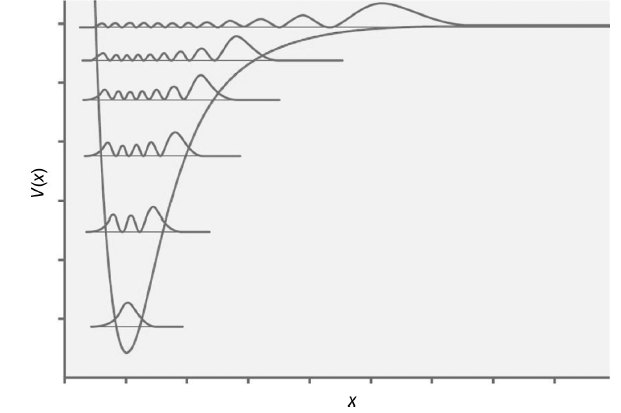
The squares of a number of vibrational energy eigenfunctions are shown superimposed on a Morse potential in the following figure. Assign quantum numbers to the levels shown. Explain the differences in the shape of the eigenfunctions compared to those for a harmonic potential. franna (x)A
The number of molecules in a given energy level is proportional to e−ΔE kBT, where ΔE is the difference in energy between the level in question and the ground state. How is it possible that a higher-lying rotational energy level can have a higher population than the ground state?
Because information about all frequencies is obtained simultaneously, the spectrum can be acquired in a much shorter time.
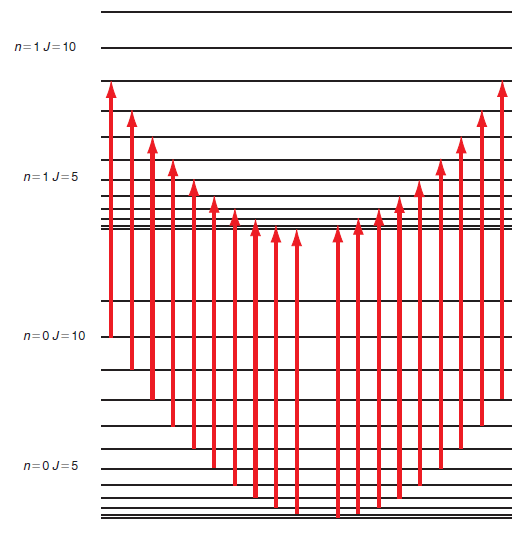
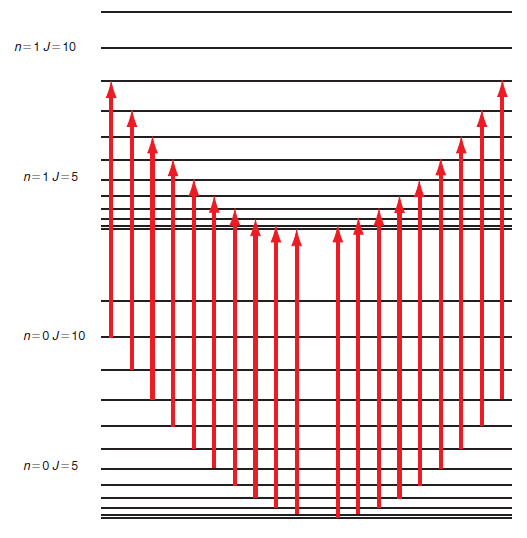
What is the explanation for the absence of a peak in the rotational€“vibrational spectrum near 3000 cmˆ’1 in Figure 19.17?Figure 19.17 n=1 J=10 n=1J=5 n=0J=10 n=0J=5
What is the difference between a permanent and a dynamic dipole moment?
If a spectral peak is broadened, can you always conclude that the excited state has a short lifetime?
If the rotational levels of a diatomic molecule were equally spaced and the selection rule remained unchanged, how would the appearance of the rotational€“vibrational spectrum in Figure 19.17 change?Figure 19.17 n=1 J=10 n=1J=5 n=0J=10 n=0J=5
What feature of the Morse potential makes it suitable for modeling dissociation of a diatomic molecule?
Does the initial excitation in Raman spectroscopy result in a stationary state of the system? Explain your answer.
Nitrogen and oxygen do not absorb infrared radiation and are therefore not greenhouse gases. Why is this the case?
What is the difference between the transition dipole moment and the dynamic dipole moment?
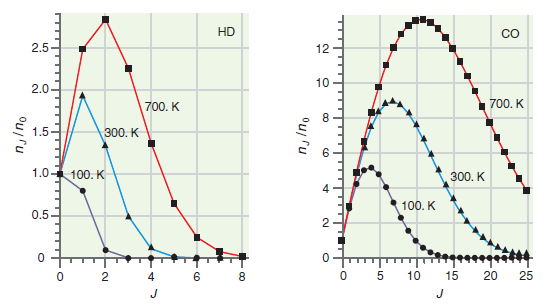
In Figure 19.16, nJ/n0increases initially with J for all three temperatures for CO, but only for the two highest temperatures for HD. Explain this difference.Figure 19.16 HD CO 2.5 12 10 2.0 700. K 700. K 1.5 300. K 1.0 100. K 300. K 100. K 0.5 2 10 15 20 25 4 6. Ou/ ru Ou/ru
A molecule in an excited state can decay to the ground state either by stimulated emission or spontaneous emission. Use the Einstein coefficients to predict how the relative probability of these processes changes as the frequency of the transition doubles.
How can you observe vibrational transitions in Raman spectroscopy using visible light lasers where the photon energy is much larger than the vibrational energy spacing?
Showing 2500 - 2600
of 3563
First
19
20
21
22
23
24
25
26
27
28
29
30
31
32
33
Last
Step by Step Answers

 Get 50% OFF
Claim Now
Get 50% OFF
Claim Now







![A) = 20 A(t) = (1 + e5())exp[i(kyp – wt)] %3D](https://dsd5zvtm8ll6.cloudfront.net/si.question.images/images/question_images/1525/3/4/1/0615aeadb85026531525341046446.jpg)


![оiОда, ) — Е Ги7sin'(E, - E - i)2H] (E, – E, – hv)?](https://dsd5zvtm8ll6.cloudfront.net/si.question.images/images/question_images/1525/3/4/0/8025aeada829f7e61525340789755.jpg)