New Semester
Started
Get
50% OFF
Study Help!
--h --m --s
Claim Now
Question Answers
Textbooks
Find textbooks, questions and answers
Oops, something went wrong!
Change your search query and then try again
S
Books
FREE
Study Help
Expert Questions
Accounting
General Management
Mathematics
Finance
Organizational Behaviour
Law
Physics
Operating System
Management Leadership
Sociology
Programming
Marketing
Database
Computer Network
Economics
Textbooks Solutions
Accounting
Managerial Accounting
Management Leadership
Cost Accounting
Statistics
Business Law
Corporate Finance
Finance
Economics
Auditing
Tutors
Online Tutors
Find a Tutor
Hire a Tutor
Become a Tutor
AI Tutor
AI Study Planner
NEW
Sell Books
Search
Search
Sign In
Register
study help
sciences
physical chemistry
Physical Chemistry 3rd edition Thomas Engel, Philip Reid - Solutions
One mole of a van der Waals gas at 25.0????C is expanded isothermally and reversibly from an initial volume of 0.010 m3 to a final volume of 0.095 m3. For the van der Waals gas, (∂U/∂V)T = a/V2m. Assume that a = 0.556 Pa m6 mol−2, and that b = 64.0 × 10⁻⁶ m3 mol−1. Calculate q, w, ΔU,
At the transition temperature of 95.4°C, the enthalpy of transition from rhombic to monoclinic sulfur is 0.38 kJ mol−1.a. Calculate the entropy of transition under these conditions.b. At its melting point, 119°C, the enthalpy of fusion of monoclinic sulfur is 1.23 kJ mol−1. Calculate the
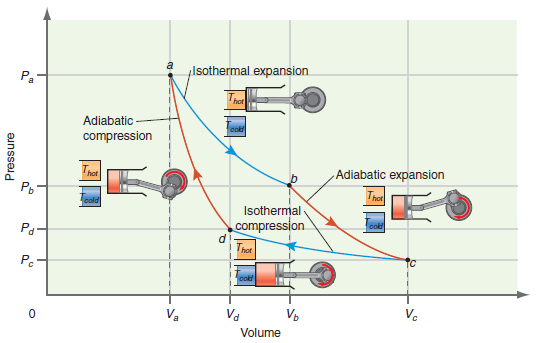
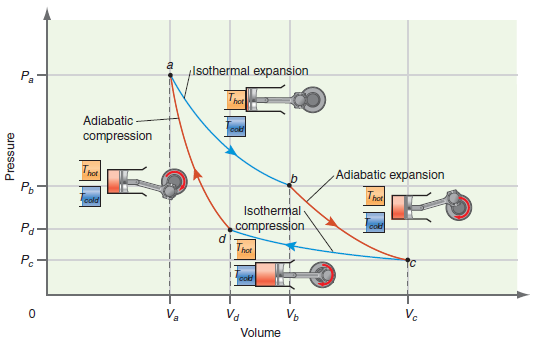
Using your results from Problem P5.7, calculate q, ΔU, and ΔH for each step in the cycle and for the total cycle described in Figure 5.2.Figure 5.2 Isothermal expansion Pa Adiabatic cold compression Adiabatic expansion hot Isothermal compression Pg- hot Pc Va Va Vo Vc Volume
The interior of a refrigerator is typically held at 36°F and the interior of a freezer is typically held at 0.00°F. If the room temperature is 65°F, by what factor is it more expensive to extract the same amount of heat from the freezer than from the refrigerator? Assume that the theoretical
3.75 moles of an ideal gas with CV ,m = 3/2 R undergoes the transformations described in the following list from an initial state described by T = 298 K and P = 4.50 bar. Calculate q, w, ΔU, ΔH, and ΔS for each process.a. The gas undergoes a reversible adiabatic expansion until the final
Using the expression dS = Cp/T dt – VβdP, calculate the decrease in temperature that occurs if 2.25 moles of water at 310. K and 1650. bar is brought to a final pressure of 1.30 bar in a reversible adiabatic process. Assume that κ = 0.
Calculate ΔS° for the reaction 3H2(g) + N2(g) → 2NH3(g) at 725 K. Omit terms in the temperature-dependent heat capacities higher than T2 /K2.
Calculate ΔS for the isothermal compression of 1.75 mol of Cu(s) from 2.15 bar to 1250. bar at 298 K. β = 0.492 × 10⁻⁴ K−1, κ = 0.78 × 10⁻⁶ bar−1, and the density is 8.92 g cm−3. Repeat the calculation assuming that κ = 0.
1.10 moles of N2at 20.5°C and 6.20 bar undergoes a transformation to the state described by 215°C and 1.75 bar. Calculate ΔS if Сри Jmol-1 к-1 + 2.3968 x 10- г? -1.0176 х 10-3. 30.81-11.87х10 3. -3T к? кз к
2.25 moles of an ideal gas with CV ,m = 5/2 R is transformed from an initial state T 680. K and P = 1.15 bar to a final state T = 298.K and P = 4.75 bar. Calculate ΔU, ΔH, and ΔS for this process.
The maximum theoretical efficiency of an internal combustion engine is achieved in a reversible Carnot cycle. Assume that the engine is operating in the Otto cycle and that CV ,m = 5/2 R for the fuel–air mixture initially at 273 K (the temperature of the cold reservoir). The mixture is compressed
Calculate ΔS, ΔS total , and ΔS surroundings when the volume of 150. g of CO initially at 273 K and 1.00 bar increases by a factor of two in a. An adiabatic reversible expansionb. An expansion against P external = 0c. An isothermal reversible expansion. Take CP,m to be constant at the value
The average heat evolved by the oxidation of foodstuffs in an average adult per hour per kilogram of body weight is 7.20 kJ kg−1 hr−1. Assume the weight of an average adult is 62.0 kg. Suppose the total heat evolved by this oxidation is transferred into the surroundings over a period lasting
Consider the reversible Carnot cycle shown in Figure 5.2 with 1.25 mol of an ideal gas with CV= 5/2R as the working substance. The initial isothermal expansion occurs at the hot reservoir temperature of Thot= 740.K from an initial volume of 3.75 L (Va) to a volume of 12.8 L (Vb). The system then
2.25 moles of an ideal gas with CV ,m = 3/2 R undergoes the transformations described in the following list from an initial state described by T = 310.K. and P = 1.00 bar. Calculate q, w, ΔU, ΔH, and ΔS for each process.a. The gas is heated to 675 K at a constant external pressure of 1.00 bar.b.
One mole of H2O(l) is compressed from a state described by P = 1.00 bar and T = 350.K to a state described by P = 590. bar and T = 750.K. In addition, β = 2.07 × 10⁻⁴ K−1, and the density can be assumed to be constant at the value 997 kg m−3. Calculate ΔS for this transformation, assuming
An air conditioner is a refrigerator with the inside of the house acting as the cold reservoir and the outside atmosphere acting as the hot reservoir. Assume that an air conditioner consumes 1.70 × 10³ W of electrical power, and that it can be idealized as a reversible Carnot refrigerator. If the
An electrical motor is used to operate a Carnot refrigerator with an interior temperature of 0.00°C. Liquid water at 0.00°C is placed into the refrigerator and transformed to ice at 0.00°C. If the room temperature is 300.K, what mass of ice can be produced in one day by a 0.50-hp motor that is
The Chalk Point, Maryland, generating station supplies electrical power to the Washington, D.C., area. Units 1 and 2 have a gross generating capacity of 710. MW (megawatt). The steam pressure is 25 × 106 Pa, and the super heater outlet temperature (Th ) is 540.°C. The condensate temperature (Tc )
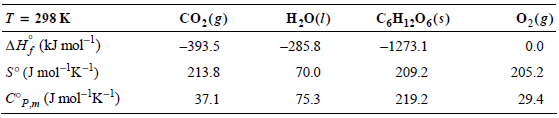
Consider the formation of glucose from carbon dioxide and water, that is, the reaction of the photosynthetic process:6CO2(g) + 6H2O(l) †’ C6H12O6(s) + 6O2(g).The following table of information will be useful in working this problem:Calculate the entropy and enthalpy changes for
Can incandescent lighting be regarded as an example of cogeneration during the heating season? In a season where air conditioning is required?
Solid methanol in thermal contact with the surroundings is reversibly melted at the normal melting point at a pressure of 1 atm. Are ΔS, ΔS surroundings , and ΔS total positive, negative, or zero? Explain your reasoning.
Without using equations, explain why ΔS for a liquid or solid is dominated by the temperature dependence of S as both P and T change.
Two vessels of equal volume, pressure, and temperature both containing Ar are connected by a valve. What is the change in entropy when the valve is opened, allowing mixing of the two volumes? Is ΔS the same if one of the volumes contained Ar, and the other contained Ne?
Why is the efficiency of a Carnot heat engine the upper bound to the efficiency of an internal combustion engine?
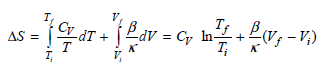
Is the equationvalid for an ideal gas? Tf PV; -V;) T; Cy dT Lav = C, n2v, -v) %3D AS = т
An ideal gas in a piston and cylinder assembly with adiabatic walls undergoes an expansion against a constant external pressure. Are ΔS, ΔS surroundings , and ΔS total positive, negative, or zero? Explain your reasoning.
A system undergoes a change from one state to another along two different pathways, one of which is reversible and the other of which is irreversible. What can you say about the relative magnitudes of q reversible and q irreversible?
If the ΔHof for the chemical compounds involved in a reaction are available at a given temperature, how can ΔHoR be calculated at another temperature?
When a saturated solution of a salt is cooled, a precipitate crystallizes out. Is the entropy of the crystalline precipitate greater or less than the dissolved solute? Explain why this process is spontaneous.
An ideal gas undergoes an adiabatic expansion into a vacuum. Are ΔS, ΔS surroundings , and ΔS total positive, negative, or zero? Explain your reasoning.
Your roommate decides to cool the kitchen by opening the refrigerator. Will this strategy work? Explain your reasoning.
One joule of work is done on a system, raising its temperature by one degree centigrade. Can this increase in temperature be harnessed to do one joule of work? Explain.
Which of the following processes is spontaneous?a. The reversible isothermal expansion of an ideal gas.b. The vaporization of superheated water at 102°C and 1 bar.c. The constant pressure melting of ice at its normal freezing point by the addition of an infinitesimal quantity of heat.d. The
Is the following statement true of false? If it is false, rephrase it so that it is true. The entropy of a system cannot increase in an adiabatic process.
Under what conditions does the equality ΔS = ΔH/T hold?
You are told that ΔS = 0 for a process in which the system is coupled to its surroundings. Can you conclude that the process is reversible? Justify your answer.
A process involving an ideal gas is carried out in which the temperature changes at constant volume. For a fixed value of ΔT, the mass of the gas is doubled. The process is repeated with the same initial mass and ΔT is doubled. For which of these processes is ΔS greater? Why?
The amplitude of a pendulum consisting of a mass on a long wire is initially adjusted to have a very small value. The amplitude is found to decrease slowly with time. Is this process reversible? Would the process be reversible if the amplitude did not decrease with time?
An ideal gas in thermal contact with the surroundings is cooled in an irreversible process at constant pressure. Are ΔS, ΔS surroundings , and ΔS total positive, negative, or zero? Explain your reasoning.
Why are ΔS fusion and ΔS vaporization always positive?
Under what conditions is ΔS < 0 for a spontaneous process?
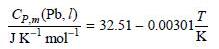
The standard entropy of Pb(s) at 298.15 K is 64.80 J K-1mol-1. Assume that the heat capacity of Pb(s) is given byThe melting point is 327.4°C and the heat of fusion under these conditions is 4770. J mol-1. Assume that the heat capacity of Pb(l) is given bya. Calculate the standard entropy of Pb(l)
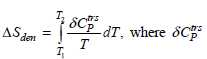
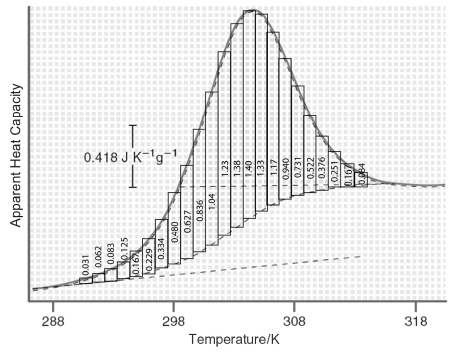
For protein denaturation, the excess entropy of denaturation is defined asis thetransition excess heat capacity. The way in which δC trs P can be extracted from differential scanning calorimetry (DSC) data is discussed in Section 4.6 and shown in Figure 4.7. The following DSC data are
An ideal gas sample containing 1.75 moles for which CV ,m = 5/2R undergoes the following reversible cyclical process from an initial state characterized by T = 275 K and P = 1.00 bar:a. It is expanded reversibly and adiabatically until the volume triples.b. It is reversibly heated at constant
The mean solar flux at the Earth’s surface is ~2.00 J cm–2 min–1. In a non-focusing solar collector, the temperature reaches a value of 79.5°C. A heat engine is operated using the collector as the hot reservoir and a cold reservoir at 298 K. Calculate the area of the collector needed to
Using your result from Problem 5.31, extrapolate the absolute entropy of L-alanine to physiological conditions, T = 310.K. Assume the heat capacity is constant between T = 300. K and T = 310. K.
At 1000.K, ΔHoR = –123.77 kJ mol–1 for the reaction N2(g) + 3H2(g) → 2NH3(g), with CP,m = 3.502R, 3.466 R, and 4.217 R for N2(g), H2(g), and NH3(g), respectively. Calculate ΔHof of NH3(g) at 450.K from this information. Assume that the heat capacities are independent of
Calculate ΔHoR and ΔUoR at 298.15 K for the following reactions:a. 4NH3(g) + 6NO(g) → 5N2(g) + 6H2O(g)b. 2NO(g) + O2(g) → 2NO2(g)c. TiCl4 (l) + 2H2O(l) → TiO2 (s) + 4HCl(g)d. 2NaOH(aq) + H2SO4(aq) → Na2SO4(aq) + 2H2O(l). Assume complete dissociation
A camper stranded in snowy weather loses heat by wind convection. The camper is packing emergency rations consisting of 58% sucrose, 31% fat, and 11% protein by weight. Using the data provided in Problem P4.32 and assuming the fat content of the rations can be treated with palmitic acid data and
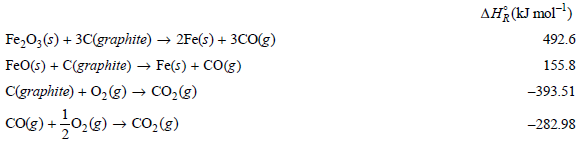
From the following data at 298.15 K calculate the standard enthalpy of formation of FeO(s) and of Fe2O3(s): AĦ¿(kJ mol) Fe,0;(s) + 3C(graphite) → 2Fe(s) + 3cO(g) FeO(s) + C(graphite) → Fe(s) + CO(g) C(graphite) + O2(g) → CO,(g) CO(e) +0,@) → Co,(3) 492.6 155.8 -393.51 -282.98
Compare the heat evolved at constant pressure per mole of oxygen in the combustion of sucrose (C12H22O11) and palmitic acid (C16H32O2) with the combustion of a typical protein, for which the empirical formula is C4.3H6.6NO. Assume for the protein that the combustion yields N2(g), CO2(g), and
Is the following statement correct? If not, rewrite it so that it is correct. Because the enthalpy of formations of elements is zero, ΔHof (O(g)) = 0.
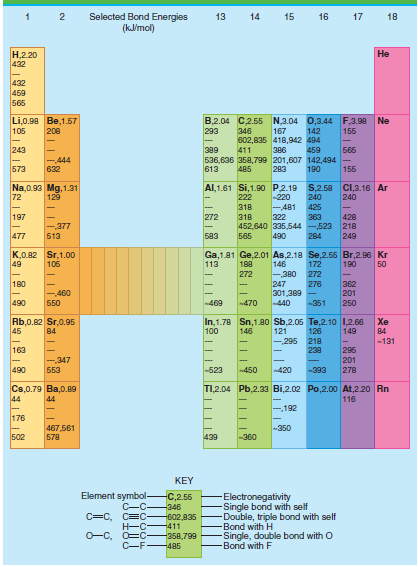
Given the data in Table 4.3 and the data tables, calculate the bond enthalpy and energy of the following:a. The C€”H bond in CH4b. The C€”C single bond in C2H6c. The C£C double bond in C2H4Use your result from part (a) to solve parts (b) and (c).Table 4.3 Selected Bond
You wish to measure the heat of solution of NaCl in water. Would the calorimetric technique of choice be at constant pressure or constant volume? Why?
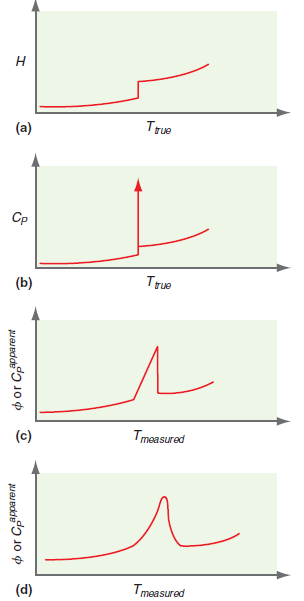
What is the advantage of a differential scanning calorimeter over a bomb calorimeter in determining the enthalpy of fusion of a series of samples?
The reactants in the reaction 2NO(g) + O2(g) → 2NO2(g) are initially at 298 K. Why is the reaction enthalpy the same if (a) the reaction is constantly kept at 298 K or (b) if the reaction temperature is not controlled and the heat flow to the surroundings is measured only after the
The total surface area of Asia consisting of forest, cultivated land, grass land, and desert is 4.46 × 10⁷ km2. Every year, the mass of carbon fixed by photosynthesis by vegetation covering this land surface according to the reaction 6CO2(g) + 6H2O(l) → C6H12O6(s) + 6O2(g) is
Is the following statement correct? If not rewrite it so that it is correct. Because the reaction H2(g) + O2(g) → H2O(l) is exothermic, the products are at a higher temperature than the reactants.
Calculate ΔH for the process in which Cl2(g) initially at 298.15 K at 1 bar is heated to 690.K at 1 bar. Use the temperature-dependent heat capacities in the data tables. How large is the relative error if the molar heat capacity is assumed to be constant at its value of 298.15 K over the
Nitrogen is a vital component of proteins and nucleic acids, and thus is necessary for life. The atmosphere is composed of roughly 80% N2, but most organisms cannot directly utilize N2for biosynthesis. Bacteria capable of €œfixing€ nitrogen (i.e., converting N2to a chemical
In a calorimetric study, the temperature of the system rises to 325 K before returning to its initial temperature of 298 K. Why doesn’t this temperature rise affect your measurement of ΔHoR at 298 K?
Derive the following expression for calculating the isothermal change in the constant volume heat capacity:(∂CV/∂V)T = T (∂2P/∂T2)V.
Use the tabulated values of the enthalpy of combustion of benzene and the enthalpies of formation of CO2(g) and H2O(l) to determine ΔHof for benzene.
Calculate the standard enthalpy of formation of FeS2(s) at 600. °C from the following data at 298.15 K. Assume that the heat capacities are independent of temperature.You are also given that for the reaction 2FeS2(s) + 11/2O2(g) †’ Fe2O2(s) + 4SO2(g).ˆ†HoR = - 1655
Why is it valid to add the enthalpies of any sequence of reactions to obtain the enthalpy of the reaction that is the sum of the individual reactions?
Is the following statement correct? If not rewrite it so that it is correct. The superscript zero in ΔHof means that the reactions conditions are 298.15 K.
Given the following heat capacity data, calculate ΔHofof CO2(g) at 525 K. C(graphite) co:(g) 0:(g) Substance CP.m/J mol-K-1 8.52 28.8 37.1
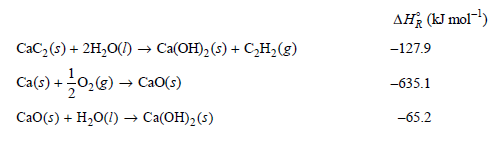
Several reactions and their standard reaction enthalpies at 298.15 K are given here:The standard enthalpies of combustion of graphite and C2H2(g) are €“393.51 and €“1299.58 kJ mol€“1, respectively. Calculate the standard enthalpy of formation of CaC2(s) at 25°C. AH
Why are heat capacities of reactants and products required for calculations of ΔHoR at elevated temperatures?
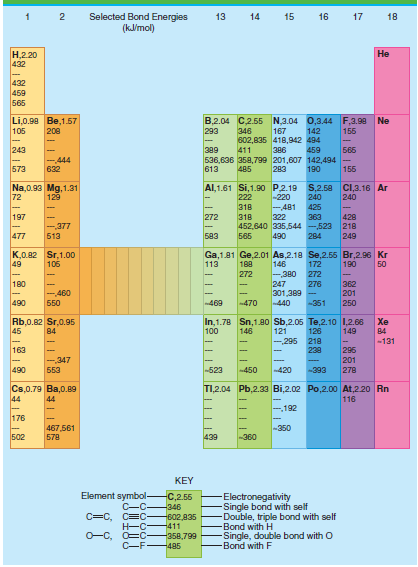
Use the average bond energies in Table 4.3 to estimate ΔU for the reaction C2H4(g) + H2(g) †’ C2H6(g). Also calculate ΔUoRfrom the tabulated values of ΔHoffor reactant and products (Appendix B, Data Tables). Calculate the percent
Using the protein DSC data in Problem P4.10, calculate the enthalpy change between the T = 288 K and T = 318 K. Give your answer in units of kJ per mole. Assume the molecular weight of the protein is 14,000. grams.
Why are elements included in the sum in Equation (4.20) when they are not included in calculating ΔHoR at 298 K?
The total surface area of the Earth covered by ocean is 3.35 × 10⁸ km2. Carbon is fixed in the oceans via hotosynthesis performed by marine plants according to the reaction 6CO2(g) + 6H2O(l) → C6H12O6(s) + 6O2(g).A lower range estimate of the mass of carbon fixed in
An 75.0g piece of gold at 650.K is dropped into 180. g of H2O(l) at 310.K in an insulated container at 1 bar pressure. Calculate the temperature of the system once equilibrium has been reached. Assume that CP,m for Au(s) and H2O(l) is constant at their values for 298 K throughout the temperature
Because (∂H/∂P)T = -CP μ J −T , the change in enthalpy of a gas expanded at constant temperature can be calculated. To do so, the functional dependence of μ J −T on P must be known. Treating Ar as a van der Waals gas, calculate ΔH when 1 mol of Ar is expanded from 325 bar to 1.75 bar at
A mass of 32.0 g of H2O(g) at 373 K is flowed into 295 g of H2O(l) at 310.K and 1 atm. Calculate the final temperature of the system once equilibrium has been reached. Assume that CP,m for H2O(l) is constant at its values for 298 K throughout the temperature range of interest. Describe the state of
Integrate the expression β = 1/V (∂V /∂T)P assuming that β is independent of pressure. By doing so, obtain an expression for V as a function of T and β at constant P.
A vessel is filled completely with liquid water and sealed at 13.56°C and a pressure of 1.00 bar. What is the pressure if the temperature of the system is raised to 82.0°C? Under these conditions, β water = 2.04 × 10⁻⁴ K-1, β vessel = 1.42 × 10⁻⁴ K-1, and K water = 4.59 × 10⁻⁵ bar-1.
A mass of 34.05 g of H2O(s) at 273 K is dropped into 185 g of H2O(l) at 310.K in an insulated container at 1 bar of pressure. Calculate the temperature of the system once equilibrium has been reached. Assume that CP,m for H2O(l) is constant at its values for 298 K throughout the temperature
Use the relation (∂U/∂V )T = T(∂P/∂T)V − P and the cyclic rule to obtain an expression for the internal pressure, (0U/0V )T , in terms of P, β , T, and κ .
The molar heat capacity CP,mof SO2(g) is described by the following equation over the range 300 K < T < 1700 K:In this equation, T is the absolute temperature in kelvin. The ratios T€/K€ ensure that CP,m has the correct dimension. Assuming ideal gas behavior, calculate
Use the result of Problem P3.10 to show that (∂CV /∂V)T for the van der Waals gas is zero.
Obtain an expression for the isothermal compressibility κ = −1/V (∂V /∂P)T for a van der Waals gas.
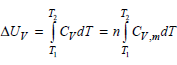
Is the expressiononly valid for an ideal gas if V is constant? T, AUr = [ CydT = n[ Cy,maT
Why was the following qualification made in Section 3.7? Note that Equation (3.47) is only applicable to a process in which there is no change in the phase of the system, such as vaporization or fusion, and in which there are no chemical reactions.
The molar volume of H2O(l) decreases with increasing temperature near 4°C. Can you explain this behavior using a molecular level model?
Is the following statement always, never, or sometimes valid? Explain your reasoning: q = 0 for a cyclic process.
Is the following statement always, never, or sometimes valid? Explain your reasoning: A thermodynamic process is completely defined by the initial and final states of the system.
Is the following statement always, never, or sometimes valid? Explain your reasoning: ΔH is only defined for a constant pressure process.
What is the relationship between a state function and an exact differential?
Why is the equation
Why are q and w not state functions?
Classify the following variables and functions as intensive or extensive: T, P, V, q, w, U, H.
Why is qV = ΔU only for a constant volume process? Is this formula valid if work other than P − V work is possible?
Can a gas be liquefied through an isenthalpic expansion if μ J −T = 0?
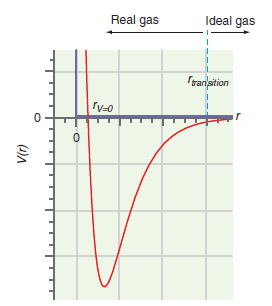
Refer to Figure 1.10 and explain why (ˆ‚U/ˆ‚V)Tis generally small for a real gas.Figure 1.10 Ideal gas Real gas Tranlaition rv-0 (4)A
Why is it reasonable to write dH ≈ CPdT + VdP for a liquid or solid sample?
Explain without using equations why (∂H /∂P)T 0H 0P is generally small for a real gas.
Why can qV be equated with a state function if q is not a state function?
Showing 3200 - 3300
of 3563
First
22
23
24
25
26
27
28
29
30
31
32
33
34
35
36
Step by Step Answers

 Get 50% OFF
Claim Now
Get 50% OFF
Claim Now