New Semester
Started
Get
50% OFF
Study Help!
--h --m --s
Claim Now
Question Answers
Textbooks
Find textbooks, questions and answers
Oops, something went wrong!
Change your search query and then try again
S
Books
FREE
Study Help
Expert Questions
Accounting
General Management
Mathematics
Finance
Organizational Behaviour
Law
Physics
Operating System
Management Leadership
Sociology
Programming
Marketing
Database
Computer Network
Economics
Textbooks Solutions
Accounting
Managerial Accounting
Management Leadership
Cost Accounting
Statistics
Business Law
Corporate Finance
Finance
Economics
Auditing
Tutors
Online Tutors
Find a Tutor
Hire a Tutor
Become a Tutor
AI Tutor
AI Study Planner
NEW
Sell Books
Search
Search
Sign In
Register
study help
sciences
physical chemistry
Physical Chemistry 3rd edition Thomas Engel, Philip Reid - Solutions
How can data from photoelectric effect experiments be used to obtain numerical values for the Planck constant h?
Why is a diffraction pattern generated by an electron gun formed by electrons interfering with themselves rather than with one another?
In the diffraction of electrons by crystals, the depth sampled by the diffracting electrons is on the order of 3 to 10 atomic layers. If He atoms are diffracted from the surface, only the topmost atomic layer is sampled. Can you explain this difference?
The inability of classical theory to explain the spectral density distribution of a blackbody was called the ultraviolet catastrophe. Why is this name appropriate?
In the double-slit experiment, researchers found that an equal number of electrons passes through each slit. Does this result allow you to distinguish between particle-like and wave-like behavior?
Why does the analysis of the photoelectric effect based on classical physics predict that the kinetic energy of electrons will increase with increasing light intensity?
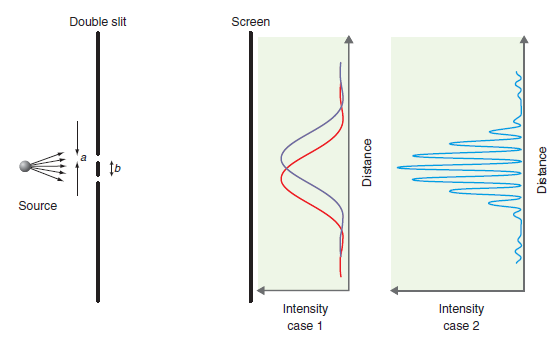
What feature of the distribution depicted as case 1 in Figure 12.8 tells you that the broad distribution arises from diffraction?Figure 12.8 Double slit Screen Source Intensity Intensity case 2 case 1 Distance Distance
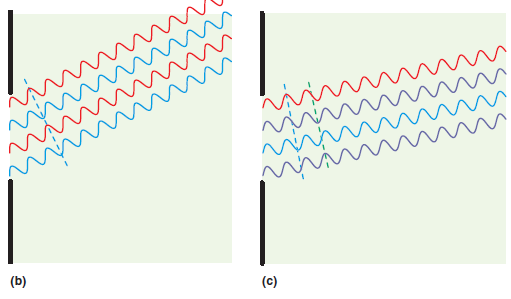
Is the intensity observed from the diffraction experiment depicted in Figure 12.7 the same for the angles shown in parts (b) and (c)?Figure 12.7 hi (b) (c)
Which of the experimental results for the photoelectric effect suggests that light can display particle like behavior?
You observe light passing through a slit of width a as λ decreases from λ ≫ a to λ ≪ a. Will you observe a sharp transition between ray optics and diffraction? Explain why or why not.
Classical physics predicts that there is no stable orbit for an electron moving around a proton. The Bohr model of the hydrogen atom preceded quantum mechanics. Justify the criterion that Niels Bohr used to define special orbits that he assumed were stable.
Why was the wave nature of particles not discovered until atomic level experiments became possible?
Why is there an upper limit to the photon energy that can be observed in the emission spectrum of the hydrogen atom?
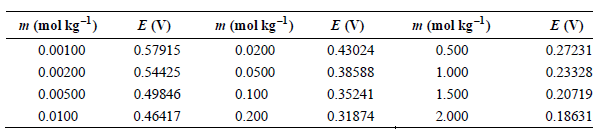
The data in the following table have been obtained for the potential of the cell Pt(s) |H2(g, f = 1atm) HCl(aq, m)|AgCl(s) Ag(s) as a function of m at 25°C.a. Determine E° using a graphical method.b. Calculate γ ± for HCl at m = 0.00100, 0.0100, and 0.100 mol kg–1. m (mol kg) m
Using half-cell potentials, calculate the equilibrium constant at 298.15K for the reaction 2H2O(l) ⇋ 2H2(g) + O2(g). Compare your answer with that calculated using ΔG°f values from Table 4.1 (see Appendix B). What is the value of E° for the overall reaction that makes the two methods
The half-cell potential for the reaction O2(g) + 4H+ (aq) + 4e– → 2H2O(l) is +1.03 V at 298.15 K when aO2 = 1. Determine aH+.
Calculate ΔGR and the equilibrium constant at 298.15K for the reaction Cr2O72– (aq) 3H2(g) + 8H+ (aq) → 2Cr3+ (aq) + 7H2O(l).
Consider the half-cell reaction O2(g) + 4H+ (aq) + 4e– → 2H2O(l). By what factor are n, Q, E, and Eo changed if all the stoichiometric coefficients are multiplied by the factor two? Justify your answers.
Consider the reaction Sn(s) + Sn4+ (aq) ⇋ 2Sn2+ (aq). If metallic tin is in equilibrium with a solution of Sn2+ (aq) in which aSn2+ = 0.250, what is the activity of Sn4+ (aq) at equilibrium at 298.15K?
Harnet and Hamer [J. American Chemical Society 57 (1935): 33] report values for the potential of the cell Pt(s) PbSO4(s) H2SO4(aq, a) PbSO4(s) PbO2(s) Pt(s) over a wide range of temperature and H2SO4 concentrations. In 1m H2SO4, their results were described by E(V) = 1.91737 + 56.1 × 10⁻⁶ t +
Determine E° for the reaction Cr2+ (aq) + 2e– → Cr(s) from the one-electron reduction potential for Cr3+ (aq) and the three-electron reduction potential for Cr3+ (aq) given in Table 11.1.
The standard potential Eo for a given cell is 1.135 V at 298.15 K and (∂E/∂T)P = −4.10 × 10⁻⁵ V K−1. Calculate ΔGoR, ΔSoR , and ΔHoR . Assume that n = 2.
Consider the Daniell cell, for which the overall cell reaction is Zn(s) + Cu2+ (aq) ⇋ Zn2+ (aq) + Cu(s). The concentrations of CuSO4 and ZnSO4 are 2.50 × 10⁻³ and 1.10 × 10⁻³ m, respectively.a. Calculate E setting the activities of the ionic species equal to their molalities.b.
The Edison storage cell is described byFe(s) FeO(s) KOH(aq, aKOH) Ni2O3(s) NiO(s) Ni(s)and the half-cell reactions are as follows:Ni2O3(s) + H2O(l) + 2e– → 2NiO(s) + 2OH– (aq)......................Eo = 0.40 VFeO(s) + H2O(l) + 2e– → Fe(s) + 2OH– (aq)..............................Eo =
The cell potential E for the cell Pt(s)|H2(g, aH2 = 1) H+(aq, aH+ = 1)NaCl(aq, m = 0.300) AgCl(s) Ag(s) is +0.260 V. Determine γ Cl− assuming that γ ± = γ Na+ = γCl–.
By finding appropriate half-cell reactions, calculate the equilibrium constant at 298.15 K for the following reactions:a. 4NiOOH(s) + 2Η2O(l) ⇋ 4Ni(OH)2(s) + O2(g)b. 4NO3– (aq)+ 4H+ (aq) ⇋4NO(g) + 2H2O(l) + 3O2(g)
Consider the couple Ox + e– → Red with the oxidized and redu ced species at unit activity. What must be the value of E° for this half-cell if the reductant Red is to liberate hydrogen at 1 atm froma. An acid solution with aH+ = 2.50?b. A basic solution with pH = 9.00?c. Is hydrogen a better
a. Calculate ΔGR and the equilibrium constant, K, at 298.15K for the reaction 2Hg(l) + Cl2(g) ⇋ Hg2Cl2(s).b. Calculate K using Table 4.1. What value of ΔGR would make the value of K the same as calculated from the half-cell potentials?
Between 0° and 90°C, the potential of the cell Pt(s) H2(g, f = 1atm) HCl(aq, m = 0.100) AgCl(s) Ag(s) is described by the equation E(V ) = 0.35510 − 0.3422 × 10⁻⁴ t − 3.2347 × 10⁻⁶ t2 + 6.314 × 10⁻⁹ t3, where t is the temperature on the Celsius scale. Write the cell reaction and
Consider the cell Fe(s) FeSO4 (aq, a = 0.0250) Hg2SO4(s) Hg(l).a. Write the cell reaction.b. Calculate the cell potential, the equilibrium constant for the cell reaction, and ΔGoR at 25°C.
For a given overall cell reaction, ∆SoR = 16.5 J mol-1 K-1 and ∆HoR = –270.0 kJ mol-1. Calculate Eo and (∂Eo/∂t)P. Assume that n = 2.
Consider the half-cell reaction AgCl(s) + e– → Ag(s) + Cl– (aq). If μ (AgCl, s) = −109.71 kJ mol−1, and if E° = +0.222 V for this half-cell, calculate the standard Gibbs energy of formation of Cl−(aq).
Determine the half-cell reactions and the overall cell reaction, calculate the cell potential, and determine the equilibrium constant at 298.15 K for the cellIs the cell reaction spontaneous as written? Zn(s) Zn* (aq, a̟ = 0.0120)|Mn* (aq, a̟ = 0.200), Mn²* (aq, a̟ = 0.0250) Pt (5)
Consider the Daniell cell for the indicated molalities: Zn(s) ZnSO4(aq, 0.200 m) CuSO4 (aq, 0.400 m) Cu(s). The activity coefficient γ ± for the indicated concentrations can be found in the Data Tables. Calculate E a. By setting the activity equal to the molalityb. By using the correct
Determine the half-cell reactions and the overall cell reaction, calculate the cell potential, and determine the equilibrium constant at 298.15K for the cell
The standard half-cell potential for the reaction O2(g) + 4H+ (aq) + 4e− → 2H2O(l) is + 1.229 V and 298.15 K. Calculate E for a 0.300-molal solution of H2SO4 for aO2 = 1.00a. Assuming that the aH+ is equal to the molalityb. Using the measured mean ionic activity coefficient for this
Determine the half-cell reactions and the overall cell reaction, calculate the cell potential, and determine the equilibrium constant at 298.15K for the cellIs the cell reaction spontaneous as written? Cd(s) Ca²*(aq. aca: = 0.150)|CT (ag. acr = 0.0100)|Ag(5)|A£C1(s)
For the half-cell reaction Hg2Cl2(s) + 2e− → 2Hg(l) + 2Cl−(aq), Eo = +0.26808 V.Using this result and ∆Gof (Hg2Cl2, s) –210.7 kJ mol-1, = determine ΔGof (Cl−, aq).
For the half-cell reaction AgBr(s) + e− → Ag(s) + Br−(aq), Eo = +0.0713 V.Using this result and ΔG°f (AgBr, s) = −96.9 kJ mol−1, determine ΔGof (Br−, aq).
You are given the following half-cell reactions:Pd2+ (aq) + 2e– → Pd(s)………………………Eo= = 0.83 VPdCl2–4 (aq) + 2e– → Pd (s) + 4Cl– (aq)……Eo = 0.64 Va. Calculate the equilibrium constant for the reactionPd2+ (aq) + 4Cl– (aq) ⇋ PdCl2–4(aq)b.
What thermodynamic quantity that cannot be measured directly can be calculated from absolute half-cell potentials?
How does the emf of an electrochemical cell change if you increase the temperature?
What is the function of a salt bridge in an electrochemical cell?
Why can more work be extracted from a fuel cell than a combustion engine for the same overall reaction?
Why can batteries only be recharged a limited number of times?
If you double all the coefficients in the overall chemical reaction in an electrochemical cell, the equilibrium constant changes. Does the emf change? Explain your answer.
You wish to maximize the emf of an electrochemical cell. To do so, should the concentrations of the products in the overall reaction be high or low relative to those of the reactants? Explain your answer.
By convention, the anode of a battery is where oxidation takes place. Is this true when the battery is charged, discharged, or both?
What is the voltage between the terminals of a battery in which the contents are in chemical equilibrium?
Why is it not necessary to know absolute half-cell potentials to determine the emf of an electrochemical cell?
Can specifically adsorbed ions in the electrochemical double layer influence electrode reactions?
Why is it possible to achieve high-resolution electrochemical machining by applying a voltage pulse rather than a dc voltage to the electrode being machined?
What is the difference in the chemical potential and the electrochemical potential for an ion and for a neutral species in solution? Under what conditions is the electrochemical potential equal to the chemical potential for an ion?
Why is the capacitance of an electrolytic capacitor so high compared with conventional capacitors?
The temperature dependence of the potential of a cell is vanishingly small. What does this tell you about the thermodynamics of the cell reaction?
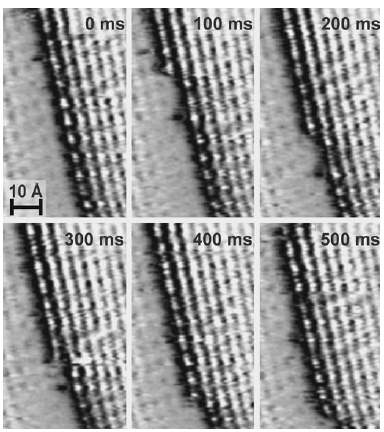
How can one conclude from Figure 11.23 that Cu atoms can diffuse rapidly over a well-ordered Au electrode in an electrochemical cell?Figure 11.23 0 ms 100 ms 200 ms 10 A 400 ms 300 ms 500 ms
Explain why the magnitude of the maximum work available from a battery can be greater than the magnitude of the reaction enthalpy of the overall cell reaction.
How is it possible to deposit Cu on a Au electrode at a potential lower than that corresponding to the reaction Cu2+ (aq) + 2e− → Cu(s)?
Show that if ΔGof (H+, aq) = 0 for all T, the potential of the standard hydrogen electrode is zero.
To determine standard cell potentials, measurements are carried out in very dilute solutions rather than at unit activity. Why is this the case?
By finding appropriate half-cell reactions, calculate the equilibrium constant at 298.15 K for the following reactions:a. 2Cd(s) + O2(g) + 2H2O(l) ⇋ 2Cd(OH)2 (s)b. 2MnO2(s) + 4OH–(aq) + O2(g) ⇋ 2MnO02–(aq) + 2H2O(i)
Determine K sp for AgBr at 298.15 K using the electrochemical cell described byAg(s)|Ag–(aq, aAg–)||Br–(aq, aBr–)|AgBr(s)Ag(s)
Consider the cell Pt(s)|H2(g,1atm)|H+ (aq, a = 1)|Fe3+ (aq),Fe2+ (aq)|Pt(s) given that Fe3+(aq) + e– ⇋ Fe2+ (aq) and E° = 0.771V.a. If the cell potential is 0.712V, what is the ratio of Fe2+ (aq) to Fe3+ (aq)?b. What is the ratio of these concentrations if the cell potential is 0.830V?c.
The equilibrium constant for the hydrolysis of dimethylamine,(CH3)2NH(aq) + H2O(aq) → CH3NH3+ (aq) + OH−(aq)Is 5.12 × 10⁻⁴. Calculate the extent of hydrolysis for a. A 0.210 m solution of (CH3)2NH in water using an iterative calculation until the answer is constant in the
Calculate the mean ionic molality and mean ionic activity of a 0.105 m K3PO4 solution for which the mean ionic activity coefficient is 0.225.
Express γ ± in terms of γ + and γ – fora. SrSO4 b. MgBr2c. K3PO4d. Ca(NO3)2. Assume complete dissociation.
Calculate the probability of finding an ion at a distance greater than 1/κ from the central ion.
Calculate the solubility of CaCO3 (K sp = 3.4 × 10⁻⁹)a. In pure H2O.b. In an aqueous solution with I = 0.0250 mol kg–1. For part (a), do an iterative calculation of γ ± and the solubility until the answer is constant in the second decimal place. Do you need to repeat this procedure in part (b)?
In the Debye–Hückel theory, the counter charge in a spherical shell of radius r and thickness dr around the central ion of charge +Q is given by −Qκ2re−κr dr. Calculate the radius at which the counter charge has its maximum value, r max , from this expression. Evaluate r max for a 0.090 m
Express μ± in terms of μ+ and μ− for a. NaCl,b. MgBr2c. Li3PO4d. Ca(NO3)2. Assume complete dissociation.
Calculate I, γ ±, and a± for a 0.0120 m solution of Na3PO4 at 298 K. Assume complete dissociation.
Calculate the ionic strength in a solution that is 0.0750 m in K2SO4, 0.0085 m in Na3PO4, and 0.0150 m in MgCl2.
Calculate ΔGo solvation in an aqueous solution for Rb+ (aq) using the Born model. The radius of the Rb+ ion is 161 pm.
Express a± in terms of a+ and a− for (a) Li2CO3(b) CaCl2(c) Na3PO4(d) K4Fe(CN)6. Assume complete dissociation.
Calculate ΔHoR and ΔGoR for the reaction Ba(NO3)2(aq) + 2KCl(aq) → BaCl2 (s) + 2KNO3(aq).
Estimate the degree of dissociation of a 0.200 m solution of nitrous acid (Ka = 4.00 × 10⁻⁴) that is also 0.500 m in the strong electrolyte given in parts (a)–(c). Use the data tables to obtain γ ± , as the electrolyte concentration is too high to use the Debye–Hückel limiting law.a.
From the data in Table 10.3 (see Appendix B, Data Tables), calculate the activity of the electrolyte in 0.200 m solutions assuming complete dissociation ofa. KCl b. Na2SO4 c. MgCl2
At 25°C, the equilibrium constant for the dissociation of acetic acid, Ka , is 1.75 × 10⁻⁵. Using the Debye–Hückel limiting law, calculate the degree of dissociation in 0.150 m and 1.50 m solutions using an iterative calculation until the answer is constant in the second decimal place.
Calculate the mean ionic activity of a 0.0350 m Na3PO4 solution for which the mean activity coefficient is 0.685.
A weak acid has a dissociation constant of Ka = 2.50 × 10⁻². a. Calculate the degree of dissociation for a 0.093m solution of this acid using the Debye–Hückel limiting law. b. Calculate the degree of dissociation for a 0.093m solution of this acid that is also 0.200m in KCl from the
Calculate the mean ionic molality, m±, in 0.0750 m solutions of a. Ca(NO3)2b. NaOHc. MgSO4d. AlCls.
Using the Debye–Hückel limiting law, calculate the value of γ ± in (a) A 7.2 × 10⁻³ m solution of NaBr(b) A 7.50 × 10⁻³ m solution of SrCl2(c) A 2.25 × 10⁻³ m solution of CaHPO4. Assume complete dissociation.
Calculate ΔS°R for the reaction AgNO3(aq) + KCl(aq) → AgCl(s) + KNO3(aq).
Calculate ΔS°R for the reaction Ba(NO3)2(aq) + 2KCl(aq) → BaCl2(s) + 2KNO3(aq).
It takes considerable energy to dissociate NaCl in the gas phase. Why does this process occur spontaneously in an aqueous solution? Why does it not occur spontaneously in CCl4?
How do you expect S°m for an ion in solution to change as the charge increases at constant ionic radius?
How do you expect S°m for an ion in solution to change as the ionic radius increases at constant charge?
Under what conditions does γ ± → 1 for electrolyte solutions?
Why is the inequality γ ± < 1 always satisfied in dilute electrolyte solutions?
What can you conclude about the interaction between ions in an electrolyte solution if the mean ionic activity coefficient is greater than one?
Why is the value for the dielectric constant for water in the solvation shell around ions less than that for bulk water?
Why do deviations from ideal behavior occur at lower concentrations for electrolyte solutions than for solutions in which the solute species are uncharged?
Why is it not appropriate to use ionic radii from crystal structures to calculate ΔG° solvation of ions using the Born model?
How does salting in affect solubility?
What is the correct order of the following inert electrolytes in their ability to increase the degree of dissociation of acetic acid?a. 0.001m NaClb. 0.001m KBrc. 0.10m CuCl2
Why does an increase in the ionic strength in the range where the Debye–Hückel law is valid lead to an increase in the solubility of a weakly soluble salt?
Why is it possible to formulate a general theory for the activity coefficient for electrolyte solutions, but not for Non-electrolyte solutions?
Why is it not possible to measure the activity coefficient of Na+ (aq)?
Tabulated values of standard entropies of some aqueous ionic species are negative. Why is this statement not inconsistent with the third law of thermodynamics?
How is the chemical potential of a solute related to its activity?
Showing 2900 - 3000
of 3563
First
22
23
24
25
26
27
28
29
30
31
32
33
34
35
36
Step by Step Answers

 Get 50% OFF
Claim Now
Get 50% OFF
Claim Now