New Semester
Started
Get
50% OFF
Study Help!
--h --m --s
Claim Now
Question Answers
Textbooks
Find textbooks, questions and answers
Oops, something went wrong!
Change your search query and then try again
S
Books
FREE
Study Help
Expert Questions
Accounting
General Management
Mathematics
Finance
Organizational Behaviour
Law
Physics
Operating System
Management Leadership
Sociology
Programming
Marketing
Database
Computer Network
Economics
Textbooks Solutions
Accounting
Managerial Accounting
Management Leadership
Cost Accounting
Statistics
Business Law
Corporate Finance
Finance
Economics
Auditing
Tutors
Online Tutors
Find a Tutor
Hire a Tutor
Become a Tutor
AI Tutor
AI Study Planner
NEW
Sell Books
Search
Search
Sign In
Register
study help
sciences
physical chemistry
Physical Chemistry 3rd edition Thomas Engel, Philip Reid - Solutions
How would you expect the partition function to vary with temperature? For example, what should the value of a partition function be at 0 K?
How is β related to temperature? What are the units of kT ?
What is degeneracy? Can you conceptually relate the expression for the partition function without degeneracy to that with degeneracy?
Why is the probability of observing a configuration of energy different from the Boltzmann distribution vanishingly small?
Explain the significance of the Boltzmann distribution. What does this distribution describe?
What does a partition function represent? Can you describe this term using concepts from probability theory?
What is an occupation number? How is this number used to describe energy distributions?
Describe what is meant by the phrase “the dominant configuration.”
How does one calculate the number of microstates associated with a given configuration?
What is meant by the “weight” of a configuration?
What is the difference between a configuration and a microstate?
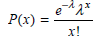
The Poisson distribution is a widely used discrete probability distribution in science:This distribution describes the number of events (x) occurring in a fixed period of time. The events occur with a known average rate corresponding to λ, and event occurrence does not depend on when
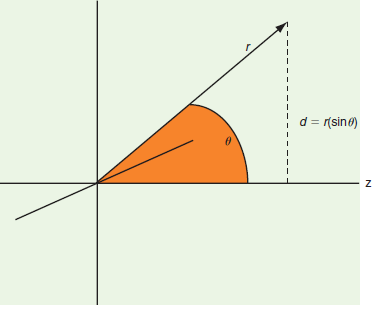
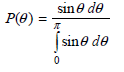
In nonlinear optical switching devices based on dye-doped polymer systems, the spatial orientation of the dye molecules in the polymer is an important parameter. These devices are generally constructed by orienting dye molecules with a large dipole moment using an electric field. Imagine placing a
Another use of distribution functions is determining the most-probable value, which is done by realizing that at the distribution maximum the derivative of the distribution function with respect to the variable of interest will be zero. Using this concept, determine the most probable value of x (0
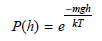
A crude model for the molecular distribution of atmospheric gases above the Earth€™s surface (denoted by height, h) can be obtained by considering the potential energy due to gravity:In this expression m is the per-particle mass of the gas, g is the acceleration due to gravity, k is a
One classic problem in quantum mechanics is the “harmonic oscillator.” In this problem a particle is subjected to a one-dimensional potential (taken to be along x) of the form V (x) ∝ x2, where −∞ ≤ x ≤ ∞. The probability distribution function for the particle in the
Consider the probability distribution for molecular velocities in one dimension (vx) given bya. Determine the normalization constant, C.b. Determine Ωvxλ.c. Determine Ωv2xλd. Determine the variance. P(v,) dv, = Cemv/2kT
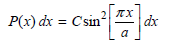
Consider the following probability distribution corresponding to a particle located between point x = 0 and x = a:a. Determine the normalization constant, C.b. Determine Ωxλ.c. Determine Ωx2λ.d. Determine the variance. P(x) dx = Csin? TX dx
Assume that the probability of occupying a given energy state is given by the relationship provided in Problem P29.27.In problem 29.27In a subsequent chapter we will encounter the energy distribution P (ε) = Ae−ε/kT, where P (ε) is the probability of a molecule occupying a given energy state,
In a subsequent chapter we will encounter the energy distribution P (ε) = Ae−ε/kT, where P (ε) is the probability of a molecule occupying a given energy state, ε is the energy of the state, k is a constant equal to 1.38 × 10⁻²³ J K−1, and T is temperature. Imagine that there are three
First-order decay processes as described in the previous problem can also be applied to a variety of atomic and molecular processes. For example, in aqueous solution the decay of singlet molecular oxygen (O2(1Δg)) to the ground-state triplet configuration proceeds according to:In the
Radioactive decay can be thought of as an exercise in probability theory. Imagine that you have a collection of radioactive nuclei at some initial time (N0) and are interested in how many nuclei will still remain at a later time (N). For first-order radioactive decay, N/N0 = e−kt. In this
You are at a carnival and are considering playing the dart game described in Example Problem 29.12; however, you are confident of your dart-throwing skills such that the probability of hitting the center area of the target is three times greater than the probability determined by area. Assuming the
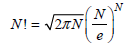
Another form of Stirling€™s approximation is:Use this approximation for N = 10, 50,100 and compare your results to those given in Example Problem 12.9. N! = V2N
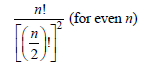
Simplify the following expressions:a.b. n! (п — 2)! n! (for even n)
In Chapter 34, we will model particle diffusion as a random walk in one dimension. In such processes, the probability of moving an individual step in the +x or −x direction is equal to one half. Imagine starting at x = 0 and performing a random walk in which 20 steps are taken.a. What is the
Imagine an experiment in which you flip a coin four times. Furthermore, the coin is balanced fairly such that the probability of landing heads or tails is equivalent. After tossing the coin 10 times, what is the probability of observing the following specific outcomes:a. No heads?b. Two heads?c.
Consider the 25 players on a professional baseball team. At any point, nine players are on the field.a. How many nine-player batting orders are possible given that the order of batting is important?b. How many nine-player batting orders are possible given that the all-star designated hitter must be
Fermions and bosons demonstrate different distribution statistics over a set of quantum states. However, in Chapter 31 we will encounter the Boltzmann distribution, in which we essentially ignore the differentiation between fermions and bosons. This is appropriate only in the “dilute limit,”
The Washington State Lottery consists of drawing five balls numbered 1 to 43, and a single ball numbered 1 to 23 from a separate machine.a. What is the probability of hitting the jackpot in which the values for all six balls are correctly predicted?b. What is the probability of predicting just the
In the neck of the flask depicted in the text, five red balls rest on five blue balls. Suppose the balls are tipped back into the flask, shaken, and the flask is re-inverted. What’s the probability that the order depicted in the figure will be seen?
The natural abundance of 13C is roughly 1%, and the abundance of deuterium (2H or D) is 0.015%. Determine the probability of finding the following in a mole of acetylene:a. H-13C-13C-Hb. D-12C-12C-Dc. H-13C-12C-D
Four bases (A, C, T, and G) appear in DNA. Assume that the appearance of each base in a DNA sequence is random.a. What is the probability of observing the sequence AAGACATGCA?b. What is the probability of finding the sequence GGGGGAAAAA?c. How do your answers to parts (a) and (b) change if the
Radio station call letters consist of four letters (for example, KUOW).a. How many different station call letters are possible using the 26 letters in the English alphabet?b. Stations west of the Mississippi River must use the letter K as the first call letter. Given this requirement, how many
Determine the numerical values for the following:a. The number of configurations employing all objects in a six-object set.b. The number of configurations employing four objects from a six-object set.c. The number of configurations employing no objects from a six-object set.d. C (50, 10).
Determine the number of permutations of size 3 that can be made from the set {1, 2, 3, 4, 5, 6}. Write down all of the permutations.
Evaluate the following:a. The number of permutations employing all objects in a six-object set.b. The number of permutations employing four objects from a six-object set.c. The number of permutations employing no objects from a six-object set.d. P (50, 10).
The natural molar abundance of 13C is roughly 1%. What is the probability of having a single 13C isotope in benzene (C6H6)? What is the probability that two 13C isotopes will be adjacent to each other in benzene?
Atomic chlorine has two naturally occurring isotopes, 35Cl and 37Cl. If the molar abundance of these isotopes is 75.4% and 24.6%, respectively, what fraction of a mole of molecular chlorine (Cl2) will have one of each isotope? What fraction will contain just the 35Cl isotope?
Proteins are made up of individual molecular units of unique structure known as amino acids. The order or “sequence” of amino acids is an important factor in determining protein structure and function. There are 20 naturally occurring amino acids.a. How many unique proteins consisting of 8
a. Consider assigning phone numbers to an area where each number consists of seven digits, each of which can be between 0 and 9. How many phone numbers can be assigned to the area?b. To serve multiple areas, you decide to introduce an area code which serves as an identifier. In the U.S., area codes
Answer Problem P29.3 assuming that “shaved” dice are used so that the number 6 appears twice as often as any other number.In Problem 29.3A pair of standard dice are rolled. What is the probability of observing the following:a. The sum of the dice is equal to 7.b. The sum of the dice is equal to
A pair of standard dice are rolled. What is the probability of observing the following:a. The sum of the dice is equal to 7.b. The sum of the dice is equal to 9.c. The sum of the dice is less than or equal to 7.
You are dealt a hand consisting of five cards from a standard deck of 52 cards. Determine the probability of obtaining the following hands:a. a flush (five cards of the same suit)b. a king, queen, jack, ten, and ace of the same suit (a “royal flush”)
Suppose that you draw a card from a standard deck of 52 cards. What is the probability of drawing:a. an ace of any suit?b. the ace of spades?c. How would your answers to parts (a) and (b) change if you were allowed to draw three times, replacing the card drawn back into the deck after each draw?
When is the higher moment of a probability distribution more useful as a benchmark value as opposed to simply using the mean of the distribution?
What is the difference between average and root-mean-squared?
What properties of atomic and molecular systems could you imagine describing using probability distributions?
When can one make the approximation of treating a probability distribution involving discrete variables as continuous?
Why is normalization of a probability distribution important? What would one have to consider when working with a probability distribution that was not normalized?
What must the outcome of a binomial experiment be if PE = 1?
What is a Bernoulli Trial?
What is Stirling’s approximation? Why is it useful? When is it applicable?
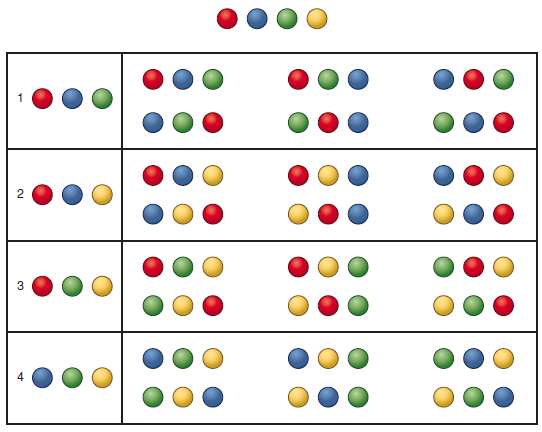
How does Figure 29.2 change if one is concerned with two versus three colored-ball configurations and permutations? 2. 3. 4)
What are the elements of a probability model, and how do they differ for continuous and discrete variables?
What is the difference between a configuration and a permutation?
Consider the first-order correction to the energy of interacting spins illustrated in Example Problem 28.3 for ψ2. Calculate the energy correction to the wave functions ψ1 = α(1) α(2), ψ2 = β(1) α(2), and ψ4 = β(1) β(2). Show that your results are consistent with ΔE = m1m2h J12 with m1
Predict the number of chemically shifted 1H peaks and the multiplet splitting of each peak that you would observe for 1-chloropropane. Justify your answer.
Calculate the spin energy eigenvalues for the wave functions ψ1 = α (1) α (2), ψ3 = α (1) β (2), and ψ4 = β (1) β (2). [Equation (28.15)] for noninteracting spins.
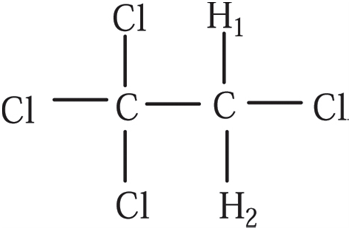
Predict the number of chemically shifted 1H peaks and the multiplet splitting of each peak that you would observe for 1, 1, 2-trichloroethane. Justify your answer.
Predict the number of chemically shifted 1H peaks and the multiplet splitting of each peak that you would observe for nitromethane. Justify your answer.
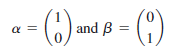
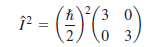
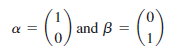
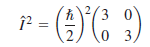
The nuclear spin operators can be represented as 2 × 2 matrices and α and β can be represented as column vectors in the formGiven thatAndShow thatAnd IÌ‚zβ = - 1/2 h̅β C) and B = () Îz h (0 h (0 h (1 9를
Predict the number of chemically shifted 1H peaks and the multiplet splitting of each peak that you would observe for nitroethane. Justify your answer.
Predict the number of chemically shifted 1H peaks and the multiplet splitting of each peak that you would observe for 1, 1, 2, 2-tetrachloroethane assuming that there is no rotation of the two substituted methyl groups around the C―C bond. Justify your answer.
Predict the number of chemically shifted1H peaks and the multiplet splitting of each peak that you would observe for 1,1,1,2-tetrachloroethane. Justify your answer. ÇI H1 -ċ-c-CI CI | Cl На
Some symmetry operations can be carried out physically using a ball-and-stick model of a molecule without disassembly and reassembly and others can only be imagined. Give two examples of each category.
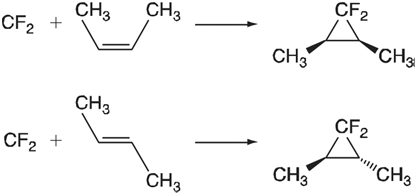
Singlet carbenes add to alkenes to yield cyclopropanes. Stereochemistry is maintained, meaning that cis- and trans-substituted alkenes give cis- and trans-substituted cyclopropanes, respectively; for example:This implies that the two σ bonds are formed more or less simultaneously,
A 250 MHz 1H spectrum of a compound shows two peaks. The frequency of one peak is 510. Hz higher than that of the reference compound (tetra-methylsilane) and the second peak is at a frequency 170. Hz lower than that of the reference compound. What chemical shift should be assigned to these two
Predict the number of chemically shifted 1H peaks and the multiplet splitting of each peak that you would observe for bromoethane. Justify your answer.
Using the matrix representation of the operators and spin eigenfunctions of Problem P28.7, show that the relationships listed in Equation (28.20) are obeyed.In Problem 28.7Given thatAndShow thatAnd IÌ‚zb = - 1/2 hb C) and B = () Îz h (0 h (0 h (1 9를
For a fixed frequency of the radiofrequency field, 1H, 13C, and 31P will be in resonance at different values of the static magnetic field. Calculate the value of B0 for these nuclei to be in resonance if the radiofrequency field has a frequency of 250. MHz.
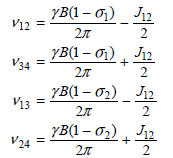
Using your results from the previous problems, show that there are four possible transitions between the energy levels of two interacting spins and that the frequencies are given by YB(1 – 07) V12 = 2 YB(1 – 01) J12 V34 = 2 YB(1 – 02) J12 V13 = 27 YB(1– 02) + V24 = 2л
Predict the number of chemically shifted +1H peaks and the multiplet splitting of each peak that you would observe for diethyl ether. Justify your answer.
Explain the difference in the mechanism that gives rise to through-space dipole–dipole coupling and through-bond coupling.
Explain why two magnetic fields, a static field and a radiofrequency field, are needed to carry out NMR experiments. Why must the two field directions be perpendicular?
Explain why T1 ≥ T2.
Order the molecules CH3I, CH3Br, CH3Cl, and CH3F in terms of increasing chemical shift for +1H. Explain your answer.
Why is the measurement time in NMR experiments reduced by using Fourier transform techniques?
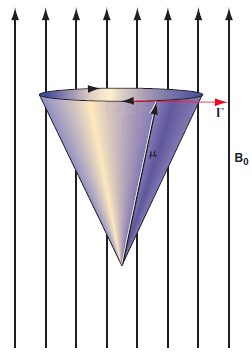
Redraw Figure 28.2 for β spins. What is the direction of precession for the spins and for the macroscopic magnetic moment? г Bo VA VVA
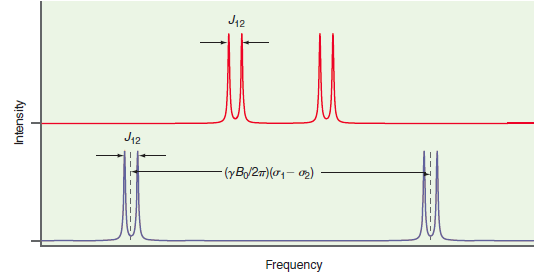
Why are the multiplet splittings in Figure 28.9 not dependent on the static magnetic field? J12 J42 (yB/2m)(01- 2) Frequency Intensity -----
Why does the H atom on the OH group not lead to a multiplet splitting of the methyl hydrogens of ethanol?
Why is the multiplet splitting for coupled spins independent of the static magnetic field?
Why does NMR lead to a higher contrast in the medical imaging of soft tissues than X-ray techniques?
Why do magnetic field in-homogeneities of only a few parts per million pose difficulties in NMR experiments?
What is the advantage of a 2-D NMR experiment over a 1-D NMR experiment?
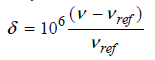
Why is it useful to define the chemical shift relative to a reference compound as follows? 8 = 10°- Vref) Vref
Why do neighboring groups lead to a net induced magnetic field at a given spin in a molecule in the solid state, but not for the same molecule in solution?
Why can the signal loss resulting from spin dephasing caused by magnetic field in-homogeneities and chemical shift be recovered in the spin-echo experiment?
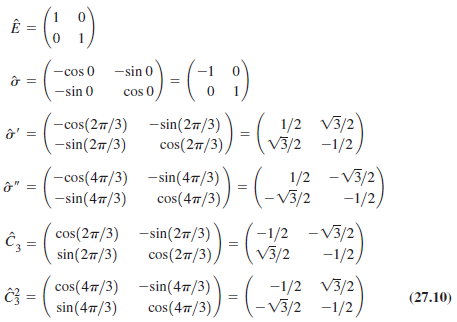
Use the 2 × 2 matrices of Equation (27.10) to derive the multiplication table for the C3vgroup. -(: ) ) - (: ) -sin 0 -cos 0 cos 0 -sin 0 1 1/2 V3/2 (V3/2 -1/2, -cos(27/3) -sin(27/3) -sin(27/3) ô' = cos(27/3) ( )-( :) -(-~ -cos(47/3) -sin(47/3) -sin(47/3) 1/2 -V3/2) ô" - V3/2 -1/2)
The C4v group has the following classes: E, 2C4, C2, 2σv, and 2σd. How many irreducible representations does this group have and what is the dimensionality of each? σd refers to a dihedral mirror plane. For example in the molecule BrF5, the σ v mirror planes each contain two of the equatorial F
Show that a molecule with a Cn axis cannot have a dipole moment perpendicular to the axis.
Assume that a central atom in a molecule has ligands with C4v symmetry. Decide by evaluating the appropriate transition dipole element if the transition px → pz is allowed with the electric field in the z direction.
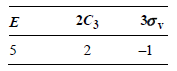
Decompose the following reducible representation into irreducible representations of the C3vgroup: 30v 2C3 –1 5 2.
Show that the presence of a C2 axis and a mirror plane perpendicular to the rotation axis imply the presence of a center of inversion.
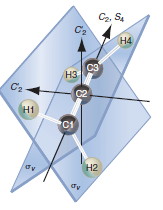
CH4belongs to the Tdpoint group with the following symmetry elements: E, 4C3, 4C23, 3C2, 3S4, 3S34, and 6σ. Make a drawing similar to Figure 27.1 showing these elements. C2, S. C2 НА СЗ нЗ C2 C2 Н1 ст Н2 dv C, Sa C1 ск. CБ си C2 C12
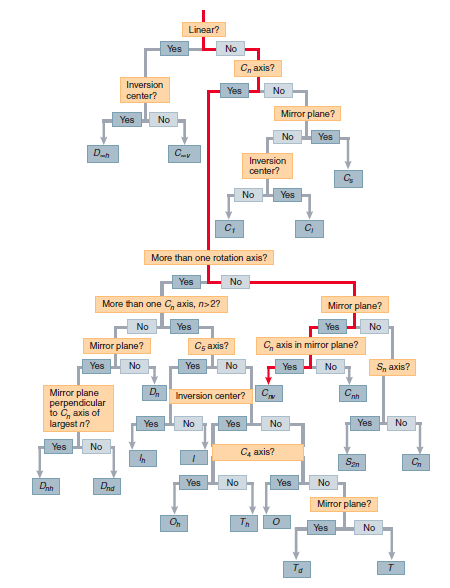
Use the logic diagram of Figure 27.2 to determine the point group for CH3Cl. Indicate your decision-making process as was done in the text for NH3.a. linear?b. Cn axis?c. more than 1Cn axis?d. σ plane?e. C3 lies in σ? Linear? Yes No Сп ахis? Inversion No Yes center? Mirror
Consider the function f (x, y) = xy integrated over a square region in the xy plane centered at the origin.a. Draw contours of constant f values (positive and negative) in the plane and decide whether the integral can have a nonzero value. Any square region centered at the origin will have equal
Use the method illustrated in Example Problem 27.2 to generate a 3 × 3 matrix for the following:a. Ĉ6 operatorb. Ŝ4 operatorc. î operator
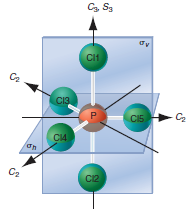
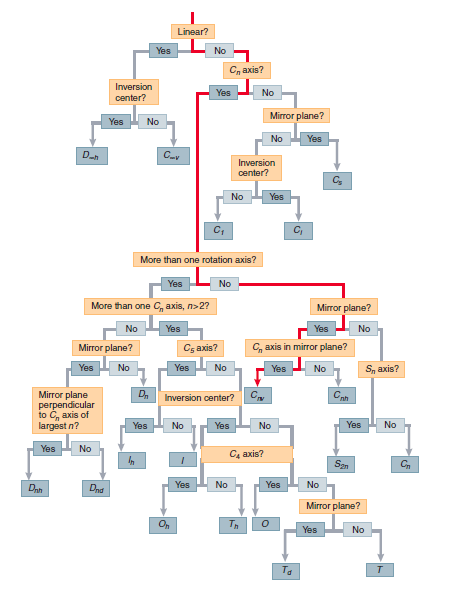
Use the logic diagram of Figure 27.2 to determine the point group for PCl5. Indicate your decision-making process as was done in the text for NH3.a. linear?b. Cn axis?c. more than 1Cn axis?d. more than 1Cn axis, n > 2?e. σ plane?f. σŠ¥ to C2? Linear? Yes No
Show that z is a basis for the A1 representation and that RZ is a basis for the A2 representation of the C3v group.
Showing 2100 - 2200
of 3563
First
15
16
17
18
19
20
21
22
23
24
25
26
27
28
29
Last
Step by Step Answers

 Get 50% OFF
Claim Now
Get 50% OFF
Claim Now



![[0,('4,)] -(2.4x10' s-1)r](https://dsd5zvtm8ll6.cloudfront.net/si.question.images/images/question_images/1525/7/5/6/5215af13269ccf531525756507625.jpg)