New Semester
Started
Get
50% OFF
Study Help!
--h --m --s
Claim Now
Question Answers
Textbooks
Find textbooks, questions and answers
Oops, something went wrong!
Change your search query and then try again
S
Books
FREE
Study Help
Expert Questions
Accounting
General Management
Mathematics
Finance
Organizational Behaviour
Law
Physics
Operating System
Management Leadership
Sociology
Programming
Marketing
Database
Computer Network
Economics
Textbooks Solutions
Accounting
Managerial Accounting
Management Leadership
Cost Accounting
Statistics
Business Law
Corporate Finance
Finance
Economics
Auditing
Tutors
Online Tutors
Find a Tutor
Hire a Tutor
Become a Tutor
AI Tutor
AI Study Planner
NEW
Sell Books
Search
Search
Sign In
Register
study help
sciences
physical chemistry
Physical Chemistry 3rd edition Thomas Engel, Philip Reid - Solutions
Why does the relation CP > CV always hold for a gas? Can CP < CV be valid for a liquid?
Why didn’t Joule change his experiment to make C surroundings /C system approx = 0.001 to increase the sensitivity of the apparatus?
What is the physical basis for the experimental result that U is a function of V at constant T for a real gas? Under what conditions will U decrease as V increases?
The heat capacity CP,m is less than CV ,m for H2O(l) near 4°C. Explain this result.
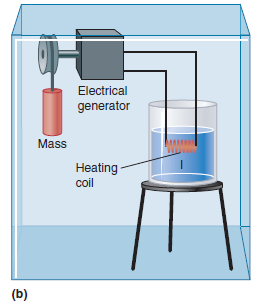
In the experiment shown in Figure 2.4b, the weight drops in a very short time. How will the temperature of the water change with time?Figure 2.4b Electrical generator Mass Heating - coil (b)
Explain the relationship between the terms exact differential and state function.
A chemical reaction occurs in a constant volume enclosure separated from the surroundings by diathermal walls. Can you say whether the temperature of the surroundings increases, decreases, or remains the same in this process? Explain.
Explain how a mass of water in the surroundings can be used to determine q for a process. Calculate q if the temperature of a 1.00 kg water bath in the surroundings increases by 1.25°C. Assume that the surroundings are at a constant pressure.
What is wrong with the following statement? Because the well-insulated house stored a lot of heat, the temperature didn’t fall much when the furnace failed. Rewrite the sentence to convey the same information in a correct way.
You have a liquid and its gaseous form in equilibrium in a piston and cylinder assembly in a constant temperature bath. Give an example of an irreversible process.
Why is it incorrect to speak of the heat or work associated with a system?
Derive a formula for ΔHoR (T) for the reaction CO(g) +1/2O2 (g) → CO2(g) assuming that the heat capacities of reactants and products do not change with temperature.
Suppose an adult is encased in a thermally insulating barrier so that all the heat evolved by metabolism of foodstuffs is retained by the body. What is her temperature increase after 2.5 hours? Assume the heat capacity of the body is 4.18 J g−1K−1 and that the heat produced by metabolism is 9.4
For 1.25 mol of an ideal gas, P external = P =350. × 103 Pa.The temperature is changed from 135°C to 21.2°C, and CV ,m = 3/2R. Calculate q, w, ΔU, and ΔH.
A nearly flat bicycle tire becomes noticeably warmer after it has been pumped up. Approximate this process as a reversible adiabatic compression. Assume the initial pressure and temperature of the air before it is put in the tire to be Pi = 1.00 bar and Ti = 280.K. The final pressure in the tire is
A 3.50 mole sample of an ideal gas with CV ,m = 3/2R is expanded adiabatically against a constant external pressure of 1.45 bar. The initial temperature and pressure are Ti = 310.K and Pi = 15.2 bar. The final pressure is Pf = 1.45 bar. Calculate q, w, ΔU, and ΔH for the process.
A 2.35 mole sample of an ideal gas, for which CV ,m = 3/2R, initially at 27.0°C and 1.75 × 10⁶ Pa undergoes a two stage transformation. For each of the stages described in the following list, calculate the final pressure, as well as q, w, ΔU, and ΔH. Also calculate q, w, ΔU, and ΔH for the
A 2.50 mol sample of an ideal gas for which CV ,m = 3/2R undergoes the following two-step process: a. From an initial state of the gas described by T = 13.1????C and P = 1.75 × 10⁵ Pa, the gas undergoes an isothermal expansion against a constant external pressure of 3.75 × 10⁴ Pa until
A major league pitcher throws a baseball with a speed of 162 kilometers per hour. If the baseball weighs 235 grams and its heat capacity is 1.7 J g−1 K−1, calculate the temperature rise of the ball when it is stopped by the catcher’s mitt. Assume no heat is transferred to the catcher’s mitt
A 3.50 mole sample of N2 in a state defined by Ti = 250.K and Vi = 3.25 L undergoes an isothermal reversible expansion until Vf = 35.5 L. Calculate w assuming a. That the gas is described by the ideal gas law b. That the gas is described by the van der Waals equation of state. What is the percent
Many processes such as the fabrication of integrated circuits are carried out in a vacuum chamber to avoid reaction of the material with oxygen in the atmosphere. It is difficult to routinely lower the pressure in a vacuum chamber below 1.0 × 10⁻¹⁰ Torr. Calculate the molar density at this
A mixture of oxygen and hydrogen is analyzed by passing it over hot copper oxide and through a drying tube. Hydrogen reduces the CuO according to the reaction CuO(s) + H2(g) → Cu(s) + H2O(l), and oxygen reoxidizes the copper formed according to Cu(s) + 1/2O2 (g) → CuO(s). At
A rigid vessel of volume 0.400 m3 containing H2 at 21.25°C and a pressure of 715 × 103 Pa is connected to a second rigid vessel of volume 0.750 m3 containing Ar at 30.15°C at a pressure of 203 × 103 Pa. A valve separating the two vessels is opened and both are cooled to a temperature of
Use the ideal gas and van der Waals equations to calculate the pressure when 2.25 mol H2 are confined to a volume of 1.65 L at 298 K. Is the gas in the repulsive or attractive region of the molecule–molecule potential?
A typical diver inhales 0.450 liters of air per breath and carries a 25 L breathing tank containing air at a pressure of 300. bar. As she dives deeper, the pressure increases by 1 bar for every 10.08 m. How many breaths can the diver take from this tank at a depth of 35 m? Assume that the
Consider a 31.0 L sample of moist air at 60.°C and one atm in which the partial pressure of water vapor is 0.131 atm. Assume that dry air has the composition 78.0 mole percent N2, 21.0 mole percent O2, and 1.00 mole percent Ar.a. What are the mole percentages of each of the gases in the sample?b.
A vessel contains 1.15 g liq H2O in equilibrium with water vapor at 30.°C. At this temperature, the vapor pressure of H2O is 31.82 torr. What volume increase is necessary for all the water to evaporate?
A 455 cm3 vessel contains a mixture of Ar and Xe. If the mass of the gas mixture is 2.245 g at 25.0°C and the pressure is 760. Torr, calculate the mole fraction of Xe in the mixture.
Use L’Hôpital’s rule lim [f(x)/g(x)]x → 0 = lim [df(x)dx/dg(x)/dx]x → 0 to show that the expression derived for Pf in part b of Example problem 1.1 hane the correct limit as y → 0.
A glass bulb of volume 0.198 L contains 0.457 g of gas at 759.0 Torr and 134.0°C. What is the molar mass of the gas?
As a result of photosynthesis, an acre of forest (1 acre = 4047 square meter) can take up 1000. kg of CO2. Assuming air is 0.0314% CO2 by volume, what volume of air is required to provide 350. kg of CO2? Assume T = 310 K and P = 1.00 atm.
Calculate the volume of all gases evolved by the complete oxidation of 0.375 g of the amino acid alanine NH2CHCH3COOH if the products are liquid water, nitrogen gas, and carbon dioxide gas, the total pressure is 1.00 atm, and T = 298 K.
Liquid N2 has a density of 875.4 kg m−3 at its normal boiling point. What volume does a balloon occupy at 298 K and a pressure of 1.00 atm if 3.10 × 10⁻³ L of liquid N2 is injected into it? Assume that there is no pressure difference between the inside and outside of the balloon.
Suppose that you measured the product PV of 1 mol of a dilute gas and found that PV = 24.35 L atm at 0.00°C and 33.54 L atm at 100.°C. Assume that the ideal gas law is valid, with T = t(°C) + a, and that the values of R and a are not known. Determine R and a from the measurements provided.
The total pressure of a mixture of oxygen and hydrogen is 1.65 atm. The mixture is ignited and the water is removed. The remaining gas is pure hydrogen and exerts a pressure of 0.190 atm when measured at the same values of T and V as the original mixture. What was the composition of the original
Carbon monoxide competes with oxygen for binding sites on the transport protein hemoglobin. CO can be poisonous if inhaled in large quantities. A safe level of CO in air is 50. parts per million (ppm). When the CO level increases to 800. ppm, dizziness, nausea, and unconsciousness occur, followed
A balloon filled with 11.50 L of Ar at 18.7°C and one atm rises to a height in the atmosphere where the pressure is 207 Torr and the temperature is –32.4°C. What is the final volume of the balloon? Assume that the pressure inside and outside the balloon have the same value.
A sealed flask with a capacity of 1.22 dm3 contains 4.50 g of carbon dioxide. The flask is so weak that it will burst if the pressure exceeds 9.500 × 10⁵ Pa. At what temperature will the pressure of the gas exceed the bursting pressure?
A mixture of H2 and NH3 has a volume of 139.0 cm3 at 0.00°C and 1 atm. The mixture is cooled to the temperature of liquid nitrogen, at which ammonia freezes out and the remaining gas is removed from the vessel. Upon warming the vessel to 0.00°C and 1 atm, the volume is 77.4 cm3. Calculate the
Consider a gas mixture in a 1.50-dm3 flask at 22.0°C. For each of the following mixtures, calculate the partial pressure of each gas, the total pressure, and the composition of the mixture in mole percent:a. 3.06 g H2 and 2.98 g O2b. 2.30 g N2 and 1.61 g O2c. 2.02 g CH4 and 1.70 g NH3
Calculate the number of molecules per m3 in an ideal gas at the standard temperature and pressure conditions of 0.00°C and 1.00 atm.
What is wrong with the following statement? Burns caused by steam at 100°C can be more severe than those caused by water at 100°C because steam contains more heat than water. Rewrite the sentence to convey the same information in a correct way.
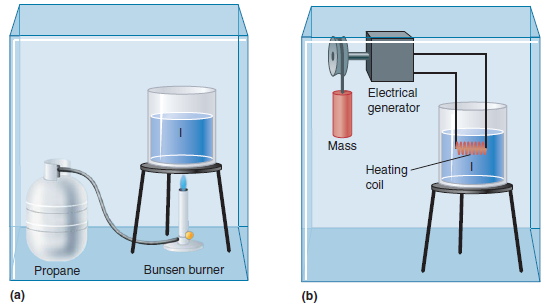
In the experiment shown in Figure 2.4a and 2.4b, ΔUsurroundings< 0, but ΔTsurroundings> 0. Explain how this is possible.Figure 2.4 Electrical generator Mass Heating- coil Bunsen burner Propane (a) (b)
A cup of water at 278 K (the system) is placed in a microwave oven and the oven is turned on for 1 minute during which it begins to boil. State whether each of q, w, and ΔU is positive, negative, or zero?
For a constant pressure process, ΔH = qp. Does it follow that qp is a state function? Explain.
Describe how reversible and irreversible expansions differ by discussing the degree to which equilibrium is maintained between the system and the surroundings.
You have a liquid and its gaseous form in equilibrium in a piston and cylinder assembly in a constant temperature bath. Give an example of a reversible process.
Two ideal gas systems undergo reversible expansion under different conditions starting from the same P and V. At the end of the expansion, the two systems have the same volume. The pressure in the system that has undergone adiabatic expansion is lower than in the system that has undergone
Electrical current is passed through a resistor immersed in a liquid in an adiabatic container. The temperature of the liquid is varied by 1°C. The system consists solely of the liquid. Does heat or work flow across the boundary between the system and surroundings? Justify your answer.
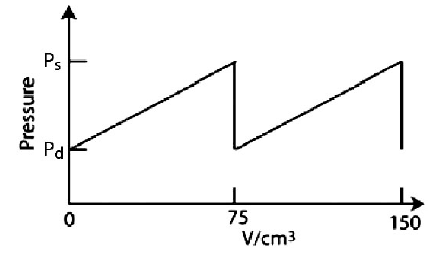
Assume the following simplified dependence of the pressure in a ventricle of the human heart as a function of the volume of blood pumped.Ps , the systolic pressure, is 120. mm Hg, corresponding to 0.158 atm. Pd , the diastolic pressure, is 80.0 mm Hg, corresponding to 0.105 atm. If the volume of
A 1.75 mole sample of an ideal gas is compressed isothermally from 62.0 L to 19.0 L using a constant external pressure of 2.80 atm. Calculate q, w, ΔU, and ΔH.
DNA can be modeled as an elastic rod which can be twisted or bent. Suppose a DNA molecule of length L is bent such that it lies on the arc of a circle of radius Rc. The reversible work involved in bending DNA without twisting is w bend =BL/2R2c where B is the bending force constant. The DNA in a
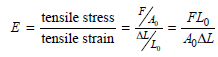
The Young’s modulus (see P2.40) of muscle fiber is approximately 2.80 × 10⁷ Pa. A muscle fiber 3.25 cm in length and 0.125 cm in diameter is suspended with a mass M hanging at its end. Calculate the mass required to extend the length of the fiber by 10%.
The formalism of the Young€™s modulus is sometimes used to calculate the reversible work involved in extending or compressing an elastic material. Assume a force F is applied to an elastic rod of cross-sectional area A0 and length L0. As a result of this force, the rod changes in
An ideal gas undergoes a single-stage expansion against a constant external pressure P external = Pf at constant temperature from T,Pi ,Vi , to T,Pf ,Vf . a. What is the largest mass m that can be lifted through the height h in this expansion?b. The system is restored to its initial state in a
A 1.75 mole sample of an ideal gas for which CV ,m = 20.8 J K-1 mol-1 is heated from an initial temperature of 21.2°C to a final temperature of 380.°C at constant volume. Calculate q, w, ΔU, and ΔH for this process.
Calculate ΔH and ΔU for the transformation of 2.50 mol of an ideal gas from 19.0°C and 1.00 atm to 550.°C and 19.5 atm ifCP,m = 20.9 + 0 042 T/K in units of J K-1 mol-1.
A pellet of Zn of mass 31.2 g is dropped into a flask containing dilute H2SO4 at a pressure of P = 1.00 bar and temperature of T = 300.K. What is the reaction that occurs? Calculate w for the process.
Consider the adiabatic expansion of 0.500 mol of an ideal monatomic gas with CV ,m = 3/2R. The initial state is described by P = 6.25 bar and T = 300.K. a. Calculate the final temperature if the gas undergoes a reversible adiabatic expansion to a final pressure of P = 1.25 bar. b.
One mole of an ideal gas is subjected to the following changes. Calculate the change in temperature for each case if CV,m = 3/2R. a. q = −425 J, w = 185 Jb. q = 315. J, w = −315 Jc. q = 0, w = 225 J
An automobile tire contains air at 225. × 103 Pa at 25.0°C. The stem valve is removed and the air is allowed to expand adiabatically against the constant external pressure of one bar until P = P external . For air, CV ,m = 5 2R. Calculate the final temperature. Assume ideal gas behavior.
Consider the isothermal expansion of 2.35 mol of an ideal gas at 415 K from an initial pressure of 18.0 bar to a final pressure of 1.75 bar. Describe the process that will result in the greatest amount of work being done by the system with P external ≥ 1.75 bar, and calculate w. Describe the
For a gas at a given temperature, the compression factor z is described by the empirical equationwhere P° = 1 bar. Calculate the fugacity coefficient for P = 150., 250., 350., 450., and 550. bar. For which of these values is the fugacity coefficient greater than 1? z = 1- 8.50 x 10³- + 3.50 x
A 1.75 mole sample of an ideal gas for which P = 2.50 bar and T = 335 K is expanded adiabatically against an external pressure of 0.225 bar until the final pressure is 0.225 bar. Calculate the final temperature, q, w, ΔH, and ΔU for a. CV ,m = 3/2 Rb. CV ,m = 5/2 R.
For values of z near one, it is a good approximation to write z(P) = 1 + (∂z/∂P)T. P. If z = 1.00104 at 298 K and 1 bar, and the Boyle temperature of the gas is 155 K, calculate the values of a, b, and Vm for the van der Waals gas.
Calculate the P and T values for which Br2(g) is in a corresponding state to Xe(g) at 330. K and 72.0 bar.
Benzoic acid, 1.35 g, is reacted with oxygen in a constant volume calorimeter to form H2O(l) and CO2(g) at 298 K. The mass of the water in the inner bath is 1.55 × 10³ g. The temperature of the calorimeter and its contents rises 2.76 K as a result of this reaction. Calculate the calorimeter
One mole of Ar initially at 310. K undergoes an adiabatic expansion against a pressure P external = 0 from a volume of 8.5 L to a volume of 82.0 L. Calculate the final temperature using the ideal gas and van der Waals equations of state. Assume CV ,m = 3/2 R.
Assume that the equation of state for a gas can be written in the form P(Vm − b(T)) = RT. Derive an expression for β = 1/V (∂V /∂T)P and κ = −1/V (∂V /∂P)T for such a gas in terms of b(T), db(T)/dT, P, and Vm.
a. Using the relationships derived in Example Problem 7.1 and the values of the critical constants for water from Table 7.2, calculate values for the van der Waals parameters a, b, and R from zc , Tc , Pc , and Vc. Do your results agree with those in Tables 1.2 and 7.4 in Appendix A?b. Calculate
A sample of Na2SO4(s) is dissolved in 225 g of water at 298 K such that the solution is 0.325 molar in Na2SO4 . A temperature rise of 0.146°C is observed. The calorimeter constant is 330. J K–1. Calculate the enthalpy of solution of Na2SO4 in water at this concentration. Compare your result with
A van der Waals gas has a value of z = 1.00061 at 410. K and 1 bar and the Boyle temperature of the gas is 195 K. Because the density is low, you can calculate Vm from the ideal gas law. Use this information and the result of Problem 7.28, z ≈ 1 + (b − a/RT)(1/Vm), to estimate a and b.
21.05 g of steam at 373 K is added to 415 g of H2O(l) at 298 K at a constant pressure of 1 bar. Is the final state of the system steam or liquid water? Calculate ΔS for the process.
When Julius Caesar expired, his last exhalation had a volume of 450. cm3 and contained 1.00 mole percent argon. Assume that T = 300.K and P = 1.00 atm at the location of his demise. Assume further that T has the same value throughout the Earth’s atmosphere. If all of his exhaled Ar atoms are now
A 2.25 mole sample of carbon dioxide, for which CP,m = 37.1 J K-1 mol-1 at 298 K, is expanded reversibly and adiabatically from a volume of 4.50 L and a temperature of 298 K to a final volume of 32.5 L. Calculate the final temperature, q, w, ΔH, and ΔU. Assume that CP,m is constant
a. Calculate ΔS if 1.00 mol of liquid water is heated from 0.00°C to 10.0°C under constant pressure if CP,m = 75.3 J K-1 mol-1 .b. The melting point of water at the pressure of interest is 0.00°C and the enthalpy of fusion is 6.010 kJ mol–1. The boiling point is 100.°C and the enthalpy of
The heat capacity of solid lead oxide is given byCalculate the change in enthalpy of 1.75 mol of PbO(s) if it is cooled from 825 to 375 K at constant pressure. 44.35 + 1.47 х10 — in units of J K-1 mol1 Срж к
Assume that air has a mean molar mass of 28.9 g mol−1 and that the atmosphere has a uniform temperature of 25.0°C. Calculate the barometric pressure in Pa in Santa Fe, for which z = 7000. ft. Use the information contained in Problem P1.20.
Calculate ˆ†HoRand ˆ†UoRfor the oxidation of benzene (g). Also calculate ΔΗ-ΔU ΔΗΡ R.
In an adiabatic compression of one mol of an ideal gas with CV ,m = 5/2 R, the temperature rises from 278 K to 450. K. Calculate q, w, ΔH, and ΔU.
Does the enthalpy of formation of H2O(l) change if the absolute enthalpies of H2(g) and O2(g) are set equal to 100. kJ mol−1 rather than to zero? Answer the same question for CO2(g). Will ΔHoR for the reaction H2O(l) + CO2(g) → H2CO3(l) change as a result of this change in the
The heat capacity of α -quartz is given byThe coefficient of thermal expansion is given by β = 0.3530 × 10ˆ’4 Kˆ’1 and Vm = 22.6 cm3 mol+. Calculate ΔSm for the transformation α -quartz (15.0°C,1atm)
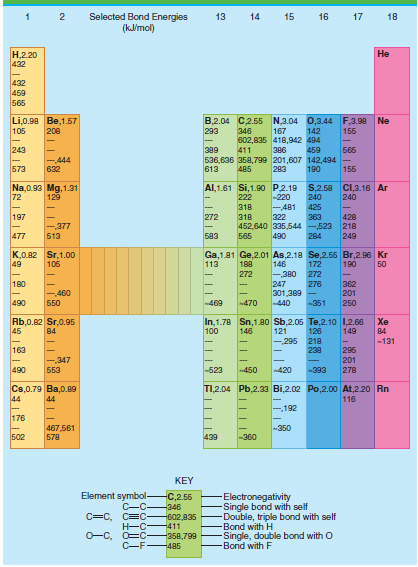
Calculate the average C€”H bond enthalpy in methane using the data tables. Calculate the percent error in equating the average C€”H bond energy in Table 4.3 with the bond enthalpy.Table 4.3 Selected Bond Energies (klmol) 13 14 15 16 17 18 Н.220 432 Не 432 459 565 B,2.04 C2.55
Consider the oxidation of the amino acid glycine NH2CH2COOH to produce water, carbon dioxide, and urea NH2CONH2:NH2CH2COOH(s) + 3O2(g) → NH2CONH2(s) + 3CO2(g) + 3H2O(l)Calculate the volume of carbon dioxide evolved at P = 1.00 atm and T = 305.K from the oxidation of 0.022 g of glycine.
Equation (1.19) states that the total pressure in a mixture of gases is equal to the sum of the partial pressures. Is this equation valid for real gases? If so, under what conditions?
You have calculated the pressure exerted by ethane using the ideal gas law and the Redlich–Kwong equations of state. How do you decide if the repulsive or attractive part of the molecular potential dominates under the given conditions?
Which of Ne or Ar has the larger van der Waals parameter b? Explain your reasoning.
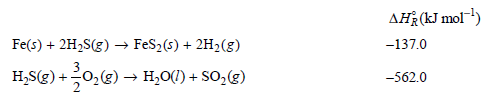
From the following data at 298.15 K as well as data in Table 4.1 (Appendix B, Data Tables), calculate the standard enthalpy of formation of H2S(g) and of FeS2(s): AĦR(kJ mol) Fe(s) + 2H2S(g) –→ FeS2(s) + 2H2(g) -137.0 H;S(g) + 0,(g) → H,O() + SO,(E) -562.0
Which of Ne or Ar has the larger van der Waals parameter a? Explain your reasoning.
Calculate the entropy of one mole of water vapor at 175°C and 0.625 bar using the information in the data tables.
An ideal gas described by Ti = 275 K, Pi = 1.10 bar, and Vi = 10.0 L is heated at constant volume until P = 10.0 bar. It then undergoes a reversible isothermal expansion until P = 1.10 bar. It is then restored to its original state by the extraction of heat at constant pressure. Depict this
An initial step in the biosynthesis of glucose C6H12O6 is the carboxylation of pyruvic acid CH3COCOOH to form oxaloacetic acid HOOCCOCH2COOHCH3COCOOH(s) + CO2(g) → HOOCCOCH2COOH(s)If you knew nothing else about the intervening reactions involved in glucose biosynthesis other than no further
Show that the van der Waals and Redlich–Kwong equations of state reduce to the ideal gas law in the limit of low gas density.
Will the fugacity coefficient of a gas above the Boyle temperature be less than 1 at low pressures?
One liter of fully oxygenated blood can carry 0.18 liters of O2 measured at T = 298 K and P = 1.00 atm. Calculate the number of moles of O2 carried per liter of blood. Hemoglobin, the oxygen transport protein in blood has four oxygen binding sites. How many hemoglobin molecules are required to
An ideal gas undergoes an expansion from the initial state described by Pi, Vi , T to a final state described by Pf , Vf , T in a. A process at the constant external pressure Pf. b. In a reversible process. Derive expressions for the largest mass that can be lifted through a height h in
In the absence of turbulent mixing, the partial pressure of each constituent of air would fall off with height above sea level in the Earth’s atmosphere as Pi = Pi0e-M,g/RT where Pi is the partial pressure at the height z,Pi0 is the partial pressure of component i at sea level, g is the
By looking at the a and b values for the van der Waals equation of state, decide whether 1 mole of O2 or H2O has the higher pressure at the same value of T and V.
Is the following statement correct? If not rewrite it so that it is correct. The standard state of water is H2O(g).
A system containing argon gas is at pressure P1 and temperature T1. How would you go about estimating the fugacity coefficient of the gas?
Showing 3300 - 3400
of 3563
First
22
23
24
25
26
27
28
29
30
31
32
33
34
35
36
Step by Step Answers

 Get 50% OFF
Claim Now
Get 50% OFF
Claim Now