New Semester
Started
Get
50% OFF
Study Help!
--h --m --s
Claim Now
Question Answers
Textbooks
Find textbooks, questions and answers
Oops, something went wrong!
Change your search query and then try again
S
Books
FREE
Study Help
Expert Questions
Accounting
General Management
Mathematics
Finance
Organizational Behaviour
Law
Physics
Operating System
Management Leadership
Sociology
Programming
Marketing
Database
Computer Network
Economics
Textbooks Solutions
Accounting
Managerial Accounting
Management Leadership
Cost Accounting
Statistics
Business Law
Corporate Finance
Finance
Economics
Auditing
Tutors
Online Tutors
Find a Tutor
Hire a Tutor
Become a Tutor
AI Tutor
AI Study Planner
NEW
Sell Books
Search
Search
Sign In
Register
study help
sciences
physical chemistry
Physical Chemistry 3rd edition Thomas Engel, Philip Reid - Solutions
A vessel containing 1.50 mol of an ideal gas with Pi = 1.00 bar and CP,m = 5/2R is in thermal contact with a water bath. Treat the vessel, gas, and water bath as being in thermal equilibrium, initially at 298 K, and as separated by adiabatic walls from the rest of the universe. The vessel, gas, and
A gas sample is known to be a mixture of ethane and butane. A bulb having a 230.0 cm3 capacity is filled with the gas to a pressure of 97.5 × 10³ Pa at 23.1°C. If the mass of the gas in the bulb is 0.3554 g, what is the mole percent of butane in the mixture?
The value of the Boyle temperature increases with the strength of the attractive interactions between molecules. Arrange the Boyle temperatures of the gases Ar, CH4, and C6H6 in increasing order.
A 2.25 mole sample of an ideal gas with CV ,m = 3/2R initially at 310. K and 1.25 × 10⁵ Pa undergoes a reversible adiabatic compression. At the end of the process, the pressure is 3.10 × 10⁶ Pa. Calculate the final temperature of the gas. Calculate q, w, ΔU, and ΔH for this process.
A van der Waals gas undergoes an isothermal reversible expansion under conditions such that z < 1. Is the work done more or less than if the gas followed the ideal gas law?
A sample of propane (C3H8) is placed in a closed vessel together with an amount of O2 that is 2.15 times the amount needed to completely oxidize the propane to CO2 and H2O at constant temperature. Calculate the mole fraction of each component in the resulting mixture after oxidation, assuming that
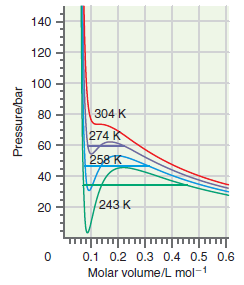
Explain why the oscillations in the two-phase coexistence region using the Redlich€“Kwong and van der Waals equations of state (see Figure 7.4) do not correspond to reality.Figure 7.4 140 120 100 304 K 80 274 K 60 258 K 40 243 K 20 ןיע ןוידד 0.1 0.2 0.3 0.4 0.5 0.6 Molar volume/L
A bottle at 325 K contains an ideal gas at a pressure of 162.5 × 10³ Pa. The rubber stopper closing the bottle is removed. The gas expands adiabatically against P external = 120.0 × 10³ Pa, and some gas is expelled from the bottle in the process. When P = P external , the stopper is quickly
A gas is slightly above its Boyle temperature. Do you expect z to increase or decrease as P increases?
Calculate ΔS surroundings and ΔS total for part (c) of Problem P5.6. Is the process spontaneous? The state of the surroundings is T = 310.K, P = 0.333 bar.
A 1.25 mole sample of an ideal gas is expanded from 320. K and an initial pressure of 3.10 bar to a final pressure of 1.00 bar, and CP,m = 5/2R. Calculate w for the following two cases:a. The expansion is isothermal and reversible.b. The expansion is adiabatic and reversible.Without resorting to
Is the ratio of fugacity to pressure greater to or less than one if the attractive part of the interaction potential between gas molecules dominates?
A system consisting of 82.5 g of liquid water at 300. K is heated using an immersion heater at a constant pressure of 1.00 bar. If a current of 1.75 A passes through the 25.0 ohm resistor for 100. s, what is the final temperature of the water?
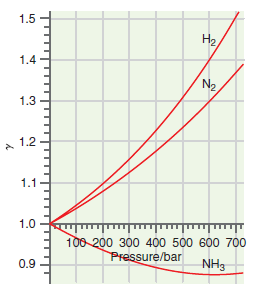
What can you conclude about the ratio of fugacity to pressure for N2,H2, and NH3at 500 bar using the data in Figure 7.10?Figure 7.10 1.5 H2, 1.4 N2 1.3 1.2 1.1 1.0 100 200 300 400 500 600 700 Pressure/bar 0.9 NH3
For a given set of conditions, the fugacity of a gas is greater than the pressure. What does this tell you about the interaction between the molecules of the gas?
In the reversible adiabatic expansion of 1.75 mol of an ideal gas from an initial temperature of 27.0°C, the work done on the surroundings is 1300. J. If CV ,m = 3/2R, calculate q, w, ΔU, and ΔH.
Given the data in Table 4.1 (Appendix B, Data Tables) and the following information, calculate the single bond enthalpies and energies for Si€”F, Si€”Cl, C€”F, N€”F, O€”F, H€”F: HF(g) SiF,(g) SiCl,(g) CF,(g) NF3(8) OF,(g) Substance AH (kJ
A van der Waals gas undergoes an isothermal reversible expansion under conditions such that z > 1. Is the work done more or less than if the gas followed the ideal gas law?
Calculate the pressure exerted by Ar for a molar volume of 1.31 L mol–1 at 426 K using the van der Waals equation of state. The van der Waals parameters a and b for Ar are 1.355 bar dm6 mol–2 and 0.0320 dm3 mol–1, respectively. Is the attractive or repulsive portion of the potential dominant
Explain the significance of the Boyle temperature.
A compressed cylinder of gas contains 2.74 × 10³ g of N2 gas at a pressure of 3.75 × 10⁷ Pa and a temperature of 18.7°C. What volume of gas has been released into the atmosphere if the final pressure in the cylinder is 1.80 × 10⁵ Pa? Assume ideal behavior and that the gas temperature is
Why is the standard state of fugacity, f °, equal to the standard state of pressure, P°?
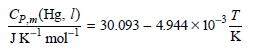
Between 0°C and 100°C, the heat capacity of Hg(l) is given byCalculate ΔH and ΔS if 2.25 moles of Hg(l) is raised in temperature from 0.00° to 88.0°C at constant P. Cp.„(Hg. I) 30.093 – 4.944 × 10⁻³² JK' mol K
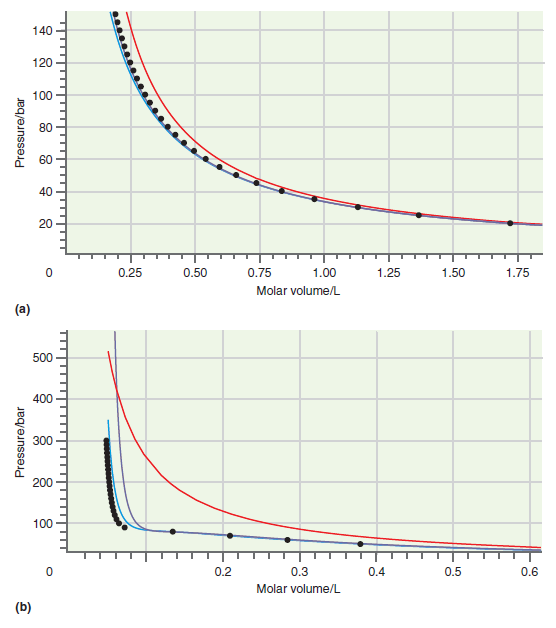
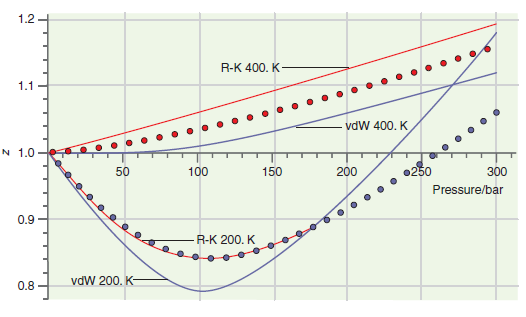
Consider the comparison made between accurate results and those based on calculations using the van der Waals and Redlich€“Kwong equations of state in Figures 7.1 and 7.5. Is it clear that one of these equations of state is better than the other under all conditions?Figure 7.1Figure 7.5
We return to the 60. kg hiker of P4.34, who is climbing the 828 m tall Burj Khalifa in Dubai. If the efficiency of converting the energy content of the bars into the work of climbing is 25%, the remaining 75% of the energy released through metabolism is heat released to her body. She eats two
Using the concept of the intermolecular potential, explain why two gases in corresponding states can be expected to have the same value for z.
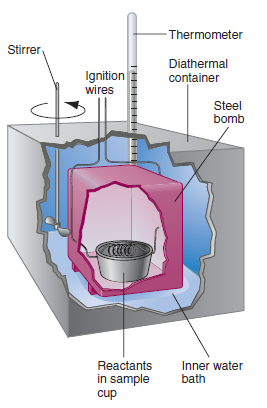
What is the point of having an outer water bath in a bomb calorimeter (see Figure 4.3), especially if its temperature is always equal to that of the inner water bath?Figure 4.3 - Thermometer Stirrer Diathermal Ignition wires container Steel bomb Reactants Inner water bath in sample cup
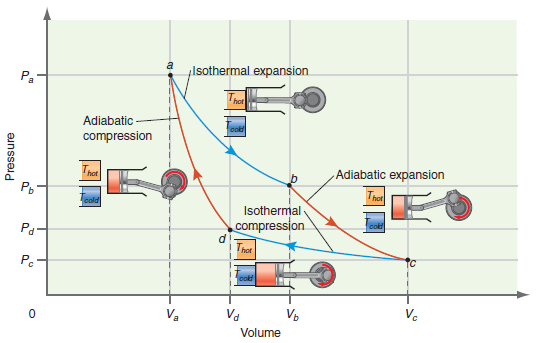
Using your results from Problems P5.18 and P5.7, calculate ΔS, ΔSsurroundings, and ΔStotalfor each step in the cycle and for the total Carnot cycle described in Figure 5.2.Figure 5.2 Isothermal expansion Pa Adiabatic cold compression Adiabatic expansion hot
In calculating ΔHoR at 285.15 K, only the ΔHof of the compounds that take part in the reactions listed in Tables 4.1 and 4.2 (Appendix B, Data Tables) are needed. Is this statement also true if you want to calculate ΔHoR at 500. K?
A cylindrical vessel with rigid adiabatic walls is separated into two parts by a frictionless adiabatic piston. Each part contains 45.0 L of an ideal monatomic gas with CV ,m = 3/2R. Initially, Ti = 300 K and Pi = 1.75 ×10⁵ Pa in each part. Heat is slowly introduced into the left part using an
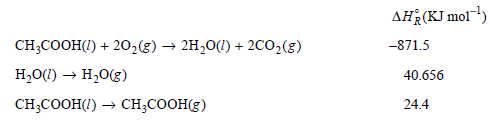
From the following data, calculate ΔHoR,391.4 Kfor the reaction CH3COOH(g) + 2O2(g) †’ 2H2O(g) + 2CO2(g):Values for ΔHoR for the first two reactions are at 298.15 K, and for the third reaction at 391.4 K. AH(KJ mol) CH;COOH(I) + 20,(g) → 2H20(1) +
A refrigerator is operated by a 0.25-hp (1 hp = 746 watts) motor. If the interior is to be maintained at 4.50°C and the room temperature is 38°C, what is the maximum heat leak (in watts) that can be tolerated? Assume that the coefficient of performance is 50.% of the maximum theoretical value.
In order to get in shape for mountain climbing, an avid hiker with a mass of 60. kg ascends the stairs in the world’s tallest structure, the 828 m tall Burj Khalifa in Dubai, United Arab Emirates. Assume that she eats energy bars on the way up and that her body is 25% efficient in converting the
Show that (∂CV/∂V)T = 0. for an ideal and for a van der Waals gas.
Approximately how many oxygen molecules arrive each second at the mitochondrion of an active person with a mass of 84 kg? The following data are available: Oxygen consumption is about 40. mL of O2 per minute per kilogram of body weight, measured at T = 300, K and P = 100 atm. In an adult there are
A muscle fiber contracts by 3.5 cm and in doing so lifts a weight. Calculate the work performed by the fiber. Assume the muscle fiber obeys Hooke’s law F = −k x with a force constant, k, of 750. N m−1.
Humans cool off through perspiration. How does the effectiveness of this process depend on the relative humidity?
Show that (∂CV/∂V)T = T(∂2 P/ ∂T2)V
Prove that C V = - (∂U/∂V)T (∂V/∂T)U.
Calculate ΔHof for NO(g), at 975 K, assuming that the heat capacities of reactants and products are constant over the temperature interval at their values at 298.15 K.
As shown in Example Problem 3.5, (∂Um/∂V)T a/V2m for a van der Waals gas. In this problem, you will compare the change in energy with temperature and volume for N2, treating it as a van der Waals gas.a. Calculate ΔU per mole of N2(g) at 1 bar pressure and 298 K if the volume is increased by
Calculate ΔS surroundings and ΔS total for the processes described in parts (a) and (b) of Problem P5.16. Which of the processes is a spontaneous process? The state of the surroundings for each part is at 298 K, 1.50 bar.
At 298 K and 1 bar pressure, the density of water is 0.9970 g cm−3, and CP,m = 75.3 J K-1 mol-1. The change in volume with temperature is given by ΔV = Vi βΔT, where β, the coefficient of thermal expansion, is 2.07 × 10⁻⁴ K−1. If the temperature of 325 g of water is increased by 25.5 K,
Use the equation CP,m − CV ,m = TVmβ2 /κ and the Data Tables to determine CV ,m for H2O(l) at 298 K. Calculate (Cp,m − CV,m)/CP,m.
Calculate the pressure exerted by benzene for a molar volume of 2.00 L at 595 K using the Redlich€“Kwong equation of state:The Redlich€“Kwong parameters a and b for benzene are 452.0 bar dm6 molˆ’2 K1/2 and 0.08271dm3 molˆ’1, respectively. Is the attractive
Explain why attractive interactions between molecules in gas make the pressure less than that predicted by the ideal gas equation of state.
Calculate ΔHoR at 675 K for the reaction 4NH3(g) + 6NO(g) → 5N2(g) + 6H2O(g) using the temperature dependence of the heat capacities from the data tables. Compare your result with ΔHoR at 298.15 K. Is the difference large or small? Why?
The mass of a He atom is less than that of an Ar atom. Does that mean that because of its larger mass, Argon exerts a higher pressure on the container walls than He at the same molar density, volume, and temperature? Explain your answer.
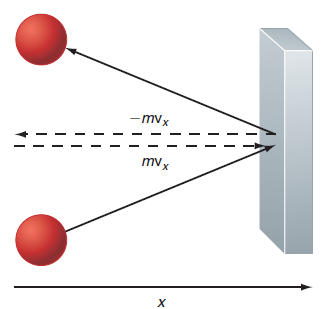
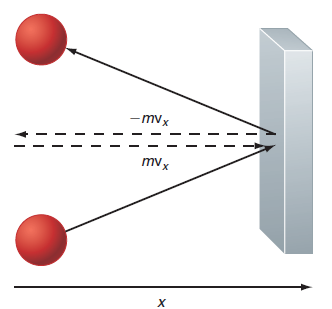
If the wall depicted in Figure 1.2 were a movable piston, under what conditions would it move as a result of the molecular collisions?Figure 1.2 mvx mvx х
Consider the equilibrium 3O2(g) ⇋ 2O3(g).a. Using the Data tables, calculate KP at 298 K.b. Assuming that the extent of reaction at equilibrium ξ eq is much less than 1, show that the degree of reaction defined as half the number of moles of O3(g) divided by the initial number moles of
Calculate w for the adiabatic expansion of 2.50 mol of an ideal gas at an initial pressure of 2.25 bar from an initial temperature of 450. K to a final temperature of 300. K. Write an expression for the work done in the isothermal reversible expansion of the gas at 300. K from an initial pressure
Rewrite the van der Waals equation using the molar volume rather than V and n.
A mixture of 2.10 × 10⁻³ g of O2, 3.88 × 10⁻³ mol of N2, and 5.25 × 10²⁰ molecules of CO are placed into a vessel of volume 5.25 L at 12.5°C.a. Calculate the total pressure in the vessel.b. Calculate the mole fractions and partial pressures of each gas.
Why do the z and y components of the velocity not change in the collision depicted in Figure 1.2?Figure 1.2 mvx mvx х
Which of the following systems are isolated?a) A bottle of wineb) A tightly sealed, perfectly insulated thermos bottlec) A tube of toothpasted) our solar system. Explain your answers.
Under anaerobic conditions, glucose is broken down in muscle tissue to form lactic acid according to the reaction: C6H12O6(s) †’ 2CH3CHOHCOOH(aq). Thermodynamic data at T = 298 K for glucose and lactic acid are given in the following table.Calculate ΔGoR atT =
Is ΔH for breaking the first C—H bond in methane equal to the average C—H bond enthalpy in this molecule? Explain your answer.
Assume the internal energy of an elastic fiber under tension (see Problem 6.16) is given by. dU = T dS – P dV – F dl. Obtain an expression for, (∂g/∂L)P,T and calculate the maximum non-expansion work obtainable when a collagen fiber contracts from [1] = 20.0 to 10.0 cm at constant P
For an ideal gas, (∂U/∂V)T and (∂h/∂P)T = 0. Prove that CV is independent of volume and CP is independent of pressure.
Calculate q, w, ΔU, and ΔH if 2.25 mol of an ideal gas with Cv,m = 3/2 R undergoes a reversible adiabatic expansion from an initial volume Vi = 5.50 m3 to a final volume. Vf =25.0 m3 .The initial temperature is 275 K.
The following heat capacity data have been reported for L-alanine:By a graphical treatment, obtain the molar entropy of L-alanine at T = 300.K.You can perform the integration numerically using either a spread sheet program or a curve-fitting routine and a graphing calculator (see Example Problem
Calculate ΔS, ΔS surroundings , and ΔS universe per day for the air conditioned house described in Problem 5.4. Assume that the interior temperature is 65°F and the exterior temperature is 99°F.
Which of the following systems are open? a) A dog,b) An incandescent light bulbc) A tomato plantd) a can of tomatoes. Explain your answers.
Consider the reaction TiO2(s) + 2 C(graphite) + 2 Cl2(g) †’ 2 CO(g) + TiCl4(l) for which ΔHoR ,298 K= €“80. kJ mol€“1. Given the following data at 25°C,Assume that the heat capacities are independent of temperature.a. Calculate
Derive the equation (∂H/∂T)V = CV + Vβ/κ from basic equations and definitions.
A 1.50 mole sample of an ideal gas at 28.5°C expands isothermally from an initial volume of 22.5 dm3 to a final volume of 75.5 dm3. Calculate w for this process a. For expansion against a constant external pressure of 0.498 × 10⁵ Pa b. For a reversible expansion.
Give an example of two systems separated by a wall that are in thermal but not chemical equilibrium.
If 3.365 g of ethanol, C2H5OH(l), is burned completely in a bomb calorimeter at 298.15 K, the heat produced is 99.472 kJ.a. Calculate ΔHo combustion for ethanol at 298.15 K.b. Calculate ΔHof of ethanol at 298.15 K.
Count Rumford observed that using cannon boring machinery a single horse could heat 11.6 kg of ice water (T = 273 K) to T = 355 K in 2.5 hours. Assuming the same rate of work, how high could a horse raise a 225 kg weight in 2.5 minutes? Assume the heat capacity of water is 4.18 J K−1 g−1.
If the reaction Fe2N(s) + 3/2H2(g) ⇋ 2Fe(s) + NH3(g) comes to equilibrium at a total pressure of 1 bar, analysis of the gas shows that at 700. and 800. K, PNH3 /PH2 = 2.165 and 1.083, respectively, if only H2(g) was initially present in the gas phase and Fe2N(s) was in excess.a.
Derive the equation (∂P/∂V)T = −1/(κV ) from basic equations and definitions.
A hiker caught in a thunderstorm loses heat when her clothing becomes wet. She is packing emergency rations which if completely metabolized will release 35 kJ of heat per gram of rations consumed. How much rations must the hiker consume to avoid a reduction in body temperature of 2.5 K as a result
Using the chain rule for differentiation, show that the isobaric expansion coefficient expressed in terms of density is given by β = −(1/ρ)(∂p/∂T)P.
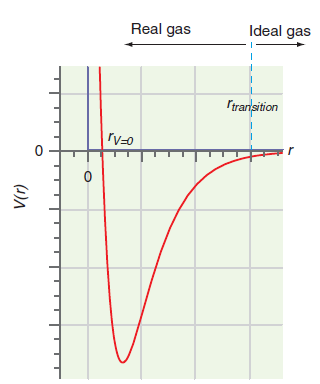
At sufficiently high temperatures, the van der Waals equation has the form P ‰ˆ L RT>(Vm- b). Note that the attractive part of the potential has no influence in this expression. Justify this behavior using the potential energy diagram of Figure 1.10.Figure 1.10 Ideal gas Real gas
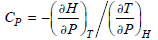
Regard the enthalpy as a function of T and P. Use the cyclic rule to obtain the expression Әт не, ан Cp ӘР, ӘР
A 2.50 mole sample of an ideal gas, for which CV ,m = 3/2 R, is subjected to two successive changes in state: a) From 25.0°C and 125. × 103 Pa, the gas is expanded isothermally against a constant pressure of 15.2 × 10³ Pa to twice the initial volume. b) At the end of the previous
The temperature of 1.75 moles of an ideal gas increases from 10.2°C to 48.6°C as the gas is compressed adiabatically. Calculate q, w, ΔU, and ΔH for this process assuming that CV ,m = 3/2 R.
An athlete at high performance inhales ~3.75 L of air at 1.0 atm and 298 K at a respiration rate of 32 breaths per minute. If the exhaled and inhaled air contain 15.3 and 20.9% by volume of oxygen, respectively, how many moles of oxygen per minute are absorbed by the athlete’s body?
One mole of H2O(l) is super cooled to −3.75°C at 1 bar pressure. The freezing temperature of water at this pressure is 0.00°C. The transformation H2O(l) → H2O(s) is suddenly observed to occur. By calculating ΔS, ΔS surroundings , and ΔS total , verify that this transformation is
This problem will give you practice in using the cyclic rule. Use the ideal gas law to obtain the three functions P = f (V, T),V = g(P, T), and T = h(P,V ). Show that the cyclic rule (∂P/∂V)T (∂V/∂T)P(∂T/∂P)V = −1is obeyed.
Aerobic cells metabolize glucose in the respiratory system. This reaction proceeds according to the overall reaction6O2(g) + C6H12O6(s) → 6CO2(g) + 6H2O(l)Calculate the volume of oxygen required at STP to metabolize 0.025 kg of glucose (C6H12O6). STP refers to standard temperature and pressure,
Give an example of two systems that are in equilibrium with respect to only one of two state variables.
N2O3 dissociates according to the equilibrium N2O3(g) ⇋ NO2(g) + NO(g). At 298 K and one bar pressure, the degree of dissociation defined as the ratio of moles of NO(g) or NO2(g) to the initial moles of the reactant assuming that no dissociatioin occurs is 3.5 × 10⁻³. Calculate ΔGoR
Starting with β = (1/V )(∂V /∂T)P, show that β = −(1/ρ )( ∂ρ /∂T)P, where ρ is the density.
The location of the boundary between the system and the surroundings is a choice that must be made by the thermodynamicist. Consider a beaker of boiling water in an airtight room. Is the system open or closed if you place the boundary just outside the liquid water? Is the system open or closed if
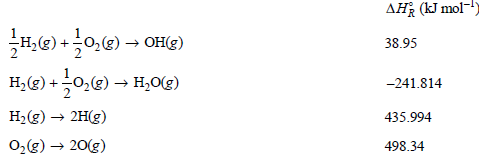
Use the following data at 298.15 K to complete this problem:Calculate ΔHoR fora. OH(g) †’ H(g) + O(g)b. H2O(g) †’ 2H(g) + O(g)c. H2O(g) †’ H(g) + OH(g)Assuming ideal gas behavior, calculate ΔHoR and
Dogs cool off in hot weather by panting. Write a chemical equation to describe this process and calculate ΔHoR.
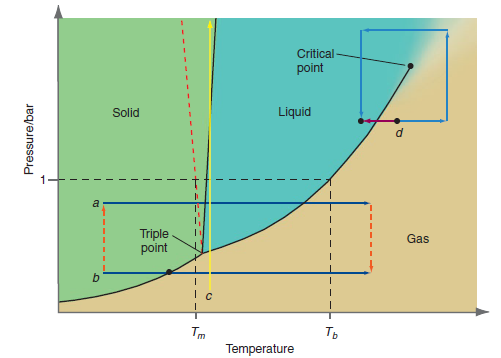
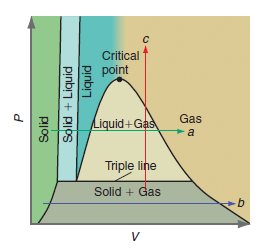
Make a drawing indicating the four-step process d of Figure 8.4 in Figure 8.13.Figure 8.4Figure 8.13 Critical- point Liquid Solid Triple point Gas т Tm Temperature Ть Pressure/bar Critical point P. Gas Liquid+Gas Triple line Solid + Gas pinbi7 Solid + Liquid Pjos
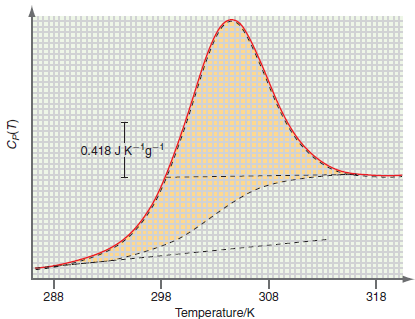
The following data are a DSC scan of a solution of a T4 lysozyme mutant. From the data determine Tm. Determine also the excess heat capacity ΔCPat T = 308 K. Determine also the intrinsic δCi nt P and transition δCi trsPexcess heat capacities T =
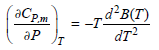
For the equation of state Vm= RT /P + B(T), show that а' в(т) = -T- dт? аСри т ӘР
Is the following statement correct? Because dry ice sublimes, carbon dioxide has no liquid phase. Explain your answer.
A 3.75 mole sample of an ideal gas with CV ,m = 3/2 R initially at a temperature Ti = 298 K and Pi = 1.00 bar is enclosed in an adiabatic piston and cylinder assembly. The gas is compressed by placing a 725 kg mass on the piston of diameter 25.4 cm. Calculate the work done in this process and the
The amino acid glycine dimerizes to form the dipeptide glycylglycine according to the reaction2Glycine(s): †’ Glycylglycine(s) + H2O(l)Calculate ΔS, ΔSsurr, and ΔSsuniverse at T = 298 K. Useful thermodynamic data follow: Glycylglycine Water -285.8
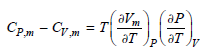
Use the relationthe cyclic rule and the van der Waals equation of state, to derive an equation for CP,m ˆ’ CV,m in terms of Vm, T, and the gas constants R, a, and b. aV Әт. ӘР Cr m = T Сри — Сти — Әт Әт
Yeast and other organisms can convert glucose (C6H12O6) to ethanol (CH3CH2OH) by a process called alcoholic fermentation. The net reaction isC6H12O6(s) → 2C2H5OH(l) + 2CO2(g)Calculate the mass of glucose required to produce 2.25 L of CO2 measured at P = 1.00 atm and T = 295 K
The amino acid glycine dimerizes to form the dipeptide glycylglycine according to the reaction2Glycine(s) †’ Glycylglycine(s) + H2O(l)Calculate ΔS, ΔSsurroundings , and ΔSuniverse at T = 298 K. Useful thermodynamic data follow: Glycylglycine
Because V is a state function, (∂(∂V/∂T)P/∂P)T = (∂ (∂V/∂P)T /∂T)P. Using this relationship, show that the isothermal compressibility and isobaric expansion coefficient are related by (∂β /∂P)T = −(∂κ/∂T)P.
What is the difference between a quasi-static process and a reversible process?
Devise a temperature scale, abbreviated G, for which the magnitude of the ideal gas constant is 5.52 J G−1 mol−1.
What can you say about ΔH vaporization of a liquid as the temperature approaches the critical temperature?
Showing 3400 - 3500
of 3563
First
22
23
24
25
26
27
28
29
30
31
32
33
34
35
36
Step by Step Answers

 Get 50% OFF
Claim Now
Get 50% OFF
Claim Now