New Semester
Started
Get
50% OFF
Study Help!
--h --m --s
Claim Now
Question Answers
Textbooks
Find textbooks, questions and answers
Oops, something went wrong!
Change your search query and then try again
S
Books
FREE
Study Help
Expert Questions
Accounting
General Management
Mathematics
Finance
Organizational Behaviour
Law
Physics
Operating System
Management Leadership
Sociology
Programming
Marketing
Database
Computer Network
Economics
Textbooks Solutions
Accounting
Managerial Accounting
Management Leadership
Cost Accounting
Statistics
Business Law
Corporate Finance
Finance
Economics
Auditing
Tutors
Online Tutors
Find a Tutor
Hire a Tutor
Become a Tutor
AI Tutor
AI Study Planner
NEW
Sell Books
Search
Search
Sign In
Register
study help
engineering
mechanical engineering
Principles of heat transfer 7th Edition Frank Kreith, Raj M. Manglik, Mark S. Bohn - Solutions
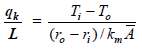
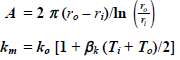
Show that the rate of heat conduction per unit length through a long hollow cylinder of inner radius ri and outer radius ro, made of a material whose thermal conductivity varies linearly with temperature, is given by where Ti = temperature at the inner surfaceTo = temperature at the outer
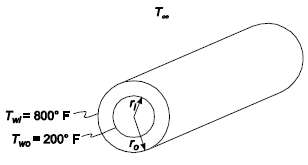
A long, hollow cylinder is constructed from a material whose thermal conductivity is a function of temperature according to k = 0.060 + 0.00060 T, where T is in ?F and k is in Btu/h ?F. The inner and outer radii of the cylinder are 5 and 10 in., respectively. Under steady-state conditions, the
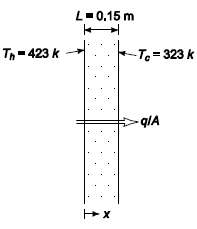
A plane wall 15 cm thick has a thermal conductivity given by the relationk = 2.0 + 0.0005 T W/(m K)where T is in degrees Kelvin. If one surface of this wall is maintained at 150 ?C and the other at 50 ?C, determine the rate of heat transfer per square meter. Sketch the temperature distribution
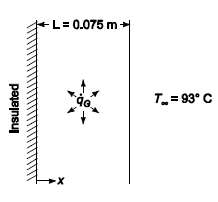
A plane wall 7.5 cm thick, generates heat internally at the rate of 105 W/m3. One side of the wall is insulated, and the other side is exposed to an environment at 90?C. The convective heat transfer coefficient between the wall and the environment is 500W/(m2 K). If the thermal conductivity of the
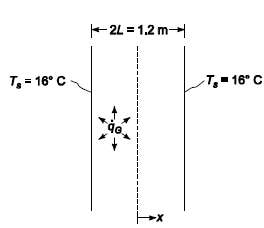
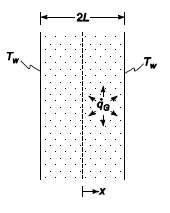
A small dam, which may be idealized by a large slab 1.2 m thick, is to be completely poured in a short period of time. The hydration of the concrete results in the equivalent of a distributed source of constant strength of 100 W/m3. If both dam surfaces are at 16?C, determine the maximum
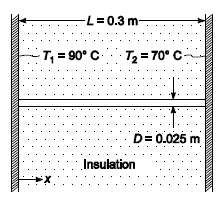
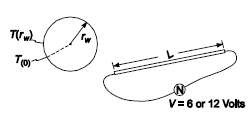
Two large steel plates at temperatures of 90? and 70?C are separated by a steel rod 0.3 m long and 2.5 cm in diameter. The rod is welded to each plate. The space between the plates is filled with insulation, which also insulates the circumference of the rod. Because of a voltage difference between
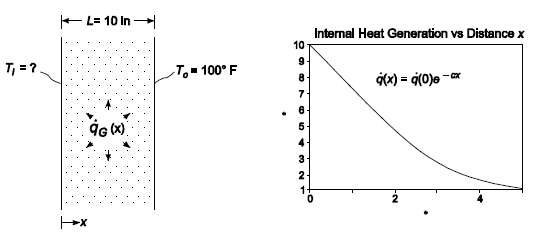
The shield of a nuclear reactor can be idealized by a large 10 in. thick flat plate having a thermal conductivity of 2 Btu/(h ft ?F). Radiation from the interior of the reactor penetrates the shield and produces heat generation in the shield which decreases exponentially from a value of 10 Btu/(h
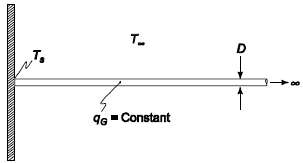
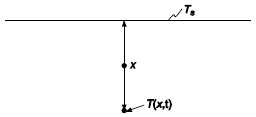
Derive an expression for the temperature distribution in an infinitely long rod of uniform cross section within which there is uniform heat generation at the rate of 1 W/m. Assume that the rod is attached to a surface at Ts and is exposed through a convective heat transfer coefficient h to a fluid
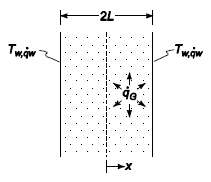
Derive an expression for the temperature distribution in a plane wall in which there are uniformly distributed heat sources which vary according to the linear relationqG = qw [1 ?? β(T ?? Tw)]where qw is a constant equal to the heat generation per unit volume at the wall temperature Tw. Both sides
A plane wall of thickness 2L has internal heat sources whose strength varies according toqG = q0 cos (ax)where q0 is the heat generated per unit volume at the center of the wall (x = 0) and a is a constant. If both sides of the wall are maintained at a constant temperature of Tw, derive an
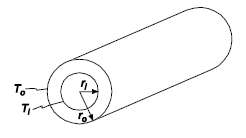
Heat is generated uniformly in the fuel rod of a nuclear reactor. The rod has a long, hollow cylindrical shape with its inner and outer surfaces at temperatures of Ti and To, respectively. Derive an expression for the temperature distribution. GIVEN A long, hollow cylinder with uniform internal
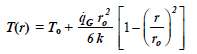
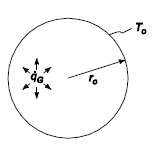
Show that the temperature distribution in a sphere of radius ro, made of a homogeneous material in which energy is released at a uniform rate per unit volume qG , is GIVENA homogeneous sphere with energy generationRadius = roASSUMPTIONSSteady state conditions persistThe thermal conductivity of
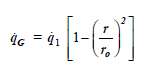
In a cylindrical fuel rod of a nuclear reactor, heat is generated internally according to the equation where qg = local rate of heat generation per unit volume at rro = outside radiusq1 = rate of heat generation per unit volume at the centerlineCalculate the temperature drop from the center
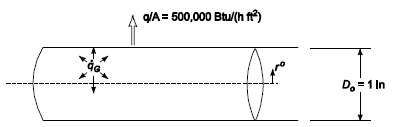
wAn electrical heater capable of generating 10,000 W is to be designed. The heating element is to be a stainless steel wire, having an electrical resistivity of 80 × 10??6 ohm-centimeter. The operating temperature of the stainless steel is to be no more than 1260?C. The heat transfer coefficient
The addition of aluminum fins has been suggested to increase the rate of heat dissipation from one side of an electronic device 1 m wide and 1 m tall. The fins are to be rectangular in cross section, 2.5 cm long and 0.25 cm thick. There are to be 100 fins per meter. The convective heat transfer
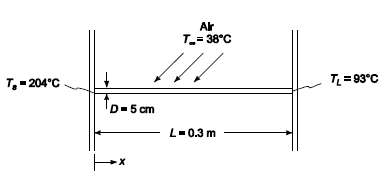
One end of a 0.3 m long steel rod is connected to a wall at 204?C. The other end is connected to a wall which is maintained at 93?C. Air is blown across the rod so that a heat transfer coefficient of 17 W/(m2 K) is maintained over the entire surface. If the diameter of the rod is 5 cm and the
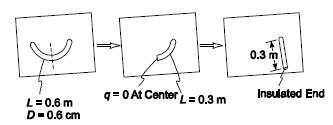
Both ends of a 0.6 cm copper U-shaped rod, as shown in the accompanying sketch, are rigidly affixed to a vertical wall, the temperature of which is maintained at 93?C. The developed length of the rod is 0.6 m and it is exposed to air at 38?C. The combined radiative and convective heat transfer
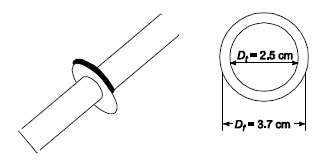
A circumferential fin of rectangular cross section, 3.7 cm OD and 0.3 cm thick surrounds a 2.5 cm diameter tube. The fin is constructed of mild steel. Air blowing over the fin produces a heat transfer coefficient of 28.4 W/(m2 K). If the temperatures of the base of the fin and the air are 260?C and
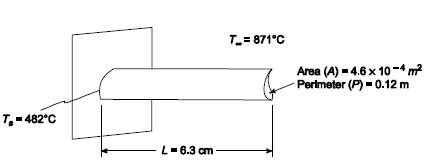
A turbine blade 6.3 cm long (see sketch on p. 156), with cross-sectional area A = 4.6 ×10??4 m2 and perimeter P = 0.12 m, is made of stainless steel (k = 18 W/(m K). The temperature of the root, Ts, is 428?C. The blade is exposed to a hot gas at 871?C, and the heat transfer coefficient h is 454
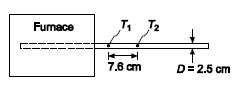
To determine the thermal conductivity of a long, solid 2.5 cm diameter rod, one half of the rod was inserted into a furnace while the other half was projecting into air at 27?C. After steady state had been reached, the temperatures at two points 7.6 cm apart were measured and found to be 126?C and
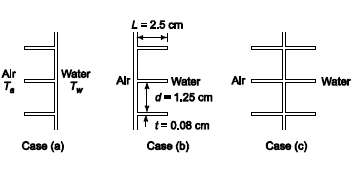
Heat is transferred from water to air through a brass wall (k = 54 W/(m K)). The addition of rectangular brass fins, 0.08 cm thick and 2.5 cm long, spaced 1.25 cm apart, is contemplated. Assuming a water-side heat transfer coefficient of 170 W/(m2 K) and an air-side heat transfer coefficient of 17
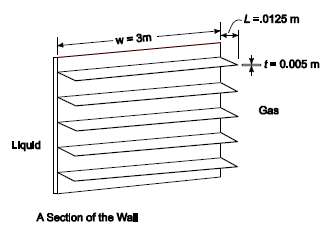
The wall of a liquid-to-gas heat exchanger has a surface area on the liquid side of 1.8 m2 (0.6m × 3m) with a heat transfer coefficient of 255 W/(m2 K). On the other side of the heat exchanger wall flows a gas, and the wall has 96 thin rectangular steel fins 0.5 cm thick and 1.25 cm high [k = 3
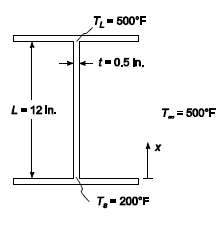
The top of a 12 in. I-beam is maintained at a temperature of 500?F, while the bottom is at 200?F. The thickness of the web is 1/2 in. Air at 500?F is blowing along the side of the beam so that h = 7 Btu/(h ft2 ?F). The thermal conductivity of the steel may be assumed constant and equal to 25 Btu/(h
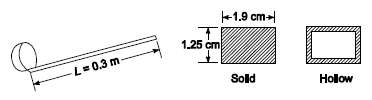
The handle of a ladle used for pouring molten lead is 30 cm long. Originally the handle was made of 1.9 × 1.25 cm mild steel bar stock. To reduce the grip temperature, it is proposed to form the handle of tubing 0.15 cm thick to the same rectangular shape. If the average heat transfer coefficient
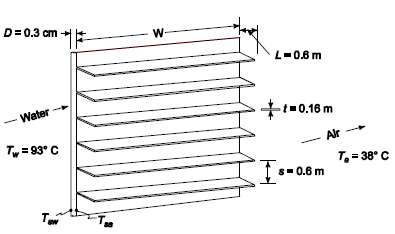
A 0.3-cm thick aluminum plate has rectangular fins on one side, 0.16 × 0.6 cm, spaced 0.6 cm apart. The finned side is in contact with low pressure air at 38?C and the average heat transfer coefficient is 28.4 W/(m2 K). On the unfinned side water flows at 93?C and the heat transfer coefficient is
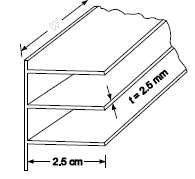
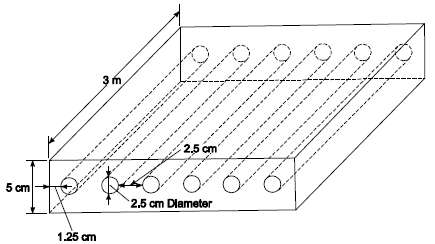
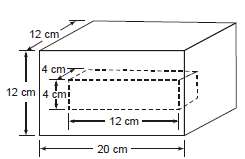
Compare the rate of heat flow from the bottom to the top in the aluminum structure shown in the sketch with the rate of heat flow through a solid slab. The top is at ??10?C, the bottom at 0?C. The holes are filled with insulation which does not conduct heat appreciably.GIVENThe aluminum structure
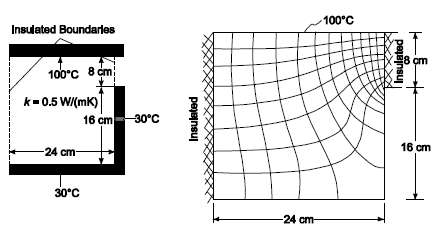
Determine by means of a flux plot the temperatures and heat flow per unit depth in the ribbed insulation shown in the accompanying sketch.GIVENThe sketch belowASSUMPTIONSSteady state conditionsTwo dimensional heat flowThe heat loss through the insulation is negligibleThe thermal conductivity of the
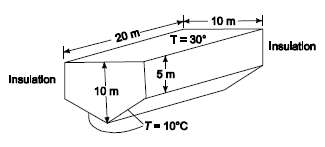
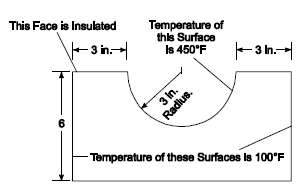
Use a flux plot to estimate the rate of heat flow through the object shown in the sketch. The thermal conductivity of the material is 15 W/(m K). Assume no heat is lost from the sides.GIVENThe shape of object shown in the sketchThe thermal conductivity of the material (k) = 15 W/(m K)The
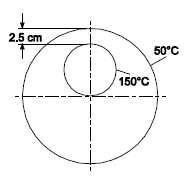
Determine the rate of heat transfer per unit length from a 5-cm-OD pipe at 150?C placed eccentrically within a larger cylinder of 85% Magnesia wool as shown in the sketch. The outside diameter of the larger cylinder is 15 cm and the surface temperature is 50?C.GIVENA pipe placed eccentrically
Determine the rate of heat flow per foot length from the inner to the outer surface of the molded insulation in the accompanying sketch. Use k = 0.1 Btu/(h ft ?F).GIVENThe object with a cross section as shown in the sketch belowThe thermal conductivity (k) = 0.1 Btu/(h ft ?F)ASSUMPTIONSThe system
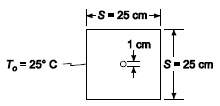
A long 1-cm-diameter electric copper cable is embedded in the center of a 25 cm square concrete block. If the outside temperature of the concrete is 25?C and the rate of electrical energy dissipation in the cable is 150 W per meter length, determine the temperatures at the outer surface and at the
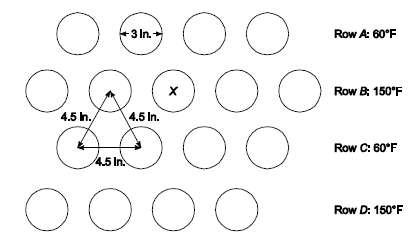
A large number of 1.5-in.-OD pipes carrying hot and cold liquids are embedded in concrete in an equilateral staggered arrangement with center line 4.5 in. apart as shown in the sketch. If the pipes in rows A and C are at 60?F while the pipes in rows B and D are at 150?F, determine the rate of heat
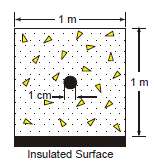
A long 1-cm-diameter electric cable is imbedded in a concrete wall (k = 0.13 W/(m K)) which is 1 m by 1 m, as shown in the sketch below. If the lower surface is insulated, the surface of the cable is 100?C and the exposed surface of the concrete is 25?C, estimate the rate of energy dissipation per
Determine the temperature distribution and heat flow rate per meter length in a long concrete block having the shape shown below. The cross-sectional area of the block is square and the hole is centered.GIVENA long concrete block having the shape shown belowThe cross-sectional area of the block is
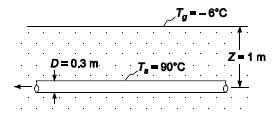
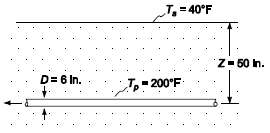
A 30-cm-OD pipe with a surface temperature of 90?C carries steam over a distance of 100 m. The pipe is buried with its center line at a depth of 1 m, the ground surface is ?? 6?C, and the mean thermal conductivity of the soil is 0.7 W/(m K). Calculate the heat loss per day, and the cost, if steam
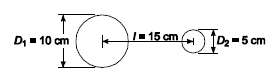
Two long pipes, one having a 10-cm-OD and a surface temperature of 300?C, the other having a 5-cm-OD and a surface temperature of 100?C, are buried deeply in dry sand with their centerlines 15 cm apart. Determine the rate of heat flow from the larger to the smaller pipe per meter length.GIVENTwo
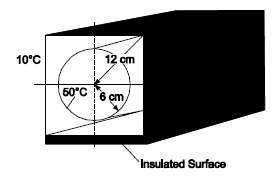
A radioactive sample is to be stored in a protective box with 4 cm thick walls having interior dimensions 4 by 4 by 12 cm. The radiation emitted by the sample is completely absorbed at the inner surface of the box, which is made of concrete. If the outside temperature of the box is 25?C, but the
A 6-in.-OD pipe is buried with its centerline 50 in. below the surface of the ground [k of soil is 0.20 Btu/(h ft ?F)]. An oil having a density of 6.7 lb/gal and a specific heat of 0.5 Btu/(lb ?F) flows in the pipe at 100 gpm. Assuming a ground surface temperature of 40?F and a pipe wall
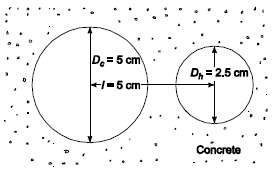
A 2.5-cm-OD hot steam line at 100?C runs parallel to a 5.0 cm OD cold water line at 15?C. The pipes are 5 cm center to center and deeply buried in concrete with a thermal conductivity of 0.87 W/(m K). What is the heat transfer per meter of pipe between the two pipes?GIVENA hot steam line runs
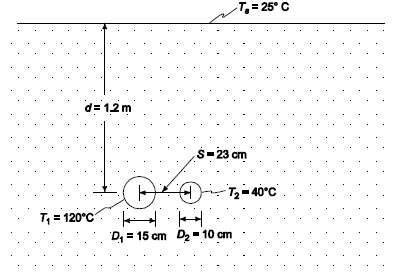
Calculate the rate of heat transfer between a 15-cm-OD pipe at 120?C and a 10-cm-OD pipe at 40?C. The two pipes are 330 m long and are buried in sand [k = 0.33W/(m K)] 12 m below the surface (Ts = 25?C). The pipes are parallel and are separated by 23 cm (center to center) distance.GIVENTwo parallel
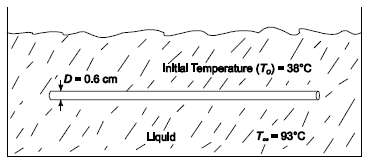
A 0.6-cm-diameter mild steel rod at 38?C is suddenly immersed in a liquid at 93?C with hc = 110W/(m2 K). Determine the time required for the rod to warm to 88?C.GIVENA mild steel rod is suddenly immersed in a liquidRod diameter (D) = 0.6 cm = 0.006 mInitial temperature of the rod (To) = 38?CLiquid
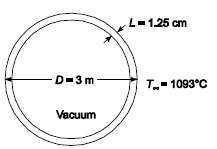
A spherical shell satellite (3-m-OD, 1.25-cm-wall thickness, made of stainless steel) reenters the atmosphere from outer space. If its original temperature is 38?C, the effective average temperature of the atmosphere is 1093?C, and the effective heat transfer coefficient is 115 W/(m2 ?C), estimate
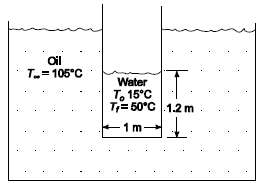
A thin-wall cylindrical vessel (1 m in diameter) is filled to a depth of 1.2 m with water at an initial temperature of 15?C. The water is well stirred by a mechanical agitator. Estimate the time required to heat the water to 50?C if the tank is suddenly immersed into oil at 105?C. The overall heat
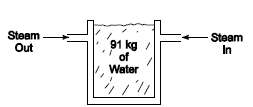
A thin-wall jacketed tank, heated by condensing steam at one atmosphere contains 91 kg of agitated water. The heat transfer area of the jacket is 0.9 m2 and the overall heat transfer coefficient U = 227 W/(m2 K) based on that area. Determine the heating time required for an increase in temperature
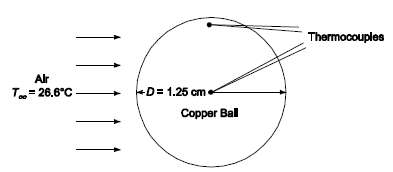
The heat transfer coefficients for the flow of 26.6?C air over a 1.25 cm diameter sphere are measured by observing the temperature-time history of a copper ball of the same dimension. The temperature of the copper ball (c = 376 J/(kg K), ρ = 8928 kg/m3) was measured by two thermocouples, one
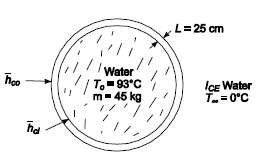
A spherical stainless steel vessel at 93?C contains 45 kg of water initially at the same temperature. If the entire system is suddenly immersed in ice water, determine (a) the time required for the water in the vessel to cool to 16?C, and (b) the temperature of the walls of the vessel at that time.
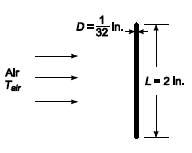
A copper wire, 1/32-in.-OD, 2 in. long, is placed in an air stream whose temperature rises at Tair = (50 + 25t)?F, where t is the time in seconds. If the initial temperature of the wire is 50?F, determine its temperature after 2 s, 10 s and 1 min. The heat transfer coefficient between the air and
A large 2.54-cm.-thick copper plate is placed between two air streams. The heat transfer coefficient on the one side is 28 W/(m2 K) and on the other side is 57 W/(m2 K). If the temperature of both streams is suddenly changed from 38?C to 93?C, determine how long it will take for the copper plate to
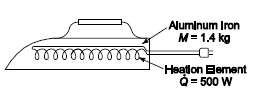
A 1.4-kg aluminum household iron has a 500 W heating element. The surface area is 0.046 m2. The ambient temperature is 21?C and the surface heat transfer coefficient is 11 W/(m2 K). How long after the iron is plugged in will its temperature reach 104?C?GIVENAn aluminum household ironMass of the
Estimate the depth in moist soil at which the annual temperature variation will be 10% of that at the surface. GIVEN Moist soil ASSUMPTIONS Conduction is one dimensional The soil has uniform and constant properties Annual temperature variation can be treated as a step change in surface temperature
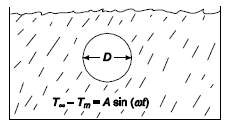
A small aluminum sphere of diameter D, initially at a uniform temperature To, is immersed in a liquid whose temperature, T??, varies sinusoidally according toT?? ?? Tm = A sin (ωt)where: Tm = time-averaged temperature of the liquidA = amplitude of the temperature fluctuationΩ = frequency of
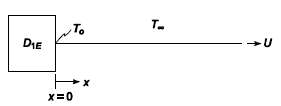
A wire of perimeter P and cross-sectional area A emerges from a die at a temperature T above ambient and with a velocity U. Determine the temperature distribution along the wire in the steady state if the exposed length downstream from the die is quite long. State clearly and try to justify all
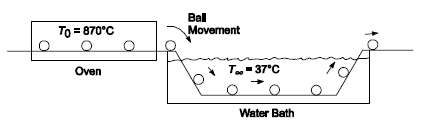
Ball bearings are to be hardened by quenching them in a water bath at a temperature of 37?C. Suppose you are asked to devise a continuous process in which the balls could roll from a soaking oven at a uniform temperature of 870?C into the water, where they are carried away by a rubber conveyer
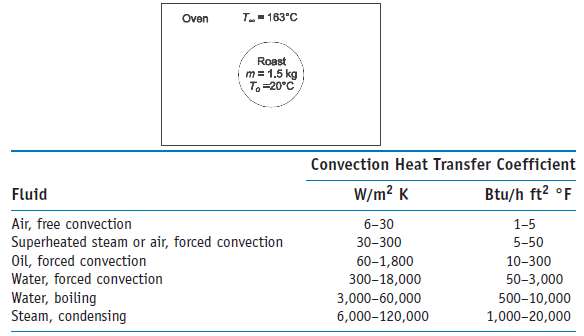
Estimate the time required to heat the center of a 1.5-kg roast in a 163?C over to 77?C. State your assumptions carefully and compare your results with cooking instructions in a standard cookbook.GIVENA roast in an ovenMass of the roast (m) = 1.5 kgOven temperature (T??) = 163?CFinal temperature of
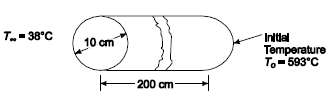
A stainless steel cylindrical billet [k = 14.4 W/(m K), α = 3.9 ×10??6m2/s] is heated to 593?C preparatory to a forming process. If the minimum temperature permissible for forming is 482?C, how long may the billet be exposed to air at 38?C if the average heat transfer coefficient is 85W/(m2K)?
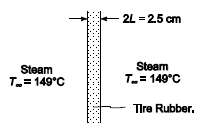
In the vulcanization of tires, the carcass is placed into a jig, and steam at 149?C is admitted suddenly to both sides. If the tire thickness is 2.5 cm, the initial temperature is 21?C, the heat transfer coefficient between the tire and the steam is 150 W/(m2 K), and the specific heat of the rubber
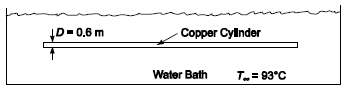
A long copper cylinder 0.6 m in diameter and initially at a uniform temperature of 38?C is placed in a water bath at 93?C. Assuming that the heat transfer coefficient between the copper and the water is 1248 W/(m2 K), calculate the time required to heat the center of the cylinder to 66?C. As a
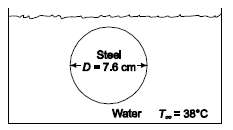
A steel sphere with a diameter of 7.6 cm is to be hardened by first heating it to a uniform temperature of 870?C and then quenching it in a large bath of water at a temperature of 38?C. The following data applysurface heat transfer coefficient h = 590 W/(m2 K)thermal conductivity of steel = 43 W/(m
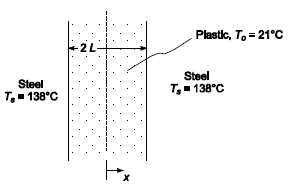
A 2.5-cm-thick sheet of plastic initially at 21°C is placed between two heated steel plates that are maintained at 138°C. The plastic is to be heated just long enough for its mid-plane temperature to reach 132°C. If the thermal conductivity of the plastic is 1.1 ?? 10???3 W/(m K), the thermal
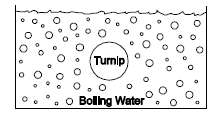
A monster turnip (assumed spherical) weighing in at 0.45 kg is dropped into a cauldron of water boiling at atmospheric pressure. If the initial temperature of the turnip is 17?C, how long does it take to reach 92?C at the center? Assume thathc = 1700W/(m2 K) cρ = 3900 J/(kg K)k = 0.52 W/(m K)
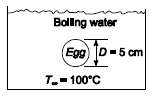
An egg, which for the purposes of this problem can be assumed to be a 5-cm-diameter sphere having the thermal properties of water, is initially at a temperature of 4?C. It is immersed in boiling water at 100?C for 15 min. The heat transfer coefficient from the water to the egg may be assumed to be
A long wooden rod at 38?C with a 2.5 cm diameter is placed into an airstream at 600?C. The heat transfer coefficient between the rod and air is 28.4 W/(m2 K). If the ignition temperature of the wood is 427?C, ρ = 800 kg/m3, k = 0.173W/(m K), and c = 2500 J/(kg K), determine the time between
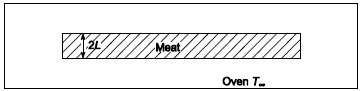
In the inspection of a sample of meat intended for human consumption, it was found that certain undesirable organisms were present. In order to make the meat safe for consumption, it is ordered that the meat be kept at a temperature of at least 121?C for a period of at least 20 min during the
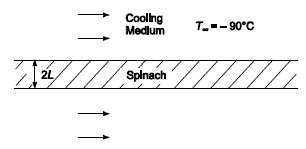
A frozen-food company freezes its spinach by first compressing it into large slabs and then exposing the slab of spinach to a low-temperature cooling medium. The large slab of compressed spinach is initially at a uniform temperature of 21?C; it must be reduced to an average temperature over the
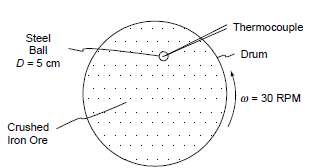
In the experimental determination of the hat transfer coefficient between a heated steel ball and crushed mineral solids, a series of 1.5% carbon steel balls were heated to a temperature of 700?C and the center temperature-time history of each was measured with a thermocouple while it was cooling
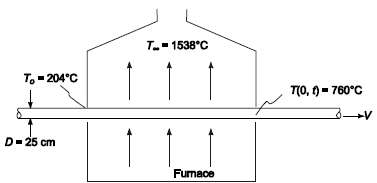
A mild-steel cylindrical billet, 25-cm in diameter, is to be raised to a minimum temperature of 760?C by passing it through a 6-m long strip type furnace. If the furnace gases are at 1538?C and the overall heat transfer coefficient on the outside of the billet is 68 W/(m2 K), determine the maximum
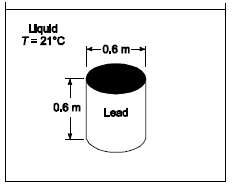
A solid lead cylinder 0.6-m in diameter and 0.6-m long, initially at a uniform temperature of 121?C, is dropped into a 21?C liquid bath in which the heat transfer coefficient hc is 1135 W/(m2 K). Plot the temperature-time history of the center of this cylinder and compare it with the time histories
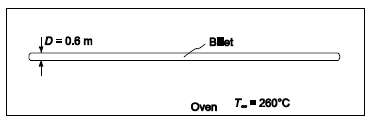
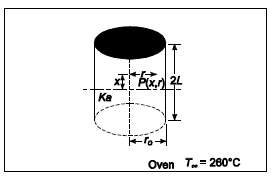
A long 0.6-m-OD 347 stainless steel (k = 14 W/(m K) cylindrical billet at 16?C room temperature is placed in an oven where the temperature is 260?C. If the average heat transfer coefficient is 170 W/(m2 K), (a) estimate the time required for the center temperature to increase to 323?C by using the
Repeat Problem 2.85(a), but assume that the billet is only 1.2-m long and the average heat transfer coefficient at both ends is 136 W/(m2 K).A long, 0.6 m OD 347 stainless steel (k = 14 W/(m K)) cylindrical billet at 16?C room temperature is placed in an over where the temperature is 260?C. If the
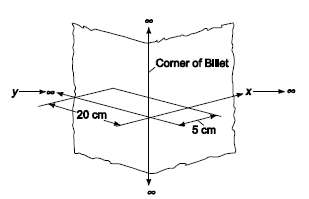
A large billet of steel initially at 260?C is placed in a radiant furnace where the surface temperature is held at 1200?C. Assuming the billet is infinite in extent, compute the temperature at point P shown in the accompanying sketch after 25 min has elapsed. The average properties of steel are: k
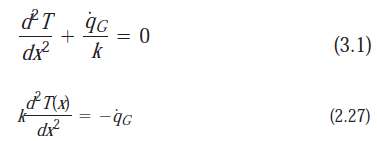
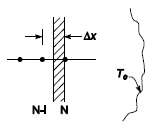
Show that in the limit ??x ?? 0, the difference equation for one-dimensional steady conduction with heat generation, Equation (3.1), is equivalent to the differential equation, Equation (2.27). GIVENOne dimensional steady conduction with heat generationSHOW(a) In the limit of small ??x, the
?What is the physical significance of the statement that the temperature of each node is just the average of its neighbors if there is no heat generation? [with reference to Equation (3.2)]?
Give an example of a practical problem in which the variation of thermal conductivity with temperature is significant and for which a numerical solution is therefore the only viable solution method.
Discuss advantages and disadvantages of using a large control volume.
For one-dimensional conduction, why are the boundary control volumes half the size of interior control volumes?GIVENOne-dimensional conductionEXPLAIN(a) Why the boundary control volume is half the size of internal control volumes
Discuss advantages and disadvantages of two methods for solving one-dimensional steady conduction problems.
Solve the system of equations 2T1 + T2 – T3 = 30T1 – T2 + 7T3 = 270T1 + 6T2 – T3 = 160by Jacobi and Gauss-Seidel iteration. Use as a convergence criterion | T2 (p) – T2 (p – 1) | < 0.001. Compare the rate of convergence for the two methods.GIVENA system of three equations
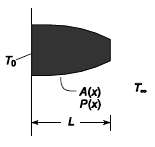
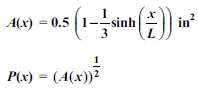
Develop the control volume difference equation for one-dimensional steady conduction in a fin with variable cross-sectional area A(x) and perimeter P(x). The heat transfer coefficient from the fin to ambient is a constant ho and the fin tip is adiabatic.GIVENFin with variable cross-sectional area
Using your results from Problem 3.8, find the heat flow at the base of the fin for the following conditions:k = 20 Btu/(h ft ?F)L = 2 in. ho = 20 Btu/(h ft2 ?F)To = 200?FT?? = 80?FUse a grid spacing of 0.2 in.From Problem 3.8: Develop the control volume difference equation for one-dimensional
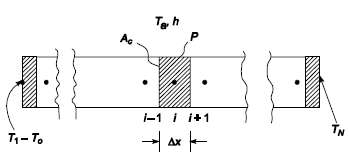
Consider a pin fin with variable conductivity k(T), constant cross sectional area Ac and constant perimeter, P. Develop the difference equations for steady one-dimensional conduction in the fin and suggest a method for solving the equations. The fin is exposed to ambient temperature Tα through a
How would you treat a radiation heat transfer boundary condition for a one-dimensional steady problem? Develop the difference equation for a control volume near the boundary and explain how to solve the entire system of difference equations. Assume that the heat flux at the surface is q = ε σ
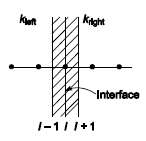
How should the control volume method be implemented at an interface between two materials with different thermal conductivities? Illustrate with a steady, one-dimensional example. Neglect contact resistance.GIVENInterface between two different materials with different thermal
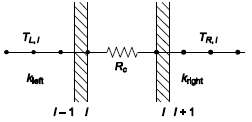
How would you include contact resistance between the two materials in Problem 3.12? Derive the appropriate difference equations. GIVEN Interface between two materials with different thermal conductivities and contact resistance at theInterface
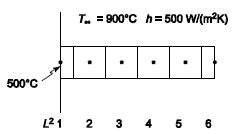
A turbine blade 5-cm long, with cross-sectional area A = 4.5 cm2 and perimeter P = 12 cm, is made of a high-alloy steel [k = 25 W/(m K)]. The temperature of the blade attachement point is 500?C and the blade is exposed to combustion gases at 900?C. The heat transfer coefficient between the blade
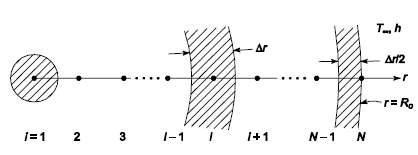
Determine the difference equations applicable to the centerline and at the surface of an axisymmetric cylindrical geometry with volumetric heat generation and convective boundary condition. Assume steady-state conditions.GIVENAxisymmetric, steady, cylindrical geometry with volumetric heat
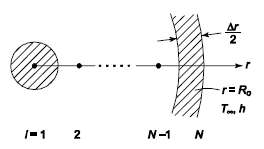
Determine the appropriate difference equations for an axisymmetric, steady, spherical geometry with volumetric heat generation. Explain how to solve the equations.GIVENAxisymmetric, steady, spherical geometry with heatgeneration
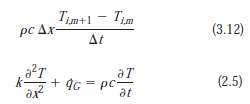
Show that in the limit ??x ?? 0 and ??t ?? 0, the difference Equation (3.12) is equivalent to the differential Equation (2.5). GIVENThe difference equation for one-dimensional transient conductionSHOW(a) As ??x and ??t ?? 0, the difference equation is equivalent to the differential equation,
Determine the largest permissible time step for a one-dimensional transient conduction problem to be solved by an explicit method if the node spacing is 1 mm and the material is (a) carbon steel 1C, and (b) window glass. Explain the difference in the two results.GIVENOne-dimensional transient
Consider one-dimensional transient conduction with a convective boundary condition in which the ambient temperature near the surface is a function of time. Determine the energy balance equation for the boundary control volume. How would the solution method need to be modified to accommodate this
What are the advantages and disadvantages of using explicit and implicit difference equations?EXPLAIN(a) Advantages and disadvantages of explicit and implicit methods
Equation (3.15) is often called the fully-implicit form of the one-dimensional transient conduction difference equation because all quantities in the equation, except for the temperatures in the energy storage term, are evaluated at the new time step, m + 1. In an alternate form called
A 3-m-long steel rod (k = 43 W/(mK), α = 1.17 \ 10–5 m2/s) is initially at 20°C and insulated completely except for its end faces. One end is suddenly exposed to the flow of combustion gases at 1000°C through a heat transfer coefficient of 250 W/(m2 K) and the other end is held at 20°C. How
A Trombe wall is a masonry wall often used in passive solar homes to store solar energy. Suppose such a wall, fabricated from 20 cm thick solid concrete blocks (k = 0.13 W/(mK), α = 0.05 \ 10–5 m2/s is initially at 15°C in equilibrium with the room in which it is located. It is suddenly
To more accurately model the energy input from the sun, suppose the absorbed flux in Problem 3.23 is given byqabs (t) = t (375 – 46.875 t)where t is in hours and qabs is in W/m2. (This time variation of qabs gives the same total heat input to the wall as in Problem 3.23, i.e., 2000 W hr/m2).
An interior wall of a cold furnace, initially at 0°C, is suddenly exposed to a radiant flux of 15 kW/m2 when the furnace is brought on line. The outer surface of the wall is exposed to ambient air at 20°C through a heat transfer coefficient of 10 W/(m2 K). The wall is 20 cm thick and is made of
A long cylindrical rod, 8 cm in diameter, is initially at a uniform temperature of 20°C. At time t = 0, the rod is exposed to an ambient temperature of 400°C through a heat transfer coefficient of 20 W/(m2 K). The thermal conductivity of the rod is 0.8 W/(mK) and the thermal diffusivity is 3
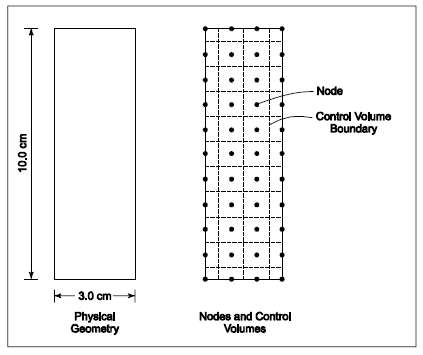
Develop a reasonable layout of nodes and control volumes for the geometry shown in the sketch below. Provide a scale drawing showing the problem geometry overlaid with the nodes and control volumes.GIVENRectangular problemgeometry
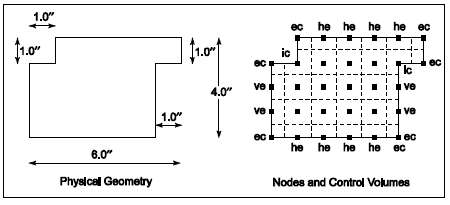
Develop a reasonable layout of nodes and control volumes for the geometry shown in the sketch below. Provide a scale drawing showing the problem geometry overlaid with the nodes and control volumes. Identify each type of control volume used.GIVENRectangular problem geometry with cornersremoved
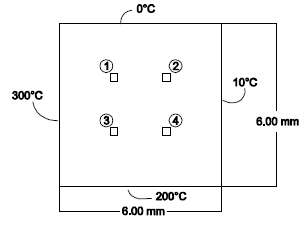
Determine the temperature at the four nodes shown in the figure. Assume steady conditions and two-dimensional heat conduction. The four faces of the square shape are each at different temperatures as shown.GIVENSquare shape with four different facetemperatures
Showing 12800 - 12900
of 18200
First
122
123
124
125
126
127
128
129
130
131
132
133
134
135
136
Last
Step by Step Answers

 Get 50% OFF
Claim Now
Get 50% OFF
Claim Now