New Semester
Started
Get
50% OFF
Study Help!
--h --m --s
Claim Now
Question Answers
Textbooks
Find textbooks, questions and answers
Oops, something went wrong!
Change your search query and then try again
S
Books
FREE
Study Help
Expert Questions
Accounting
General Management
Mathematics
Finance
Organizational Behaviour
Law
Physics
Operating System
Management Leadership
Sociology
Programming
Marketing
Database
Computer Network
Economics
Textbooks Solutions
Accounting
Managerial Accounting
Management Leadership
Cost Accounting
Statistics
Business Law
Corporate Finance
Finance
Economics
Auditing
Tutors
Online Tutors
Find a Tutor
Hire a Tutor
Become a Tutor
AI Tutor
AI Study Planner
NEW
Sell Books
Search
Search
Sign In
Register
study help
engineering
mechanical engineering
Fundamentals of Heat and Mass Transfer 6th Edition Incropera, Dewitt, Bergman, Lavine - Solutions
Consider the evacuated tube solar collector described in part (d). In the interest of maximizing collector efficiency, what spectral radiative characteristics are desired for the outer tube and for the inner tube?
Solar flux of 900 W/m2 is incident on the top side of a plate whose surface has a solar absorptivity of 0.9 and an emissivity of 0.1. The air and surroundings are at 17°C and the convection heat transfer coefficient between the plate and air is 20 W/m2 ∙ K. Assuming that the bottom side of the
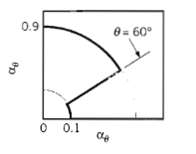
Consider an opaque, gray surface whose directional absorptivity is 0.8 for 0 < θ < 60° and 0.1 for θ > 60°. The surface is horizontal and exposed to solar irradiation comprised of direct and diffuse components.(a) What is the surface absorptivity to direct solar radiation that is
The absorber plate of a solar collector may be coated with an opaque material for which the spectral, directional absorptivity is characterized by relations of the form the zenith angle θ is formed by the sun's rays and the plate normal, and α1. and α2 are constants.(a) Obtain an expression for
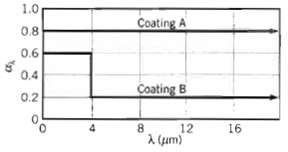
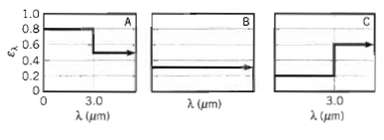
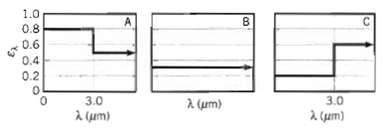
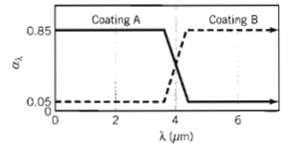
A contractor must select a roof covering material from the two diffuse, opaque coatings with ??, (?) as shown. Which of the two coatings would result in a lower roof temperature? Which is preferred for summer use? For winter use sketch the spectral distribution of ??, that would be ideal for summer
It is not uncommon for the night sky temperature in desert regions to drop to –40°C. If the ambient air temperature is 20°C and the convection coefficient for still air conditions is approximately 5 W/m2 ∙ K, can a shallow pan of water freeze?
Radiation from the atmosphere or sky can be estimated as a fraction of the blackbody radiation corresponding to the air temperature near the ground, Tair, That is, irradiation from the sky can be expressed as G sky = ε sky σT4air and for a clear night sky, the emissivity is correlated by an
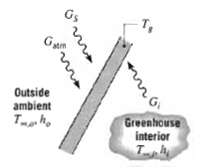
A thin sheet of glass is used on the roof of a greenhouse and is irradiated as shown. The irradiation comprises the total solar flux GS, the flux G aim due to atmospheric emission (sky radiation), and the flux Gi due to emission from interior surfaces. The fluxes G aim and G; are concentrated in
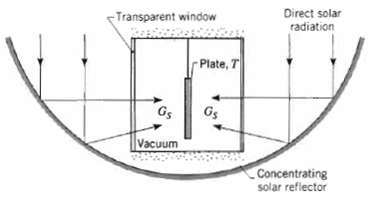
A solar furnace consists of an evacuated chamber with transparent windows, through which concentrated solar radiation is passed. Concentration may be achieved by mounting the furnace at the focal point of a large curved reflector that tracks radiation incident directly from the sun. The furnace may
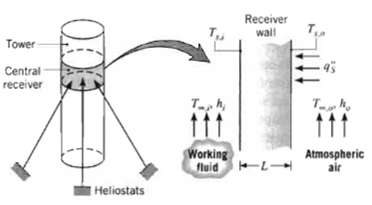
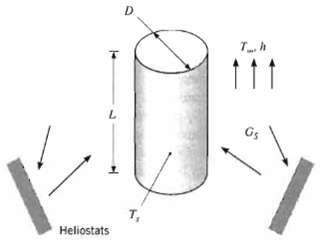
In the central receiver concept of solar energy collection, a large number of heliostats (reflectors) provide a concentrated solar flux of q''S = 80,000 W/m2 to the receiver, which is positioned at the top of a tower. The receiver wall is exposed to the solar flux at its outer surface and to
Consider the central receiver of Problem 12.117 to be a cylindrical shell of outer diameter D = 7 m and length L = 12 m. The outer surface is opaque and diffuse, with a spectral absorptivity of ?? = 0.9 for ? 3?m. The surface is exposed to quiescent ambient air for which T? = 300 K. (a) Consider
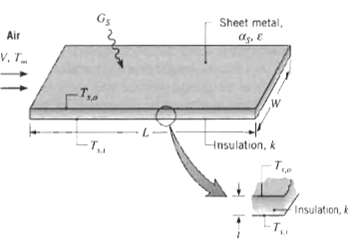
The flat roof on the refrigeration compartment of a food deli very truck is of length L = 5 m and width W = 2 m. It is fabricated from thin sheet metal to which a fiberboard insulating material of thickness t = 25 mm and thermal conductivity k = 0.05 W/m ? K is bonded. During normal operation, the
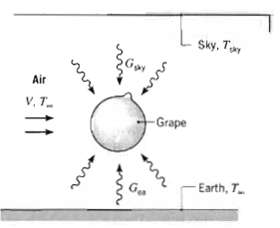
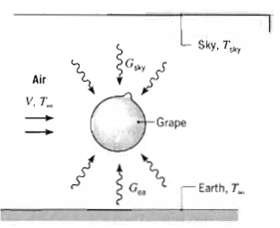
Growers use giant fans to prevent grapes from freezing when the effective sky temperature is low. The grape, which may be viewed as a thin skin of negligible thermal resistance enclosing a volume of sugar water, is exposed to ambient air and is irradiated from the sky above and ground below. Assume
A circular metal disk having a diameter of 0.4 m is placed firmly against the ground in a barren horizontal region where the earth is at a temperature of 280 K. The effective sky temperature is also 280 K. The disk is exposed to quiescent ambient air at 300 K and direct solar irradiation of 745
The neighborhood cat likes to sleep on the roof of our shed in the backyard. The roofing surface is weathered galvanized sheet metal (ε = 0.65, αS = 0.8). Consider a cool spring day when the ambient air temperature is 10°C and the convection coefficient can be estimated from an empirical
The exposed surface of a power amplifier for an earth satellite receiver of area 130 mm by 130 mm has a diffuse, gray, opaque coating with an emissivity of 0.5. For typical amplifier operating conditions, the surface temperature is 58°C under the following environmental conditions: air
Consider a thin opaque, horizontal plate with an electrical heater on its backside. The front side is exposed to ambient air that is at 20°C and provides a convection heat transfer coefficient of 10 W/m2 ? K, solar irradiation of 600 W/m2, and an effective sky temperature of -40°C. What is the
Growers use giant fans to prevent grapes from freezing when the effective sky temperature is low. The grape, which may be viewed as a thin skin of negligible thermal resistance enclosing a volume of sugar water, is exposed to ambient air and is irradiated from the sky above and ground below. Assume
Two plates, one with a black painted surface and the other with a special coating (chemically oxidized copper) are in earth orbit and are exposed to solar radiation. The solar rays make an angle of 30° with the normal to the plate. Estimate the equilibrium temperature of each plate assuming they
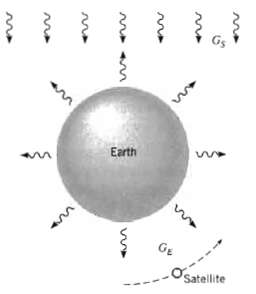
A spherical satellite of diameter D is in orbit about the earth and is coated with a diffuse material for which the spectral absorptivity is ?? = 0.6 for A 3?m. When it is on the "dark" side of the earth, the satellite sees irradiation from the earth's surface only. The irradiation may be assumed
A radiator on a proposed satellite solar power station must dissipate heat being generated within the satellite by radiating it into space. The radiator surface has a solar absorptivity of 0.5 and an emissivity of 0.95. What is the equilibrium surface temperature when the solar irradiation is 1000
A spherical satellite in near-earth orbit is exposed to solar irradiation of 1353 W/m2. To maintain a desired operating temperature, the thermal control engineer intends to use a checker pattern for which a fraction F of the satellite surface is coated with an evaporated aluminum film (8 = 0.03,
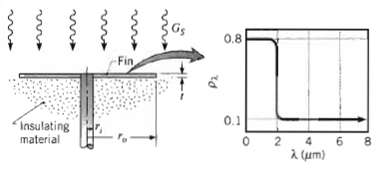
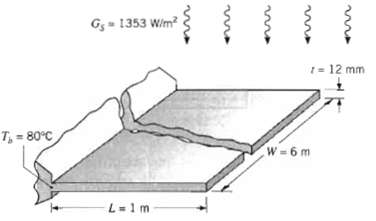
An annular fin of thickness t is used as a radiator to dissipate heat for a space power system. The fin is insulated on the bottom and may be exposed to solar irradiation GS. The fin is coated with a diffuse, spectrally selective material whose spectral reflectivity is specified. Heat is conducted
(a) If the base of the radiator is maintained at Tb = 80°C, what is its tip temperature and the rate of heat rejection? Use a computer-based, finite-difference method with a space increment of 0.1 m to obtain your solution. (b) Repeat the calculation of part (a) for the case when the space ship is
The directional absorptivity of a gray surface varies with ? as follows. (a) What is the ratio of the normal absorptivity an to the hemispherical emissivity of the surface? (b) Consider a plate with these surface characteristics on both sides in earth orbit. If the solar flux incident on one side
Two special coatings are available for application to an absorber plate installed below the cover glass described in Example 12.8. Each coating is diffuse and is characterized by the spectral distributions shown. Which coating would you select for the absorber plate? Explain briefly. For the
Consider the spherical satellite of Problem 12.127. Instead of the entire satellite being coated with a material that is spectrally selective, half of the satellite is covered with a diffuse gray coating characterized by α1 = 0.6. The other half of the satellite is coated with a diffuse gray
(a) Derive a differential equation for predicting the capsule temperature as a function of time. Solve this equation to obtain the temperature as a function of time in terms of capsule parameters and its initial temperature Ti.(b) If the capsule begins its journey at 20°C, predict the position of
Consider the spherical satellite of Problem 12.127. By changing the chemistry of the diffuse material used for the coating, engineers can control the cutoff wavelength that marks the boundary between αλ = 0.6 and αλ = 0.3.(a) What cutoff wavelength will minimize the steady-state temperature of
(b) What cutoff wavelength will maximize the steady-state temperature of the satellite when it is on the dark side of the earth? What will the corresponding steady-state temperature be on the bright side?
It is known that on clear nights a thin layer of water on the ground will freeze before the air temperature drops below 0°C. Consider such a layer of water on a clear night for which the effective sky temperature is - 30°C and the convection heat transfer coefficient due to wind motion is h = 25
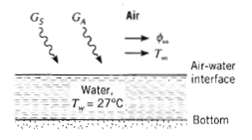
A shallow layer of water is exposed to the natural environment as shown. Consider conditions for which the solar and atmospheric irradiations are GS = 600 W/m2 and GA = 300 W/m2, respectively, and the air temperature and relative humidity are T? = 27°C and ?? = 0.50, respectively. The
A roof-cooling system, which operates by maintaining a thin film of water on the roof surface, may be used to reduce air-conditioning costs or to maintain a cooler environment in non-conditioned buildings. To determine the effectiveness of such a system, consider a sheet metal roof for which the
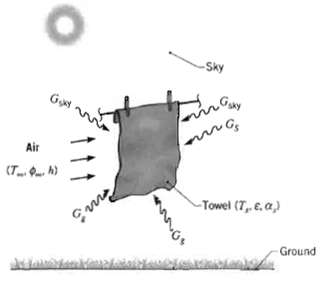
A wet towel hangs on a clothes line under conditions for which one surface receives solar irradiation of GS = 900 W/m 2 and both surfaces are exposed to atmospheric (sky) and ground radiation of G sky = 200 W/m2 and Gg = 250 W/m2, respectively. Under moderately windy conditions, air flow at a
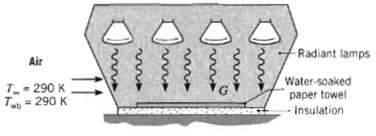
Our students perform a laboratory experiment to determine mass transfer from a wet paper towel experiencing forced convection and irradiation from radiant lamps. For the values of T? and Twb prescribed on the sketch, the towel temperature was found to be Ts = 310 K. In addition flat-plate
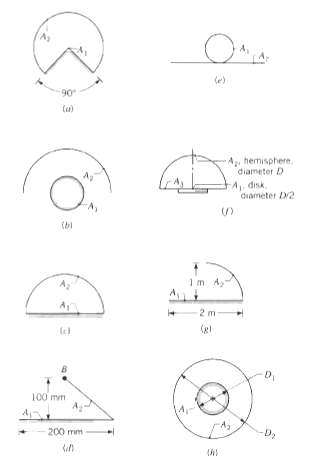
Determine F12 and F21 for the following configurations using the reciprocity theorem and other basic shape factor relations. Do not use tables or charts. (a) Long duct (b) Small sphere of area A1 under a concentric hemisphere of area A2 = 2A1 (c) Long duct. What is F22 for this case? (d) Long
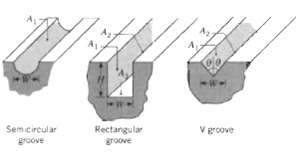
Consider the following grooves, each of width W, that have been machined from a solid block of material. (a) For each case obtain an expression for the view factor of the groove with respect to the surroundings outside the groove. (b) For the V groove, obtain an expression for the view factor F12,
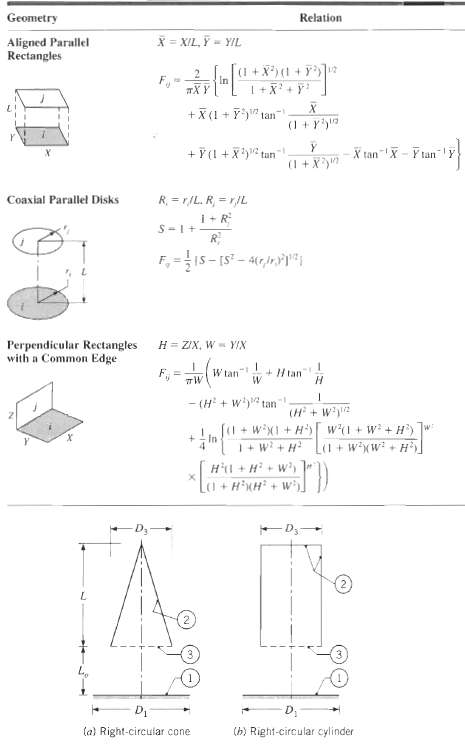
A right -circular cone and a right -circular cylinder of the same diameter and length (A2) are positioned coaxially at a distance Lo from the circular disk (A1) shown schematically. The inner base and lateral surfaces of the cylinder may be treated as a single surface, A2. The hypothetical area
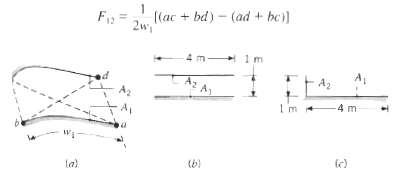
The "crossed-strings" method of Hottel [13] provides a simple means to calculate view factors between surfaces that are of infinite extent in one direction. For two such surfaces (a) with unobstructed views of one another, the view factor is of the form. Use this method to evaluate the view factors
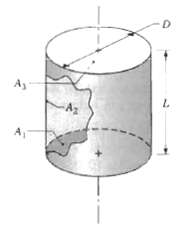
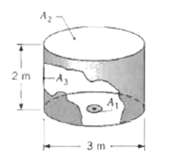
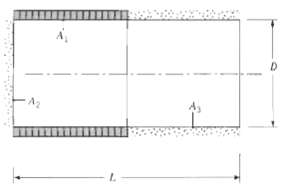
Consider the right-circular cylinder of diameter D, length L. and the areas A1, A2, and A3 representing the base, inner, and top surfaces, respectively. (a) Show that the view factor between the base of the cylinder and the inner surface has the form F12 = 2H [(1 + H2)1/2 - H], where H = L/D. (b)
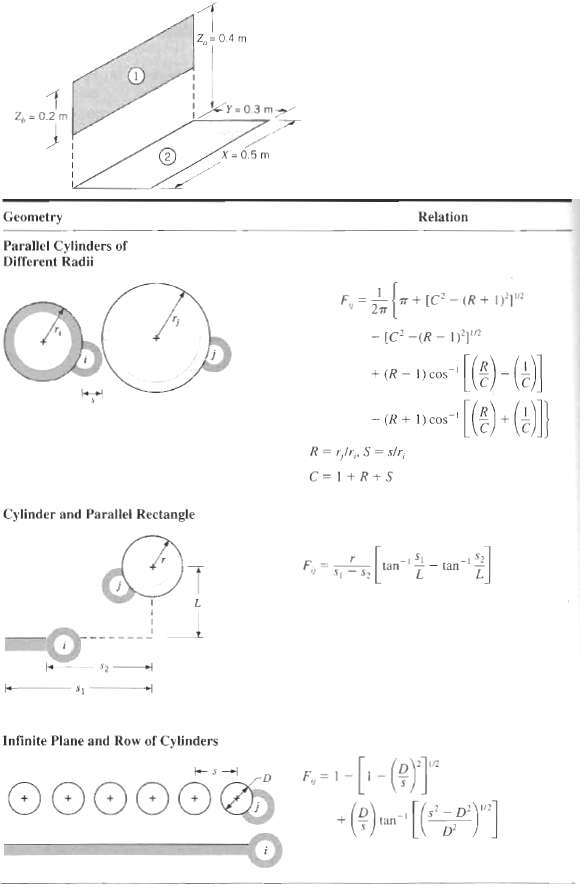
Consider the perpendicular rectangles shown schematically. (a) Determine the shape factor F12. (b) For rectangle widths of X = 0.5, 1.5, and 5 m, plot F12 as a function of Zb for 0.05 Zb 0.4m. Compare your results with the view factor obtained from the two-dimensional relation for perpendicular
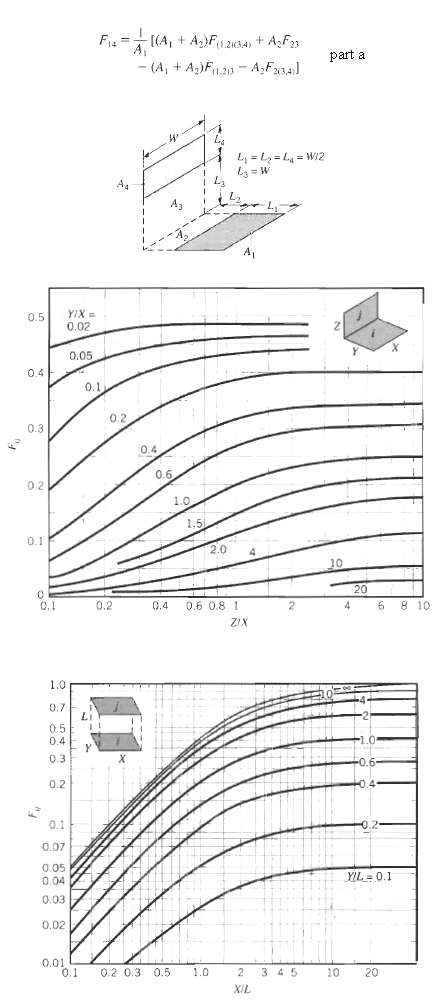
The reciprocity relation, the summation rule, and Equations 13.5 to 13.7 can be used to develop view factor relations that allow for applications of Figure 13.4 and/or 13.6 to more complex configurations.?Consider the view factor F14 for surfaces 1 and 4 of the following geometry. These surfaces
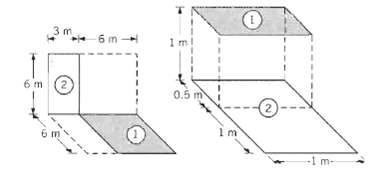
Determine the shape factor, F12 for the rectangles shown. (a) Perpendicular rectangles (b) Parallel rectangles of without common edge unequal areas.
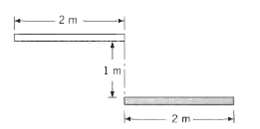
Consider the parallel planes of infinite extent normal to the page having opposite edges aligned as shown in the sketch. (a) Using appropriate view factor relations and the results for opposing parallel planes, develop an expression for the view factor F12. (b) Use Hottel's crossed-string method
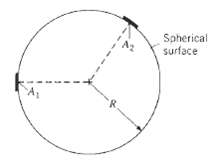
Consider two diffuse surfaces A 1 and A 2 on the inside of a spherical enclosure of radius R. Using the following methods derive an expression for the view factor F12 in terms of A2 and R. (a) Find F12 by beginning with the expression Fij = qi?j?/ AiJi. (b) Find F12 using the view factor integral,
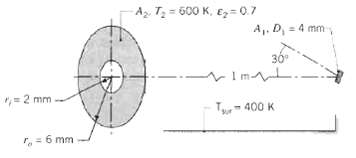
As shown in the sketch, consider the disk A1 located coaxially 1m distant, but tilted 30? off the normal, from the ring-shaped disk Az. What is the irradiation on A1 due to radiation from A2, which is a diffuse? Gray surface with an emissivity of 0.7
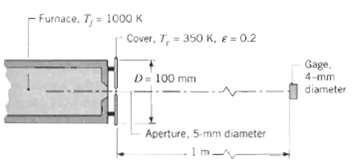
A heat flux gage of 4-mm diameter is positioned normal to and 1 m from the 5 mm-diameter aperture of a blackbody furnace at 1000 K. The diffuse, gray cover shield (E = 0.2) of the furnace has an outer diameter of 100 mm and its temperature is 350 K. The furnace and gage are located in a large room
A circular ice rink 25 m in diameter is enclosed by a hemispherical dome 35 m in diameter. If the ice and dome surfaces may be approximated as blackbodies and are at 0 and 15° C, respectively, what is the net rate of radiative transfer from the dome to the rink?
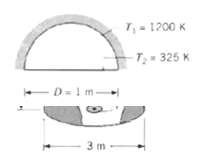
A drying oven consists of a long semicircular duct of diameter D = 1 m. Materials to be dried cover the base of the oven while the wall is maintained at 1200 K. What is the drying rate per unit length of the oven (kg/s ? m) if a water-coated layer of material is maintained at 325 K during the
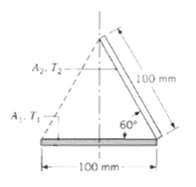
Consider the arrangement of the three black surfaces shown, where A1 is small compared to A2 or A3. Determine the value of F13. Calculate the net radiation heat transfer from A1 to A3 if A1 = 0.05 m2, T, = 1000 K, and T3 = 500 K.
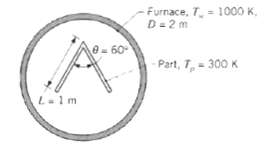
A long, V-shaped part is heat treated by suspending it in a tubular furnace with a diameter of 2 m and a wall temperature of 1000 K. The "vee" is I-m long on a side and has an angle of 60?. If the wall of the furnace and the surfaces of the part may be approximated as blackbodies and the part is at
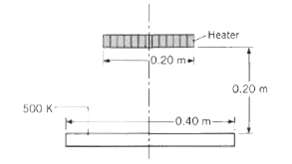
Consider coaxial, parallel, black disks separated a distance of 0.20 m. The lower disk of diameter 0.40 m is maintained at 500 K and the surroundings are at 300 K. What temperature will the upper disk of diameter 0.20 m achieve if electrical power of 17.5 W is supplied to the heater on the back
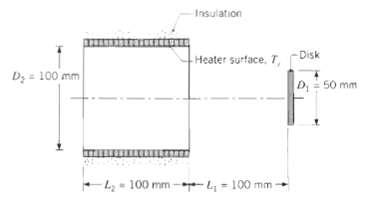
A tubular heater with a black inner surface of uniform temperature Ts = 1000 K irradiates a coaxial disk. (a) Determine the radiant power from the heater which is incident on the disk, qs?1. What is the irradiation on the disk, G1? (b) For disk diameters of Di = 25, 50, and 100 mm, plot qs?1 and G1
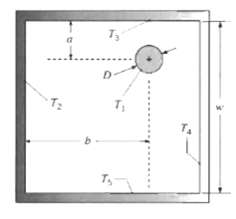
A long cylindrical rod of very high emissivity is heat treated within a long, evacuated oven of square cross section as shown in the sketch. The oven walls exhibit blackbody behavior. Due to non-uniform heat losses, the temperatures of the oven walls are slightly different and are T2 = 600 K, T3 =
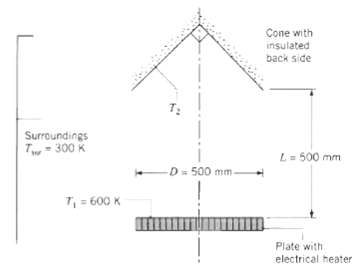
A circular plate of 500-mm diameter is maintained at T1 = 600 K and is positioned coaxial to a conical shape. The back side of the cone is well insulated. The plate and the cone, whose surfaces are black, are located in a large, evacuated enclosure whose walls are at 300 K. (a) What is the
Two furnace designs, as illustrated and dimensioned in Problem 13.4, are used to heat a disk-shaped work piece (A1). The power supplied to the conical and cylindrical furnaces (A2) is 50 W. The work piece is located in a large room at a temperature of 300 K. and its back side is well insulated.
A furnace is constructed in three sections, which include insulated circular (2) and cylindrical (3) sections, as well as an intermediate cylindrical section (1) with imbedded electrical resistance heaters. The overall length and diameter are 200 mm and 100 mm, respectively, and the cylindrical
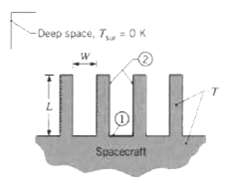
To enhance heat rejection from a spacecraft, an engineer proposes to attach an array of rectangular fins to the outer surface of the spacecraft and to coat all surfaces with a material that approximates blackbody behavior. Consider the U-shaped region between adjoining fins and subdivide the
A cylindrical cavity of diameter D and depth L is machined in a metal block, and conditions are such that the base and side surfaces of the cavity are maintained at T1 = 1000 K and T2 = 700 K, respectively. Approximating the surfaces as black, determine the emissive power of the cavity if L = 20 mm
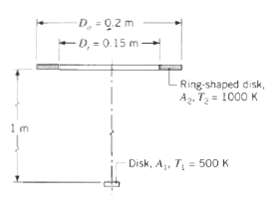
In the arrangement shown, the lower disk has a diameter of 30 mm and a temperature of 500 K. The upper surface, which is at 1000 K, is a ring-shaped disk with inner and outer diameters of 0.15 m and 0.2 m. This upper surface is aligned with and parallel to the lower disk and is separated by a
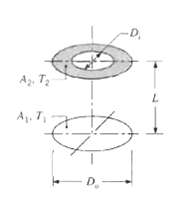
Two plane coaxial disks are separated by a distance L = 0.20 m. The lower disk (A1) is solid with a diameter Do = 0.80 m and a temperature T1 = 300 K. The upper disk (A2), at temperature Tz = 1000 K, has the same outer diameter but is ring-shaped with an inner diameter Di = 0.40 m. Assuming the
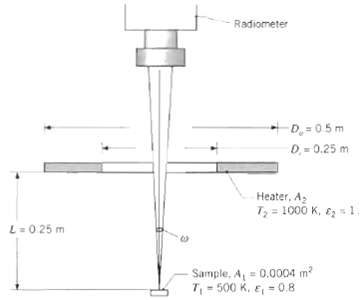
A radiometer views a small target (1) that is being heated by a ring-shaped disk heater (2). The target has an area of A1 = 0.0004 m2, a temperature of T1 = 500 K, and a diffuse, gray emissivity of ?1 = 0.8. The heater operates at T2 = 1000 K and has a black surface. The radiometer views the entire
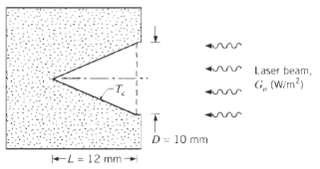
A meter to measure the optical power of a laser beam is constructed with a thin walled, black conical cavity that is well insulated from its housing. The cavity has an opening of D = 10 mm and a depth of L = 12 mm. The meter housing and surroundings are at a temperature of 25.0?C. A fine-wire
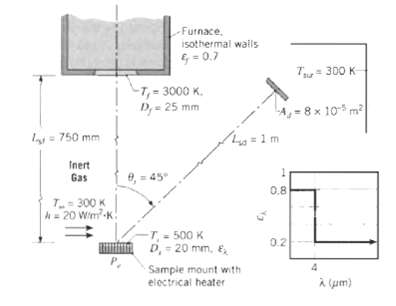
An electrically heated sample is maintained at a surface temperature of Ts = 500 K. The sample coating is diffuse but spectrally selective, with the spectral emissivity distribution shown schematically. The sample is irradiated by a furnace located coaxially at a distance of Lsf = 750 mm. The
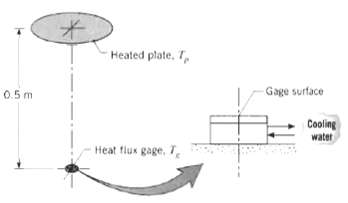
The arrangement shown is to be used to calibrate a heat flux gage. The gage has a black surface that is 10 mm in diameter and is maintained at 17?C by means of a water cooled backing plate. The heater, 200 mm in diameter, has a black surface that is maintained at 800 K and is located 0.5 m from the
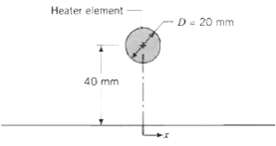
A long, cylindrical heating element of 20-mm diameter operating at 700 K in vacuum is located 40 mm from an insulated wall of low thermal conductivity (a) Assuming both the element and the wall are black, estimate the maximum temperature reached by the wall when the surroundings are at 300 K. (b)
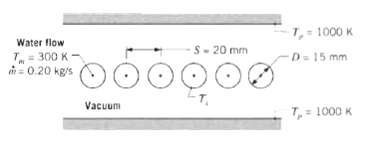
Water flowing through a large number of long, circular, thin-walled tubes is heated by means of hot parallel plates above and below the tube array. The space between the plates is evacuated and the plate and tube surfaces may be approximated as black bodies. (a) Neglecting axial variations,
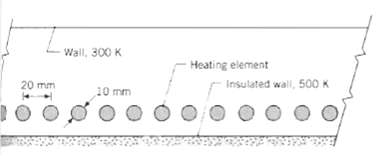
A row of regularly spaced cylindrical heating elements is used to maintain an insulated furnace wall at 500 K. The opposite wall is at a uniform temperature of 300 K. The insulated wall experiences convection with air at 450 K and a convection coefficient of 200 W/m2 ? K. Assuming the walls and
A manufacturing process calls for heating long copper rod which are coated with a thin film having ε = 1, by placing them in a large evacuated oven whose surface is maintained at 1650 K. The rods are of 10-mm diameter and are placed in the oven with an initial temperature of 300 K.(a) What is the
Consider the very long, inclined black surfaces (A1, A2) maintained at uniform temperatures of T1 = 1000 K and T2 = 800 K. Determine the net radiation exchange between the surfaces per unit length of the surfaces. Consider the configuration when a black surface (A3), whose back side is insulated,
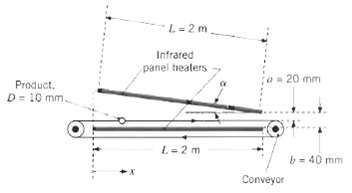
Many products are processed in a manner that requires a specified product temperature as a function of time. Consider a product in the shape of long 10-mm-diameter cylinders that are conveyed slowly through a processing oven as shown in the schematic. The product exhibits near-black behavior and is
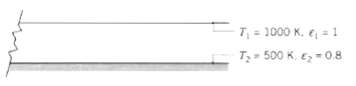
Consider two very large parallel plates with diffuse, gray surfaces. Determine the irradiation and radiosity for the upper plate. What is the radiosity for the lower plate? What is the net radiation exchange between the plates per unit area of the plates?
A flat-bottomed hole 6 mm in diameter is bored to a depth of 24 mm in a diffuse, gray material having an emissivity of 0.8 and a uniform temperature of 1000 K.(a) Determine the radiant power leaving the opening of the cavity.(b) The effective emissivity εe of a cavity is defined as the ratio of
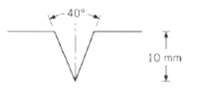
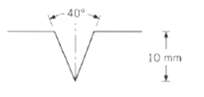
Consider a long V groove 10 mm deep machined on a block that is maintained at 1000 K. If the groove surfaces are diffuse and gray with an emissivity of 0.6, determine the radiant flux leaving the groove to its surroundings. Also determine the effective emissivity of the cavity, as defined in
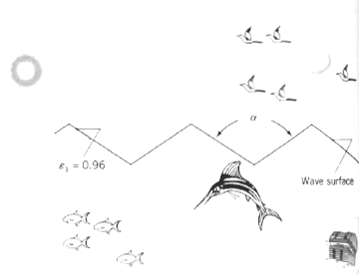
In Problems 12.19 and 12.20, we estimated the earth's surface temperature, assuming the earth is black. Most of the earth's surface is water, which has a hemispherical emissivity of ? = 0.96. In reality, the water surface is not flat but has waves and ripples. (a) Assuming the wave geometry can be
Consider the cavities formed by a cone, cylinder and sphere having the same opening size (d) and major dimension (L), as shown in the diagram. (a) Find the view factor between the inner surface of each cavity and the opening of the cavity (b) Find the effective emissivity of each cavity ?e, as
A t = 5 mm thick sheet of anodized aluminum is used to reject heat in a space power application. The edge of the sheet is attached to a hot source, and the sheet is maintained at nearly isothermal conditions at T = 300 K. The sheet is not subjected to irradiation.(a) Determine the net radiation
Consider the spacecraft heat rejection scheme of Problem 13.27, but under conditions for which surfaces 1 and 2 may not be approximated as blackbodies.(a) For isothermal surfaces of temperature T = 325 K and emissivity 8 = 0.7 and a V-section of width W = 25 mm and length L = 125 mm. determine the
An electronic device dissipating 50W is attached to the inner surface of an isothermal cubical container that is 120 mm on a side. The container is located in the much larger service bay of the space shuttle, which is evacuated and whose walls are at 150 K. If the outer surface of the container has
A long, thin-walled horizontal tube 100 mm in diameter is maintained at 120°C by the passage of steam through its interior. A radiation shield is installed around the tube, providing an air gap of 10 mm between the tube and the shield, and reaches a surface temperature of 35°C. The tube and
A very long electrical conductor 10 mm in diameter is concentric with a cooled cylindrical tube 50 mm in diameter whose surface is diffuse and gray with an emissivity of 0.9 and temperature of 27°C. The electrical conductor has a diffuse, gray surface with an emissivity of 0.6 and is dissipating
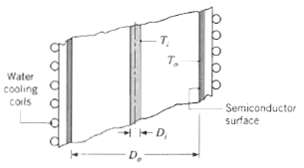
An arrangement for direct conversion of thermal energy to electrical power is shown. The inner cylinder of diameter Di = 25 mm is heated internally by a combustion process that brings the ceramic cylinder (?i = 0.9) to a surface temperature of Ti = 1675?C. The outer cylinder of diameter Do = 0.38 m
Liquid oxygen is stored in a thin-walled, spherical container 0.8 m in diameter, which is enclosed within a second thin-walled, spherical container 1.2 m in diameter. The opaque, diffuse, gray container surfaces have an emissivity of 0.05 and are separated by an evacuated space. If the outer
Two concentric spheres of diameter D) = 0.8 m and D1 = 1.2 m are separated by an air space and have surface temperatures of T1 = 400 K and T2 = 300 K.(a) If the surfaces are black, what is the net rate of radiation exchange between the spheres?(b) What is the net rate of radiation exchange between
Determine the steady-state temperatures of two radiation shields placed in the evacuated space between two infinite planes at temperatures of 600 and 325 K. All the surfaces are diffuse and gray with emissivities of 0.7.
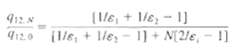
Consider two large (infinite) parallel planes that are diffuse-gray with temperatures and emissivities of T1, ?1 and T2, ?2. Show that the ratio of the radiation transfer rate with multiple shields, N, of emissivity ?s to that with no shields, N = 0 is, where q12, N and q12, O represent the
Consider two large, diffuse gray, parallel surfaces separated by a small distance. If the surface emissivities are 0.8, what emissivity should a thin radiation shield have to reduce the radiation heat transfer rate between the two surfaces by a factor of 10?
Heat transfer by radiation occurs between two large parallel plates, which are maintained at temperatures T1 and T2, with T1 > T2. To reduce the rate of heat transfer between the plates, it is proposed that they be separated by a thin shield that has different emissivities on opposite surfaces.
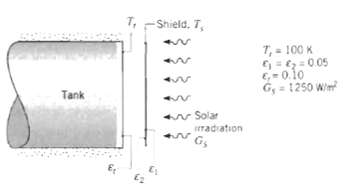
The end of a cylindrical liquid cryogenic propellant tank in free space is to be protected from external (solar) radiation by placing a thin metallic shield in front of the tank. Assume the view factor Fts between the tank and the shield is unity; all surfaces are diffuse and gray, and the
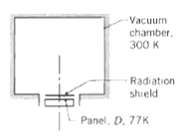
At the bottom of a very large vacuum chamber whose walls are at 300 K, a black panel 0.1 m in diameter is maintained at 77 K. To reduce the heat gain to this panel, a radiation shield of the same diameter D and an emissivity of 0.05 are placed very close to the panel. Calculate the net heat gain to
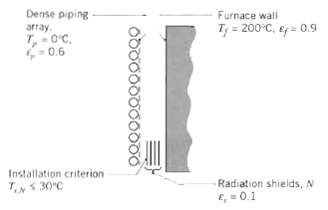
A furnace is located next to a dense array of cryogenic fluid piping. The ice-covered piping approximates a plane surface with an average temperature of Tp = 0?C and an emissivity of ?p = 0.6. The furnace wall has a temperature of T? = 200?C and an emissivity of ?? = 0.9. To protect the
A cryogenic fluid flows through a tube 20 mm in diameter, the outer surface of which is diffuse and gray with an emissivity of 0.02 and temperature of 77 K. This tube is concentric with a larger tube of 50-mm diameter, the inner surface of which is diffuse and gray with an emissivity of 0.05 and
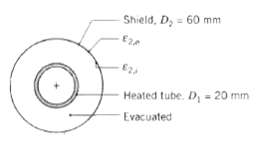
A diffuse, gray radiation shield of 60-mm diameter and emissivities of ?2, i = 0.01 and ?2, o = 0.1 on the inner and outer surfaces, respectively, is concentric with a long tube transporting a hot process fluid. The tube surface is black with a diameter of 20 mm. The region interior to the shield
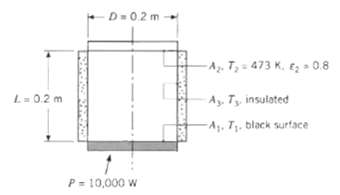
Consider the three-surface enclosure shown. The lower plate (A1) is a black disk of 200-mm diameter and is supplied with a heat rate of 10,000 W. The upper plate (A2) a disk coaxial to A J, is a diffuse gray surface with ?2 = 0.8 and is maintained at T2 = 473 K. The diffuse, gray sides between the
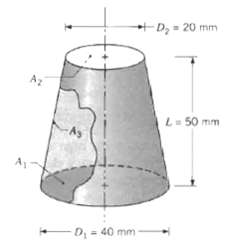
A furnace has the form of a truncated conical section, as shown in the schematic. The floor of the furnace has an emissivity of ?1 = 0.7 and is maintained at 1000 K with a heat flux of 2200 W/m2. The lateral wall is perfectly insulated with an emissivity of ?3 = 0.3. Assume that all the surfaces
Consider two aligned, parallel, square planes (0.4 m x 0.4 m) spaced 0.8 m apart and maintained at T1 = 500 K and T2 = 800 K. Calculate the net radiative heat transfer from surface 1 for the following special conditions:(a) Both planes are black and the surroundings are at 0 K.(b) Both planes are
Two parallel, aligned disks, 0.4 m in diameter and separated by 0.1 m, are located in a large room whose walls are maintained at 300 K. One of the disks is maintained at a uniform temperature of 500 K with an emissivity of 0.6, while the backside of the second disk is well insulated. If the disks
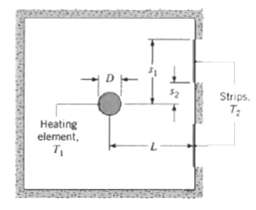
Coatings applied to long metallic strips are cured by installing the strips along the walls of a long oven of square cross section. Thermal conditions in the oven are maintained by a long silicon carbide rod (heating element), which is of diameter D = 20 mm and is operated at T1 = 1700 K. Each of
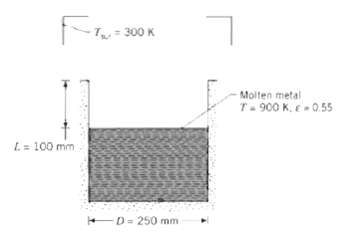
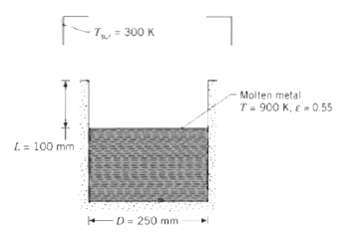
A molten aluminum alloy at 900 K is poured into a cylindrical container that is well insulated from large surroundings at 300 K. The inner diameter of the container is 250 mm, and the distance from the surface of the melt to the top of the container is 100 mm. If the oxidized aluminum at the
The proposed design for a blackbody simulator consists of a diffuse gray, circular plate with an emissivity of 0.9 maintained at Tp = 600 K and mounted over a well-insulated hemispherical cavity of radius ro =100 mm. The opening in the circular plate is ro/2. (a) Calculate the radiant power leaving
Showing 12200 - 12300
of 18200
First
116
117
118
119
120
121
122
123
124
125
126
127
128
129
130
Last
Step by Step Answers

 Get 50% OFF
Claim Now
Get 50% OFF
Claim Now