New Semester
Started
Get
50% OFF
Study Help!
--h --m --s
Claim Now
Question Answers
Textbooks
Find textbooks, questions and answers
Oops, something went wrong!
Change your search query and then try again
S
Books
FREE
Study Help
Expert Questions
Accounting
General Management
Mathematics
Finance
Organizational Behaviour
Law
Physics
Operating System
Management Leadership
Sociology
Programming
Marketing
Database
Computer Network
Economics
Textbooks Solutions
Accounting
Managerial Accounting
Management Leadership
Cost Accounting
Statistics
Business Law
Corporate Finance
Finance
Economics
Auditing
Tutors
Online Tutors
Find a Tutor
Hire a Tutor
Become a Tutor
AI Tutor
AI Study Planner
NEW
Sell Books
Search
Search
Sign In
Register
study help
engineering
mechanical engineering
Principles of heat transfer 7th Edition Frank Kreith, Raj M. Manglik, Mark S. Bohn - Solutions
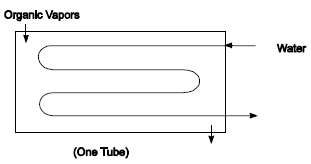
A horizontal shell-and-tube heat exchanger is used to condense organic vapors. The organic vapors condense on the outside of the tubes. Water is used as the cooling medium on the inside of the tubes. The condenser tubes are 1.9 cm O.D., 1.6 cm ID copper tubes, 2.4 m in length. There are a total of
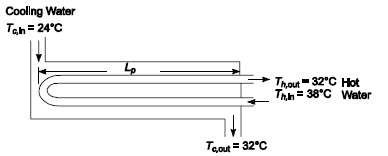
A shell-and-tube heat exchanger is to be used to cool 200,000 lb/h (25.2 kg/s) of water from 100?F (38?C) to 90?F (32?C). The exchanger has one shell-side pass and two tube side passes. The hot water flows through the tubes and the cooling water flows through the shell. The cooling water enters at
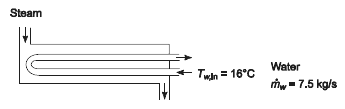
A shell-and-tube heat exchanger with the characteristics given below is to be used to heat 27,000 kg/h of water before it is sent to a reaction system. Saturated steam at 2.36 atm absolute pressure is available as the heating medium and will be condensed without sub-cooling on the outside of the
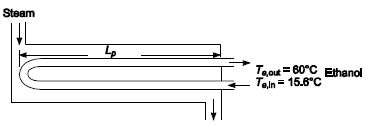
Determine the appropriate size of a shell-and-tube heat exchanger with two tube passes and one shell pass to heat 70,000 lb/h (8.82 kg/s) of pure ethanol from 60 to 140?F (15.6 to 60?C). The heating medium is saturated steam at 22 psia (152 kPa) condensing on the outside of the tubes with a
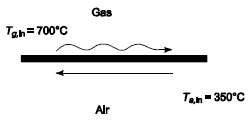
A counterflow regenerator is used in a gas turbine power plant to preheat the air before it enters the combustor. The air leaves the compressor at a temperature of 350?C. Exhaust gas leaves the turbine at 700?C. The mass flow rates of air and gas are 5 kg/s. Take the cp of air and gas to be equal
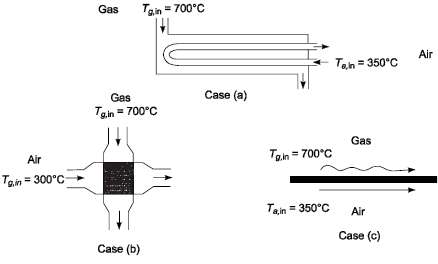
Determine the heat transfer area requirements of Problem 8.41 if a 1-2 shell and tube, an unmixed crossflow, and a parallel flow heat exchanger are used, respectively. From Problem 8.41: A regenerator is used in a gas turbine power plant to preheat the air before it enters the combustor. The air
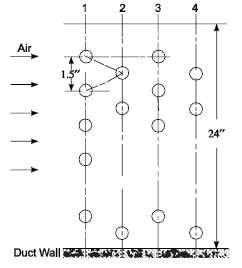
A small space heater is constructed of 1/2-in., 18-gauge brass tubes, 2 ft long. The tubes are arranged in equilateral, staggered triangles on 1 1/2-in. centers, four rows of 15 tubes each. A fan blows 2000 cfm of atmospheric pressure air at 70?F uniformly over the tubes (see sketch). Estimate:(a)
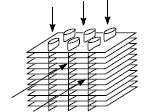
A one-tube pass cross-flow heat exchanger is considered for recovering energy from the exhaust gases of a turbine-driven engine. The heat exchanger is constructed of flat plates, forming an egg-crate pattern as shown in the sketch below. The velocities of the entering air (10°C) and exhaust gases
A shell-and-tube counterflow heat exchanger is to be designed for heating an oil from 80 to 180?F. The heat exchanger has two tube passes and one shell pass. The oil is to pass through 1 1/2-in. schedule 40 pipes at a velocity of 2000 fpm and steam is to condense at 215?F on the outside of the
A shell-and-tube heat exchanger in an ammonia plant is preheating 1132 cubic meters of atmospheric pressure nitrogen per hour from 21 to 65?C using steam condensing at 138,000 N/m2. The tube in the heat exchanger have an inside diameter of 2.5 cm. In order to change from ammonia synthesis to
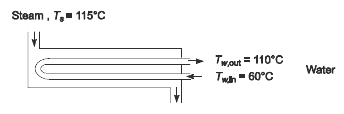
In an industrial plant a shell-and-tube heat exchanger is heating pressurized dirty water at the rate of 38 kg/s from 60 to 110°C by means of steam condensing at 115°C on the outside of the tubes. The heat exchanger has 500 steel tubes (ID = 1.6 cm, OD = 2.1 cm) in a tube bundle which is 9 m
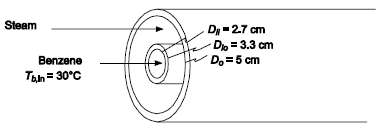
Liquid benzene (specific gravity = 0.86) is to be heated in a counterflow concentric-pipe heat exchanger from 30 to 90?C. For a tentative design, the velocity of the benzene through the inside pipe (ID = 2.7 cm; OD = 3.3 cm) can be taken as 8 m/s. Saturated process steam at 1.38 x 10⁶ N/m2 is
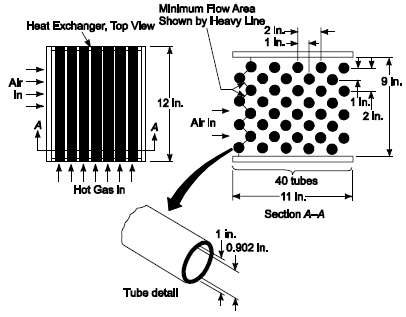
Calculate the overall heat transfer coefficient and the rate of heat flow from the hot gasses to the cold air in the cross flow tube-bank of heat exchanger shown in the accompanying illustration for the following operating conditionsAir flow rate = 3000 lb/h.Hot gas flow rate = 5000
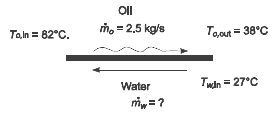
An oil having a specific heat of 2100 J/(kg K) enters an oil cooler at 82°C at the rate of 2.5 kg/s. The cooler is a counterflow unit with water as the coolant, the transfer area being 28 m2 and the overall heat transfer coefficient being 570 W/(m2 K). The water enters the exchanger at 27°C.
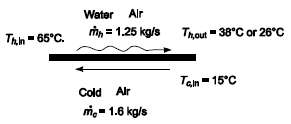
Dry air is cooled from 65 to 38?C, while flowing at the rate of 1.25 kg/s in a simple counterflow heat exchanger, by means of cold air which enters at 15?C and flows at a rate of 1.6 kg/s. It is planned to lengthen the heat exchanger so that 1.25 kg/s. of air can be cooled from 65 to 26?C with a
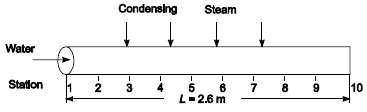
Saturated steam at 1.35 atm condenses on the outside of a 2.6 m length of copper tubing heating 5m kg/hr of water flowing in the tube. The water temperatures, measured at 10 equally spaced stations along the tube length are Calculate (a) average overall heat transfer coefficient Uo based on the
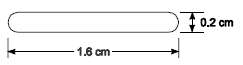
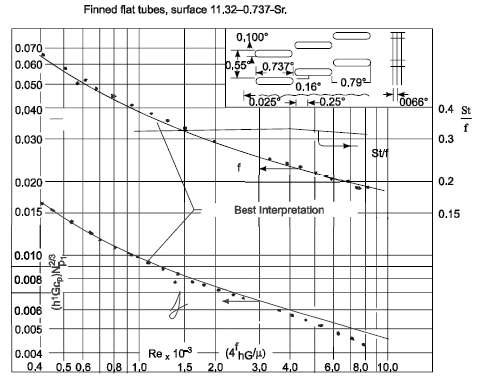
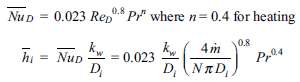
Calculate the water side heat transfer coefficient and the coolant pressure drop per unit length of tube for the core of a compact air-to-water intercooler for a 5,000 hp gas turbine plant. The water flows inside of a flattened aluminum tube having the cross-section shown below. The inside
An air-to-water compact heat exchanger is to be designed to serve as an intercooler for a 5,000 hp gas turbine plant. The exchanger is to meet the following heat transfer and pressure drop performance specificationsAir-side Operating ConditionsFlow rate 200,000 lb/h (25.2 kg/s)Inlet
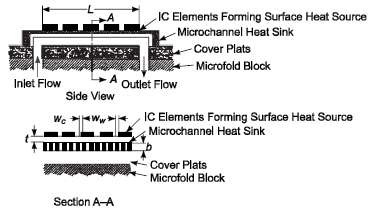
Microchannel compact heat exchangers can be used to cool high heat flux microelectronic devices. The sketch below shows a schematic view of a typical microchannel heat sink. Micro-fabrication techniques can be used to mass produce aluminum channels and fins with the following dimensions:Wc = Ww =
For an ideal radiator (hohlraum) with a 10 cm diameter opening, located in black surroundings at 16?C,(a) Calculate the net radiant heat transfer rate for hohlraum temperatures of 100?C and 560?C,(b) The wavelength at which the emission is a maximum,(c) The monochromatic emission at λmax, and(d)
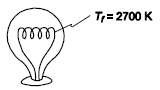
A tungsten filament is heated to 2700 K. At what wavelength is the maximum amount of radiation emitted? What fraction of the total energy is in the visible range (0.4 to 0.75 m m)?Assume that the filament radiates as a gray body.GIVENHeated tungsten filamentFilament temperature (Tf) = 2700
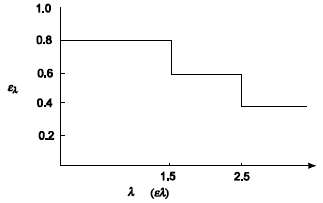
Determine the total average hemispherical emissivity and the emissive power of a surface that has a spectral hemispherical emissivity of 0.8 at wavelengths less than 1.5 mm. 0.6 from 1.5 to 2.5 mm, and 0.4 at wavelengths longer than 2.5 mm. The surface temperature is 7777 K.GIVENA surface at
Shown that (a) Ebλ/T5 = f(λT). Also, for λT = 5000 μm K, calculate Ebλ/T5.GIVENλT = 5000 μm K = 0.005 m K
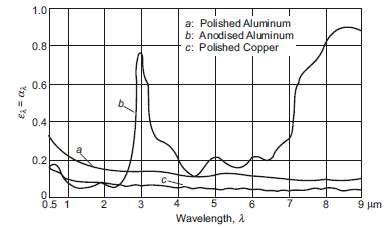
Compute the average emittance of anodized aluminum at 100?C and 650?C from the spectral curve in Figure. Assume ελ = 0.8 for λ > 9 mmGIVENThe spectral curve of Figure for anodizedaluminum
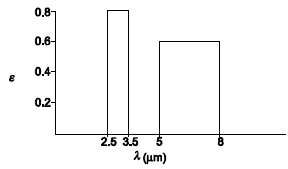
A large body of nonluminous gas at a temperature of 1100?C has emission bands between 2.5 and 3.5 mm and between 5 and 8 mm. At 1100?C, the effective emittance in the first band is 0.8 and in the second 0.6. Determine the emissive power of this gas in W/m2.GIVENA large body of nonluminous gasGas
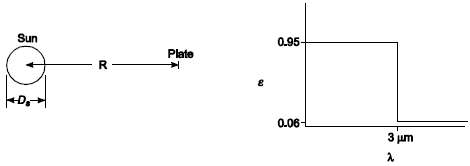
A flat plate is in a solar orbit 150,000,000 km from the sun. It is always oriented normal to the rays of the sun and both sides of the plate have a finish which has a spectral absorptance of 0.95 at wavelengths shorter than 3 μ m and a spectral absorptance of 0.06 at wavelengths longer than 3 mm.
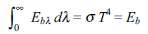
By substituting Equation 9.1 for Ebλ (T) in Equation 9.4 and performing the integration over the entire spectrum, derive a relationship between s and the constants C1 and C2 in Equation 9.1.GIVENEquation 9.1 Equation9.4
Determine the ratio of the total hemispherical emissivity to the normal emissivity for a nondiffuse surface if the intensity of emission varies as the cosine of the angle measured from the normal.GIVENA nondiffuse surfaceIntensity of emission varies as the cosine of the angle measured fromnormal
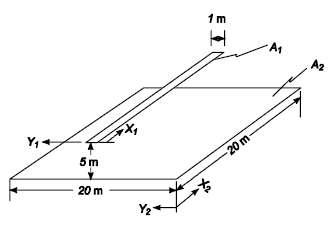
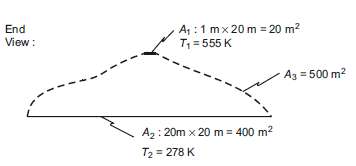
Derive an expression for the geometric shape factor F1??2 for a rectangular surface A1, 1 by 20 m placed parallel to and centered 5 m above a 20-m-square surface A2.GIVENRectangular surface A1 and square surface A2A1 is parallel to and centered 5 m above A2Dimensions of A1 = 1 m x 20 mA2 is 20
Determine the shape factor F1??4 for the geometrical configuration shown below. GIVENGeometrical configurations shown aboveThe shape factorF1??4
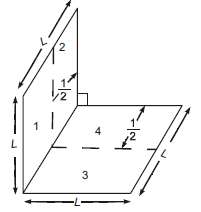
Determine this shape factor F1??2 for the geometrical configuration shownGIVENThe geometrical configuration shownabove
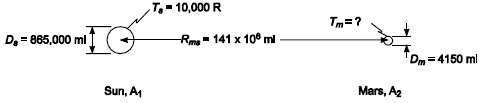
Using basic shape-factor definitions, estimate the equilibrium temperature of the planet Mars which has a diameter of 4150 miles and revolves around the sun at a distance of 141 x 106 miles. The diameter of the sun is 865,000 miles. Assume that both the planet Mars and the sun act as blackbodies
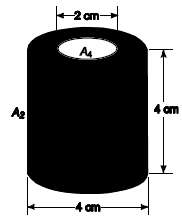
A 4-cm-diameter cylindrical enclosure of black surfaces, as shown in the accompanying sketch, has a 2-cm hole in the top cover. Assuming the walls of the enclosure are at the same temperature, determine the percentage of the total radiation emitted from the walls which will escape through the hole
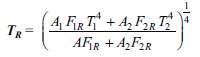
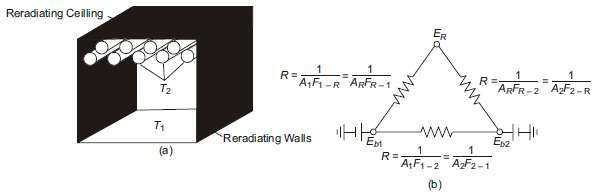
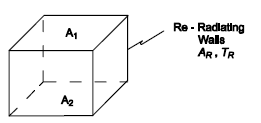
Show that the temperature of the re-radiating surface Tr in Figure 9.37 is GIVENFigure shown belowASSUMPTIONSSteady stateThe re-radiating surface temperature isuniform
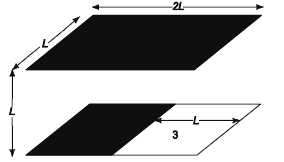
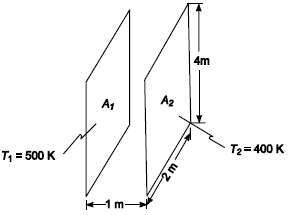
In the construction of a space platform, two equally sized structural members with surfaces that may be considered black are placed relative to each other as shown schematically below. Assuming that the left member attached to the platform is at 500 K while the other is at 400 K and that the
A radiation source is to be built, as shown in the diagram, for an experimental study of radiation. The base of the hemisphere is to be covered by a circular plate having a centered hole of radius R/2. The underside of the plate is to be held at 555 K by heaters embedded in its surface. The heater
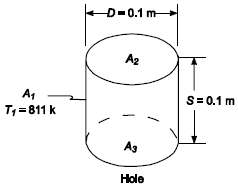
A large slab of steel 0.1 m thick has in it a 0.1 m-diam hole, with axis normal to the surface. Considering the sides of the hole to be black, specify the rate of radiative heat loss from the hole in W and Btu/hr. The plate is at 811 K, the surroundings are at 300 K.GIVENA large slab of steel with
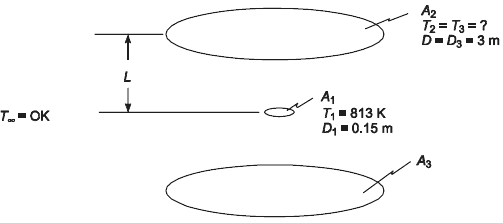
A 15 cm black disk is placed halfway between two black 3 m diameter disks which are 7 m apart with all disk surfaces parallel to each other. If the surroundings are 0 K, determine the temperature of the two larger disks required to maintain the smaller disk at 540?C.GIVENA black disk (A1) halfway
Show that the effective conductance. A1 F1-2 for two black parallel planes of equal area connected by re-radiating walls at a constant temperature isGIVENTwo black parallel planes of equal area connected by re-radiating walls at a constanttemperature
Calculate the net radiant-heat-transfer rate if the two surfaces in Problem 9.10 are black and connected by a refractory surface of 500-sq-m area. A1 is at 555 K and A2 is at 278 K. What is the refractory surface temperature?From Problem 9.10: Derive an expression for the geometric shape factor
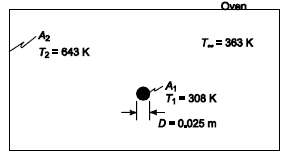
A black sphere (2.5 cm diam) is placed in a large infrared heating oven whose walls are maintained at 370?C. The temperature of the air in the oven is 90?C and the heattransfer coefficient for convection between the surface of the sphere and the air is 30 W/(m2 K). Estimate the net rate of heat
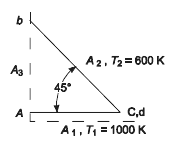
The wedge-shaped cavity shown in the accompanying sketch consists of two long strips joined along one edge. Surface 1 is 1 m wide and has an emittance of 0.4 and a temperature of 1000 K. The other wall has a temperature of 600 K. Assuming gray diffuse processes and uniform flux distribution;
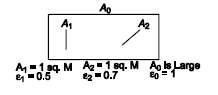
Derive an equation for the net rate of radiant heat transfer from surface 1 in the system shown in the accompanying sketch. Assume that each surface is at a uniform temperature and that the geometrical shape factor F1??2 is 0.1.GIVENThe system shown aboveASSUMPTIONSSteady stateA1 and A2 are gray,
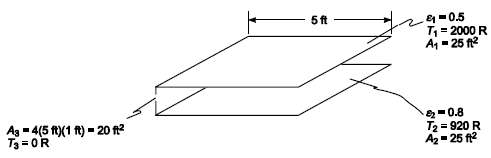
Two 5-ft-square and parallel flat plates are 1 ft apart. Plate A1 is maintained at a temperature of 1540?F and A2 at 460?F. The emittances of the plates are 0.5 and 0.8, respectively. Considering the surroundings black at 0 R and including multiple inter-reflections, determine(a) The net radiant
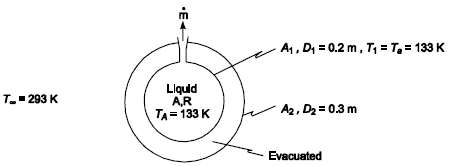
Two concentric spheres 0.2 m and 0.3 m in diam, with the space between them evacuated, are to be used to store liquid air (133 K). If the surfaces of the spheres have been flashed with aluminum and the liquid air has a talent heat of vaporization of 209 kJ/kg, determine the number of kilograms of
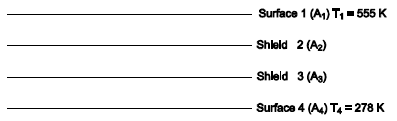
Determine the steady-state temperatures of two radiation shields placed in the evacuated space between two infinite planes at temperatures of 555 K and 278 K. The emissivity of all surfaces is 0.8.GIVENTwo radiant shields placed in the evacuated space between two infinite planesTemperature of the
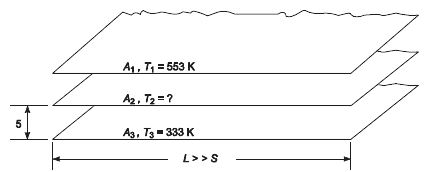
Three thin sheets of polished aluminum are placed parallel to each other so that the distance between them is very small compared to the size of the sheets. If one of the outer sheets is at 280?C, and the other outer sheet is at 60?C, calculate the temperature of the intermediate sheet and the net
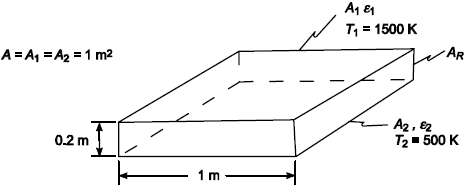
Determine the rate of heat transfer between two 1 by 1 m parallel flat plates placed 0.2 m apart and connected by re-radiating walls. Assume that plate 1 is maintained at 1500 K and plate 2 at 500 K.(a) Plate 1 has an emissivity of 0.9 over the entire spectrum and plate 2 has an emissivity of
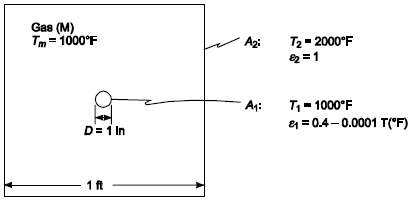
A small sphere (1 in. diam) is placed in a heating oven whose cavity is a 1 ft cube filled with air at 14.7 psia, contains 3 per cent water vapor at 1000?F, and whose walls are at 2000?F. The emissivity of the sphere is equal to 0.4 ?? 0.0001 T, where T is the surface temperature in ?F. When the
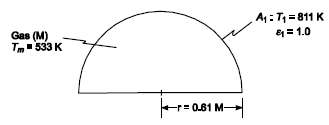
A 0.61 m radius hemisphere (811 K surface temperature) is filled with a gas mixture at 533 K and 2-atm pressure containing 6.67 percent CO2 and water vapor at 0.5 percent relative humidity. Determine the emissivity and absorptivity of the gas, and the net rate of radiant heat flow to the gas.GIVENA
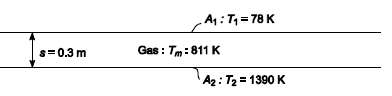
Two infinitely large black plane surfaces are 0.3 m apart and the space between them is filled by an isothermal gas mixture at 811 K and atmospheric pressure consisting of 25% CO2, 25% H2O, and 50% N2 by volume. If one of the surfaces is maintained at 278 K and the other at 1390 K respectively,
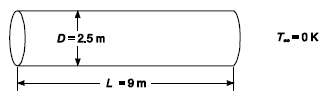
A manned spacecraft capsule has a shape of a cylinder 2.5 m in diameter and 9 m long. The air inside the capsule is maintained at 20?C and the convection-heat-transfer coefficient on the interior surface is 17 W/(m2 K). Between the outer skin and the inner surface is a 15 cm layer of glass-wool
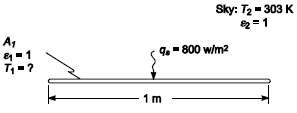
A 1m x 1 m square solar collector is placed on the roof of a house. The collector receives a solar radiation flux of 800 W/m2. Assuming that the surroundings act as a blackbody at an effective sky temperature of 30?C, calculate the equilibrium temperature of the collector(a) Assuming its surface is
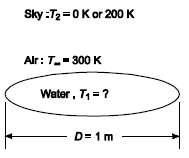
A Thin layer of water is placed in a pan 1 m in diameter in the desert. The upper surface is exposed to 300 K air and the convection heat transfer coefficient between the upper surface of the water and the air is estimated to be 10 W/(m2 K). The effective sky temperature depends on atmospheric
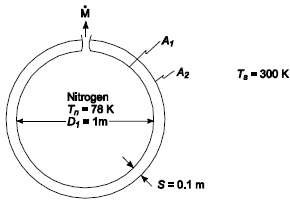
Liquid nitrogen is stored in a dewar made of two concentric spheres with the space between them evacuated. The inner sphere has an outside diameter of 1 m and the space between the two spheres is 0.1 m. The surfaces of both spheres are gray with an emissivity of 0.2. If the saturation temperature
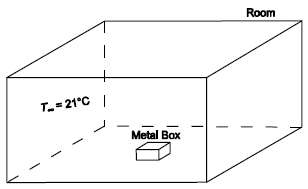
A Package of electronic equipment is enclosed in a sheet-metal box which has a 0.3 m square base and is 0.15 m high. The equipment uses 1200 W of electrical power and is placed on the floor of a large room. The emissivity of the walls of the box is 0.80 and the room air and the surrounding
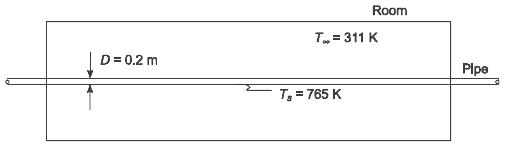
An 0.2 m OD oxidized steel pipe at a surface temperature of 756 K passes through a large room in which the air and the walls are at 38°C. If the heat transfer coefficient by convection from the surface of the pipe to the air in the room is 28 W/(m2 K), estimate the total heat loss per meter length
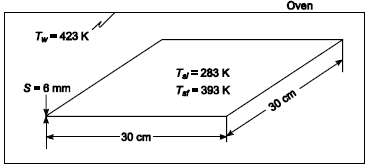
A 6 mm thick sheet of polished 304 stainless steel is suspended in a comparatively large vacuum-drying oven with black walls. The dimensions of the sheet are 30 cm x 30cm, and its specific heat is 565 J/(kg K). If the walls of the oven are uniformly at 150?C and the metal is to be heated from 10 to
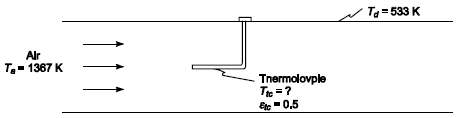
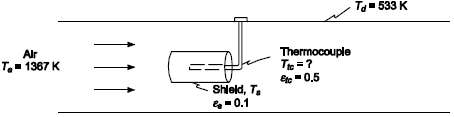
Calculate the equilibrium temperature of a thermocouple in a large air duct if the air temperature is 1367 K, the duct-wall temperature 533 K, the emissivity of the thermocouple 0.5, and the convective heat transfer coefficient, hc, is 114 W/(m2 K).GIVENA thermocouple in a large air ductAir
Repeat Problem 9.40 with the addition of a radiation shield with emissivity ε, = 0.1. From Problem 9.40: Calculate the equilibrium temperature of a thermocouple in a large air duct if the air temperature is 1367 K, the duct-wall temperature 533 K, the emittance of the couple 0.5, and the
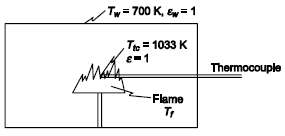
A thermocouple is used to measure the temperature of a flame in a combustion chamber. If the thermocouple temperature is 1033 K and the walls of the chamber are at 700 K, what is the error in the thermocouple reading due to radiation to the walls? Assume all surfaces are black and the convection
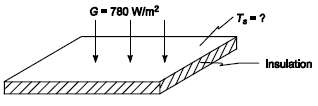
A metal plate is placed in the sunlight. The incident radiant energy G is 780 W/m2. The air and the surroundings are at 10?C. The heat transfer coefficient by natural convection from the upper surface of the plate is 17 W/(m2 K). The plate has an average emissivity of 0.9 at solar wavelengths and
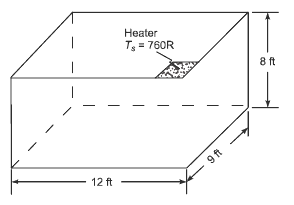
A 2-ft-square section of panel heater is installed in the corner of the ceiling of a room having a 9-by-12-ft floor area with an 8-ft ceiling. If the surface of the heater, made from oxidized iron, is at 300°F and the walls and the air of the room are at 68°F in the steady state,
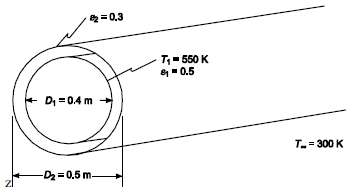
In a manufacturing process, a fluid is transported through a cellar maintained at a temperature of 300 K. The fluid is contained in a pipe having an external diameter of 0.4 m and whose surface has an emissivity of 0.5. To reduce heat losses, the pipe is surrounded by a thin shielding pipe having
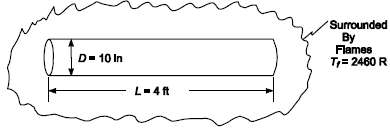
One hundred pounds of carbon dioxide is stored in a high-pressure cylinder 10 in. in diameter (OD), 4 ft long and 1/2 in. thick. The cylinder is fitted with a safety rupture diaphragm designed to fail at 2000 psig (with the specified charge, this pressure will be reached when the temperature
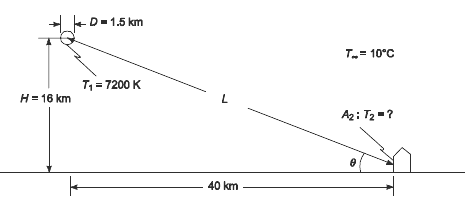
A hydrogen bomb may be approximated by a fireball at a temperature of 7200 K according to a report published in 1950 by the Atomic Energy Commission.(a) Calculate the total rate of radiant-energy emission in watts, assuming that the gas radiates as a blackbody and has a diameter of 1.5 km, (b)
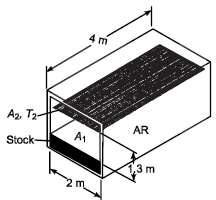
An electric furnace is to be used for batch heating a certain material (specific heat of 670 J/(kg K)) from 20 to 760?C. The material is placed on the furnace floor which is 2m x 4m in area as shown in the accompanying sketch. The side walls of the furnace are made of a refractory material.
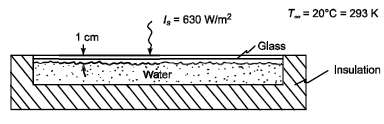
A rectangular flat water tank is placed on the roof of a house with its lower portion perfectly insulated. A sheet of glass whose transmission characteristics are tabulated below is placed 1 cm above the water surface. Assuming that the average incident solar radiation is 630 W/m2, calculate the
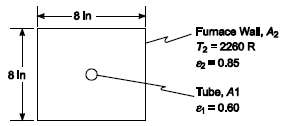
Mercury is to be evaporated at 605?F in a furnace. The mercury flows through a 1-in. BWG No. 18 gauge 304 stainless-steel tube, which is placed in the center of the furnace whose cross section, perpendicular to the tube axis, is a square 8 by 8 in. The furnace is made of brick having an emissivity
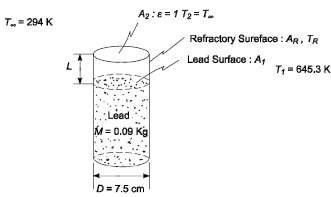
A 2.5 cm diameter cylindrical refractory crucible for melting lead is to be built for thermocouple calibration. An electrical heater immersed in the metal is shut off at some temperature above the melting point. The fusion-cooling curve is obtained by observing the thermocouple emf as a function of
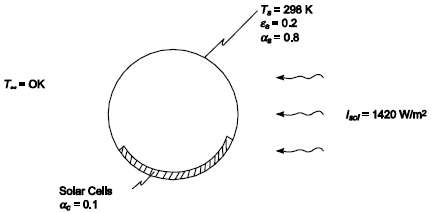
A spherical satellite circling the sun is to be maintained at a temperature of 25?C. The satellite rotates continuously and is covered partly with solar cells having a gray surface with an absorptivity of 0.1. The rest of the sphere is to be covered by a special coating which has an absorptivity of
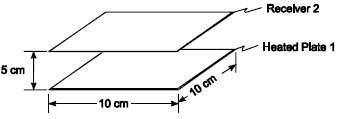
An electrically heated plate, 10 cm square, is placed in a horizontal position 5 cm below a second plate of the same size as shown schematically below. The heating surface is gray (emissivity = 0.8) while the receiver has a black surface. The lower plate is heated uniformly over its surface with a
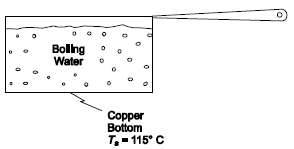
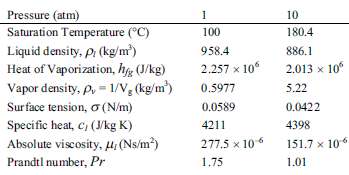
Water at atmospheric pressure is boiling in a pot with a flat copper bottom on an electric range which maintains the surface temperature at 115?C. Calculate the boiling heat transfer coefficient.GIVENWater at atmospheric pressure boiling in a copper bottom potSurface temperature of the pot bottom
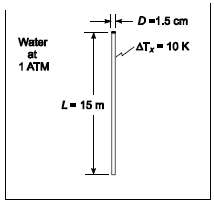
Predict the nucleate-boiling heat transfer coefficient for water boiling at atmospheric pressure on the outside surface of a 1.5 cm OD vertical copper tube 1.5 m long. Assume the tube-surface temperature is constant at 10 K above the saturation temperature.GIVENWater boiling at atmospheric pressure
Estimate the maximum heat flux obtainable with nucleate pool boiling on a clean surface for(a) Water at 1 atm on brass,(b) Water at 10 atm on brass.GIVENNucleate pool boiling on a clean surfaceASSUMPTIONSWater is at saturationtemperature
Determine the excess temperature at one-half of the maximum heat flux for the fluid-surface combinations in Problem 10.3.From Problem 10.3: Estimate the maximum heat flux obtainable with nucleate pool boiling on a clean surface for(a) Water at 1 atm on brass,(b) Water at 10 atm on
In a pool boiling experiment with water boiling on a large horizontal surface at atmospheric pressure, a heat flux of 4 x 10⁵ W/m2 was measured at an excess temperature of 14.5 K. What was the boiling surface material?GIVENWater at atmospheric pressure boiling on an unknown surfaceHeat flux and
Compare the critical heat flux for a flat horizontal surface with that for a submerged horizontal wire of 3 mm diameter in water at saturation temperature and pressure.GIVENFlat, horizontal surface and a submerged, horizontal wireASSUMPTIONSThe water is at atmospheric pressure
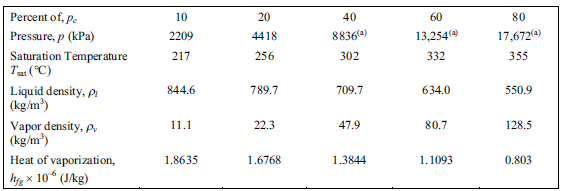
For saturated pool boiling of water on a horizontal plate, calculate the peak heat flux at pressures of 10, 20, 40, 60, and 80 percent of the critical pressure pc and plot your rsesults as q'' max/pc versus p/pc. The surface tension of water may be taken as σ = 0.0743 (1 ?? 0.0026 T), where σ is
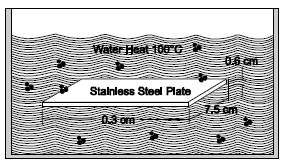
A 0.6-cm-thick flat plate of stainless steel, 7.5 cm wide and 0.3 m long, is immersed horizontally at an initial temperature of 980?C in a large water bath at 100?C and at atmospheric pressure. Determine how long it will take this plate to cool to 540?C.GIVENA flat stainless steel plate is immersed
Calculate the maximum heat flux attainable in nucleate boiling with saturated water at 2 atm pressure in a gravitational field equivalent to one-tenth that of the earth.GIVENNucleate boiling with saturated waterPressure = 2 atmGravitational field = 1/10 that of earthASSUMPTIONSSteady state
Prepare a graph showing the effect of subcooling between 0 and 50°C on the maximum heat flux calculated in Problem 10.9.From Problem 10.9: Calculate the maximum heat flux attainable in nucleate boiling with saturated water at 2 atm pressure in a gravitational field equivalent to one-tenth that of
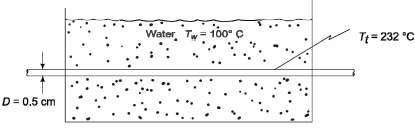
A thin-walled horizontal copper tube of 0.5 cm OD is placed in a pool of water at atmospheric pressure and 100?C. Inside the tube, an organic vapor is condensing and the outside surface temperature of the tube is uniform at 232?C. Calculated the average heat transfer coefficient on the outside of
In boiling (and condensation) heat transfer, the convection coefficient, h, is expected to depend on the difference between surface and saturation temperature ∆T = Tsurface – Tsaturation, the body force arising from the density difference between liquid and vapor, g(ρl – ρv), the latent
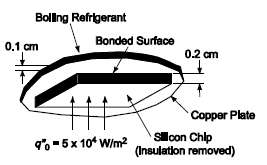
Environmental concerns have recently motivated the search for replacements for chlorofluorocarbon refrigerants. An experiment has been devised to determine the feasibility of such a replacement. A silicon chip is bonded to the bottom of a thin copper plate as shown in the sketch below. The chip is
It has recently been proposed by Andraka el al. of Sandia National Laboratories, Albuquerque, in Sodium Reflux Pool-Boiler Solar Receiver On-Sun Test Results (SAND89-2773, June 1992), that the heat flux from a parabolic dish solar concentrator could be delivered effectively to a Stirling engine by
Calculate the peak heat flux for nucleate pool boiling of water at 3 atm and 110°C on clean copper.GIVENNucleate pool boiling of water on clean copperPressure = 3 atmWater temperature (Tw) = 390°CASSUMPTIONSSteady state
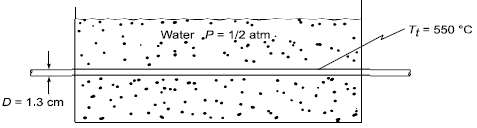
Calculate the heat transfer coefficient for film boiling of water on a 1.3 cm horizontal tube if the tube temperature is 550?C and the system is placed under pressure of 1/2 atm.GIVENFilm boiling of water on a horizontal tubeTube outside diameter (D) = 1.3 cm = 0.013 mTube temperature (Tt) =
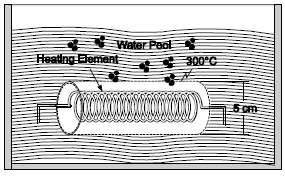
A metal-clad electrical heating element of cylindrical shape, as shown in the sketch below, is immersed in water at atmospheric pressure. The element has a 5 cm diameter and heat generation produces a surface temperature of 300?C. Estimate the heat flux under steady state conditions and the rate of
Calculate the maximum safe heat flux in the nucleate-boiling regime for water flowing at a velocity of 15 m/s through a 1.2-cm-ID copper tube 0.31 m long if the water enters at 1 atm pressure and 100?C saturated liquid.GIVENNucleate boiling of water flowing through a tubeWater velocity (V) = 15
During the 1980s, solar thermal electric technology was commercialized with the installation of 350 MW of electrical power capacity in the California desert. The technology involved heating a heat transfer oil in receiver tubes placed at the focus of line-focus, parabolic trough solar
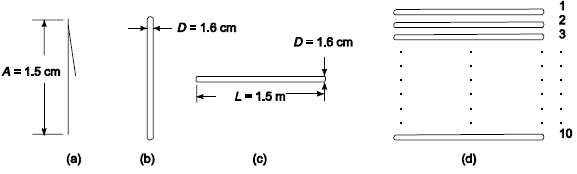
Calculate the average heat transfer coefficient for film-type condensation of water at pressures of 10 kPa and 101 kPa for(a) A vertical surface 1.5 m high(b) The outside surface of a 1.5-cm-OD vertical tube 1.5 m long(c) The outside surface of a 1.6-cm-OD horizontal tube 1.5 m long and(d) A
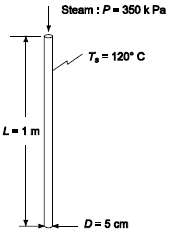
The inside surface of a 1 m long vertical 5 cm-ID tube is maintained at 120?C. For saturated steam at 350 kPa condensing inside, estimate the average heat transfer coefficient and the condensation rate, assuming the steam velocity is small.GIVENSteam condensing inside a vertical tubeTube length (L)
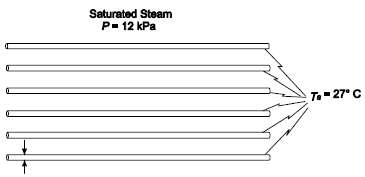
A horizontal 2.5 cm-OD tube is maintained at a temperature of 27?C on its outer surface. Calculate the average heat transfer coefficient if saturated steam at 12 kPa is condensing on this tube.GIVENSaturated steam condensing on a horizontal tubeTube outside diameter (D) = 2.5 cm = 0.025 mTube outer
Repeat Problem 10.22 for a tier of six horizontal 2.5 cm OD tubes under similar thermal conditions.From Problem 10.22: Horizontal tubes are maintained at a temperature of 27?C on its outer surface. Calculate the average heat transfer coefficient if saturated steam at 12 kPa is condensing on this
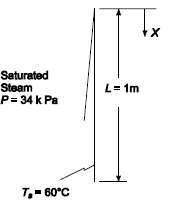
Saturated steam at 34 kPa condenses on a 1 m tall vertical plate whose surface temperature is uniform at 60?C. Compute the average heat transfer coefficient and the value of the coefficient 1/3, 2/3, and 1 m from the top. Also, find the maximum plate height for which the condensate film will remain
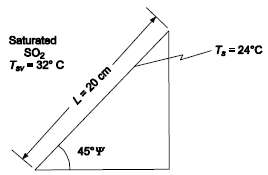
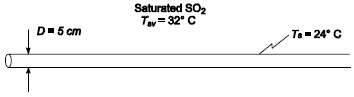
At a pressure of 490 kPa, the saturation temperature of sulfur dioxide (SO2) is 32?C, the density is 1350 kg/m3, the heat of vaporization is 343 kJ/kg, the absolute viscosity is 3.2 x 10??4 (Ns)/m2, the specific heat is 1445 J/(kg K) and the thermal conductivity is 0.192 W/(m K). If the SO2 is to
Repeat Problem 10.25 part (b) and (c) but assume that condensation occurs on a 5 cmcm-OD horizontal tube.From Problem 10.25: At a pressure of 490 kPa, the saturation temperature of sulfur dioxide (SO2) is 32?C, the density is 1350 kg/m3, the heat of vaporization is 343 kJ/kg, the absolute viscosity
In problem 10.12, it was indicated that the Nusselt number for condensation depends on the Prandtl number and four other dimensionless groups including the Jacob number, the Bond number, and a nameless group resembling the Grashof number, ρg (ρl – ρv)L3/μ2. Give a physical explanation of each
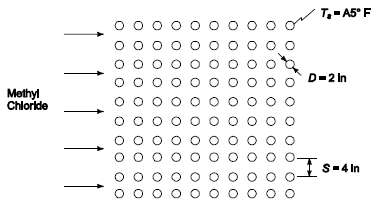
Saturated methyl chloride at 62 psia condenses on a horizontal bank of tubes, ten-by-ten, 2 in. OD, equally spaced, 4 in. apart center-to-center on rows and columns. If the surface temperature of the tubes is maintained at 45?F by water pumped through them, calculate the rate of condensation of
Showing 12600 - 12700
of 18200
First
120
121
122
123
124
125
126
127
128
129
130
131
132
133
134
Last
Step by Step Answers

 Get 50% OFF
Claim Now
Get 50% OFF
Claim Now