New Semester
Started
Get
50% OFF
Study Help!
--h --m --s
Claim Now
Question Answers
Textbooks
Find textbooks, questions and answers
Oops, something went wrong!
Change your search query and then try again
S
Books
FREE
Study Help
Expert Questions
Accounting
General Management
Mathematics
Finance
Organizational Behaviour
Law
Physics
Operating System
Management Leadership
Sociology
Programming
Marketing
Database
Computer Network
Economics
Textbooks Solutions
Accounting
Managerial Accounting
Management Leadership
Cost Accounting
Statistics
Business Law
Corporate Finance
Finance
Economics
Auditing
Tutors
Online Tutors
Find a Tutor
Hire a Tutor
Become a Tutor
AI Tutor
AI Study Planner
NEW
Sell Books
Search
Search
Sign In
Register
study help
engineering
mechanical engineering
Fundamentals of Heat and Mass Transfer 6th Edition Incropera, Dewitt, Bergman, Lavine - Solutions
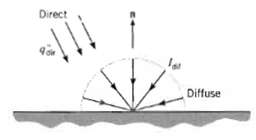
According to its directional distribution, solar radiation incident on the earth's surface may be divided into two components. The direct component consists of parallel rays incident at a fixed zenith angle ?, while the diffuse component consists of radiation that may be approximated as being
Solar radiation incident on the earth's surface may be divided into the direct and diffuse components described in Problem 12.6. Consider conditions for a day in which the intensity of the direct solar radiation is I dir = 2.10 x 10⁷ W/m2 ∙ sr in the solid angle subtended by the sun with respect
On an overcast day the directional distribution of the solar radiation incident on the earth's surface may be approximated by an expression of the form I1 = In cos θ, where In = 80 W/m2 ∙ sr is the total intensity of radiation directed normal to the surface and θ is the zenith angle. What is
Determine the fraction of the total, hemispherical emissive power that leaves a diffuse surface in the directions π/4 < θ < π/2 and 0 < Φ < π.
A furnace with an aperture of 20-mm diameter and emissive power of 3.72 x 10⁵ W/m2 is used to calibrate a heat flux gage having a sensitive area of 1.6 x 10⁻⁵ m2.(a) At what distance, measured along a normal from the aperture, should the gage be positioned to receive irradiation of 1000 W/m2?(b) If
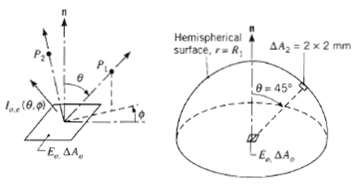
Consider a 5-mm-square, diffuse surface ?Ao having a total emissive power of Eo = 4000 W/m2. The radiation field due to emission into the hemispherical space above the surface is diffuse, thereby providing a uniform intensity I (?, ?). Moreover, if the space is a non-participating medium
A furnace with an aperture of 20-mm diameter and emissive power of 3.72 x 10⁵ W/m2 is used to calibrate a heat flux gage having a sensitive area of 1.6 x 10⁻⁵ m2.(a) At what distance, measured along a normal from the aperture, should the gage be positioned to receive irradiation of 1000 W/m2?(b) If
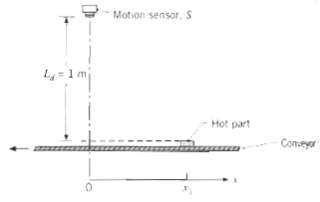
In order to initiate a process operation, an infrared motion sensor (radiation detector) is employed to determine the approach of a hot part on a conveyor system. To set the sensor's amplifier discriminator, the engineer needs a relationship between the sensor output signal, S. and the position of
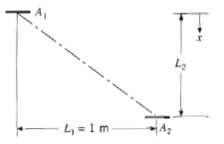
A small radiant heat source of area A1 = 2 x 10⁻⁴ m2 emits diffusely with an intensity I1 = 1000 W/m2 ? sr. A second small area, A2 = 1 x 10⁻⁴ m2, is located as shown in the sketch. (a) Determine the irradiation of A2 for L2 = 0.5 m. (b) Plot the irradiation of A2 over the range 0
Assuming blackbody behavior, determine the temperature of, and the energy emitted by, areas A1 in Example 12.1 and Problems 12.3, 12.5, and 12.14, as well as area Ah in Problem 12.12.
Assuming blackbody behavior, determine the temperature of, and the energy emitted by, areas A1 in Example 12.1 and Problems 12.3, 12.5, and 12.14, as well as area Ah in Problem 12.12. Discuss.
A spherical aluminum shell of inside diameter D = 2 m is evacuated and is used as a radiation test chamber. If the inner surface is coated with carbon black and maintained at 600 K, what is the irradiation on a small test surface placed in the chamber? If the inner surface were not coated and
An enclosure has an inside area of 100 m2, and its inside surface is black and is maintained at a constant temperature. A small opening in the enclosure has an area of 0.02 m2. The radiant power emitted from this opening is 70 W. What is the temperature of the interior enclosure wall? If the
Assuming the earth's surface is black, estimate its temperature if the sun has an equivalent blackbody temperature of 5800 K. The diameters of the sun and earth are 1.39 x 10⁹ and 1.29 x 10⁷m, respectively, and the distance between the sun and earth is 1.5 x 10¹¹ m.
The energy flux associated with solar radiation incident on the outer surface of the earth's atmosphere has been accurately measured and is known to be 1353 W/m2. The diameters of the sun and earth are 1.39 x 10⁹ and 1.29 x 10⁷ m, respectively, and the distance between the "un and the earth is 1.5
The energy flux associated with solar radiation incident on the outer surface of the earth's atmosphere has been accurately measured and is known to be 1353 W/m2. The diameters of the sun and earth are 1.39 x 10⁹ and 1.29 x 10⁷ m, respectively, and the distance between the "un and the earth is 1.5
Estimate the wavelength corresponding to maximum emission from each of the following surfaces: the sun, a tungsten filament at 2500 K, a heated metal at 1500 K, human skin at 305 K. and a cryogenically cooled metal surface at 60 K. Estimate the fraction of the solar emission that is in the
The human eye as well as the light-sensitive chemicals on color photographic film responds differently to lighting sources with different spectral distributions. Daylight lighting corresponds to the spectral distribution of the solar disk, which may be approximated as a blackbody at 5800 K.
Thermal imagers have radiation detectors that are sensitive to a spectral region and provide white-black or color images with shading to indicate relative temperature differences in the scene. The imagers, which have appearances similar to a video camcorder, have numerous applications, such as for
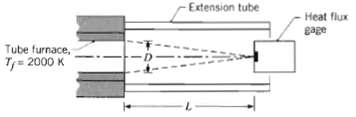
A furnace with a long isothermal graphite tube of diameter D = 12.5 mm is maintained at Tf = 2000 K and is used as a blackbody source to calibrate heat flux gages. Traditional heat flux gages are constructed as blackened thin films with thermopiles to indicate the temperature change caused by
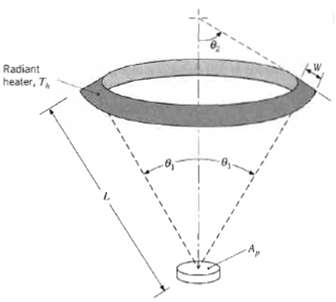
An electrically powered, ring-shaped radiant heating element is maintained at a temperature of Th = 3000 K and is used in a manufacturing process to heat a small part having a surface area of Ap = 0.007 m2. The surface of the heating element may be assumed to be black. For ?1 = 30°, ?2 = 60°, L =
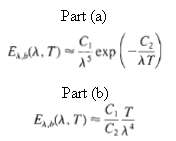
Approximations to Planck's law for the spectral emissive power are the Wien and Rayleigh-Jeans spectral distributions, which are useful for the extreme low and high limits of the product ?T, respectively, (a) Show that Planck's spectral distribution will have the form when C2/T >> 1 and
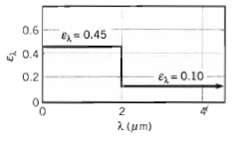
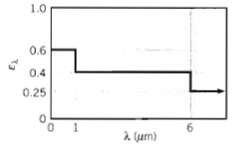
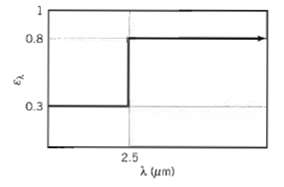
The spectral, hemispherical emissivity of tungsten may be approximated by the distribution depicted below. Consider a cylindrical tungsten filament that is of diameter D = 0.8 mm and length L = 20 mm. The filament is enclosed in an evacuated bulb and is heated by an electrical current to a
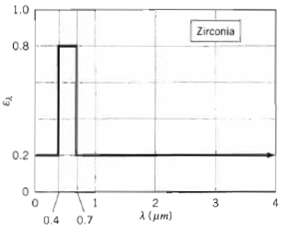
A zirconia-based ceramic has the spectral, hemispherical emissivity shown below and is being considered for use as the filament of a light bulb. (a) What is the total, hemispherical emissivity of a zirconia fi lament operating at 3000 K? (b) Using the spectral distribution provided in Problem
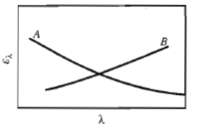
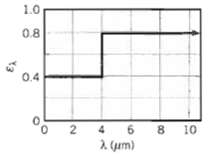
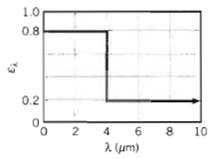
For materials A and B, whose spectral hemispherical emissivities vary with wavelength as shown below, how does the total, hemispherical emissivity vary with temperature? Explain briefly.
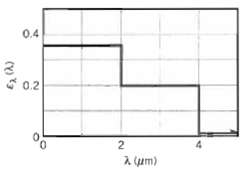
Consider the metallic surface of Example 12.6. Additional measurements of the spectral, hemispherical emissivity yield a spectral distribution which may be approximated as follows: (a) Determine corresponding values of the total, hemispherical emissivity ??? and the total emissive power E at 2000
The spectral emissivity of unoxidized titanium at room temperature is well described by the expression ελ. = 0.52λ–0.5 for 0.3μm < λ < 30μm.(a) Determine the emissive power associated with an unoxidized titanium surface at T = 300 K. Assume the spectral emissivity is ελ. = 0.1 for
The spectral, directional emissivity of a diffuse material at 2000 K has the following distribution: Determine the total, hemispherical emissivity at 2000 K. Determine the emissive power over the spectral range 0.8 to 2.5?m and for the directions 0
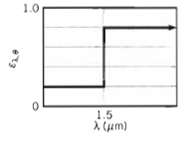
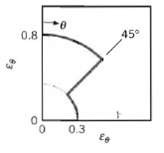
Consider the directionally selective surface having the directional emissivity ??, as shown. Assuming that the surface is isotropic in the ? direction, calculate the ratio of the normal emissivity ?n, to the hemispherical emissivity ?h,
The directional total emissivity of nonmetallic materials may be approximated as εθ, = εn, cos θ, where εn, is the normal emissivity. Show that the total hemispherical emissivity for such materials is 2/3 of the normal emissivity.
A sphere is suspended in air in a dark room and maintained at a uniform incandescent temperature. When first viewed with the naked eye, the sphere appears to be brighter around the rim. After several hours, however, it appears to be brighter in the center. Of what type material would you reason the
A sphere is suspended in air in a dark room and maintained at a uniform incandescent temperature. When first viewed with the naked eye, the sphere appears to be brighter around the rim. After several hours, however, it appears to be brighter in the center. Of what type material would you reason the
A sphere is suspended in air in a dark room and maintained at a uniform incandescent temperature. When first viewed with the naked eye, the sphere appears to be brighter around the rim. After several hours, however, it appears to be brighter in the center. Of what type material would you reason the
For a prescribed wavelength A, measurement of the spectral intensity Iλ.c (λ, T) = ελ Iλ, b of radiation emitted by a diffuse surface may be used to determine the surface temperature, if the spectral emissivity ελ is known, or the spectral emissivity, if the temperature is known.(a) Defining
Sheet steel emerging from the hot roll section of a steel mill has a temperature of 1200 K, a thickness of ? = 3 mm, and the following distribution for the spectral, hemispherical emissivity. The density and specific heat of the steel are 7900 kg/m3 and 640 J/kg ? K, respectively. What is the total
A large body of non-luminous gas at a temperature of 1200 K has emission bands between 2.5 and 3.5μm and between 5 and 8μm. The effective emissivity in the first band is 0.8 and in the second 0.6. Determine the emissive power of this gas.
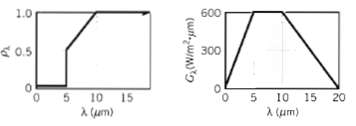
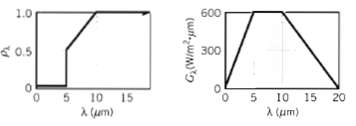
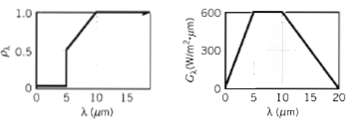
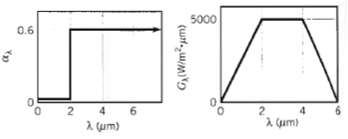
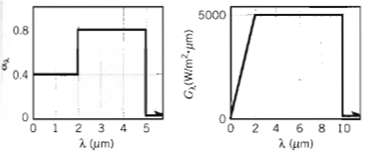
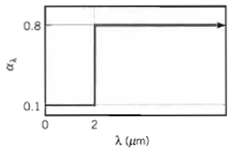
An opaque surface with the prescribed spectral, hemispherical reflectivity distribution is subjected to the spectral irradiation shown. (a) Sketch the spectral hemispherical absorptivity distribution. (b) Determine the total irradiation on the surface. (c) Determine the radiant flux that is
An opaque surface with the prescribed spectral, hemispherical reflectivity distribution is subjected to the spectral irradiation shown. (a) Sketch the spectral hemispherical absorptivity distribution. (b) Determine the total irradiation on the surface. (c) Determine the radiant flux that is
An opaque surface with the prescribed spectral, hemispherical reflectivity distribution is subjected to the spectral irradiation shown. (a) Sketch the spectral hemispherical absorptivity distribution. (b) Determine the total irradiation on the surface. (c) Determine the radiant flux that is
An opaque surface, 2 m by 2 m, is maintained at 400 K and is simultaneously exposed to solar irradiation with G = 1200 W/m2 . The surface is diffuse and its spectral absorptivity is αλ = 0, 0.8, 0, and 0.9 for 0 < λ < 0.5μm, 0.5μm < λ < 1μm, 1μm, < λ < 2μm, and λ >
A diffuse, opaque surface at 700 K has spectral emissivities of ?? = 0 for 0
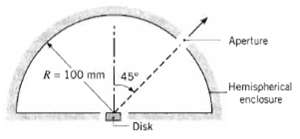
A small disk 5 mm in diameter is positioned at the center of an isothermal hemispherical enclosure. The disk is diffuse and gray with an emissivity of 0.7 and is maintained at 900 K. The hemispherical enclosure, maintained at 300 K, has a radius of 100 mm and an emissivity of 0.85. Calculate the
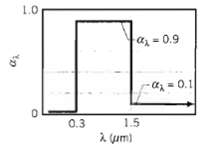
The spectral, hemispherical absorptivity of an opaque surface is as shown. What is the solar absorptivity, ?S? If it is assumed that ?? = ?? and that the surface is at a temperature of 340 K. what is its total, hemispherical emissivity?
The spectral, hemispherical absorptivity of an opaque surface and the spectral distribution of radiation incident on the surface are depicted below. What is the total, hemispherical absorptivity of the surface? If it is assumed that ?? = ?? and that the surface is at 1000 K, what is its total,
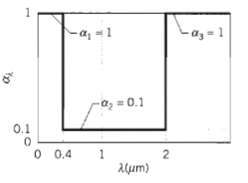
Consider an opaque, diffuse surface for which the spectral absorptivity and irradiation are as fol1ows: What is the total absorptivity of the surface for the prescribed irradiation? If the surface is at a temperature of 1250 K, what is its emissive power? How will the surface temperature vary with
The tungsten filament described in Problem 12.29 dissipates 75 W in an evacuated spherical light bulb of 75-mm diameter. The bulb is in quiescent air and large surroundings at a temperature of 25°C. The reflectivity of the glass is negligible, while the spectral absorptivity is characterized by
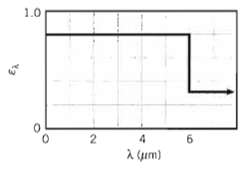
The spectral emissivity of an opaque, diffuse surface is as shown. (a) If the surface is maintained at 1000 K, what is the total, hemispherical emissivity? (b) What is the total, hemispherical absorptivity of the surface when irradiated by large surroundings of emissivity 0.8 and temperature 1500
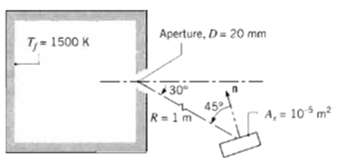
Radiation leaves a furnace of inside surface temperature 1500 K through an aperture 20 mm in diameter. A portion of the radiation is intercepted by a detector that is 1 m from the aperture, has a surface area of 10-5 m2, and is oriented as shown. If the aperture is open, what is the rate at which
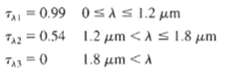
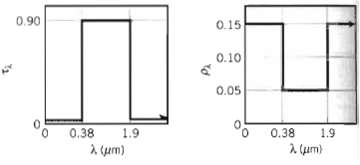
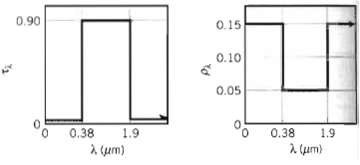
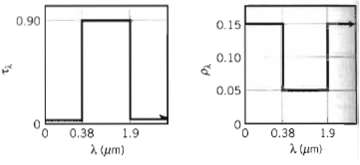
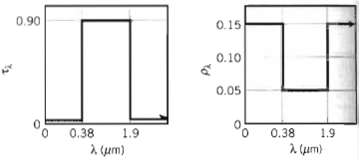
The spectral transmissivity of a 1-mm-thick layer of liquid water can be approximated as follows: (a) Liquid water can exist only below its critical temperature, Tc = 647.3 K. Determine the maximum possible total transmissivity of a 1-mm-thick layer of liquid water when the water is housed in an
The spectral transmissivity of plain and tinted glass can be approximated as follows:Plain glass: τλ = 0.9 0.3 < λ < 2.5μmTinted glass: τλ = 0.9 0.5 < λ < 1.5μmOutside the specified wavelength ranges, the spectral transmissivity is zero for both glasses. Compare the solar energy
The research group of a glass manufacturer is working on development of a coating that would render glass highly transparent to radiation at wavelengths below 0.7μm and highly reflective to radiation above 0.7μm. An application of special interest is to the inner surface of glass light bulbs.(a)
Referring to the distribution of the spectral transmissivity of low iron glass (Figure), describe briefly what is meant by the "greenhouse effect." That is, how does the glass influence energy transfer to and from the contents of a greenhouse?
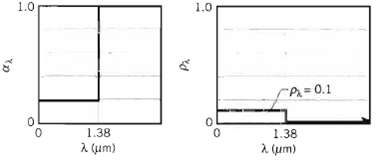
The spectral absorptivity ?? and spectral reflectivity p? for a spectrally selective, diffuse material are as shown. (a) Sketch the spectral transmissivity ??. (b) If solar irradiation with GS = 750 W/m2 and the spectral distribution of a blackbody at 5800 K is incident on this material, determine
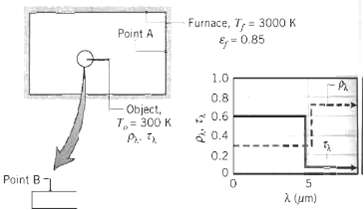
Consider a large furnace with opaque, diffuse, gray walls at 3000 K having an emissivity of 0.85. A small, diffuse, spectrally selective object in the furnace is maintained at 300 K. For the specified points on the furnace wall (A) and the object (B), indicate values for ?, ?, E, G, and J.
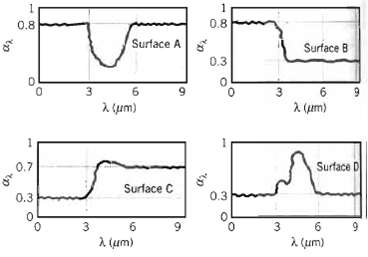
Four diffuse surfaces having the spectral characteristics shown are at 300 K and are exposed to solar radiation, which of the surfaces may be approximated as being gray?
Consider a material that is gray, but directionally selective with αθ (θ, Φ) = 0.5(1 – cos Φ). Determine the hemispherical absorptivity α when collimated solar flux irradiates the surface of the material in the direction θ = 45° and Φ = 0°. Determine the hemispherical emissivity B of
The spectral transmissivity of a 50-μm-thick polymer film is measured over the wavelength range 2.5μm < λ < 15μm. The spectral distribution may be approximated as τλ = 0.80 for 2.5μm < λ < 7μm, τλ = 0.05 for 7μm < λ < 13μm, and τλ = 0.55 for 13μm < λ <
An opaque, horizontal plate has a thickness of L = 21 mm and thermal conductivity k = 25 W/m ∙ K. Water flows adjacent to the bottom of the plate and is at a temperature of T∞,w = 25°C. Air flows above the plate at T∞,a = 260°C with ha = 40 W/m2 ∙ K. The top of the plate is diffuse and is
Two small surfaces, A and B, are placed inside an isothermal enclosure at a uniform temperature. The enclosure provides an irradiation of 6300 W/m2 to each of the surfaces, and surfaces A and B absorb incident radiation at rates of 5600 and 630 W/m2, respectively. Consider conditions after a long
Consider an opaque horizontal plate that is well insulated on its back side. The irradiation on the plate is 2500 W/m2 of which 500 W/m2 is reflected. The plate is at 227°C and has an emissive power of 1200 W/m2. Air at 127°C flows over the plate with a heat transfer convection coefficient of 15
A horizontal, opaque surface at a steady-state temperature of 77°C is exposed to an airflow having a free stream temperature of 27°C with a convection heat transfer coefficient of 28 W/m2 ∙ K. The emissive power of the surface is 628 W/m2, the irradiation is 1380 W/m2, and the reflectivity is
A novel process has been proposed to create a composite palladium tube for use as a hydrogen separation membrane in order to produce high-purity hydrogen. To fabricate the composite palladium tube, a gas containing palladium (species A) flows through a porous-walled tube, and the palladium deposits
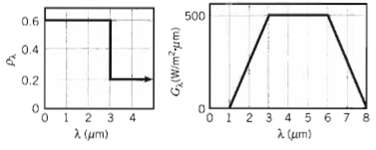
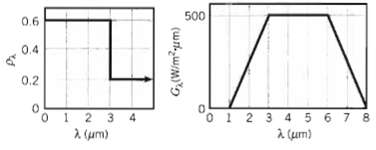
Consider an opaque, diffuse surface whose spectral reflectivity varies with wavelength as shown. The surface is at 750 K, and irradiation on one side varies with wavelength as shown. The other side of the surface is insulated. What are the total absorptivity and emissivity of the surface? What is
Consider an opaque, diffuse surface whose spectral reflectivity varies with wavelength as shown. The surface is at 750 K, and irradiation on one side varies with wavelength as shown. The other side of the surface is insulated. What are the total absorptivity and emissivity of the surface? What is
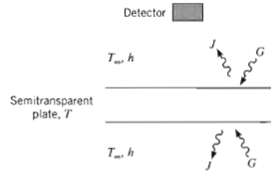
A horizontal semitransparent plate is uniformly irradiated from above and below, while air at T? = 300 K flows over the top and bottom surfaces, providing a uniform convection heat transfer coefficient of h = 40 W/m2 ? K. The total, hemispherical absorptivity of the plate to the irradiation is
The 50-mm peephole of a large furnace operating at 450°C is covered with a material having τ = 0.8 and p = 0 for irradiation originating from the furnace. The material has an emissivity of 0.8 and is opaque to irradiation from a source at room temperature. The outer surface of the cover is
The window of a large vacuum chamber is fabricated from a material of prescribed spectral characteristics. A collimated beam of radiant energy from a solar simulator is incident on the window and has a flux of 3000 W/m2. The inside walls of the chamber, which are large compared to the window area,
(c) Calculate the net radiation transfer per unit area of the window to the vacuum chamber wall, excluding the transmitted simulated solar flux.
(c) Calculate the net radiation transfer per unit area of the window to the vacuum chamber wall, excluding the transmitted simulated solar flux.
(c) Calculate the net radiation transfer per unit area of the window to the vacuum chamber wall, excluding the transmitted simulated solar flux.
A sphere (k = 185 W/m ∙ K, α = 7.25 x 10⁻⁵ m2/s) of 30-mm diameter whose surface is diffuse and gray with an emissivity of 0.8 is placed in a large oven whose walls are of uniform temperature at 600 K. The temperature of the air in the oven is 400 K, and the convection heat transfer
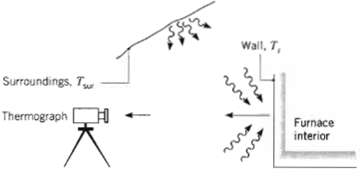
A thermograph is a device responding to the radiant power from the scene, which reaches its radiation detector within the spectral region 9-12?m. The thermograph provides an image of the scene, such as the side of a furnace, from which the surface temperature can be determined. (a) For a black
A radiation thermometer is a radiometer calibrated to indicate the temperature of a blackbody. A steel billet having a diffuse gray surface of emissivity 0.8 is heated in a furnace whose walls are at 1500 K. Determine the temperature of the billet when the radiation thermometer viewing the billet
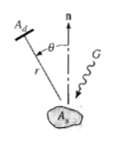
A radiation detector has an aperture of area Ad = 10-6 m2 and is positioned at a distance of r = 1 m from a surface of area A, = 10-4 m2. The angle formed by the normal to the detector and the surface normal is ? = 30°. The surface is at 500 K and is opaque, diffuse, and gray with an emissivity of
A radiation thermometer is a radiometer calibrated to indicate the temperature of a blackbody. A steel billet having a diffuse gray surface of emissivity 0.8 is heated in a furnace whose walls are at 1500 K. Estimate the temperature of the billet when the radiation thermometer viewing the billet
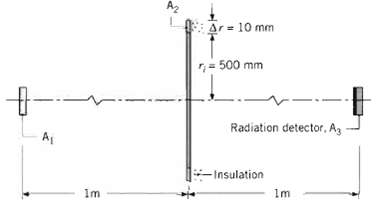
Consider the diffuse, gray opaque disk A1, which has a diameter of 10 mm, an emissivity of 0.3, and is at a temperature of 400 K. Coaxial to the disk A1, there is a black, ring-shaped disk A2 at 1000 K having the dimensions shown in the sketch. The backside of A2 is insulated and does not directly
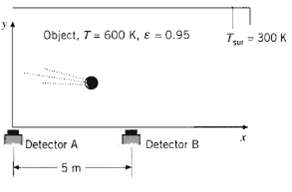
A diffuse, spherical object of diameter and temperature 9 mm and 600 K, respectively, has an emissivity of 0.95. Two very sensitive radiation detectors each with an aperture area of 300 x 10-6 m2, detect the object as it passes over at high velocity from left to right as shown in the schematic. The
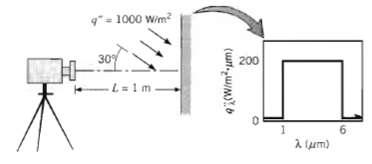
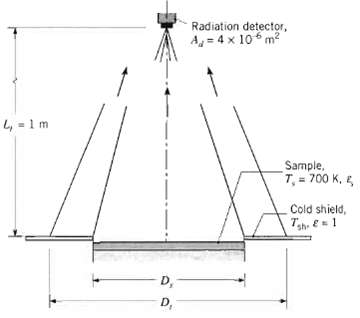
A radiation detector having a sensitive area of Ad = 4 x 10⁻⁶ m2 is configured to receive radiation from a target area of diameter D1 = 40 mm when located a distance of L1 = 1 m from the target. For the experimental apparatus shown in the sketch we wish to determine the emitted radiation from a hot
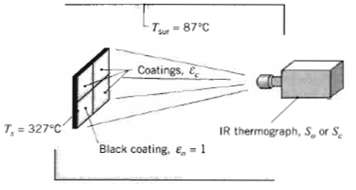
An infrared (IR) thermograph is a radiometer that provides an image of the target scene, indicating the apparent temperature of elements in the scene by a black-white brightness or blue-red color scale. Radiation originating from an element in the target scene is incident on the radiation detector,
A charge-coupled device (CCD) infrared imaging system operates in a manner similar to a digital video camera. Instead of being sensitive to irradiation in the visible part of the spectrum, however, each small sensor in the infrared system's CCD array is sensitive in the spectral region 9-12μm.
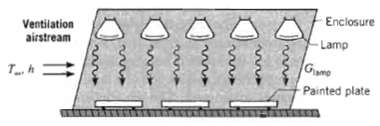
Square plates freshly sprayed with an epoxy paint must be cured at 140°C for an extended period of time. The plates are located in a large enclosure and heated by a bank of infrared lamps. The top surface of each plate has an emissivity of ? = 0.8 and experiences convection with a ventilation
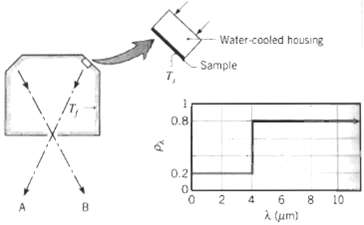
An apparatus commonly used for measuring the reflectivity of materials is shown below. A water-cooled sample, of 30-mm diameter and temperature Ts = 300 K, is mounted flush with the inner surface of a large enclosure. The walls of the enclosure are gray and diffuse with an emissivity of 0.8 and a
A very small sample of an opaque surface is initially at 1200 K and has the spectral, hemispherical absorptivity shown. The sample is placed inside a very large enclosure whose walls has an emissivity of 0.2 and is maintained at 2400 K. (a) What is the total, hemispherical absorptivity of the
A manufacturing process involves heating long copper rods, which are coated with a thin film, in a large furnace whose walls are maintained at an elevated temperature Tw. The furnace contains quiescent nitrogen gas at l-atm pressure and a temperature of T∞ = Tw. The film is a diffuse surface with
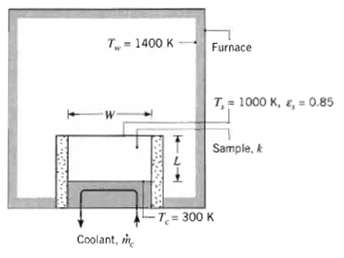
A procedure for measuring the thermal conductivity of solids at elevated temperatures involves placement of a sample at the bottom of a large furnace. The sample is of thickness L and is placed in a square container of width W on a side. The sides are well insulated. The walls of the cavity are
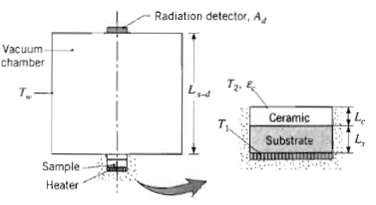
One scheme for extending the operation of gas turbine blades to higher temperatures involves applying a ceramic coating to the surfaces of blades fabricated from a super alloy such as inconel. To assess the reliability of such coatings, an apparatus has been developed for testing samples under
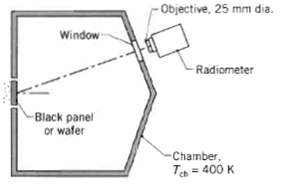
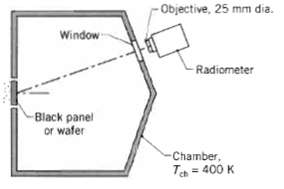
The equipment for heating a wafer during a semiconductor manufacturing process is shown schematically. The wafer is heated by an ion beam source (not shown) to a uniform, steady-state temperature. The large chamber contains the process gas, and its walls are at a uniform temperature of Tch = 400 K.
The fire brick of Example 12.9 is used to construct the walls of a brick oven. The irradiation on the interior surface of the wall is G = 50,000 W/m2 and has a spectral distribution proportional to that of a black-body at 2000 K. The temperature of the gases adjacent to the inner wall of the oven
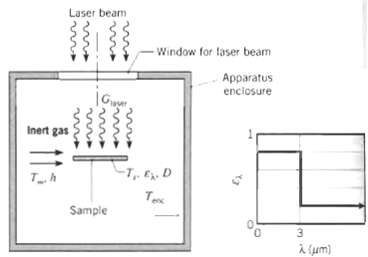
A laser-materials-processing apparatus encloses a sample in the form of a disk of diameter D = 25 mm and thickness w = 1 mm. The sample has a diffuse surface for which the spectral distribution of the emissivity, ?? (?), is prescribed. To reduce oxidation, an inert gas stream of temperature T? =
The equipment for heating a wafer during a semiconductor manufacturing process is shown schematically. The wafer is heated by an ion beam source (not shown) to a uniform, steady-state temperature. The large chamber contains the process gas, and its walls are at a uniform temperature of Tch = 400 K.
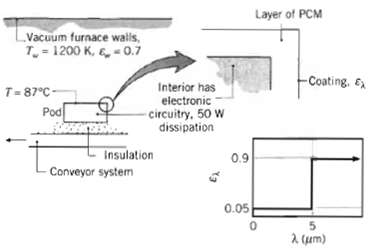
An instrumentation transmitter pod is a box containing electronic circuitry and a power supply for sending sensor signals to a base receiver for recording. Such a pod is placed on a conveyor system, which passes through a large vacuum brazing furnace as shown in the sketch. The exposed surfaces of
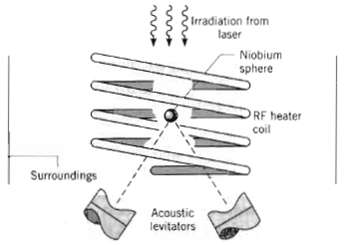
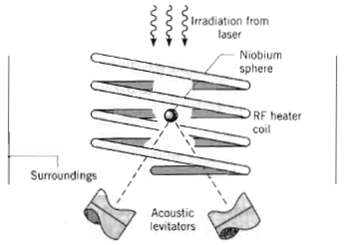
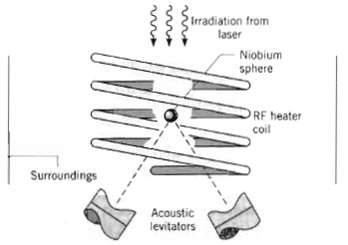
To simulate materials processing under the microgravity conditions of space, a niobium sphere of diameter 3 mm is levitated by an acoustical technique in a vacuum chamber. Initially the sphere is at 300 K and is suddenly irradiated with a laser providing an irradiation of 10 W/mm 2 to raise its
To simulate materials processing under the microgravity conditions of space, a niobium sphere of diameter 3 mm is levitated by an acoustical technique in a vacuum chamber. Initially the sphere is at 300 K and is suddenly irradiated with a laser providing an irradiation of 10 W/mm 2 to raise its
To simulate materials processing under the microgravity conditions of space, a niobium sphere of diameter 3 mm is levitated by an acoustical technique in a vacuum chamber. Initially the sphere is at 300 K and is suddenly irradiated with a laser providing an irradiation of 10 W/mm 2 to raise its
A thin coating, which is applied to long, cylindrical copper rods of 10-mm diameter, is cured by placing the rods horizontally in a large furnace whose walls are maintained at 1300 K. The furnace is filled with nitrogen gas, which is also at 1300 K and at a pressure of 1 atm. The coating is
A large combination convection-radiation oven is used to heat-treat a small cylindrical product of diameter 25 mm and length 0.2 m. The oven walls are at a uniform temperature of 1000 K and hot air at 750 K is in cross flow over the cylinder with a velocity of 5m/s. The cylinder surface is opaque
A 10-mm-thick work piece, initially at 25°C, is to be annealed at a temperature above 725°C for a period of at least 5 minutes and then cooled. The work piece is opaque and diffuse, and the spectral distribution of its emissivity is shown schematically. Heating is effected in a large furnace with
After being cut from a large single-crystal boule and polished, silicon wafers undergo a high-temperature annealing process. One technique for heating the wafer is to irradiate its top surface using high-intensity, tungsten-halogen lamps having a spectral distribution approximating that of a
(a) Estimate the roof temperature under steady-state conditions.(b) Explore the effect of changes in the absorptivity, emissivity, and convection coefficient on the steady-state temperature.
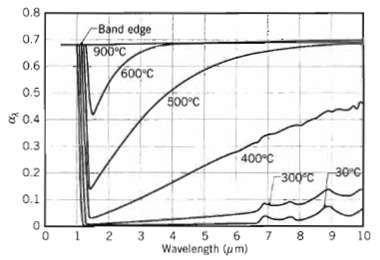
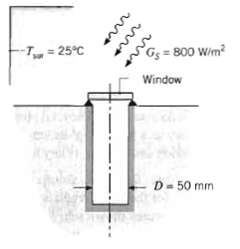
A deep cavity of 50-mm diameter approximates a blackbody and is maintained at 250°C while exposed to solar irradiation of 800 W/m 2 and surroundings and ambient air at 25°C. A thin window of spectral transmissivity and reflectivity 0.9 and 0, respectively, for the spectral range 0.2 to 4?m is
Showing 12100 - 12200
of 18200
First
115
116
117
118
119
120
121
122
123
124
125
126
127
128
129
Last
Step by Step Answers

 Get 50% OFF
Claim Now
Get 50% OFF
Claim Now