New Semester
Started
Get
50% OFF
Study Help!
--h --m --s
Claim Now
Question Answers
Textbooks
Find textbooks, questions and answers
Oops, something went wrong!
Change your search query and then try again
S
Books
FREE
Study Help
Expert Questions
Accounting
General Management
Mathematics
Finance
Organizational Behaviour
Law
Physics
Operating System
Management Leadership
Sociology
Programming
Marketing
Database
Computer Network
Economics
Textbooks Solutions
Accounting
Managerial Accounting
Management Leadership
Cost Accounting
Statistics
Business Law
Corporate Finance
Finance
Economics
Auditing
Tutors
Online Tutors
Find a Tutor
Hire a Tutor
Become a Tutor
AI Tutor
AI Study Planner
NEW
Sell Books
Search
Search
Sign In
Register
study help
engineering
mechanical engineering
Fundamentals of Heat and Mass Transfer 6th Edition Incropera, Dewitt, Bergman, Lavine - Solutions
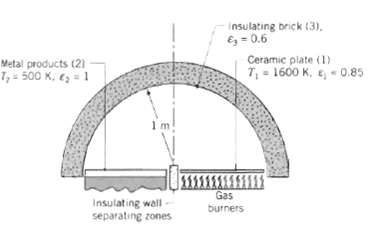
A long, hemi cylindrical (l-m radius) shaped furnace used to heat treat sheet metal products is comprised of three zones. The heating zone (1) is constructed from a ceramic plate of emissivity 0.85 and is operated at 1600 K by gas burners. The load zone (2) consists of sheet metal products, assumed
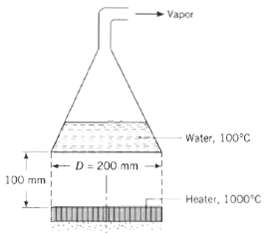
The bottom of a steam-producing still of 200-mm diameter is heated by radiation. The heater, maintained at 1000?C and separated 100 mm from the still, has the same diameter as the still bottom. The still bottom and heater surfaces are black. (a) By what factor could the vapor production rate be
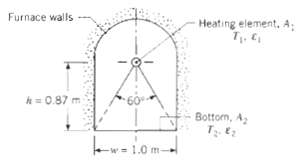
A long cylindrical heater element of diameter D = 10 mm, temperature T1 = 1500 K, and emissivity ?1 = 1 is used in a furnace. The bottom area A2 is a diffuse gray surface with ?2 = 0.6 and is maintained at T2 = 500 K. The side and top walls are fabricated from an insulating, refractory brick that
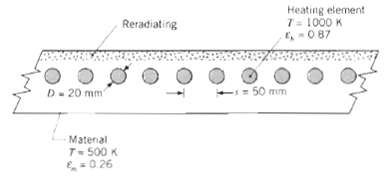
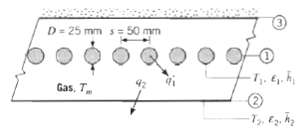
A radiative heater consists of a bank of ceramic tubes with internal heating elements. The tubes are of diameter D = 20 mm and are separated by a distance s = 50 mm. A reradiating surface is positioned behind the heating tubes as shown in the schematic. Determine the net radiative heat flux to the
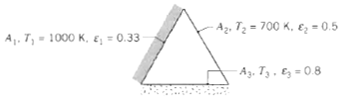
Consider a long duct constructed with diffuse, gray walls 1 m wide(a) Determine the net radiation transfer from surface A1 per unit length of the duct.(b) Determine the temperature of the insulated surface A3.(c) What effect would changing the value of ε3 have on your result? After considering
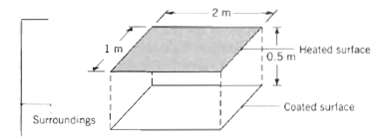
The coating on aim by 2 m metallic surface is cured by placing it 0.5 m below an electrically heated surface of equivalent dimensions, and the assembly is exposed to large surroundings at 300 K. The heater is well insulated on its top side and is aligned with the coated surface. Both the heater and
A cubical furnace 2 m on a side is used for heat treating steel plate. The top surface of the furnace consists of electrical radiant heaters that have an emissivity of 0.8 and a power input of 1.5 x 10⁵ W. The sidewalls consist of a well-insulated refractory material, while the bottom consists of
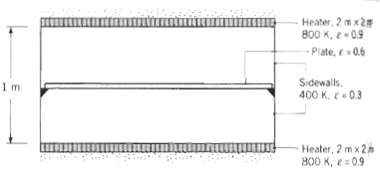
An electric furnace consisting of two heater sections, top and bottom, is used to heat treat a coating that is applied to both surfaces of a thin metal plate inserted midway between the heaters. The heaters and the plate are 2 m by 2 m on a side, and each heater is separated from the plate by a
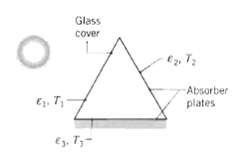
A solar collector consists of a long duct through which air is blown; its cross section forms an equilateral triangle 1 m on a side. One side consists of a glass cover of emissivity ?1 = 0.9, while the other two sides are absorber plates with ?2 = ?3 = 1.0. During operation the surface temperatures
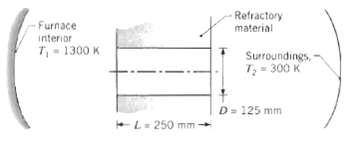
The cylindrical peephole in a furnace wall of thickness L = 250 mm has a diameter of D = 125 mm. The furnace interior has a temperature of 1300 K, and the surroundings outside the furnace have a temperature of 300 K. Determine the heat loss by radiation through the peephole.
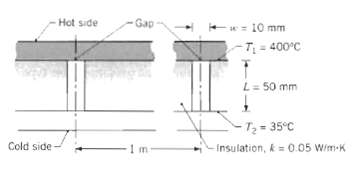
A composite wall is comprised of two large plates separated by sheets of refractory insulation, as shown in the schematic. In the installation process, the sheets of thickness L = 50 mm and thermal conductivity k = 0.05 W/m ? K are separated at I-m intervals by gaps of width w = 10 mm. The hot and
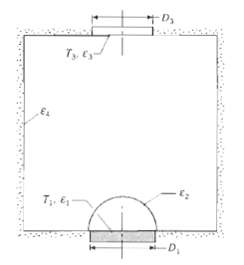
A small disk of diameter D1 = 50 mm and emissivity ?1 = 0.6 is maintained at a temperature of T1 = 900 K. The disk is covered with a hemispherical radiation shield of the same diameter and an emissivity of ?2 = 0.02 (both sides). The disk and cap are located at the bottom of a large evacuated
Consider a cylindrical cavity of diameter D = 100 mm and depth L = 50 mm whose sidewall and bottom are diffuse and gray with an emissivity of 0.6 and are at a uniform temperature of 1500 K. The top of the cavity is open and exposed to surroundings that are large and at 300 K.(a) Calculate the net
Consider a circular furnace that is 0.3 m long and 0.3 m in diameter. The two ends have diffuse, gray surfaces that are maintained at 400 and 500 K with emissivities of 0.4 and 0.5, respectively. The lateral surface is also diffuse and gray with an emissivity of 0.8 and a temperature of 800 K.
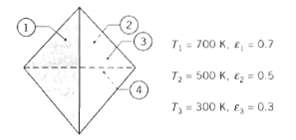
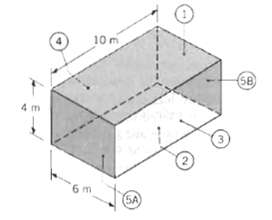
Consider the diffuse, gray, four-surface enclosure with all sides equal as shown. The temperatures of three surfaces are specified, while the fourth surface is well insulated and can be treated as a reradiating surface. Determine the temperature of the reradiating surface (4).
A room is represented by the following enclosure, where the ceiling (1) has an emissivity of 0.8 and is maintained at 40?C by embedded electrical heating elements. Heaters are also used to maintain the floor (2) of emissivity 0.9 at 50?C. The right wall (3) of emissivity 0.7 reaches a temperature
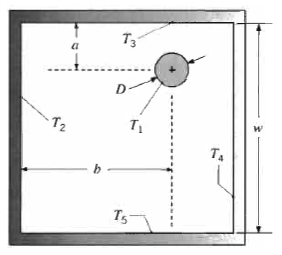
Work Problem 13.23, part (b), except with wall and cylinder emissivity of ε w = 0.95 and εe = 0.12, respectively.Data from 13.23A long cylindrical rod of very high emissivity is heat treated within a long, evacuated oven of square cross section as shown in the sketch. The oven walls exhibit
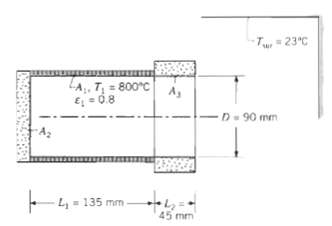
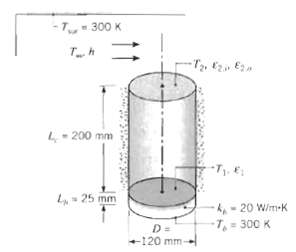
A cylindrical furnace for heat-treating materials in a spacecraft environment has a 90-mm diameter and an overall length of 180 mm. Heating elements in the 135-mm-long section (1) maintain a refractory lining of ?1 = 0.8 at 800?C. The linings for the bottom (2) and upper (3) sections are made of
In manufacturing semiconductors, rapid thermal processing (RTP) is used to rapidly heat a silicon wafer to an elevated temperature in order to induce effects such as ion diffusion, annealing, and oxidation. One type of RTP device consists of a cylindrical enclosure with a coaxially positioned
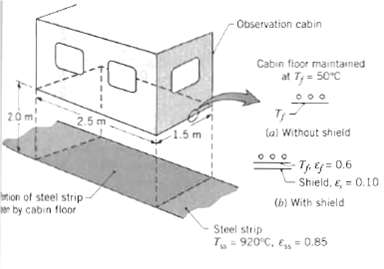
An observation cabin is located in a hot-strip mill directly over the line, as shown in the schematic. The cabin floor is exposed to a portion of the hot strip that is at a temperature of T ss = 920?C and has an emissivity of ? ss = 0.85, as well as to surroundings within the mill (not shown) at a
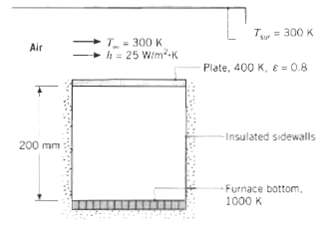
An opaque, diffuse, gray (200 mm by 200 mm) plate with an emissivity of 0.8 is placed over the opening of a furnace and is known to be at 400 K at a certain instant. The bottom of the furnace having the same dimensions as the plate is black and operates at 1000 K. The side-walls of the furnace are
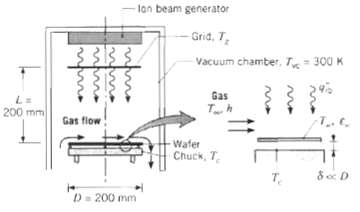
A tool for processing silicon wafers is housed within a vacuum chamber whose walls are black and maintained by a coolant at Tvc = 300 K. The thin silicon wafer is mounted close to, but not touching, a chuck, which is electrically heated and maintained at the temperature Tc. The surface of the chuck
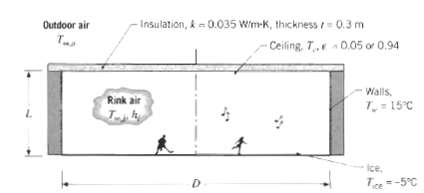
Most architects know that the ceiling of an ice-skating rink must have a high reflectivity. Otherwise, condensation may occur on the ceiling and water may drip?onto the ice, causing bumps on the skating surface. Condensation will occur on the ceiling when its surface temperature drops below the dew
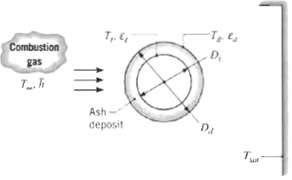
Boiler tubes exposed to the products of coal combustion in a power plant are subject to fouling by the ash (mineral) content of the combustion gas. The ash forms a solid deposit on the tube outer surface which reduces heat transfer to a pressurized water/steam mixture flowing through the tubes.
Consider two very large parallel plates. The bottom plate is warmer than the top plate, which is held at a constant temperature of T1 = 330 K. The plates are separated by L = 0.1m and the gap between the two surfaces is filled with air at atmospheric pressure. The heat flux from the bottom plate is
Coated metallic disks are cured by placing them at the top of a cylindrical furnace whose bottom surface is electrically heated and whose sidewall may be approximated as a reradiating surface. Curing is accomplished by maintaining a disk at T2 = 400 K for an extended period. The electrically heated
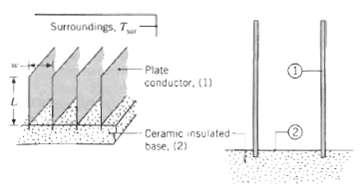
Electrical conductors, in the form of parallel plates of length L = 40 mm, have one edge mounted to a ceramic insulated base and are spaced a distance w = 10 mm apart. The plates are exposed to large isothermal surroundings at Tsur = 300 K. The conductor (1) and ceramic (2) surfaces are diffuse and
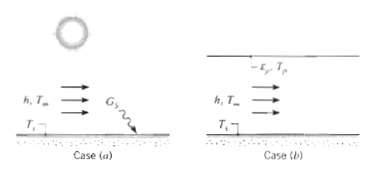
The spectral absorptivity of a large diffuse surface is ?? = 0.9 for A ? = 0.3 for ? > 1?m. The bottom of the surface is well insulated while the top may be exposed to one of two different conditions. (a) In case (a) the surface is exposed to the sun which provides an irradiation of Gs = 1200
A long uniform rod of 50-mm diameter with a thermal conductivity of 15 W/m · K is heated internally by volumetric energy generation of 20 kW/m3. The rod is positioned coaxially within a larger circular tube of 60-mm diameter whose surface is maintained at 500°C. The annular region between the rod
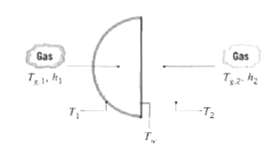
The cross section of a long circular tube, which is divided into two semi cylindrical ducts by a thin wall, is shown below. Sides 1 and 2 are maintained at temperatures of T1 = 600 K and T2 = 400 K, respectively, while the mean temperatures of gas flows through ducts 1 and 2 are Tg, 1 = 571 K and
A row of regularly spaced, cylindrical heating elements (1) is used to cure a surface coating that is applied to a large panel (2) positioned below the elements. A second large panel (3), whose top surface is well insulated, is positioned above the elements. The elements are black and maintained at
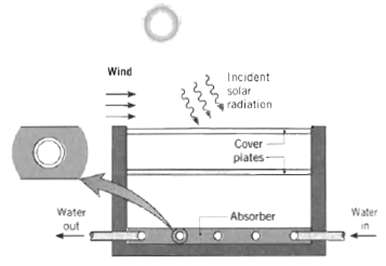
In recent years there has been considerable interest in developing flat-plate solar collectors for home heating needs. The typical collector configuration consists of an absorbing surface that is thermally insulated on the edges and on the back side. Solar radiation is transmitted through one or
Applying high-emissivity paints to radiating surfaces is a common technique used to enhance heat transfer by radiation.(a) For large parallel plates, determine the radiation heat flux across the gap when the surfaces are at T1 = 350 K, T2 = 300 K, ε1 = ε2 = εs = 0.85.(b) Determine the radiation
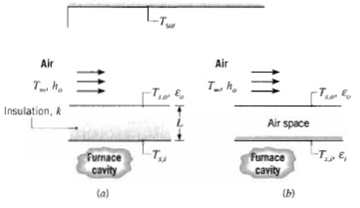
Options for thermally shielding the top ceiling of a large furnace include the use of an insulating material of thickness L and thermal conductivity k, case (a), or an air space of equivalent thickness formed by installing a steel sheet above the ceiling, case (b).(a) Develop mathematical models
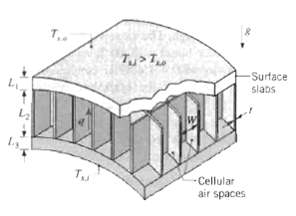
The composite insulation shown, which was described in Chapter 1 (Problem 1.72e), is being considered as a ceiling material. It is proposed that the outer and inner slabs be made from low-density particle board of thicknesses L, = L3 = 12.5 mm and that the honeycomb core be constructed from a
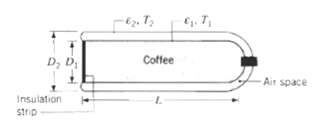
Hot coffee is contained in a cylindrical thermos bottle that is of length L = 0.3 m and is lying on its side (horizontally). The coffee container consists of a glass flask of diameter D1 = 0.07 m, separated from an aluminum housing of diameter D2 = 0.08 m by air at atmospheric pressure. The outer
A vertical air space in the wall of a home is 0.1 m thick and 3 m high. The air separates a brick exterior from a plaster board wall, with each surface having an emissivity of 0.9. Consider conditions for which the temperatures of the brick and plaster surfaces exposed to the air are -10 and 18°C,
Consider a vertical, double-pane window for the conditions prescribed in Problem 9.96. That is, vertical panes at temperatures of T1 = 22° and T2 = - 20° C are separated by atmospheric air, and the critical Rayleigh number for the onset of convection is Ra L, c = 2000.(a) What is the conduction
Consider the double-pane window of Problem 9.97, for which 1m x 1 m panes are separated by a 25-mm gap of atmospheric air. The window panes are approximately isothermal and separate quiescent room air at T∞, i = 20°C from quiescent ambient air at T∞, o = - 20°C.(a) For glass panes of
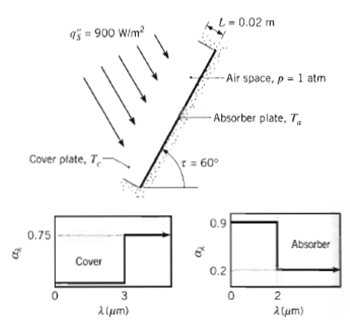
A flat-plate solar collector consisting of an absorber plate and single cover plate, is inclined at an angle of T = 60° relative to the horizontal. Consider conditions for which the incident solar radiation is collimated at an angle of 60° relative to the horizontal and the solar flux is 900
Consider the tube and radiation shield of Problem 13.49, but now account for free convection in the gap between the tube and the shield.(a) What is the total rate of heat transfer per unit length between the tube and the shield?(b) Explore the effect of variations in the shield diameter on the
Consider the tube and radiation shield of Problem 13.49, but now account for free convection in the gap between the tube and the shield, as well as for the fact that the temperature of the shield may not be arbitrarily prescribed but, in fact, depends on the nature of the surroundings. If the
Consider the flat-plate solar collector of Problem 9.100. The absorber plate has a coating for which ε1 = 0.96, and the cover plate has an emissivity of ε2 = 0.92. With respect to radiation exchange, both plates may be approximated as diffuse, gray surfaces.(a) For the conditions of Problem
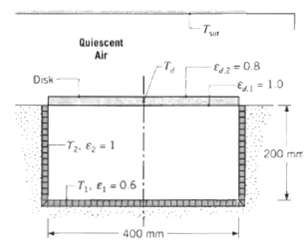
The lower side of a 400-mm-diameter disk is heated by an electric furnace, while the upper side is exposed to quiescent, ambient air and surroundings at 300 K. The radiant furnace (negligible convection) is of circular construction with the bottom surface (?1 = 0.6) and cylindrical side surface (?2
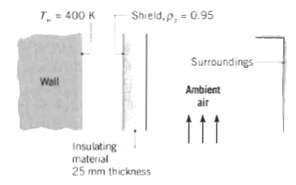
The surface of a radiation shield facing a black hot wall at 400 K has a reflectivity of 0.95. Attached to the back side of the shield is a 25-mm-thick sheet of insulating material having a thermal conductivity of 0.016 W/m ? K. The overall heat transfer coefficient (convection and radiation) at
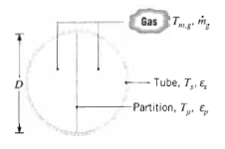
The fire tube of a hot water heater consists of a long circular duct of diameter D = 0.07 m and temperature Ts = 385 K, through which combustion gases flow at a temperature of Tm, g = 900 K. To enhance heat transfer from the gas to the tube, a thin partition is inserted along the mid plane of the
Consider Problem 9.95 with N = 4 sheets of thin aluminum foil (εƒ = 0.07), equally spaced throughout the 50-mm gap so as to form five individual air gaps each 10 mm thick. The hot and cold surfaces of the enclosure are characterized by E = 0.85.(a) Neglecting conduction or convection in the air,
Consider the conditions of Problem 9.105. Accounting for radiation, as well as convection, across the helium-filled cavity, determine the mass rate at which gaseous nitrogen is vented from the system. The cavity surfaces are diffuse and gray with emissivities of εi = εo = 0.3. If the cavity is
A special surface coating on a square panel that is 5 m by 5 m on a side is cured by placing the panel directly under a radiant heat source having the same dimensions. The heat source is diffuse and gray and operates with a power input of 75 kW. The top surface of the heater, as well as the bottom
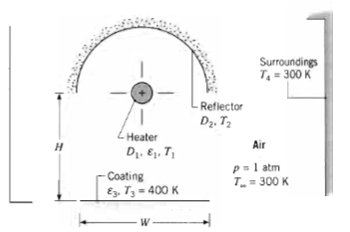
A long rod heater of diameter D1 = 10 mm and emissivity ε1 = 1.0 is coaxial with a well-insulated, semi cylindrical reflector of diameter D2 = 1 m. A long panel of width W = 1 m is aligned with the reflector and is separated from the heater by a distance of H = 1 m. The panel is coated with a
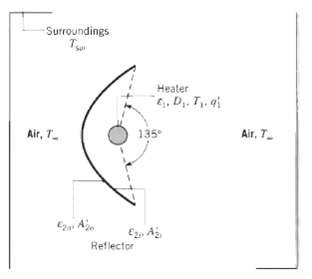
A radiant heater, which is used for surface treatment processes, consists of a long cylindrical heating element of diameter D1 = 0.005 m and emissivity ?1 = 0.80. The heater is partially enveloped by a long, thin parabolic reflector whose inner and outer surface emissivities are ?2i = 0.10 and ?20
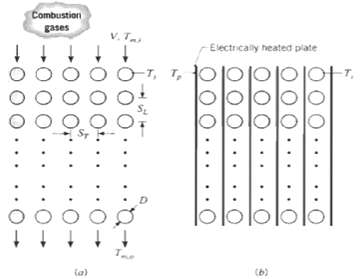
A steam generator consists of an in-line array of tubes, each of outer diameter D = 10 mm and length L = 1m. The longitudinal and transverse pitches are each SL = S? = 20 mm, while the numbers of longitudinal and transverse rows are N L = 20 and NT = 5. Saturated water (liquid) enters the tubes at
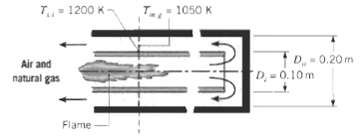
The sketch shows a gas-fired radiant tube of the single- ended recuperative (SER) type. A mixture of air and natural gas is injected at the left end of the central tube, and combustion is essentially complete while the gases are still in the inner tube. The products of combustion are exhausted
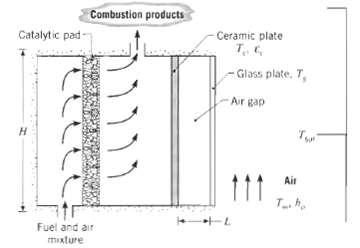
A wall-mounted natural gas heater uses combustion on a porous catalytic pad to maintain a ceramic plate of emissivity Tc = 0.95 at a uniform temperature of Tc = 1000 K. The ceramic plate is separated from a glass plate by an air gap of thickness L = 50 mm. The surface of the glass is diffuse, and
A furnace having a spherical cavity of 0.5-m diameter contains a gas mixture at 1 atm and 1400 K. The mixture consists of CO2 with a partial pressure of 0.25 atm and nitrogen with a partial pressure of 0.75 atm. If the cavity wall is black, what is the cooling rate needed to maintain its
A gas turbine combustion chamber may be approximated as a long tube of 0.4-m diameter. The combustion gas is at a pressure and temperature of 1 atm and 1000°C, respectively, while the chamber surface temperature is 500°C. If the combustion gas contains CO2 and water vapor, each with a mole
A flue gas at 1-atm total pressure and a temperature of 1400 K contains CO2 and water vapor at partial pressures of 0.05 and 0.10 atm, respectively. If the gas flows through a long flue of 1-m diameter and 400 K surface temperature, determine the net radiative heat flux from the gas to the surface.
A furnace consists of two large parallel plates separated by 0.75 m. A gas mixture comprised of O2, N2, CO2, and water vapor, with mole fractions of 0.20, 0.50, 0.15, and 0.15, respectively, flows between the plates at a total pressure of 2 atm and a temperature of 1300 K. If the plates may be
In an industrial process, products of combustion at a temperature and pressure of 2000 K and 1 atm, respectively, flow through a long, 0.25-m-diameter pipe whose inner surface is black. The combustion gas contains CO2 and water vapor each at a partial pressure of 0.10 atm. The gas may be assumed to
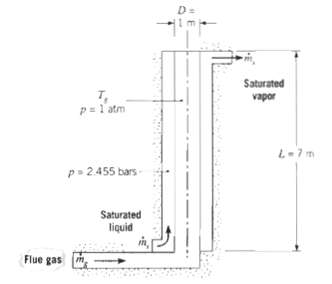
Waste heat recovery from the exhaust (flue) gas of a melting furnace is accomplished by passing the gas through a vertical metallic tube and introducing saturated water (liquid) at the bottom of an annular region around the tube. The tube length and inside diameter are 7 and 1 m, respectively, and
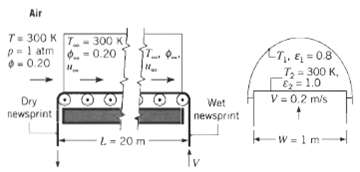
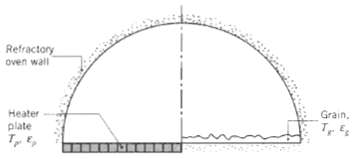
A radiant oven for drying newsprint consists of a long duct (L = 20 m) of semicircular cross section. The newsprint moves through the oven on a conveyor belt at a velocity of V = 0.2 m/s. The newsprint has a water content of 0.02 kg/m2 as it enters the oven and is completely dry as it exits. To
(a) Neglecting convection heat transfer, determine the required temperature Tp of the heater plate. (b) If the water vapor is swept from the duct by the flow of dry air, what convection mass transfer coefficient hm, must be maintained by the flow? (c) If the air is at 300 K, is the assumption of
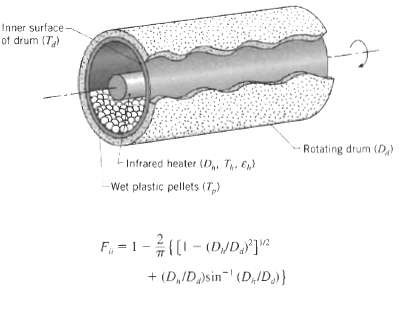
A novel infrared recycler has been proposed for reclaiming the millions of kilograms of waste plastics produced by the dismantling and shredding of auto-motive vehicles following their retirement. To address the problem of sorting mixed plastics into components such as polypropylene and
Assuming air to be composed exclusively of O2 and N2, with their partial pressures in the ratio 0.21: 0.79, what are their mass fractions?
A mixture of CO2 and N2 is in a container at 25°C, with each species having a partial pressure of 1 bar. Calculate the molar concentration, the mass density, the mole fraction, and the mass fraction of each species.
A He-Xe mixture containing 0.75 mole fraction of helium is used for cooling of electronics in an avionics application. At a temperature of 300 K and atmospheric pressure, calculate the mass fraction of helium and the mass density, molar concentration, and molecular weight of the mixture. If the
Consider an ideal gas mixture of n species.(a) Derive an equation for determining the mass fraction of species i from knowledge of the mole fraction and the molecular weight of each of the n species. Derive an equation for determining the mole fraction of species i from knowledge of the mass
Consider air in a closed, cylindrical container with its axis vertical and with opposite ends maintained at different temperatures. Assume that the total pressure of the air is uniform throughout the container.(a) If the bottom surface is colder than the top surface, what is the nature of
Estimate values of the mass diffusivity DAB for binary mixtures of the following gases at 350K and 1 atm: ammonia-air and hydrogen-air.
A 100-mm-long, hollow iron cylinder is exposed to a 1000°C carburizing gas (a mixture of CO and CO2) at its inner and outer surfaces of radii 4.30 and 5.70 mm, respectively. Consider steady-state conditions for which carbon diffuses from the inner surface of the iron wall to the outer surface and
An old-fashioned glass apothecary jar contains a patent medicine. The neck is closed with a rubber stopper that is 20 mm tall, with a diameter of 10 mm at the bottom end, widening to 20 mm at the top end. The molar concentration of medicine vapor in the stopper is 2 x 10⁻³k mol/m3 at the bottom
Consider the evaporation of liquid A into a column containing a binary gas mixture of A and B. Species B cannot be absorbed in liquid A and the boundary conditions are the same as in Section 14.2.2. Show how the ratio of the molar-average velocity to the species velocity of A, v*x/v A,x, varies
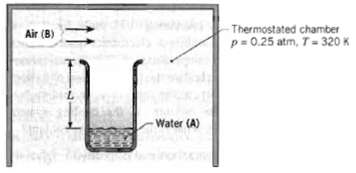
An open pan of diameter 0.2 m and height 80 mm (above water at 27°C) is exposed to ambient air at 27°C and 25% relative humidity. Determine the evaporation rate, assuming that only mass diffusion occurs. Determine the evaporation rate, considering bulk motion.
A spherical droplet of liquid A and radius ro evaporates into a stagnant layer of gas B. Derive an expression for the evaporation rate of species A in terms of the saturation pressure of species A, pA(ro) = PA,sat, the partial pressure of species A at an arbitrary radius r, pA(r), the total
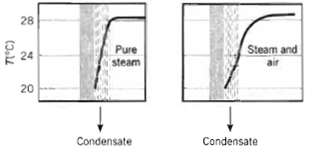
The presence of a small amount of air may cause a significant reduction in the heat rate to a water-cooled steam condenser surface. For a clean surface with pure steam and the prescribed conditions, the condensate rate is 0.020 kg/m2 ? s. With the presence of stagnant air in the steam, the
A laboratory apparatus to measure the diffusion coefficient of vapor-gas mixtures consists of a vertical, small-diameter column containing the liquid phase that evaporates into the gas flowing over the mouth of the column. The gas flow rate is sufficient to maintain a negligible vapor concentration
Beginning with a differential control volume, derive the diffusion equation, on a molar basis, for species A in a three-dimensional (Cartesian coordinates), stationary medium, considering species generation with constant properties. Compare your result with Equation 14.48b.
Consider the radial diffusion of a gaseous species (A) through the wall of a plastic tube (B), and allow for chemical reactions that provide for the depletion of A at a rate NA (k mol/s ∙ m3). Derive a differential equation that governs the molar concentration of species A in the plastic.
Beginning with a differential control volume, derive the diffusion equation, on a molar basis, for species A in a one-dimensional, spherical, stationary medium, considering species generation. Compare your result with Equation 14.50.
Gaseous hydrogen at 10 bars and 27°C is stored in a 100-mm-diameter spherical tank having a steel wall 2 mm thick. The molar concentration of hydrogen in the steel is 1.50k mol/m3 at the inner surface and negligible at the outer surface, while the diffusion coefficient of hydrogen in steel is
A thin plastic membrane is used to separate helium from a gas stream. Under steady-state conditions the concentration of helium in the membrane is known to be 0.02 and 0.005k mol/m3 at the inner and outer surfaces, respectively. If the membrane is 1 mm thick and the binary diffusion coefficient of
Consider the interface between atmospheric air and a body of water, both at 17°C.(a) What are the mole and mass fractions of water at the air side of the interface, at the water side of the interface?(b) What are the mole and mass fractions of oxygen at the air side of the interface, at the water
Oxygen gas is maintained at pressures of 2 bars and 1 bar on opposite sides of a rubber membrane that is 0.5 mm thick, and the entire system is at 25°C. What is the molar diffusive flux of O 2 through the membrane? What are the molar concentrations of O2 on both sides of the membrane (outside the
Insulation degrades (experiences an increase in thermal conductivity) if it is subjected to water vapor condensation. The problem may occur in home insulation during cold periods, when vapor in a humidified room diffuses through the dry wall (plaster board) and condenses in the adjoining
Helium gas at 25°C and 4 bars is contained in a glass cylinder of 100-mm inside diameter and 5-mm thickness. What is the rate of mass loss per unit length of the cylinder?
Helium gas at 25°C and 4 bars is stored in a spherical Pyrex container of 200-mm inside diameter and 10-mm thickness. What is the rate of mass loss from the container?
Hydrogen at a pressure of 2 atm flows within a tube of diameter 40 mm and wall thickness 0.5 mm. The outer surface is exposed to a gas stream for which the hydrogen partial pressure is 0.1 atm. The mass diffusivity and solubility of hydrogen in the tube material are 1.8 x 10⁻¹¹ m2/s and 160kmol/m3
Consider the blister packaging material of Example 14.3.(a) Under the same conditions as in the example, determine the solubility of the polymer material (k mol/m3 bar) if the temperature is 295 K and the relative humidity inside and outside the package is Φ2 = 0.1 and Φ1 = 0.9, respectively.(b)
An experiment is designed to measure the partition coefficient, K, associated with the transfer of a pharmaceutical product through a polymer material. The partition coefficient is defined as the ratio of the densities of the species of interest (the pharmaceutical) on either side of an interface.
Ultra-pure hydrogen is required in applications ranging from the manufacturing of semiconductors to powering fuel cells. The crystalline structure of palladium allows only the transfer of atomic hydrogen (H) through its thickness, and therefore palladium membranes are used to filter hydrogen from
Nitric oxide (NO) emissions from automobile exhaust can be reduced by using a catalytic converter, and the following reaction occurs at the catalytic surface: NO + CO → ½ N2 + CO2. The concentration of NO is reduced by passing the exhaust gases over the surface, and the rate of reduction at
Pulverized coal pellets, which may be approximated as carbon spheres of radius ro = 1 mm, are burned in a pure oxygen atmosphere at 1450 K and 1 atm. Oxygen is transferred to the particle surface by diffusion, where it is consumed in the reaction C + O2 → CO2. The reaction rate is first order and
To enhance the effective surface, and hence the chemical reaction rate, catalytic surfaces often take the form of porous solids. One such solid may be visualized as consisting of a large number of cylindrical pores, each of diameter D and length L. Consider conditions involving a gaseous mixture of
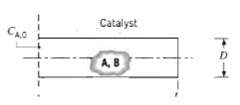
A platinum catalytic reactor in an automobile is used to convert carbon monoxide to carbon dioxide in an oxidation reaction of the form 2CO + O2 → 2CO2. Species transfer between the catalytic surface and the exhaust gases may be assumed to occur by diffusion in a film of thickness L = 10 mm.
A novel process has been proposed to create a composite palladium tube for use as a hydrogen separation membrane in order to produce high-purity hydrogen. To fabricate the composite palladium tube, a gas containing palladium (species A) flows through a porous-walled tube, and the palladium deposits
Consider combustion of hydrogen gas in a mixture of hydrogen and oxygen adjacent to the metal wall of a combustion chamber. Combustion occurs at constant temperature and pressure according to the chemical reaction 2H2 + O2 → 2H2O. Measurements under steady-state conditions at a distance of 10 mm
Consider a spherical organism of radius ro within which respiration occurs at a uniform volumetric rate of NA = –k0. That is, oxygen (species A) consumption is governed by a zero-order, homogeneous chemical reaction.(a) If a molar concentration of CA (r0) = CA, 0 is maintained at the surface of
Referring to Problem 14.34, a more representative model of respiration in a spherical organism is one for which oxygen consumption is governed by a first-order reaction of the form NA = – k1CA.(a) If a molar concentration of CA (r0) = CA, 0 is maintained at the surface of the organism, obtain an
Consider the problem of oxygen transfer from the interior lung cavity, across the lung tissue, to the network of blood vessels on the opposite side. The lung tissue (species B) may be approximated as a plane wall of thickness L. The inhalation process may be assumed to maintain a constant molar
As an employee of the Los Angeles Air Quality Commission, you have been asked to develop a model for computing the distribution of NO2 in the atmosphere. The molar flux of NO2 at ground level, N''A2, is presumed known. This flux is attributed to automobile and smoke stack emissions. It is also
Showing 12300 - 12400
of 18200
First
117
118
119
120
121
122
123
124
125
126
127
128
129
130
131
Last
Step by Step Answers

 Get 50% OFF
Claim Now
Get 50% OFF
Claim Now