New Semester
Started
Get
50% OFF
Study Help!
--h --m --s
Claim Now
Question Answers
Textbooks
Find textbooks, questions and answers
Oops, something went wrong!
Change your search query and then try again
S
Books
FREE
Study Help
Expert Questions
Accounting
General Management
Mathematics
Finance
Organizational Behaviour
Law
Physics
Operating System
Management Leadership
Sociology
Programming
Marketing
Database
Computer Network
Economics
Textbooks Solutions
Accounting
Managerial Accounting
Management Leadership
Cost Accounting
Statistics
Business Law
Corporate Finance
Finance
Economics
Auditing
Tutors
Online Tutors
Find a Tutor
Hire a Tutor
Become a Tutor
AI Tutor
AI Study Planner
NEW
Sell Books
Search
Search
Sign In
Register
study help
engineering
mechanical engineering
Principles of heat transfer 7th Edition Frank Kreith, Raj M. Manglik, Mark S. Bohn - Solutions
Mercury flows inside a copper tube 9 m long with a 5.1 cm inside diameter at an average velocity of 7 m/s. The temperature at the inside surface of the tube is 38°C uniformly throughout the tube, and the arithmetic mean bulk temperature of the mercury is 66°C. Assuming the velocity and
A heat exchanger is to be designed to heat a flow of molten bismuth from 377?C to 477?C. The heat exchanger consists of a 50 mm ID tube with surface temperature maintained uniformly at 500?C by an electrical heater. Find the length of the tube and the power required to heat 4 kg/s and 8 kg/s of
Liquid sodium is to be heated from 500 K to 600 K by passing it at a flow rate of 5.0 kg/s through a 5 cm ID tube whose surface is maintained at 620 K. What length of tube is required?GIVENLiquid sodium flow in a tubeBulk temperaturesInlet (Tb,in) = 500 KOutlet (Tb,out) = 600 KInside tube diameter
A 2.54-cm-OD, 1.9-cm-ID steel pipe carries dry air at a velocity of 7.6 m/s and a temperature of –7°C. Ambient air is at 21°C and has a dew point of 10°C. How much insulation with a conductivity of 0.18 W/(m K) is needed to prevent condensation on the exterior of the insulation if h = 2.4
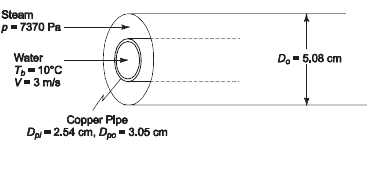
A double-pipe heat exchanger is used to condense steam at 7370 N/m2. Water at an average bulk temperature of 10????C flows at 3.0 m/s through the inner pipe, which is made of copper and has a 2.54-cm ID and a 3.05-cm OD. Steam at its saturation temperature flows in the annulus formed between the
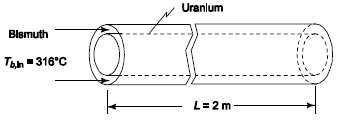
Assume that the inner cylinder in Problem 6.31 is a heat source consisting of an aluminum-clad rod of uranium, 5-cm-OD and 2 m long. Estimate the heat flux that will raise the temperature of the bismuth 40?C and the maximum center and surface temperatures necessary to transfer heat at this rate.
Evaluate the rate of heat loss per meter from pressurized water flowing at 200°C through a 10-cm-ID pipe at a velocity of 3 m/s. The pipe is covered with a 5-cm-thick layer of 85% magnesia wool which has an emissivity of 0.5. Heat is transferred to the surroundings at 20°C by natural convection
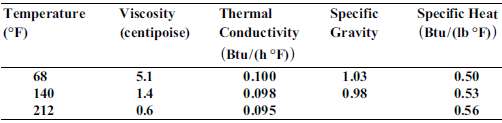
In a pipe-within-a-pipe heat exchanger, water is flowing in the annulus and an aniline-alcohol solution having the properties listed in Problem 6.20 is flowing in the central pipe. The inner pipe is 0.527 in. ID, 0.625 in. OD, and the ID of the outer pipe is 0.750 in. For a water bulk temperature
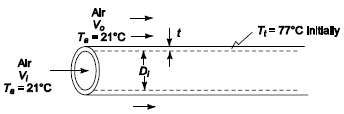
A plastic tube of 7.6-cm ID and 1.27 cm wall thickness having a thermal conductivity of 1.7 W/(m K), a density of 2400 kg/m3, and a specific heat of 1675 J/(kg K) is cooled from an initial temperature of 77?C by passing air at 20?C inside and outside the tube parallel to its axis. The velocities of
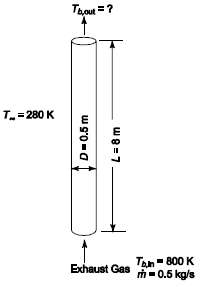
Exhaust gases having properties similar to dry air enter an exhaust stack at 800 K. The stack is made of steel and is 8 m tall and 0.5 m ID. The gas flow rate is 0.5 kg/s and the ambient temperature is 280 K. The outside of the stack has an emissivity of 0.9. If heat loss from the outside is by
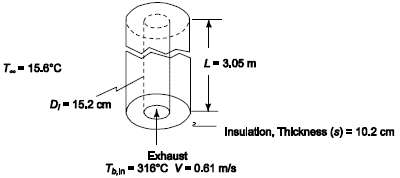
A 10 ft (3.05 m) long vertical cylindrical exhaust duct from a commercial laundry has an ID of 6.0 in (15.2 cm). Exhaust gases having physical properties approximating those of dry air enter at 600?F (316?C). The duct is insulated with 4 in (10.2 cm) of rock wool having a thermal conductivity of: k
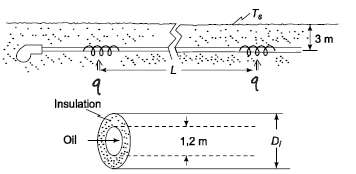
A long 1.2 m OD pipeline carrying oil is to be installed in Alaska. To prevent the oil from becoming too viscous for pumping, the pipeline is buried 3 m below ground. The oil is also heated periodically at pumping stations as shown schematically belowThe oil pipe is to be covered with insulation
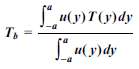
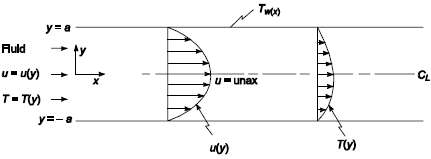
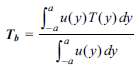
Show that for fully developed laminar flow between two flat plates spaced 2a apart, the Nusselt number based on the ??bulk mean?? temperature and the passage spacing is 4.12 if the temperature of both walls varies linearly with the distance x, i.e., ??T/??x = C. The ??bulk mean?? temperature is
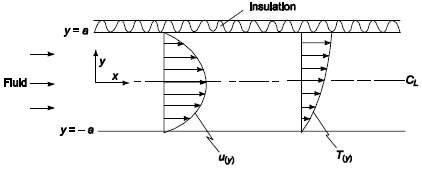
Repeat Problem 6.44 but assume that one wall is insulated while the temperature of the other walls increases linearly with x. From Problem 6.44: For fully developed laminar flow between two flat plates spaced 2a apart, find the Nusselt number based on the ??bulk mean?? temperature if the
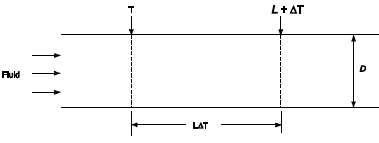
For fully turbulent flow in a long tube of diameter D, develop a relation between the ratio (L/??T)/D in terms of flow and heat transfer parameters, where L/??T is the tube length required to raise the bulk temperature of the fluid by ??T. Use Equation 6.63 for fluids with Prandtl number of the
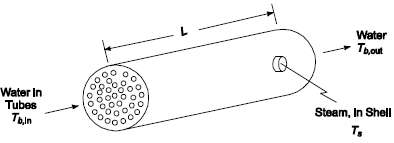
Water in turbulent flow is to be heated in a single-pass tubular heat exchanger by steam condensing on the outside of the tubes. The flow rate of the water, its inlet and outlet temperatures, and the steam pressure are fixed. Assuming that the tube wall temperature remains constant, determine the
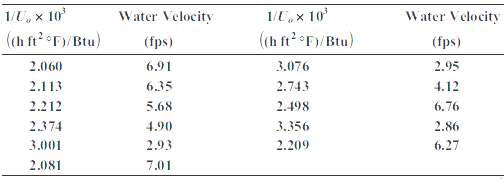
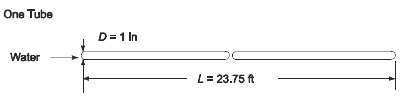
The following thermal-resistance data were obtained on a 50,000-ft2 condenser constructed with 1-in.-OD brass tubes, 23 3/4 ft long, 0.049 in. wall thickness, at various water velocities inside the tubes [Trans. ASME, vol. 58, p. 672, 1936]. Assuming that the heat transfer coefficient on the steam
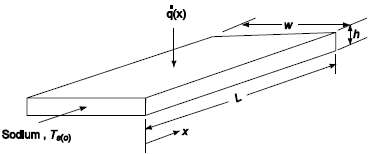
A nuclear reactor has rectangular flow channels with a large aspect ratio (w/h)>>1 Heat generation is equal from the upper and lower surface and uniform at any value of x. However, the rate varies along the flow path of the sodium coolant according toq'' (x) = qo'' sin(πx/L)Assuming that
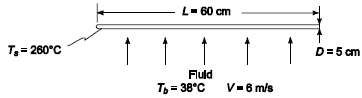
Determine the heat transfer coefficient at the stagnation point and the average value of the heat transfer coefficient for a single 5-cm-OD, 60-cm-long tube in cross-flow. The temperature of the tube surface is 260?C, the velocity of the fluid flowing perpendicularly to the tube axis is 6 m/s, and
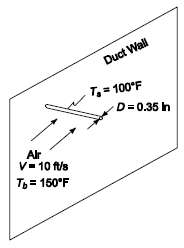
A mercury-in-glass thermometer at 100?F (OD = 0.35 in.) is inserted through duct wall into a 10 ft/s air stream at 150?F. Estimate the heat transfer coefficient between the air and the thermometer.GIVENThermometer in an air streamThermometer temperature (Ts) = 100?FThermometer outside diameter (D)
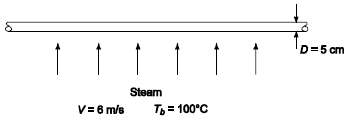
Steam at 1 atm and 100?C is flowing across a 5-cm-OD tube at a velocity of 6 m/s. Estimate the Nusselt number, the heat transfer coefficient, and the rate of heat transfer per meter length of pipe if the pipe is at 200?C.GIVENSteam flowing across a tubeSteam pressure = 1 atmSteam bulk temperature
An electrical transmission lin of 1.2 cm diameter carries a current of 200 Amps and has a resistance of 3 x 10⁻⁴ ohm per meter of length. If the air around this line is at 16°C, determine the surface temperature on a windy day, assuming a wind blows across the line at 33 km/h.GIVENAn electrical
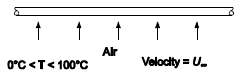
Derive an equation in the form hc = f(T, D, U??) for flow of air over a long horizontal cylinder for the temperature range 0?C to 100?C, using Equation (7.3) as a basis.GIVENFlow over a long horizontal cylinderAir temperature range is 0?C ASSUMPTIONSSteady statePrandtl number variation isnegligible
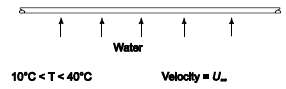
Repeat Problem 7.5 for water in the temperature range 10?C to 40?C. From Problem 7.5: Derive an equation in the form hc = f(T, D, U??) for flow over a long horizontal cylinder using Equation (7.3) as a basis.GIVENWater flow over a long horizontal cylinderWater temperature range is 10?C
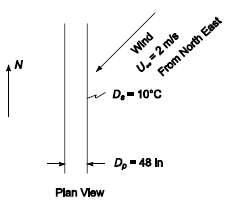
The Alaska Pipeline carries 2 million barrels per day of crude oil from Prudhoe Bay to Valdez covering a distance of 800 miles. The pipe diameter is 48 in. and it is insulated with 4 in. of fiberglass covered with steel sheeting. Approximately half of the pipeline length is above ground, nominally
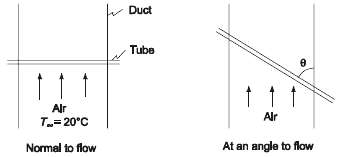
An engineer is designing a heating system which consists of multiple tubes placed in a duct carrying the air supply for a building. She decides to perform preliminary tests with a single copper tube, 2 cm o.d., carrying condensing steam at 100?C. The air velocity in the duct is 5 m/s and its
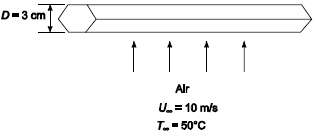
A long hexagonal copper extrusion is removed from a heat-treatment oven at 400?C and immersed into a 50?C air stream flowing perpendicular to its axis at 10 m/s. Due to oxidation, the surface of the copper has an emissivity of 0.9. The rod is 3 cm across opposing flats, has a cross-sectional area
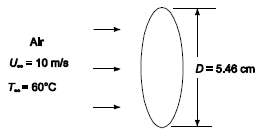
Repeat Problem 7.9 if the extrusion cross-section is elliptical, major axis normal to the air flow and same mass per unit length. The major axis of the elliptical cross-section is 5.46 cm and its perimeter is 12.8 cm. From Problem 7.9: A long copper extrusion is removed from a heat-treatment oven
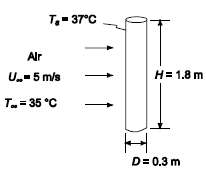
Calculate the rate of heat loss from a human body at 37?C in an air stream of 5 m/s, 35?C. The body can be modeled as a cylinder 30 cm in diameter, 1.8 m high. Compare your results with those for natural convection from a body and with the typical energy intake from food, 1033 kcal/day (Problem
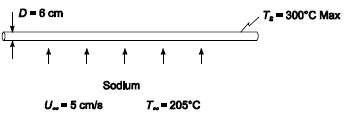
A nuclear reactor fuel rod is a circular cylinder 6 cm in diameter. The rod is to be tested by cooling it with a flow of sodium at 205?C and a velocity of 5 cm/s Perpendicular to its axis. If the rod surface is not to exceed 300?C, estimate the maximum allowable power dissipation in the
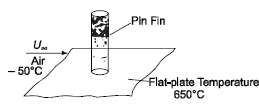
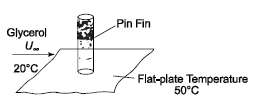
A stainless steel pin fin 5 cm long, 6 mm OD, extends from a flat plate into a 175 m/s air stream as shown in the accompanying sketch.(a) Estimate the average heat transfer coefficient between air and the fin.(b) Estimate the temperature at the end of the fin.(c) Estimate the rate of heat flow from
Repeat Problem 7.13 with glycerol at 20?C flowing over the fin at 2 m/s. The plate temperature is 50?C. From Problem 7.13: A stainless steel pin fin 5 cm long, 6-mm-OD, extends from a flat plate into a 175 m/s glycerol stream as shown in the accompanying sketch.(a) Estimate the average heat
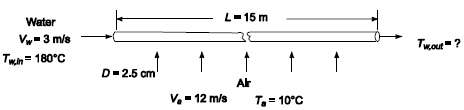
Water at 180?C and at 3 m/s enters a bare, 15-m-long, 2.5-cm wrought iron pipe, if air at 10?C flows perpendicular to the pipe at 12 m/s, determine the outlet temperature of the water. (Note that the temperature difference between the air and the water varies along the pipe.)GIVENWrought-iron pipe
The temperature of air flowing through a 25-cm-diameter duct whose inner walls are at 320°C is to be measured with a thermocouple soldered in a cylindrical steel wall of 1.2 cm OD, whose exterior is oxidized as shown in the accompanying sketch. The air flows normal to the cylinder at a mass
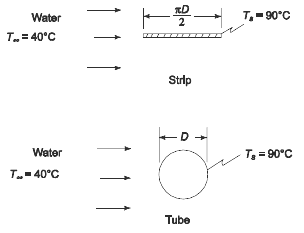
Develop an expression for the ratio of the rate of heat transfer to water at 40°C from a thin flat strip of width πD/2 and length L at zero angle of attack and a tube of the same length and diameter D in cross-flow with its axis normal to the water flow in the Reynolds number range between 50 and
Repeat Problem 7.17 for air flowing over the same two surfaces in the Reynolds number range between 40,000 and 200,000. Neglect radiation. From Problem 7.17: Develop an expression for the ratio of the rate of heat transfer to air at 40°C from a thin flat strip of width πD/2 and length L at zero
The instruction manual for a hot-wire anemometer states that ‘roughly speaking, the current varies as the one-fourth power of the average velocity at a fixed wire resistance’. Check this statement, using the heat transfer characteristics of thin wire in air and water.GIVENA thin current
A hot-wire anemometer is used to determine the boundary layer velocity profile in the air flow over a scale model of an automobile. The hot-wire is held in a traversing mechanism that moves the wire in a direction normal to the surface of the model. The hot-wire is operated at constant temperature.
A platinum hot-wire anemometer operated in the constant-temperature mode has been used to measure the velocity of a helium stream. The wire diameter is 20 m, its length is 5 mm, and it is operated at 90°C. The electronic circuit used to maintain the wire temperature has a maximum power output of 5
A hot-wire anemometer consists of a 5 m diameter platinum wire, 5 mm long. The probe is operated at constant current of 0.03 amp. The electrical resistivity of platinum is 17Wcm at 20°C and increases by 0.385% per °C.(a) If the voltage across the wire is 1.75 Volts, determine the velocity of the
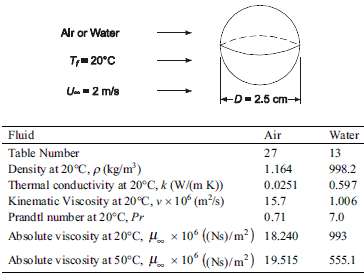
A 2.5 cm sphere is maintained at 50?C in an air stream or a water stream, both at 20?C and 2 m/s velocity. Compare the rate of heat transfer and the drag on the sphere for both fluids.GIVENA sphere in an air stream or a water streamSphere diameter (D) = 2.5 cm = 0.025 mSphere temperature (Ts) =
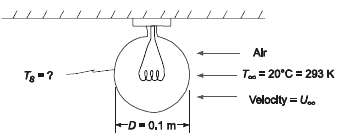
Compare the effect of forced convection on heat transfer from an incandescent lamp, Problem 5.27. What will the glass temperature be for air velocities of 0.5, 1, 2, and 4 m/s? From Problem 5.27: Only ten percent of the energy dissipated by the tungsten filament of an incandescent lamp is in the
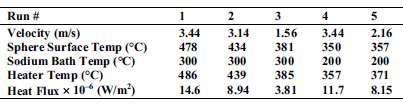
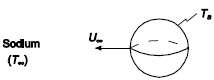
An experiment was conducted in which the heat transfer from a sphere in sodium was measured. The sphere, 0.5 in. in diameter was pulled through a large sodium bath at a given velocity while an electrical heater inside the sphere maintains the temperature at a set point. The following table gives
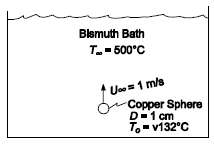
A copper sphere initially at a uniform temperature of 132?C is suddenly released at the bottom of a large bath of bismuth at 500?C. The sphere diameter is 1 cm and it rises through the bath at 1 m/s. How far will the sphere rise before its center temperature is 300?C? What is its surface
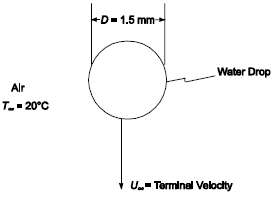
A spherical water droplet of 1.5 mm diameter is freely falling in atmospheric air. Calculate the average convection heat transfer coefficient when the droplet has reached its terminal velocity. Assume that the water is at 50?C and the air is at 20?C. Neglect mass transfer and radiation.GIVENA
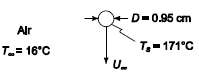
In a lead-shot tower, spherical 0.95-cm-diameter BB shots are formed by drops of molten lead which solidify as they descend in cooler air. At the terminal velocity, i.e., when the drag equals the gravitational force, estimate the total heat transfer coefficient if the lead surface is at 171?C, the
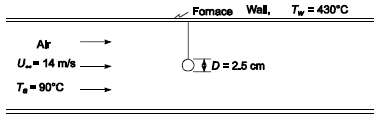
A copper sphere 2.5 cm in diameter is suspended by a fine wire in the center of an experimental hollow cylindrical furnace whose inside wall is maintained uniformly at 430?C. Dry air at a temperature of 90?C and a pressure of 1.2 atm is blown steadily through the furnace at a velocity of 14 m/s.
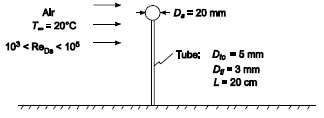
A method for measuring the convective heat transfer from spheres has been proposed. A 20 m diameter copper sphere with an embedded electrical heater is to be suspended in a wind tunnel. A thermocouple inside the sphere measures the sphere surface temperature. The sphere is supported in the tunnel
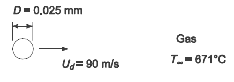
Estimate (a) The heat transfer coefficient for a spherical fuel droplet injected into a diesel engine at 80°C and 90 m/s. The oil droplet is 0.025 mm in diameter, the cylinder pressure is 4800 kPa, and the gas temperature is 944 K. (b) Estimate the time required to heat the droplet to
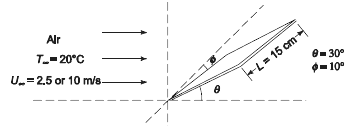
Heat transfer from an electronic circuit board is to be determined by placing a model for the board in a wind tunnel. The model is a 15 cm square plate with embedded electrical heaters. The wind from the tunnel air is delivered at 20°C. Determine the average temperature of the model as a function
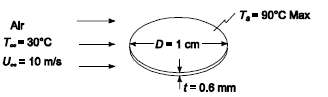
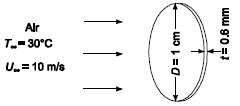
An electronic circuit contains a power resistor that dissipates 1.5 watts. The designer wants to modify the circuitry in such a way that it will be necessary for the resistor to dissipate 2.5 watts. The resistor is in the shape of a disk 1 cm in diameter and 0.6 mm thick. Its surface is aligned
Suppose the resistor in Problem 7.33 is rotated so that its axis is aligned with the flow. What is the maximum permissible power dissipation? From Problem 7.33: An electronic circuit contains a power resistor that dissipates 1.5 watts. The designer wants to modify the circuitry in such a way that
To decrease the size of personal computer mother boards, designers have turned to a more compact method of mounting memory chips on the board. The single in-line memory modules, as they are called, essentially mount the chips on their edges so that their thin dimension is horizontal, as shown in
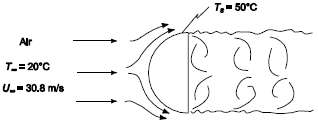
A long, half-round cylinder is placed in an air stream with its flat face down-stream. An electrical resistance heater inside the cylinder maintains the cylinder surface temperature at 50?C. The cylinder diameter is 5 cm, the air velocity is 31.8 m/s, and the air temperature is 20?C. Determine the
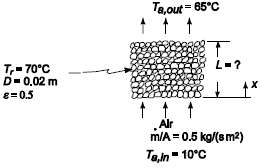
One method of storing solar energy for use during cloudy days, or at night, is to store it in the form of sensible heat in a rock bed. Suppose such a rock bed has been heated to 70?C and it is desired to heat a stream of air by blowing it through the bed. If the air inlet temperature is 10?C and
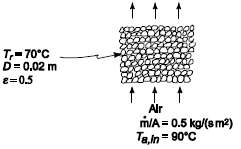
Suppose the rock bed in Problem 7.37 has been completely discharged and the entire bed is at 10?C. Hot air at 90?C and 0.2 m/s is then used to recharge the bed. How long will it take until the first rocks are back up to 70?C and what is the total heat transfer from the air to the bed?From Problem
An automotive catalytic convertor is a packed bed in which a platinum catalyst is coated on the surface of small alumina spheres. A metal container holds the catalyst pellets and allows engine exhaust gases to flow through the bed of pellets. The catalyst must be heated by the exhaust gases to
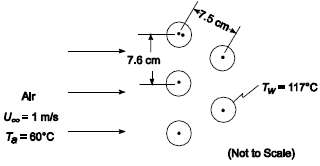
Determine the average heat transfer coefficient for air at 60?C flowing at a velocity of 1 m/s over a bank of 6-cm-OD tubes arranged as shown in the accompanying sketch. The tube-wall temperature is 117?C.GIVENAir flow through the tube bank shownAir temperature (Ta) = 60?CAir velocity (Us) = 1
Repeat Problem 7.40 for a tube bank in which all of the tubes are spaced with their centerlines 7.5 cm apart.From Problem 7.40: Determine the average heat transfer coefficient for air at 60?C flowing at a velocity of 1 m/s over a bank of 6-cm-OD tubes. The tubewall temperature is 117?C.GIVENAir
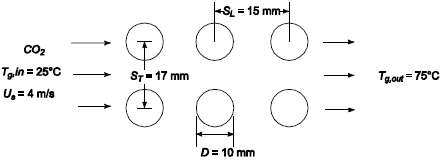
Carbon dioxide gas at 1 atmosphere pressure it to be heated from 25?C to 75?C by pumping it through a tube bank at a velocity of 4 m/s. The tubes are heated by steam condensing within them at 200?C. The tubes are 10 mm outside diameter, are in an in??line arrangement, have a longitudinal spacing of
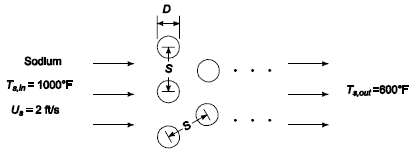
Estimate the heat transfer coefficient for liquid sodium at 1000?F flowing over a 10-row staggered-tube bank of 1 inch diameter tubes arranged in an equilateral-triangular array with a 1.5 pitch-to-diameter ratio. The entering velocity is 2 ft/s, based on the area of the shell, and the tube surface
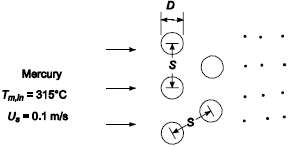
Liquid mercury at a temperature of 315?C flows at a velocity of 10 cm/s over a staggered bank of 5/8-in. 16 BWG stainless steel tubes, arranged in an equilateral triangular array with a pitch-to-diameter ratio of 1.375. If water at 2 atm pressure is being evaporated inside the tubes, estimate the
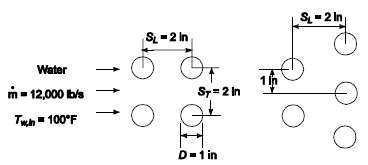
Compare the rate of heat transfer and the pressure drop for an in-line and a staggered arrangement of a tube bank consisting of 300 tubes, 6 ft long and 1 in. OD. The tubes are to be arranged in 15 rows with longitudinal and transverse spacing of 2 in. The tube surface temperature is 200?F and
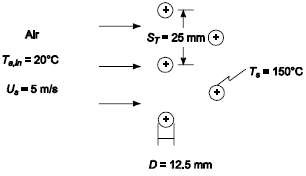
Consider a heat exchanger consisting of 12.5 mm outside diameter copper tubes in a staggered arrangement with transverse spacing 25 mm, longitudinal spacing 30 mm, and 9 tubes in the longitudinal direction. Condensing steam at 150?C flows inside the tubes. The heat exchanger is used to heat a
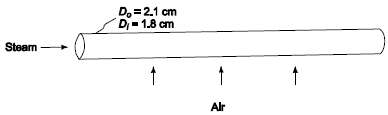
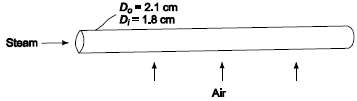
In a heat exchanger, air flows over brass tubes of 1.8 cm ID and 2.1 cm OD that contain steam. The convective heat-transfer coefficients on the air and steam sides of the tubes are 70 W/(m2 K) and 210 W/(m2 K), respectively. Calculate the overall heat transfer coefficient for the heat exchanger (a)
Repeat Problem 8.1 but assume that a fouling factor on the inside of the tube of 0.00018 (m2 K)/W has developed during operation.From Problem 8.1: In a heat exchanger, air flows over brass tubes of 1.8 cm ID and 2.1 cm OD that contain steam. The convective heat-transfer coefficients on the air and
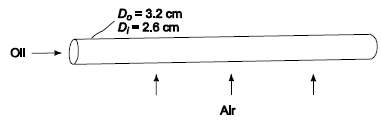
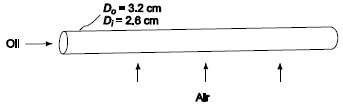
A light oil flows through a copper tube of 2.6 cm ID and 3.2 cm OD. Air is flowing over the exterior of the tube. The convection heat transfer coefficient for the oil is 120 W/(m2 K) and for the air is 35 W/(m2 K). Calculate the overall heat transfer coefficient based on the outside area of the
Repeat Problem 8.3, but assume that fouling factor of 0.0009 (m2 K)/W on the inside and 0.0004 (m2 K)/W on the outside respectively have developed.From Problem 8.3: A light oil flows through a copper tube of 2.6 cm ID and 3.2 cm OD. Air is flowing over the exterior of the tube. The convection heat
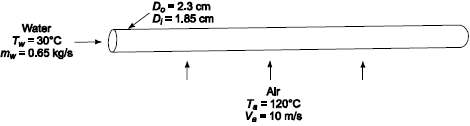
Water flowing in a long aluminum tube is to be heated by air flowing perpendicular to the exterior of the tube. The ID of the tube is 1.85 cm and its OD is 2.3 cm. The mass flow rate of the water through the tube is 0.65 kg/s and the temperature of the water in the tube averages 30?C. The free
Hot water is used to heat air in a double pipe heat exchanger. If the heat transfer coefficients on the water side and on the air side are 100 Btu/(h ft2 ?F) and 10 Btu/(h ft2 ?F), respectively, calculate the overall heat transfer coefficient based on the outer diameter. The heat exchanger pipe is
Repeat Problem 8.6, but assume that a fouling factor of 0.001 (hr °F ft2)/Btu based on the tube outside diameter has developed over time.From Problem 8.6: Hot water is used to heat air in a double pipe heat exchanger. If the heat transfer coefficients on the water side and on the air side are 100
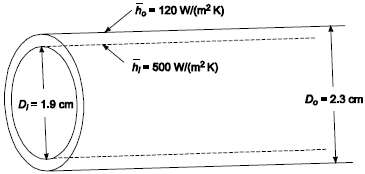
The heat transfer coefficient on the inside of a copper tube (1.9 cm ID and 2.3 cm OD) is 500 W/(m2 K) and 120 W/(m2 K) on the outside, but a deposit with a fouling factor of 0.009 (m2 K)/W (based on the tube outside diameter) has built up over time. Estimate the percent increase in the overall
In a shell-and-tube heat exchanger with hi = ho = 5600 W/(m2 K) and negligible wall resistance, by what percent would the overall heat transfer coefficient (based on the outside area) change if the number of tubes was doubled? The tubes have an outside diameter of 2.5 cm and a tube wall thickness
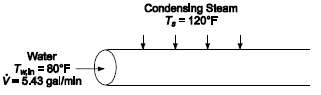
Water at 80°F enters a No. 18 BWG 5/8 in. condenser tube made of nickel chromium steel (k = 15 Btu/(h ft2 ∞F)) at a rate of 5.43 gpm. The tube is 10 ft long and its outside is heated by steam condensing at 120°F. Under these conditions, the average heat-transfer coefficient on the water side is
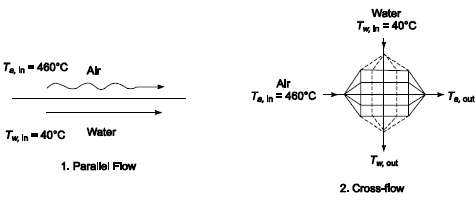
Water is heated by hot air in a heat exchanger. The flow rate of the water is 12 kg/s and that of the air is 2 kg/s. The water enters at 40?C and the air enters at 460?C. The overall heat transfer coefficient of the heat exchanger is 275 W/(m2 K) based on a surface area of 14 m2. Determine the
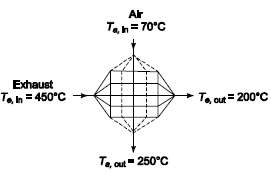
Exhaust gases from a power plant are used to preheat air in a cross-flow heat exchanger. The exhaust gases enter the heat exchanger at 450?C and leave at 200?C. The air enters the heat exchanger at 70?C, leaves at 250?C, and has a mass flow rate of 10 kg/s. Assume the properties of the exhaust
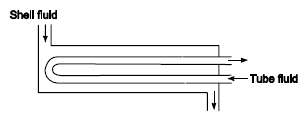
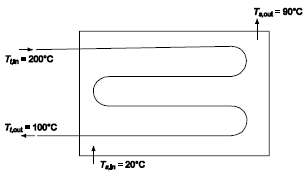
A shell-and-tube heat exchanger has one shell pass and four tube passes. The fluid in the tubes enters at 200?C and leaves at 100?C. The temperature of the fluid entering the shell is 20?C and is 90?C as it leaves the shell. The overall heat transfer coefficient based on the surface area of 12 m2
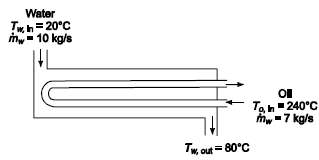
Oil (cp = 2.1 kJ/(kg K)) is used to heat water in a shell and tubeheat exchanger with a single shell and two tube passes. The overall heat transfer coefficient is 525 W/(m2 K). The mass flow rates are 7 kg/s for the oil and 10 kg/s for the water. The oil and water enter the heat exchanger at 240?C
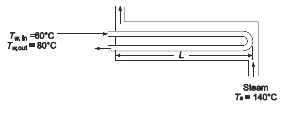
Heat water by condensing steam in the shell. The flow rate of the water is 15 kg/s and it is heated from 60 to 80°C. The steam condenses at 140°C and the overall heat transfer coefficient of the heat exchanger is 820 W/(m2 K). If there are 45 tubes with an OD of 2.75 cm, calculate the length of
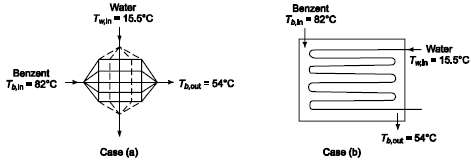
Benzene flowing at 12.5 kg/s is to be cooled continuously from 80?C to 54?C by 10 kg/s of water available at 15.5?C. Using Table 8.5, estimate the surface area required for(a) Cross-flow with six tube passes and one shell pass with neither of the fluids mixed and(b) A counterflow exchanger with one
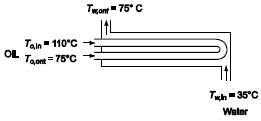
Water entering a shell-and-tube heat exchanger at 35?C is to be heated to 75?C by an oil. The oil enters at 110?C and leaves at 75?C. The heat exchanger is arranged for counterflow with the water making one shell pass and the oil two tube passes. If the water flow rate is 68 kg per minute and the
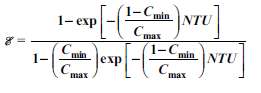
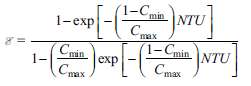
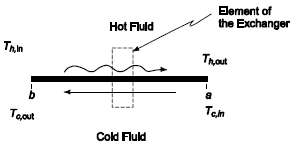
Starting with a heat balance, show that the effectiveness for a counterflow arrangement is GIVENCounterflow heat exchanger ASSUMPTIONSHeat loss to surroundings innegligible
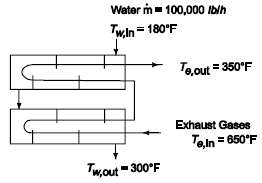
In a tubular heat exchanger with two shell passes and eight tube passes, 100,000 lb/h of water are heated in the shell from 180 to 300?F. Hot exhaust gases having roughly the same physical properties as air enter the tubes at 650?F and leave at 350?F. The total surface, based on the outer tube
In gas turbine recuperators, the exhaust gases are used to heat the incoming air and Cmin/Cmax is therefore approximately equal to unity. Show that for this casee = NTU/(1 + NTU) for counterflow and e = 1/2 (1 ?? e?? 2NTU) for parallel flow.GIVENGas turbine recuperatorCmin /Cmax ??1
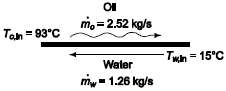
In a single-pass counterflow heat exchanger, 4536 kg/h of water enter at 15?C and cool 9071 kg/h of an oil having a specific heat of 2093 J/(kg ?C) from 93 to 65?C. If the overall heat transfer coefficient is 284 W/(m2 ?C), determine the surface area required.GIVENOil and water in a single-pass
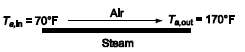
A steam-heated single-pass tubular preheater is designed to raise 45,000 lb/h of air from 70 to 170?F, using saturated steam at 375 psia. It is proposed to double the flow rate of air and, in order to be able to use the same heat exchanger and achieve the desired temperature rise, it is proposed to
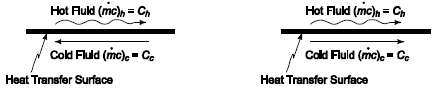
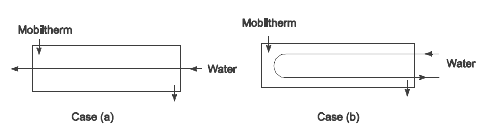
A heat exchanger performs as shown below in the Figure A for safety reasons. An engineer suggests that it would be wise to double the heat transfer area so as to double the heat transfer rate. The suggestion is made to add a second, identical exchanger as shown in Figure B. Evaluate this
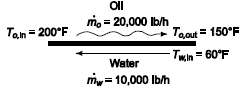
In a single-pass counterflow heat exchanger, 10,000 lb/hr of water enter at 60?F and cool 20,000 lb/h of an oil having a specific heat of 0.50 Btu/(lb ?F) from 200?F to 150?F. If the overall heat transfer coefficient is 50 Btu/(h ft2 ?F), determine the surface area required.GIVENWater cooling oil
Determine the outlet temperature of oil in Problem 8.24 for the same initial temperatures of the fluids if the flow arrangement is one shell pass and two tube passes, but with the same total area and average overall heat transfer coefficient as the unit inProblem 8.24. From Problem 8.24: In a heat
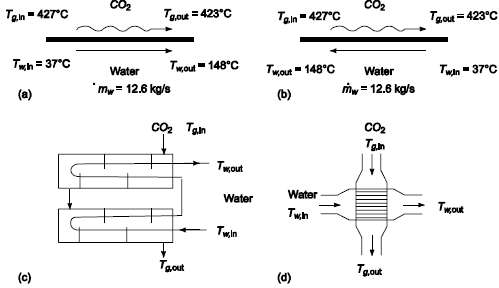
Carbon dioxide at 427?C is to be used to heat 12.6 kg/s of pressurized water from 37?C to 148?C while the gas temperature drops 204?C. For an overall heat transfer coefficient of 57 W/(m2 K), compute the required area of the exchanger in square feet for(a) Parallel flow,(b) Counterflow,(c) A 2-4
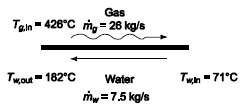
An economizer is to be purchased for a power plant. The unit is to be large enough to heat 7.5 kg/s of pressurized water from 71 to 182?C. There are 26 kg/s of flue gases (cp = 1000 J/(kg K)) available at 426?C. Estimate(a) The outlet temperature of the flue gases,(b) The heat transfer area
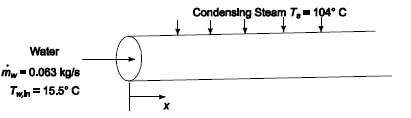
Water is heated while flowing through a pipe by steam condensing on the outside of the pipe.(a) Assuming a uniform overall heat transfer coefficient along the pipe, derive an expression for the water temperature as a function of distance from the entrance.(b) For an overall heat transfer
At a rate of 5.43 gpm, water at 80?F enters a No. 18 BWG 5/8-in a condenser tube made of nickel chromium steel (k = 15 Btu/(h ft ?F)) . The tube is 10 ft long and its outside is heated by steam condensing at 120?F. Under these conditions, the average heat transfer coefficient on the water side is
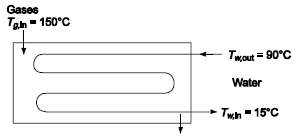
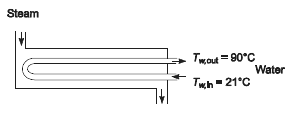
It is proposed to preheat the water for a boiler with flue gases from the boiler stack. The flue gases are available at 150?C, at the rate of 0.25 kg/s and specific heat of 1000 J/(kg K). The water entering the exchanger at 15?C at the rate of 0.05 kg/s is to be heated at 90?C. The heat exchanger
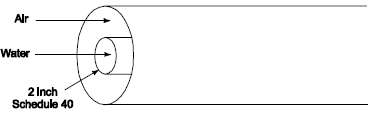
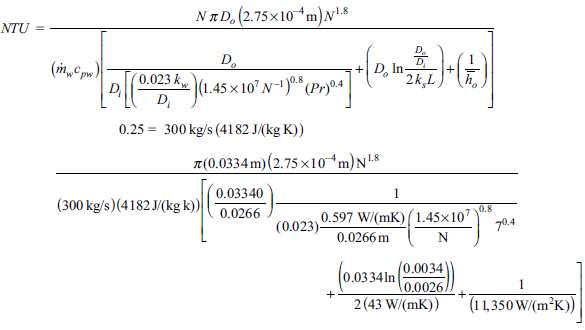
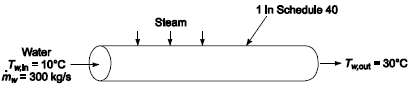
Water is to be heater from 10 to 30?C, at the rate of 300 kg/s by atmospheric pressure steam in a single-pass shell-and-tube heat exchanger consisting of 1-in schedule 40 steel pipe. The surface coefficient on the steam side is estimated to be 11,350 W/(m2 K). A pump is available which can deliver
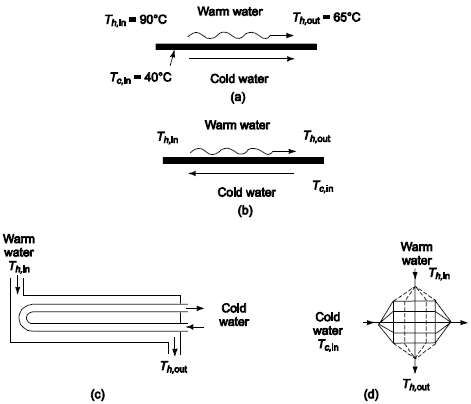
Water flowing at a rate of 12.6 kg/s is to be cooled from 90 to 65?C by means of an equal flow rate of cold water entering at 40?C. The water velocity with the such that the overall coefficient of heat transfer U is 2300 W/(m2 K). Calculate the square meters of heat-exchanger surface needed for
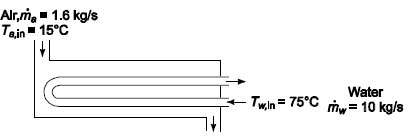
Water flowing at a rate of 10 kg/s through 50 double-pass tubes in a shell and tube heat exchanger heats air that flows through the shell side. The length of the brass tubes is 6.7 m and they have an outside diameter of 2.6 cm and an inside diameter of 2.3 cm. The heat transfer coefficient of the
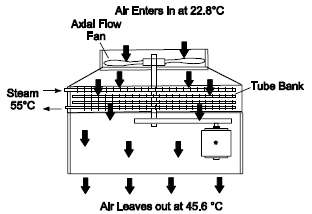
An air-cooled low-pressure-steam condenser is shown below. The tube bank is four rows deep in the direction of air flow. There are 80 tubes total. The tubes have ID = 2.2 cm and OD 2.5 cm and are 9 m long. The tubes have circular fins on the outside. The tube-plus-fin area is 16 times the bare
Design (i.e., determine the overall area and a suitable arrangement of shell and tube passes) for a tubular-feed water heater capable of heating 2,300 kg/h of water from 21 to 90°C. The following specification are given (a) Saturated steam at 920 kPa absolute pressure is condensing on the
Two engineers are having an argument about the efficiency of a tube-side multipass heat exchanger compared to a similar exchanger with a single tube-side pass. Mr. Smith claims that for a given number of tubes are rate of heat transfer, more area is required in a two-pass exchanger than in a
Showing 12500 - 12600
of 18200
First
119
120
121
122
123
124
125
126
127
128
129
130
131
132
133
Last
Step by Step Answers

 Get 50% OFF
Claim Now
Get 50% OFF
Claim Now