New Semester
Started
Get
50% OFF
Study Help!
--h --m --s
Claim Now
Question Answers
Textbooks
Find textbooks, questions and answers
Oops, something went wrong!
Change your search query and then try again
S
Books
FREE
Study Help
Expert Questions
Accounting
General Management
Mathematics
Finance
Organizational Behaviour
Law
Physics
Operating System
Management Leadership
Sociology
Programming
Marketing
Database
Computer Network
Economics
Textbooks Solutions
Accounting
Managerial Accounting
Management Leadership
Cost Accounting
Statistics
Business Law
Corporate Finance
Finance
Economics
Auditing
Tutors
Online Tutors
Find a Tutor
Hire a Tutor
Become a Tutor
AI Tutor
AI Study Planner
NEW
Sell Books
Search
Search
Sign In
Register
study help
physics
electricity and magnetism
College Physics 7th Edition Raymond A. Serway, Jerry S. Faughn, Chris Vuille, Charles A. Bennett - Solutions
A sinusoidal electromagnetic wave is propagating in a vacuum in the + z-direction. If at a particular instant and at a certain point in space the electric field is in the +x-direction and bas magnitude 4.00 V/m, what are the magnitude and direction of the magnetic field of the wave at this same
(a) Show that in the Bohr model, the frequency of revolution of an electron in its circular orbit around a stationary hydrogen nucleus is f = me4/4ε02n3h3. (b) In classical physics, the frequency of revolution of the electron is equal to the frequency of the radiation that it emits. Show that
Testing a Space Radio Transmitter you are a NASA mission specialist on your first flight aboard the space shuttle. Thanks to your extensive training in physics, you have been assigned to evaluate the performance of a new radio transmitter on board the International Space Station (ISS). Perched on
The intensity of a cylindrical laser beam is 0.800 W/m2. The cross-sectional area of the beam is 3.0 x 10⁻⁴ m2 and the intensity is uniform across the cross section of the beam. (a) What is the average power output of the laser? (b) What is the rms value of the electric field in the beam?
A space probe 2.0 X 10¹⁰ m from a star measures the total intensity of electromagnetic radiation from the star to be 5.0 x 10³ W/m2. If the star radiates uniformly in all directions, what is its total average power output?
A sinusoidal electromagnetic wave emitted by a cellular phone has a wavelength of 35A cm and an electric-field amplitude of 5.40 x 10⁻² V/m at a distance of 250 m from the antenna. Calculate(a) The frequency of the wave; (b) The magnetic-field amplitude;(c) The intensity of the wave.
A monochromatic light source with power output 60.0 W radiates light of wavelength 700 nm uniformly in all directions. Calculate Emax and Bmax for the 700-nm light at a distance of 5.00 m from the source.
For the electromagnetic wave represented by Eq. (32.19), show that the Poynting vector (a) Is in the same direction as the propagation of the wave and (b) Has average magnitude given by Eqs. (32.29).
An intense light source radiates uniformly in all directions. At a distance of 5.0 m from the source, the radiation pressure on a perfectly absorbing surface is 9.0 x 10⁻⁶ Pa. What is the total average power output of the source?
Television Broadcasting, Public television station KQED in San Francisco broadcasts a sinusoidal radio signal at a power of 316 kW. Assume that the wave spreads out uniformly into a hemisphere above the ground. At a home 5.00 km away from the antenna, (a) What average pressure does this wave exert
If the intensity of direct sunlight at a point on the earth's surface is 0.78kW/m2, find (a) The average momentum density (momentum per unit volume) in the sunlight and (b) The average momentum flow rate in the sunlight.
In the 25-ft Space Simulator facility at NASA's Jet Propulsion Laboratory, a bank of overhead arc lamps can produce light of intensity 2500 W 1m' at the floor of the facility. (This simulates the intensity of sunlight near the planet Venus.) Find the average radiation pressure (in Pascals and in
Verify that all the expressions in Eqs. (32.27) are equivalent to Eq. (32.26).
An electromagnetic standing wave in air of frequency 750 MHz is set up between two conducting planes 80.0 cm apart. At which positions between the planes could a point charge be placed at rest so that it would remain at rest? Explain.
A standing electromagnetic wave in a certain material has frequency 2.20 x 10¹⁰ Hz. The nodal planes of B are 3.55 mm apart. Find (a) The wavelength of the wave in this material; (b) The distance between adjacent nodal planes of the E field; (c) The speed of propagation of the wave.
An electromagnetic standing wave in air has frequency 75.0 MHz. (a) What is the distance between nodal planes of the E field? (b) What is the distance between a nodal plane of E and the closest nodal plane of B?
An electromagnetic standing wave in a certain material has frequency 1.20 x 10¹⁰ Hz and speed of propagation 210 x 108 m/s.(a) What is the distance between a nodal plane of B and the closest anti-nodal plane of B? (b) What is the distance between an anti-nodal plane of E and the closest anti-nodal
Show that the electric and magnetic fields for standing waves given by Eqs. (3234) and (32.35) (a) Satisfy the wave equation, Eq. (32.15), and (b) Satisfy Eqs. (32.12) and (32.14)
Microwave Oven, the microwaves in a certain microwave oven have a wavelength of 12.2cm. (a) How wide must this oven be so that it will contain five anti-nodal planes of the electric field along its width in the standing wave pattern? (b) What is the frequency of these microwaves? (c) Suppose a
Consider a sinusoidal electromagnetic wave with fields E = Emax j sin (kx – wt) and B = Bmax k sin (kx – wt + Ф), with – π < Ф < π. Show that if E and B are to satisfy Eqs. (32.12) and (32.14), then Emax = cBmax and Ф = 0. (The result Ф = 0 means the E and B
Show that the magnetic field Bz(x, t) in a plane electromagnetic wave propagating in the + x-direction must satisfy Eq. (32.15).
For a sinusoidal electromagnetic wave in vacuum, such as that described by Eq. (32.16), show that the average energy density in the electric field is the same as that in the magnetic field
A satellite 575 km above the earth's surface transmits sinusoidal electromagnetic waves of frequency 92.4 MHz uniformly in all directions, with a power of 25.0 kW. (a) What is the intensity of these waves as they reach a receiver at the surface of the earth directly below the satellite? (b) What
A plane sinusoidal electromagnetic wave in air has a wavelength of 3.84 cm and an E-field amplitude of 1.35 V/m. (a) What is the frequency? (b) What is the B-field amplitude? (c) What is the intensity? (d) What average force does this radiation exert on a totally absorbing surface with area 0.240
A small helium-neon laser emits red visible light with a power of 3.20mW in a beam that has a diameter of 2.50 mm.(a) What are the amplitudes of the electric and magnetic fields of the light? (b) What is the average energy densities associated with the electric field and with the magnetic field?
Consider a plane electromagnetic wave such as that shown in Fig. 325, but in which E and B also have components in the x-direction (along the direction of wave propagation). Use Gauss's law for electric and magnetic fields to show that the components E. and B. must both be equal to zero so that the
The sun emits energy in the form of electromagnetic waves at a rate of 3.9 x 1026 W. This energy is produced by nuclear reactions deep in the sun's interior. (a) Find the intensity of electromagnetic radiation and the radiation pressure on an absorbing object at the surface of the sun (radius r = R
It bas been proposed to place solar-power-collecting satellites in earth orbit. The power they collect would be beamed down to the earth as microwave radiation. For a microwave beam with a cross-sectional area of 36.0 m2 and a total power of 2.80 kW at the earth's surface, what is the amplitude of
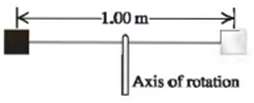
Two square reflectors, each 1.50 cm on a side and of mass 4.00 g, are located at opposite ends of a thin, extremely light, 1.00-m rod that can rotate without friction and in a vacuum about an axle pe1JlCndicular to it through its center (Fig. 32.24). These reflectors are small enough to be treated
The plane of a that surface is perpendicular to the propagation direction of an electromagnetic wave of intensity 1. The surface absorbs a fraction w of the incident intensity, where 0 < w < 1, and reflects the rest. (a) Show that the radiation pressure on the surface equals (2 - w) I/c. (b) Show
A cylindrical conductor with a circular cross section bas a radius a and a resistivity p and carries a constant current. (a) What arc the magnitude and direction of the electric-field vector E at a point just inside the wire at a distance a from the axis? (b) What are the magnitude and direction of
A source of sinusoidal electromagnetic waves radiates uniformly in all directions. At 10.0 m from this source, the amplitude of the electric field is measured to be 1.50 N/C. What is the electric field amplitude at a distance of 20.0 cm from the source?
A circular loop of wire can be used as a radio antenna. If a 18.0-cm-diameter antenna is located 2.50 km from a 95.0-MHz source with a total power of 55.0 kW, what is the maximum emf induced in the loop? (Assume that the plane of the antenna loop is perpendicular to the direction of the radiation's
In a certain experiment, a radio transmitter emits sinusoidal electromagnetic waves of frequency 110.0 MHz in opposite directions inside a narrow cavity with reflectors at both ends, causing a standing wave pattern to occur. (a) How far apart are the nodal planes of the magnetic field? (b) If the
Flashlight to the Rescue, you are the sole crew member of the interplanetary spaceship T: 1339 Vorga, which makes regular cargo runs between the earth and the mining colonies in the asteroid belt You are working outside the ship one day while at a distance of 2.0 AU from the sun. [1 AU
The 19th-century inventor Nikola Tesla proposed to transmit electric power via sinusoidal electromagnetic waves. Suppose power is to be transmitted in a beam of cross-sectional area 100 m2. What electric- and magnetic-field amplitudes are required to transmit an amount of power comparable to that
Global Positioning System (GPS) The GPS network consists of 24 satellites, each of which makes two orbits around the earth per day. Each satellite transmits a 50.0-W (or even less) sinusoidal e1ectromagneti.c signal at two frequencies, one of which is 1575.42 MHz. Assume that a satellite transmits
NASA is giving serious consideration to the concept of solar sailing. A solar sail craft uses a large, low-mass sail and the energy and momentum of sunlight for propulsion. (a) Should the sail be absorbing or reflective? Why? (b) The tota1 power output of the sun is 3.9 x 1026 W. How large a sail
Interplanetary space contains many small particles referred to as interplanetary dust. Radiation pressure from the sun sets a lower limit on the size of such dust particles. To see the origin of this limit, consider a spherical dust particle of radius R and mass density p. (a) Write an expression
The Classical Hydrogen Atom The electron in a hydrogen atom can be considered to be in a circular orbit with a radius of 0.0529 nm and a kinetic energy of 13.6 eV. If the electron behaved classically, how much energy would it radiate per second (see Challenge Problem 32.57)? What does this tell you
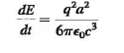
Electromagnetic radiation is emitted by accelerating charges. The rate at which energy is emitted from an accelerating charge that has charge q and acceleration a is given by where c is the speed of light.(a) Verify that this equation is dimensionally correct.(b) If a proton with a kinetic energy
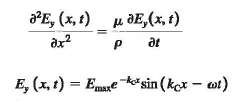
Electromagnetic waves propagate much differently in conductors than they do in dielectrics or in vacuum. If the resistivity of the conductor is sufficiently low (that is, if it is a sufficiently good conductor), the oscillating electric field of the wave gives rise to an oscillating conduction
The plate on the back nf a certain computer scanner says that the unit draws 0.34 A of current from a 120-V, 60-Hz line. Find(a) The root-mean-square current, (b) The current amplitude, (c) the average current; (d) the average square of the current.
A sinusoidal current i = 1cos wt has an rms value Irms = 2.10 A. (a) What is the current amplitude? (b) The current is passed through a full-wave rectifier circuit. What is the rectified average current? (c) Which is larger: Irms or Irav? Explain, using graphs of i2 and of the rectified current.
The voltage across the terminals of an ac power supply vaties with time according to Eq. (31.1). The voltage amplitude is V = 45.0 V. What are (a) The root-mean.,.quare potential difference Vrms,? and (b) The average potential difference Vav between the two terminals of the power supply?
A 2.20-µF capacitor is connected across an ac source whose voltage amplitude is kept constant at 60.0 V but whose frequency can be varied. Find the current amplitude when the angular frequency is (a) 100 rad/s; (b) 1000 rad/s; (c) 10,000 rad/s. (d) Show the results of parts (a) through (c) in a
A 5.00-H inductor with negligible resistance is connected across the ac source of Exercise 31.4. Find the current amplitude when the angular frequency is (a) 100 rad/s; (b) 1000 rad/s;(c) 10,000 rad/s. (d) Show the results of parts (a) through (c) in a plot of log I versus log w.
A capacitance C and an inductance L are operated at the same angular frequency. (a) At what angular frequency will they have the same reactance? (b) If L = 5.00mH and C = 3.50µF, what is the numerical value of the angular frequency in part (a), and what is the reactance of each element?
In each circuit described next, an ac voltage source producing a current i = I cos wt is connected to an additional circuit element.(a) The ac source is connected across a resistor R. Sketch graphs of the current in the circuit and the potential difference across the resistor as functions of time,
(a) Compute the reactance of a 0.450-H inductor at frequencies of 60.0 Hz and 600 Hz. (b) Compute the reactance of a 2.50-µF capacitor at the same frequencies. (c) At what frequency is the reactance of a 0.450-H inductor equal to that of a 2.50-µF capacitor?
(a) What is the reactance of a 3.oo-H inductor at a frequency of 50.0 Hz? (b) What is the inductance of an inductor whose reactance is 120 Ω at 50.0 Hz? (c) What is the reactance of a 4.00-µF capacitor at a frequency of 80.0 Hz? (d) What is the capacitance of a capacitor whose
A Radio Inductor. You want the current amplitude through a 0.450-mH inductor (pan of the circuitry for a radio receiver) to be 2.60 rnA when a sinusoidal voltage with amplitude 12.0 V is applied across the inductor. What frequency is required?
Kitchen Capacitance. The wiring for a refrigerator contains a starter capacitor. A voltage of amplitude 170 V and frequency 60.0 Hz applied across the capacitor is to produce a currentamplitude of 0.850 A through the capacitor. What capacitance C is required?
A 250- Ω resistor is connected in series with a 4.80-µF capacitor. The voltage across the capacitor is Vc = (7.60V) sin [(120 rad/s)t]. (a) Determine the capacitive reactance of the capacitor. (b) Derive an expression for the voltage vR across the resistor.
A 150- Ω resistor is connected in series with a 0.250-H inductor. The voltage across the resistor is vR = (3.80 V) cos [(720 rad/s)t]. (a) Derive an expression for the circuit current. (b) Determine the inductive reactance of the inductor. (c) Derive an expression for the voltage v L
You have a 200-Ω resistor, a 0.400-H inductor, and a 6.00-µF capacitor. Suppose you take the resistor and inductor and make a series circuit with a voltage source that has voltage amplitude 30.0 V and an angular frequency of 250 rad/s. (a) What is the impedance of the circuit? (b) What
(a) For the R-L circuit of Exercise 31.14, graph v, vR' and vL versus t for t = 0 to t = 50.0 ms. The current is given by i = Icos wt, so v = Vcos(wt + φ). (b) What are v, VR' and VL at t = 20.0 ms? Compare VR + VL to v at this instant. (c) Repeat part (b) for t = 40.0 ms.
Repeat Exercise 31.14 with the circuit consisting of only the capacitor and the inductor in series. For part (c), calculate the voltage amplitudes across the capacitor and across the inductor.
Repeat Exercise 31.14 with the circuit consisting of only the resistor and the capacitor in series. For part (c), calculate the voltage amplitudes across the resistor and across the capacitor.
(a) For the R-C circuit of Exercise 31.17, grapb v, vR, and vC versus t for t = 0 to t = 50.0 ms. The current is given by i = Icoswt, so v = Vcos(wt + φ). (b) What are v, vR, and vC at t = 20.0 ms? Compare vR + vC to v at this instant. (c) Repeat pan (b) for t = 40.0 ms.
The resistor, inductor, capacitor, and voltage source described in Exercise 31.14 are connected to form an L-R-C series circuit. (a) What is the impedance of the circuit? (b) What is the current amplitude? (c) What is the phase angle of the source voltage with respect to the current? Does the
(a) For the L-R-C circuit of Exercise 31.19, graph v, vR, vL, and vC versus t for t = 0 to t = 50.0 ms. The current is given byi = lcoswt, so V = Vcos(wt + φ). (b) What are v, vR, vL,and vC at t = 20.0 ms? Compare vR + vL + vC to v at this instant. (c) Repeat pan (b) for t = 40.0 ms.
Analyzing an L-R-C Circuit. You have a 200- Ω resistor, a 0.400-H inductor, a 5.00-μF capacitor, and a variable-frequency ac source with an amplitude of 3.00 V. You connect all four elements together to form a series circuit. (a) At what frequency will the current in the circuit be
(b) At the angular frequency in part (a), what is the maximum current through the inductor?
In an L-R-C series circuit, the rms voltage across the resistor is 30.0 V, across the capacitor it is 90.0 V, and across the inductor it is 50.0 V. What is the rms voltage of the source?
Define the reactance X of an L-R-C circuit to be X = XL – Xc. (a) Show that X = 0 when the angular frequency w of the current is equal to the resonance angular frequency w0. (b) What is the sign of X when w > w0? (c) What is the sign of X when w < wo? (d) Graph X versus w.
The power of a certain CD player operating at 120 V rms is 20.0 W. Assuming that the CD player behaves like a pure resistance, find (a) The maximum instantaneous power; (b) The rms current;(c) The resistance of this player.
In a series L-R-C circuit, the components have the following values: L = 20.0mH, C = 140nF, and R = 350Ω. The generator has an rms voltage of 120 V and a frequency of 1.25 kHz. Determine (a) The power supplied by the generator; and (b) The power dissipated in the resistor.
(a) Show that for an L-R-C series circuit the power factor is equal to R/Z. (b) Show that for any ac circuit, not just one containing pure resistance only, the average power delivered by the voltage source is given by Pav = Irms2R.
An L-R-C series circuit is connected to a 120-Hz ac source that has Vrms = 80.0 V. The circuit has a resistance of 75.0Ω and an impedance at this frequency of 105Ω. What average power is delivered to the circuit by the source?
An L-R-C series circuit with L = 0.120 H, R = 240 Ω, and C = 7.30 μF carries an rms current of OA50 A with a frequency of 400 Hz. (a) What are the phase angle and power factor for this circuit?(b) What is the impedance of the circuit? (c) What is the rms voltage of the source? (d)
A series ac circuit contains a 250- Ω resistor, a 15-mH inductor, a 3.5-μF capacitor and an ac power source of voltage amplitude 45 V operating at an angular frequency of 360rad/s, (a) What is the power factor of this circuit? (b) Find the average power delivered to the entire
In an L-R-C series circuit, R = 300Ω, L = 0.400 H, and C = 6.00 X 10⁻⁸ F. When the ac source operates at the resonance frequency of the circuit, the current amplitude is 0.500 A. (a) What is the voltage amplitude of the source? (b) What is the amplitode of the voltage across the resistor,
An L-R.C series circuit consists of a source with voltage amplitude 120 V and angular frequency 50.0 radls, a resistor with R = 400 Ω an inductor with L = 9.00 H, and a capacitor with capacitance C. (a) For what value of C will the current amplitude in the circuit be a maximum? (b) When C
(d) What average power is delivered by the source? (e) What is the average rate at which electrical energy is converted to thermal energy in the resistor? (f) What is the average rate at which electrical energy is dissipated (converted to other forms) in the capacitor? (g) In the inductor?
In an L-R-C series circuit, R = 400 Ω, L = 0.350 H, and C = 0.0120μF. (a) What is the resonance angular frequency of the circuit? (b) The capacitor can withstand a peak voltage of 550 V. If the voltage source operates at the resonance frequency, what maximwn voltage amplimde can it
A series circuit consists of an ac source of variable frequency, a 115- Ω resistor, a 1.25-μF capacitor, and a 4.50-mH inductor. Find the impedance of this circuit wben the angular frequency of the ac source is adjusted to (a) The resonance angular frequency; (b) Twice the resonance
In an L-R-C series circuit, L = 0.280 H and C = 4.00μF. The voltage amplitude of the source is 120 V. (a) What is the resonance angular frequency of the circuit? (b) When the source operates at the resonance angular frequency, the current amplitude in the circuit is 1.70 A. What is the
A Step-Down Transformer A transformer connected to a 120-V (rms) ac line is to supply 12.0 V (rms) to a portable electronic device. The load resistance in the secondary is 5.00 Ω. (a) What should the ratio of primary to secondary turns of the transformer be? (b) What rms current must the
A Step-Up Transformer A transformer connected to a 120-V (rms) ac line is to supply 13,000 V (rms) for a neon sign. To reduce shock hazard, a fuse is to be inserted in the primary circuit; the fuse is to blow when the rms current in the secondary circuit exceeds 8.50rnA. (a) What is the ratio of
Off to Europe! You plan to take your hair blower to Europe, where the electrical outlets puts out 240 V instead of the 120 V seen in the United States. The blower puts out 1600 W at 120 V. (a) What could you do to operate your blower via the 240-V line in Europe? (b) What current will your blower
Figure 31.12a shows the crossover network in a loudspeaker system. One branch consists of a capacitor C and a resistor R in series (the tweeter). This branch is in parallel with a second branch (the woofer) that consists of an inductor L and a resistor R in series. The same source voltage with
A coil has a resistance of 48.0 Ω. At a frequency of 80.0 Hz the voltage across the coil leads the current in it by 52.3o. Determine the inductance of the coil.
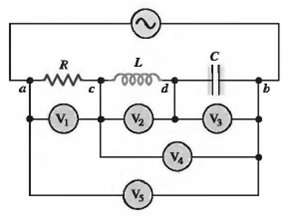
Five infinite-impedance voltmeters, calibrated to read rms values, are connected as shown in Fig 31.25. Let R = 200 ?, L = 0.400 H, C = 6.00?F, and V = 30.0 V. What is the reading of each voltmeter if(a) w = 200rad/s; and(b) w = 1000rad/s?
A sinusoidal current is given by i = I cos wt. The full-wave rectified current is shown in Fig. 31.3b. (a) Let t1 and t2 be the two smallest positive times at which the rectified current is zero. Express 11 and 12 in terms of Cd. (b) Find the area under the rectified i versus t curve between t1 and
A large electromagnetic coil is connected to a 120-Hz ac source. The coil has resistance 400 n, and at this source frequency the coil has inductive reactance 250 Ω. (a) What is the inductance of the coil? (b) What must the rms voltage of the source be if the coil is to consume an average
A series circuit has an impedance of 60.0 Ω and a power factor of 0.720 at 50.0 Hz. The source voltage lags the current. (a) What circuit element, an inductor or a capacitor, should be placed in series with the circuit to raise its power factor? (b) What size element will raise the power
A circuit consists of a resistor and a capacitor in series with an ac source that supplies an rms voltage of 240 V. At the frequency of the source the reactance of the capacitor is 50.0 Ω. The rms current in the circuit is 3.00 A. What is the average power supplied by the source?
(b) If the frequency is now doubled, but nothing else is changed, which of the quantities in part (a) willchange? Find the new values for those that do change.
At a frequency cu, the reactance of a certain capacitor equals that of a certain inductor. (a) If the frequency is changed to w2 = 2w1, what is the ratio of the reactance of the inductor to that of the capacitor? Which reactance is larger? (b) If the frequency is changed to w3 = w1/3, what is the
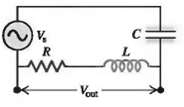
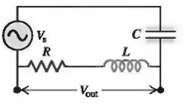
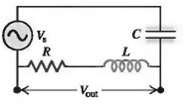
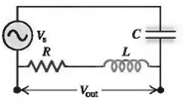
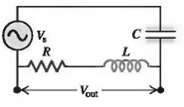
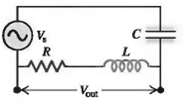
A High-Pass Filter. One application of L-R-C series circuits is to high-pass or low-pass filters, which filter out either the low- or high-frequency components of a sigual. Ahigh-pass filter is shown in Fig. 31.26, where the output voltage is taken across the L-R combination. (The L-R combination
A Low-Pass Filter. Figure 31.27 shows a low-pass filter (see Problem 31.49); the output voltage is taken across the capacitor in an L-R-C series circuit. Derive an expression for voutlvs, the ratio of the output and source voltage amplitudes, as a function of the angular frequeocy w of the source.
A Low-Pass Filter. Figure 31.27 shows a low-pass filter (see Problem 31.49); the output voltage is taken across the capacitor in an L-R-C series circuit. Derive an expression for voutlvs, the ratio of the output and source voltage amplitudes, as a function of the angular frequeocy w of the source.
A Low-Pass Filter. Figure 31.27 shows a low-pass filter (see Problem 31.49); the output voltage is taken across the capacitor in an L-R-C series circuit. Derive an expression for voutlvs, the ratio of the output and source voltage amplitudes, as a function of the angular frequeocy w of the source.
A Low-Pass Filter. Figure 31.27 shows a low-pass filter (see Problem 31.49); the output voltage is taken across the capacitor in an L-R-C series circuit. Derive an expression for voutlvs, the ratio of the output and source voltage amplitudes, as a function of the angular frequeocy w of the source.
A Low-Pass Filter. Figure 31.27 shows a low-pass filter (see Problem 31.49); the output voltage is taken across the capacitor in an L-R-C series circuit. Derive an expression for voutlvs, the ratio of the output and source voltage amplitudes, as a function of the angular frequeocy w of the source.
(c) At resonance, what is the phase angle of the source current with respect to the source voltage? How does this compare to the phase angle for an L-R-C series circuit at resonance?(d) Draw the circuit diagram for an L-R-C parallel circuit. Arrange the circuit elements in your diagram so that the
A 400-Ω resistor and a 6.00-μF capacitor are connected in parallel to an ac generator that supplies an rms voltage of 220 Vat an angular frequency of 360rad/s. Use the results of Problem 31.54. Note that since there is no inductor in the circuit, the 1/wL term is not present in the
(a) The current amplitude in the resistor; (b) The current amplitude in the capacitor;(c) The phase angle of the source current with respect to the source voltage; (d) The amplitude of the current through the generator.(e) Does the source current lag or lead the source voltage?
An L-R-C series circuit consists of a 2.50-μF capacitor, a 5.00-mH inductor, and a 75.0-Ω resistor connected across an ac source of voltage amplitude 15.0 V having variable frequency. (a) Under what circumstances is the average power delivered to the circuit equal to ½ Vrms, Irmv?
Showing 3100 - 3200
of 8940
First
25
26
27
28
29
30
31
32
33
34
35
36
37
38
39
Last
Step by Step Answers

 Get 50% OFF
Claim Now
Get 50% OFF
Claim Now