New Semester
Started
Get
50% OFF
Study Help!
--h --m --s
Claim Now
Question Answers
Textbooks
Find textbooks, questions and answers
Oops, something went wrong!
Change your search query and then try again
S
Books
FREE
Study Help
Expert Questions
Accounting
General Management
Mathematics
Finance
Organizational Behaviour
Law
Physics
Operating System
Management Leadership
Sociology
Programming
Marketing
Database
Computer Network
Economics
Textbooks Solutions
Accounting
Managerial Accounting
Management Leadership
Cost Accounting
Statistics
Business Law
Corporate Finance
Finance
Economics
Auditing
Tutors
Online Tutors
Find a Tutor
Hire a Tutor
Become a Tutor
AI Tutor
AI Study Planner
NEW
Sell Books
Search
Search
Sign In
Register
study help
physics
electricity and magnetism
Fundamentals of Physics 8th Extended edition Jearl Walker, Halliday Resnick - Solutions
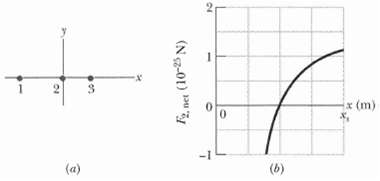
Figure (a) shows charged particles 1 and 2 that are fixed in place on an x axis. Particle t has a charge with a magnitude of |q1| = 8.00e. Particle 3 of charge q3 = + 8.00e is initially on the x axis near particle 2. Then particle 3 is gradually moved in the positive direction of the x axis. As a
Calculate the number of coulombs of positive charge in 250 cm3 of (neutral) water.
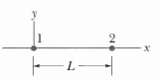
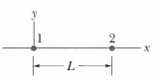
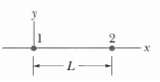
In Figure particles 1 and 2 are fixed in place on an x axis, at a separation of L = 8.00cm. Their charges are q1 = + e and q2 = ?? 27e.Particle 3 with charge q3 = + 4e is to be placed on the line between particles 1 and 2, so that they produce a net electrostatic force F3net on it.(a) At what
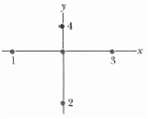
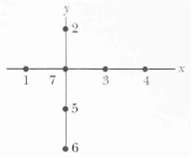
In Figure particles 2 and 4, of charge ?? e, are fixed in place on a y axis, at y2 = ?? 10.0 cm and y4 = 5.00 cm. Particles 1 and 3, of charge ?? e, can be moved along the x axis. Particle 5, of charge + e, is fixed at the origin. Initially particle 1 is at x1 = ?? 10.0 cm and particle 3 is at x3 =
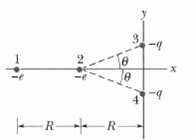
Figure shows electrons 1 and 2 on an x axis and charged ions 3 and 4 of identical charge ?? q and at identical angles ?. Electron 2 is free to move; the other three particles are fixed in place at horizontal distances R from electron 2 and are intended to hold electron2 rn place. For physically
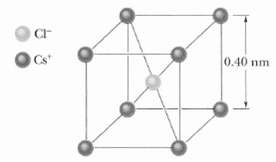
In crystals of the salt cesium chloride, cesium ions Cs+ form the eight corners of a cube and a chlorine ion Cl?? is at the cube's center (Figure). The edge length of the cube is 0.40 nm. The Cs+ ions are each deficient by one electron (and thus each has a charge of + e), and the Cl ?? ion has one
Electrons and positrons are produced by the nuclear transformations of protons and neutrons known as beta decay. (a) If a proton transforms into a neutron, is an electron or a positron produced?(b) If a neutron transforms into a proton, is an electron or a positron produced?
Identify X in the following nuclear reaction (a) 1H + 9Be → X + n; (b) 12C + 1H → X; (c) 15N + 1H → 4He + X.
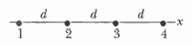
In Figure, four particles are fixed along an x axis, separated by distances d = 2.00cm. The charges are q1 = + 2e, q1 = ?? e, q3 = + e, and q4 = + 4e, with e = 1.60 x 10??19C, in unit-vector notation, what is the net electrostatic force on(a) Particle 1 and(b) Particle 2 due to the otherparticles?
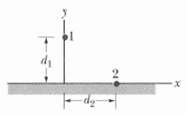
In Figure particle 1 of charge + 4e is above a floor by distance d1 = 2.00 mm and particle 2 of charge + 6e is on the floor, at distance d2 = 6.00 mm horizontally from particle 1. What is the -r component of the electrostatic force on particle 2 due to particle 1?
A particle of charge Q is fixed at the origin of an xy coordinate system. At t = 0 a particle (m = 0.800g q = 4.00?C) is located on the x axis at x = 20.0 cm, moving with a speed of 50.0 m/s in the positive y direction. For what value of Q will the moving particle execute circular motion? (Neglect
A charged non-conducting rod, with a length of 2.00 m and a cross-section al area of 4.00 cm2, lies along the positive side of an x axis with one end at the origin. The volume charge density p is charge per unit volume in coulombs per cubic meter. How many excess electrons are on the rod if p
A charge of 6.0μC is to be split into two parts that are then separated by 3.0 mm. What is the maximum possible magnitude of the electrostatic force between those two parts?
How many mega coulombs of positive charge are in 1.00 mol of neutral molecular-hydrogen gas (H2)?
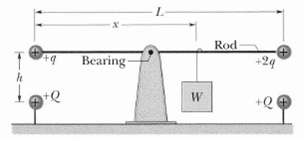
Figure shows a long, non-conducting, mass less rod of length L, pivoted at its center and balanced with a block of weight W at a distance x from the left end. At the left and right ends of the rod are attached small conducting spheres with positive charges q and 2q, respectively. A distance h
A neutron consists of one "up" quark of charge +2e/3 and two "down" quarks each having charge –e/3.If we assume that the down quarks are 2.6 x 10⁻¹⁵ m apart inside the neutron, what is the magnitude of the electrostatic force between them?
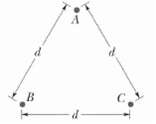
In Figure three identical conducting spheres form an equilateral triangle of side length d = 20.0 cm. The sphere radii are much smaller than d, and the sphere charges are qA = ?? 2.00nC, qB = ?? 4.00nC, and qC = + 8.00nC.(a) What is the magnitude of the electrostatic force between spheres A and C?
What would be the magnitude of the electrostatic force between two 1.00 C point charges separated by a distance of?(a) 1.00 m and (b) 1.00 km if such point charges existed (they do not) and this configuration could be set up?
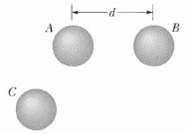
In Figure three identical conducting spheres initially have the following charges: sphere A, 4Q; sphere B, ?? 6Q; and sphere C, 0. Spheres A and B are fixed in place, with a center-to-center separation that is much larger than the spheres. Two experiments are conducted. In experiment 1, sphere C is
We know that the negative charge on the electron and the positive charge on the proton are equal. Suppose, however, that these magnitudes differ from each other by 0.00010%. With what force would two copper coins, placed 1.0 m apart, repel each other? Assume that each coin contains 3 x 10²² copper
How far apart must two protons be if the magnitude of the electrostatic force acting on either one due to the other is equal to the magnitude of the gravitational force on a proton at Earth's surf ace?
Of the charge Q on a tiny sphere, a fraction d is to be transferred to a second, nearby sphere. The spheres can be treated as particles. (a) What value of a maximizes the magnitude F of the electrostatic force between the two spheres?What are the (b) Smaller and (c) Larger values of a that put F at
If a cat repeatedly rubs against your cotton slacks on a dry day, the charge transfer between the cat hair and the cotton can leave you with an excess charge of – 2.00μC. (a) How many electrons are transferred between you and the cat? You will gradually discharge via the floor, but if
(a) What equal positive charges would have to be placed on Earth and on the Moon to neutralize their gravitational attraction? (b) Why don't you need to know the lunar distance to solve this problem? (c) How many kilograms of hydrogen ions (that is, protons) would be needed to provide the positive
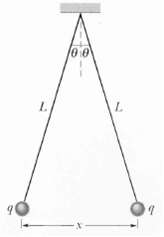
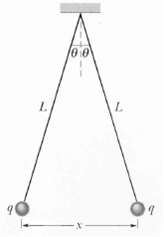
In Figure two tiny conducting balls of identical mass m and identical charge q hang from non-conducting threads of length L. Assume that θ is so small that tan θ can be replaced by its approximate equal, sin θ. (a) Show that x = (q2L/2πε0mg) 1/3 gives the equilibrium separation r of the
(a) Explain what happens to the balls of Problem 54 if one of them is discharged (loses its charge q to, say, the ground).(b) Find the new equilibrium separation x, using the given values of L and m and the computed value of|q|.
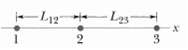
In Figure particles 1 and 2 are fixed in place, but particle 3 is free to move. If the net electrostatic force on particle 3 due to particles 1 and 2 ts zero and L23 = 2.00L12, what is the ratioq1/q2?
What is the total charge in coulombs of 75.0 kg of electrons?
In Figure six charged particles surround particle 1 at radial distances of either d = 1.0 cm or 2d, as drawn. The charges are q1 = + 2e, q2 = + 4e, q3 = + e, q4 = + 43, q5 = + 2e, q6 = + 8e, q7 = + 6e, with e = 160 x 10-19 C. What is the magnitude of the net electrostatic force on particle 7?
Three charged particles form a triangle: particle 1 with charge Q1 = 80.0nC is at xy coordinates (0, 3.00 mm), particle 2 with charge Q2 is at (0, -3.00mm), and particle 3 with charge q = 18.0nC is at (4.00 mm, 0). In unit-vector notation, what is the electrostatic force on particle 3 due to the
In Figure what are the(a) Magnitude and(b) Direction of the net electrostatic force on particle 4 due to the other three particles? All four particles are fixed in the xy plane and q1 = -3.20 x 10.
Two point charges of 30nC and – 40nC are held fixed on an x axis, at the origin and at x = 72cm, respectively. A particle with a charge of 42μC is released from rest at x = 28 cm. If the initial acceleration of the particle has a magnitude of 100 km/s2, what is the particle's mass?
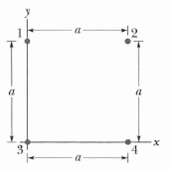
In Figure four particles form a square. The charges q1 = + Q, q2 = q3 = q, and q4 = -2.00Q. What is q/Q if the net electrostatic force on particle 1 is zero?
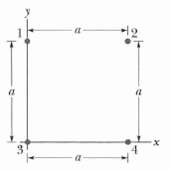
In Figure four particles form a square. The charges q1 = + Q, q2 = q3 = q, and q4 = -2.00Q. What is q/Q if the net electrostatic force on particle 1 is zero?
In Figure particle 1 of charge ?? 80.0μC and particle 2 of charge + 40.0μC are held at separation L = 20.0 cm on an x axis. In unit-vector notation, what is the net electrostatic force on particle 3, of charge q3 = 20.0μC, if particle 3 is placed at (a) x = 40.0 cm and (b) x = 80.0 cm? What
In the radioactive decay of Eq. 21-73, a 238U nucleus transforms to 234Th and an ejected 4He. (These are nuclei, not atoms, and thus electrons are not involved.) When the separation between 234Th and 4He is 9.0 x 10⁻¹⁵m, what are the magnitudes of?(a) The electrostatic force between them and(b) The
Two small, positively charged spheres have a combined charge of 5.0 x 10⁻⁵ C. If each sphere is repelled from the other by an electrostatic force of 1.0N when the spheres are 2.0 m apart, what is the charge on the sphere with the smaller charge?
The initial charges on the three identical metal spheres in Figure are the following: sphere A.Q: sphere B – Q/4; and sphere C, Q/2, where Q = 2.00 x 10⁻¹⁴ C. Spheres A and B are fired in place, with a center-to-center separation of. d = 1.20m, which is much larger than the spheres. Sphere C is
An electron is in a vacuum near Earth's surface and located at y = 0 on a vertical y axis. At what value of v should a second electron be placed such that its electrostatic force on the first electron balances the gravitational force on the first electron?
In Figure particle 1 of charge ?? 5.00q and particle 2 of charge + 2.00q are held at separation L on an x axis. If particle 3 of unknown charge q3 is to be located such that the net electrostatic force on it from particles 1 and 2 ts zero, what must be the (a) X and (b) Y coordinates of particle 3?
Two engineering students, John with a mass of 90 kg and Mary with a mass of 45 kg, are 30 m apart. Suppose each has a 0.01% imbalance in the amount of positive and negative charge, one student being positive and the other negative. Find the order of magnitude of the electrostatic force of
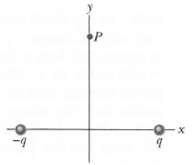
Figure shows two charged particles on an x axis; ?? q = ??3.20 x 10⁻¹⁹ C at x = ?? 3.00 m and q = 3.20 x 10⁻¹⁹ C at x = + 3.00m. What are the (a) Magnitude and (b) Direction (relative to the positive direction of the x axis) of the net electric field produced at point P at y = 4.00m?
Figure (a) shows two charged particles fixed in place on an x axis with separation L. The ratio q1/q2 of their charge magnitudes is 4.00. Figure (b) shows the x component Enet,x of their net electric field along the x axis just to the right of particle 2. The x axis scale is set by xs = 30.0 cm.(a)
In Figure the three particle are fixed in place and have charges q1 = q2 = +e and q3 = + 2e. Distance a = 6.00 pm. What are the? (a) Magnitude and (b) Direction of the net electric field at point P due to the particles?
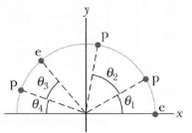
Figure shows an uneven arrangement of electrons (e) and protons (p) on a circular arc of radius r = 2.00 cm, with angles θ1 = 30.0o, θ2 = 50.0o, θ3 = 30.0o, and θ4 = 20.0o. What are the (a) Magnitude and (b) Direction (relative to the positive direction of the x axis) of the net electric field
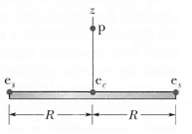
Figure shows a proton (p) on the central axis through a disk with a uniform charge density due to excess electrons. Three of those electrons are shown: electron ec, at the disk center and electrons es at opposite sides of the disk, at radius R from the center. The proton is initially at distance z
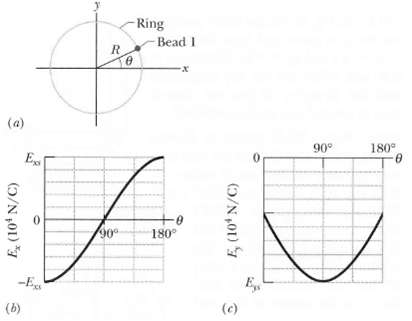
Figure shows a plastic ring of radius R = 50.0 cm. Two small charged beads are on the ring: Bead 1 of charge +2.00μC is fixed in place at the left side; bead 2 of charge +6.00μC can be moved along the ring. The two beads produce a net electric field of magnitude E at the center of the ring. At
Two charged beads are on the plastic ring in Figure (a) Bead 2, which is not shown, is fixed in place on the ring, which has radius R = 60.0 cm. Bead 1 is initially on the x axis at angle ? = 0o. It is then moved to the opposite side, at angle ? = 180o, through the first and second quadrants of the
Equations and are approximations of the magnitude of the electric field of an electric dipole, at points along the dipole axis. Consider a point P on that axis at distance z = 5.00d from the dipole center (d is the separation distance between the particles of the dipole). Let Eappr be the magnitude
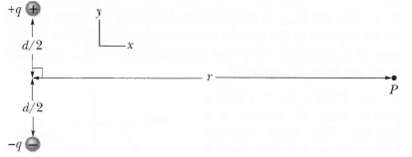
Figure shows an electric dipole. What are the (a) Magnitude and (b) Direction (relative to the positive direction of the x axis) of the dipole's electric field at point P, located at distance r >>d?
The electric field of an electric dipole along the dipole axis is approximated by Eqs 22-8 and 22-9. If a binomial expansion is made of Eq. 22-7, what is the next term in the expression for the dipole's electric field along the dipole axis? That is, what is – E next in the expression E = 1/2πε0
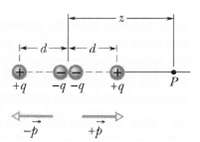
Electric quadrupole Figure shows an electric quadrupole. It consists of two dipoles with dipole moments that are equal in magnitude but opposite in direction. Show that the value of E on the axis of the quadrupole for a point P a distance z from its center (assume z >> d) is given by E =
Density, density, density(a) A charge – 300e is uniformly distributed along a circular arc of radius 4.00cm, which subtends an angle of 40o. What is the linear charge density along the arc?(b) A charge – 300e is uniformly distributed over one face of a circular disk of radius 2.00 cm. What is
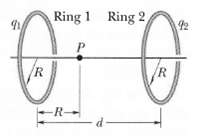
Figure shows two parallel non-conducting rings with their central axes along a common line. Ring 1 has uniform charge h and radius R; ring 2 has uniform charge q1 and the same radius R. The rings are separated by distance d = 3.00R. The net electric field at point P on the common line, at distance
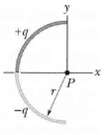
In Figure a thin glass rod forms a semicircle of radius r = 5.00 cm. Charge is uniformly distributed along the rod, with = q = 4.50pC in the upper half and ? q = ? 4.50pC in the lower half. What are the? (a) Magnitude and? (b) Direction (relative to the positive direction of the x axis) of the
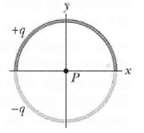
In Figure two curved plastic rods, one of charge + q and the other of charge ? q, form a circle of radius R = 8.50 cm in an xy plane. The x axis asses through both of the connecting points, and the charge are distributed uniformly on both rods. If q = 15.0pC, what are the? (a) Magnitude and (b)
Charge is uniformly distributed around a ring of radius R = 2.40cm, and the resulting electric field magnitude E is measured along the ring's central axis (perpendicular to the plane of the ring).At what distance from the ring's center is E maximum?
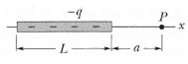
In Figure a non-conducting rod of length L = 8.15 cm has charge ? q = ? 4.23 fC uniformly distributed along its length.? (a) What is the linear charge density of the rod? What are the? (b) Magnitude and (c) Direction (relative to the positive direction of the x axis) of the electric field produced
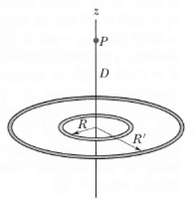
Figure shows two concentric rings, of radii R and R' = 3.00R, that lie on the same plane. Point P lies on the central z axis, at distance D = 2.00R from the center of the rings. The smaller ring has uniformly distributed charge + Q. In terms of Q, what is the uniformly distributed charge on the
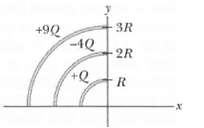
Figure shows three circular arcs centered on the origin of a coordinate system. On each arc, the uniformly distributed charge is given in terms of Q = 2.00?C. The radii are given in terms of R = 10.0 cm. What are the? (a) Magnitude and? (b) Direction (relative to the positive x direction) of the
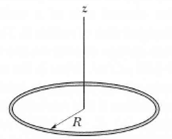
A thin non-conducting rod with a uniform distribution of positive charge Q is bent into a circle of radius R (Figure). The central perpendicular axis through the ring is a z axis, with the origin at the center of the ring. What is the magnitude of the electric field due to the rod at (a) z = 0
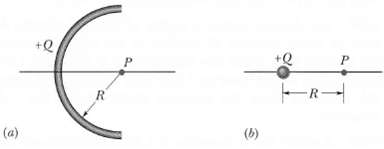
Figure a shows a non-conducting rod with a uniformly distributed charge = + Q. The rod forms a half-circle with radius R and produces an electric field of magnitude Earc at its center of curvature P. If the arc is collapsed to a point at distance R from P (Figure b), by what factor is the magnitude
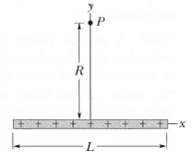
In Figure positive charge q = 7 .81pC is spread uniformly along a thin non-conducting rod of length L = 14.5 cm. What are the (a) Magnitude and (b) Direction (relative to the positive direction of the x axis) of the electric field produced at point P, at distance R = 6.00 cm from the rod along its
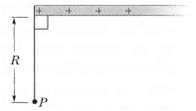
In Figure a "semi-infinite" non-conducting rod (that is, infinite in one direction only) has uniform linear charge density λ, Show that the electric field Ep at point P makes an angle of 45o with the rod and that this result is independent of the distance R.
A disk of radius 2.5 cm has a surface charge density of 5.3μC/m2 on its upper face. What is the magnitude of the electric field produced by the disk at a point on its central axis at distance z = 12cm from the disk?
At what distance along the central perpendicular axis of a uniformly charged plastic disk of radius 0.600 m is the magnitude of the electric field equal to one-half the magnitude of the field at the center of the surface of the disk?
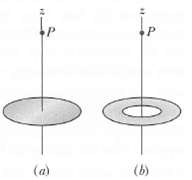
Suppose you design an apparatus in which a uniformly charged disk of radius R is to produce an electric field. The field magnitude is most important along the central perpendicular axis of the disk, at a point P at distance 2.00R from the disk (Figure a). Cost analysis suggests that you switch to a
A circular plastic disk with radius R = 2.00 cm has a uniformly distributed charge Q = + (2.00 x 10⁶)e on one face. A circular ring of width 30 pm is centered on that face, with the center of that width at radius r = 0.50 cm. In coulombs, what charge is contained within the width of the ring?
An electron is released from rest in a uniform electric field of magnitude 2.00 x 10⁴N/C. Calculate the acceleration of the electron. (Ignore gravitation.)
An electron is accelerated eastward at 1.80 x 10⁹ m/s2 by an electric field. Determine the (a) Magnitude and(b) Direction of the electric field.
An electron on the axis of an electric dipole is 25 nm from the center of the dipole. What is the magnitude of the electrostatic force on the electron if the dipole moment is 3.6 x 10⁻²⁹Cm? Assume that 25 nm is much larger than the dipole charge separation.
An alpha particle (the nucleus of a helium atom) has a mass of 6.64 x 10⁻²⁷ kg and a charge of + 2e. What are the(a) Magnitude and(b) Direction of the electric field that will balance the gravitational force on the particle?
A charged cloud system produces an electric field in the air near Earth's surface. A particle of charge – 2.0 x 10⁻⁹ C is acted on by a downward electrostatic force of 3.0 x 10⁻⁶ N when placed in this field.(a) What is the magnitude of the electric field? What are the(b) Magnitude and(c)
Humid air breaks down (its molecules become ionized) in an electric field of 3.0 x 10⁶ N/C. In that field, what is the magnitude of the electrostatic force on?(a) An electron and(b) An ion with a single electron missing?
Beams of high-speed protons can be produced in "guns" using electric fields to accelerate the protons.(a) What acceleration would a proton experience if the gun's electric field were 2.00 x 10⁴ N/C?(b) What speed would the proton attain if the field accelerated the proton through a distance of 1.00
An electron with a speed of 5.00 x 108cm/s enters an electric field of magnitude 1.00 x 10³N/C, traveling along a field line in the direction that retards its motion. (a) How far will the electron travel in the field before stopping momentarily, and (b) How much time will have elapsed? (c) If the
In Millikan's experiment, an oil drop of radius 1.64μm and density 0.851g/cm3 is suspended in chamber C (Figure) when a downward electric field of 1.92 x 10⁵N/C is applied. Find the charge on the drop, in terms of e.
At some instant the velocity components of an electron moving between two charged parallel plates are vx = 1.5 x 10⁵ m/s and vy = 3.0 x 10³ m/s. Suppose the electric field between the plates is given by E = (120 N/C)j. In unit-vector notation, what are?(a) The electron's acceleration in that field
A uniform electric field exists in a region between two oppositely charged plates. An electron is released from rest at the surface of the negatively charged plate and strikes the surface of the opposite plate, 2.0 cm away, in a time l.5 x 10-8 s. (a) What is the speed of the electron as it strikes
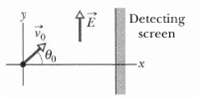
In Figure an electron is shot at an initial speed of v0 = 2.00 x 10⁶ m/s, at angle ?0 = 40.0o from an x axis. It moves through a uniform electric field E = (5.00 N/C)j. A screen for detecting electrons is positioned parallel to the y axis, at distance x = 3.00 m. In unit-vector notation, what is
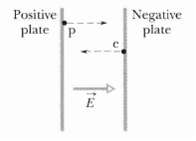
Two large parallel copper plates are 5.0 cm apart and have a uniform electric field between them as depicted in Figure. An electron is released from the negative plate at the same time that a proton is released from the positive plate. Neglect the force of the particles on each other and find their
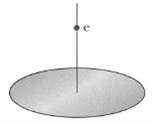
In Figure an electron (e) is to be released from rest on the central axis of a uniformly charged disk of radius R. The surface charge density on the disk is + 4.00?C/m2. What is the magnitude of the electron's initial acceleration if it is released at a distance?(a) R,(b) R/100, and(c) R/1000 from
A 10.0 g block with a charge of + 8.00 x 10⁻⁵ C is placed in an electric field E = (3000i – 600j) N/C. What are the (a) Magnitude and (b) Direction (relative to the positive direction of the x axis) of the electrostatic force on the block? If the block is released from rest at the origin at time
An electron enters a region of uniform electric field with an initial velocity of 40 km/s in the same direction as the electric field, which has magnitude E – 50 N/C. (a) What is the speed of the electron 1.5 ns after entering this region? (b) How far does the electron travel during the 1.5ns
(a) What is the magnitude of the net electrostatic force on the grain due to the bee? Next, assume that the bee brings the grain to a distance of 1.000 mm from the tip of a flower's stigma and that the tip is a particle of charge – 45.0pC. (b) What is the magnitude of the net electrostatic force
An electric dipole consists of charges + 2e and – 2e separated by 0.78 nm. It is in an electric field of strength 3.4 x 10⁶N/C. Calculate the magnitude of the torque on the dipole when the dipole moment is(a) Parallel to,(b) Perpendicular to, and(c) Anti parallel to the electric field.
An electric dipole consisting of charges of magnitude 1.50nC separated by 6.20 pm is in an electric field of strength 1100 N/C. What are?(a) The magnitude of the electric dipole moment and(b) The difference between the potential energies for dipole orientations parallel and anti parallel to E?
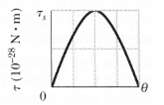
A certain electric dipole is placed in a uniform electric field E of magnitude 40 N/C. Figure gives the magnitude τ of the torque on the dipole not versus the angle θ between field E and the dipole moment p. The vertical axis scale is set by τs = 100 x 10-28 N ?? m. What is the magnitude of p?
Find an expression for the oscillation frequency of an electric dipole of dipole moment p; and rotational inertia 1 for small amplitudes of oscillation about its equilibrium position in a uniform electric field of magnitude E.
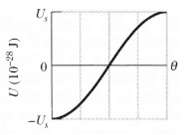
A certain electric dipole is placed in a uniform electric field E of magnitude 20 N/C. Figure gives the potential energy U of the dipole versus the angle 0 between E and the dipole moment p. The vertical axis scale is set by Us = 100 x 10-28J. What is the magnitude ofp?
How much work is required to turn an electric dipole 180o in a uniform electric field of magnitude E = 46.0 N/C if p = 3.02 x 10⁻²⁵ C ∙ m and the initial angle is 64o?
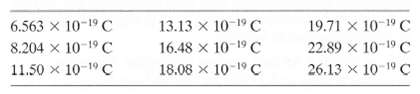
In one of his experiments, Millikan observed that the following measured charges, among others, appeared at different times on a single drop: What value for the elementary charge e can be deduced from these data?
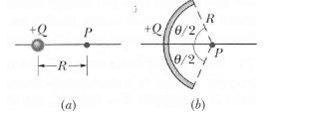
In Figure (a) a particle of charge + Q produces an electric field of magnitude E part, at point P, at distanceR from the particle R from the particle, in figure (b) that same amount of charge is spread uniformly along a circular arc that has radius R and subtends an angle θ. The charge on the arc
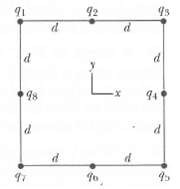
In Figure eight particles form a square in which distance d = 2.0cm. The charges are q1 = +3e, q2 = +e, q3 = ? 5e, q4 = ?2e, q5 = 3e, q6 = e, q7 = ?5e, and q8 = +e. In unit-vector notation, what net electric field do the particles produce at the square's center?
Two particles, each with a charge of magnitude 12nC, are at two of the vertices of an equilateral triangle with edge length 2.0 m. What is the magnitude of the electric field at the third vertex if (a) Both charges are positive and (b) One charge is positive and the other is negative?
Three particles, each with positive charge Q, form an equilateral triangle, with each side of length d. What is the magnitude of the electric field produced by the particles at the midpoint of any side?
A particle of charge – q1 is at the origin of an x axis. (a) At what location on the axis should a particle of charge – 4q1 be placed so that the net electric field is zero at x = 2.0 mm on the axis? (b) If instead a particle of charge + 4q1 is placed at that location, what is the direction
A proton and an electron form two corners of an equilateral triangle of side length 2.0 x 10⁻⁶ m. What is the magnitude of the net electric field these two particles produce at the third corner?
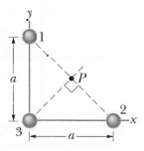
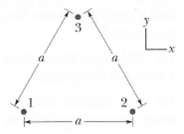
In Figure particle 1 (of charge + 1.00?C), particle 2 (of charge + 1.00?C), and particle 3 (of charge Q) form an equilateral triangle of edge length a. For what value of Q (both sign and magnitude) does the net electric field produced by the particles at the center of the triangle vanish?
(a) What total (excess) charge q must the disk in Figure have for the electric field on the surface of the disk at its center to have magnitude 3.0 x 10⁶ N/C, the E value at which air breaks down electrically, producing sparks? Take the disk radius as 2.5 cm, and use the listing for air in Table
Showing 3400 - 3500
of 8940
First
28
29
30
31
32
33
34
35
36
37
38
39
40
41
42
Last
Step by Step Answers

 Get 50% OFF
Claim Now
Get 50% OFF
Claim Now