New Semester
Started
Get
50% OFF
Study Help!
--h --m --s
Claim Now
Question Answers
Textbooks
Find textbooks, questions and answers
Oops, something went wrong!
Change your search query and then try again
S
Books
FREE
Study Help
Expert Questions
Accounting
General Management
Mathematics
Finance
Organizational Behaviour
Law
Physics
Operating System
Management Leadership
Sociology
Programming
Marketing
Database
Computer Network
Economics
Textbooks Solutions
Accounting
Managerial Accounting
Management Leadership
Cost Accounting
Statistics
Business Law
Corporate Finance
Finance
Economics
Auditing
Tutors
Online Tutors
Find a Tutor
Hire a Tutor
Become a Tutor
AI Tutor
AI Study Planner
NEW
Sell Books
Search
Search
Sign In
Register
study help
physics
electricity and magnetism
Fundamentals of Physics 8th Extended edition Jearl Walker, Halliday Resnick - Solutions
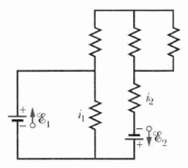
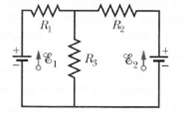
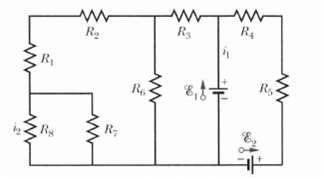
In Figure the ideal batteries have emf s ?1 = 12.0 V and ?2 = 4.00 V and the resistances are each 4.00?. What are the (a) Size and (b) Direction (up or down) of i1 and the (c) Size and (d) Direction of i2? (e) Does battery 1 supply or absorb energy, and? (f) What is its energy transfer rate? (g)
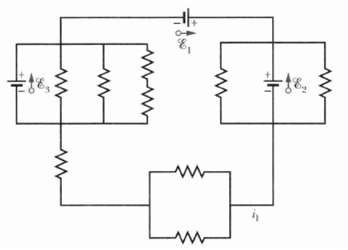
In Figure the ideal batteries have emf s ? 1=: 20.0 V, ?2?= 10.0 V and ?3 = 5.00 V and the resistances are each 2.00?. What are the (a) Size and (b) Direction (left or right) of current i1? (c) Does battery 1 supply or absorb energy, and (d) What is its power? (e) Does battery 2 supply or absorb
A temperature-stable resistor is made by connecting a resistor made of silicon in series with one made of iron. If the required total resistance is 1000Ω in a wide temperature range around 20°C, what should be the resistance of the(a) Silicon resistor and(b) Iron resistor?
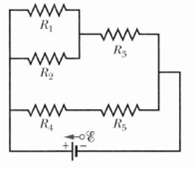
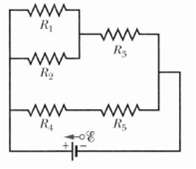
In Figure an ideal battery of emf ξ = 12.0 V is connected to a network of resistances R1 = 6.00??, R2 = 12.0??, R3 = 4.00??, R4 = 3.00?? and R5 = 5.00??. What is the potential difference across resistance 5?
Thermal energy is to be generated in a 0.10Ω resistor at the rate of 10 W by connecting the resistor to a battery whose emf is 1.5 V.(a) What potential difference must exist across the resistor?(b) What must be the internal resistance of the battery?
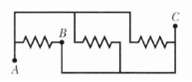
Figure shows three 20.0? resistors. Find the equivalent resistance between points (a) A and B, (b) A and C, and (c) B and C.
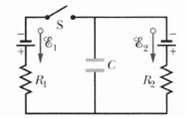
The circuit of Figure shows a capacitor, two ideal batteries, two resistors, and a switch S. Initially S has been open for a long time. If it is then closed for a long time, what is the change in the charge on the capacitor? Assume C = 10?F, ?1 = 1.0 V, ?2?= 3.0 V, R1 = 0.20?, and R2 = 0.40?.
In Figure a, calculate the potential difference between a and c by considering a path that contains R, r1, and ξ1.
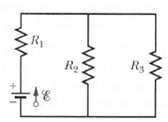
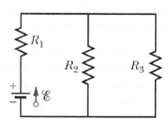
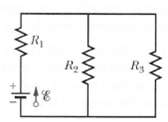
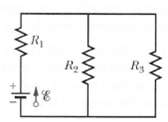
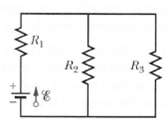
In Figure a, find the potential difference across R2 if ξ = 12 V, R1 = 3.0Ω, R2 = 4.0Ω, and R3 = 5.0Ω.
In Figure assume that ξ = 5.0 V, r = 2.0Ω, R1=- 5.0Ω, and R2 = 4.0Ω. If the ammeter resistance RA is 0.10Ω, what percent error does it introduce into the measurement of the current? Assume that the voltmeter is not present.
A 120 V power line is protected by a 15 A fuse. What is the maximum number of 500 W lamps that can be simultaneously operated in parallel on this line without "blowing" the fuse because of an excess of current?
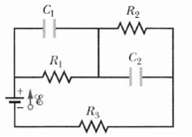
In Figure Rl = 5.00?, R2 = 10.0?, R3 = 15.0?, C1 = 5.00?F, C2 = 10.0?F, and the ideal battery has emf ? = 20.0 V. Assuming that the circuit is in the steady state, what is the total energy stored in the two capacitors?
An initially uncharged capacitor C is fully charged by a device of constant emf ξ connected in series with a resistor R.(a) Show that the final energy stored in the capacitor is half the energy supplied by the emf device.(b) By direct integration of i2R over the charging time, show that the
Two resistors R1 and R2 may be connected either in series or in parallel across an ideal battery with emf ?. We desire the rate of energy dissipation of the parallel combination to be five times that of the series combination. If Rl = 100?, what are the (a) Smaller and (b) Larger of the two values
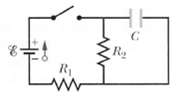
In Figure the ideal battery has emf ? = 30 V, the resistances are R1 = 20k? and R2 = 10k?, and the capacitor is uncharged. When the switch is closed at time t = 0, what is the current in (a) Resistance 1 and (b) Resistance 2? (c) A long time later, what is the current in resistance 2?
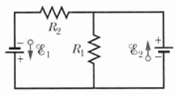
In Figure R1 = 10.0?, R2 = 20.0? and the ideal batteries have emf s ?1 = 20.0 V and ?2?= 50.0 V. What value of later, results in no current through battery 1?
In Figure R1 = R2 = 10.0?, and the ideal battery has emf ? = 12.0 V. (a) What value of R3 maximizes the rate at which the battery supplies energy and (b) What is that maximum rate?
Each of the six real batteries in Figure has an emf of 20 V and a resistance of 4.0Ω.(a) What is the current through the (external) resistance R = 4.0Ω?(b) What is the potential difference across each battery?(c) What is the power of each battery?(d) At what rate does each battery transfer
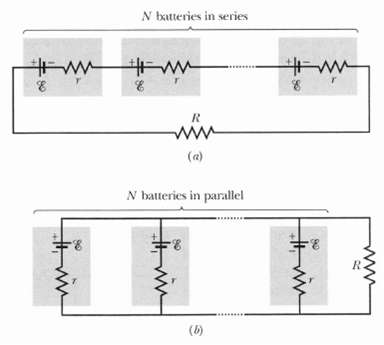
A group of N identical batteries of emf ξ and internal resistance r may be connected all in series (Figure a) or all in parallel (Figure b) and then across a resistor R. Show that both arrangements give the same current in R if R = r.
The following table gives the electric potential difference VT across the terminals of a battery as a function of current i being drawn from the battery. (a) Write an equation that represents the relationship between VT and i enter the data into your graphing calculator and perform a linear
In Figure ?1 = 6.00 V, ?2 = 1.20 V, R1 = 200?, and R2 = 100?. What are the (a) Size and (b) Direction (up or down) of the current through resistance 1, the (c) Size and (d) Direction of the current through resistance 2, and the (e) Size and (f) Direction of the current through battery 2
A three-way 120 V lamp bulb that contains two filaments is rated for 100-200-300 W. One filament burns out. Afterward, the bulb operates at the same intensity (dissipates energy at the same rate) on its lowest as on its highest switch positions but does not operate at all on the middle position.(a)
In Figure R1 = R2 = 2.0?, R3 = 4.0?, R4?= 3.0?, R5 = 1.0?, and R6 = R7 = R8 = 8.0?, and the ideal batteries have emf s ?1 = 16 V and ?2 = 8.0 V. What are the (a) Size and (b) Direction (up or down) of current i1 and the (c) Size and (d) Direction of current i2? What is the energy transfer rate
In Figure ? = 6.00 V, R1 = 100?, R2 = 300?, and R3 = 600?. What are? (a) The equivalent resistance of the three resistors, (b) The electric potential across resistance 1, and (c) The current through resistance 3?
In Figure the ideal battery has emf ? = 12.0 V and the resistances are each 4.00?. What are? (a) The current in resistance 3 and (b) The rate at which energy is supplied?
A capacitor with capacitance C0, after having been connected to a battery with emf ξ0 for a long time, is discharged through a 200 000Ω resistor at time t = 0. The potential difference across the capacitor is measured as a function of time for a brief time interval; the results are recorded
Power is supplied by a device of emf ? to a transmission line with resistance R. Find the ratio of the power dissipated in the line for ? = 110 000 V to that dissipated for ? = 110 V assuming the power supplied is the same for the two cases
A battery of emf ? = 2.00 V and internal resistance r = 0.500? is driving a motor. The motor is lifting 2.00 N mass at constant speed v = 0.500 m/s. Two combinations of current i in the battery-motor circuit and potential difference V across the motor terminals allow this. Of the two possible pairs
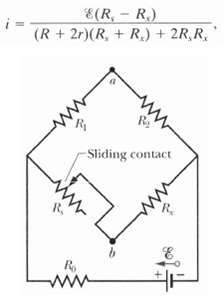
(a) If points a and b in Figure are connected by a wire of resistance r, show that the current in the wire is where ? is the emf of the ideal battery and R = R1 = R2. Assume that R0 equals zero. (b) Is this formula consistent with the result of Problem 55?
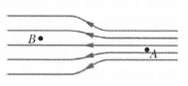
In Figure the electric field lines on the left have twice the separation of those on the right.? (a) If the magnitude of the field at A is 40 N/C, what is the magnitude of the force on a proton at A?? (b) What is the magnitude of the field at B?
Sketch qualitatively the electric field lines both between and outside two concentric conducting spherical shells when a uniform positive charge – q2 is on the inner shell and a uniform negative charge – q2 is on the outer. Consider the q1 > q2, q1 = q2, and q1 < q2.
What is the magnitude of a point charge whose electric field 50 cm away has the magnitude 2.0 N/C?
What is the magnitude of a point charge that would create an electric field of 1.00 N/C at points 1.00 m away?
The nucleus of a plutonitm-239 atom contains 94 protons. Assume that the nucleus is a sphere with radius 6.64 fm and with the charge of the protons uniformly spread through the sphere. At the nucleus surface, what are the(a) Magnitude and(b) Direction (radially inward or outward) of the electric
Two particles are fixed to an r axis: particle 1 of charge – 2.00 x 10⁻⁷ C at x = 6.00 cm and particle 2 of charge + 2.00 x 10⁻⁷ C at x = 21.0cm. Midway between the particles, what is their net electric field in unit-vector notation?
An electron that has velocity V = (2.0 x 10⁶ m/s) i + (3.0 x 10⁶ m/s)j moves through the uniform magnetic field B = (0.030 T)i - (0.15 T)j.(a) Find the force on the electron due to the magnetic field.(b) Repeat your calculation for a proton having the same velocity.
An alpha particle travels at a velocity v of magnitude 550 m/s through a uniform magnetic field B of magnitude 0.045 T. (An alpha particle has a charge of +3.2 x 10⁻¹⁹ C and a mass of 6.6 x 10 27 kg.) The angle between v and B is 52°. What is the magnitude of?(a) The force FB acting on the
A proton traveling at 23.0° with respect to the direction of a magnetic field of strength 2.60mT experiences a magnetic force of 6.50 x 10⁻¹⁷ N. Calculate(a) The proton's speed and(b) Its kinetic energy in electron-volts.
A particle of mass 10 g and charge 80μC moves through a uniform magnetic field, in a region where the free-fall acceleration is -9.8j m/s2. The velocity of the particle is a constant 20i km/s, which is perpendicular to the magnetic field. What, then, is the magnetic field?
An electron moves through a uniform magnetic field given by B = Bx i + (3.0Bx) j. At a particular instant, the electron has velocity v = (2.0i + 4.0) j m/s and the magnetic force acting on it is (6.4 x 10⁻¹⁹N) k. Find Bx
A proton moves through a uniform magnetic field given by B = (10i - 20j + 30k) m T. At time t1, the proton has a velocity given by v = vx i + vy j + (2.0 km/s) k and the magnetic force on the proton is FB = (4.0 x 10⁻¹⁷ N) i + (2.0 x 10⁻¹⁷ N) j. At that instant, what are?(a) v x and(b) v y?
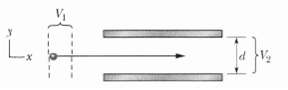
In Figure an electron accelerated from rest through potential difference V1 = 1.00 kV enters the gap between two parallel plates having separation d = 20.0 mm and potential difference V2 = 100 V. The lower plate is at the lower potential. Neglect fringing and assume that the electron's velocity
An electric field of 1.50kV/m and a perpendicular magnetic field of 0.400 T act on a moving electron to produce no net force. What is the electron's speed?
An electron has an initial velocity of (12.0 j + 15.0 k) km/s and a constant acceleration of (2.00 x 10¹² m/s2) i in a region in which uniform electric and magnetic fields are present. If B = (400μT) i, find the electric field E.
A proton travels through uniform magnetic and electric fields. The magnetic field is B = 2.50imT. At one instant the velocity of the proton is v = 2000j m/s. At that instant and in unit vector notation, what is the net force acting on the proton if the electric field is?(a) 4.00k V/m,(b) -4.00k
An ion source is producing 6Li ions, which have charge +e and mass 9.99 x 10⁻²⁷ kg. The ions are accelerated by a potential difference of 10 kV and pass horizontally into a region in which there is a uniform vertical magnetic field of magnitude B = 1.2T. Calculate the strength of the smallest
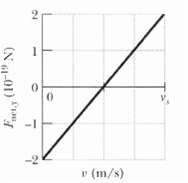
At time t1, an electron is sent along the positive direction of an x axis, through both an electric field E and a magnetic field B, with E directed parallel to the y axis. Figure gives the y component F net, y of the net force on the electron due to the two fields, as a function of the electron's
A strip of copper 150μm thick and 4.5 mm wide is placed in a uniform magnetic field B of magnitude 0.65 T, with E perpendicular to the strip. A current i = 23 A is then sent through the strip such that a Hall potential difference V appears across the width of the strip. Calculate V. (The number of
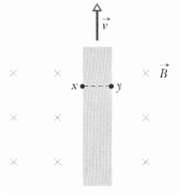
A metal strip 6.50 cm long 0.850 cm wide, and 0.760 mm thick moves with constant velocity v through a uniform magnetic field B = 1.20mT directed perpendicular to the strip , as shown in Figure. A potential difference of 3 .90μV is measured between points x and y across the strip. Calculate the
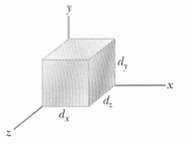
In Figure a conducting rectangular solid of dimensions dx = 5.00 m, d y = 3.00 m, and dz = 2.00 m moves at constant velocity v = (20.0 m/s) i through a uniform magnetic field B = (30.0mT) j. What is the resulting? (a) Electric field within the solid, in unit-vector notation, and (b) Potential
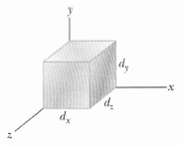
Figure shows a metallic block, with its faces parallel to coordinate axes. The block is in a uniform magnetic field of magnitude 0.020 T. One edge length of the block is 25 cm; the block is not drawn to scale. The block is moved at 3.0 m/s parallel to each axis, in turn, and the resulting potential
An electron of kinetic energy 1.20keV circles in a plane perpendicular to a uniform magnetic field. The orbit radius is 25.0 cm. Find(a) The electron's speed,(b) The magnetic field magnitude,(c) The circling frequency, and(d) The period of the motion.
An electron is accelerated from rest by u potential difference of 350 V. It then enters a uniform magnetic field of magnitude 200mT with its velocity perpendicular to the field. Calculate(a) The speed of the electron and(b) The radius of its path in the magnetic field.
What uniform magnetic field, applied perpendicular to a beam of electrons moving at 1.30 x 10⁶ m/s, is required to make the electrons travel in a circular arc of radius 0.350 m?
In a nuclear experiment a proton with kinetic energy 1.0 MeV moves in a circular path in a uniform magnetic field. What energy must?(a) An alpha particle (q = +2e, m = 4.0 u) and(b) A deuteron (q = +e, m = 2.0 u) have if they are to circulate in the same circular path?
(a) Find the frequency of revolution of an electron with energy of 100 eV in a uniform magnetic field of magnitude 35.0μT.(b) Calculate the radius of the path of this electron if its velocity is perpendicular to the magnetic field.
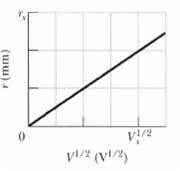
An electron is accelerated rest through potential difference V and then enters a region of uniform magnetic field where it undergoes uniform circular motion. Figure gives the radius r of that motion versus V1/2. The vertical axis scale is 0 set by r s = 3.0 mm, and the horizontal axis scale is set
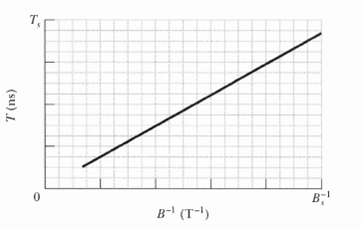
A certain particle is sent into a uniform magnetic field, with the particle's velocity vector perpendicular to the direction of the field. Figure gives the period T of the particle's motion versus the inverse of the field magnitude B. The vertical axis scale is set by Ts = 40.0 ns, and the
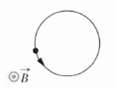
In Figure a particle moves along a circle in a region of uniform magnetic field of magnitude B = 4.00mT the particle is either a proton or an electron (you must decide which). It experiences a magnetic force of magnitude 3.20 x 10¹⁵ N. What are? (a) The particle's speed, (b) The radius of the
An alpha particle (q = +2e, m = 4.00 u) travels in a circular path of radius 4.50 cm in a uniform magnetic field with B = 1.20 T. Calculate(a) Its speed,(b) Its period of revolution,(c) Its kinetic energy, and(d) The potential difference through which it would have to be accelerated to achieve this
A particle undergoes uniform circular motion of radius 26.1μm in a uniform magnetic field. The magnetic force on the particle has a magnitude of 1.60 x 10⁻¹⁷ N. What is the kinetic energy of the particle?
An electron follows a helical path in a uniform magnetic field of magnitude 0.300 T. The pitch of the path is 6.00μm, and the magnitude of the magnetic force on the electron is 2.00 x 10⁻¹⁵ N. What is the electron's speed?
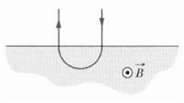
In Figure a charged particle moves into a region of uniform magnetic field B, goes through half a circle, and then exits that region. The particle is either a proton or an electron (you must decide which). It spends 130 ns in the region. (a) What is the magnitude of B? (b) If the particle is sent
A positron with kinetic energy 2.00keV is projected into a uniform magnetic field B of magnitude 0.100 T with its velocity vector making an angle of 89.0° with B. Find(a) The period,(b) The pitch p, and(c) The radius r of its helical path.
An electron follows a helical path in a uniform magnetic field given by B = (20i – 50j - 30k)mT. At time t = 0, the electron's velocity is given by v = (20i – 30j + 50k) m/s.(a) What is the angle Φ between v and B? The electron's velocity changes with time. Do(b) Its speed and(c) The angle, f
A certain commercial mass spectrometer (see Sample Problem 28-3) is used to separate uranium ions of mass 3.92 x 10⁻²⁵ kg and charge 3.20 x 10⁻¹⁹ C from related species. The ions are accelerated through a potential difference of 100 kV and then pass into a uniform magnetic field, where they are
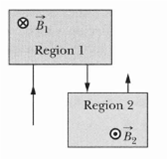
In Figure an electron with an initial kinetic energy of 4.0keV enters region 1 at time t = 0. That region contains a uniform magnetic field directed into the page, with magnitude 0.010 T. The electron goes through a half-circle and then exits region 1, headed toward region 2 across a gap of 25.0
A particular type of fundamental particle decays by transforming into an electron e- and a positron e+. Suppose the decaying particle is at rest in a uniform magnetic field B of magnitude 3.53mT and the e- and e+ move away from the decay point in paths lying in a plane perpendicular to B. How long
A source injects an electron of speed v = 15 x 107 m/s into a uniform magnetic field of magnitude B = 1.0 x 10⁻³ T. The velocity of the electron makes an angle θ = 10° with the direction of the magnetic field. Find the distance d from the point of injection at which the electron next crosses the
Estimate the total path length traveled by a deuteron in the cyclotron of Sample Problem 28-5 during the (entire) acceleration process. Assume that the accelerating potential between the Dees is 80 kV.
In a certain cyclotron a proton moves in a circle of radius 0.500 m. The magnitude of the magnetic field is 1.20 T.(a) What is the oscillator frequency?(b) What is the kinetic energy of the proton, in electron-volts?
A proton circulates in a cyclotron, beginning approximately at rest at the center. Whenever it passes through the gap between Dees, the electric potential difference between the Dees is 200 V.(a) By how much does its kinetic energy increase with each passage through the gap?(b) What is its kinetic
A cyclotron with Dee radius 53.0 cm is operated at any oscillator frequency of 12.0 MHz to accelerate protons.(a) What magnitude B of magnetic field is required to achieve resonance?(b) At that field magnitude, what is the kinetic energy of a proton emerging from the cyclotron? Suppose, instead,
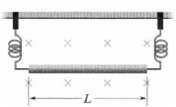
A 13.0 g wire of length L = 62.0 cm is suspended by a pair of flexible leads in a uniform magnetic field of magnitude 0.440 T (Figure). What are the (a) Magnitude and (b) Direction (left or right) of the current required removing the tension in the supporting leads?
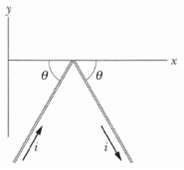
The bent wire shown in Figure lies in a uniform magnetic field. Each straight section is 2.0 m long and makes an angle of θ = 60? with the x axis, and the wire carries a current of 2.0 A. What is the net magnetic force on the wire in unit-vector notation if the magnetic field is given by? (a) 4.0k
A horizontal power line carries a current of 5000 A from south to north. Earth's magnetic field (60.0μT) is directed toward the north and inclined downward at 70.0° to the horizontal. Find the(a) Magnitude and(b) Direction of the magnetic force on 100 m of the line due to Earth's field.
A wire 1.80 m long carries a current of 13.0 A and makes an angle of 35.0° with a uniform magnetic field of magnitude B = 1.50 T. Calculate the magnetic force on the wire.
A wire 50.0 cm long carries a 0.500 A current in the positive direction of an x axis through a magnetic field B = (3.00mT) j + (10.0mT) k. In unit-vector notation, what is the magnetic force on the wire?
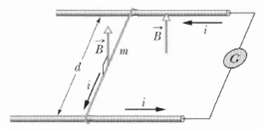
In Figure, a metal wire of mass m = 24.1 mg can slide with negligible friction on two horizontal parallel rails separated by distance d = 2.56 cm. The track lies in a vertical uniform magnetic field of magnitude 56.3mT. At time t = 0, device G is connected to the rails, producing a constant current
A 1.0 kg copper rod rests on two horizontal rails 1.0 m apart and carries a current of 50 A from one rail to the other. The coefficient of static friction between rod and rails is 0.60. What are the (a) Magnitude and(b) Angle (relative to the vertical) of the smallest magnetic field that puts the
A long, rigid conductor, lying along an x axis, carries a current of 5.0 A in the negative x direction. A magnetic field B is present, given B = 3.0i + 8.0 x2j, with x in meters and F in milliteslas. Find, in unit-vector notation, the force on the 2.0 m segment of the conductor that lies between x
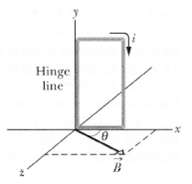
Figure shows a rectangular 20-turn coil of wire, of dimensions 10 cm by 5.0 cm. It carries a current of 0.10 A and is hinged along one long side. It is mounted in the xy plane, at angle θ = 30? to the direction of a uniform magnetic field of magnitude 0.50 T. In unit-vector notation, what is the
A single-turn current loop, carrying a current of 4.00 A, is in the shape of a right triangle with sides 50.0, 120, and 130 cm. The loop is in a uniform magnetic field of magnitude 75.0mT whose direction is parallel to the current in the 130 cm side of the loop. What is the magnitude of the
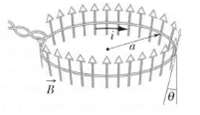
Figure shows a wire ring of radius a = 1.8 cm that is perpendicular to the general direction of a radially symmetric, diverging magnetic field. The magnetic field at the ring is everywhere of the same magnitude B = 3.4mT, and its direction at the ring everywhere makes an angle 0 = 20? with a normal
In Figure a rectangular loop carrying current lies in the plane of a uniform magnetic field of magnitude 0.040 T. The loop consists of a single turn of flexible conducting wire that is wrapped around a flexible mount such that the dimensions of the rectangle can be changed. (The total length of the
The coil of a certain galvanometer has a resistance of 75.3Ω; its needle shows a full scale deflection when a current of 1.62 mA passes through the coil.(a) Determine the value of the auxiliary resistance required to convert the galvanometer to a voltmeter that reads 1.00 V at full-scale
An electron moves in a circle of radius r = 5.29 x 10⁻¹¹ m with speed 2.19 x 10⁶ m/s. Treat the circular path as a current loop with a constant current equal to the ratio of the electron's charge magnitude to the period of the motion. If the circle lies in a uniform magnetic field of magnitude B =
Figure shows a wood cylinder of mass m = 0.250 kg and length L = 0.100 m, with N = 10.0 turns of wire wrapped around it longitudinally, so that the plane of the wire coil contains the long central axis of the cylinder. The cylinder is released on a plane inclined at an angle θ to the horizontal,
A circular wire loop of radius 15.0 cm carries a current of 2.60 A. It is placed so that the normal to its plane makes an angle of 41.0° with a uniform magnetic field of magnitude 12.0 T.(a) Calculate the magnitude of the magnetic dipole moment of the loop.(b) What is the magnitude of the torque
A circular coil of 160 turns has a radius of 1.90 cm.(a) Calculate the current that results in a magnetic dipole moment of magnitude 2.30 A ∙ m2.(b) Find the maximum magnitude of the torque that the coil, carrying this current, can experience in a uniform 35.0mT magnetic field.
The magnetic dipole moment of Earth has magnitude 8.00 x 10²² J/T. Assume that this is produced by charges flowing in Earth's molten outer core. If the radius of their circular path is 3500 km, calculate the current they produce.
A current loop, carrying a current of 5.0 A, is in the shape of a right triangle with sides 30, 40, and 50 cm. The loop is in a uniform magnetic field of magnitude 80mT whose direction is parallel to the current in the 50 cm side of the loop. Find the magnitude of(a) The magnetic dipole moment of
A magnetic dipole with a dipole moment of magnitude 0.020 J/T is released from rest in a uniform magnetic field of magnitude 52mT. The rotation of the dipole due to the magnetic force on it is unimpeded. When the dipole rotates through the orientation where its dipole moment is aligned with the
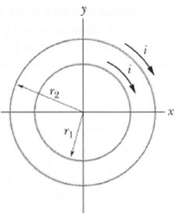
Two concentric, circular wire loops, of radii r1 = 20.0 cm and r2 = 30.0 cm, are located in a xy plane; each carries a clockwise current of 7.00 A (Figure). (a) Find the magnitude of the net magnetic dipole moment of the system. (b) Repeat for reversed current in the inner loop.
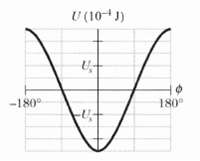
Figure gives the potential energy U of a magnetic dipole in an external magnetic field B, as a function of angle Φ between the directions of B and the dipole moment. The vertical axis scale is set by U? s = 2.0 x 10⁻⁴ J. The dipole can be rotated about an axle with negligible friction so as to
A circular loop of wire having a radius of 8.0 cm carries a current of 0.20 A. A vector of unit length and parallel to the dipole moment i, of the loop is given by 0.60i - 0.80j If the loop is located in a uniform magnetic field given by B = (0.25 T) i + (0.30T) k, find(a) The torque on the loop
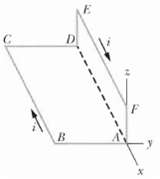
Figure shows a current loop ABCDEFA carrying a current i = 5.00 A. The sides of the loop are parallel to the coordinate axes shown, with AB = 20.0 cm, BC = 30.0 cm, and FA = 10.0 cm. In unit vector notation, what is the magnetic dipole moment of this loop?
A wire of length 25.0 cm carrying a current of 4.57 mA is to be formed into a circular coil and placed in a uniform magnetic field B of magnitude 5.71mT. If the torque on the coil from the field is maximized, what are?(a) The angle between E and the coil's magnetic dipole moment and(b) The number
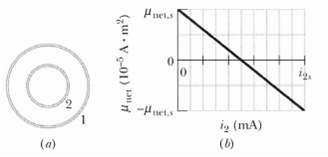
In Figure a, two concentric coils, lying in the same plane, carry currents in opposite directions. The current in the larger coil 1 is fixed. Current i2 in coil 2 can be varied. Figure b gives the net magnetic moment of the two-coil system as a function of i2. The vertical axis scale is set by μ
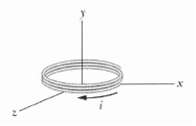
The coil in Figure carries current i = 2.00 A in the direction indicated, is parallel to an xz plane, has 3.00 turns and an area of 4.00 x 10⁻³ m2, and lies in a uniform magnetic field B = (2.00 i - 3.00 j - 4.00 k) mT. What are? (a) The magnetic potential energy of the coil-magnetic field system
Showing 3600 - 3700
of 8940
First
30
31
32
33
34
35
36
37
38
39
40
41
42
43
44
Last
Step by Step Answers

 Get 50% OFF
Claim Now
Get 50% OFF
Claim Now