New Semester
Started
Get
50% OFF
Study Help!
--h --m --s
Claim Now
Question Answers
Textbooks
Find textbooks, questions and answers
Oops, something went wrong!
Change your search query and then try again
S
Books
FREE
Study Help
Expert Questions
Accounting
General Management
Mathematics
Finance
Organizational Behaviour
Law
Physics
Operating System
Management Leadership
Sociology
Programming
Marketing
Database
Computer Network
Economics
Textbooks Solutions
Accounting
Managerial Accounting
Management Leadership
Cost Accounting
Statistics
Business Law
Corporate Finance
Finance
Economics
Auditing
Tutors
Online Tutors
Find a Tutor
Hire a Tutor
Become a Tutor
AI Tutor
AI Study Planner
NEW
Sell Books
Search
Search
Sign In
Register
study help
physics
electricity and magnetism
Fundamentals of Physics 8th Extended edition Jearl Walker, Halliday Resnick - Solutions
A wire lying along a y axis from y = 0 to y = 0.250 m carries a current of 2.00 mA in the negative direction of the axis. The wire fully lies in a non uniform magnetic field given by B = (0.300 T/m) y i + (0.400 T/m) y j. In unit-vector notation, what is the magnetic force on the wire?
Physicist S. A. Goudsmit devised a method for measuring the mass of heavy ions by timing their period of revolution in a known magnetic field. A singly charged ion of iodine makes 7.00 rev in a 45.0mT field in 1.29ms. Calculate its mass in atomic mass units.
An electron in an old-fashioned TV camera tube is moving at 7.20 x 10⁶ m/s in a magnetic field of strength 83.0mT. What is the(a) Maximum and(b) Minimum magnitude of the force acting on the electron due to the field?(c) At one point the electron has an acceleration of magnitude 4.90 x 10¹⁴ m/s2.
A stationary circular wall clock has a face with a radius of 15 cm. Six turns of wire are wound around its perimeter; the wire carries a current of 2.0 A in the clockwise direction. The clock is located where there is a constant, uniform external magnetic field of magnitude 70mT (but the clock
In a Hall-effect experiment, a current of 3.0 A sent lengthwise through a conductor 1.0 cm wide, 4.0 cm long, and 10 pm thick produces a transverse (across the width) Hall potential difference of 10μV when a magnetic field of 1.5 T is passed perpendicularly through the thickness of the conductor.
Atom 1 of mass 35 u and atom 2 of mass 37 u are both singly ionized with a charge of +e. After being introduced into a mass spectrometer (Figure) and accelerated from rest through a potential difference V = 7.3 kV each ion follows a circular path in a uniform magnetic field of magnitude B = 0.50 T.
An electron with kinetic energy 2.5keV moving along the positive direction of an x axis enters a region in which a uniform electric field of magnitude 10 kV/m is in the negative direction of the y axis. A uniform magnetic field B is to be set up to keeps the electron moving along the x axis, and
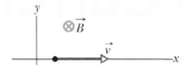
In Figure an electron moves at speed v = 100 m/s along an x axis through uniform electric and magnetic fields. The magnetic field B is directed into the page and has magnitude 5.00 T In unit vector notations, what is the electric field?
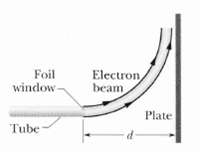
A beam of electrons whose kinetic energy is K emerges from a thin-foil "window" at the end of an accelerator tube. A metal plate at distance d from this window is perpendicular to the direction of the emerging beam (Figure). (a) Show that we can prevent the beam from hitting the plate if we apply a
A proton, a deuteron (q = +e, m = 2.0 u), and an alpha particle (q = +2e, m = 4.0 u) are accelerated through the same potential difference and then enter the same region of uniform magnetic field B, moving perpendicular to B. What is the ratio of?(a) The proton's kinetic energy K p to the alpha
A proton of charge +e and mass m enters a uniform magnetic field B = Bi with an initial velocity v = v0xi + v0yi. Find an expression in unit-vector notation for its velocity v at any later time t.
A particle of mass 6.0 g moves at 4.0 km/s in a xy plane, in a region with a uniform magnetic field given by 5.0imT. At one instant, when the particle's velocity is directed 37° counterclockwise from the positive direction of the x axis, the magnetic force on the particle is 0.48t N. What is the
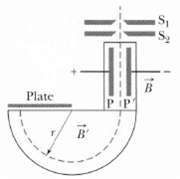
Bainbridge's mass spectrometer, shown in Figure, separates ions having the same velocity. The ions, after entering through slits, S1 and S, pass through a velocity selector composed of an electric field produced by the charged plates P and P', and a magnetic field B perpendicular to the electric
At one instant, v = (-2.00 i + 4.00 i - 6.00 j) m/s is the velocity of a proton in a uniform magnetic field B = (2.00 i 4.00 j + 8.00k) mT. At that instant, what are?(a) The magnetic force F on the proton, in unit-vector notation,(b) The angle between v and F, and(c) The angle between v and B?
(a) In Figure show that the ratio of the Hall electric field magnitude E to the magnitude EC of the electric field responsible for moving charge (the current) along the length of the strip is E/EC = B/ nep, where p is the resistivity of the material and n is the number density of the charge
At time t = 0, an electron with kinetic energy 12keV moves through x = 0 in the positive direction of an x axis that is parallel to the horizontal component of Earth's magnetic field B. The field's vertical component is downward and has magnitude 55.0μT.(a) What is the magnitude of the electron's
An electron has velocity v = (32 i + 40 i) km/s as it enters a uniform magnetic field B = 60iμT. What are?(a) The radius of the helical path taken by the electron and(b) The pitch of that path?(c) To an observer looking into the magnetic field region from the entrance point of the electron, does
A proton, a deuteron (q = +e, m = 2.0 u), and an alpha particle (q = +2e, m = 4.0 u) all having the same kinetic energy enter a region of uniform magnetic field B, moving perpendicular to B. What is the ratio of?(a) The radius r d of the deuteron path to the radius r p of the proton path and(b) The
A particle with charge 2.0 C moves through a uniform magnetic field. At one instant the velocity of the particle is (2.0 i + 4.0 j + 6.0 k) m/s and the magnetic force on the particle is (4.0 i – 20 j + 12 k) N. The x and y components of the magnetic field are equal. What is B?
A 5.0μC particle moves through a region containing the magnetic field -20imT and the electric field 300 j V/m. At one instant the velocity of the particle is (17i - 11j + 7.0k) km/s. At that instant and in unit-vector notation, what is the net electromagnetic force (the sum of the electric and
A wire lying along an x axis from x = 0 to x = 1.00 m carries a current of 3.00 A in the positive x direction. The wire is immersed in a non uniform magnetic field given by B = (4.00 T/m2) x2i - (0.600 T/m2) x2j inn unit-vector notation. What is the magnetic force on the wire?
Prove that the relation τ = Ni AB sin θ holds not only for the rectangular loop of Figure but also for a closed loop of any shape.
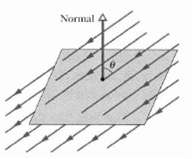
The square surface shown in Figure measures 3.2 mm on each side it is immersed in a uniform electric field with magnitude E = 1800 N/C and with field lines at an angle of θ = 35o with a normal to the surface, as shown. Take that normal to be directed "outward," as though the surface were one face
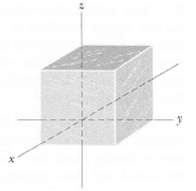
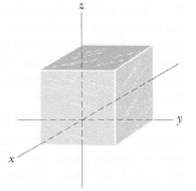
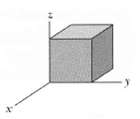
An electric field given by E = 4.0i – 3.0(y2 + 2.0)j pierces a Gaussian cube of edge length 2.0 m and positioned as shown in Figure (The magnitude E is in Newton’s per coulomb and the position x is in meters.) What is the electric flux through the(a) Top face,(b) Bottom face,(c) Left face,
The cube in Figure has edge length 1.40 m and is oriented as shown in a region of uniform electric field. Find the electric flux through the right face if the electric field, in Newton?s per coulomb, is given by? (a) 6.00i,? (b) ? 2.00j, and (c) ? 3.00i + 4.00k.? (d) What is x the total flux
At each point on the surface of the cube shown in Figure, the electric field is parallel to the z axis. The length of each edge of the cube is 3.0 m. On the top face of the cube E = ?? 34k N/C, and on the bottom face E = + 20k N/C. Determine the net charge contained within the cube.
A point charge of 1.8pC is at the center of a cubical Gaussian surface 55 cm on edge. What is the net electric flux through the surface?
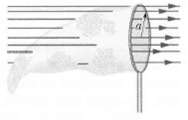
In Figure a butterfly net is in a uniform electric field of magnitude E = 3.0mN/C. The rim, a circle of radius a = 11 cm, is aligned perpendicular to the field. The net contains no net charge. Find the electric flux through the netting.
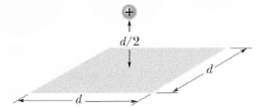
In Figure a proton is a distance d/2 directly above the center of a square of side d. What is the magnitude of the electric flux through the square?
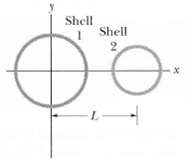
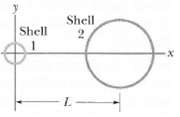
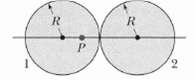
Figure shows two non-conducting spherical shells fixed in place. Shell 1 has uniform surface charge density + 6.0?C/m2 on its outer surface and radius 3.0 cm; shell 2 has uniform surface charge density + 4.0?C/m2?on its outer surface and radius 2.0 cm; the shell centers are separated by L = 10 cm.
It is found experimentally that the electric field in a certain region of Earth's atmosphere is directed vertically down. At an altitude of 300 m the field has magnitude 60.0 N/C; at an altitude of 200 m, the magnitude is 100 N/C. Find the net amount of charge contained in a cube 100 m on edge,
When a shower is turned on in a closed bathroom, the splashing of the water on the bare tub can fill the room's air with negatively charged ions and produce an electric field in the air as great as 1000 N/C. Consider a bathroom with dimensions 2.5m x 3.0m x 2.0m. Along the ceiling, floor, and four
Figure shows a Gaussian surface in the shape of a cube with edge length 1.40 m. What are?(a) The net flux Φ through the surface and(b) The net charge qenc enclosed by the surface if E = (3.00yj) N/C, with y in meters what are?(c) Φ and(d) qenc if E = [– 4.00i + (6.00 + 3 00y)j] N/C?
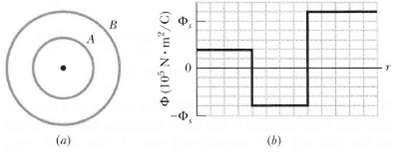
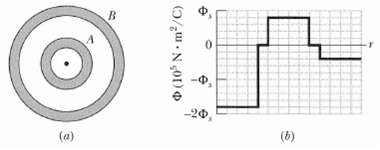
Flux and non-conducting shells a charged particle is suspended at the center of two concentric spherical shells that is very thin and made of non-conducting material. Figure (a) shows a cross section. Figure (b) gives the net flux ? through a Gaussian sphere centered on the particle, as a function
A particle of charge + q is placed at one corner of a Gaussian cube. What multiple of q/ε0 gives the flux through?(a) Each cube face forming that corner and(b) Each of the other cube faces?
Figure shows a closed Gaussian surface in the shape of a cube of edge length 2.00 m. It lies in a region where the electric field is given by E = (3.00x + 4.00)i + 6.00j + 7.00k N/C, What is the net charge contained by thecube?
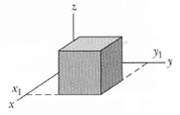
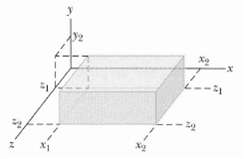
Figure shows a closed Gaussian surface in the shape of a cube of edge length 2.00 m, with one corner at x1 = 5.00m, y1 = 4.00m. The cube lies in a region where the electric field vector is given by E = ?? 3.00i - 4.00y2j + 3.00k N/C, with y in meters. What is the net charge contained by thecube?
The box-like Gaussian surface of Figure encloses a net charge of + 24.0?0 C and lies in an electric field given by E = [(10.0 +2.00x)i - 3.00j + bzk/N/C, with x and in meters and b a constant. The bottom face is in the xz plane; the top face is in the horizontal plane passing through y2 = 1.00 m.
Space vehicles traveling through Earth's radiation belts can intercept a significant number of electrons. The resulting charge buildup can damage electronic components and disrupt operations. Suppose a spherical metal satellite 1.3 m in diameter accumulates 2.4μC of charge in one orbital
Flux and conducting shells a charged particle is held at the center of two concentric conducting spherical shells. Figure (a) shows a cross section. Figure (b) gives the net flux ? through a Gaussian sphere centered on the particle, as a function of the radius r of the sphere. The scale of the
A uniformly charged conducting sphere of 1.2 m diameter has a surface charge density of 8.1μC/m2.(a) Find the net charge on the sphere.(b) What is the total electric flux leaving the surface of the sphere?
The electric field just above the surface of the charged drum of a photocopying machine has a magnitude E of 2.3 x 10⁵ N/C. What is the surface charge density on the drum, assuming the drum is a conductor?
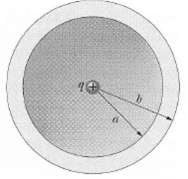
An isolated conductor of arbitrary shape has a net charge of + 10 x 10-6 C. Inside the conductor is a cavity within which is a point charge q = + 3.0 x 10⁻⁶ C. What is the charge on?(a) The cavity wall and(b) On the outer surface of the conductor?
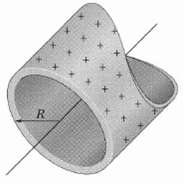
Figure shows a section of a long, thin-walled metal tube of radius R = 3.00 cm, with a charge per unit length ? = 2.00 x 10⁻⁸C/m. What is the magnitude E of the electric field at radial distance? (a) r = R/2.00 and? (b) r = 2.00R?? (c) Graph E versus r for the range r = 0 to 2.00R.
An in finite line of charge produces a field of magnitude 4.5 x 10⁴ N/C at a distance of 2.0 m. Calculate the linear charge density.
An electron is released from rest at a perpendicular distance of 9.0 cm from a line of charge on a very long non-conducting rod. That charge is uniformly distributed, with 6.0μC per meter. What is the magnitude of the electron's initial acceleration?
(a) The drum of a photocopying machine has a length of 42 cm and a diameter of 12 cm. The electric field just above the drum's surface is 2.3 x 10⁵ N/C. What is the total charge on the drum?(b) The manufacturer wishes to produce a desktop version of the machine. This requires reducing the drum
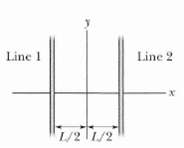
In Figure short sections of two very long parallel lines of charge are show, fixed in place, separated by L = 8.0 cm. The uniform linear charge densities are + 6.0?C/m for line 1 and ? 2.0?C/m for line 2.Where along the x axis shown is the net electric field from the two lines zero?
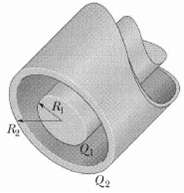
Figure is a section of a conducting rod of radius R1?= 1.30 mm and length L = 11.00 m inside a thin-walled coaxial conducting cylindrical shell of radius R2 = 10.0R1 and the (same) length L. The net charge on the rod is Q1 = + 3.40 x 10⁻¹² C; that on the shell is Q2 = ?2.00Q1. What are the? (a)
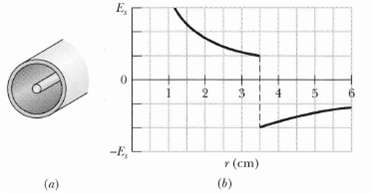
Figure a, shows a narrow charged solid cylinder that is coaxial with a larger charged cylindrical shell. Both are non-conducting and thin and have uniform surface charge densities on their outer surfaces. Figure b, gives the radial component E of the electric field versus radial distance r from the
Two long, charged, thin-walled, concentric cylindrical shells have radii of 3.0 and 6.0 cm. The charge per unit length is 5.0 x 10⁻⁶Cm on the inner shell and – 7.0 x 10⁻⁶ C/m on the outer shell. What are the(a) Magnitude E and(b) Direction (radially inward or outward) of the electric field at
A charge of uniform linear density 2.0nC/m is distributed along a long, thin, non-conducting rod. The rod is coaxial with a long conducting cylindrical shell (inner radius = 5.0 cm, outer radius = 10 cm). The net charge on the shell is zero.(a) What is the magnitude of the electric field 15 cm from
A long, straight wire has fixed negative charge with a linear charge density of magnitude 3.6nC/m. The wire is to be enclosed by a coaxial, thin-walled non-conducting cylindrical shell of radius 1.5 cm. The shell is to have positive charge on its outside surface with a surface charge density σ
A long, non-conducting, solid cylinder of radius 4.0 cm has a non-uniform volume charge density p that is a function of radial distance r from the cylinder axis: p = Ar2. For A = 2.5μC/m5, what is the magnitude of the electric field at(a) r = 3.0 cm and(b) r = 5.0 cm?
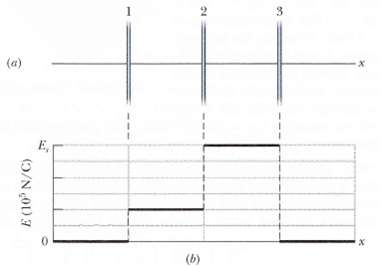
Figure a, shows three plastic sheets that are large, parallel, and uniformly charged. Figure b, gives the component of the net electric field along an x axis through the sheets. The scale of the vertical axis is set by Es = 6.0 x 10⁵ N/C. What is the ratio of the charge density on sheet 3 to that
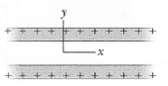
Figure shows cross sections through two large, parallel, non-conducting sheets with identical distributions of positive charge with surface charge density σ = 1.77 x 10⁻²²C/m2. In unit-vector notation, what is E at points (a) Above the sheets, (b) Between them, and (c) Below them?
A square metal plate of edge length 8.0 cm and negligible thickness has a total charge of 6.0 x 10⁻⁶ C.(a) Estimate the magnitude E of the electric field just off the center of the plate (at, say, a distance of 0.50 mm from the center) by assuming that the charge is spread uniformly over the two
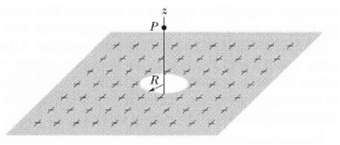
In Figure a small circular hole of radius R = 1.80 cm has been cut in the middle of an infinite, flat, non-conducting surface that has uniform charge density σ = 4.50pC/m2. A z axis, with its origin at the holes center, is perpendicular to the surface. In unit-vector notation, what is the electric
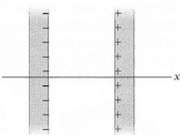
In Figure two large, thin metal plates are parallel and close to each other. On their inner faces, the plates have excess surface charge densities of opposite signs and magnitude 7.00 x 10⁻²²C/m2. In unit-vector notation, what is the electric field at points? (a) To the left of the plates, (b) To
Two large metal plates of area 1.0 m2 face each other. They are 5.0 cm apart and have equal but opposite charges on their inner surfaces. If the magnitude E of the electric field between the plates is 55 N/C, what is the magnitude of the charge on each plate? Neglect edge effects.
An electron is shot directly toward the center of a large metal plate that has surface charge density –2.0 x 10⁻⁶ C/m2. If the initial kinetic energy of the electron is 1.60 x l0-17J and if the electron is to stop (due to electrostatic repulsion from the plate) just as it reaches the plate, how
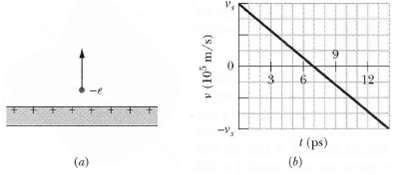
In Figure a, an electron is shot directly away from a uniformly charged plastic sheet, at speed vs = 2.0 x 10⁵ m/s. The sheet is non-conducting, flat, and very large. Figure b, gives the electron's vertical velocity component y versus time t until the return to the launch point. What is the sheet's
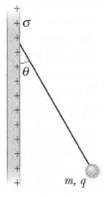
In Figure a small, non-conducting ball of mass m = 1.0 mg and charge q = 2.0 x 10⁻⁸C (distributed uniformly through its volume) hangs from an insulating thread that makes an angle ? = 30o with a vertical, uniformly charged non-conducting sheet (shown in cross section). Considering the gravitational
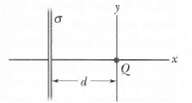
Figure shows a very large non-conducting sheet that has a uniform surface charge density of ? = - 2.00?C/m2; it also shows a particle of charge Q = 6.00?C, at distance d from the sheet. Both are fixed in place. If d = 0.200 m, at what? (a) Positive and? (b) Negative coordinate on the x axis (other
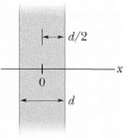
Figure shows a cross section through a very large non-conducting slab of thickness d = 9.40 mm and uniform volume charge density p = 5.80fC/m3. The origin of an x axis is at the slab's center. What is the magnitude of the slab's electric field at an x coordinate of? (a) 0, (b) 2.00mm, (c) 4.70 mm,
A point charge causes an electric flux of – 750N ∙ m2/C to pass through a spherical Gaussian surface of 10.0cm radius centered on the charge?(a) If the radius of the Gaussian surface were doubled, how much flux would pass through the surface?(b) What is the value of the point charge?
An unknown charge sits on a conducting solid sphere of radius 10 cm. If the electric field 15 cm from the center of the sphere has the magnitude 3.0 x 10³ N/C and is directed radially inward, what is the net charge on the sphere?
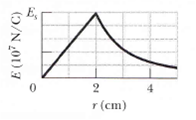
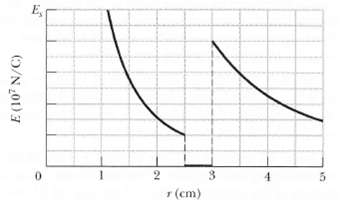
Figure gives the magnitude of the electric field inside and outside a sphere with a positive charge distributed uniformly throughout its volume. The scale of the vertical axis is set by Es = 5.0 x 10⁷ N/C. What is the charge on the sphere?
Two charged concentric spherical shells have radii 10.0 cm and 15.0 cm. The charge on the inner shell is 4.00 x 10⁻⁸ C, and that on the outer shell is 2.00 x 10⁻⁸ g. Find the electric field(a) At r = 12.0 cm and(b) At r = 20.0 cm.
Figure shows two non-conducting spherical shells fixed in place on an x axis. Shell t has uniform surface charge density + 4.0?C/m2 on its outer surface and radius 0.50cm, and shell 2 has uniform surface charge density ? 2.00?C/m2?on its outer surface and radius 2.0 cm; the centers are separated by
In Figure a non-conducting spherical shell of inner radius a = 2.00 cm and outer radius b = 2.40 cm has (within its thickness) a positive volume charge density p = A/r, where A is a constant and r is the distance from the center of the shell. In addition, a small ball of charge q = 45.0fC is
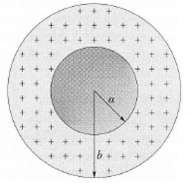
Figure shows a spherical shell with uniform volume charge density p = 1.84nC/m3, inner radius a = 10.0 cm, and outer radius b = 2.00a.What is the magnitude of the electric field at radial distances (a) r = 0; (b) r = a/2.00, (c) r = a, (d) r = 1.50a, (e) r = b, and (f) r =3.00b?
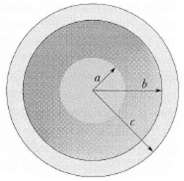
In Figure a solid sphere of radius a = 2.00 cm is concentric with a spherical conducting shell of inner radius b = 2.00a and outer radius c = 2.40a. The sphere has a net uniform charge q1 = + 5.00fC; the shell has a net charge q2 = q1. What is the magnitude of the electric field at radial
A charged particle is held at the center of a spherical shell. Figure gives the magnitude E of the electric field versus radial distance r. The scale of the vertical axis is set by Es = 10.0 x 10⁷ N/C. Approximately, what is the net charge on the shell?
A charge distribution that is spherically symmetric but not uniform radially produces an electric field of magnitude E = Kr4, directed radially outward from the center of the sphere. Here r is the radial distance from that center, and K is a constant. What is the volume density p of the charge
Figure shows in cross-section two solid spheres with uniformly distributed charge throughout their volumes. E ach has radius R. Point P lies on a line connecting the centers of the spheres, at radial distance R/R2.00 from the center of sphere 1. If the net electric field at point P is zero, what is
A solid non-conducting sphere of radius R = 5.60 cm has a non-uniform charge distribution of volume charge density p: (14.1pC/m3)r/R, where r is radial distance from the sphere's center.(a) What is the sphere's total charge? What is the magnitude E of the electric field at(b) r = 0,(c) r = R/2.00,
The chocolate crumb mystery explosions ignited by electrostatic discharges (sparks) constitute a serious danger in facilities handling grain or powder. Such an explosion occurred in chocolate crumb powder at a biscuit factory in the 1970s. Workers usually emptied newly delivered sacks of the powder
Charge Q is uniformly distributed in a sphere of radius R.(a) What fraction of the charge is contained within radius r = R/2.00?(b) What is the ratio of the electric field magnitude at r = R/2.00 to that on the surface of the sphere?
Charge of uniform volume p = 3.2μC/m3 fills a non-conducting solid sphere of radius 5.0cm. What is the magnitude of the electric field?(a) 3.5 cm and(b) 8.0cm from the sphere's center
The electric field at point P just outside the outer surface of a hollow spherical conductor of inner radius 10 cm and outer radius 20 cm has magnitude 450 N/C and is directed outward. When an unknown point charge Q is introduced into the center of the sphere, the electric field at P is still
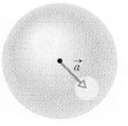
Assume that a ball of charged particles has a uniformly distributed negative charge density except for a narrow radial tunnel through its center, from the surface on one side to the surface on the opposite side. Also assume that we can position a proton anywhere along the tunnel or outside the
Charge of uniform volume density p = 1.2nC/m3 fills an infinite slab between x = – 5.0 cm and x = +5.0 cm. What is the magnitude of the electric field at any point with the coordinate?(a) x = 4.0 cm and(b) x = 6.0 cm?
A uniform surface charge of density 8.0nC/m2 is distributed over the entire xy plane. What is the electric flux through a spherical Gaussian surface centered on the origin and having a radius of 5.0 cm?
A thin-walled metal spherical shell has radius 25.0 cm and charge 2.00 x 10⁻⁷ g. Find E for a point(a) Inside the shell,(b) Just outside it, and(c) 3.00 m from the center
The electric field in a particular space is E = (x + 2)i N/C, with r in meters. Consider a cylindrical Gaussian surface of radius 20 cm that is coaxial with the x axis. One end of the cylinder is at x = 0.(a) What is the magnitude of the electric flux through the other end of the cylinder at x =
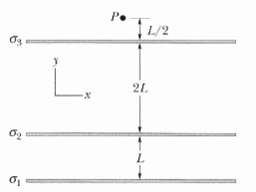
Figure shows, in cross section, three infinitely large non-conducting sheets on which charge is uniformly spread. The surface charge densities are ?1 = +2.00pC/m2 ?2 = +4.00pC/m2, and ?3 = ? 5.00?C/m2, and distance L = 1.50 cm. In unit-vector notation, what is the net electric field at point P?
The net electric flux through each face of a die (singular of dice) has a magnitude in units of 103 N ∙ m2 that is exactly equal to the number of spots l/ on the face (1 through 6). The flux is inward for l/ odd and outward for N even. What is the net charge inside the die?
A Gaussian surface in the form of a hemisphere of radius R = 5.68 cm lies in a uniform electric field of magnitude E = 2.50 N/C. The surface encloses no net charge. At the (flat) base of the surface, the field is perpendicular to the surface and directed into the surface. What is the flux
A point charge q = 1.0 x 10⁻⁷ C is at the center of a spherical cavity of radius 3.0 cm in a chunk of metal. Use Gauss' law to find the electric field(a) 1.5 cm from the cavity center and(b) Anyplace in the metal.
A thin-walled metal spherical shell of radius a has a charge qa. Concentric with it is a thin-walled metal spherical shell of radius b > a and charge qb. Find the electric field at points a distance r from the common center, where(a) r < a,(b) a < r < b, and(c) r > b.(d) Discuss the
What net charge is enclosed by the Gaussian cube of Problem2?
A proton with speed v = 3.00 x 10⁵ m/s orbits just outside a charged sphere of radius r = 1.00 cm. What is the charge on the sphere?
Equation 23-11 (E = σ/ε0) gives the electric field at points near a charged conducting surface. Apply this equation to a conducting sphere of radius r and charge q, and show that the electric field outside the sphere is the same as the field of a point charge located at the center of the sphere.
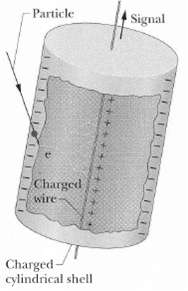
Figure shows a Geiger counter, a device used to detect ionizing radiation, which causes ionization of atoms. A thin, positively charged central wire is surrounded by a concentric, circular, conducting cylindrical shell with an equal negative charge, creating a strong radial electric field. The
Charge is distributed uniformly throughout the volume of an infinitely long solid cylinder of radius R.(a) Show that, at a distance r < R from the cylinder axis, E = pr/2ε0, where p is the volume charge density"(b) Write an expression fore when r > R.
Water in an irrigation ditch of width w = 3.22 m and depth d = 1.04 m flows with a speed of 0.20Jm/s. The mass flux of the flowing water through an imaginary surface is the product of the water's density (1000 kg/m3) and its volume flux through that surface. Find the mass flux through the following
A free electron is placed between two large, parallel, non-conducting plates that are horizontal and 2.3 cm apart. One plate has a uniform positive charge; the other has an equal amount of uniform negative charge. The force on the electron due to the electric field E between the plates balances the
A non-conducting solid sphere has a uniform volume charge density p. Let V be the vector from the center of the sphere to a general point P within the sphere.? (a) Show that the electric field at P is given by E = pr/3?0. (Note that the result is independent of the radius of the sphere.)? (b) A
A uniform charge density of 500nC/m3 is distributed throughout a spherical volume of radius 6.00 cm. Consider a cubical Gaussian surface with its center at the center of the sphere. What is the electric flux through this cubical surface if its edge length is(a) 4.00 cm and(b) 14.0 cm
Showing 3700 - 3800
of 8940
First
31
32
33
34
35
36
37
38
39
40
41
42
43
44
45
Last
Step by Step Answers

 Get 50% OFF
Claim Now
Get 50% OFF
Claim Now