New Semester
Started
Get
50% OFF
Study Help!
--h --m --s
Claim Now
Question Answers
Textbooks
Find textbooks, questions and answers
Oops, something went wrong!
Change your search query and then try again
S
Books
FREE
Study Help
Expert Questions
Accounting
General Management
Mathematics
Finance
Organizational Behaviour
Law
Physics
Operating System
Management Leadership
Sociology
Programming
Marketing
Database
Computer Network
Economics
Textbooks Solutions
Accounting
Managerial Accounting
Management Leadership
Cost Accounting
Statistics
Business Law
Corporate Finance
Finance
Economics
Auditing
Tutors
Online Tutors
Find a Tutor
Hire a Tutor
Become a Tutor
AI Tutor
AI Study Planner
NEW
Sell Books
Search
Search
Sign In
Register
study help
physics
electricity and magnetism
Fundamentals of Physics 8th Extended edition Jearl Walker, Halliday Resnick - Solutions
A spherical water drop 1.20 pm in diameter is suspended in calm air due to a downward-directed atmospheric electric field of magnitude E = 462N/C. (a) What is the magnitude of the gravitational force on the drop? (b) How many excess electrons does it have?
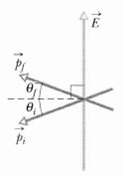
In Figure an electric dipole swings from an initial orientation i (?i = 20.0o) to a final orientation f (?i = 20.0o) in a uniform external electric field E. The electric dipole moment is 1.60 x 10⁻²¹ C ? m; the field magnitude is 3.00 x 10⁶ N/C. What is the change in the dipole's potential energy?
A charge of 20nC is uniformly distributed along a straight rod of length 4.0 m that is bent into a circular arc with a radius of 2.0 m. What is the magnitude of the electric field at the center of curvature of the arc?
(a) What is the magnitude of an electron's acceleration in a uniform electric field of magnitude 1.40 x 10⁶ N/C? (b) How long would the electron take, starting from rest, to attain one tenth the speed of light? (c) How far would it travel in that time?
A clock face has negative point charges – q, – 2q, – 3q, . . , –12q fixed at the positions of the corresponding numerals the clock hands do not perturb the net field due to the point charges. At what time does the hour hand point in the same direction as the electric field vector at the
An electron is constrained to the central axis of the ring of charge of radius R in Figure with z << R. Show that the electrostatic force on the electron can cause it to oscillate through the ring center with an angular frequency w = √eq/πε0mR3 where q is the ring's charge and m rs the
An electric field E with an aver age magnitude of about 150 N/C points downward in the atmosphere near Earth's surface. We wish to "float" a sulfur sphere weighing 4.4 N in this field by charging the sphere. (a) What charge (both sign and magnitude) must be used? (b) Why is the experiment
Calculate the electric dipole moment of an electron and a proton 4.30 nm apart.
The electric field in an xy plane produced by a positively charged particle is 7.2(4.0i + 3.0j) N/C at the point (3.0, 3.0) cm and 100i N/C at the point (2.0, 0) cm. What are the (a) x and (b) y coordinates of the particle? (c) What is the charge of the particle?
A circular rod has a radius of curvature R = 9.00 cm and a uniformly distributed positive charge Q = 6.25pC and subtends an angle θ = 2.40 rad. What is the magnitude of the electric field that Q produces at the center of curvature?
An electric dipole with dipole moment p = (3.00i + 4.00j) (1.24 x 10⁻³⁰ C ∙ m) in an electric field E = (4000 N/C)i. (a) What is the potential energy of the electric dipole? (b) What is the torque acting on it? (c) If an external agent turns the dipole until its electric dipole
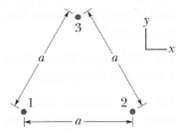
In Figure particle 1 (of charge + 2.00pC), particle 2 (of charge ?? 2.00pC), and particle 3 (of charge + 5.00pC) form an equilateral triangle of edge length a = 9.50 cm. (a) Relative to the positive direction of the x axis determines the direction of the force Ft on particle 3 due to the other
A charge (uniform linear density = 9.0nC/m) lies on a string that is stretched along an x axis from x = 0 to x = 3.0 m. Determine the magnitude of the electric field at x = 4.0 m on the x axis.
Two particles, each of positive charge q, are fixed in place on ay axis, one at y = d and the other at y = – d. (a) Write an expression that gives the magnitude E of the net electric field at points on the x axis given by x = ad. (b) Graph E versus a for the range 0 < a < 4. From the graph,
In Figure particle 1 of charge q1 = 1.00pC and particle 2 of charge q1 = ? 2.00pC are fixed at a distance d = 5.00 cm apart. In unit-vector notation, what is the net electric field at points?? (a) A,? (b) B, and? (c) C?? (d) Sketch the electric field lines.
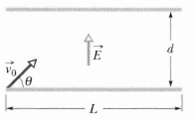
In Figure a uniform upward electric field E of magnitude 2.00 x 10³ N/C has been set up between two horizontal plates by charging the lower plate positively and the upper plate negatively. The plates have length L = 10.0cm and separation d = 2.00cm. An electron is then shot between the plates from
For the data of Problem 62, assume that the charge q on the drop is given | by q = ne, where n is an integer and e is the elementary charge.(a) Find n for each given value of q.(b) Do a linear regression fit of the values of q versus the values of n and then use that fit to find e.
In Figure let both charges be positive, assuming z >> d, show that E at point P in that figure is then given by E = 1/4πε0 2q/z2.
A wire of resistance 5.0Ω is connected to a battery whose emf ξ is 2.0 V and whose internalresistance is 1.0Ω. In 2.0 min, how much energy is?(a) Transferred from chemical form in the battery,(b) Dissipated as thermal energy in the wire, and(c) Dissipated as thermal energy in the battery?
A certain car battery with a 12.0 V emf has an initial charge of 120 A ∙ h. Assuming that the potential across the terminals stays constant until the battery is completely discharged, for how many hours can it deliver energy at the rate of 100 W?
A 5.0 A current is set up in a circuit for 6.0 min by a rechargeable battery with a 6.0 V emf. By how much is the chemical energy of the battery reduced?
A standard flashlight battery can deliver about 2.0 W ∙ h of energy before it runs down.(a) If a battery costs US$0.80, what is the cost of operating a 100 W lamp for 8.0 h using batteries?(b) What is the cost if energy is provided at the rate of US$0.06 per kilowatt-hour?
A car battery with a 12 V emf and an internal resistance of 0.040Ω is being charged with a current of 50 A. What are?(a) The potential difference V across the terminals,(b) The rate Pr of energy dissipation inside the battery, and(c) The rate Pemf of energy conversion to chemical form? When the
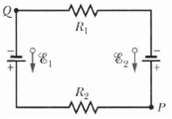
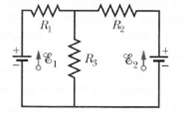
In Figure the ideal batteries have emf ?1 = 150 V and ??2 = 50 V and the resistances are R1 = 3.0? and R2 = 2.0 A. If the potential at P is defined to be 100 V, what is the potential at Q?
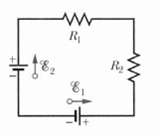
In Figure the ideal batteries have emfsξ1 = 12 V and ξ2 = 6.0 V and the resistors have resistances R1 = 4.0?? and R2 = 8.0??. What are? (a) The current, the dissipation rate in (b) Resistor 1 and (c) Resistor 2 and the energy transfer rate in (d) Battery 1 and (e) Battery 2? Is energy being
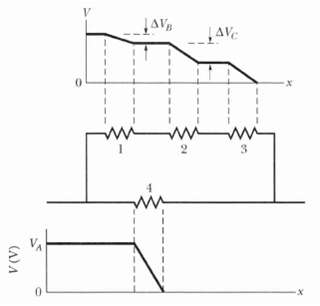
Figure shows a circuit of four resistors that are connected to a larger circuit. The graph below the circuit shows the electric potential V(x) as a function of position x along the lower branch of the circuit, through resistor 4; the potential VA is 12.0 V. The graph above the circuit shows the
A total resistance of 3.00 Ω is to be produced by connecting an unknown resistance to a 12.0Ω resistance.(a) What must be the value of the unknown resistance, and(b) Should it be connected in series or in parallel?
(a) In electron-volts, how much work does an ideal battery with a 12.0 V emf do on an electron that passes through the battery from the positive to the negative terminal?(b) If 3.40 x 10¹⁸ electrons pass through each second, what is the power of the battery in watts?
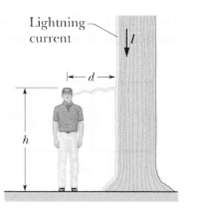
Side flash figure indicates one reason no one should stand under a tree during a lightning storm. If lightning comes down the side of the tree, a portion can jump over to the person, especially if the current on the tree reaches a dry region on the bark and thereafter must travel through air to
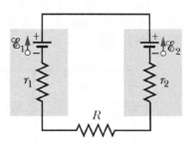
(a) In Figure what value must R have if the current in the circuit is to be 1.0 mA? Take ?1 = 2.0V, ?2 = 3.0 V and r1 = r2 = 3.0? (b) What is the rate at which thermal energy appears in R?
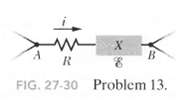
In Figure circuit section AB absorbs energy at a rate of 50 W when current i = 1.0 A through it is in the indicated direction. Resistance R = 2.0?. (a) What is the potential difference between A and B? Emf device X lacks internal resistance. (b) What is its emf? (c) Is point B connected to the
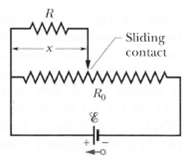
Figure shows a battery connected across a uniform resistor R0 A sliding contact can move across the resistor from x = 0 at the left to x = 10 cm at the right. Moving the contact changes how much resistance is to the left of the contact and how much is to the right. Find the rate at which energy is
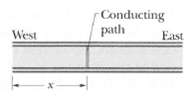
An l0-km-long underground cable extends east to west and consists of two parallel wires each of which has resistance 13?/km. An electrical short develops at distance x from the west end when a conducting path of resistance R connects the wires (Figure). The resistance of the wires and the short is
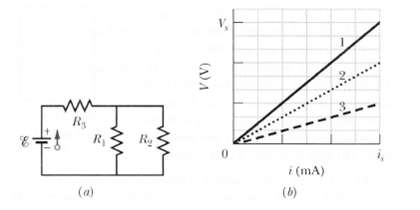
The ideal battery in Figure a has emf ? = 6.0 V. Plot 1 in Figure b gives the electric potential difference V that can appear across resistor 1 of the circuit versus the current i in that resistor. The scale of the Taxis is set by Vs = 18.0V, and the scale of the i axis is set by is = 3.00 mA.
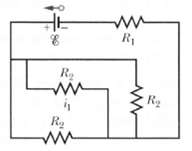
Figure R1 = 6.00?, R2 = 18.0? and the ideal battery has emf ? = 12.0 V. What are the (a) Size and (b) Direction (left or right) of current it? (c) How much energy is dissipated by all four resistors in 1.00 min?
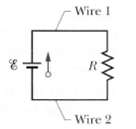
Figure shows a resistor of resistance R = 6.00? connected to an ideal battery of emf ? = 12.0V by means of two copper wires. Each wire has length 20.0 cm and radius 1.00 mm. In dealing with such circuits in this chapter, we generally neglect the potential differences along the wires and the
The current in a single-loop circuit with one resistance R is 5.0 A. When an additional resistance of 2.0Ω is inserted in series with R the current drops to 4.0 A. What is R?
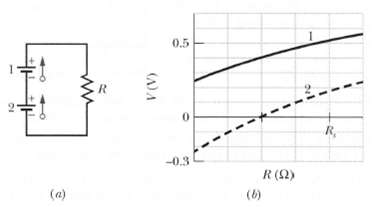
In Figure ?a? both batteries have emf ? = 1.20 V and the external resistance R is a variable resistor. Figure ?b? gives the electric potentials 7 between the terminals of each battery as functions of R: Curve 1 corresponds to battery 1, and curve 2 corresponds to battery 2. The horizontal scale is
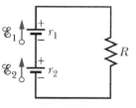
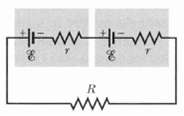
In Figure battery 1 has emf 1 = 12.0V and the resistance r1 = 0.016? and the battery 2 has emf ?2 = 12.0V and internal resistance r2 = 0.012?. The batteries are connected in series witan external resistance R. (a) What R value makes the terminal-to-terminal potential difference of one of the
A solar cell generates a potential difference of 0.10 V when a 500Ω resistor is connected across it, and a potential difference of 0.15 V when a 1000Ω resistor is substituted. What are the(a) Internal resistance and(b) Emf of the solar cell?(c) The area of the cell is 5.0 cm2, and the rate per
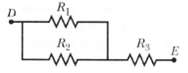
In Figure R1 = R2 = 4.00? and R3?= 2.50?. Find the equivalent resistance between points D and E.
When resistors 1 and 2 are connected in series, the equivalent resistance is 16.0Ω. When they are connected in parallel, the equivalent resistance is 3.0Ω. What are?(a) The smaller resistance and(b) The larger resistance of these two resistors?
Four 18.0Ω resistors are connected in parallel across a 25.0 V ideal battery. What is the current through the battery?
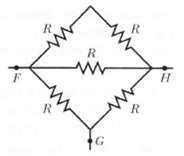
Figure shows five 5.00? resistors. Find the equivalent resistance between points (a) F and H and (b) F and G.
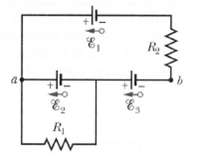
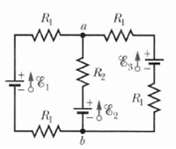
In Figure R1 = 100?, R2 = 50?, and the ideal batteries have emf s ?1 = 6.0 V, ?2 = 5.0 V, and ?3 = 4.0 V. Find (a) The current in resistor 1, (b) The current in resistor 2, and (c) The potential difference between points a and b.
In Figure, what is the potential difference Vd - Vc, between points d and c if ξ1 = 4.0 V, ξ2 = 1.0 V, R1 = R2 = 10Ω, and R3 = 5.0Ω, and the battery is ideal?
Nine copper wires of length l and diameter d are connected in parallel to form a single composite conductor of resistance R. What must be the diameter D of a single copper wire of length l if it is to have the same resistance?
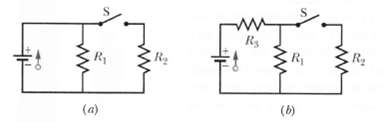
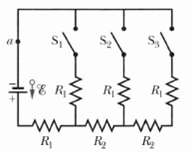
The resistances in Figure a and b are all 6.0?, and the batteries are ideal 12V batteries. (a) When switch S in Figure a is closed, what is the change in the electric potential V1 across resistor 1, or does V1 remain the same? (b) When switch S in Figure b is closed, what is the change in V1 across
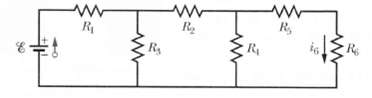
In Figure the current in resistance 6 is i6 = 1.40 A and the resistances are R1 = R2 = R3 = 2.00?, R4 = 16.0?, R5?= 8.00?, and R6 = 4.00?. What is the emf of the ideal battery?
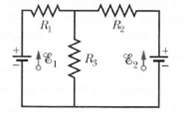
In Figure the ideal batteries have emfs?1 = 10.0 V and ?2 = 0.500?1, and the resistances are each 4.00 0. What is the current in? (a) Resistance 2 and (b) Resistance 3?
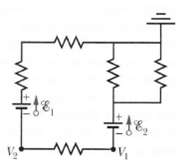
In Figure the ideal batteries have emfs?1 = 5.0 V and ?2 = 12 V, the resistances are each 2.0?, and the potential is defined to be zero at the grounded point of the circuit. What are potentials? (a) V1 and (b) V2 at the indicated points?
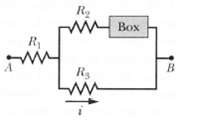
Figure shows a section of a circuit. The resistances are R1 = 2.0?, R2 = 4.0?, and R3 = 6.0?, and the indicated current is i = 6.0 A. The electric potential difference between points A and B that connect the section to the rest of the circuit is VA - VB = 78 V. (a) Is the device represented by
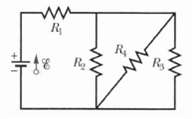
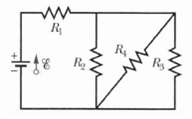
In Figure R1 = 2.00?, R2 = 5.00?, and the battery is ideal. What value of R3 maximizes the dissipation rate in resistance 3?
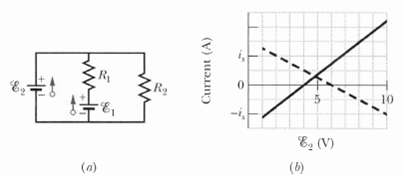
Both batteries in Figure a are ideal. Emf ?1 of battery 1 has a fixed value, but emf ?2 of battery 2 can be varied between 1.0 V and 10 V. The plots in Figure b give the currents through the two batteries as a function of ?2. The vertical scale is set by is = 0.20 A. You must decide which plot
In Figure, the resistances are R1 = 1.0? and R2 = 2.0?, and the ideal batteries have emf s ?1 = 2.0V and ?2 = ?3 = 4.0 V. What are the (a) Size and (b) Direction (up or down) of the current in battery 1, the (c) Size and (d) Direction of the current in battery 2, and the (e) Size and (f) Direction
In Figure ?1 = 6.00 V, ?2 = 12.0 V, R1 = 100?, R2 = 200?, and R3 = 300?. One point of the circuit is grounded (V = 0). What are the (a) Size and (b) Direction (up or down) of the current through resistance 1, the (c) Size and (d) Direction (left or right) of the current through resistance 2, and
In Figure ? = 12.0V, R1 = 2000?, R2 = 3000? and R3 = 4000?. What are the potential differences? (a) VA - VB, (b) VB?- VC, (c) VC?- VD, and (d) VA - VC?
In Figure R1 = 100? R2 = R3 = 50.0?, R4 = 75.0?, and the ideal battery has emf ? = 6.00 V. (a) What is the equivalent resistance? What is i in (b) Resistance 1, (c) Resistance 2, (d) Resistance 3, and (e) Resistance 4? (e) Resistance 4?
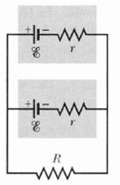
In Figure two batteries of emf ? = 12.0 V and internal resistance r = 0.300? are connected in parallel across a resistance R. (a) For what value of R is the dissipation rate in the resistor a maximum? (b) What is that maximum?
Two identical batteries of emf ? = 12.0 V and internal resistance r = 0.200? are to be connected to an external resistance R either in parallel (Figure) or in series (Figure). If R = 2.00r, what is the current i in the external resistance in the (a) Parallel and (b) Series arrangements? (c) For
In Figure ?1 = 3.00 V, ?2 = 1.00 V, R1 = 4.00?, R2 = 2.00?, R3 = 5.00?, and both batteries are ideal. What is the rate at which energy is dissipated in?(a) R1,(b) R2, and(c) R3? What is the power of?(d) Battery 1 and(e) Battery 2?
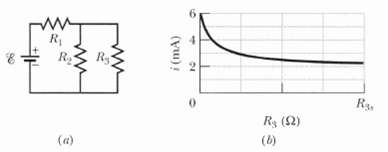
In Figure a resistor 3 is a variable resistor and the ideal battery has emf ? = 12 V. Figure b gives the current i through the battery as a function of R3. The horizontal scale is set by R3 = 20?. The curve has an asymptote of 2.0 mA as R3???. What are? (a) Resistance R1 and (b) Resistance R2?
You are given a number of 10Ω resistors, each capable of dissipating only 1.0 W without being destroyed. What is the minimum number of such resistors that you need to combine in series or in parallel to make a 10Ω resistance that is capable of dissipating at least 5.0 W?
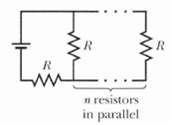
In Figure an array of n parallel resistors is connected in series to a resistor and an ideal battery. All the resistors have the same resistance. If an identical resistor were added in parallel to the parallel array, the current through the battery would change by 1.25%. What is the value of n?
A copper wire of radius a = 0.250 mm has an aluminum jacket of outer radius b = 0.380 mm. There is a current i = 2.00 A in the composite wire. Using Table 26-1, calculate the current in(a) The copper and(b) The aluminum.(c) If a potential difference V = 12.0 V between the ends maintains the
In Figure R1 = 7.00?, R2 = 12.0?, R3?= 4.00?, and the ideal battery's emf is ? = 24.0 V. For what value of R4 will the rate at which the battery transfers energy to the resistors equal (a) 60.0 W, (b) The maximum possible rate P max, and (c) The minimum possible rate P min? What are? (d) P max
In Figure assume that ξ = 3.0 V, r = 100Ω, R1 = 250Ω and R3 = 300Ω. If the voltmeter resistance R v is 5.0Ω, what percent error does it introduce into the measurement of the potential difference across R1? Ignore the presence of the ammeter.
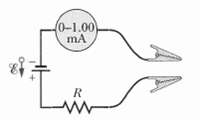
A simple ohmmeter is made by connecting a 1.50 V flashlight battery in series with a resistance R and an ammeter that reads from 0 to 1.00 mA shown in Figure. Resistance R is adjusted so that when the clip leads are shorted together, the meter deflects to its full-scale value of 1.00 mA. What
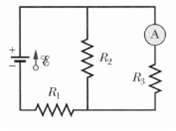
(a) In Figure what does the ammeter read if ? = 5.0 V (ideal battery), R1 = 2.0?, R2 = 4.0?, and R3 = 6.0?? (b) The ammeter and battery are now interchanged. Show that the ammeter reading is unchanged.?
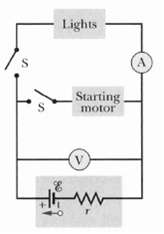
When the lights of a car are switched on, an ammeter in series with them reads 10.0 A and a voltmeter connected across them reads 12.0 V (Figure). When the electric starting motor is turned on, the ammeter reading drops to 8.00 A and the lights dim somewhat. If the internal resistance of the
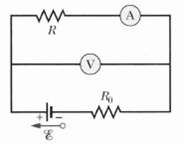
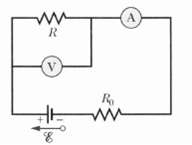
In Figure, a voltmeter of resistance R v = 300? and an ammeter of resistance RA = 3.00? are being used to measure a resistance R in a circuit that also contains a resistance R0 = 100? and an ideal battery of emf ? = 12.0 V. Resistance R is given by R = V/i, where V is the potential across R and i
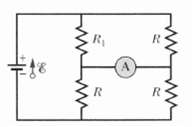
In Figure R1 = 2.00R, the ammeter resistance is zero, and the battery is ideal. What multiple of ?/R gives the current in the ammeter?
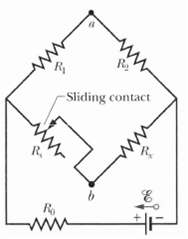
In Figure, Rs is to be adjusted in value by moving the sliding contact across it until points a and b are brought to the same potential. (One test for this condition by momentarily connecting a sensitive ammeter between a and b if these points are at the same potential. the ammeter will not
In Figure a voltmeter of resistance R v = 300? and an ammeter of resistance RA = 3.00? are being used to measure a resistance R in a circuit that also contains a resistance R0 = 100? and an ideal battery of emf ? = 12.0 V. Resistance R is given by R = V/i, where V is the voltmeter reading and i is
What multiple of the time constant τ gives the time taken by an initially uncharged capacitor in an RC series circuit to be charged to 99.0% of its final charge?
A capacitor with initial charge q0 is discharged through a resistor. What multiple of the time const ant r gives the time the capacitor takes to lose(a) The first one-third of its charge and(b) Two-thirds of its charge?
A 15.0kΩ resistor and a capacitor are connected in series, and then a 12.0 V potential difference is suddenly applied across them. The potential difference across the capacitor rises to 5.00 V in 1.30μs.(a) Calculate the time constant of the circuit.(b) Find the capacitance of the capacitor
In an RC series circuit, ξ = 12.0 V, R = 1.40 MΩ, and C = 1.80μF.(a) Calculate the time constant.(b) Find the maximum charge that will appear on the capacitor during charging.(c) How long does it take for the charge to build up to 16.0μC?
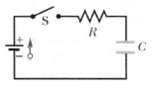
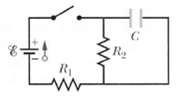
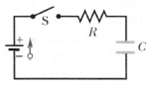
Switch S in Figure is closed at time t = 0, to begin charging an initially uncharged capacitor of capacitance C = 15.0μF through a resistor of resistance R = 20.0??. At what time is the potential across the capacitor equal to that across the resistor?
A capacitor with an initial potential difference of 100 V is discharged through a resistor when a switch between them is closed at t = 0. At t = 10.0 s, the potential difference across the capacitor is 1.00 V.(a) What is the time constant of the circuit?(b) What is the potential difference across
The potential difference between the plates of a leaky (meaning that charge leaks from one plate to the other) 2.0μF capacitor drops to one-fourth its initial value in 2.0 s. What is the equivalent resistance between the capacitor plates?
A 1.0μF capacitor with an initial stored energy of 0.50 J is discharged through a 1.0 MΩ resistor. (a) What is the initial charge on the capacitor? (b) What is the current through the resistor when the discharge starts? Find an expression that gives, as a function of time t, (c) The
In the circuit of Figure ξ = l.2kV, C = 6.5μF, R1 = R2 = R3 = 0.73 MΩ. With C completely uncharged, switch S is suddenly closed (at t = 0). At t = 0, what are(a) Current i1 in resistor 1,(b) Current i2 in resistor 2, and(c) Current i3 in resistor 3? At t = ∞ (that is, after many time
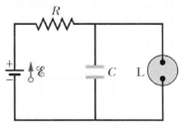
Figure shows the circuit of a flashing lamp, like those attached to barrels at highway construction sites. The fluorescent lamp L (of negligible capacitance) is connected in parallel across the capacitor C of an RC circuit. There is a current through the lamp only when the potential difference
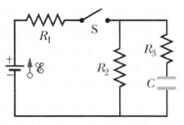
In Figure R1 = 10.0k?, R2?= 15.0k?, C = 0.400?F, and the ideal battery has emf ? = 20.0 V. First, the switch is closed a long time so that the steady state is reached. Then the switch is opened at time t = 0. What is the current in resistor 2 at t = 4.00 ms?
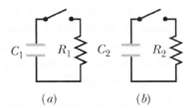
Figure displays two circuits with a charged capacitor that is to be discharged through a resistor when a switch is closed. In Figure a, R1 = 20.0? and C1 = 5.00?F. In Figure b, R2 = 10.0? and C2 = 8.00?F. The ratio of the initial charges on the two capacitors is q02/q01 = 1.50. At time t = 0, both
A 3.00 MΩ resistor and a 1.00μF capacitor are connected in series with an ideal battery of emf ξ = 4.00 V. At 1.00 s after the connection is made, what is the rate at which (a) The charge of the capacitor is increasing, (b) Energy is being stored in the capacitor, (c) Thermal
What are the (a) Size and (b) Direction (up or down) of current i in Figure where all resistances are 4.0?? and all batteries are ideal and have an emf of 10 V?
Suppose that, while you are sitting in a chair, charge separation between your clothing and the chair puts you at a potential of 200 V with the capacitance between you and the chair at 150pF. When you stand up, the increased separation between your body and the chair decreases the capacitance to
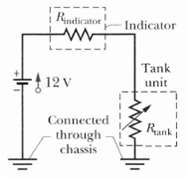
An automobile gasoline gauge is shown schematically in Figure. The indicator (on the dashboard) has a resistance of 10?. The tank unit is a float connected to a variable resistor whose resistance varies linearly with the volume of gasoline. The resistance is 140? when the tank is empty and 20? when
A controller on an electronic arcade game consists of a variable resistor connected across the plates of a 0.220μF capacitor. The capacitor is charged to 5.00 V then discharged through the resistor the time for the potential difference across the plates to decrease to 0.800 V is measured by a
(a) In Figure a, show that the rate at which energy is dissipated in R as thermal energy is a maximum when R = r.(b) Show that this maximum power is P = ξ2/4r.
Wires A and B, having equal lengths of 40.0 m and equal diameters of 2.60 mm, are connected in series. A potential difference of 60.0 V is applied between the ends of the composite wire. The resistances are RA = 0.127Ω and RB = 0.729Ω. For wire A, what are?(a) Magnitude J of the current density
Figure shows an ideal battery of emf ? = 12 V, a resistor of resistance R = 4.0?, and an uncharged capacitor of capacitance C = 4.0?F. After switch S is closed, what is the current through the resistor when the charge on the capacitor is 8.0?C?
The starting motor of a car is turning too slowly, and the mechanic has to decide whether to replace the motor, the cable, or the battery. The car's manual says that the 12V battery should have no more than 0.020Ω internal resistance, the motor no more than 0.200Ω resistance and the cable any
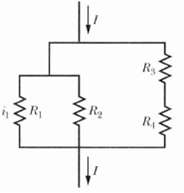
Figure shows a portion of a circuit through which there is a current I = 6.00 A. The resistances are R1 = R2 = 2.00 R3 = 2.00 R4 = 4.00?. What is the current i1 through resistor 1?
In Figure R1 = 20.0?, R2 = 10.0?, and the ideal battery has emf ? = 120V.What is the current at point a if we close (a) Only switch S1, (b) Only switches S1 and S2, and (c) All three switches?
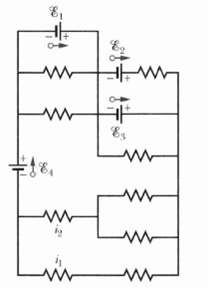
In Figure the ideal batteries have emf s ?1 = 20.0 V, ?2?= 10.0 V, ?3 = 5.00 V and ?4 = 5.00 V and the resistances are each 2.00?. What are the (a) Size and (b) Direction (left or right) of current i1 and the (c) Size and (d) Direction of current i2? (This can be answered with only mental
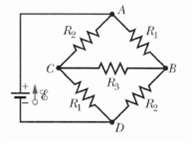
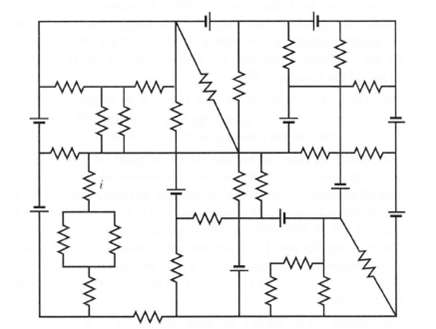
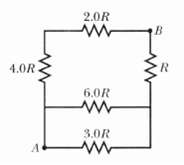
In Figure R = 10?. What is the equivalent resistance between points A and B?
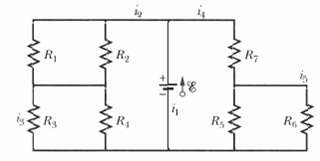
In Figure the ideal battery has emf ? = 30.0 V and the resistances are R1 = R2 = 14?, R3 = R4 = R5 = 6.0?, R6 = 2.0?, and R7 = 1.5?. What are currents?(a) i2,(b) i4,(c) i1,(d) i3, and(e) i5?
Showing 3500 - 3600
of 8940
First
29
30
31
32
33
34
35
36
37
38
39
40
41
42
43
Last
Step by Step Answers

 Get 50% OFF
Claim Now
Get 50% OFF
Claim Now