New Semester
Started
Get
50% OFF
Study Help!
--h --m --s
Claim Now
Question Answers
Textbooks
Find textbooks, questions and answers
Oops, something went wrong!
Change your search query and then try again
S
Books
FREE
Study Help
Expert Questions
Accounting
General Management
Mathematics
Finance
Organizational Behaviour
Law
Physics
Operating System
Management Leadership
Sociology
Programming
Marketing
Database
Computer Network
Economics
Textbooks Solutions
Accounting
Managerial Accounting
Management Leadership
Cost Accounting
Statistics
Business Law
Corporate Finance
Finance
Economics
Auditing
Tutors
Online Tutors
Find a Tutor
Hire a Tutor
Become a Tutor
AI Tutor
AI Study Planner
NEW
Sell Books
Search
Search
Sign In
Register
study help
physics
electricity and magnetism
Fundamentals of Physics 8th Extended edition Jearl Walker, Halliday Resnick - Solutions
In an L-R-C series circuit the magnitude of the phase angle is 54.0", with the source voltage lagging the current. The reactance of the capacitor is 350 Ω, and the resistor resistance is 180 Ω. The average power delivered by the source is 140 W. Find (a) The reactance of the inductor;
An L-R-C series circuit has R = 500 Ω, L = 2.00 H, C = 0.500μF, and V = 100 V. (a) For w = 800rad/s, calculate VR, VL, VC, and Ф. Using a single set of axes, graph v, VR, VL, and VC as functions of time. Include two cycles of v on your graph. (b) Repeat part (a) for w =
In an L-R-C series circuit, the source has a voltage amplitude of 120 V, R = 80.0 Ω, and the reactance of the capacitor is 480 n. The voltage amplitude across the capacitor is 360 V. (a) What is the current amplitude in the circuit? (b) What is the impedance? (c) What two values can the
A series circuit consists of a 1.50-mH inductor, a 125-Ω resistor, and a 25.0-nF capacitor connected across an ac source having an rms voltage of 35.0 V and variable frequency. (a) At what angular frequency will the current amplitude be equal to l/3 of its maximum possible value? (b) At
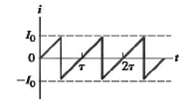
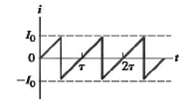
The current in a certain circuit varies with time as shown in Fig. 31.28. Find the average current and the rms current in terms ofI0
The current in a certain circuit varies with time as shown in Fig. 31.28. Find the average current and the rms current in terms ofI0
An inductor, a capacitor, and a resistor are all connected in series across an ac source. If the resistance, inductance, and capacitance are all doubled, by what factor does each of the following quaotities change? Indicate whether they increase or decrease: (a) The resonance angular
An inductor, a capacitor, and a resistor are all connected in series across an ac source. If the resistance, inductance, and capacitance are all doubled, by what factor does each of the following quaotities change? Indicate whether they increase or decrease: (a) The resonance angular frequency; (b)
You want to double the resonance angular frequency of a series R-L-C circuit by changing only the pertinent circuit elements all by the same factor.(a) Which ones should you change? (b) By what factor should you change them?
A resistance R, capacitance C, and inductance L are connected in series to a voltage source with amplitude V and variable angular frequency w. If w = w0 the resonance angu1ar frequency, find (a) The maximum current in the resistor; (b) The maximum voltage across the capacitor;(c) The maximum
Repeat Problem 31.68 for the case w = w0/2.
Repeat Problem 31.68 for the case w = 2w0.
Finding an Unknown Inductance, your boss gives you an inductor and asks you to measure its inductance. You have available a resistor, an ac voltmeter of high impedance, a capacitor, and an ac source. Explain how you might use these to determine the inductance, and cite any other piece of equipment
An L-R-C series circuit draws 220 W from a 120-V (rms), 50.0-Hz ac line. The power factor is 0.560, and the source voltage leads the current. (a) What is the net resistance R of the circuit?(b) Find the capacitance of the series capacitor that will result in a power factor of unity
An L-R-C series circuit draws 220 W from a 120-V (rms), 50.0-Hz ac line. The power factor is 0.560, and the source voltage leads the current. (a) What is the net resistance R of the circuit?(b) Find the capacitance of the series capacitor that will result in a power factor of unity when it is added
(i). At what angular frequency is the voltage amplitude across the resistor in an L-R-C series circuit at maximum value?(ii). At what angular frequency is the voltage amplitude across the inductor at maximum value?(iii). At what angular frequency is the voltage amplitude across the capacitor at
(a) At what angular frequency is the voltage amplitude across the resistor in an L-R-C series circuit at maximum value?(b) At what angular frequency is the voltage amplitude across the inductor at maximum value? (c) At what angular frequency is the voltage amplitude across the capacitor at maximum
The two metal objects in Figure have net charges of +70pC and -70pC, which result in a 20 V potential difference between them. (a) What is the capacitance of the system? (b) If the charges are changed to +200pC and -200pC, what does the capacitance become? (c) What does the potential difference
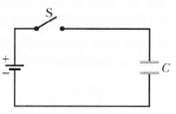
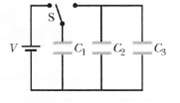
The capacitor in Figure has capacitance of 25μF and is initially uncharged. The battery provides a potential difference of 120 V. After switch S is closed, how much charge will pass through it?
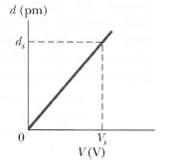
If an unchanged parallel-plate capacitor (capacitance C) is connected to a battery, one plate becomes negatively charged as electrons move to the plate face (area A). In Figure the depth d from which the electrons come in the plate in a particular capacitor is plotted against a range of values for
You have two flat metal plates, each of area 1.00 m2, with which to construct a parallel-plate capacitor.(a) If the capacitance of the device is to be 1.00 F, what must be the separation between the plates?(b) Could this capacitor actually be constructed?
A parallel-plate capacitor has circular plates of 8.20 cm radius and 1.30 mm separation.(a) Calculate the capacitance.(b) What charge will appear on the plates if a potential difference of 120 V is applied?
The plates of a spherical capacitor have radii 38.0 mm and 40.0 mm.(a) Calculate the capacitance.(b) What must be the plate area of a parallel-plate capacitor with the same plate separation and capacitance?
What is the capacitance of a drop that results when two mercury spheres, each of radius R = 2.00 mm, merge?
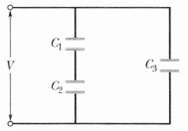
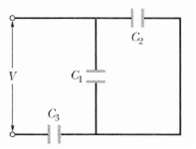
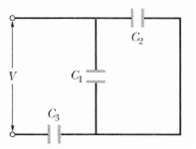
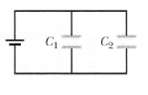
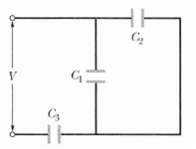
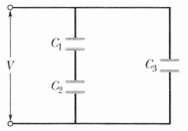
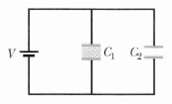
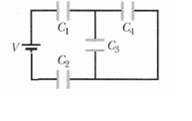
In Figure find the equivalent capacitance of the combination. Assume that C1 is 10.0μF, C2 is 5.00μF, and C3 is 4.00μF.
In Figure find the equivalent capacitance of the combination. Assume that C1 = 10.0μF, C2 = 5.00μF, and C3 = 4.00μF.
How many 1.00μF capacitors must be connected in parallel to store a charge of 1.00 C with a potential of 110 V across the capacitors?
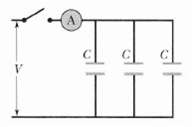
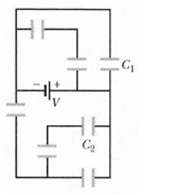
Each of the uncharged capacitors in Figure has a capacitance of 25.0μF. A potential difference of V = 4200 V is established when the switch is closed. How many coulombs of charge then pass through meter A?
In Figure the battery has a potential difference of V = 10.0 V and the five capacitors each have a capacitance of 10.0μF, what is the charge on(a) Capacitor 1 and(b) Capacitor 2?
In Figure a potential difference of V = 100.0 V is applied across a capacitor arrangement with capacitances C1 = 10.0μF, C2 = 5.00μF, and C3 = 4.00μF, If capacitor 3 undergoes electrical breakdown so that it becomes equivalent to conducting wire, what is the increase in (a) The charge on
Two parallel-plate capacitors, 6.0μF each, are connected in parallel to a 10 V battery. One of the capacitors is then squeezed so that its plate separation is 50.0% of its initial value. Because of the squeezing,(a) How much additional charge is transferred to the capacitors by the battery and(b)
A 100 pF capacitor is charged to a potential difference of 50 V, and the charging battery is disconnected. The capacitor is then connected in parallel with a second (initially uncharged) capacitor. If the potential difference across the first capacitor drops to 35 V what is the capacitance of this
Figure shows a circuit section of four air-filled capacitors that is connected to a larger circuit. The graph below the section shows the electric potential V(x) as a function of position x along the lower part of the section, through capacitor 4. Similarly, the graph above the section shows the
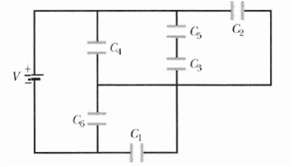
In Figure a 20JV battery is connected across capacitors of capacitances C1 = C6 = 3.00μF and C3 = C5 = 2.00C2 = 2.00C4 = 4.00μF. What are? (a) The equivalent capacitance Ceq of the capacitors and (b) The charges stored by Ceq? What are? (c) Vl and (d) q1 of capacitor 1, (e) V2, and (f) q2 of
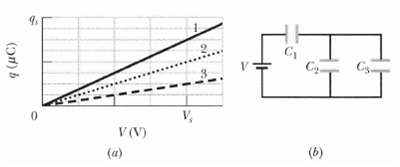
Plot 1 in Figure a gives the charge q that can be stored on capacitor 1 versus the electric potential 1 set up across it. The vertical scale is set by qs = 16.0μC, and the horizontal scale is set by V, =2.0 V. Plots 2 and 3 arc similar plots for capacitors 2 and 3, respectively. Figure b shows a
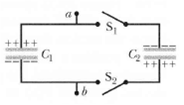
In Figure the capacitances arc C1 = 1.0μF and C2 = 3.0μF, and both capacitors are charged to a potential difference of V = 100 V but with opposite polarity as shown. Switches S1 and S2 are now closed. (a) What is now the potential difference between points a and b? What now is the charge on
In Figure V =10 V C1 =10μF, and C2= C3= 20μF. Switch S is first thrown to the left side until capacitor 1 reaches equilibrium. Then the switch is thrown to the right. When equilibrium is again reached, how much charge is on capacitor 1?
In Figure two parallel-plate capacitors (with air between the plates) are connected to a battery. Capacitor t has a plate area of 1.5 cm2 and an electric field (between its plates) of magnitude 2000 V/m. Capacitor 2 has a plate area of 0.70 cm2 and an electric field of magnitude 1500 V/m. What is
Figure represents two air-filled cylindrical capacitors connected in series across a battery with potential V = 10 V. Capacitor 1 has an inner plate radius of 5.0 mm, an outer plate radius of 1.5 cm, and a V length of 5.0 cm. Capacitor 2 has an inner plate radius of 2.5 mm, an outer plate radius of
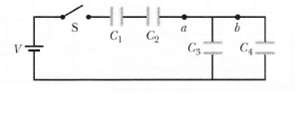
In Figure the battery has potential difference V = 9.0 V, C2 = 3.0μF, C4 = 4.0μF, and all the capacitors are initially uncharged. When switch S is closed, a total charge of 12μC passes through point a and a total charge of 8.0μC passes through point b. What are? (a) C1 and (b) C3?
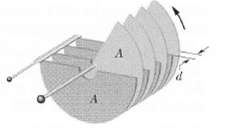
Figure shows a variable "air gap" capacitor for manual tuning. Alternate plates are connected together; one group of plates is fixed in position, and the other group is capable of rotation. Consider a capacitor of n = 8 plates of alternating polarity, each plate having area A = 1.25 cm2 and
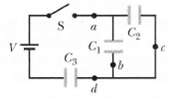
The capacitors in Figure are initially uncharged. The capacitances are C1 = 4.0μF, C2 = 8.0μF, and C3 = 12μF, and the battery's potential difference is V = 12V When switch S is closed, how many electrons travel through (a) Point a, (b) Point b, (c) Point c, and (d) Point d? In the figure, do the
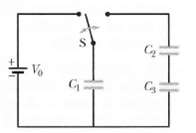
Figure displays a 12.0 V battery 3 four uncharged capacitors of capacitances C1 = 4.00μF, C2 = 6.00μF, and C3 = 3.00μF. The switch is thrown to the left side until capacitor 1 is fully charged. Then the switch is thrown to the right. What is the final charge on? (a) Capacitor 1, (b) Capacitor 2,
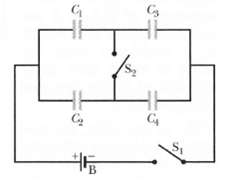
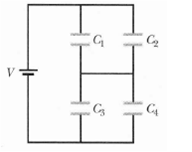
Figure shows a 12.0V battery and four uncharged capacitors of capacitances C1 = 1.00μF, C2 = 2.00μF, C3 = 3.00μF, and C4 = 4.00μF, If only switch S1 is closed, what is the charge on (a) Capacitor 1, (b) Capacitor 2, (c) Capacitor 3, and (d) Capacitor 4? If both switches are closed, what is the
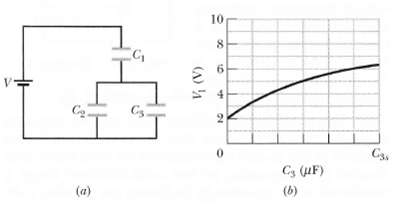
Capacitor 3 in Figure is a variable capacitor (its capacitance C3 can be varied). Figure gives the electric potential V1 across capacitor 1 versus C3. The horizontal scale is set by C3s = 12.0μF. Electric potential V1 approaches an asymptote of 10 V as C3 ????. What are? (a) The electric potential
A 2.0μF capacitor and a 4.0μF capacitor are connected in parallel across a 300 V potential difference. Calculate the total energy stored in the capacitors.
A parallel-plate air-filled capacitor having area 40 cm2 and plate spacing 1.0 mm is charged to a potential difference of 600 V. Find(a) The capacitance,(b) The magnitude of the charge on each plate,(c) The stored energy,(d) The electric field between the plates, and(e) The energy density between
What capacitance is required to store energy of 10 kW ∙ h at a potential difference of 1000 V?
How much energy is stored in 1.00 m3 of air due to the "fat weather" electric field of magnitude 150 V/m?
Assume that a stationary electron is a point of charge. What is the energy density u of its electric field at radial distances?(a) r = 1.00mm,(b) r = 1.00μm,(c) r = 1.00nm, and(d) r = 1.00 pm?(e) What is u in the limit as r → 0?
In Figure a potential difference V = 100 V is applied across a capacitor arrangement with capacitances C1 = 10.0μF, C2 = 5.00μF, and C3 = 15.0μF. What are? (a) Charge q3, (b) Potential difference V3, and (c) Stored energy U3for capacitor 3, (d) q1 (e) V1 and (f) U1 for capacitor 1, and (g)
The parallel plates in a capacitor, with a plate area of 8.50 cm2 and an air-filled separation of 3.00 mm, are charged by u 6.00 V battery. They are then disconnected from the battery and pulled apart (without discharge) to a separation of 8.00 mm. Neglecting fringing, find(a) The potential
In Figure a potential difference V = 100 V is applied across a capacitor arrangement with capacitances C1= 10.0μF, C2= 5.00μF, and C3= 4.00μF. What are? (a) Charge q3, (b) Potential difference V3, and (c) stored energy U3 for capacitor 3, (d) q1, (e) V1, and (f) U1 for capacitor 1, and (g)
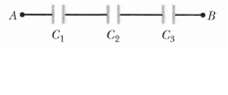
In Figure C1 = 10.0μF, C2 = 20.0μF, and C3 = 25.0μF. If no capacitor can withstand a potential difference of more than 100 V without failure, what are? (a) The magnitude of the maximum potential difference that can exist between points A and B and (b) The maximum energy that can be stored in the
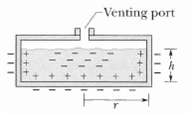
As a safety engineer, you must evaluate the practice of storing flammable conducting liquids in non conducting containers. The company supplying a certain liquid has been using a squat, cylindrical plastic container of radius r = 0.20 m and filling it to height h = 10 cm which is not the
A charged isolated metal sphere of diameter 10 cm has a potential of 8000 V relative to V = 0 at infinity. Calculate the energy density in the electric field near the surface of the sphere.
A parallel-plate air-filled capacitor has a capacitance of 50pF.(a) If each of its plates has an area of 0.35 m2, what is the separation?(b) If the region between the plates is now filled with material having K = 5.6, what is the capacitance?
Given a 7.4μF air-filled capacitor, you are asked to convert it to a capacitor that can store up to 7 .4μJ with a maximum potential difference of 652 V. Which dielectric in Table 25-l should you use to fill the gap in the capacitor if you do not allow for a margin of error?
An air-filled parallel-plate capacitor has a capacitance of 1.3pF. The separation of the plates is doubled, and wax is inserted between them. The new capacitance is 2.6pF. Find the dielectric constant of the wax.
A coaxial cable used in a transmission line has an inner radius of 0.10 mm and an outer radius of 0.60 mm. Calculate the capacitance per meter for the cable. Assume that the space between the conductors is filled with polystyrene.
In Figure how much charge is stored on the parallel plate capacitors by the 12.0V battery? One is filled with air, and the other is filled with a dielectric for which K = 3.00; both capacitors have a plate area of 5.00 x 10⁻³ m2 and a plate separation of 2.00mm.
A certain substance has a dielectric constant of 2.8 and a dielectric strength of 18 MV/m. If it is used as the dielectric material in a parallel-plate capacitor, what minimum area should the plates of the capacitor have to obtain a capacitance of 7.0 x 10⁻²μF and to ensure that the capacitor will
You are asked to construct a capacitor having a capacitance near 1nF and a breakdown potential in excess of 10 000 V. You think of using the sides of a tall Pyrex drinking glass as a dielectric, lining the inside and outside curved surfaces with aluminum foil to act as the plates. The glass is 15
A certain parallel-plate capacitor is filled with a dielectric for which K = 5.5. The area of each plate is 0.034 m2, and the plates are separated by 2.0 mm. The capacitor will fail (short out and burn up) if the electric field between the plates exceeds 200 kN/C. What is the maximum energy that
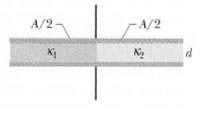
Figure shows a parallel-plate capacitor with a plate area A = 5.56 cm2 and separation d = 5.56 mm. The left half of the gap is filled with material of dielectric constant K1 = 7.00; the right half is filled with material of dielectric constant K2 = 12.00. What is the capacitance?
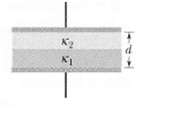
Figure shows a parallel plate capacitor with a plate area A = 7.89 cm2 and plate separation d = 4.62 mm. The top half of the gap is filled with material of dielectric constant K1 = 11.0; the bottom half is filled with material of dielectric constant K2 = 12.0. What is the capacitance?
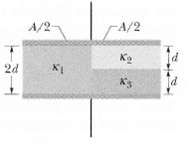
Figure shows a parallel-plate capacitor of plate area A = 10.5 cm2 and plate separation 2d = 7 .12 mm. The left half of the gap is filled with material of dielectric constant K1 = 21.0; the top of the right half is filled with material of dielectric constant K2 = 42.0; the bottom of the right half
A parallel-plate capacitor has a capacitance of 100 pF, a plate area of 100 cm2, and a mica dielectric (K = 5.4) completely filling the space between the plates. At 50 V potential differences, calculate(a) The electric field magnitude E in the mica,(b) The magnitude of the free charge on the
In Sample Problem, suppose that the battery remains connected while the dielectric slab is being introduced. Calculate(a) The capacitance,(b) The charge on the capacitor plates,(c) The electric field in the gap, and(d) The electric field in the slab, after the slab is in place.
The space between two concentric conducting spherical shells of radii b = 1.70 cm and a = 1.20 cm is filled with a substance of dielectric constant K = 23.5. A potential difference V = 73.0 V is applied across the inner and outer shells. Determine(a) The capacitance of the device,(b) The free
Two parallel plates of area 100 cm2 are given charges of equal magnitudes 8.9 x l0-7 C but opposite signs. The electric field within the dielectric material filling the space between the plates is 1.4 X 10⁶ V/m.(a) Calculate the dielectric constant of the material.(b) Determine the magnitude of the
A parallel-plate capacitor has plates of area 0.12 m2 and a separation of 1.2 cm. A battery charges the plates to a potential difference of 120 V and is then disconnected. A dielectric slab of thickness 4.0 mm and dielectric constant 4.8 is then placed symmetrically between the plates.(a) What is
The chocolate crumb mystery this story begins with Problem. As part of the investigation of the biscuit factory explosion, the electric potentials of the workers were measured as they emptied sacks of chocolate crumb powder into the loading bin, stirring up a cloud of the powder around them. Each
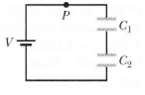
Figure shows capacitor 1 (C1 = 8.00μF), capacitor 2 (C2 = 6.00μF), and capacitor 3 (C3 = 8.00μF) connected to a 12.0 V battery. When switch S is closed so as to connect uncharged capacitor 4 (C4 = 6.00μF),(a) How much charge passes through point P from the battery and(b) How much charge shows
Two air-filled, parallel-plate capacitors are to be connected to a 10 V battery, first individually, then in series, and then in parallel. In those arrangements, the energy stored in the capacitors turns out to be, listed least to greatest: 75μJ, 100μJ, 300μJ, and 400μJ. Of the two capacitors,
Two parallel-plate capacitors, 6.0μF each, are connected in series to a 10 V battery. One of the capacitors is then squeezed so that its plate separation is halved. Because of the squeezing,(a) How much additional charge is transferred to the capacitors by the battery and(b) What is the increase
In Figure V = 12V, C1 = C5 = C6 = 6.0μF, and C2 = C3 = C4μf. What are?(a) The net charge stored on the capacitors and(b) The charge on capacitor 4?
In Figure V = 9.0 V, C1 = C2 = 30μF, and C3 = C4 = 15μF. What is the charge on capacitor 4?
In Figure the battery potential difference V is 10.0 V and each of the seven capacitors has capacitance l0.0μF. What is the charge on? (a) Capacitor and (b) Capacitor 2?
In Figure V = 12 V, C1 = C4 = 2.0μF, C2 = 4.0μF, and C3 = 1.0μF. What is the charge on capacitor 4?
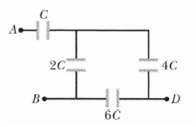
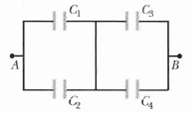
The capacitances of the four capacitors shown in Figure are given in terms of a certain quantity C. (a) It C = 50μF, what is the equivalent capacitance between points A and B? (b) Repeat for points A and D.
A capacitor of capacitance C1 = 6.00μF is connected in series with a capacitor of capacitance C2 = 4.00μF, and a potential difference of 200 V is applied across the pair.(a) Calculate the equivalent capacitance. What are?(b) Charge q1 and(c) Potential difference V1 on capacitor 1 and(d) q2,
Repeat Problem 65 for the same two capacitors but with them now connected in parallel.
A capacitor of unknown capacitance C is charged to 100 V and connected across an initially uncharged 60μF capacitor. If the final potential difference across the 60μF capacitor is 40 V what is C?
A cylindrical capacitor has radii a and b as in Figure Show that half the stored electric potential energy lies within a cylinder whose radius is r = √ ab
In figure two parallel capacitors A and B are connected in parallel across a 600 V battery. Each plate has area 80.0 cm2 the plate separations are 3.00 mm. Capacitor A is filled with air; capacitor B is filled with a dielectric of dielectric constant K = 2.60. Find the magnitude of the electric
A potential difference of 300 V is applied to a series connection of two capacitors of capacitances C1 = 2.00μF and C2 = 8.00μF. What are? (a) Charge q1 and (b) Potential difference V1 on capacitor 1 and (c) q2 and (d) V2 on capacitor 2? The charged capacitors are then disconnected
A certain capacitor is charged to a potential difference V. It you wish to increase its stored energy by 10%, by what percentage should you increase V?
You have two plates of copper, a sheet of mica (thickness = 0.10 mm, K = 5.4), a sheet of glass (thickness = 2.0 mm, K = 7 .0), and a slab of paraffin (thickness = 1.0 cm, K = 2.0). To make a parallel-plate capacitor with the largest C, which sheet should you place between the copper plates?
In Figure the parallel-plate capacitor of plate area 2.00 x 10⁻² m2 is filled with two dielectric slabs, each with thickness 2.00 mm. One slab has dielectric constant 3.00, and the other, 4.00. How much charge does the 7.00 V battery store on thecapacitor?
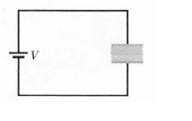
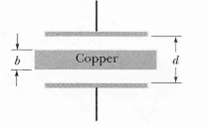
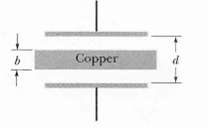
A slab of copper of thickness b = 2.00 mm is thrust into a parallel plate capacitor of plate area A = 2.40 cm2 and plate separation d = 5.00 mm, as shown in Figure the slab is exactly between the plates. (a) What is the capacitance after the slab is introduced? (b) If a charge q = 3.40μC is
Repeat Problem 74, assuming that a potential difference V = 85.0 V, rather than the charge, is heldconstant.
You have many 2.0μF capacitors, each capable of withstanding 200 V without undergoing electrical breakdown (in which they conduct charge instead of storing it). How would you assemble a combination having an equivalent capacitance of?(a) 0.40μF and(b) 1.2μF, each combination capable of
Figure shows four-capacitor arrangement that is connected to a larger circuit at points A and B. The capacitances are C1 = l0 p and C2 = C3 = C4 = 20μF.The charge on capacitor 1 is 30μC. What is the magnitude of the potential difference VA - VB?.
A 10 V battery is connected to a series of n capacitors, each of capacitance 2.0μF. If the total energy stored in the capacitors is 25μJ, what is n?
During the 4.0 min a 5.0 A current is set up in a wire, how many(a) Coulombs and(b) Electrons pass through any cross section across the wire's width?
An isolated conducting sphere has a 10 cm radius. One wire carries a current of 1.000 002 0 A into it. Another wire carries a current of 1.000 000 0 A out of it. How long would it take for the sphere to increase in potential by 1000 V?
A charged belt, 50 cm wide, travels at 30 m/s between a source of charge and a sphere. The belt carries charge into the sphere at a rate corresponding to 100μA. Compute the surface charge density on the belt.
A small but measurable current of 1.2 x 10⁻¹⁰ A exists in a copper wire whose diameter is 2.5 mm. The number of charge carriers per unit volume is 8.49 x 1028 m-3.Assuming the current is uniform, calculate the(a) Current density and(b) Electron drifts speed.
A fuse in an electric circuit is a wire that is designed to melt, and thereby open the circuit, if the current exceeds a predetermined value. Suppose that the material to be used in a fuse melts when the current density rises to 440 A/cm2. What diameter of cylindrical wire should be used to make a
Showing 3200 - 3300
of 8940
First
26
27
28
29
30
31
32
33
34
35
36
37
38
39
40
Last
Step by Step Answers

 Get 50% OFF
Claim Now
Get 50% OFF
Claim Now