New Semester
Started
Get
50% OFF
Study Help!
--h --m --s
Claim Now
Question Answers
Textbooks
Find textbooks, questions and answers
Oops, something went wrong!
Change your search query and then try again
S
Books
FREE
Study Help
Expert Questions
Accounting
General Management
Mathematics
Finance
Organizational Behaviour
Law
Physics
Operating System
Management Leadership
Sociology
Programming
Marketing
Database
Computer Network
Economics
Textbooks Solutions
Accounting
Managerial Accounting
Management Leadership
Cost Accounting
Statistics
Business Law
Corporate Finance
Finance
Economics
Auditing
Tutors
Online Tutors
Find a Tutor
Hire a Tutor
Become a Tutor
AI Tutor
AI Study Planner
NEW
Sell Books
Search
Search
Sign In
Register
study help
physics
electricity and magnetism
Fundamentals of Physics 8th Extended edition Jearl Walker, Halliday Resnick - Solutions
A spherical conducting shell has a charge of – 14μC on its outer surface and a charged particle in its hollow. If the net charge on the shell is -10μC, what is the charge?(a) On the inner surface of the shell and(b) Of the particle?
A charge of 6.00pC is spread uniformly throughout the volume of a sphere of radius r = 4.00 cm. What is the magnitude of the electric field at a radial distance of?(a) 6.00 cm and(b) 3.00 cm?
A spherical ball of charged particles has a uniform charge density. In terms of the ball's radius R, at what radial distances(a) Inside and(b) Outside the ball is the magnitude of the ball's electric field equal to i of the maximum magnitude of that field?
Charge of uniform surface density 8.00nC/m2 is distributed over an entire xy plane; charge of uniform surface density 3.00nC/m2 is distributed over the parallel plane defined by z = 2.00 m. Determine the magnitude of the electric field at any point having a z coordinate of?(a) 1.00 m and(b) 3.00 m.
Much of the material making up Saturn's rings is in the form of tiny dust grains having radii on the order of 10-6 m. These grains are located in a region containing a dilute ionized gas, and they pick up excess electrons. As an approximation, suppose each grain is spherical, with radius R = l .0 x
The electric potential difference between the ground and a cloud in a particular thunderstorm is 1.2 x 10⁹ V. In the unit electron-volts, what is the magnitude of the change in the electric potential energy of an electron that moves between the ground and the cloud?
A particular 12V car battery can send a total charge of 84 A ∙ h (ampere-hours) through a circuit, from one terminal to the other.(a) How many coulombs of charge does this represent?(b) If this entire charge undergoes a change in electric potential of 12 V, how much energy is involved?
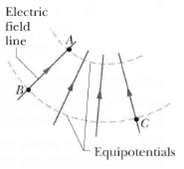
When an electron moves from A to B along an electric field line in Figure the electric field does 3.94 x 10⁻¹⁹ J of work on it. What are the electric potential differences? (a) VB ?? VA, (b) VC ?? VA, and (c) VC ??VB?
An infinite non-conducting sheet has a surface charge density σ = 0.10μC/m2 on one side. How far apart are equipotential surfaces whose potentials differ by 50 V?
Two large, parallel, conducting plates are 12 cm apart and have charges of equal magnitude and opposite sign on their facing surfaces. An electrostatic force of 3.9 x 10⁻¹⁵ N acts on an electron placed anywhere between the two plates. (Neglect fringing.)(a) Find the electric field at the position
An infinite non-conducting sheet has a surface charge density σ = +5.80pC/m2.(a) How much work is done by the electric field due to the sheet if a particle of charge q = + 1.60 x 10⁻¹⁹ C is moved from the sheet to a point P at distance d = 3.56 cm from the sheet?(b) If the electric potential V is
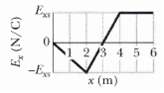
A graph of the x component of the electric field as a function of x in a region of space is shown in Figure. The scale of the vertical axis is set by Exs = 20.0 N/C. The y and z components of the electric field are zero in this region. If the electric potential at the origin is 10V, (a) What is the
The electric field in a region of space has the components Ey = Ez = 0 and Ex = (4.00 N/C) x. Point A is on the y axis at y = 3.00 m, and point B is on the x axis at x = 4.00 m. What is the potential difference VB = VA?
Two uniformly charged, infinite, non-conducting planes are parallel to a yz plane and positioned at x = 50 cm and x = +50 cm. The charge densities on the planes are – 50nC/m2 and + 25nC/m2, respectively. What is the magnitude of the potential difference between the origin and the point on the x
A non-conducting sphere has radius R = 2.31 cm and uniformly distributed charge q = + 3.50 fC. Take the electric potential at the sphere's center to be V0 = 0. What is V at radial distance?(a) r = 1.45 cm and(b) r = R.
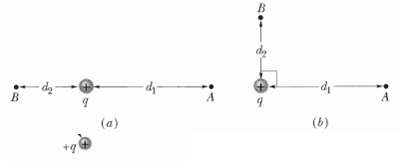
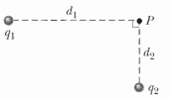
Consider a point charge q = 1.0μC, point A at distance d1 = 2.0m from q, and point B at distance d2 = 1.0 m. (a) If A and B arc diametrically opposite each other, as in Figure a, what is the electric potential difference VA ?? VB? (b) What is that electric potential difference 1t A and B arc
What are?(a) The charge and(b) The charge density on the surface of a conducting sphere of radius 0.15 m whose potential is 200 V (with V = 0 at infinity)?
As a space shuttle moves through the dilute ionized gas of Earth's ionosphere, the shuttle's potential is typically changed by – 1.0V during one revolution. Assuming the shuttle is a sphere of radius 10m; estimate the amount of charge it collects.
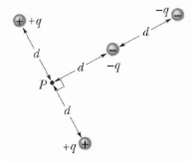
In figure what is the net electric potential at point P due to the four particles if V = 0 at infinity, q = 5.00fC, and d =4.00cm?
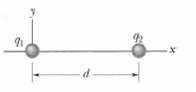
Two particles, of charges q1 and q2 are separated by distance d in Figure. The net electric field due to the particles is zero at x = d/4, with V = 0 at infinity, locate (in terms of. d) any point on the x axis (other than at infinity) at which the electric potential due to the two particles is
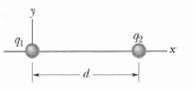
In figure particles of the charges q1 ?? + 5e and q2 = ?? 15e are fixed in place with a separation of d = 24.0 cm. With V = 0 at infinity, what are the finite (a) Positive and (b) Negative values of x at which the net electric potential on the x axis is zero?
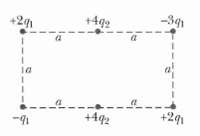
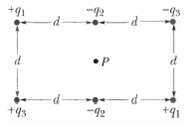
Figure shows a rectangular array of charged particles fixe in place, with distance a = 39.0cm and the charges shown as integer multiples of q1 = 3.40pC and q2 = 6.00pC. With V = 0 at infinity, what is the net electric potential at the rectangle??scenter.
A spherical drop of water carrying a charge of 30pC has a potential of 500 V at its surface (with V = 0 at infinity).(a) What is the radius of the drop?(b) If two such drops of the same charge and radius combine to form a single spherical drop, what is the potential at the surface of the new drop?
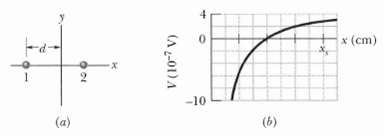
Two charged particles are shown in Figure Particle 1,, with charge et, is fixed in place at distance d. Particle 2, with charge q2, can be moved along the x axis. Figure b gives the net electric potential V at the origin due to the two particles as a function of the x coordinate of particle 2. The
The ammonia molecule NH3 has a permanent electric dipole moment equal to 1.47 D, where 1 D = 1 Debye unit = 3.34 x 10⁻³⁰C.m. Calculate the electric potential due to an ammonia molecule at a point 52.0 nm away along the axis of the dipole. (Set V = 0 at infinity.)
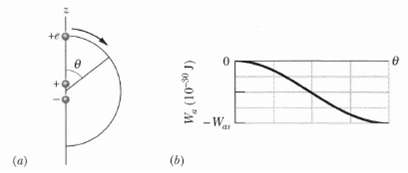
In Figure a, a particle of charge le is initially at coordinate z = 20 nm on the dipole axis through an electric dipole, on the positive side of the dipole. (The origin of z is at the dipole center.) The particle is then moved along a circular path around the dipole center until it is at coordinate
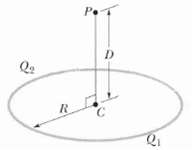
A plastic rod has been bent into a circle of radius R = 8.20 cm. It has a charge Q1 = + 4.20pC uniformly distributed along one-quarter of its circumference and a charge Q2 = ?? 6Q1, uniformly distributed along the rest of the circumference (Figure). With V = 0 at infinity, what is the electric
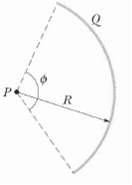
In Figure a plastic rod having a uniformly distributed charge Q = ?? 25.6pC has been bent into a circular arc of radius R = 3.71 cm and central angle Φ = 120o. With V = 0 at infinity, what is the electric potential at P, the center of curvature of the rod?
In Figure a plastic rod having a uniformly distributed charge Q = ?? 25.6pC has been bent into a circular arc of radius R = 3.71 cm and central angle Φ = 120o. With V = 0 at infinity, what is the electric potential at P, the center of curvature of the rod?
A Gaussian sphere of radius 4.00 cm is centered on a ball that has a radius of 1.00 cm and a uniform charge distribution. The total (net) electric flux through the surface of the Gaussian sphere is + 5.60 x 10⁴N ∙ m2/C. What is the electric potential 12.0 cm from the center of the ball?
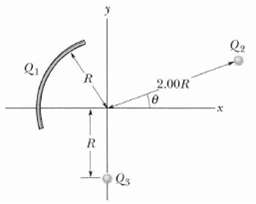
In Figure what is the net electric potential at the origin due to the circular arc of charge Q1 = + 7.21pC and the two particles of charges Q2 = 4.00Q1 and Q3 = ?? 2.00Q1? The arc's center of curvature is at the origin and its radius is R - 2.00 m; the angle indicated is θ = 20.0o.
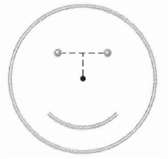
The smiling face of Figure consists of three items: 1. A thin rod of charge ?? 3.0μC that forms a full circle of radius 6.0 cm; 2. A second thin rod of charge 2.0μC that forms a circular arc of radius 4.0 cm, subtending an angle of 90o about the center of the full circle; 3. An electric dipole
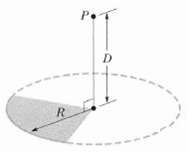
A plastic disk of radius R = 64.0 cm is charged on one side with a uniform surface charge density σ = 7 .73fC/m2, and then three quadrants of the disk are removed. The remaining quadrant is shown in Figure. With V = 0 at infinity, what is the potential due to the remaining quadrant at point P,
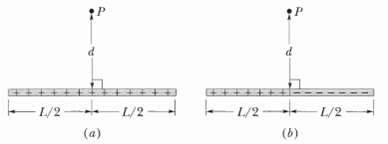
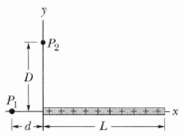
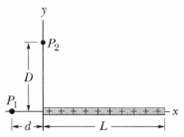
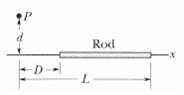
Figure shows a thin plastic rod of length L = 12.0 cm and uniform positive charge Q = 56.1fC lying on an x axis with V = 0 at infinity, find the electric potential at point Pr on the axis at distance d = 2.50 cm from one end of the rod.
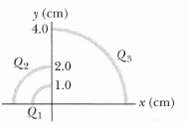
In Figure three thin plastic rods form quarter-circles with a common center of curvature at the origin. The uniform charges on the rods are Q1 = + 30nC, Q2 = + 3.0 Q1 and Q3 = ?? 8.0 Q1 what is the net electric potential at the origin due to the rods?
A non-uniform linear charge distribution given by λ = bx, where b is a constant, is located along an x axis from x = 0 to r = 0.20 m. If b = 20nC/m2 and V = 0 at infinity, what is the electric potential at(a) The origin and(b) The point y = 0.15 m on the y axis?
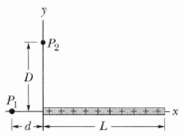
The thin plastic rod shown in Figure has length L = 12.0 cm and a non-uniform linear charge density λ = cx, where c = 289pC/m2. With V = 0 at infinity, find the electric potential at point P1 on the axis, at distance d = 3.00 cm from one end.
The electric potential V in the space between two flat parallel plates 1 and 2 is given (in volts) by V = 1500x2, where x (in meters) is the perpendicular distance from plate 1. At x = 1.3 cm,(a) What is the magnitude of the electric field and(b) Is the field directed toward or away from plate 1?
The electric potential at points in an xy plane is given by V = (2.0V/m2)x2 – (3.0V/m2)y2. In unit-vector notation, what is the electric fled at the point (3.0 m, 2.0m)?
Two large parallel metal plates are 1.5 cm apart and have charges of equal magnitudes but opposite signs on their facing surfaces. Take the potential of the negative plate to be zero. If the potential halfway between the plates is then + 5.0 V what is the electric field in the region between the
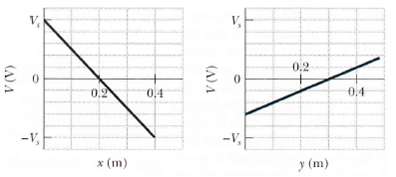
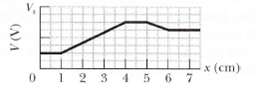
An electron is placed in an xy plane where the electric potential depends on x and y as shown in Figure (the potential does not depend on z). The scale of the vertical axis is set by Vs = 500 V. In unit-vector notation, what is the electric force on the electron?
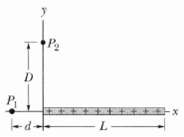
Figure shows a thin plastic rod of length L = 13.5 cm and uniform charge 43.6fC. (a) In terms of distance d, find an expression for the electric potential at point Pr. (b) Next, substitute variable x for d and find an expression for the magnitude of the component Ex of the electric field at P1. (c)
What is the magnitude of the electric field at the point (3.00i – 2.00j + 4.00k) m if the electric potential is given by V = 2.00xyz2, where V is in volts and x, y, and z are in meters?
The thin plastic rod of length L = 10.0 cm in Figure has a non-uniform linear charge density λ = cx, where c = 49.9pC/m2. (a) With V = 0 at infinity find the electric potential at point P2 on the y axis at y = 3.56cm. (b) Find the electric field component Ey at P2. (c) Why cannot the field
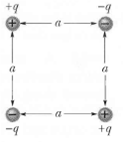
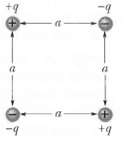
How much work is required to set up the arrangement of Figure if q = 2.30pC, a = 64.0cm, and the particles are initially infinitely far apart and at rest?
In Figure, seven charged particles are fixed in place to form a square with an edge length of 4.0 cm. How much work must we do to bring a particle of charge + 6e initially at rest from an infinite distance to the center of the square?
A particle of charge +7 .5μC is released from rest at the point x = 60 cm on an x axis. The particle begins to move due to the presence of a charge Q that remains fixed at the origin. What is the kinetic energy of the particle at the instant it has moved 40 cm if (a) Q = +20μC and (b) Q = ??
(a) What is the electric potential energy of two electrons separated by 2.00 nm?(b) If the separation increases, does the potential energy increase or decrease?
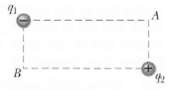
In the rectangle of Figure the sides have lengths 5.0cm and 15cm, q1 = - 5.0μC, and q2 = + 2.0μC. With V = 0 at infinity, what is the electric potential at? (a) Corner A and (b) Corner B? (c) How much work is required to move a charge q3 = + 3.0μC from B to A along a diagonal of the
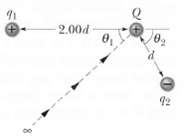
In Figure how much work must we do to bring a particle, of charge Q = + 16e and initially at rest, along the dashed line from infinity to the indicated point near two fixed particles of charges q1 = + 4e and q2 = - q1/2? Distance d = 1.40cm θ1 = 43o, and θ2 = 60o.
A particle of charge q is fixed at point P, and a second particle of mass m and the same charge q ts initially held a distance r1 from P. The second particle is then released. Determine its speed when it is a distance r2 from P. Let q = 3.1μC, m = 20 mg, r1 = 0.90 mm, and r2 = 2.5 mm.
A charge of – 9.0nC is uniformly distributed around a thin plastic ring lying in a yz plane with the ring center at the origin. A – 6.0pC point charge is located on the x axis at x = 3.0 m. For a ring radius of 1.5 m, how much work must an external force do on the point charge to move it to the
What is the escape speed for an electron initially at rest on the surface of a sphere with a radius of 1.0 cm and a uniformly distributed charge of 1.6 x 10⁻¹⁵ C? That is, what initial speed must the electron have in order to reach an infinite distance from the sphere and have zero kinetic energy
A thin, spherical, conducting shell of radius R is mounted on an isolating support and charged to a potential of – 125 V. An electron is then fired directly toward the center of the shell, from point P at distance r from the center of the shell (r > R). What initial speed us is needed for the
Two tiny metal spheres A and B of mass mA = 5.00 g and mB = 10.0 g have equal positive charge q = 5.00μC. The spheres are connected by a mass less non-conducting string of length d = 1.00 m, which is much greater than the radii of the spheres.(a) What is the electric potential energy of the
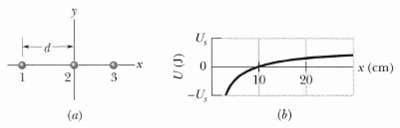
Figure a shows three particles on an x axis. Particle 1 (with a charge of + 5.0μC) and particle 2 (with a charge of + 3.0μC) are fixed in place with separation d = 4.0 cm. Particle 3 can be moved along the x axis to the right of particle 2. Figure b gives the electric potential energy U of the
Two electrons are fixed 2.0 cm apart. Another electron is shot from infinity and stops midway between the two. What is its initial speed?
Proton in a well figure shows electric potential V along an x axis. The scale of the vertical axis is set by Vs = 10.0 V. A proton is to be released at x = 3.5 cm with initial kinetic energy 4.00eV. (a) If it is initially moving in the negative direction of the axis, does it reach a turning point
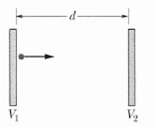
In Figure a charged particle (either an electron or a proton) is moving rightward between two parallel charged plates separated by distance d = 2.00 mm. The plate potentials are V1 = ?? 70.0 V and V2 = ?? 50.0 V. The particle is slowing from an initial speed of 90.0 km/s at the left plate. (a) Is
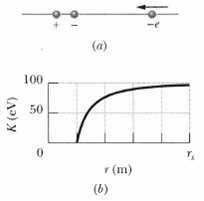
Figure a shows an electron moving along an electric dipole axis toward the negative side of the dipole. The dipole is fixed in place. The electron was initially very far from the dipole, with kinetic energy 100eV. Figure b gives the kinetic energy K of the electron versus its distance r from the
An electron is projected with an initial speed of.3.2 x 105 m/s directly toward a proton that is fixed in place. If the electron is initially a great distance from the proton, at what distance from the proton is the speed of the electron instantaneously equal to twice the initial value?
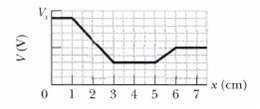
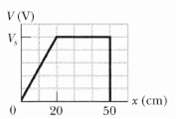
A positron (charge + e, mass equal to the electron mass) is moving at 1.0 x 10⁷ m/s in the positive direction of an x axis when, at x = 0, it encounters an electric field directed along the x axis. The electric potential V associated with the field is given in Figure. The scale of the vertical axis
Identical 50μC charges are fixed on an x axis at x = + 3.0 m. A particle of charge q = – 15μC is then released from rest at a point on the positive part of the y axis. Due to the symmetry of the situation, the particle moves along the y axis and has kinetic energy 1,.2 J as it passes through
In Figure a, we move an electron from an infinite distance to a point at distance R = 8.00 cm from a tiny charged ball. The move requires work W = 2.76 x 10⁻¹³ J by us. (a) What is the charge Q on the ball? In Figure b, the ball has been sliced up and the slices spread out so that an equal amount
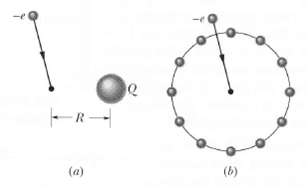
Suppose N electrons can be placed in either of two configurations. In configuration 1, they are all placed on the circumference of a narrow ring of radius R and are uniformly distributed so that the distance between adjacent electrons is the same everywhere. In configuration 2, N – 1 electron are
A hollow metal sphere has a potential of + 400 V with respect to ground (defined to be at V = 0) and a charge of 5.0 x 10⁻⁹ C. Find the electric potential at the center of the sphere.
What is the excess charge on a conducting sphere of radius r = 0.15 m if the potential of the sphere is 1500 V and V = 0 at infinity?
Sphere 1 with radius R1 has positive charge q. Sphere 2 with radius 2.00 R1 is far from sphere 1 and initially uncharged. After the separated spheres are connected with a wire thin enough to retain only negligible charge,(a) Is potential V1 of sphere 1 greater than, less than, or equal to potential
Two metal spheres, each of radius 3.0 cm, have a center-to-center separation of 2.0 m. Sphere 7 has charge + 1.0 x 10⁻⁸ C; sphere 2 has charge – 3.0 x 10⁻⁸ C. Assume that the separation is large enough for us to assume that the charge on each sphere is uniformly distributed (the spheres do not
Two isolated, concentric, conducting spherical shells have radii R1 = 0.500 m and R2 = 1.00 m, uniform charges q1 = + 2.00μC and q2 = +1.00μC, and negligible thicknesses. What is the magnitude of the electric fleld E at radial distance?(a) r = 4.00 m,(b) r = 0.700 m, and(c) r = 0.200 m with V = 0
A metal sphere of radius 15 cm has a net charge of 3.0 x 10⁻⁸ C.(a) What is the electric fleld at the sphere's surface?(b) If V = 0 at infinity, what is the electric potential at the sphere's surface?(c) At what distance from the sphere's surface has the electric potential decreased by 500 V?
The chocolate crumb mystery(a) From the answer to part(a) Of that problem, find an expression for the electric potential as a function of the radial distance r from the center of the pipe. (The electric potential is zero on the grounded pipe wall.)(b) For the typical volume charge density p = -1.1
An electron is released from rest on the axis of an electric dipole that has charge e and charge separation d = 20pm and that is fixed in place. The release point is on the positive side of the dipole, at distance 7 .0d from the dipole center. What is the electron's speed when it reaches a point
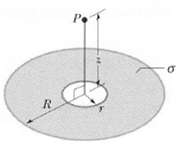
Figure shows a ring of outer radius R = 13.0 cm, inner radius r = 0.200R, and uniform surface charge density σ = 6.20pC/m2. With V - 0 at infinity, find the electric potential at point P on the central axis of the ring, at distance z = 2.00R from the center of the ring.
Electron in a well figure shows electric potential V along an x axis. The scale of the vertical axis is set by Vs = 8.0V. An electron is to be released at x = 4.5 cm with initial kinetic energy 3.00eV. (a) If it is initially moving in the negative direction of the axis, does it reach a turning
A solid conducting sphere of radius 3.0 cm has a charge of 30nC distributed uniformly over its surface. Let A be a point 1.0 cm from the center of the sphere, S be a point on the surface of the sphere, and B be a point 5.0 cm from the center of the sphere. What are the electric potential
In Figure point P is at distance dt = 4.00 m from particle 1 (q1 = ?? 2r) and distance d2 = 2.00 m from particle 2 (q2 = +2e), with both particles fixed in place. (a) With V = 0 at infinity, what rs V at P? If we bring a particle of charge q3 = + 2e from infinity to P, (b) How much work do we do
Figure shows a thin rod with a uniform charge density of 2.00μC/m. Evaluate the electric potential at point P if d = D = L/4.00.
Three + 0.12 C charges form an equilateral triangle 1.7 m on a side using energy supplied at the rate of 0.83 kW how many days would be required to move one of the charges to the midpoint of the line joining the other two charges?
The magnitude E of an electric field depends on the radial distance r according to E = A/r4, where A is a constant with the unit volt-cubic meter. As a multiple of A, what is the magnitude of the electric potential difference between r = 2.00m and r = 3.00m?
A long, solid, conducting cylinder has a radius of 2.0 cm. The electric field at the surface of the cylinder is 160 N/C, directed radially outward. Let A, B, and C be points that are 1.0 cm, 2.0 cm, and 5.0 cm, respectively, from the central axis of the cylinder. What are?(a) The magnitude of the
(a) If Earth had a net surface charge density of 1.0 electron/m2 (A very artificial assumption), what would its potential be? (Set V = 0 at infinity.) What would be the(b) Magnitude and(c) Direction (radially inward or outward) of the electric field due to Earth just outside its surf ace?
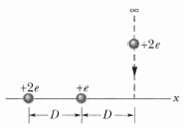
In Figure we move a particle of charge + 2e in from infinity to the x axis. How much work do we do? Distance D is 4.00m
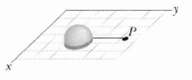
Figure shows a hemisphere with a charge of 4.00μC distributed uniformly through its volume. The hemisphere lies on an xy plane the way half a grapefruit might lie face down on a kitchen table. Point P is located on the plane, along a radial line from the hemisphere's center of curvature, al radial
Initially two electrons are fixed in place with a separation of 2.00μm. How much work must we do to bring a third electron in from infinity to complete an equilateral triangle?
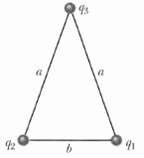
Three particles, charge q1 = +10μC, q2 = ?? 20μC, and q3 = +30μC, are positioned at the vertices of an isosceles triangle as shown in Figure. If a = 10 cm and b = 6.0 cm, how much work must an external agent do to exchange the positions of (a) q1 and q3 and, instead, (b) q1 and q2?
(a) If an isolated conducting sphere 10 cm in radius has a net charge of 4.0μC and if V = 0 at infinity, what is the potential on the surface of the sphere?(b) Can this situation actually occur, given that the air around the sphere undergoes electrical breakdown when the field exceeds 3.0 MV/m?
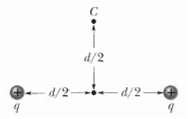
Two charges q = +2.0μC are fixed a distance d = 2.0 cm apart (Figure). (a) With V = 0 at infinity, what is the electric potential at point C? (b) You bring a third charge q = + 2.0μC from infinity to C. How much work must you do? (c) What is the potential energy U of the three-charge
A uniform charge of + 16.0μC is on a thin circular ring lying in an xy plane and centered on the origin. The ring's radius is 3.00 cm. If point A ts at the origin and point B is on the z axis at z: 4.00 cm, what is VB – VA?
The charges and coordinates of two point charges 1ocated in an xy plane are q1 = +3.00 x 10⁻⁶C, x + 3.50 cm, y = + 0.500 cm and q2 = - 4.00 x 10⁻⁶ C, x = -2.00 cm, y = + 1.50 cm. How much work must be done to locate these charges at their given positions, starting from infinite separation?
Two charged, parallel, flat conducting surfaces are spaced d = 100 cm apart and produce a potential difference ΔV = 625 V between them. An electron is projected from one surface directly toward the second. What is the initial speed of the electron if it stops just at the second surface?
A particle of positive charge Q is fixed at point P. A second particle of mass m and negative charge – q moves at constant speed in a circle of radius r1, centered at P. Derive an expression for the work W that must be done by an external agent on the second particle to increase the radius of the
An electric field of approximately 100 V/m is often observed near the surface of Earth. If this were the field over the entire surface, what would be the electric potential of a point on the surface? (Set V = 0 at infinity.)
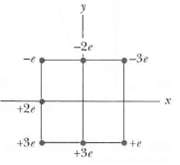
In Figure point P is at the center of the rectangle. With V = 0 at infinity, q1 = 5.00fC, q2 = 2.00fC, q3 = 3.00fC, and d = 2.54cm, what is the net electric potential at P due to the six charged particles?
Figure shows two charged particles on an axis. Sketch the electric field lines and the equipotential surfaces in the plane of the page for(a) q1 = + q, q2 = +2q and(b) q1 = q, q2 = – 3q.
A charge q is distributed uniformly throughout a spherical volume of radius R. Let V = 0 at infinity. What are?(a) V at radial distance r < R and(b) The potential difference between points at r = R and the point at r = 0?
A thick-walled spherical shell of charge Q and uniform volume charge density p is bounded by radii r1 and r2 > r1. With V = 0 at infinity, find the electric potential V as a function of distance r from the center of the distribution, considering regions(a) r > r2,(b) r2 > r > r1, and(c)
An alpha particle (which has two protons) is sent directly toward a target nucleus containing 92 protons. The alpha particle has an initial kinetic energy of 0.48pJ. What is the least center-to-center distance the alpha particle will be from the target nucleus, assuming the nucleus does not move?
Starting from Eq. 24-30, derive an expression for the electric fleld due to a dipole at a point on the dipole axis.
A charge of 1.50 x 10⁻⁸ C lies on an isolated metal sphere of radius 16.0 cm. With V = 0 at infinity, what is the electric potential at points on the sphere's surface?
Showing 3800 - 3900
of 8940
First
32
33
34
35
36
37
38
39
40
41
42
43
44
45
46
Last
Step by Step Answers

 Get 50% OFF
Claim Now
Get 50% OFF
Claim Now