New Semester
Started
Get
50% OFF
Study Help!
--h --m --s
Claim Now
Question Answers
Textbooks
Find textbooks, questions and answers
Oops, something went wrong!
Change your search query and then try again
S
Books
FREE
Study Help
Expert Questions
Accounting
General Management
Mathematics
Finance
Organizational Behaviour
Law
Physics
Operating System
Management Leadership
Sociology
Programming
Marketing
Database
Computer Network
Economics
Textbooks Solutions
Accounting
Managerial Accounting
Management Leadership
Cost Accounting
Statistics
Business Law
Corporate Finance
Finance
Economics
Auditing
Tutors
Online Tutors
Find a Tutor
Hire a Tutor
Become a Tutor
AI Tutor
AI Study Planner
NEW
Sell Books
Search
Search
Sign In
Register
study help
physics
mechanics
Fundamentals of Physics 8th Extended edition Jearl Walker, Halliday Resnick - Solutions
An electron with a speed of 1 .2 x 107 m/s moves horizontally into a region where a constant vertical force of 4.5 x l0-16N acts on it. The mass of the electron is 9.11 x 10⁻³¹ kg. Determine the vertical distance the electron is deflected during the time it has moved 30 mm horizontally.
A car that weighs 1.30 x 10⁴ N is initially moving at 40 km/h when the brakes are applied and the car is brought to a stop in 15 m, assuming the force that stops the car is constant, find(a) The magnitude of that force and(b) The time required for the change in speed. If the initial speed is
The velocity of a 3.00 kg particle is given by v = (8.00ti + 3.00t2j) m/s, with time t in seconds. At the instant the net force on the particle has a magnitude of 35.0 N, what is the direction (relative to the positive direction of the x axis) of(a) The net force and(b) The particle's direction of
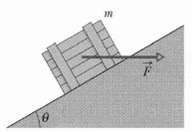
In Figure, a crate of mass m = 100 kg is pushed at constant speed up a frictionless ramp (θ = 30.0o) by a horizontal force F. What are the magnitudes of?(a) F and(b) The force on the crate from the ramp?
A 40 kg girl and an 8.4 kg sled are on the frictionless ice of a frozen lake, 15 m apart but connected by u rope of negligible mass. The girl exerts a horizontal 5.2N force on the rope. What are the acceleration magnitudes of? (a) The sled and (b) The girl? (c) How far from the girl's initial
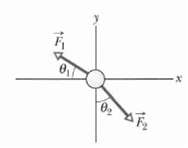
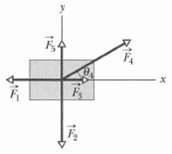
Figure shows an overhead view of a 0.0250 kg lemon half and two of the three horizontal forces that act on it as it is on a frictionless table. Force F1 has a magnitude of 6.00 N and is at θ1 = 30.0o. Force F2 has a magnitude of 7.00 N and is at θ2 = 30.0o. In unit-vector notation, what is the
A block is projected up a frictionless inclined plane with initial speed v0: 3.50 m/s. The angle of incline is θ = 32.0o.(a) How far up the plane does the block go?(b) How long does it take to get there?(c) What is its speed when it gets back to the bottom?
A 40 kg skier skis directly down a frictionless slope angled at l-0o to the horizontal. Assume the skier moves in the negative direction of an x axis along the slope. A wind force with component Fx acts on the skier. What is Fx if the magnitude of the skier's velocity is(a) Constant,(b) Increasing
A sphere of mass 3.0 x 10⁻⁴ kg is suspended from a cord. A steady horizontal breeze pushes the sphere so that the cord makes a constant angle of 37o with the vertical. Find(a) The push magnitude and(b) The tension in the cord.
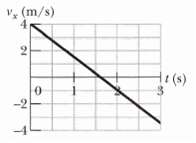
A dated box of dates, of mass 5.00 kg, is sent sliding up a frictionless ramp at an angle of θ to the horizontal. Figure gives, as a function of time t, the component vx of the box's velocity along an x axis that extends directly up the ramp. What is the magnitude of the normal force on the box
An elevator cab and its load have a combined mass of 1600 kg. Find the tension in the supporting cable when the cab, originally moving downward at 12 m/s, is brought to rest with constant acceleration in a distance of 42 m.
Holding on to a towrope moving parallel to a frictionless ski slope, a 50 kg skier is pulled up the slope, which is at an angle of 8.0o with the horizontal. What is the magnitude F rope of the force on the skier from the rope when(a) The magnitude y of the skier's velocity is constant at 2.0 m/s
An elevator cab that weighs 27.8kN moves upward. What is the tension in the cable if the cab's speed is?(a) Increasing at a rate of 1 .22 m/s2 and(b) Decreasing at a rate of 1 .22 m/s2?
A lamp hangs vertically from a cord in a descending elevator that decelerates at 2.4 m/s2.(a) If the tension in the cord is 89 N what is the lamp's mass?(b) What is the cord's tension when the elevator ascends with an upward acceleration of 2.4 m/s2?
Using a rope that will snap if the tension in it exceeds 387N, you need to lower a bundle of old roofing material weighing 449 N from a point 6.1 m above the ground.(a) What magnitude of the bundle's acceleration will put the rope on the verge of snapping?(b) At that acceleration, with what speed
An elevator cab is pulled upward by a cable. The cab and its single occupant have a combined mass of 2000 kg. When that occupant drops a coin, its acceleration relative to the cab is 8.00m/s2 downward. What is the tension in the cable?
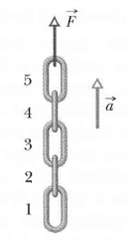
In Figure, a chain consisting of five links, each of mass 0.100 kg, is lifted vertically with constant acceleration of magnitude a = 2.50 m/s2. Find the magnitudes of (a) The force on link 1 from link 2, (b) The force on link 2 from link 3, (c) The force on link 3 from link 4, and (d) The force on
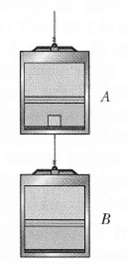
In Figure, elevator cabs A and B are connected by a short cable and can be pulled upward or lowered by the cable above cab A. Cab A has mass 1700 kg; cab B has mass 1300 kg. A 12.0 kg box of catnip lies on the floor of cab A, the tension in the cable connecting the cabs is 1.91 x 10⁴ N. What is the
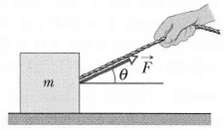
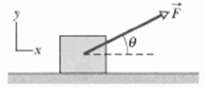
In Figure, a block of mass m = 5.00kg is pulled along a horizontal frictionless floor by a cord that exerts a force of magnitude F = 12.0 N at an angle θ = 25.0o. (a) What is the magnitude of the block's acceleration? (b) The force magnitude F is slowly increased. What is its value just before the
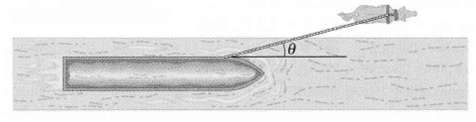
In earlier days, horses pulled barges down canals in the manner shown in Figure. Suppose the horse pulls on the rope with a force of 7900 N at an angle of θ = 18o to the direction of motion of the barge, which is headed straight along the positive direction of an x axis. The mass of the barge is
The Zucchini family was renowned for their human cannonball act in which a family member was shot from a cannon using either elastic bands or compressed air. In one version of the act, Emanuel Zucchini was shot over three Ferris wheels to land in a net at the same height as the open end of the
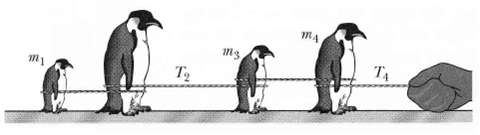
Figure shows four penguins that are being playfully pulled along very slippery (frictionless) ice by a curator. The masses of three penguins and the tension in two of the cords are m1 = 12 kg, m3 = 15 kg, m4 = 20 kg, T2 = 111N, and T4 = 222 N. Find the penguin mass m2 that is not given.
In Figure, three connected blocks are pulled to the right on a horizontal frictionless table by a force of magnitude T3 = 65.0 N. If m1 = 12.0kg, m2 = 24.0 kg, and m3 = 31.0 kg, calculate (a) The magnitude of the system's acceleration, (b) The tension Ty and (c) The tension T2.
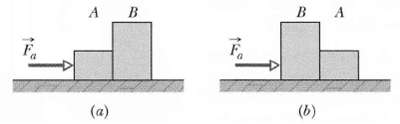
In Figure a, a constant horizontal force Fa is applied to block, 4, which pushes against block B with a 20.0N force directed horizontally to the right. In Figure b, the same force Fa is applied to block B; now block, A pushes on block B with a 10.0 N force directed horizontally to the left. The
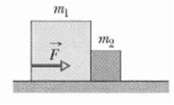
Two blocks are in contact on a frictionless table. A horizontal force is applied to the larger block, as shown in Figure. (a) If m1 = 2.3 kg, m2 = 1.2 kg, and F = 3.2 N, find the magnitude of the force between the two blocks. (b) Show that if a force of the same magnitude F is applied to the
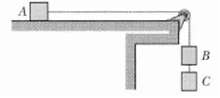
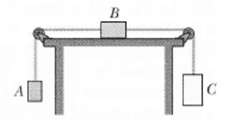
In Figure three ballot boxes are connected by cords, one of which wraps over a pulley having negligible friction on its axle and negligible mass. The three masses are mA = 30.0 kg, mB = 40.0 kg, and mC = 10.0 kg. When the assembly is released from rest, (a) What is the tension in the cord
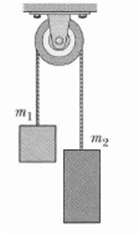
Figure shows two blocks connected by a cord (of negligible mass) that passes over a frictionless pulley (also of negligible mass). The arrangement is known as Atwood's machine. One block has mass m1 = 1.30 kg; the other has mass m2 = 2.80 kg. What are? (a) The magnitude of the blocks' acceleration
In shot putting, many athletes elect to launch the shot at an angle that is smaller than the theoretical one (about 42o) at which the distance of a projected ball at the same speed and height is greatest. One reason has to do with the speed the athlete can give the shot during the acceleration
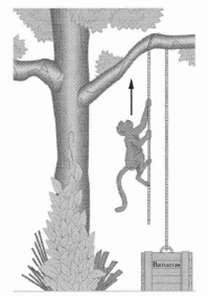
A 10 kg monkey climbs up a mass less rope that runs over a frictionless tree limb and back down to a 15 kg package on the ground (Figure).(a) What is the magnitude of the least acceleration the monkey must have if it is to lift the package off the ground? If, after the package has been lifted, the
An 85 kg man lowers himself to the ground from a height of 10.0 m by holding onto a rope that runs over a frictionless pulley to a 65 kg sandbag. With what speed does the man hit the ground if he started from rest?
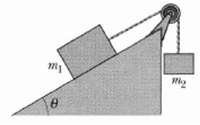
A block of mass m1 = 3.70 kg on a frictionless plane inclined at angle θ = 30.0o is connected by a cord over a mass less, frictionless pulley to a second block of mass m2 = 2.30 kg (Figure). What are? (a) The magnitude of the acceleration of each block, (b) The direction of the acceleration of the
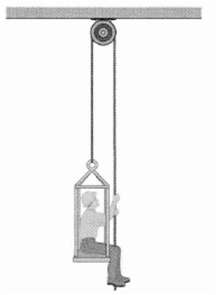
Figure shows a man sitting in a bosun's chair that dangles from a mass less rope, which runs over a mass less, frictionless pulley and back down to the man's hand. The combined mass of man and chair is 95.0 kg. With what force magnitude must the man pull on the rope if he is to rise (a) With a
A hot-air balloon of mass M is descending vertically with downward acceleration of magnitude a. How much mass (ballast) must be thrown out to give the balloon an upward acceleration of magnitude a? Assume that the upward force from the air (the lift) does not change because of the decrease in mass.
Figure shows a 5.00 kg block being pulled along a frictionless floor by a cord that applies a force of constant magnitude 20.0 N but with an angle θ (t) that varies with time. When angle θ = 25.0o, at what rate is the block's acceleration changing if(a) θ(t) = (2.00 x 10⁻² deg/s)t and(b) θ(t)
Figure shows Atwood's machine, in which two containers are connected by a cord (of negligible mass) passing over a frictionless pulley (also of negligible mass). At time t = 0, container 1 has mass 1.30 kg and container 2 has mass 2.80 kg, but container 1 is losing mass (through a leak) at the
A shot putter launches a 7.260 kg shot by pushing it along a straight line of length 1.650 m and at an angle of 34.10o from the horizontal accelerating the shot to the launch speed from its initial speed of 2.500 m/s (which is due to the athlete's preliminary motion). The shot leaves the hand at a
Figure shows three blocks attached by cords that loop over frictionless pulleys. Block B lies on a frictionless table; the masses mA = 6.00 kg, mB = 8.00kg, and mC = 10.0kg. When the blocks are released, what is the tension in the cord at the right?
Figure shows a box of mass m2 = 1.0 kg on a frictionless plane inclined at angle θ = 30o. It is connected by a cord of negligible mass to a box of mass m1 = 3.0 kg on a horizontal frictionless surface. The pulley is frictionless and mass less. (a) If the magnitude of horizontal force F is 2.3 N,
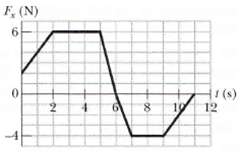
Figure gives, as a function of time t, the force component Fx that as a function of time t, the force acts on a 3.00 kg ice block that can move only along the x axis. At t = 0, the block is moving in the positive direction of the axis, with a speed of 3.0 m/s. What are its (a) Speed and (b)
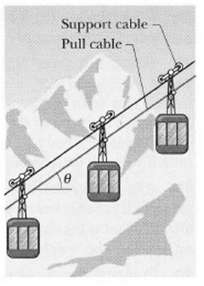
Figure shows a section of a cable-car system. The maximum permissible mass of each car with occupants is 2800 kg. The cars, riding on a support cable, are pulled by a second cable attached to the support tower on each car. Assume that the cables are taut and inclined at angle θ = 35o. What is the
Blowing off units throughout your physics course, your instructor will expect you to be careful with units in your calculations" Yet some students tend to neglect them and just trust that they always work out properly. Maybe this real world example will keep you from such a sloppy habit. On July
The only two forces acting on a body have magnitudes of 20 N and 35 N and directions that differ by 80o. The resulting acceleration has a magnitude of 20 m/s2. What is the mass of the body?
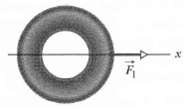
Figure is an overhead view of a 12 kg tire that is to be pulled by three horizontal ropes. One rope's force (F1 = 50 N) is indicated. The forces from the other ropes are to be oriented such that the tire's acceleration magnitude a is least. What is that least a if? (a) F2 = 30N, F3 = 20 N; (b) F2 =
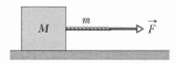
A block of mass M is pulled along a horizontal frictionless surface by u rope of mass m, as shown in Figure. A horizontal force F acts on one end of the rope. (a) Show that the rope must sag, even if only by an imperceptible amount. Then, assuming that the sag is negligible find (b) The
A worker drags a crate across a factory floor by pulling on a rope tied to the crate. The worker exerts a force of magnitude F = 450N on the rope, which is inclined at an upward angle θ = 38o to the horizontal, and the floor exerts a horizontal force of magnitude f = 125N that opposes the motion.
Three forces act on a particle that moves with unchanging velocity v = (2 m/s)i – (7 m/s)i. Two of the forces are F1 = (2 N)i + (3 N)j + (– 2N)k and F2 = (– 5N)i + (8 N)j + (– 2 N)k. What is the third force?
A 52 kg circus performer is to slide down a rope that will break if the tension exceeds 425 N.(a) What happens if the performer hangs stationary on the rope?(b) At what magnitude of acceleration does the performer just avoid breaking the rope?
An 80 kg man drops to a concrete patio from a window 0.50 m above the patio. He neglects to bend his knees on landing, taking 2.0 cm to stop.(a) What is his average acceleration from when his feet first touch the patio to when he stops?(b) What is the magnitude of the average stopping force exerted
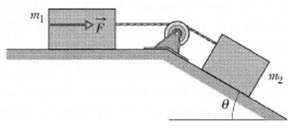
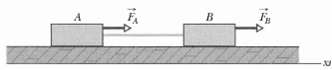
In Figure, 4.0 kg block A and 6.0 kg block B are connected by a string of negligible mass. Force FA = (12 N)i acts on block A; force FB = (24 N)i acts on block B. What is the tension in thestring?
In the overhead view of Fig. 5-64, five forces pull on a box of mass m = 4.0kg. The force magnitudes are F1 = 11 N, F2 = 17 N, F3 = 3.0 N, F4 = 14 N, and F5 = 5.0 N, and angle θ4 is 30o. Find the box's acceleration (a) In unit-vector notation and as (b) A magnitude and (c) An angle relative to the
A certain force gives an object of mass m1 an acceleration of 12.0 m/s2 and an object of mass wt2 ?rr acceleration of 3.30 m/s2. What acceleration would the force give to an object of mass?(a) m2 – m1 and(b) m2 + m1?
Imagine a landing craft approaching the surface of Callisto, one of Jupiter's moons. If the engine provides an upward force (thrust) of 3260 N, the craft descends at constant speed; if the engine provides only 2200N, the craft accelerates downward at 0.39 m/s2.(a) What is the weight of the landing
An object is hung from a spring balance attached to the ceiling of an elevator cab. The balance reads 65 N when the cab is standing still. What is the reading when the cab is moving upward?(a) With a constant speed of 7.6 m/s and(b) With a speed of 7 .6 m/s while decelerating at a rate of 2.4 m/s2?
In Figure, a force F of magnitude 12 N is applied to a FedEx box of mass m2 = 1.0 kg. The force is directed up a plane tilted by θ = 37o. The box is connected by a cord to a UPS box of mass m1 = 3.0 kg on the floor. The floor, plane, and pulley are frictionless, and the masses of the pulley and
A certain particle has a weight of 22 N at a point where g = 9.8 m/s2. What are its(a) Weight and(b) Mass at a point where g = 4.9 m/s2? What are its(c) Weight and(d) Mass if it is moved to a point in space where g = 0?
Compute the weight of a 75 kg space ranger(a) On Earth,(b) On Mars, where g - 3.7 m/s2, and(c) In interplanetary space, where g = 0.(d) What is the ranger's mass at each location?
A 1400 kg jet engine is fastened to the fuselage of a passenger jet by just three bolts (this is the usual practice). Assume that each bolt supports one-third of the load.(a) Calculate the force on each bolt as the plane waits in line for clearance to take off.(b) During flight, the plane
An 80 kg person is parachuting and experiencing a downward acceleration of 2.5 m/s2. The mass of the parachute is 5.0 kg. (a) What is the upward force on the open parachute from the air? (b) What is the downward force on the parachute from the person?
Suppose that in Fig. 5-13, the masses of the blocks are 2.0kg and 4.0kg.(a) Which mass should the hanging block have if the magnitude of the acceleration is to be as large as possible? What then are?(b) The magnitude of the acceleration and(c) The tension in the cord?
You pull a short refrigerator with a constant force F across a greased (frictionless) floor, either with F horizontal (case 1) or with F tilted upward at an angle θ (case 2).(a) What is the ratio of the refrigerator's speed in case 2 to its speed in case 1 if you pull for a certain time t?(b) What
A spaceship lifts off vertically from the Moon, where g = 1.6 m/s2. If the ship has an upward acceleration of 1.0 m/s2 as it lifts off, what is the magnitude of the force exerted by the ship on its pilot, who weighs 735 N on Earth?
Compute the initial upward acceleration of a rocket of mass 1.3 x 10⁴ kg if the initial upward force produced by its engine (the thrust) is 26 x 105 N. Do now neglect the gravitational force on the rocket.
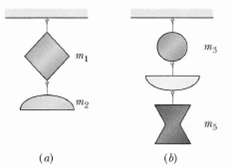
Figure (a) shows a mobile hanging from a ceiling; it consists of two metal pieces (m1= 3.5) kg and m2= 4.5kg) that are strung together by cords of negligible mass. What is the tension in?? (a) The bottom cord and? (b) The top cord? Figure (b) shows a mobile consisting of three metal pieces. Two of
If the 1 kg standard body is accelerated by only F1 = (3.0 N)i + (4.0 N)j and F2 = (– 2.0 N)i + (– 6.0 N)j, then t is F net. (a) In unit-vector notation and as (b) A magnitude and (c) An angle relative to the positive x direction? What are the (d) Magnitude and (e)
A nucleus that captures a stray neutron must bring the neutron to a stop within the diameter of the nucleus by means of the strong force. That force, which "glues" the nucleus together, is approximately zero outside the nucleus. Suppose that a stray neutron with an initial speed of 1.4 x 10⁷ m/s is
A 15 000 kg helicopter lifts a 4500 kg truck with an upward acceleration of 1.4 m/s2. Calculate(a) The net upward force on the helicopter blades from the air and(b) The tension in the cable between helicopter and truck.
A motorcycle and 60.0 kg rider accelerate at 3.0 m/s2 up a ramp inclined 10 degrees above the horizontal what are the magnitudes of(a) The net force on the rider and(b) The force on the rider from the motorcycle?
An interstellar ship has a mass of 1.20 x 10⁶ kg and is initially at rest relative to a star system.(a) What constant acceleration is needed to bring the ship up to a speed of 0.10c (where c is the speed of light, 3.0 x 10⁸ m/s) relative to the star system in 3.0 days?(b) What is that acceleration
For sport, a 12 kg armadillo runs onto a large pond of level, frictionless ice. The armadillo's initial velocity is 5.0 m/s along the positive direction of an x axis. Take its initial position on the ice as being the origin. It slips over the ice while being pushed by a wind with a force of 17N in
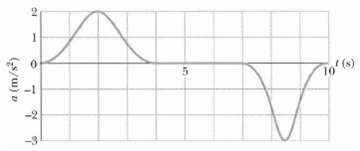
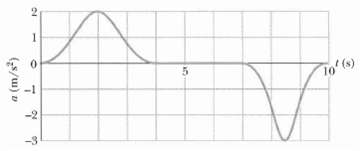
A 50 kg passenger rides in an elevator cab that starts from rest on the ground floor of a building at t = 0 and rises to the top floor during a 10 s interval. The cab's acceleration as a function of the time is shown in Figure, where positive values of the acceleration mean that it is directed
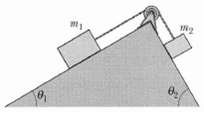
Figure shows a box of dirty money (mass m1= 3.0 kg) on a frictionless plane inclined at angle θ1= 30?. The box is connected via a cord of negligible mass to a box of laundered money (mass m2= 2.0 kg) on a frictionless plane inclined at angle θ2= 60?. The pulley is frictionless and has negligible
Suppose the 1 kg standard body accelerates at 4.00m/s2 at 160o from the positive direction of an x axis due to two forces; one is F1 = (2.50N)i + (4.60N)j What is the other force (a) In unit-vector notation and as (b) A magnitude and (c) An angle?
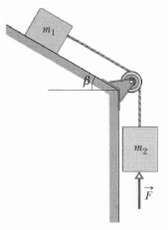
In Figure, a tin of antioxidants (m1= 1.0 kg) on a frictionless inclined surface is connected to a tin of corned beef (m2= 2.0 kg). The pulley is mass less and frictionless. An upward force of magnitude F = 6.0 N acts on the corned beef tin, which has a downward acceleration of 5.5 m/s2. What
A rocket and its payload have a total mass of 5.0 x 10⁴ kg. How large is the force produced by the engine (the thrust) when the rocket is(a) "Hovering" over the launch pad just after ignition and(b) Accelerating upward at 20 m/s2?
A motorcycle of weight 2.0kN accelerates from 0 to 88.5 km/h in 6.0 s. What are the magnitudes of(a) The constant acceleration and(b) The net force causing the acceleration?
An initially stationary electron (mass = 9.1 x 10⁻³¹ kg) undergoes a constant acceleration through 1-5cm, reaching 6.0 x 10⁶ m/s what are?(a) The magnitude of the force accelerating the electron and?(b) The electron's weight?
A bedroom bureau with a mass of 45 kg, including drawers and clothing, rests on the floor.(a) If the coefficient of static friction between the bureau and the floor is 0.45, what is the magnitude of the minimum horizontal force that a person must apply to start the bureau moving?(b) If the drawers
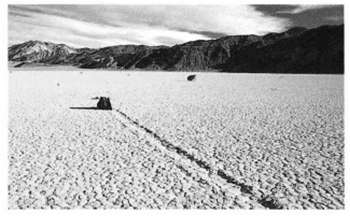
The mysterious sliding stones, along the remote Racetrack Playa in Death Valley, California, stones sometimes gouge out prominent trails in the desert floor, as if the stones had been migrating (Fig. 6-19). For year??s curiosity mounted about why the stones moved. One explanation was that strong
A person pushes horizontally with a force of 220 N on a 55 kg crate to move it across a level floor. The coefficient of kinetic friction is 0.35. What is the magnitude of?(a) The frictional force and(b) The crate's acceleration?
A baseball player with mass m = 79 kg, sliding into second base, is retarded by u frictional force of magnitude 470 N. What is the coefficient of kinetic friction µk between the player and the ground?
The floor of a railroad flatcar is loaded with loose crates having a coefficient of static friction of 0.25 with the floor. If the train is initially moving at a speed of 48 km/h, in how short a distance can the train be stopped at constant acceleration without causing the crates to slide over the
A slide-loving pig slides down a certain 35o slide in twice the time it would take to slide down a frictionless 35o slide. What is the coefficient of kinetic friction between the pig and the slide?
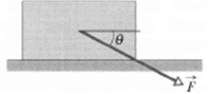
A 3.5 kg block is pushed along a horizontal floor by a force F of magnitude 15 N at an angle θ = 40owith the horizontal (Figure). The coefficient of kinetic friction between the block and the floor is 0.25. Calculate the magnitudes of? (a) The frictional force on the block from the floor and? (b)
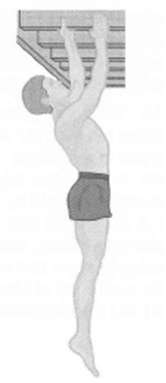
In about 7915, Henry Sincosky of Philadelphia suspended himself from a rafter by gripping the rafter with the thumb of each hand on one side and the fingers on the opposite side (Figure). Sincosky's mass was 79 kg. If the coefficient of static friction between hand and rafter was 0.70, what was the
A worker pushes horizontally on a 35 kg crate with a force of magnitude 110 N. The coefficient of static friction between the crate and the floor is 0.37. (a) What is the value of fs,max under the circumstances? (b) Does the crate move?(c) What is the frictional force on the crate from the
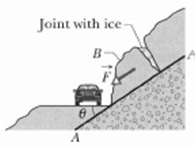
Figure 6-23 shows the cross section of a road cut into the side of a mountain. The solid line AA' represents a weak bedding plane along which sliding is possible. Block B directly above the highway is separated from uphill rock by a large crack (called a joint), so that only friction between the
A 68 kg crate is dragged across a floor by pulling on a rope attached to the crate and inclined 15o above the horizontal.(a) If the coefficient of static friction is 0.50, what minimum force magnitude is required from the rope to start the crate moving? (b) If µk = 0.35, what is the magnitude
Figure shows an initially stationary block of mass m on a floor. A force of magnitude 0.500mg is then applied at upward angle θ = 20o. What is the magnitude of the acceleration of the block across the floor if? (a) ?s = 0.600 and ?s = 0.500 and? (b) ?s = 0.400 and ?k = 0.300?
The coefficient of static friction between Teflon and scrambled eggs is about 0.04. What is the smallest angle from the horizontal that will cause the eggs to slide across the bottom of a Teflon-coated skillet?
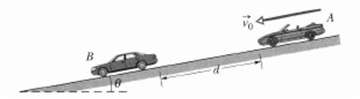
You testify as an expert witness in a case involving an accident in which car A slid into the rear of car B, which was stopped at a red light along a road headed down a hill (Fig. 6-25). You find that the slope of the hill is θ = 12.0o, that the cars were separated by distance d = 24.0 m when the
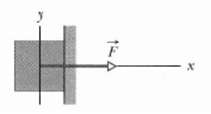
A 12 N horizontal force F pushes a block weighing 5.0 N against a vertical wall (Fig. 6-26). The coefficient of static friction between the wall and the block is 0.60, and the coefficient of kinetic friction is 0.40. Assume that the A 12 N horizontal force F pushes a block weighing 5.0 N against a
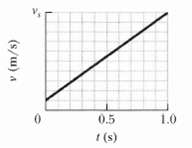
A 4.10 kg block is pushed along a floor by a constant applied force that is horizontal and has a magnitude of 40.0 N. Figure 6-27 gives the block's speed y versus time t as the block moves along an x axis on the floor. The scale of the figure's vertical axis is set by ys= 5.0 m/s. What is the
An initially stationary box of sand is to be pulled across a floor by means of a cable in which the tension should not exceed 1100 N. The coefficient of static friction between the box and the floor is 0.35. (a) What should be the angle between the cable and the horizontal in order to pull the
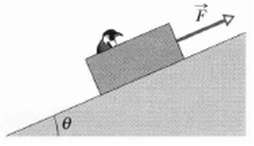
A loaded penguin sled weighing 80 N rests on a plane inclined at angle ? = 20o to the horizontal (Fig. 6-28). Between the sled and the plane, the coefficient of static friction is 0.25, and the coefficient of kinetic friction is 0.15.(a) What is the least magnitude of the force F, parallel to the
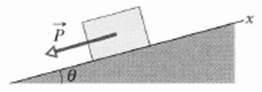
In Fig. 6-29, a force P acts on a block weighing 45 N. The block is initially at rest on a plane inclined at angle θ = 15oto the horizontal. The positive direction of the x axis is up the plane. The coefficients of friction between block and plane are ?s= 0.50 and ?k= 0.34.In unit vector notation,
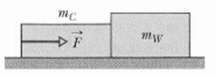
In Figure, a box of Cheerios (mass mC?= 1.0kg) and a box of Wheaties (massmW?= 3.0kg) are accelerated across a horizontal surface by a horizontal force f applied to the Cheerios box. The magnitude of the frictional force on the Cheerios box is 2.0 N, and the magnitude of the frictional force on the
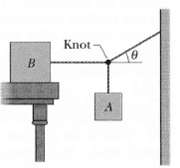
Block B in Figure weighs 711 N. The coefficient of static friction between block and table is 0.25; angle θ is 30o; assume that the cord between B and the knot is horizontal. Find the maximum weight of block A for which the system will be stationary.
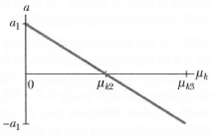
A block is pushed across a floor by a constant force that is applied at downward angle θ (Figure). Figure gives the acceleration magnitude a versus a range of values for the coefficient of kinetic friction Ft between block and floor a1?= 3.0m/s2, ?k2?= 0.20, and ?k3= 0.40. What is the value of θ?
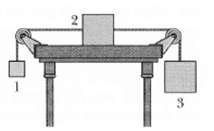
When the three blocks in Figure are released from rest, they accelerate with a magnitude of 0.500 m/s2. Block t has mass M, block 2 has 2M, and block 3 has 2M. What is the coefficient of kinetic friction between block 2 and the table?
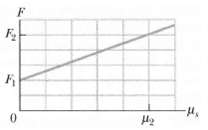
In Figure a sled is held on an inclined plane by a cord pulling directly up the plane. The sled is to be on the verge of moving up the plane. In Fig. 6-34, the magnitude F required of the cord's force on the sled is plotted versus a range of values for the coefficient of static friction ?s, between
Showing 4600 - 4700
of 21795
First
40
41
42
43
44
45
46
47
48
49
50
51
52
53
54
Last
Step by Step Answers

 Get 50% OFF
Claim Now
Get 50% OFF
Claim Now