New Semester
Started
Get
50% OFF
Study Help!
--h --m --s
Claim Now
Question Answers
Textbooks
Find textbooks, questions and answers
Oops, something went wrong!
Change your search query and then try again
S
Books
FREE
Study Help
Expert Questions
Accounting
General Management
Mathematics
Finance
Organizational Behaviour
Law
Physics
Operating System
Management Leadership
Sociology
Programming
Marketing
Database
Computer Network
Economics
Textbooks Solutions
Accounting
Managerial Accounting
Management Leadership
Cost Accounting
Statistics
Business Law
Corporate Finance
Finance
Economics
Auditing
Tutors
Online Tutors
Find a Tutor
Hire a Tutor
Become a Tutor
AI Tutor
AI Study Planner
NEW
Sell Books
Search
Search
Sign In
Register
study help
physics
mechanics
Fundamentals of Physics 8th Extended edition Jearl Walker, Halliday Resnick - Solutions
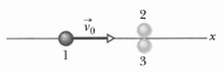
The three balls in the overhead view of Figure are identical. Balls 2 and 3 touch each other and are aligned perpendicular to the path of ball L. The velocity of ball t has magnitude v0 = 10 m/s and is directed at the contact point of balls l and 2. After the collision, what are the (a) Speed
In a game of pool, the cue ball strikes another ball of the same mass and initially at rest. After the collision, the cue ball moves at 3.50 m/s along a line making an angle of 22.0o with the cue ball's original direction of motion, and the second ball has a speed of 2.00 m/s. Find(a) The angle
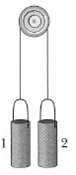
In Figure two identical containers of sugar are connected by a cord that passes over a frictionless pulley. The cord and pulley have negligible mass, each container and its sugar together have a mass of 500 g, the centers of the containers are separated by 50 mm, and the containers are held fixed
A 0.15 kg ball hits a wall with a velocity of (5.00 m/s)i + (6.50 m/s)j + (4.00 m/s)k. It rebounds from the wall with a velocity of (2.00 m/s)i + (3.50 m/s)j + (–3.20 m/s)k. What are?(a) The change in the ball's momentum,(b) The impulse on the ball, and(c) The impulse on the wall?
At time t = 0, force F1 = (–4.00i + 5.00i) N acts on an initially stationary particle of mass 2.00 x 10⁻³ kg and force F2 = (2.00i - 4.00j) N acts on an initially stationary particle of mass 4.00 x 10⁻³ kg. From time t = 0 to t = 2.00 ms, what are the(a) Magnitude and(b) Angle (relative to
A 0.550 kg ball falls directly down onto concrete, hitting it with a speed of 12.0 m/s and rebounding directly upward with a speed of 3.00 m/s. Extend a y axis upward. In unit-vector notation, what are?(a) The change in the ball's momentum,(b) The impulse on the ball, and(c) The impulse on the
A collision occurs between a 2.00 kg particle traveling with velocity v1 = (–4.00 m/s)i + (–5.00 m/s)j and a 4.00 kg particle traveling with velocity v2 = (6.00 m/s)i + (–2.00m/s)j. The collision connects the two particles. What then is their velocity in(a) Unit-vector notation and as a(b)
An atomic nucleus at rest at the origin of an xy coordinate system transforms into three particles. Particle l, mass 16.7 x 10⁻²⁷ kg, moves away from the origin at velocity (6.00 x 10⁶ m/s)i; particle 2, mass 8.35 x 10⁻²⁷ kg, moves away at velocity (–8.00 x 10⁶ m/s)i.(a) In unit-vector
An electron undergoes a one-dimensional elastic collision with an initially stationary hydrogen atom. What percentage of the electron's initial kinetic energy is transferred to kinetic energy of the hydrogen atom? (The mass of the hydrogen atom is 1840 times the mass of the electron)
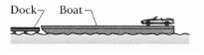
The script for an action movie calls for a small race car (of mass 1500 kg and length 3.0 m) to accelerate along a flattop boat (of mass 4000 kg and length 14 m), from one end of the boat to the other, where the car will then jump the gap between the boat and a somewhat lower dock. You are the
A rocket sled with a mass of 2900 kg moves at 250 m/s on a set of rails. At a certain point, a scoop on the sled dips into a trough of water located between the tracks and scoops water into an empty tank on the sled. By applying the principle of conservation of linear momentum, determine the speed
A 140 g ball with speed 7.8 m/s strikes a wall perpendicularly and rebounds in the opposite direction with the same speed. The collision lasts 3.80ms. What are the magnitudes of the(a) Impulse and(b) Average force on the wall from the ball?
(a) How far is the center of mass of the Earth-Moon system from the center of Earth? (Appendix C gives the masses of Earth and the Moon and the distance between the two.)(b) What percentage of Earth's radius is that distance?
A 500.0 kg module is attached to a 400.0 kg shuttle craft, which moves at 1000 m/s relative to the stationary main spaceship. Then a small explosion sends the module backward with speed 100.0 m/s relative to the new speed of the shuttle craft. As measured by someone on the main spaceship, by what
A 6100 kg rocket is set for vertical firing from the ground. If the exhaust speed is 1200 m/s, how much gas must be ejected each second if the thrust(a) Is to equal the magnitude of the gravitational force on the rocket and(b) Is to give the rocket an initial upward acceleration of 21 m/s2?
A 2140 kg railroad flatcar, which can move with negligible friction, is motionless next to a platform. A 242 kg sumo wrestler runs at 5.3 m/s along the platform (parallel to the track) and then jumps onto the flatcar. What is the speed of the flatcar if he then(a) Stands on it,(b) Runs at 5.3 m/s
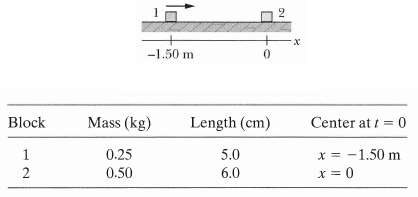
In Figure block 1 slide along an x axis on a frictionless floor with a speed 0.75m/s. When it reaches stationary block 2, the two blocks undergo an elastic collision. The following table gives the mass and length of the (uniform) blocks and also the locations of their centers at time t = 0. Where
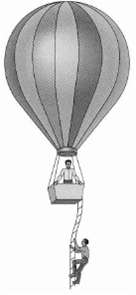
In Figure an 80 kg man is on a ladder hanging from a balloon that has a total mass of 320 kg (including the basket passenger). The balloon is initially stationary relative to the ground. If the man on the ladder begins to climb at 2.5m/s relative to the ladder, (a) In what direction and (b) At what
Particle 1 of mass 200 g and speed 3.00m/s undergoes a one-dimensional collision with stationary particle 2 of mass 400 g. What is the magnitude of the impulse on particle 1 if the collision is?(a) Elastic and(b) Completely inelastic?
During a lunar mission, it is necessary to increase the speed of a spacecraft by 2.2m/s when it is moving at 400 m/s relative to the Moon. The speed of the exhaust products from the rocket engine is 1000 m/s relative to the spacecraft. What fraction of the initial mass of the spacecraft must be
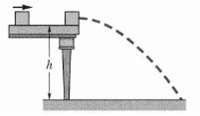
In Figure a 3.2 kg box of running shoes slides on a horizontal frictionless table and collides with a 2.0 kg box of ballet slippers initially at rest on the edge of the table, at height h = 0.40 m. The speed of the 3.2 kg box is 3.0 m/s just before the collision. If the two boxes stick together
In the two-sphere arrangement of Sample Problem 9-11, assume that sphere t has a mass of 50 g and an initial height of h1 = 9.0cm, and that sphere 2 has a mass of 85 g. After sphere 1 is released and collides elastically with sphere 2, what height is reached by?(a) Sphere 1 and(b) Sphere 2? After
A 3000 kg block falls vertically through 6.0 m and then collides with a 500 kg pile, driving it 3.0 cm into bedrock. Assuming that the block-pile collision is completely inelastic, find the magnitude of the average force on the pile from the bedrock during the 3.0 cm descent
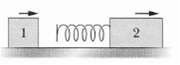
In Figure, block 1 (mass 6.0 kg) is moving rightward at 8.0 m/s and block 2 (mass a.0 kg) is moving rightward at 2.0 m/s. The surface is frictionless, and a spring with a spring constant of 8000 N/m is fixed to block 2. Eventually block lover takes block 2. At the instant block 1 is moving
An electron (mass m1 = 9.11 x 10⁻³¹ kg) and a proton (mass m2 = 1.67 x 10⁻²⁷ kg) attract each other via an electrical force. Suppose that an electron and a proton are released from rest with an initial separation d = 3.0 x 10⁻⁶ m. When their separation has decreased to 1.0 x 10⁻⁶ m, what is the
A railroad freight car weighing 280kN and traveling at 1.52 m/s overtakes one weighing 210kN and traveling at 0.914 m/s in the same direction. If the cars couple together, find(a) The speed of the cars after the collision and(b) The loss of kinetic energy during the collision. If instead, as is
A 3.0 kg object moving at 8.0m/s in the positive direction of an x axis has a one-dimensional elastic collision with an object of mass M, initially at rest. After the collision the object of mass M has a velocity of 6.0 m/s in the positive direction of the axis. What is mass M?
Two particles P and Q are released from rest l.0 m apart. P has a mass of 0.10 kg, and Q a mass of 0.30 kg. P and Q attract each other with a constant force of 1.0 x 10⁻² N. No external forces act on the system.(a) What is the speed of the center of mass of P and Q when the separation is 0.50 m?(b)
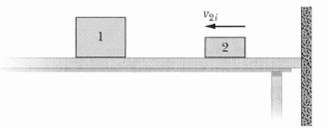
In Figure, block 1 of mass m1 = 6.6 kg is at rest on a long frictionless table that is up against a wall. Block 2 of mass m2 is placed between block 1 and the wall and sent sliding to the left, toward block L, with constant speed v2i. Find the value of m2 for which both blocks move with the same
A rocket of mass M moves along an x axis at the constant speed vi = 40m/s. A small explosion separates the rocket into a rear section (of mass m1) and a front section; both sections move along the x axis. The relative speed between the rear and front sections is 20 m/s. What are?(a) The minimum
A 2.65 kg stationary package explodes into three parts that then slide across a frictionless floor. The package had been at the origin of a coordinate system. Part 1 has mass m1 = 0.500 kg and velocity (10.0i + 12.0j) m/s. Part 2 has mass m2 = 0.750 kg and a speed of 14.0 m/s, and travels at an
Particle 1 with mass 3.0 kg and velocity (5.0 m/s)i undergoes a one-dimensional elastic collision with particle 2 with mass 2.0kg and velocity (-6.0 m/s)i. After the collision, what are the velocities of(a) Particle 1 and(b) Particle 2?
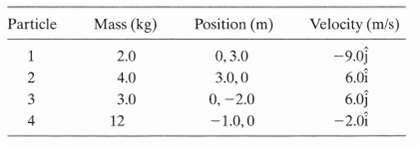
At a certain instant, four particles have the xy coordinates and velocities given in the following table. At that instant, what are the (a) X and (b) Y coordinates of their center of mass and (c) The velocity of their center of mass?
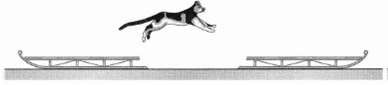
Figure shows two 22.7 kg ice sleds that are placed a short distance apart, one directly behind the other. A 3.63 kg cat initially standing on one sled jumps to the other one and then back to the first. Both jumps are made at a speed of 3.05 m/s relative to the ice. What are the final speeds of? (a)
A good baseball pitcher can throw a baseball toward home plate at 85 mi/h with a spin of 1800 rev/min. How many revolutions does the baseball make on its way to home plate? For simplicity, assume that the 60 ft path is a straight line.
What is the angular speed of?(a) The second hand,(b) The minute hand, and(c) The hour hand of a smoothly running analog watch, answer in radians per second.
A diver makes 2.5 revolutions on the way from a 10-m-high platform to the water. Assuming zero initial vertical velocity, find the average angular velocity during the dive.
The angular position of a point on the rim of a rotating wheel is given by θ = 4.0t - 3.0t2+ t3, where θ is in radian and t is in seconds. What are the angular velocities at?(a) T = 2.0 s and(b) T = 4.0 s?(c) What is the average angular acceleration for the time interval that begins at t = 2.0 s
When a slice of buttered toast is accidentally pushed over the edge of a counter, it rotates as it falls. If the distance to the floor is 76 cm and for rotation less than 1 rev, what are the(a) Smallest and(b) Largest angular speeds that cause the toast to hit and then topple to be butter-side down?
The angular position of a point on a rotating wheel is given by θ = 2.0 + 4.0t2 + 4.0t3, where θ is in radians and t is in seconds. At t = 0, what are?(a) The point's angular position and(b) Its angular velocity?(c) What is its angular velocity at t = 4.0 s?(d) Calculate its angular acceleration
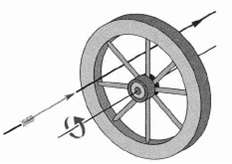
The wheel in Figure has eight equally spaced spokes and a radius of 30 cm. It is mounted on a fixed axle and is spinning at 2.5 rev/s. You want to shoot a 20-cm-long arrow parallel to this axle and through the wheel without hitting any of the spokes. Assume that the arrow and the spokes are very
The angular acceleration of a wheel is a = 6.0t4 - 4.0t2, with α in radians per second-squared and t in seconds. At time t = 0, the wheel has an angular velocity of +2.0 rad/s and an angular position of +1.0 rad. Write expressions for(a) The angular velocity (rad/s) and(b) The angular position
A disk, initially rotating at 120 rad/s, is slowed down with a constant angular acceleration of magnitude 4.0 rads2.(a) How much time does the disk take to stop?(b) Through what angle does the disk rotate during that time?
The angular speed of an automobile engine is increased at a constant rate from 1200 rev/min to 3000 rev/min in 12 s.(a) What is its angular acceleration in revolutions per minute squared?(b) How many revolutions does the engine make during this 12 s interval?
A drum rotates around its central axis at an angular velocity of 12.60 rad/s. If the drum then slows at a constant rate of 4.20 rad/s2,(a) How much time does it take and(b) Through what angle does it rotate in coming to rest?
Starting from rest, a disk rotates about its central axis with constant angular acceleration. In 5.0 s, it rotates 25 rad. During that time, what are the magnitudes of(a) The angular acceleration and(b) The average angular velocity?(c) What is the instantaneous angular velocity of the disk at the
A wheel has a constant angular acceleration of 3.0 rad/s2. During a certain 4.0 s interval, it turns through an angle of 120 rad, assuming that the wheel started from rest, how long has it been in motion at the start of this 4.0 s interval?
A merry-go-round rotates from rest with an angular acceleration of 1.50 rad/s2. How long does it take to rotate through(a) The firs 2.00 rev and(b) The next 2.00 rev?
At t = 0, a flywheel has an angular velocity of 4.7 rad/s, a constant angular acceleration of – 0.25 rad/s2, and a reference line at θo = 0.(a) Through what maximum angle θmax will the reference line turn in the positive direction? What are the(b) First and(c) Second times the reference line
A disk rotates about its central axis starting from rest and accelerates with constant angular acceleration. At one time it is rotating at 10 rev/s; 60 revolutions later, its angular speed is 15 rev/s. Calculate(a) The angular acceleration,(b) The time required to complete the 60 revolutions,(c)
A flywheel turns through 40 rev as it slows from an angular speed of 1.5 rad/s to a stop.(a) Assuming a constant angular acceleration, find the time for it to come to rest.(b) What is its angular acceleration?(c) How much time is required for it to complete the first20 of the 40 revolutions?
A vinyl record is played by rotating the record so that an approximately circular groove in the vinyl slides under a stylus. Bumps in the groove run into the stylus, causing it to oscillate. The equipment converts those oscillations to electrical signals and then to sound. Suppose that a record
Between 1911 and l990, the top of the leaning bell tower at Pisa, Italy, moved toward the south at an average rate of 1.2 mm/y. The tower is 55 m tall. In radians per second, what is the average angular speed of the tower's top about its base?
An astronaut is being tested in a centrifuge. The centrifuge has a radius of 10 m and, in starting, rotates according to θ = 0.30t2, where t is in seconds and θ is in radians. When t = 5.0 s, what are the magnitudes of the astronaut's(a) Angular velocity,(b) Linear velocity,(c) Tangential
A flywheel with a diameter of 1.20 m is rotating at an angular speed of 200rev/min.(a) What is the angular speed of the flywheel in radians per second?(b) What is the linear speed of a point on the rim of the flywheel?(c) What constant angular acceleration (in revolutions per minute squared) will
If an airplane propeller rotates at 2000 rev/min while the airplane flies at a speed of 480 km/h relative to the ground, what is the linear speed of a point on the tip of the propeller, at radius 1.5 m, as seen by?(a) The pilot and(b) An observer on the ground? The plane's velocity is parallel to
What are the magnitudes of?(a) The angular velocity,(b) The radial acceleration, and(c) The tangential acceleration of a spaceship taking a circular turn of radius 3220 km at a speed of 29 000 km/h?
An object rotates about a fixed axis, and the angular position of a reference line on the object is given by θ = 0.40e2t, where θ is in radians and t is in seconds. Consider a point on the object that is 4.0 cm from the axis of rotation. At t = 0, what are the magnitudes of the point's(a)
A disk, with a radius of 0.25 m, is to be rotated like a merry-go-round through 800 rad, starting from rest, gaining angular speed at the constant rate α1 through the first 400 rad and then losing angular speed at the constant rate -αl until it is again at rest. The magnitude of the centripetal
A gyroscope flywheel of radius 2.83 cm is accelerated from rest at l4.2 rad/s2 until its angular speed is 2760 rev/min.(a) What is the tangential acceleration of a point on the rim of the flywheel during this spin-up process?(b) What is the radial acceleration of this point when the flywheel is
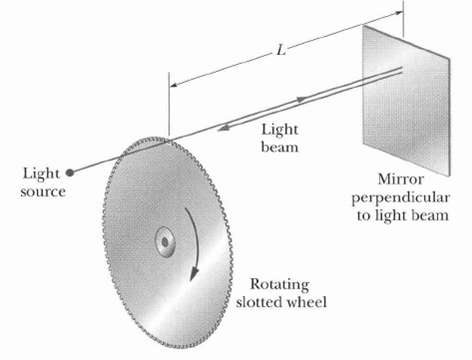
An early method of measuring the speed of light makes use of a rotating slotted wheel. A beam of light passes through one of the slots at the outside edge of the wheel, as in Figure, travels to a distant mirror, and returns to the wheel just in time to pass through the next slot in the wheel. One
The flywheel of a steam engine runs with a constant angular velocity of 150rev/min. When steam is shut off, the friction of the bearings and of the air stops the wheel in 2.2h.(a) What is the constant angular acceleration, in revolutions per minute-squared, of the wheel during the slowdown?(b) How
(a) What is the angular speed ar about the polar axis of a point on Earth's surface at latitude 40° N? (Earth rotates about that axis.)(b) What is the linear speed y of the point? What are?(c) w and(d) v for a point at the equator?
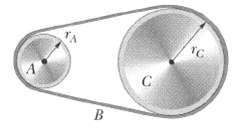
In Figure, wheel A of radius rA = 10 cm is coupled by belt B to wheel C of radius rc = 25 cm. The angular speed of wheel A is increased from rest at a constant rate of I.6 rad/s2. Find the time needed for wheel C to reach an angular speed of 100rev/min, assuming the belt does not slip.
A record turntable is rotating at 33 1/3 rev/min. A watermelon seed is on the turntable 6.0 cm from the axis of rotation.(a) Calculate the acceleration of the seed, assuming that it does not slip. (b) What is the minimum value of the coefficient of static friction between the seed and the turntable
A pulsar is a rapidly rotating neutron star that emits a radio beam the way a lighthouse emits a light beam. We receive a radio pulse for each rotation of the star. The period T of rotation is found by measuring the time between pulses. The pulsar in the Crab nebula has a period of rotation of T =
Calculate the rotational inertia of a wheel that has a kinetic energy of 24 400 J when rotating at 602 rev/min.
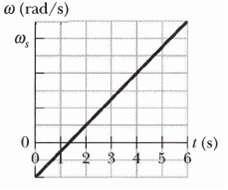
Figure gives angular speed versus time for a thin rod that rotates around one end. The scale on the w axis is set by wy = 6.0 rad/s. (a) What is the magnitude of the rod's angular acceleration? (b) At r = 4.0 s, the rod has a rotational kinetic energy of 1.60 J. What is its kinetic energy at t = 0?
Calculate the rotational inertia of a meter stick, with mass 0.56 kg, about an axis perpendicular to the stick and located at the 20 cm mark. (Treat the stick as a thin rod.)
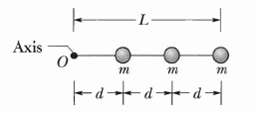
Figure shows three 0.0100 kg particles that have been glued to a rod of length L = 6.00 cm and negligible mass. The assembly can rotate around a perpendicular axis through point O at the left end. If we remove one particle (that is, 33% of the mass), by what percentage does the rotational inertia
Two uniform solid cylinders, each rotating about its central (longitudinal) axis at 235 rad/s, have the same mass of 1.25 kg but differ in radius. What is the rotational kinetic energy of(a) The smaller cylinder, of radius 0.25 m, and(b) The larger cylinder, of radius 0.75 m?
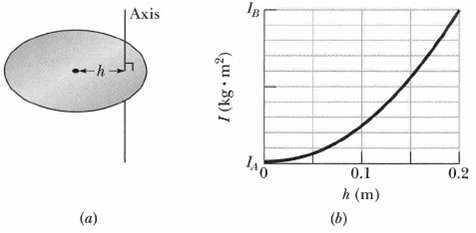
Figure (a) shows a disk that can rotate about an axis at a radial distance h from the center of the disk. Figure (b) gives the rotational inertia I of the disk about the axis as a function of that distance h, from the center out to the edge of the disk. The scale on the I axis is set by IA = 0.050
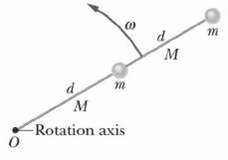
In Figure, two particles, each with mass m = 0.85 kg, are fastened to each other, and to a rotation axis at O, by two thin rods, each with length d = 5.6 cm and mass M = I.2 kg. The combination rotates around the rotation axis with angular speed w = 0.30 rad/s. Measured about O, what are the
Four identical particles of mass 0.50 kg each ate placed at the vertices of a 2.0 m x 2.0 m square and held there by four massless rods, which form the sides of the square. What is the rotational inertia of this rigid body about an axis that(a) Passes through the midpoints of opposite sides and
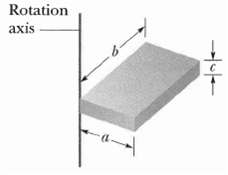
The uniform solid block in Figure has mass 0.172 kg and edge lengths a = 3.5 cm, b = 8.4 cm, and c = 1.4 cm. Calculate its rotational inertia about an axis through one corner and perpendicular to the large faces.
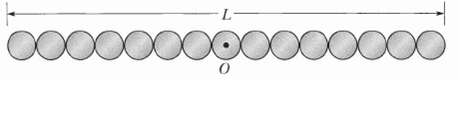
Figure shows an arrangement of 15 identical disks that have been glued together in a rod-like shape of length L = 1.0000 m and (total) mass M = 100.0 mg. The disk arrangement can rotate about a perpendicular axis through its central disk at point O. (a) What is the rotational inertia of the
Trucks can be run on energy stored in a rotating flywheel, with an electric motor getting the flywheel up to its top speed of 200π rad/s. One such flywheel is a solid, uniform cylinder with a mass of 500 kg and a radius of 1.0 m.(a) What is the kinetic energy of the flywheel after charging?(b) If
The masses and coordinates of four particles are as follows: 50 g, x = 2.0 cm, y = 2.0 cm; 25 g, x = 0, y = 4.0 cm; 25g, x = -3.0 cm, y = -3.0 cm; 30 g, x = -2.0 cm, y = 4.0 cm. What are the rotational inertias of this collection about the(a) X,(b) Y, and(c) Z axes?(d) Suppose the answers to (a)
A small ball of mass 0.75 kg is attached to one end of a 1.25-m-long massless rod, and the other end of the rod is hung from a pivot. When the resulting pendulum is 30° from the vertical, what is the magnitude of the gravitational torque calculated about the pivot?
The length of a bicycle pedal arm is 0.1.52 m, and a downward force of 111 N is applied to the pedal by the rider. What is the magnitude of the torque about the pedal arm's pivot when the arm is at angle?(a) 30°,(b) 90°, and(c) 180° with the vertical?
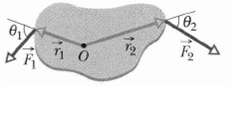
The body in Figure is pivoted at O, and two forces act on it as shown. If r1 = 1.30 m, r2 = 2.15 m, F1 = 4.20 N F2 = 4.90 N, θ1 = 75.0?, and θ2 = 60.0?, what is the net torque about the pivot?
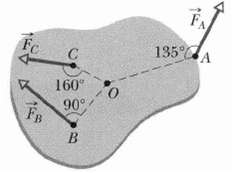
The body in Figure is pivoted at O. Three forces act on it: FA = 10 N at point A, 8.0 m from O; FB = 16 N at B, 4.0 m from O; and FC = 19 N at C, 3.0 m from O. What is the net torque about O?
During the launch from a board, a diver's angular speed about her center of mass changes from zero to 6.20 rad/s in 220ms. Her rotational inertia about her center of mass is 12.0 kg-m2. During the launch, what are the magnitudes of(a) Her average angular acceleration and(b) The average external
If a 32.0 N-m torque on a wheel causes angular acceleration 25.0 rad/s2, what is the wheel's rotational inertia?
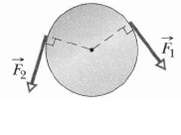
Figure shows a uniform disk that can rotate around its center like a merry-go-round. The disk has a radius of 2.00 cm and a mass of 20.0 grams and is initially at rest. Starting at time t = 0, two forces are to be applied tangentially to the rim as indicated, so that at time t = 1.25 s the disk has
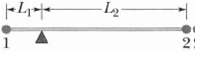
Figure shows particles 1 and 2, each of mass m, attached to the ends of a rigid massless rod of length L1 + L2, with L1 = 20 cm and L2 = 80 cm. The rod is held horizontally on the fulcrum and then released. What are the magnitudes of the initial accelerations of? (a) Particle 1 and (b) Particle 2?
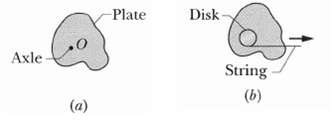
In Figure (a), an irregularly shaped plastic plate with uniform thickness and density (mass per unit volume) is to be rotated around an axle that is perpendicular to the plate face and through point O. The rotational inertia of the plate about that axle is measured with the following method. A
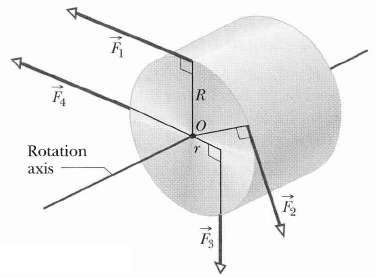
In Figure, a cylinder having a mass of 2.0 kg can rotate about its central axis through point O. Forces are applied as shown: F1 = 6.0 N, F2 = 4.0 N, F3 = 2.0 N, and F4 = 5.0 N. Also, r = 5.0 cm and R = 12 cm. Find the (a) Magnitude and (b) Direction of the angular acceleration of the cylinder.
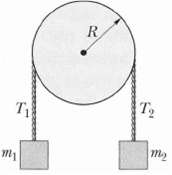
In Figure block 1 has mass m1 = 460 g, block 2 has mass m2 = 500 g, and the pulley, which is mounted on a horizontal axle with negligible friction, has radius R = 5.00 cm. When released from rest, block 2 falls 75.0 cm in 5.00 s without the cord slipping on the pulley. (a) What is the magnitude of
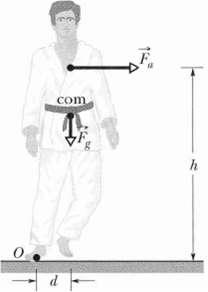
In a judo foot-sweep move, you sweep your opponent's left foot out from under him while pulling on his gi (uniform) toward that side. As a result, your opponent rotates around his right foot and onto the mat. Figure shows a simplified diagram of your opponent as you face him, with his left foot
A pulley, with a rotational inertia of 1.0 x 10⁻³ kg-m2 about its axle and a radius of 10 cm, is acted on by a force applied tangentially at its rim. The force magnitude varies in time as F = 0.50t + 0.30t2, with F in newtons and t in seconds. The pulley is initially at rest. At t = 3.0 s what
A thin rod of length 0.75 m and mass 0.42 kg is suspended freely from one end. It is pulled to one side and then allowed to swing like a pendulum, passing through its lowest position with angular speed 4.0 rad/s. Neglecting friction and air resistance, find(a) The rod's kinetic energy at its lowest
A 32.0 kg wheel, essentially a thin hoop with radius 1.20 m, is rotating at 280 rev/min. It must be brought to a stop in 15.0 s.(a) How much work must be done to stop it?(b) What is the required average power?
(a) If R = 12 cm, M = 400 g, and m = 50 g in Figure, find the speed of the block after it has descended 50 cm starting from rest. Solve the problem using energy conservation principles.(b) Repeat (a) with R – 5.0 cm.
An automobile crankshaft transfers energy from the engine to the axle at the rate of 100 hp (= 74.6 kW) when rotating at a speed of 1800 rev/min. What torque (in newtonmeters) does the crankshaft deliver?
A uniform cylinder of radius 10 cm and mass 20 kg is mounted so as to rotate freely about a horizontal axis that is parallel to and 5.0 cm from the central longitudinal axis of the cylinder.(a) What is the rotational inertia of the cylinder about the axis of rotation?(b) If the cylinder is released
A meter stick is held vertically with one end on the floor and is then allowed to fall. Find the speed of the other end just before it hits the floor, assuming that the end on the floor does not slip.
In Figure, three 0.0100 kg particles have been glued to a rod of length L = 6.00 cm and negligible mass and can rotate around a perpendicular axis through point O at one end. How much work is required to change the rotational rate?(a) From 0 to 20.0 rad/s,(b) From 20.0 rad/s to 40.0 rad/s, and(c)
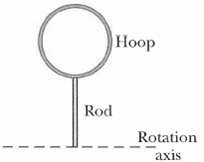
Figure shows a rigid assembly of a thin hoop (of mass m and radius R = 0.150 m) and a thin radial rod (of mass m and length L = 2.00R). The assembly is upright, but if we give it a slight nudge, it will rotate around a horizontal axis in the plane of the rod and hoop, through the lower end of Hoop
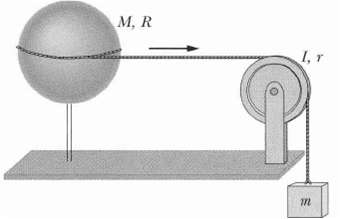
A uniform spherical shell of mass M = 4.5 kg and radius R = 8.5 cm can rotate about a vertical axis on frictionless bearings (Figure). A massless cord passes around the equator of the shell, over a pulley of rotational inertia I = 3.0 x 10⁻³ kg-m2 and radius r = 5.0 cm, and is attached to a small
Showing 5100 - 5200
of 21795
First
45
46
47
48
49
50
51
52
53
54
55
56
57
58
59
Last
Step by Step Answers

 Get 50% OFF
Claim Now
Get 50% OFF
Claim Now