New Semester
Started
Get
50% OFF
Study Help!
--h --m --s
Claim Now
Question Answers
Textbooks
Find textbooks, questions and answers
Oops, something went wrong!
Change your search query and then try again
S
Books
FREE
Study Help
Expert Questions
Accounting
General Management
Mathematics
Finance
Organizational Behaviour
Law
Physics
Operating System
Management Leadership
Sociology
Programming
Marketing
Database
Computer Network
Economics
Textbooks Solutions
Accounting
Managerial Accounting
Management Leadership
Cost Accounting
Statistics
Business Law
Corporate Finance
Finance
Economics
Auditing
Tutors
Online Tutors
Find a Tutor
Hire a Tutor
Become a Tutor
AI Tutor
AI Study Planner
NEW
Sell Books
Search
Search
Sign In
Register
study help
physics
mechanics
Fundamentals of Physics 8th Extended edition Jearl Walker, Halliday Resnick - Solutions
George Washington Gale Ferris, Jr., a civil engineering graduate from Rensselaer Polytechnic Institute, built the original Ferris wheel for the 1893 World's Columbian Exposition in Chicago. The wheel, an astounding engineering construction at the time, carried 36 wooden cars, each holding up to 60
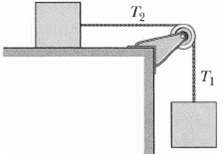
In Figure, two 6.20 kg blocks are connected by a massless string over a pulley of radius 2.40 cm and rotational inertia 7.40 x 10⁻⁴ kg-m2. The string does not slip on the pulley; it is not known whether there is friction between the table and the sliding block; the pulley's axis is frictionless.
Figure shows a flat construction of two circular rings that have a common center and are held together by three rods of negligible mass. The construction, which is initially at rest, can rotate around the common center (like a merry-go-round), where another rod of negligible mass lies. The mass,
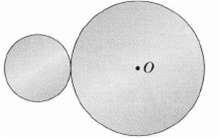
In Figure, a small disk of radius r = 2.00 cm has been glued to the edge of a larger disk of radius R = 4.00 cm so that the disks lie in the same plane. The disks can be rotated around a perpendicular axis through point O at the center of the larger disk. The disks both have a uniform density (mass
At 7:14 A.M on June 30, 1908, a huge explosion occurred above remote central Siberia, at latitude 61° N and longitude 102° E; the fireball thus created was the brightest flash seen by anyone before nuclear weapons. The Tunguska Event, which according to one chance witness "covered an enormous
In Figure, two blocks, of mass m1 = 400 g and m2 = 600 g, are connected by a massless cord that is wrapped around a uniform disk of mass M = 500 g and radius R = 12.0 cm. The disk can rotate without friction about a fixed horizontal axis through its center; the cord cannot slip on the disk. The
Attached to each end of a thin steel rod of length 1.20 m and mass 6.40 kg is a small ball of mass 1.06 kg. The rod is constrained to rotate in a horizontal plane about a vertical axis through its midpoint. At a certain instant, it is rotating at 39.0rev/s. Because of friction, it slows to a stop
A uniform helicopter rotor blade is 7.80 m long, has a mass of 110 kg, and is attached to the rotor axle by a single bolt.(a) What is the magnitude of the force on the bolt from the axle when the rotor is turning at 320rev/min?(b) Calculate the torque that must be applied to the rotor to bring it
A wheel, starting from rest, rotates with a constant angular acceleration of 2.00 rad/s2. During a certain 3.00 s interval, it turns through 90.0 rad.(a) What is the angular velocity of the wheel at the start of the 3.00 s interval?(b) How long has the wheel been turning before the start of the
A golf ball is launched at an angle of 20° to the horizontal, with a speed of 60 m/s and a rotation rate of 90 rad/s. Neglecting air drag, determine the number of revolutions the ball makes by the time it reaches maximum height.
Two uniform solid spheres have the same mass of 1.65 kg, but one has a radius of 0.226 m and the other has a radius of 0.854 m. Each can rotate about an axis through its center.(a) What is the magnitude τ of the torque required to bring the smaller sphere from rest to an angular speed of 317 rad/s
The thin uniform rod in Figure has length 2.0 m and can pivot about a horizontal, frictionless pin through one end. It is released from rest at angle θ = 40° above the horizontal. Use the principle of conservation of energy to determine the angular speed of the rod as it passes through the
The flywheel of an engine is rotating at 25-A rad/s. When the engine is turned off, the flywheel slows at a constant rate and stops in 20.0 s. Calculate(a) The angular acceleration of the flywheel,(b) The angle through which the flywheel rotates in stopping, and(c) The number of revolutions made by
A small ball with mass 1.30 kg is mounted on one end of a rod 0.780 m long and of negligible mass. The system rotates in a horizontal circle about the other end of the rod at 5010 rev/min.(a) Calculate the rotational inertia of the system about the axis of rotation.(b) There is an air drag of 2.30
Starting from rest at t = 0, a wheel undergoes a constant angular acceleration. When t = 2.0 s, the angular velocity of the wheel is 5.0 rad/s. The acceleration continues until t = 20 s, when it abruptly ceases. Through what angle does the wheel rotate in the interval t = 0 to t = 40 s?
A high-wire walker always attempts to keep his center of mass over the wire (or rope). He normally carries a long, heavy pole to help: If he leans, say to his right (his com moves to the right) and is in danger of rotating around the wire, he moves the pole to his left (its com moves to the left)
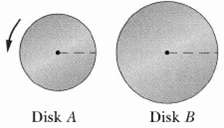
Racing disk Figure shows two disk that can rotate about there centers like a merry-go-round. At time t = 0, the references lines of the two disks have the same orientation. Disk A is already rotating, with a constant velocity of 9.5 rad/s. Disk B has been stationary but now begins to rotate at a
A bicyclist of mass 70 kg puts all his mass on each downward- moving pedal as he pedals up a steep road. Take the diameter of the circle in which the pedals rotate to be 0.40 m, and determine the magnitude of the maximum torque he exerts about the rotation axis of the pedals.
A disk rotates at constant angular acceleration, from angular position θ1 = 10.0 rad to angular position θ2 = 70.0 rad in 6.00 s. Its angular velocity at θ2 is 15.0 rad/s.(a) What was its angular velocity at θ1?(b) What is the angular acceleration?(c) At what angular position was the disk
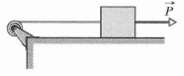
A wheel of radius 0.20 m is mounted on a frictionless horizontal axis. The rotational inertia of the wheel about the axis is 0.050 kg ?? m2. A massless cord wrapped around the wheel is attached to a 2.0 kg block that slides on a horizontal frictionless surface. If a horizontal force of magnitude P
Our Sun is 2.3 x 10⁴ ly (light-years) from the center of our Milky Way galaxy and is moving in a circle around that center at a speed of 250 km/s.(a) How long does it take the Sun to make one revolution about the galactic center?(b) How many revolutions has the Sun completed since it was
A record turntable rotating at 331/3 rev/min slows down and stops in 30 s after the motor is turned off.(a) Find its (constant) angular acceleration in revolutions per minute-squared.(b) How many revolutions does it make in this time?
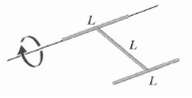
A rigid body is made of three identical thin rods, each with length L = 0.600 m, fastened together in the form of a letter H (Figure). The body is free to rotate about a horizontal axis that runs along the length of one of the legs of the H. The body is allowed to fall from rest from a position in
(a) Show that the rotational inertia of a solid cylinder of mass M and radius R about its central axis is equal to the rotational inertia of a thin hoop of mass M and radius R/√2 about its central axis. (b) Show that the rotational inertia 1 of any given body of mass M about any given axis
A thin spherical shell has a radius of l.90 m. An applied torque of 960 N ∙ m gives the shell an angular acceleration of 6.20 rad/s2 about an axis through the center of the shell. What Are(a) The rotational inertia of the shell about that axis and(b) The mass of the shell?
In Figure, a wheel of radius 0.20 rn is mounted on a frictionless horizontal axle. A massless cord is wrapped around the wheel and attached to a 2.0 kg box that slides on a frictionless surface inclined at angle θ = 20° with the horizontal. The box accelerates down the surface at 2.0m/s2. What is
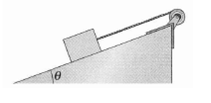
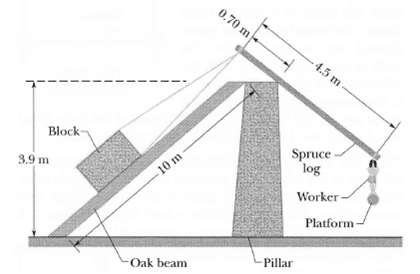
The method by which the massive lintels (top stones) were lifted to the top of the upright stones at Stonehenge has long been debated. One possible method was tested in a small Czech town. A concrete block of mass 5124 kg was pulled up along two oak beams whose top surfaces had been debarked and
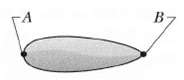
Figure shows a propeller blade that rotates at 2000 rev/min about a perpendicular axis at point B. Point A is at the outer tip of the blade, at radial distance 1.50 m.(a) What is the difference in the magnitudes a of the centripetal acceleration of point A and of aPoint at radial distance 0.150
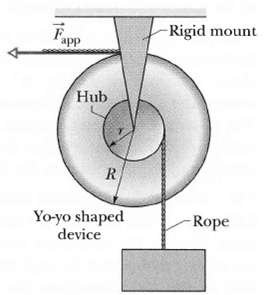
A yo-yo-shaped device mounted on a horizontal frictionless axis is used to lift a 30 kg box as shown in Figure. The outer radius R of the device is 0.50 m, and the radius r of the hub is 0.20 m. When a constant horizontal force Fappof magnitude 140 N is applied to a rope wrapped around the outside
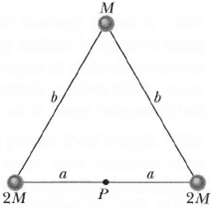
The rigid body shown in Figure consists of three particles connected by massless rods. It is to be rotated about an axis perpendicular to its plane through point P. If M = 0.40 kg, a = 30 cm, and b = 50 cm, how much work is required to take the body from rest to an angular speed of 5.0rad/s?
Beverage engineering the pull tab was a major advance in the engineering design of beverage containers. The tab pivots on a central bolt in the can's top. When you pull upward on one end of the tab, the other end presses downward on a portion of the can's top that has been scored. If you pull
Cheetahs running at top speed have been reported at an astounding 114 km/h (about 71mi/h) by observers driving alongside the animals. Imagine trying to measure a cheetah's speed by keeping your vehicle abreast of the animal while also glancing at your speedometer, which is registering 114 km/h. You
A point on the rim of a 0.75-m-diameter grinding wheel changes speed at a constant rate from 12 m/s to 25 m/s in 6.2 s. What is the average angular acceleration of the wheel?
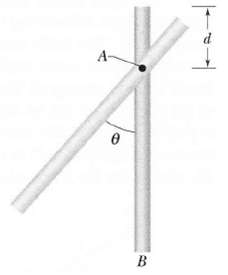
In Figure, a thin uniform rod (mass 3.0 kg, length 4.0 m) rotates freely about a horizontal axis A that is perpendicular to the rod and passes through a point at distance d = 1.0 m from the end of the rod. The kinetic energy of the rod as it passes through the vertical position is 20 J.(a) What is
A car starts from rest and moves around a circular track of radius 30.0 m. Its speed increases at the constant rate of 0.500 m/s2(a) What is the magnitude of its net linear acceleration 15.0 s later?(b) What angle does this net acceleration vector make with the car's velocity at this time?
A pulley wheel that is 8.0 cm in diameter has a 5.6-m-long cord wrapped around its periphery. Starting from rest, the wheel is given a constant angular acceleration of 1.5 rad/s2. (a) Through what angle must the wheel turn for the cord to unwind completely?(b) How long will this take?
A heavy flywheel rotating on its central axis is slowing down because of friction in its bearings. At the end of the first minute of slowing, its angular speed is 0.900 of its initial angular speed of 250 rev/min, assuming a constant angular acceleration, find its angular speed at the end of the
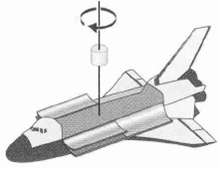
Figure shows a communications satellite that is a solid cylinder with mass 1210 kg, diameter 1.21, m, and length 1.75m. Prior to launch from the shuttle cargo bay, the satellite is set spinning at 1.52rev/s about its long axis. What are?(a) Its rotational inertia about the rotation axis and(b) Its
A vinyl record on a turntable rotates at 331/3 rev/min.(a) What is its angular speed in radians per second? What is the linear speed of a point on the record?(b) 15 cm and(c) 7.4 cm from the turntable axis?
What is the angular speed of a car traveling at 50 km/h and rounding a circular turn of radius 110 m?
Calculate(a) The torque,(b) The energy, and(c) The average power required to accelerate Earth in 1 day from rest to its present angular speed about its axis.
The oxygen molecule O2 has a mass of 5.30 x 10⁻²⁶ kg and a rotational inertia of 1.94 x 10-46 kg-m2 about an axis through the center of the line joining the atoms and perpendicular to that line. Suppose the center of mass of an O2 molecule in a gas has a translational speed of 500 m/s and the
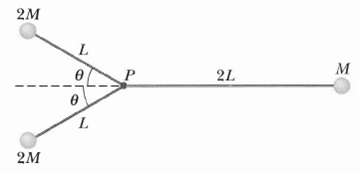
The angular speed of an automobile engine is increased at a constant rate from 1200 rev/min to 3000 rev/min in 12 s.(a) An axis that passes through point P and is perpendicular to the plane of the figure and(b) An axis that passes through point P, is perpendicular to the rod of length 2L, and lies
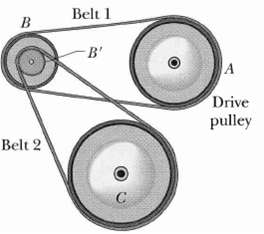
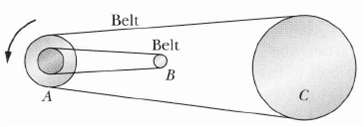
In Figure, four pulleys are connected by two belts. Pulley A (radius 15 cm) is the drive pulley, and it rotates at 10 rad/s. Pulley B (radius 10 cm) is connected by belt 1 to pulley A. Pulley B' (radius 5 cm) is concentric with pulley B and is rigidly attached to it. Pulley C (radius 25 cm) is
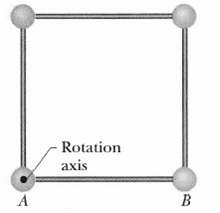
Four particles, each of mass 0.20 kg, are placed at the vertices of a square with sides of length 0.50 m. The particles are connected by rods of negligible mass. This rigid body can rotate in a vertical plane about a horizontal axis A that passes through one of the particles. The body is released
The turntable of a record player has an angular speed of 8.0 rad/s at the instant it is switched off. Three seconds later, the turntable has an angular speed of 2.6 rad/s. Through how many radians does the turntable rotate from the time it is turned off until it stops? (Assume constant α.)
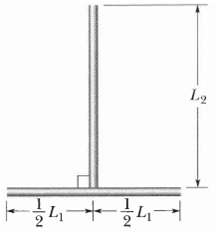
Two thin rods (each of mass 0.20 kg) are joined together to form a rigid body as shown in Figure. One of the rods has lengthL1= 0.40 m, and the other has lengthL2= 0.50 m. What is the rotational inertia of this rigid body about? (a) An axis that is perpendicular to the plane of the paper and passes
In Figure (a), a wheel of radius 0.20 m is mounted on a frictionless horizontal axis. The rotational inertia of the wheel about the axis is 0.40 kg-m2. A massless cord wrapped around the wheel's circumference is attached to a 6.0 kg box. The system is released from rest. When the box has a kinetic
Three 0.50 kg particles form an equilateral triangle with 0.60 m sides. The particles are connected by rods of negligible mass. What is the rotational inertia of this rigid body about?(a) An axis that passes through one of the particles and is parallel to the rod connecting the other two,(b) An
A hollow sphere of radius 0.15 m, with rotational inertia 1 = 0.040 kg- m2 about a line through its center of mass, rolls without slipping up a surface inclined at 30° to the horizontal. At a certain initial position, the sphere's total kinetic energy is 20 J.(a) Center,(b) Top, and(c) Bottom of
An automobile traveling at 80.0 km/h has tires of 75.0 cm diameter.(a) What is the angular speed of the tires about their axles?(b) If the car is brought to a stop uniformly in 30.0 complete turns of the tires (without skidding), what is the magnitude of the angular acceleration of the wheels?(c)
A 1000 kg car has four 10 kg wheels. When the car is moving, what fraction of its total kinetic energy is due to rotation of the wheels about their axles? Assume that the wheels have the same rotational inertia as uniform disks of the same mass and size. Why do you not need to know the radius of
A uniform solid sphere rolls down an incline.(a) What must be the incline angle if the linear acceleration of the center of the sphere is to have a magnitude of 0.109?(b) If a frictionless block were to slide down the incline at that angle, would its acceleration magnitude be more than, less than,
A 140 kg hoop rolls along a horizontal floor so that the hoop's center of mass has a speed of 0.150 m/s. How much work must be done on the hoop to stop it?
A hollow sphere of radius 0.15 m, with rotational inertia 1 = 0.040 kg- m2 about a line through its center of mass, rolls without slipping up a surface inclined at 30° to the horizontal. At a certain initial position, the sphere's total kinetic energy is 20 J.(a) How much of this initial kinetic
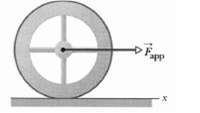
In Figure, a constant horizontal force Fappof magnitude 10 N is applied to a wheel of mass 10 kg and radius 0.30 m. The wheel rolls smoothly on the horizontal surface, and the acceleration of its center of mass has magnitude 0.60 m/s2. (a) In unit-vector notation, what is the frictional force on
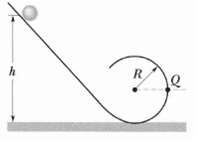
In Figure, a solid brass ball of mass 0.280 g will roll smoothly along a loop-the-loop track when released from rest along the straight section. The circular loop has radius R = 14.0 cm, and the ball has radius r (a) What is h if the ball is on the verge of leaving the track when it reaches the top
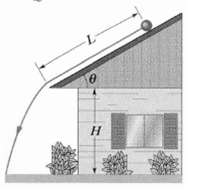
In Figure, a solid cylinder of radius 10 cm and mass 12 kg starts from rest and rolls without slipping a distance L = 6.0 m down a roof that is inclined at the angle θ = 30?. (a) What is the angular speed of the cylinder about its center as it leaves the roof? (b) The roof's edge is at height H =
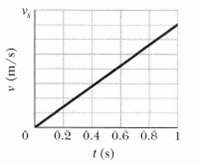
Figure gives the speed v versus time t for a 0.500 kg object of radius 6.00 cm that rolls smoothly down a 30? ramp. The scale on the velocity axis is set by vs = 4.0 m/s. What is the rotational inertia of theobject?
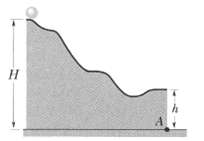
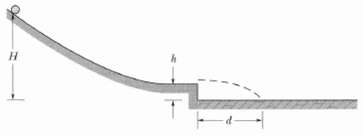
In Figure a solid ball rolls smoothly from rest (starting at height H = 6.0 m) until it leaves the horizontal section at the end of the track, at height h = 2.0 m. How far horizontally from point A does the ball hit thefloor?
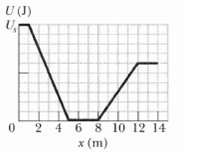
Figure shows the potential energy U(x) of a solid ball that can roll along an x axis. The scale on the U axis is set by U3 = 100 J. The ball is uniform, rolls smoothly, and has a mass of 0.400 kg. It is released at x = 7.0 m headed in the negative direction of the x axis with a mechanical energy of
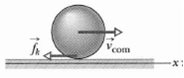
A bowler throws a bowling ball of radius R = 11 cm along a lane. The ball (Figure) slides on the lane with initial speed vcom,0 = 8.5 m/s and initial angular speed w0 = 0. The coefficient of kinetic friction between the ball and the lane is 0.21. The kinetic frictional force f k acting on the ball
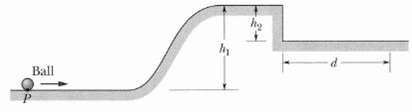
In Figure a small, solid, uniform ball is to be shot from point P so that it rolls smoothly along a horizontal path, up along a ramp, and onto a plateau. Then it leaves the plateau horizontally to land on a game board, at a horizontal distance d from the right edge of the plateau. The vertical
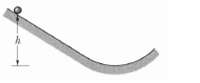
Non-uniform ball in Figure, a ball of mass M and radius R rolls smoothly from rest down a ramp and onto a circular loop of radius 0.48 m. The initial height of the ball is h = 0.36 m. At the loop bottom, the magnitude of the normal force on the ball is 2.00Mg. The ball consists of an outer
Non-uniform cylindrical object, in Figure, a cylindrical object of mass M and radius R rolls smoothly from rest down a ramp and onto a horizontal section. From there it rolls off the ramp and onto the floor, landing a horizontal distance d = 0.506 m from the end of the ramp. The initial height of
A yo-yo has a rotational inertia of 950 g ∙ cm2 and a mass of 120 g. Its axle radius is 3.2 mm, and its string is 120 cm long. The yo-yo rolls from rest down to the end of the string. (a) What is the magnitude of its linear acceleration? (b) How long does it take to reach the end of the
In 1980, over San Francisco Bay, a large yo-yo was released from a crane. The 116 kg yo-yo consisted of two uniform disks of radius 32 cm connected by an axle of radius 3.2 cm. What was the magnitude of the acceleration of the yo-yo during?(a) Its fall and(b) Its rise?(c) What was the tension in
In unit-vector notation, what is the torque about the torque about the origin on a particle located at coordinate (0, -4.0m 3.0m) if that torque is due to (a) Force F1 with components F 1x = 2.0 N, F1y = 0, and(b) Force F2 with components F 2x = 0, F2y = 2.0 N, F2 = 4.0N?
A plum is located at coordinates (-2.0 m, 0, 4.0 m). In unit-vector notation, what is the torque about the origin on the plum if that torque is due to a force F whose only component is?(a) F x = 6.0 N,(b) F x = -6.0 N,(c) F z = 6.0 N, and(d) F z = -6.0 N?
In unit-vector notation, what is the net torque about the origin on a flea located at coordinates (0, -4.0 m, 5.0 m) when forces F1 = (3.0 N) k and F2 = (-2.0 N) j act on the flea?
In unit-vector notation, what is the torque about the origin on a jar of jalapeno peppers located at coordinates (3.0 m, -2.0 m, 4.0 m) due to?(a) Force F2 = (3.0N) i – (4.0N) j + (5.0) k,(b) Force F2 = (-3.0N) i – (4.0N) j – (5.0N) k, and(c) The vector sum of F1 and F2?(d) Repeat part (c)
Force F = (-8.0 N) i + (6.0 N) j acts on a particle with p on vector r = (3.0 m) i + (4.0 m) j. What are?(a) The torque on the particle about the origin, in unit-vector notation, and(b) The angle between the directions of r and F?
A particle moves through an xyz coordinate system while a force acts on the particle. When the particle has the position vector r = (2.00 m) i - (3.00 m) j + (2.00 m) k, the force is F = F xi + (7.00N) j – (6.00 N) k and the corresponding sponding torque about the origin is r = (4.00 N ∙ m)
Force F = (2.0 N) i - (3.0 N) k acts on a pebble with position vector r = (0.50 m) j - (2.0 m) k relative to the origin. In unit-vector notation, what is the resulting torque on the pebble about?(a) The origin and(b) The point (2.0 m, 0, -3.0 m)?
A 2.0 kg particle-like object moves in a plane with velocity components v x = 30 m/s and vy = 60 m/s as it passes through the point with (x, y) coordinates of (3.0, - 4.0) m. Just then, in unit-vector notation, what is its angular momentum relative to(a) The origin and(b) The point (-2.0, -2.0) m?
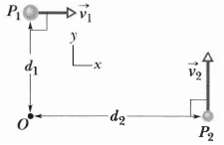
In the instant of Figure, two particles move in an xy plane. Particle P1 has mass 6.5 kg and speed v1 = 2.2 m/s and it is at distance d1 = 1.5 m from point O. Particle P2 has mass 3.1 kg and speed v2 = 3.6 m/s, and it is at distance d2 = 2.8 m from point O. What are the(a) Magnitude and(b)
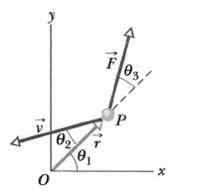
At the instant of Figure a 2.0 kg particle P has a position vector r of magnitude 3.0 m and angle ?1 = 45? and a velocity vector r of magnitude 4.0 m/s and angle ?2 = 30?. Force F, of magnitude 2.0 N and angle ?3 = 30?, acts on P. All three vectors lie in the xy plane. About the origin, what are
At one instant, force F = 4.0j N acts on a 0.25 kg object that has position vector r = (2.0i - 2.0k) m and velocity vector r = (-5.0i + 5.0k) m/s. About the origin and in unit vector notation, what are?(a) The object's angular momentum and(b) The torque acting on the object?
At the instant the displacement of a 2.00 kg object relative to the origin is d = (2.00 m)i + (4.00 m)j - (3.00m)k, its velocity is v = -(6.00 m/s)i + (3.00 m/s)j + (3.00 m/s)k and it is subject to a force F = (6.00 N)i - (8.00 N)i + (4.00 N)k. Find(a) The acceleration of the object,(b) The angular
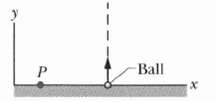
In Figure, a 0.400 kg ball is shot directly upward at initial speed 40.0 m/s. What is its angular momentum about P, 2.00 m horizontally from the launch point, when the ball is?(a) At maximum height and(b) Halfway back to the ground? What is the torque on the gravitational force when the ball is?(c)
A particle is to move in an xy plane, clockwise around the origin as seen from the positive side of the z axis. In unit vector notation, what torque acts on the particle if the magnitude of its angular momentum about the origin is? (a) 4.0kg ∙ m2/s, (b) 4.0t2 kg ∙ m2/s, (c) 4.0
A 3.0 kg particle with velocity v = (5.0 m/s) i - (6.0 m/s) j is at x = 3.0 m, y = 8.0 m. It is pulled by a 7.0 N force in the negative x direction. About the origin, what are?(a) The particle's angular momentum,(b) The torque acting on the particle, and(c) The rate at which the angular momentum is
A particle is acted on by two torques about the origin r1 has a magnitude of 2.0 N ∙ m and is directed in the positive direction of the x axis, and r2 has a magnitude of 4.0 N ∙ m and is directed in the negative direction of the y axis. In unit vector notation, find dℓ/dt where
At time t, r = 4.0t2i - (2.0t + 6.0t2) j gives the position of a 3.0 kg particle relative to the origin of an xy coordinate system (r is in meters and t is in seconds).(a) Find an expression for the torque acting on the particle relative to the origin.(b) Is the magnitude of the particle's angular
A sanding disk with rotational inertia 1.2 x 10⁻³ kg ∙ m2 is attached to an electric drill whose motor delivers a torque of magnitude 16 N ∙ m about the central axis of the disk. About that axis and with the torque applied for 33 ms, what is the magnitude of the (a) Angular momentum
The angular momentum of a flywheel having a rotational inertia of 0.140 kg ∙ m2 about its central axis decreases from 3.00 to 0.800 kg ∙ m2/s in 1.50 s. (a) What is the magnitude of the average torque acting on the flywheel about its central axis during this period? (b) Assuming a
Figure shows three rotating, uniform disks that are coupled by belts. One belt runs around the rims of disks A and C. Another belt runs around a central hub on disk A and the rim of disk B. The belts move smoothly without slippage on the rims and hub. Disk A has radius R; its hub has radius
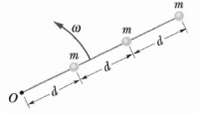
In Figure, three particles of mass m = 23 g are fastened to three rods of length d = 12 cm and negligible mass. The rigid assembly rotates around point O at angular speed w = 0.85 rad/s. About O, what are?(a) The rotational inertia of the assembly,(b) The magnitude of the angular momentum of the
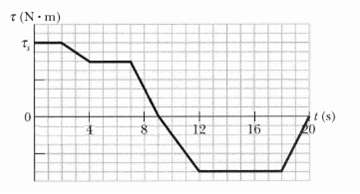
Figure gives the torque r that acts on an initially stationary disk that can rotate about its center like a merry-go-round. The scale on the r axis is set by r?2 = 4.0 N ? m. What is the angular momentum of the disk about the rotation axis at times?(a) t = 7 .0 s and(b) t = 20 s?
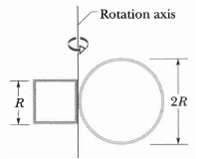
Figure shows a rigid structure consisting of a circular hoop of radius R and mass m, and a square made of four thin bars, each of length R and mass m. The rigid structure rotates at a constant speed about a vertical axis, with a period of rotation of 2.5 s. Assuming R = 0.50 m and m = 2.0 kg,
A disk with a rotational inertia of 7.00 kg ∙ m2 rotates like a merry-go-round while undergoing a torque given by τ = (5.00 + 2.00t) N ∙ m. At time t = 1.00 s, its angular momentum is 5.00 kg.m2/s. What is its angular momentum at t = 3.00 s?
A man stands on a platform that is rotating (without friction) with an angular speed of 1.2 rev/s; his arms are outstretched and he holds a brick in each hand. The rotational inertia of the system consisting of the man, bricks, and platform about the central vertical axis of the platform is 6.0 kg
The rotor of an electric motor has rotational inertia Im = 2.0 x 10 3 kg ∙ m2 about its central axis. The motor is used to change the orientation of the space probe in which it is mounted. The motor axis is mounted along the central axis of the probe; the probe has rotational inertia If = 12
A wheel is rotating freely at angular speed 800rev/min on a shaft whose rotational inertia is negligible. A second wheel, initially at rest and with twice the rotational inertia of the first, is suddenly coupled to the same shaft.(a) What is the angular speed of the resultant combination of the
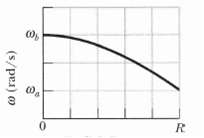
A Texas cockroach first rides at the center of a circular disk that rotates freely like merry-go-round without external torques. The cockroach walk out the edge of the disk, at radius R. Figure gives the angular speed ro of the cockroach - disk system during the walk. The scale on the w axis is set
Two disks are mounted (like a merry-go-round) on low-friction bearings on the same axle and can be brought together so that they couple and rotate as one unit. The first disk, with rotational inertia 3.30 kg ∙ m about its central axis, is set spinning counterclockwise at 450rev/min. The
The rotational inertia of a collapsing spinning star drops to 1/3 its initial value. What is the ratio of the new rotational kinetic energy to the initial rotational kinetic energy?
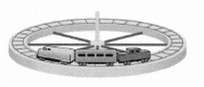
A track is mounted on a large wheel that is free to turn with negligible friction about a vertical axis (Figure). A toy train of mass m is placed on the track and, with the system initially at rest; the train's electrical power is turned on. The train reaches speed 0.15 m/s with respect to the
A Texas cockroach of mass 0.17 kg runs counterclockwise around the rim of a lazy Susan (a circular disk mounted on a vertical axle) that has radius 15 cm, rotational inertia 5.0 x 10⁻³ kg ∙ m2, and frictionless bearings. The cockroach's speed (relative to the ground) is 2.0 m/s, and the lazy
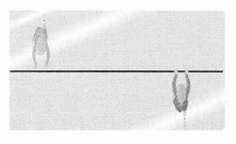
In Figure, two skaters, each of mass 50 kg, approach each other along parallel paths separated by 3.0 m. They have opposite velocities of 1.4 m/s each. One skater carries one end of a long pole of negligible mass, and the other skater grabs the other end as she passes. The skaters then rotate
Showing 5200 - 5300
of 21795
First
46
47
48
49
50
51
52
53
54
55
56
57
58
59
60
Last
Step by Step Answers

 Get 50% OFF
Claim Now
Get 50% OFF
Claim Now



.PNG)