New Semester
Started
Get
50% OFF
Study Help!
--h --m --s
Claim Now
Question Answers
Textbooks
Find textbooks, questions and answers
Oops, something went wrong!
Change your search query and then try again
S
Books
FREE
Study Help
Expert Questions
Accounting
General Management
Mathematics
Finance
Organizational Behaviour
Law
Physics
Operating System
Management Leadership
Sociology
Programming
Marketing
Database
Computer Network
Economics
Textbooks Solutions
Accounting
Managerial Accounting
Management Leadership
Cost Accounting
Statistics
Business Law
Corporate Finance
Finance
Economics
Auditing
Tutors
Online Tutors
Find a Tutor
Hire a Tutor
Become a Tutor
AI Tutor
AI Study Planner
NEW
Sell Books
Search
Search
Sign In
Register
study help
physics
mechanics
Fundamentals of Physics 8th Extended edition Jearl Walker, Halliday Resnick - Solutions
(a) At a certain instant, a particle-like object is acted o a force F = (4.0 N)i – (2.0 x)i + (9.0N)k while the object's velocity is v = – (2.0m/s)i + (4.0m/s)k. What is the instantaneous rate at which the force does work on the object?(b) At some other time, the velocity consists of only a y
A cord is used to vertically lower an initially stationary block of mass M at a constant downward acceleration of g/4. When the block has fallen a distance d, find(a) The work done by the cord's force on the block,(b) The work done by the gravitational force on the block,(c) The kinetic energy of
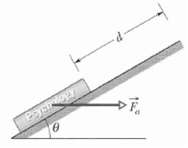
In Figure a horizontal force Fa of magnitude 20.0 N is applied to a 3.00 kg psychology book as the book slides a distance d = 0.500m up a frictionless ramp at angle g = 30.0o. (a) During the displacement, what is the net work done on the book by Fa, the gravitational force on the book, and the
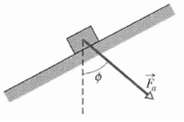
In Figure, a constant force Fa of magnitude 82.0 N is applied to a 3.00 kg shoe box at angle Ф = 53.0o, causing the box to move up a frictionless ramp at constant speed. How much work is done on the box by Fa when the box has moved through vertical distance h = 0.150 m?
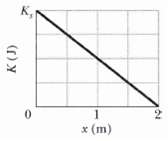
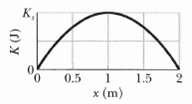
A block is sent up a frictionless ramp along which an x axis extends upward. Figure 7-33 gives the kinetic energy of the block as a function of position x; the scale of the figure's vertical axis is set by Ks = 40.0 J. If the block's initial speed is 4.00 m/s, what is the normal force on the block?
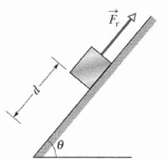
In Figure a block of ice slides down a frictionless ramp at angle θ = 50o while an ice worker pulls on the block (via a rope) with a force Fr that has a magnitude of 50N and is directed up the ramp. As the block slides thorugh distance d = 0.50m along the ramp, its kinetic energy icnreases by 80J.
A cave rescue team lifts an injured spelunker directly upward and out of a sinkhole by means of a motor-driven cable. The lift is performed in three stages, each requiring a vertical distance of 10.0 m:(a) The initially stationary spelunker is accelerated to a speed of 5.00 m/s;(b) He is then
In Figure a 0.250 kg block of cheese lies on the floor of a 900 kg elevator cab that is being pulled upward by a cable through distance d1 = 2.40 m and then through distance d2 = 10.5 m. (a) Through dr, if the normal force on the block from the floor has constant magnitude FN = 3.00 N, how much
During spring semester at MIT, residents of the parallel buildings of the East Campus dorms battle one another with large catapults that are made with surgical hose mounted on a window frame. A balloon filled with dyed water is placed in a pouch attached to the hose, which is then stretched through
A spring and block are in the arrangement of Fig. 7-11. When the block is pulled out to x = + 4.0cm, we must apply a force of magnitude 360 N to hold it there. We pull the block to x = 11 cm and then release it. How much work does the spring do on the block as the block moves from xi = +5.0 cm
In Figure, we must apply a force of magnitude 80 N to hold the block stationary at x = – 2.0 cm. From that position, we then slowly move the block so that our force does + 4.0 J of work on the spring-block system; the block is then again stationary. What is the block's position?
The only force acting on a 2.0kg body as it moves along a positive x axis has an .r component Fx = – 6x N, with x in meters. The velocity at x = 3.0 m is 8.0 m/s.(a) What is the velocity of the body at x = 4.0 m?(b) At what positive value of x will the body have a velocity of 5.0m/s?
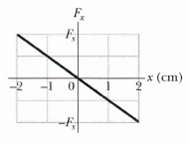
Figure gives spring force Fx versus position x for the spring-block arrangement of Fig. 7 -11 The scale is set by F = 160.0 N. We release the block at x = 12 cm. How much work does the spring do on the block when the block moves from xi = + 8.0 cm to (a) x = +5.0 cm, (b) x = ?? 5.0 cm, (c) x = ??
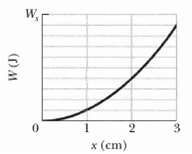
In the arrangement of Figure we gradually pull the block from x = 0 to x = +3.0 cm, where it is stationary. Figure gives the work that our force does on the block. The scale of the figure's vertical axis is set by Ws = 1.0 J. We then pull the block out to x = + 5.0 cm and release it from rest. How
In Figure (a) a block of mass m lies on a horizontal frictionless surface and is attached to one end of a horizontal spring (spring constant k) whose other end is fixed. The block is initially at rest at the position where the spring is un-stretched (x = 0) when a constant horizontal force F in the
The block in Figure a lies on a horizontal frictionless surface, and the spring constant is 50 N/m. Initially, the spring is at its relaxed length and the block is stationary at position x = 0. Then an applied force with a constant magnitude of 3.0 N pulls the block in the positive direction of the
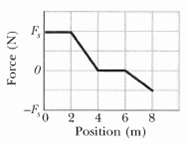
A 5.0 kg block moves in a straight line on a horizontal frictionless surface under the influence of a force that varies with position as shown in Figure. The scale of the figure's vertical axis is set by Fs = 10.0 N. How much work is done by the force as the block moves from the origin to x = 8.0m?
The force on a particle is directed along an x axis and given by F = F0(x/x0 – 1). Find the work done by the force in moving the particle from x = 0 to x = 2x0 by(a) Plotting F(x) and measuring the work from the graph and(b) Integrating F(x)
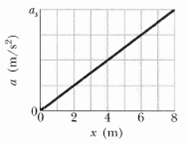
A 10 kg brick moves along an x axis. Its acceleration as a function of its position is shown in Fig. 7-40.The scale of the figure's vertical axis is set by as = 20.0 m/s2. What is the net work performed on the brick by the force causing the acceleration as the brick moves from x = 0 to x =8.0m?
A single force acts on a 3.0 kg particle-like object whose position is given by x = 3.0t – 4.0t2 + 1.0t3, with x in meters and t in seconds. Find the work done on the object by the force from t = 0 to t = 4.0 s.
A can of sardines is made to move along an x axis from x = 0.25 m to x = 1.25 m by a force with a magnitude given by F = exp (– 4x2), with x in meters and F in Newton’s. (Here exp is the exponential function.) How much work is done on the can by the force?
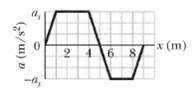
Figure gives the acceleration of a 2.00 kg particle as an applied force Fa moves it from rest along an x axis from x = 0 to x = 9.0m. The scale of the figure's vertical axis is set by as = 6.0 m/s2. How much work has the force done on the particle when the particle reaches (a) x = 4.0 m, (b) x = 7
A 1.5 kg block is initially at rest on a horizontal frictionless surface when a horizontal force along an x axis is applied to the block. The force is given by F(x) = (2.5 – x2)i N, where x is in meters and the initial position of the block is x = 0.(a) What is the kinetic energy of the block as
A force F = (cx – 3.00x2)i acts on a particle as the particle moves along an x axis, with F in Newton’s, x in meters, and c a constant. At x = 0, the particle's kinetic energy is 20.0 J; at x = 3.00 m, it is 11.0 J. Find c.
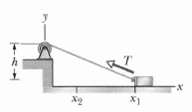
Figure shows a cord attached to a cart that can slide along a frictionless horizontal rail aligned along an x axis. The left end of the cord is pulled over a pulley, of negligible mass and friction and at cord height h = 1.20 m, so the cart slides from x1 = 3.00 m to x2 = 1.00 m. During the move,
A 100 kg block is pulled at a constant speed of 5.0 m/s across a horizontal floor by an applied force of 122 N directed 37o above the horizontal. What is the rate at which the force does work on the block?
The loaded cab of an elevator has a mass of 3.0 x 10³ kg and moves 210 m up the shaft in 23 s at constant speed. At what average rate does the force from the cable do work on the cab?
A force of 5.0 N acts on a 15 kg body initially at rest. Compute the work done by the force in (a) The first, (b) The second, and (c) The third seconds and (d) The instantaneous power due to the force at the end of the third second.
A skier is pulled by a towrope up a frictionless ski slope that makes an angle of 12o with the horizontal. The rope moves parallel to the slope with a constant speed of 1.0 m/s. The force of the rope does 900 J of work on the skier as the skier moves a distance of 8.0 m up the incline. (a) If the
A fully loaded, slow-moving freight elevator has a cab with a total mass of 1200 kg, which is required to travel upward 54 m in 3.0 min, starting and ending at rest. The elevator's counterweight has a mass of only 950 kg, and so the elevator motor must help. What average power is required of the
(a) In 1975 the roof of Montreal's Velodrome, with a weight of 360kN, was lifted by 10 cm so that it could be centered. How much work was done on the roof by the forces making the lift? (b) In 1960 a Tampa, Florida, mother reportedly raised one end of a car that had fallen onto her son when a
A machine carries a 4.0 kg package from an initial position of d1= (0.50m)i + (0.75m)j + (0.20 m)k at t = 0 to a final position of df = (7.50 m)i + (12.0 m)j + (7 .20 m)k at t = 12s. The constant force applied by the machine on the package is F = (2.00 N)i + (4.00 N)j + (6.00 N)k. For that
A 0.30 kg ladle sliding on a horizontal frictionless surface is attached to one end of a horizontal spring (k = 500 N/m) whose other end is fixed. The ladle has a kinetic energy of 10J as it passes through its equilibrium position (the point at which the spring force is zero). (a) At what rate is
A force F = (3.00 N)i + (7.00 N)j + (7.00 N)k acts on a 2.00 kg mobile object that moves from an initial position of di = (3.00 m)i – (2.00 m)i + (5.00 m)k to a final position of df = – (5.00 m)i + (4.00 m)i + (7.00 m)k in 4.00 s. Find (a) The work done on the object by the force in the 4.00 s
A funny car accelerates from rest through a measured track distance in time T with the engine operating at a constant power P. If the track crew can increase the engine power by u differential amount dP, what is the change in the time required for the run?
An explosion at ground level leaves a crater with a diameter that is proportional to the energy of the explosion raised to the 1/3 power; an explosion of 1 megaton of TNT leaves a crater with a 1 km diameter. Below Lake Huron in Michigan there appears to be an ancient impact crater with a 50 km
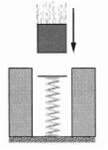
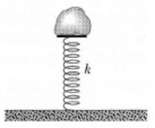
A 250 g block is dropped onto a relaxed vertical spring that has a spring constant of k = 2.5 N/cm (Figure).The block becomes attached to the spring and compresses the spring 12 cm before momentarily stopping. While the spring is being compressed, what work is done on the block by?(a) The
How much work is done by a force F = (2x N)i + (3 N)i, with x in meters, that moves a particle from a position ri = (2 m)i + (3 m)j to a position rf = – (4 m)i – (3 m)j?
To pull a 50 kg crate across a horizontal frictionless floor, a worker applies a force of 210 N, directed 20o above the horizontal. As the crate moves 3.0 m, what work is done on the crate by (a) The worker's force, (b) The gravitational force on the crate, and (c) The normal force on the crate
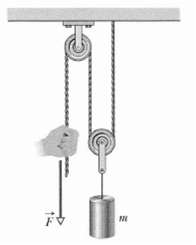
In Figure a cord runs around two mass less, frictionless pulleys. A canister with mass m = 20 kg hangs from one pulley, and you exert a force F on the free end of the cord.(a) What must be the magnitude of F if you are to lift the canister at a constant speed?(b) To lift the canister by 2.0 cm, how
A force F = (4.0 N)i + cj acts on a particle as the particle goes through displacement d = (3.0 m)i – (2.0 -)i. (Other forces also act on the particle.) What is c if the work done on the particle by force F is (a) 0, (b) 17 J, and (c) – 18 J?
A constant force of magnitude 10 N makes an angle of 150o (measured counterclockwise) with the positive x direction as it acts on a 2.0kg object moving in an xy plane. How much work is done on the object by the force as the object moves from the origin to the point having position vector (2.0m)i
An initially stationary 2.0 kg object accelerates horizontally and uniformly to a speed of 10 m/s in 3.0 s.(a) In that 3.0 s interval, how much work is done on the object by the force accelerating it? What is the instantaneous power due to that force?(b) At the end of the interval and(c) At the end
If a ski lift raises 100 passengers averaging 660 N in weight to a height of 150 m in 60.0 s, at constant speed, what average power is required of the force making the lift?
Boxes are transported from one location to another in a warehouse by means of a conveyor belt that moves with a constant speed of 0.50 m/s. At a certain location the conveyor belt moves for 2.0 m up an incline that makes an angle of 10" with the horizontal then for 2.0 m horizontally and finally
A horse pulls a cart with a force of 40 lb at an angle of 30o above the horizontal and moves along at a speed of 6.0 mi/h.(a) How much work does the force do in 10 min?(b) What is the average power (in horsepower) of the force?
An iceboat is at rest on a frictionless frozen lake when a sudden wind exerts a constant force of 200 N, toward the east, on the boat. Due to the angle of the sail, the wind causes the boat to slide in a straight line for a distance of 8.0 m in a direction 20o north of east. What is the kinetic
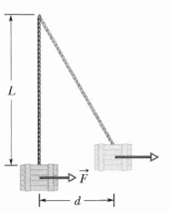
A230 kg crate hangs from the end of a rope of length L = 12.0 m. You push horizontally on the crate with a varying force F to move it distance d = 4.00 m to the side (Figure). (a) What is the magnitude of F when the crate is in this final position? During the crate's displacement, what are? (b) The
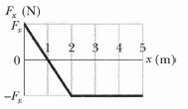
The only force acting on a 2.0kg body as the body moves along an x axis varies as shown in Figure. The scale of the figure??s vertical axis is set by Fs = 4.0N. The velocity of the body at x = 0 is 4.0 m/s. (a) What is the kinetic energy of the body at x = 3.0 m? (b) At what value of x will the
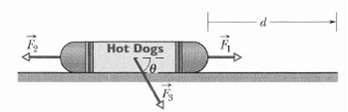
Figure shows a cold package of hot dogs sliding rightward across a frictionless floor through a distance d = 20.0 cm while three forces act on the package. Two of them are horizontal and have the magnitudes F1 = 5.00 N and F2 = 1.00 N; the third is angled down by θ = 60.0o and has the magnitude F3
A frightened child is restrained by her mother as the child slides down a frictionless playground slide. If the force on the child from the mother is 100 N up the slide, the child's kinetic energy increases by 30 J as she moves down the slide a distance of 1.8 m.(a) How much work is done on the
To push a 25.0 kg crate up a frictionless incline, angled at 25.0o to the horizontal, a worker exerts a force of 209 N parallel to the incline. As the crate slides 1.50 m, how much work is done on the crate by?(a) The worker's applied force,(b) The gravitational force on the crate, and(c) The
If a car of mass 1200 kg is moving along a highway at 120 km/h, what is the car's kinetic energy as determined by someone standing alongside the highway?
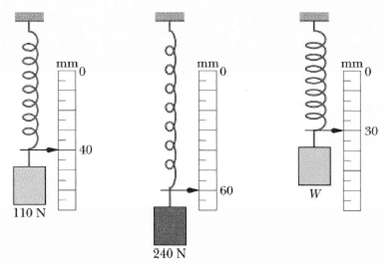
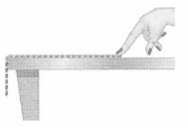
A spring with a pointer attached is hanging next to a scale marked in millimeters. Three different packages are hung from the spring, in turn, as shown in Figure. (a) Which mark on the scale will the pointer indicate when no package is hung from the spring? (b) What is the weight W of the third
A particle moves along a straight path through displacement d = (8 m)i + cj while force F = (2 N)i – (4N)i acts on it. (Other forces also act on the particle.) What is the value of c if the work done by F on the particle is?(a) Zero,(b) Positive, and(c) Negative?
An elevator cab has a mass of 4500 kg and can carry a maximum load of 1800 kg. If the cab is moving upward at full load at 3.80 m/s, what power is required of the force moving the cab to maintain that speed?
A 45 kg block of ice slides down a frictionless incline l.5 m long and 0.91 m high, a worker pushes up against the ice, parallel to the incline, so that the block slides down at constant speed.(a) Find the magnitude of the worker's force. How much work is done on the block by?(b) The worker's
A force F in the positive direction of an x axis acts on an object moving along the axis. If the magnitude of the force is F = 10e–x/2.0 N, with x in meters, find the work done by F as the object moves from x = 0 to x = 2.0 m by(a) Plotting F(x) and estimating the area under the curve and(b)
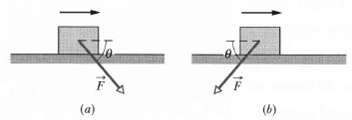
In Figure (a) a 2.0 N force is applied to a 4.0 kg block at a downward angle θ as the block moves rightward through 1.0 m across a frictionless floor. Find an expression for the speed vf of the block at the end of that distance if the block's initial velocity is (a) 0 and (b) 1.0 m/s to the
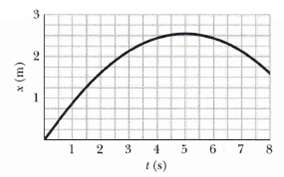
A 2.0 kg lunchbox is sent sliding over a frictionless surface, in the positive direction of an x axis along the surface. Beginning at time t = 0, a steady wind pushes on the lunchbox in the negative direction of the x axis. Figure shows the position x of the lunchbox as a function of time t as the
Numerical integration breadbox is made to move along an x axis from x = 0.15 m to x = 1.20 m by a force with a magnitude given by F = exp (– 2x2), with x in meters and F in Newton’s. (Here exp is the exponential function.) How much work is done on the breadbox by the force?
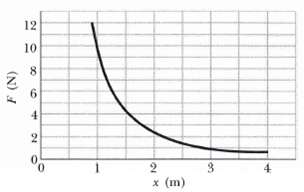
As a particle moves along an x axis, a force in the positive direction of the axis acts on it. Figure shows the magnitude F of the force versus position x of the particle. The curve is given by F = a/x2, with a = 9.0 N ?? m2.Find the work done on the particle by the force as the particle moves from
A CD case slides along a floor in the positive direction of an x axis while an applied force Fa acts on the case. The force is directed along the x axis and has the x component Fax = 9x – 3x2, with x in meters and Fax in Newton’s. The case starts at rest at the position x = 0, and it moves
You drop a 2.00 kg book to a friend who stands on the ground at distance D = 10.0 m below. If your friend's outstretched hands are at distance d = 1.50m above the ground (Figure),(a) How much work W, does the gravitational force do on the book as it drops to her hands?(b) What is the change in the
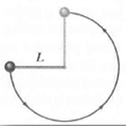
Figure shows a ball with mass m = 0.341 kg attached to the end of a thin rod with length L = 0.452 m and negligible mass. The other end of the rod is pivoted so that the ball can move in a vertical circle.The rod is held horizontally as shown and then given enough of a downward push to cause the
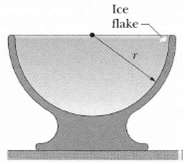
In Figure a 2.00 g ice flake is released from the edge of a hemispherical bowl whose radius r is 220cm. The flake -bowl contact is frictionless. (a) How much work is done on the flake by the gravitational force during the flake's descent to the bottom of the bowl? (b) What is the change in the
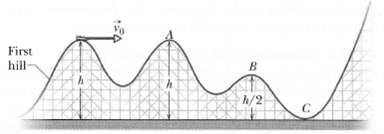
In Figure a frictionless roller-coaster car of mass m - 825 kg tops the first hill with speed v0 = 17 .0 m/s at height h = 42.0 m. How much work does the gravitational force do on the car from that point to (a) Point A? (b) Point B, and (c) Point C? If the gravitational potential energy of the car
What is the spring constant of a spring that stores 25 J of elastic potential energy when compressed by 7.5 cm?
A 1.50 kg snowball is fired from a cliff I2.5 m high. The snowball's initial velocity is 14.0 m/s, directed 41.0o above the horizontal.(a) How much work is done on the snowball by the gravitational force during its flight to the flat ground below the cliff?(b) What is the change in the
Figure shows a thin rod, of length L = 2.00 m and negligible mass, that can pivot about one end to rotate in a vertical circle. A ball of mass m = 5.00 kg is attached to the other end. The rod is pulled aside to angle θ0 = 30.0o and released with initial velocity v0 = 0. As the ball descends to
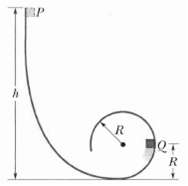
In Figure a small block of mass m = 0.032 kg can slide along the frictionless loop-the loop, with loop radius R = 12 cm. The block is released from rest at point P, at height h = 5.0R above the bottom of the loop. How much work does the gravitational force do on the block as the block travels from
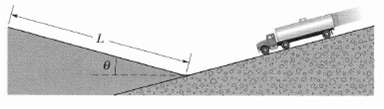
In Figure a runaway truck with failed brakes is moving downgrade at 130 km/h just before the driver steers the truck up a frictionless emergency escape ramp with an inclination of 0 = 15o. The truck's mass is 1.2 x 10⁴ kg. (a) What minimum length L must the ramp have if the truck is to stop
(a) In Problem 1, what is the speed of the book when it reaches the hands?(b) If we substituted a second book with twice the mass, what would its speed be?(c) If, instead, the book were thrown down, would the answer to (a) increase, decrease, or remain the same?
(a) In Problem 3, what is the speed of the flake when it reaches the bottom of the bowl?(b) If we substituted a second flake with twice the mass, what would its speed be?(c) If, instead, we gave the flake an initial downward speed along the bowl, would the answer to (a) increase, decrease, or
(a) In Problem 2, what initial speed must be given the ball so that it reaches the vertically upward position with zero speed? What then is its speed at?(b) The lowest point and(c) The point on the right at which the ball is level with the initial point?(d) If the ball's mass were doubled, would
(a) In Problem 4, what is the speed of the car at (a) point A,(b) Point B, and(c) Point C?(d) How high will the car go on the last hill, which is too high for it to cross?(e) If we substitute a second car with twice the mass, what then are the answers to (a) through (d)?
(a) In Problem 6, using energy techniques rather than the techniques find the speed of the snowball as it reaches the ground below the cliff. What is that speed(b) If the launch angle is changed to 41.0o below the horizontal and(c) If the mass is changed to 2.50 kg?
A 5.0 g marble is fired vertically upward using a spring gun. The spring must be compressed 8.0 cm if the marble is to just reach a target 20 m above the marble's position on the compressed spring.(a) What is the change LU, in the gravitational potential energy of the marble-Earth system during the
(a) In Problem, what is the speed of the ball at the lowest point?(b) Does the speed increase, decrease, or remain the same if the mass is increased?
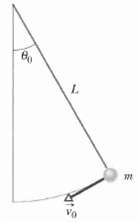
Figure 8-34 shows a pendulum of length L = 1.25 m. Its bob (which effectively has all the mass) has speed v0 when the cord makes an angle θ0 = 40.0o with the vertical.(a) What is the speed of the bob when it is in its lowest position if v0 = 8.00 m/s? What is the least value that v0 can have if
A 700 g block is released from rest at height h0 above a vertical spring with spring constant k = 400 N/m and negligible mass. The block sticks to the spring and momentarily stops after compressing the spring 19.0 cm. How much work is done?(a) By the block on the spring and(b) By the spring on the
In Problem 8, what are the magnitudes of(a) The horizontal component and(b) The vertical component of the net force acting on the block at point Q?(c) At what height h should the block be released from rest so that it is on the verge of losing contact with the track at the top of the loop? (On the
A single conservative force F = (6.0x – 12)i N, where x is in meters, acts on a particle moving along an axis. The potential energy U associated with this force is assigned a value of 27 J at x = 0.(a) Write an expression for U as a function of x, with U in joules and x in meters.(b) What is the
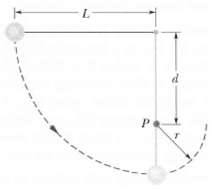
The string in Figure is L = 120 cm long, has a ball attached to one end, and is fixed at its other end. The distance d from the fixed end to a fixed peg at point P is 75.0 cm. When the initially stationary ball is released with the string horizontal as shown, it will swing along the dashed arc.
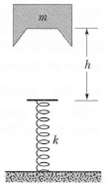
A block of mass m = 2.0 kg is dropped from height h = 40 cm onto a spring of spring constant k = 1960 N/m (Figure). Find the maximum distance the spring is compressed.
At t = 0 a 1.0 kg ball is thrown from a tall tower with v = (18 m/s)i + (24m/s)j. What is ∆U of the ball-Earth system between t = 0and t = 6.0s (still free fall)?
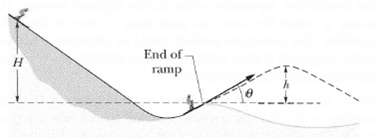
A 60 kg skier starts from rest at height H = 20 m above the end of a ski-jump ramp (Figure) and leaves the ramp at angle θ = 28o. Neglect the effects of air resistance and assume the ramp is frictionless. (a) What is the maximum height h of his jump above the end of the ramp? (b) If he increased
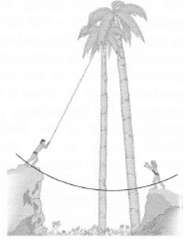
Tarzan, who weighs 688N, swings from a cliff at the end of a vine 18m long (Figure). From the top of the cliff to the bottom of the swing, he descends by 3.2m. The vine will break if the force on it exceeds 950n. (a) Does the vine break? (b) If no, what is the greatest force on it during the swing?
A pendulum consists of a 2.0 kg stone swinging on a 4.0 m string of negligible mass. The stone has a speed of 8.0 m/s when it passes its lowest point.(a) What is the speed when the string is at 60" to the vertical?(b) What is the greatest angle with the vertical that the string will reach during
Figure shows an 8.00 kg stone at rest on a spring. The spring is compressed 10.0 cm by the stone. (a) What is the spring constant? (b) The stone is pushed down an additional 30.0 cm and released. What is the elastic potential energy of the compressed spring just before that release? (c) What is the
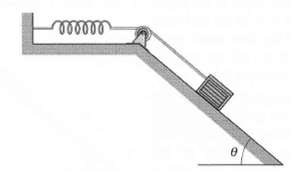
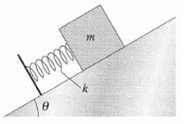
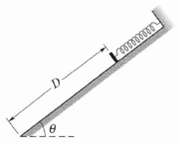
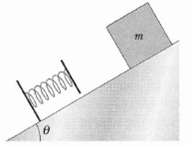
(a) What is the speed of the box when it has moved 10 cm down the incline? (b) How far down the incline from its point of release does the box slide before momentarily stopping, and what are the (c) Magnitude and (d) Direction (up or down the incline) of the box's acceleration at the instant the
A block with mass m = 2.00 kg is placed against a spring on a frictionless incline with angle θ = 30.0o (Figure b) (The block is not attached to the spring.) The spring, with spring constant k = 19.6 N/cm, is compressed 20.0 cm and then released. (a) What is the elastic potential energy of the
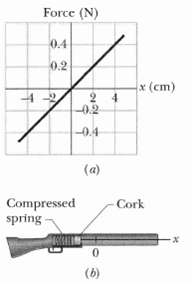
Figure a applies to the spring in a cork gun (Figure b); it shows the spring force as a function of the stretch or compression of the spring. The spring is compressed by 5.5 cm and used to propel a 3.8 g cork from the gun. (a) What is the speed of the cork if it is released as the spring passes
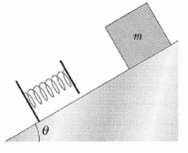
In Figure a block of mass m = 12 kg is released from rest on a frictionless incline of angle θ = 30o. Below the block is a spring that can be compressed 2.0 cm by a force of 270 N. The block momentarily stops when it compresses the spring by 5.5 cm. (a) How far does the block move down the incline
In Figure a chain is held on a frictionless table with one-fourth of its length hanging over the edge. If the chain has length L = 28 cm and mass m = 0.012 kg, how much work is required to pull the hanging part back onto the table?
(a) What is the speed of the canister at the instant the spring returns to its relaxed length (which is when the canister loses contact with the spring)? (b) What is the speed of the canister when it reaches the lower end of the incline?
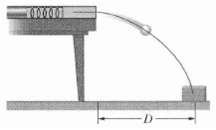
Two children are playing a game in which they try to hit a small box on the floor with a marble fired from a spring-loaded gun that is mounted on a table. The target box is horizontal distance D = 2.20 m from the edge of the table; see Figure. Bobby compresses the spring 1.10 cm, but the center of
A uniform cord of length 25 cm and mass 15 g is initially stuck to a ceiling. Later, it hangs vertically from the ceiling with only one end still stuck. What is the change in the gravitational potential energy of the cord with this change in orientation?
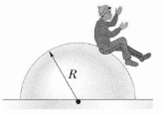
A boy is initially seated on the top of a hemispherical ice mound of radius R = 13.8 m. He begins to slide down the ice, with a negligible initial speed (Figure g).Approximate the ice as being frictionless. At what height does the boy lose contact with the ice?
In Figure, a block of mass m = 3.20 kg slides from rest a distance d down a frictionless incline at angle 0 = 30.0o where it runs into a spring of spring constant 431 N/m. When the block momentarily stops, it has compressed the spring by 21.0 cm. What are? (a) Distance d and (b) The distance
Showing 4800 - 4900
of 21795
First
42
43
44
45
46
47
48
49
50
51
52
53
54
55
56
Last
Step by Step Answers

 Get 50% OFF
Claim Now
Get 50% OFF
Claim Now