New Semester
Started
Get
50% OFF
Study Help!
--h --m --s
Claim Now
Question Answers
Textbooks
Find textbooks, questions and answers
Oops, something went wrong!
Change your search query and then try again
S
Books
FREE
Study Help
Expert Questions
Accounting
General Management
Mathematics
Finance
Organizational Behaviour
Law
Physics
Operating System
Management Leadership
Sociology
Programming
Marketing
Database
Computer Network
Economics
Textbooks Solutions
Accounting
Managerial Accounting
Management Leadership
Cost Accounting
Statistics
Business Law
Corporate Finance
Finance
Economics
Auditing
Tutors
Online Tutors
Find a Tutor
Hire a Tutor
Become a Tutor
AI Tutor
AI Study Planner
NEW
Sell Books
Search
Search
Sign In
Register
study help
physics
mechanics
Fundamentals of Physics 8th Extended edition Jearl Walker, Halliday Resnick - Solutions
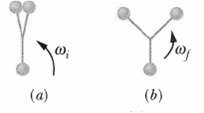
A bola consists of three massive, identical spheres connected to a common point by identical lengths of sturdy string (Figure). To launch this native South American weapon, you hold one of the spheres overhead and then rotate that hand about its wrist so as to rotate the other two spheres in a
A horizontal vinyl record of mass 0.10 kg and radius 0.10 m rotates freely about a vertical axis through its center with an angular speed of 4.7 rad/s. The rotational inertia of the record about its axis of rotation is 5.0 x 10⁻⁴ kg ∙ m2. A wad of wet putty of mass 0.020 kg drops vertically
In a long jump, an athlete leaves the ground with an initial angular momentum that tends to rotate her body forward, threatening to ruin her landing. To counter this tendency, she rotates her outstretched arms to "take up" the angular momentum (Figure). In 0.700 s, one arm sweeps through 0.500 rev
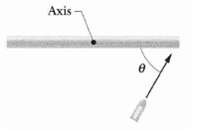
A uniform thin rod of length 0.500 m and mass 4.00 kg can rotate in a horizontal plane about a vertical axis through its center. The rod is at rest when a 3.00 g bullet traveling in the rotation plane is fired into one end of the rod. As viewed from above, the bullet's path makes angle ? = 60.0?
A cockroach of mass m lies on the rim of a uniform disk of mass 4.00m that can rotate freely about its center like a merry-go-round. Initially the cockroach and disk rotate together with an angular velocity of 0.260 rad/s. Then the cockroach walks halfway to the center of the disk.(a) What then is
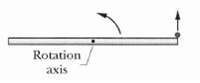
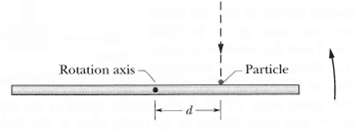
Figure is an over head view of a thin uniform rod 0.800 m and mass m rotating horizontally at angular speed 20.0 rad/s about an axis through its center. A particle of mass M/3.00 initially attached to one end is ejected from the rod and travels along a path that is perpendicular to the rod at the
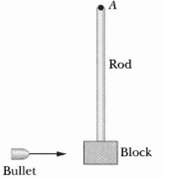
In Figure, a 1.0 g bullet is fired into a 0.50 kg block attached to the end of a 0.60 m non uniform rod of mass 0.50 kg. The block-rod-bullet system then rotates in the plane of the figure, about a fixed axis at A. The rotational inertia of the rod alone about that axis at A is 0.060 kg ? m2 Treat
A uniform disk of mass 10m and radius 3.0r can rotate freely about its fixed center like a merry-go-round. A smaller uniform disk of mass m and radius r lies on top of the larger disk, concentric with it. Initially the two disks rotate together with an angular velocity of 20 rad/s. Then a slight
A horizontal platform in the shape of a circular disk rotates on a frictionless bearing about a vertical axle through the center of the disk. The platform has a mass of 150 kg, a radius of 2.0 m, and a rotational inertia of 300 kg ∙ ms about the axis of rotation. A 60 kg student walks slowly
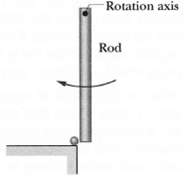
The uniform rod (length 0.60 m, mass 1.0 kg) in Figure rotates in the plane of the figure about an axis through one end, with a rotational inertia of 0.12 kg ? m2. As the rod swings through its lowest position, it collides with a 0.20 kg putty wad that sticks to the end of the rod. If the rod's
A ballerina begins a tour jete, (Figure) with angular speed ai and a rotational inertia consisting of two parts: Ileg = 1.44 kg ∙ m2 for her leg extended outward at angle θ = 90.0° to her body and Itrunk = 0.660 kg ∙ m2 for the rest of her body (primarily her trunk). Near her
Figure is an overhead view of a thin uniform rod of length 0.600 m and mass M rotating horizontally at 80.0 rad/s counterclockwise about an axis through its center. A particle of mass M/3.00 and traveling horizontally at speed 40.0 m/s hits the rod and sticks. The particle's path is perpendicular
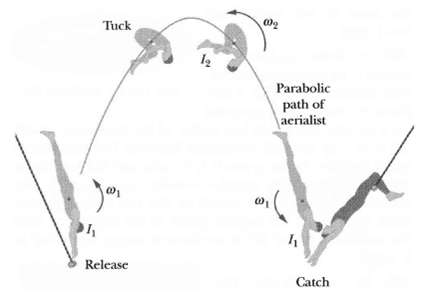
During a jump to his partner, an aerialist is to make a quadruple somersault lasting a time t = 1.87 s. For the first and last quarter-revolution, he is in the extended orientation shown in Figure, with rotational inertia I1 19.9 kg ? m2 around his center of mass (the dot). During the rest of the
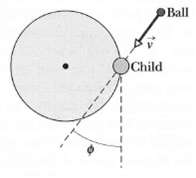
In Figure, a 30 kg child stands on the edge of a stationary merry-go-round of mass 100 kg and radius 2.0 m. The rotational inertia of the merry-go-round about its rotation axis is 150 kg ? m. The child catches a ball of mass 1.0 kg thrown by a friend. Just before the ball is caught, it has a
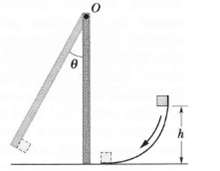
In Figure a small 50 g block slides down a frictionless surface through height h = 20 cm and then sticks to a uniform rod of mass 100 g and length 40 cm. The rod pivots about point O through angle ? before momentarily stopping. Find ?
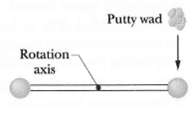
Two 2.00 kg balls are attached to the ends of a thin rod of length 50.0 cm and negligible mass. The rod is free to rotate in a vertical plane without friction about a horizontal axis through its center. With the rod initially horizontal (Figure), a 50.0 g wad of wet putty drops onto one of the
A top spins at 30rev/s about an axis that makes an angle of 30° with the vertical. The mass of the top is 0.50 kg, its rotational inertia about its central axis is 5.0 x 10⁻⁴ kg ∙ m2, and its center of mass is 4.0 cm from the pivot point. If the spin is clockwise from an overhead view, what
A certain gyroscope consists of a uniform disk with a 50 cm radius mounted at the center of an axle that is 11 cm long and of negligible mass. The axle is horizontal and supported at one end. If the disk is spinning around the axle at 1000 rev/min, what is the precession rate?
A uniform block of granite in the shape of a book has face dimensions of 20 cm and 15 cm and a thickness of 1.2 cm. The density (mass per unit volume) of granite is 2.64 g/cm3. The block rotates around an axis that is perpendicular to its face and halfway between its center and a corner. Its
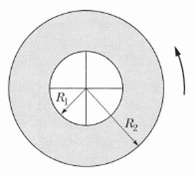
Figure shows an overhead view of a ring that can rotate about its center like a merry-go-round. Its outer radius R2 is 0.800 m, its inner radius R1 is R2/2.00, its mass M is 8.00 kg, and the mass of the crossbars at its center is negligible. It initially rotates at an angular speed of 8.00 rad/s
A 2.50 kg particle that is moving horizontally over a floor with velocity (-3.00 m/s) j undergoes a completely inelastic collision with a 4.00 kg particle that is moving horizontally over the floor with velocity (4.50 m/s) i. The collision occurs at xy coordinates (-0.500 m, -0.100 m). After the
Two particles, each of mass 2.90 x 10⁻⁴ kg and speed 5.46 m/s, travel in opposite directions along parallel lines separated by 4.20 cm.(a) What is the magnitude L of the angular momentum of the two-particle system around a point midway between the two lines?(b) Does the value of L change if the
A uniform rod rotates in a horizontal plane about a vertical axis through one end. The rod is 6.00 m long, weighs 10.0 N and rotates at 240 rev/min. Calculate(a) Its rotational inertia about the axis of rotation and(b) The magnitude of its angular momentum about that axis.
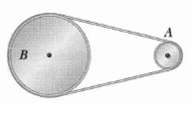
Wheels A and B in Figure are connected by a belt that does not slip. The radius of B is 3.00 times the radius of A. What would be the ratio of the rotational inertias IA/ IB if the angular momentum about their central axes and(a) The same angular momentum about their central axes and(b) The same
At time t = 0, a 2.0 kg particle has position vector r = (4.0m) i - (2.0 m) j relative to the origin. Its velocity is given by v = (-6.0t2 m/s) i for t > 0 in seconds. About the origin, what are?(a) The particle's angular momentum i and(b) The torque r acting on the particle, both in unit-vector
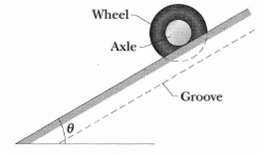
A uniform wheel of mass 10.0 kg and radius 0.400 m is mounted rigidly on an axle through its center (Figure). The radius of the axle is 0.200 m, and the rotational inertia of the wheel - axle combination about its central axis is 0.600 kg ?? m2. The wheel is initially at rest at the top of a
Suppose that the yo-yo in Problem 17, instead of rolling from rest, is thrown so that its initial speed down the string is 1.3 m/s.(a) How long does the yo-yo take to reach the end of the string? As it reaches the end of the string, what are its(b) Total kinetic energy,(c) Linear speed,
A small solid sphere with radius 0.25 cm and mass 0.56 g rolls without slipping on the inside of a large fixed hemisphere with radius 15 cm and a vertical axis of symmetry. The sphere starts at the top from rest.(a) What is its kinetic energy at the bottom?(b) What fraction of its kinetic energy at
A uniform solid ball rolls smoothly along a floor, then up a ramp inclined at 15.0°. It momentarily stops when it has rolled 1.50 m along the ramp. What was its initial speed?
A body of radius R and mass m is rolling smoothly with speed v on a horizontal surface. It then rolls up a hill to a maximum height h.(a) If h = 3v2/4g, what is the body's rotational inertia about the rotational axis through its center of mass?(b) What might the body be?
A wheel of radius 0.250 m, which is moving initially at 43.0 m/s, rolls to a stop in 225 m. calculate the magnitudes of (a) Its linear acceleration and (b) Its angular acceleration. (c) The wheel's rotational inertia is 0.155 kg ∙ m2 two wheels about its central axis. Calculate the
If Earth's polar ice caps fully melted and the water returned to the oceans, the oceans would be deeper by about 30 m. What effect would this have on Earth's rotation? Make an estimate of the resulting change in the length of the day.
A 1200 kg airplane is flying in a straight line at 80 m/s, 1.3 km above the ground. What is the magnitude of its angular momentum with respect to a point on the ground directly under the path of the plane?
In a playground, there is a small merry-go-round of radius 1.20 m and mass 180 kg. Its radius of gyration is 91.0 cm. A child of mass 44.0 kg runs at a speed of 3.00 m/s along a path that is tangent to the rim of the initially stationary merry-go-round and then jumps on. Neglect friction between
A wheel rotates clockwise about its central axis with an angular momentum of 600 kg ∙ m2/s. At time t = 0, a torque of magnitude 50 N ∙ m is applied to the wheel to reverse the rotation. At what time t is the angular speed zero?
A 3.0 kg toy car moves along an x axis with a velocity given by v = -2.0t3i m/s, with t in seconds. For t > 0, what are?(a) The angular momentum L of the car and(b) The torque r on the car, both calculated about the origin? What are?(c) L and(d) r about the point (2.0 m, 5.0 m, 0)?(e) L and(f) r
A thin-walled pipe rolls along the floor. What is the ratio of its translational kinetic energy to its rotational kinetic energy about the central axis parallel to its length?
A solid sphere of weight 36.0 N rolls up an incline at an angle of 30.0°. At the bottom of the incline the center of mass of the sphere has a translational speed of 4.90 m/s.(a) What is the kinetic energy of the sphere at the bottom of the incline?(b) How far does the sphere travel up along the
An automobile has a total mass of 1700 kg. It accelerates from rest to 40 km/h in 10 s. Assume each wheel is a uniform 32 kg disk. Find, for the end of the 10 s interval,(a) The rotational kinetic energy of each wheel about its axle,(b) The total kinetic energy of each wheel, and(c) The total
With axle and spokes of negligible mass and a thin rim, a certain bicycle wheel has a radius of 0.350 m and weighs 37.0 N; it can turn on its axle with negligible friction. A man holds the wheel above his head with the axle vertical while he stands on a turntable that is free to rotate without
For an 84 kg person standing at the equator, what is the magnitude of the angular momentum about Earth's center due to Earth's rotation?
A girl of mass M stands on the rim of a frictionless merry-go-round of radius R and rotational inertia I that is not moving. She throws a rock of mass m horizontally in a direction that is tangent to the outer edge of the merry-go- round. The speed of the rock, relative to the ground, is v.
A 4.0 kg particle moves in an xy plane. At the instant w\en the particle's position and velocity are V = (2.0 i + 4.0 j) m and v = - 4.0 j m/s, the force on the particle is F = - 3.0i N. At this instant, determine(a) The particle's angular momentum about the origin,(b) The particle's angular
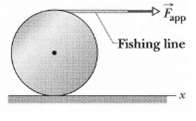
In Figure, a constant horizontal force F app, of magnitude 12 N is applied to a uniform solid cylinder by fishing line wrapped around the cylinder. The mass of the cylinder is 10 kg, its radius is 0.10 m, and the cylinder rolls smoothly on the horizontal surface.(a) What is the magnitude of the
(a) In Sample Problem 10-8, when the rotor exploded, how much angular momentum, calculated about the rotation axis was released to the surroundings?(b) If we assume that most of the pieces of the rotor were stopped within 0.025 s after the explosion, what was the magnitude of the average torque on
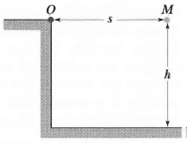
A particle of mass M = 0.25 kg is dropped from a point that is at height h = 1.80 m above the ground and horizontal distance s = 0.45 m from an observation point O, as shown in Figure. What is the magnitude of the angular momentum of the particle with respect to point O when the particle has
At one instant, a 0.80 kg particle is located at the position r = (2.0 m) i + (3.0 m) j. The linear momentum of the particle lies in the xy plane and has a magnitude of 2.4 kg ∙ m/s and a direction of 115° measured counterclockwise from the positive direction of x. What is the angular
What must the separation be between a 5.2 kg particle and a 2.4 kg particle for their gravitational attraction to have a magnitude of 2.3 x 10⁻¹² N?
The Sun and Earth each exert a gravitational force on the Moon. What is the ratio FSun/Fearth of these two forces? (The average Sun-Moon distance is equal to the Sun-Earth distance.)
A mass M is split into two parts, m and M - m, which are then separated by a certain distance. What ratio m/M maximizes the magnitude of the gravitational force between the parts?
Moon effects some people believe that the Moon controls their activities. If the Moon moves from being directly on the opposite side of Earth from you to being directly overhead, by what percent does(a) The Moon's gravitational pull on you increase and(b) Your weight (as measured on a scale)
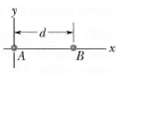
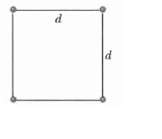
One dimension in figure two point particles are fixed on a x-axis separately by distance d. Particle A has mass mA and particle B has mass 3.00mA. A Pro third particle C, of mass 75.0mA, is to be placed on the x axis and near particles, A and B. In terms of distance d, at what x coordinate should C
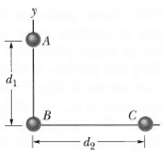
In Figure, three 5.00 kg spheres are located at distances d1 = 0.300 m and d2 = 0.400 m. What are the(a) Magnitude and(b) Direction (relative to the positive direction of the x axis) of the net gravitational force on sphere B due to spheres A andC?
How far from Earth must a space probe be along a line toward the Sun so that the Sun's gravitational pull on the probe balances Earth's pull?
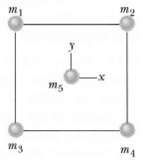
In Figure, a square of edge length 20.0 cm is formed by four spheres of masses m1 = 5.00 g, m2 = 3.00 g, m3 = 1.00 g, and m4 = 5.00 g. In unit-vector notation, what is the net gravitational force from them on a central sphere with mass m5 = 2.50g?
Miniature black holes left over from the big-bang beginning of the universe, tiny black holes might still wander through the universe. If one with a mass of 1 x 10¹¹ kg (and radius of only 1 x 10-16 m) reached Earth, at what distance from your head would its gravitational pull on you match that of
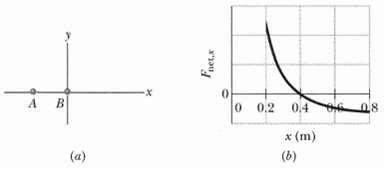
In Figure particle A is fixed in place at x = 0.20 m on the x axis and particle B, with a mass of 1.0 kg, is fixed in place at the origin. Particle C (not shown) can be moved along the x axis, between particle B and x = ?. Figure shows the x component Fnet,x of the net gravitational force on
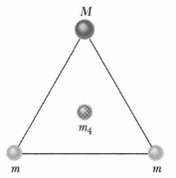
As seen in Figure, two spheres of mass m and a third sphere of mass M form an equilateral triangle, and a fourth sphere of mass m4 is at the center of the triangle. The net gravitational force on that central sphere from the three other spheres is zero.(a) What is M in terms of m?(b) If we double
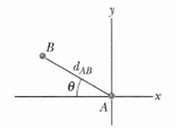
Three point particles are fixed in position in a xy plane. Two of them, particle A of mass 6.00 g and particle B of mass 12.0 g, are shown in Figure with a separation of dAB = 0.500 m at angle ? = 30?. Particle C, with mass 8.00 g, is not shown. The net gravitational force acting on particle A due
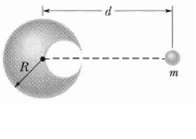
Figure shows a spherical hollow inside a lead sphere of radius R = 4.00 cm; the surface of the hollow passes through the center of the sphere and "touches" the right side of the sphere. The mass of the sphere before hollowing was M = 2.95 kg. With what gravitational force does the hollowed-out lead
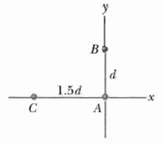
Two dimensions in Figure three point particles are fixed in place in a xy plane. Particle A has mass mA, particle B has mass 2.00mA, and particle C has mass 3.00mn. A fourth particle D, with mass 4.00ma, is to be placed near the other three particles. In terms of distance d, at what(a) x coordinate
Three dimensions three point particles are fixed in place in a xyz coordinate system. Particle A, at the origin, has mass mA. Particle B, at xyz coordinates (2.00d, 1.00d, 2.00d), has mass 2.00ma, and particle C, at coordinates (-1.00d, 2.00d, -3.00d), has mass 3.00mn. A fourth particle D, with
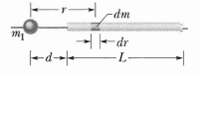
In Figure a particle F of mass m1 = 0.67 kg is a distance d = 23 cm from one end of a uniform rod with length L = 3.0 m and mass M = 5.0 kg. What is the magnitude of the gravitational force F on the particle from therod?
At what altitude above Earth's surface would the gravitational acceleration be 4.9 m/s2?
Mile-high building in 1956, Frank Lloyd Wright proposed the construction of a mile-high building in Chicago. Suppose the building had been constructed. Ignoring Earth's rotation, find the change in your weight if you were to ride an elevator from the street level, where you weigh 600 N to the top
(a) What will an object weigh on the Moon's surface if it weights 100 N on Earth's surface?(b) How many Earth radii must this same object be from the center of Earth if it is to weight the same as it does on the Moon?
Mountain pull a large mountain can slightly affect the direction of "down" as determined by a plumb line. Assume that we can model a mountain as a sphere of radius R = 2.00 km and density (mass per unit volume) 2.6 x 10³ kg/m3 assume also that we hang a 0.50 m plumb line at a distance of 3R from
One model for a certain planet has a core of radius R and mass M surrounded by an outer shell of inner radius R, outer radius 2R, and mass 4M. It M = 4.1 x I024 kg and R = 6.0 x 10⁶ m, what is the gravitational acceleration of a particle at points(a) R and(b) 3R from the center of the planet?
The radius Rh and mass Mh of a black hole are related by Rh = 2GMh/c2, where c is the speed of light. Assume that the gravitational acceleration ar of an object at a distance ro = 1.001Rh, from the center of a black hole is given by Eq. (it is, for large black holes).(a) In terms of Mh, find ag at
Certain neutron stars (extremely dense stars) are believed to be rotating at about 1 rev/s. If such a star has a radius of 20 km, what must be its minimum mass so that material on its surface remains in place during the rapid rotation?
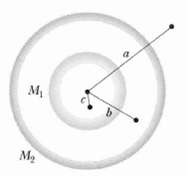
Two concentric spherical shells with uniformly distributed masses M1 and M2 are situated as shown in Figure. Find the magnitude of the net gravitational force on a particle of mass m, due to the shells, when the particle is located at radial distance (a) a, (b) b, and (c)c.
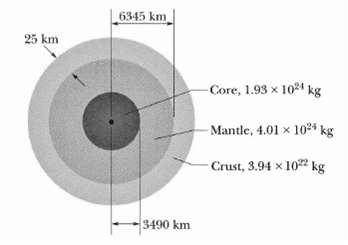
Figure shows, not to scale, a cross section through the interior of Earth. Rather than being uniform throughout, Earth is divided into three zones: an outer crust, a mantle, and an inner core. The dimensions of these zones and the masses contained within them are shown on the figure. Earth has a
Assume a planet is a uniform sphere of radius R that (somehow) has a narrow radial tunnel through its center (Figure). Also assume we can position an apple anywhere along the tunnel or outside the sphere. Let FR be the magnitude of the gravitational force on the apple when it is located at the
A solid uniform sphere has a mass of 1.0 x 10⁴ kg and a radius of 1.0 m. What is the magnitude of the gravitational force due to the sphere on a particle of mass m located at a distance of?(a) 1.5 m and(b) 0.50 m from the center of the sphere?(c) Write a general expression for the magnitude of the
Consider a pulsar, a collapsed star of extremely high density, with a mass M equal to that of the Sun (1.98 x l030 kg), a radius R of only 12 km, and a rotational period T of 0.041s. By what percentage does the free-fall acceleration g differ from the gravitational acceleration ar at the equator of
The mean diameters of Mars and Earth are 6.9 x 10³ km and 1.3 x 10⁴ km, respectively. The mass of Mars is 0.11 times Earth's mass(a) What is the ratio of the mean density (mass per unit volume) of Mars to that of Earth?(b) What is the value of the gravitational acceleration on Mars?(c) What is the
(a) What is the gravitational potential energy of the two-particle system in Problem 1? If you triple the separation between the particles, how much work is done(b) By the gravitational force between the particles and(c) By you?
What multiple of the energy needed to escape from Earth gives the energy needed to escape from (a) The Moon and(b) Jupiter?
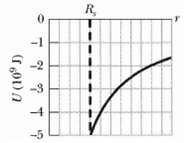
Figure gives the potential energy function U(r) of a projectile, plotted outward from the surface of a planet of radius R. If the projectile is launched radially outward from the surface with a mechanical energy of - 2.0 x 10⁹ J what are? (a) Its kinetic energy at radius r - 1.25R, and (b) Its
Figure gives the potential energy function U(r) of a projectile, plotted outward from the surface of a planet of radius RS. What least kinetic energy is required of a projectile launched at the surface if the projectile is to "escape" the planet?
In Problem, what ratio m/M gives the least gravitational potential energy for the system?
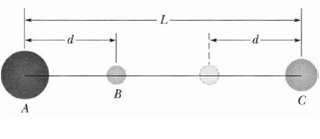
The three spheres in Figure with masses mA = 80 g, mB = 10 g, and mC = 20 g, have their centers on a common line, with L = 12 cm and d = 4.0 cm. You move sphere B along the line until its center-to-center separation from C is d = 4.0 cm. How much work is done on sphere B? (a) By you and (b) By the
A projectile is shot directly away from Earth's surface. Neglect the rotation of Earth. What multiple of Earth's radius Rs gives the radial distance a projectile reaches if(a) Its initial speed is 0.500 of the escape speed from Earth and(b) Its initial kinetic energy is 0.500 of the kinetic energy
(a) What is the escape speed on a spherical asteroid whose radius is 500 km and whose gravitational acceleration at the surface is 3.0 m/s2?(b) How far from the surface will a particle go if it leaves the asteroid's surface with a radial speed of 1000 m/s?(c) With what speed will an object hit the
Zero, a hypothetical planet, has a mass of 5.0 x 10²³ kg, u radius of 3.0 x 10⁶ m, and no atmosphere. A 10 kg space probe is to be launched vertically from its surf ace.(a) If the probe is launched with an initial energy of 5.0 x 10⁷ J, what will be its kinetic energy when it is 4.0 x 10⁶ m from
Two neutron stars are separated by a distance of 1.0 x 10¹⁰ m. They each have a mass of 1.0 x 1030 kg and a radius of l.0 x 105 m. They are initially at rest with respect to each other. As measured from that rest frame, how fast are they moving when?(a) Their separation has decreased to one-half
In deep space, sphere A of mass 20kg is located at the origin of an x axis and sphere B of mass 10 kg is located on the axis at x = 0.80 m. Sphere B is released from rest while sphere A is held at the origin.(a) What is the gravitational potential energy of the two-sphere system just as B is
Figure shows four particles, each of mass 20.0 g, that form a square with an edge length of d = 0.600 m. If d is reduced to 0.200 m, what is the change in the gravitational potential energy of the four-particlesystem?
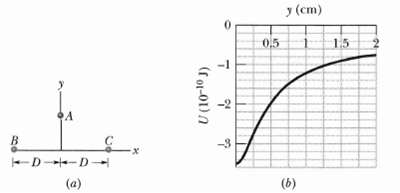
Figure shows a particle A that can be moved along a y axis from an infinite distance to the origin. That origin lies at the midpoint between particles B and C, which have identical masses, and the y axis is a perpendicular bisector between them. Distance D is 0.3057 m. Figure shows the potential
The Martian satellite Phobos travels in an approximately circular orbit of radius 9.4 x 10⁶ m with a period of 7 h 39 min calculate the mass of Mars from this information.
The first known collision between space debris and a functioning satellite occurred in 1996: At an altitude of 700 km, a year-old French spy satellite was hit by a piece of an Arianne rocket that had been in orbit for 10 years. A stabilizing boom on the satellite was demolished, and the satellite
The Sun, which is 2.2 x 10²⁰ m from the center of the Milky Way galaxy, revolves around that center once every 2.5 X 10⁸ years. Assuming each star in the Galaxy has a mass equal to the Sun's mass of 2.0 x 1030 kg, the stars are distributed uniformly in a sphere about the galactic center, and the
The mean distance of Mars from the Sun is 1.52 times that of Earth from the Sun. From Kepler's law of periods, calculate the number of years required for Mars to make one revolution around the Sun; compare your answer with the value given in Appendix C.
A satellite, moving in an elliptical orbit, is 360 km above Earth's surface at its farthest point and 180 km above at its closest point. Calculate(a) The semi major axis and(b) The eccentricity of the orbit.
A satellite is put in a circular orbit about Earth with a radius equal to one-half the radius of the Moon's orbit. What is its period of revolution in lunar months? (A lunar month is the period of revolution of the Moon.)
(a) What linear speed must an Earth satellite have to be in a circular orbit at an altitude of 160 km above Earth's surface?(b) What is the period of revolution?
The Sun's center is at one focus of Earth's orbit. How far from this focus is the other focus,(a) In meters and(b) In terms of the solar radius, 6.96 x 10⁸ m? The eccentricity is 0.0167, and the semi major axis is 1.50 x 10¹¹ m.
A comet that was seen in April 574 by Chinese astronomers on a day known by them as the Woo Woo day was spotted again in May 1994. Assume the time between observations is the period of the Woo Woo day comet and take its eccentricity as 0.11.What is?(a) The semi major axis of the comet's orbit
An orbiting satellite stays over a certain spot on the equator of (rotating) Earth. What is the altitude of the orbit (called a geosynchronous orbit)?
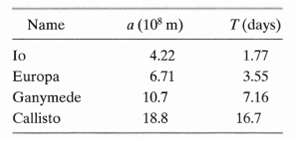
In 1610, Galileo used his telescope to discover four prominent moons around Jupiter. Their mean orbital radii a and periods T arc as follows: (a) Plot log a (y axis) against log T (x axis) and show that you get a straight line. (b) Measure the slope of the line and compare it with the value that
Showing 5300 - 5400
of 21795
First
47
48
49
50
51
52
53
54
55
56
57
58
59
60
61
Last
Step by Step Answers

 Get 50% OFF
Claim Now
Get 50% OFF
Claim Now