New Semester
Started
Get
50% OFF
Study Help!
--h --m --s
Claim Now
Question Answers
Textbooks
Find textbooks, questions and answers
Oops, something went wrong!
Change your search query and then try again
S
Books
FREE
Study Help
Expert Questions
Accounting
General Management
Mathematics
Finance
Organizational Behaviour
Law
Physics
Operating System
Management Leadership
Sociology
Programming
Marketing
Database
Computer Network
Economics
Textbooks Solutions
Accounting
Managerial Accounting
Management Leadership
Cost Accounting
Statistics
Business Law
Corporate Finance
Finance
Economics
Auditing
Tutors
Online Tutors
Find a Tutor
Hire a Tutor
Become a Tutor
AI Tutor
AI Study Planner
NEW
Sell Books
Search
Search
Sign In
Register
study help
physics
mechanics
Fundamentals of Physics 8th Extended edition Jearl Walker, Halliday Resnick - Solutions
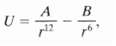
The potential energy of a diatomic molecule (a two-atom system like H2 or O) is given by where r is the separation of the two atoms of the molecule and A and B are positive constants. This potential energy is associated with the force that binds the two atoms together. (a) Find the equilibrium
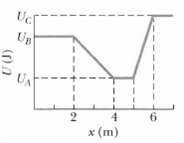
Figure shows a plot of potential energy U versus position x of a 0.90 kg particle that can travel only along an x axis. (Non conservative forces are not involved.) Three values are UA = 15.0J, UB = 35.0 J, and JC = 45.0 J. The particle is released at x = 4.5 m with an initial speed of 7.0 m/s,
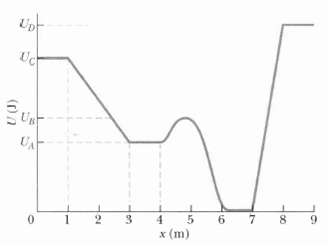
Figure shows a plot of potential energy U versus position x of a0.200 kg particle that can travel only along an x axis under the influence of a conservative force. The graph has these values: UA = 9.00 J, UC = 20.00 J, and UD = 24.00 J. The particle is released at the point where U forms a
A single conservative force F(x) acts on a 1.0 kg particle that moves along an x axis. The potential energy U(x) associated with F(x) is given by where x is in meters. At x = 5.0 m the particle has a kinetic energy of 2.0 J.(a) What is the mechanical energy of the system?(b) Make a plot of U(x) as
A worker pushed a 27 kg block 9.2 m along a level floor at constant speed with a force directed 32o below the horizontal. If the coefficient of kinetic friction between block and floor was 0.20, what were?(a) The work done by the worker's force and(b) The increase in thermal energy of the block-
A collie drags its bed box across a floor by applying a horizontal force of 8.0 N. The kinetic frictional force acting on the box has magnitude 5.0 N. As the box is dragged through 0.70 m along the way, what are?(a) The work done by the collie's applied force and(b) The increase in thermal energy
A horizontal force of magnitude 35.0 N pushes a block of mass 4.00 kg across a floor where the coefficient of kinetic friction is 0.600.(a) How much work is done by that applied force on the block-floor system when the block slides through a displacement of 3.00 m across the floor?(b) During that
A rope is used to pull a3.57 kg block at constant speed 4.06 m along a horizontal floor. The force on the block from the rope is 7.68 N and directed 15.0o above the horizontal. What are?(a) The work done by the rope's force,(b) The increase in thermal energy of the block-floor system, and(c) The
A 60 kg skier leaves the end of a ski-jump ramp with a velocity of 24 m/s directed 25o above the horizontal. Suppose that as a result of air drag the skier returns to the ground with a speed of.22 m/s, landing 14 m vertically below the end of the ramp. From the launch to the return to the ground,
A 25 kg bear slides, from rest, 12 m down a lodge pole pine tree, moving with a speed of 5.6 m/s just before hitting the ground.(a) What change occurs in the gravitational potential energy of the bear-Earth system during the slide?(b) What is the kinetic energy of the bear just before hitting the
An outfielder throws a baseball with an initial speed of 81.8 mi/h. Just before an infielder catches the ball at the same level, the ball's speed is 110 ft/s. In foot-pounds, by how much is the mechanical energy of the ball-Earth system reduced because of air drag? (The weight of a baseball is 9.0
A 75 g Frisbee is thrown from a point 1.1 m above the ground with a speed of 12 m/s. When it has reached a height of 2.1 m, its speed is 10.5 m/s. What was the reduction in Emec of the Frisbee–Earth system because of air drag?
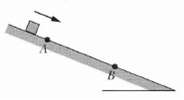
In Figure, a block slides down an incline. As it moves from point A to point-B, which are 5.0 m apart, force F acts on the block, with magnitude 2.0 N and directed down the incline. The magnitude of the frictional force acting on the block is 10 N. If the kinetic energy of the block increases by 35
During a rockslide, a 520 kg rock slides from rest down a hillside that is 500 m long and 300 m high. The coefficient of kinetic friction between the rock and the hill surface is 0.25.(a) If the gravitational potential energy LI of the rock-Earth system is zero at the bottom of the hill, what is
You push a 2.0 kg block against a horizontal spring, compressing the spring by 15 cm. Then you release the block, and the spring sends it sliding across a tabletop. It stops 75 cm from where you released it. The spring constant is 200 N/m. What is the block-table coefficient of kinetic friction?
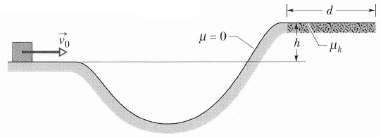
In Figure a block slides along a track from one level to a higher level after passing through an intermediate valley. The track is frictionless until the block reaches the higher level. There a frictional force stop the block in a distance d, the block's initial speed us is 6.0m/s the height
A large fake cookie sliding on a horizontal surface is attached to one end of a horizontal spring with spring constant k = 400 N/m; the other end of the spring is fixed in place. The cookie has a kinetic energy of 20.0 J as it passes through the spring's equilibrium position. As the cookie slides,
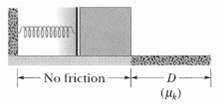
In Figure, a 3.5 kg block is accelerated from rest by a compressed spring of spring constant 640 N/m. The block leaves the spring at the spring's relaxed length and then travels over a horizontal floor with a coefficient of kinetic friction ?k= 0.25. The frictional force stops the block in distance
A 4.0 kg bundle starts up a 30o incline with 128 J of kinetic energy. How far will it slide up the incline if the coefficient of kinetic friction between bundle and incline is 0.30?
When a click beetle is upside down on its back, it jumps upward by suddenly arching its back, transferring energy stored in a muscle to mechanical energy. This launching mechanism produces an audible click, giving the beetle its name. Videotape of a certain click-beetle jump shows that a beetle of
A child whose weight is 267 N slides down a 6.1 m playground slide that makes an angle of 20o with the horizontal. The coefficient of kinetic friction between slide and child is 0.10. (a) How much energy is transferred to thermal energy?(b) If she starts at the top with a speed of 0.457m/s,
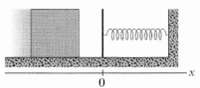
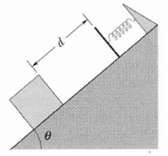
In Figure, a block of mass m = 2.5 kg slides head on into a spring of spring constant k = 320 N/m. When the block stops, it has compressed the spring by 7.5 cm. The coefficient of kinetic friction between block and floor is 0.25. While the block is in contact with the spring and being brought to
A cookie jar is moving up a 40o incline. At a point 55 cm from the bottom of the incline (measured along the incline), the jar has a speed of 1.4 m/s. The coefficient of kinetic friction between jar and incline is 0.15. (a) How much farther up the incline will the jar move? (b) How fast will it be
A stone with a weight of 5.29 N is launched vertically from ground level with an initial speed of 20.0 m/s, and the air drag on it is 0.265 N throughout the flight. What are? (a) The maximum height reached by the stone and (b) Its speed just before it hits the ground?
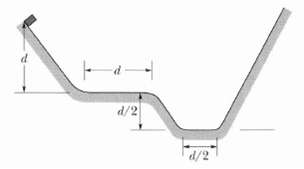
In Figure a block is released from rest at height d = 40 cm and slides down a frictionless ramp and onto a first plateau, which has length d and where the coefficient of kinetic friction is 0.50. If the block is still moving, it then slides down a second frictionless ramp through height d/2 and
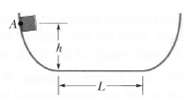
A particle can slide along a track with elevated ends and a flat central part, as shown in Figure. The flat part has length L = 40cm. The curved portions of the track are frictionless, but for the flat part the coefficient of kinetic friction is ?k= 0.20. The particle is released form rest at point
In Figure a block slides along a path that is without friction until the block reaches the section of length L = 0.75m, which begins at height h = 2.0m on a ramp of angle θ = 30o. In that section, the coefficient of kinetic friction is 0.40. The block passes through point A with a speed of 8.0
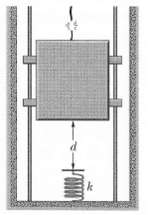
The cable of the 1800 kg elevator cab in Figure snaps when the cab is at rest at the first floor, where the cab bottom is a distance d = 3.7 m above a spring of spring constant k = 0.15 MN/m. A safety device clamps the cab against guide rails so that a constant frictional force of 4.4kN opposes
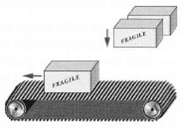
At a certain factory, 300 kg crates are dropped vertically from a packing machine onto a conveyor belt moving at 1.20 m/s (Figure). (A motor maintains the belt's constant speed.) The coefficient of kinetic friction between the belt and each crate is 0.400. After a short time, slipping between the
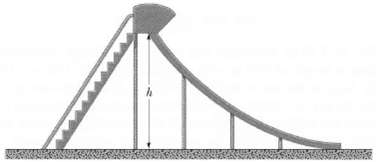
A playground slide is in the form of an arc of a circle that has a radius of 12 m. The maximum height of the slide is h = 4.0m, and the ground is tangent to the circle (Figure). A 25 kg child starts from rest at the top of the slide and has a speed of 6.2 m/s at the bottom.(a) What is the length of
In Figure, the string is L = 120 cm long, has a ball attached to one end, and is fixed at its other end. A fixed peg is at point P. Released from rest, the ball swings down until the string catches on the peg; then the ball swings up, around the peg. If the ball is to swing completely around the
In Figure, a block is sent sliding down a frictionless ramp. Its speeds at points A and B are 2.00 m/s and 2.60 m/s, respectively. Next, it is again sent sliding down the ramp, but this time its speed at point -4 is 4.00 m/s. What then is its speed at point B?
A certain spring is found not to conform to Hooke's law. The force (in Newton’s) it exerts when stretched a distance x (in meters) is found to have magnitude 52.8x + 38.4x2 in the direction opposing the stretch. (a) Compute the work required to stretch the spring from x = 0.500 m to x = 1.00
A factory worker accidentally releases a 180 kg crate that was being held at rest at the top of a ramp that is 3.7 m long and inclined at 39° to the horizontal. The coefficient of kinetic friction between the crate and the ramp, and between the crate and the horizontal factory floor, is 0.28.(a)
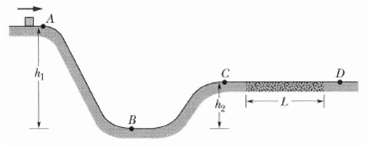
In Figure, a small block is sent through point A with a speed of 7.0 m/s. Its path is without friction until it reaches the section of length L = 12 m, where the coefficient of kinetic friction is 0.70. The indicated heights are h1= 6.0 m and h2= 2.0 m. What are the speeds of the block at?? (a)
A 2.50 kg beverage can is thrown directly downward from a height of 4.00 m, with an initial speed of 3.00 m/s the at drag on the can is negligible. What is the kinetic energy of the can? (a) As it reaches the ground at the end of its fall and (b) When it is halfway to the ground? What are? (c) The
A 1.50 kg water balloon is shot straight up with an initial speed of 3.00 m/s. (a) What is the kinetic energy of the balloon just as it is launched? (b) How much work does the gravitational force do on the balloon during the balloon's full ascent?(c) What is the change in the gravitational
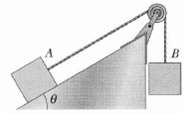
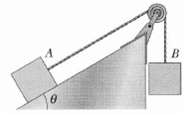
In Figure the pulley has negligible mass, and both it and the inclined plane are frictionless. Block A has a mass of 1.0 kg, block B has a mass of 2.0 kg, and angle ? is 30o. If the blocks are released from rest with the connecting cord taut, what is their total kinetic energy when block B has
From the edge of a cliff, a 0.55 kg projectile is launched with an initial kinetic energy of 1550 J. The projectile's maximum upward displacement from the launch point is + 140 m.What are the (a) Horizontal and (b) Vertical components of its launch velocity? (c) At the instant the vertical
The only force acting on a particle is conservative force if the particle is at point A, the potential energy of the system associated with F and the particle is 40 J. If the particle moves from point A to point B, the work done on the particle by F is + 25 J. What is the potential energy of the
A constant horizontal force moves a 50 kg trunk 6.0 m up a 30o incline at constant speed. The coefficient of kinetic friction between the trunk and the incline is 0.20. What are? (a) The work done by the applied force and (b) The increase in the thermal energy of the trunk and incline?
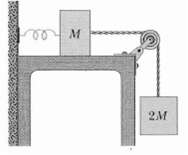
Two blocks, of masses M = 2.0kg and 2M, are connected to a spring of spring constant k = 200 N/m that has one end fixed, as shown in Figure.The horizontal surface and the pulley are frictionless, and the pulley has negligible mass. The blocks are released from rest with the spring relaxed.(a) What
A volcanic ash flow is moving across horizontal ground when it encounters a L0 upslope. The front of the flow then travels 920 m up the slope before stopping. Assume that the gases entrapped in the flow lift the flow and thus make the frictional force from the ground negligible; assume also that
A 0.50 kg banana is thrown directly upward with an initial speed of 4.00 m/s and reaches a maximum height of 0.80 m. What change does air drag cause in the mechanical energy of the banana-Earth system during the ascent?
If a 70 kg baseball player steals home by sliding into the plate with an initial speed of 10 m/s just as he hits the ground,(a) What is the decrease in the player's kinetic energy and(b) What is the increase in the thermal energy of his body and the ground along which he slides?
(a) What is the kinetic energy of the block at the instant it has compressed the spring 0.20 m?(b) With what kinetic energy must the block be projected up the plane if it is to stop momentarily when it has compressed the spring by 0.40m?
A 3.2 kg sloth hangs 3.0 m above the ground. (a) What is the gravitational potential energy of the sloth - Earth system if we take the reference point y = 0 to be at the ground? If the sloth drops to the ground and air drag on it is assumed to be negligible, what are the (b) Kinetic energy and (c)
A machine pulls a 40 kg trunk 2.0 m up a 40o ramp at constant velocity, with the machine's force on the trunk directed parallel to the ramp. The coefficient of kinetic friction between the trunk and the ramp is 0.40. What are? (a) The work done on the trunk by the machine's force and (b)
The luxury liner Queen Elizabeth 2 has a diesel-electric power plant with a maximum power of 92 MW at a cruising speed of 32.5 knots. What forward force is exerted on the ship at this speed? (1 knot = 1.852 km/h.)
The temperature of a plastic cube is monitored while the cube is pushed 3.0 m across a floor at constant speed by u horizontal force of 15 N. The thermal energy of the cube increases by 20 J. What is the increase in the thermal energy of the floor along which the cube slides?
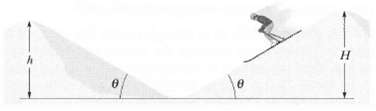
Two snowy peaks are at heights H = 850 m and h = 750 m above the valley between them. A ski run extends between the peaks, with a total length of 3.2 km and an average slope of θ = 30o(Figure).? (a) A skier starts from rest at the top of the higher peak. At what speed will he arrive at the top of
A swimmer moves through the water at an average speed of 0.22 m/s. The average drag force is 110 N. What average power is required of the swimmer?
An automobile with passengers has weight 16400 N and is moving at 113 km/h when the driver brakes, sliding to a stop. The frictional force on the wheels from the road has a magnitude of 8230 N. Find the stopping distance.
A 0.63 kg ball thrown directly upward with an initial speed of 14 m/s reaches a maximum height of 8.1 m. What is the change in the mechanical energy of the ball-Earth system during the ascent of the ball to that maximum height?
The summit of Mount Everest is 8850 m above sea level. (a) How much energy would a 90 kg climber expend against the gravitational force on him in climbing to the summit from sea level? (b) How many candy bars, at 1.25 MJ per bar, would supply an energy equivalent to this? Your answer should suggest
A sprinter who weighs 670 N runs the first 7.0 m of a race in 1.6 s, starting from rest and accelerating uniformly. What are the sprinters?(a) Speed and(b) Kinetic energy at the end of the 1.6 s?(c) What average power does the sprinter generate during the 1.6 s interval?
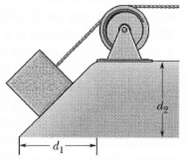
In Figure, a 1400kg clock kg block of granite is pulled up an incline at a constant speed of 1.34 m/s by a cable and winch. The indicated distances are d1= 40 m and d2= 30 m. The coefficient of kinetic friction between the block and the incline is 0.40. at is the power due to the force applied to
A 1.50 kg snowball is shot upward at an angle of 34.0o to the horizontal with an initial speed of 20.0 m/s. (a) What is its initial kinetic energy? (b) BV how much does the gravitational potential energy of the snowball-Earth system change as the snowball moves from the launch point to the point of
A20 kg object is acted on by a conservative force given by F = – 3.0x – 5.0x2, with Fin Newton’s and x in meters. Take the potential energy associated with the force to be zero when the object is at x = 0. (a) What is the potential energy of the system associated with the force when the
A 9.40 kg projectile is fired vertically upward. Air drag decreases the mechanical energy of the projectile-Earth system by 68.0 kJ during the projectile's ascent. How much higher would the projectile have gone were air drag negligible?
A metal tool is sharpened by being held against the rim of a wheel on a grinding machine by a force of 180 N. The frictional forces between the rim and the tool grind off small pieces of the tool. The wheel has a radius of 20.0 cm and rotates at 2.50rev/s, the coefficient of kinetic friction
A spring with a spring constant of 3200N/m is initially stretched until the elastic potential energy of the spring is 1.44 J. (U = 0 for the relaxed spring.) What is ∆U it the initial stretch is changed to? (a) A stretch of 2.0 cm, (b) A compression of 2.0 cm, and (c) A compression of
The spring in the muzzle of a child's spring gun has a spring constant of 700 N/m. To shoot a ball from the gun, first the spring is compressed and then the ball is placed on it. The gun's trigger then releases the spring, which pushes the ball through the muzzle. The ball leaves the spring just as
A 60.0 kg circus performer slides 4.00 m down a pole to the circus floor, starting from rest. What is the kinetic energy of the performer as she reaches the floor if the frictional force on her from the pole? (a) Is negligible (she will be hurt) and (b) Has a magnitude of 500 N?
In 1981, Daniel Goodwin climbed 443 m up the exterior of the Sears Building in Chicago using suction cups and metal clips.(a) Approximate his mass and then compute how much energy he had to transfer from biomechanical (internal) energy to the gravitational potential energy of the Earth-Goodwin
A 30 g bullet moving a horizontal velocity of 500 m/s comes to a stop 12 cm within a solid wall. (a) What is the change in the bullet's mechanical energy? (b) What is the magnitude of the average force from the wall stopping it?
Resistance to the motion of an automobile consists of road friction, which is almost independent of speed, and air drag, which is proportional to speed-squared. For a certain car with a weight of 12000 N, the total resistant force F is given by F = 300 = 1.8v2, with F in Newton’s and y in meters
A locomotive with a power capability of 1.5 MW can accelerate a train from a speed of 10 m/s to 25 m/s in 6.0 min.(a) Calculate the mass of the train. Find(b) The speed of the train and(c) The force accelerating the train as functions of time (in seconds) during the 6.0 min interval.(d) Find the
A 5.0 kg block is projected at 5.0 m/s up a plane that is inclined at 30o with the horizontal. How far up along the plane does the block go? (a) If the plane is frictionless and (b) If the coefficient of kinetic friction between the block and the plane is 0.40? (c) In the latter
A 20 kg block on a horizontal surface is attached to a horizontal spring of spring const ant k = 4.0kN/m. The block is pulled to the right so that the spring is stretched 10 cm beyond its relaxed length, and the block is then released from rest. The frictional force between the sliding block and
A 70.0 kg man jumping from a window lands in an elevated fire rescue net 11.0 m below the window. He momentarily stops when he has stretched the net by 1.50 m, assuming that mechanical energy is conserved during this process and that the net functions like an ideal spring, find the elastic
To form a pendulum, a 0.092 kg ball is attached to one end of a rod of length 0.62 m and negligible mass, and the other end of the rod is mounted on a pivot. The rod is rotated until it is straight up, and then it is released from rest so that it swings down around the pivot. When the ball reaches
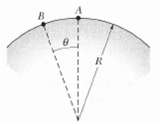
A skier weighing 600 N goes over a frictionless circular hill of radius R - 20 m (Figure). Assume that the effects of air resistance on the skier are negligible. As she comes up the hill, her speed is 8.0 m/s at point B, at angle θ = 20o.? (a) What is her speed at the hilltop (point A) it she
A 50 g ball is thrown from a window with an initial velocity of 8.0 m/s at an angle of 30o above the horizontal. Using energy methods, determine (a) The kinetic energy of the ball at the top of its flight and(b) Its speed when it is 3.0 m below the window. Does the answer to (b) depend on
A 68 kg sky diver falls at a constant terminal speed of 59 m/s. (a) At what rate is the gravitational potential energy of the Earth-sky diver system being reduced? (b) At what rate is the system's mechanical energy being reduced?
A river descends 15 m through rapids. The speed of the water is 3.2 m/s upon entering the rapids and 13 m/s upon leaving. What percentage of the gravitational potential energy of the water-Earth system is transferred to kinetic energy during the descent?
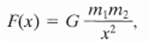
The magnitude of the gravitational force between a particle of mass ml and one of mass m2given by where G is a constant and x is the distance between the particles. (a) What is the corresponding potential energy function U(x)? Assume that U(x) ?? 0 as x ?? ?? and that x is positive. (b) How much
A river descends 15 m through rapids. The speed of the water is 3.2 m/s upon entering the rapids and 13 m/s upon leaving. What percentage of the gravitational potential energy of the water-Earth system is transferred to kinetic energy during the descent? Discuss.
A 1500 kg car starts from rest on a horizontal road and gains a speed of 72 km/h in 30 s. (a) What is its kinetic energy at the end of the 30 s? (b) What is the average power required of the car during the 30 s interval? (c) What is the instantaneous power at the end of the 30 s interval, assuming
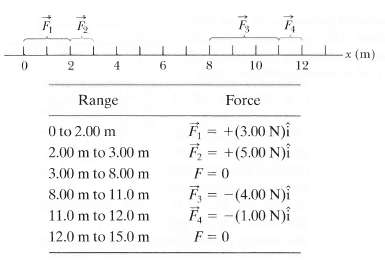
A particle can move along only an x axis, where conservative forces act on it (Figure and the following table). The particle is released at x = 5.00 m with a kinetic energy of K = 14.0 J and a potential energy of U = 0. If its motion is in the negative direction of the r axis, what are its? (a) K
For the arrangement of forces in Problem 117, a 2.00 kg particle is released at x = 5.00 m with an initial velocity of 3.45 m/s in the negative direction of the x axis.(a) If the particle can reach x = 0 m, what is its speed there, and if it cannot, what is its turning point? Suppose, instead, the
A 0.42 kg shuffleboard disk is initially at rest when a player uses a cue to increase its speed to 4.2 m/s at constant acceleration. The acceleration takes place over a 2.0 m distance, at the end of which the cue loses contact with the disk. Then the disk slides an additional 12m before stopping.
We move a particle along an x axis, first outward from x = 1.0 m to x = 4.0 m and then back to x = 1.0 m, while an external force acts on it. That force is directed along the x axis, and its x component can have different values for the outward trip and for the return trip. Here are the values (in
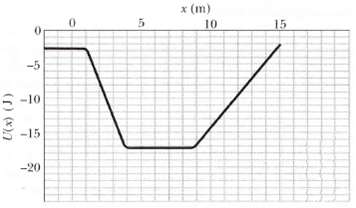
A conservative force F(x) acts on a 2.0 kg particle that moves along an x axis. The potential energy U(x) associated with F(x) is graphed in Figure. When the particle is at x = 2.0m, its velocity is ?? 1.5 m/s. What are the(a) Magnitude and(b) Direction of F(x) at this on the(c) Left and(d) Right
To make a pendulum, a 300 g ball is attached to one end of a string that has a length of 1 .4 m and negligible mass. (The other end of the string is fixed.) The ball is pulled to one side until the string makes an angle of 30.0o with the vertical; then (with the string taut) the ball is released
A 1500 kg car begins sliding down a 5.0o inclined road with a speed of 30 km/h. The engine is turned off, and the only forces acting on the car are a net frictional force from the road and the gravitational force. After the car has traveled 50 m along the road, its speed is 40 km/h. (a) How much is
In a circus act, a 60 kg clown is shot from a cannon with an initial velocity of 16 m/s at some unknown angle above the horizontal. A short time later the clown lands in a net that is 3.9 m vertically above the clown's initial position. Disregard air drag. What is the kinetic energy of the clown as
The maximum force you can exert on an object with one of your back teeth is about 750 N. Suppose that as you gradually bite on a clump of licorice, the licorice resists compression by one of your teeth by acting like a spring for which k = 2.5 x 10⁵ N/m. Find(a) The distance the licorice is
A 70 kg firefighter slides, from rest, 4.3 m down a vertical pole. (a) If the firefighter holds onto the pole lightly, so that the frictional force of the pole on her is negligible, what is her speed just before reaching the ground floor? (b) If the firefighter grasps the pole more firmly as she
A 15 kg block is accelerated at 2.0m/s2 along a horizontal frictionless surface, with the speed increasing from 10 m/s to 30 m/s. What are?(a) The change in the block's mechanical energy and (b) The average rate at which energy is transferred to the block? What is the instantaneous rate of that
Repeat Problem 127, but now with the block accelerated up a frictionless plane inclined at 5.0o to the horizontal.
The surface of the continental United States has an area of about B x 106 km2 and an average elevation of about 500 m (above sea level). The average yearly rainfall is 75 cm. The fraction of this rainwater that returns to the atmosphere by evaporation is 2/3; the rest eventually flows into the
The surface of the continental United States has an area of about B x 106 km2 and an average elevation of about 500 m (above sea level). The average yearly rainfall is 75 cm. The fraction of this rainwater that returns to the atmosphere by evaporation is 2/3; the rest eventually flows into the
Each second, 1200 m3 of water passes over a waterfall 100 m high. Three-fourths of the kinetic energy gained by the water in falling is transferred to electrical energy by u hydroelectric generator. At what rate does the generator produce electrical energy? (The mass of 1 m3 of water is 1000 kg.)
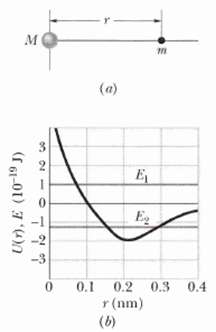
Figure a shows a molecule consisting of two atoms of masses m and M (with m (a) If the total mechanical energy E of the two-atom system is greater than zero (as is E1), and(b) If E is less than zero (as is E2). For E1 = 1 x 10-19 J and r = 0.3 nm, find(c) The potential energy of the system,(d) The
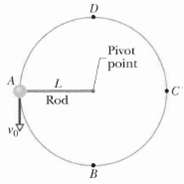
A mass less rigid rod of length L has a ball of mass m attached to one end (Figure). The other end is pivoted in such a way that the ball will move in a vertical circle. First, assume that there is no friction at the pivot. The system is launched downward from the horizontal position A with initial
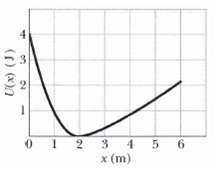
Conservative force F(x) acts on a particle that moves along an x axis Figure shows how the potential energy U(x) associated with force F(x) varies with the position of the particle.(a) Plot F(x) for the range 0 (b) The mechanical energy E of the system is 4.0 J. Plot the kinetic energy K(x) of the
Fasten one end of a vertical spring to a ceiling, attach a cabbage to the other end, and then slowly lower the cabbage until the upward force on it from the spring balances the gravitational" force on it. Show that the loss of gravitational potential energy of the cabbage-Earth system equals twice
A 2.00kg particle has the y coordinates (– 1.20 m, 0.500 m), and a 4.00kg particle has the xy coordinates (0.600 m, – 0.750 m). Both lie on a horizontal plane. At what (a) x and (b) y coordinates must you place a 3.00kg particle such that the center of mass of the three-particle system has the
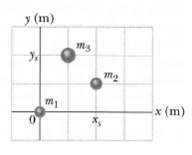
Figure shows a three-particle system, the masses m1 = 3.0 kg, m2 = 4.0kg, m3 = 8.0 kg. The scales on the axes are set by xs = 2.0 m and ys = 2.0m. What are?(a) The x coordinate and(b) The y coordinate of the system??s center of mass?(c) If m3 is gradually increased, does the center of mass of the
Showing 4900 - 5000
of 21795
First
43
44
45
46
47
48
49
50
51
52
53
54
55
56
57
Last
Step by Step Answers

 Get 50% OFF
Claim Now
Get 50% OFF
Claim Now